THE STUDY OF PHTHALATES MIGRATION IN WINE PRODUCTS
BY GC-MS METHOD
¶1Duca George
1, Sturza Rodica
2, Lazakovich Dmitri
31 Academician. President of the Academy of Sciences of Moldova. Chisinau, Republic of Moldova. [email protected]
2 Administrator of National Center for Quality Testing of the Alcoholic Beverages Chisinau, Republic of Moldova. [email protected]
3 Doctoral student. Institute of Chemistry ASM. Center for Quality Testing of the Alcoholic Beverages Chisinau, Republic of Moldova. [email protected]
Abstract. A number of studies have shown phthalates’ potential impact on human health due to their carcinogenic and
endocrine-disrupting effects. More than 2000 analyses for determination of phthalates’ rests in alcoholic beverages were done in the laboratory of National Center for Quality Testing of the Alcoholic Beverages (Republic of Moldova) using modern method of analysis like GC-MS.
Keywords: phthalates, wine, gas-chromatography, mass-spectrometry, migration.
1. Introduction
Today, in modern, industrialized society people can hardly imagine life without home appliances, communication systems, a convenient plastic packaging, fragrance and cosmetics. Most of these and many other chemical products have their properties such as strength, ductility, durability, incombustibility, etc., owing to a number of synthetic organic chemicals. Phthalates are among the members of this series. Phthalates (esters of phthalic acid) are included in the compositions of almost all types of plastics, rubber, paints and varnishes, giving them elasticity and strength [1]. Almost 90% of produced phthalates are used as plasticizers. Phthalates act as solvents and fl avor fi xatives especially in perfumes and cosmetics.
Humans always are surrounded by materials containing phthalates, such as linoleum, insulation of wires, pipes, plastic housings of domestic appliances, toys, varnishes and paints.
It is supposed that phthalates accumulate in the human body, which negatively affects its hormones, liver and kidneys may also become the causes of allergies, asthma and cancer, neurodevelopmental disorders and abnormalities in the development of children. Molecules of phthalates are not structural elements of the polymer chains and therefore easily stand out in the environment, getting into the human body through food, skin or by inhalation.
In a number of investigated wine-products released by vendors the presence of phthalates was detected. Particular attention was given to the dibutylphthalate.
2. Experimental
2.1. Material and methods
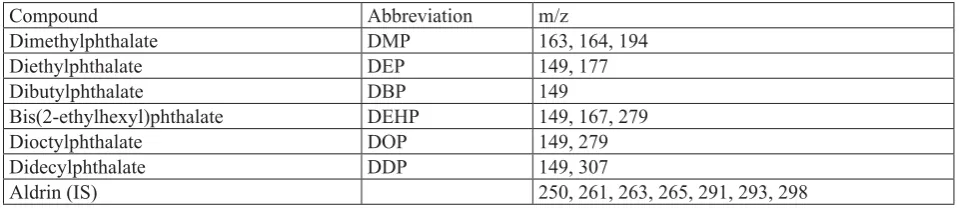
Measuring the concentration of phthalates in wine and base-wine relied on its elimination by chloroform extraction, chromatographic separation on a capillary column, identify the retention time and mass spectrum, and quantify with the characteristic ions m/z . Measuring the concentration of phthalates in alcoholic beverages such as vodka, brandy, cognac alcohol, rectifi ed ethyl alcohol was based on chromatographic separation of the sample on a capillary column using Aldrin with a purity above 99.3% and supplied by SUPELCO as an internal standard, the identifi cation was made by retention times and mass spectrum, quantifi cation of characteristic ions m/z for phthalates and for Aldrin. Tab.1.
Table 1
Measured m/z ratios characteristic for phthalates and IS
Compound Abbreviation m/z
Dimethylphthalate DMP 163, 164, 194
Diethylphthalate DEP 149, 177
Dibutylphthalate DBP 149
Bis(2-ethylhexyl)phthalate DEHP 149, 167, 279
Dioctylphthalate DOP 149, 279
Didecylphthalate DDP 149, 307
Aldrin (IS) 250, 261, 263, 265, 291, 293, 298
The background solution (synthetic wine) was used to prepare the calibration solutions. It consisted of aqueous solution of 15% ethanol and tartaric acid (6g/dm3) (tartaric acid, supplied by Fluka, puriss. p.a. for ion chromatography)
and carried to the pH to 3.5 with 5M sodium hydroxide. Synthetic wine was used for calibration standard solutions with concentrations of phthalates: 0 - 1,00 mg/dm3 (DMP - 99.6%, DEP - 99.6%, DBP - 99.8%, DEHP - 99.7%, DNOP -
99.7%, DNDP - 99.8% Pestanal from Sigma-Aldrich). For the extraction of phthalates, 100 ml of sample (calibration solution) was placed in a separatoring funnel of 250 cm3 with addition of 10 cm3 of chloroform (Chloroform, LGC
Promochem, for HPLC). Extraction was implemented in 10 min with continuous shaking. After separating the organic layer the bottom layer of chloroform was drained through a paper fi lter with anhydrous sodium sulfate (sodium sulfate anhydrous, Stanchem, Spain). Collected 10 ml of the chloroform extract was transferred into a gas chromatography vial, from which was selected 1,0 μl of extract by microsyringe directly for analysis using gas chromatography with mass-spectrometer.
2.2. Instruments
SHIMADZU GCMS-QP-2010S (IS) with a COMBI PAL autosampler (CTC ANALYTICS, Zwingen, Switzerland) equipped with fused silica column RESTEK-Rtx-5MS (30m/0.25mm/0.25μm 5% diphenyl / 95% dimethylpolisiloxane phase) was used to perform injections and gas chromatographic analyses in an automated way.
2.3. Gas chromatography–mass-spectrometry
The oven program started at an initial temperature of 160°C for 1 min. Temperature was then increased at a rate of 10°C/min to 200°C, maintained for 1 min, then increased at a rate of 20°C/min to 320°C and maintained for 10 min. The carrier gas was helium at 1.0 ml/min (99.9990%), split 5. Ionisation was performed by electron impact (EI). The temperatures used were 320°C for the injector, 320°C for the transfer line, and 200°C for the ion source. The compounds were quantifi ed in selected ion monitoring (SIM) mode[3]. The analyte to internal standard peak area ratio was used as analytical signal for constructing the calibration graphs.
Duration of gas chromatography-mass spectrometric analysis for phthalates constituted 30 minutes.
For the analysis of strong alcoholic beverages calibration solutions of phthalates were prepared on the basis of 50% water-alcohol mixture with the addition of a solution of aldrin as internal standard (IS).
3. Results and discussion
The studies conducted in the laboratory of National Center for Quality Testing of the Alcoholic Beverages (Republic of Moldova) included more than 2000 samples of the bottled wine, base-wine and strong alcoholic beverages for the presence of phthalates.
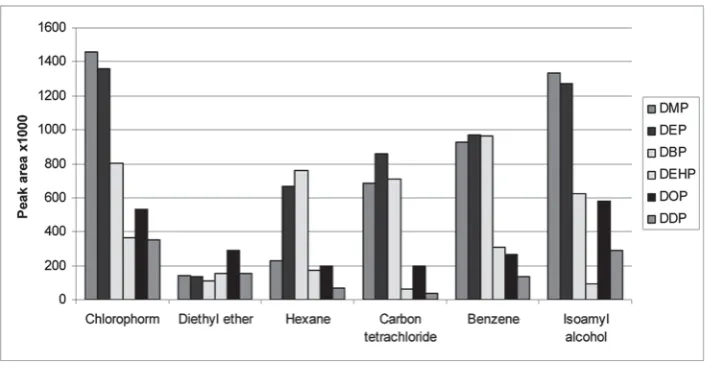
For determination of optimal conditions of extraction there were done a number of studies described below. There was made comparative analysis (investigation) of extraction grade obtained with different organic solvents, such as chloroform, diethyl ether, hexane, carbon tetrachloride, benzene and isoamyl alcohol. Conditions: ratio wine/ organic solvent = 100mL/10mL; extraction time = 10min. The results are shown in fi g.1. and fi g. 4. (average between four extractions).
Fig. 1. Signals intensity of phtalates in various extractants
Fig. 2. Relative standard deviation of four extractions. Prices of organic solvents for 1L/€*
* - Prices of organic solvents according to the catalogue (SIGMA-ALDRICH 2011) for 1L grade p.a. or similar
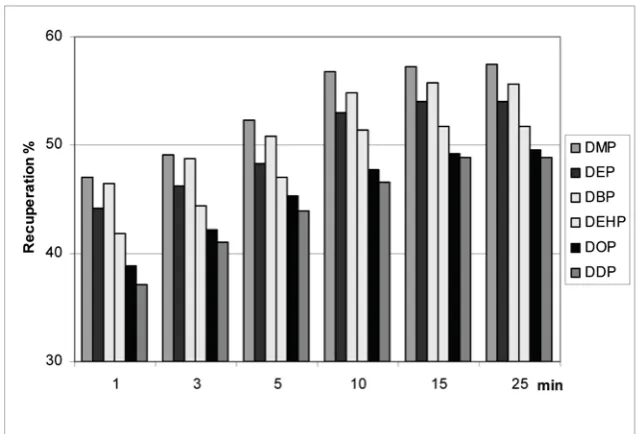
Fig. 3. Determination of optimum phthalates extraction time from wine with chloroform
For the purpose of improvement of analytical characteristics the comparative analysis of two technics of injection has been carried out: method of direct injection of liquid samples into the capillary column and the solid phase microextraction (SPME) – method was recommended by Carrillo J. D. at al. [2]. The results are shown in tab.1.
Table 1
Comparative analysis of injection methods - direct injection and SPME
Methods Liquid injection SPME
Sample preparation Extraction:
chloroform/ wine sample 10ml/100ml
Solid Phase Micro Extraction with CW-DVB fi ber.
RSD % 2,18±0.51 3,11±0.72
The cost of presampling of one sample ~1.65€* ~9.55€*
*- According to the catalogue prices (SIGMA-ALDRICH)
In order to optimize the extraction process of phtalates during presampling were investigated some dependencies:
b) Similarly, the infl uence of sugar content on the extractability of DBP was investigated with Synthetic wine (2.1). Sugar concentration in the samples was formed using concentrated must (C (DBP) <0.01mg/dm3). DBP was added to
the obtained model solutions with concentrations of sugars: 0, 30, 50, 100 and 150 g/dm3. Chloroform extracts of these
samples were analyzed. The results are expressed in fi g. 5.
30 40 50 60 70 80 90 100
3,5 4 4,5 5 5,5 6 6,5 7
pH
R
e
c
upe
ra
ti
on %
Fig. 4. Dependence: Recuperation level % =f(pH)
70 75 80 85 90 95 100 105
0 20 40 60 80 100 120 140 160
sugar content g/L
R
e
c
upe
ra
ti
on %
Fig. 5. Dependence: Recuperation level % =f(sugar content g/L)
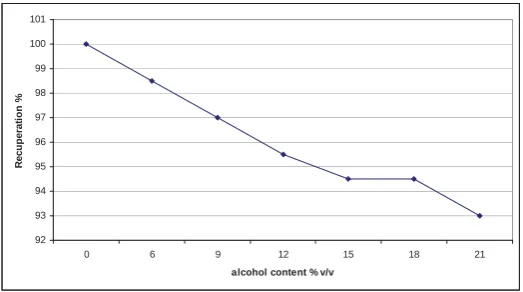
c) Effect of alcohol content on the extractability of DBP was also investigated using synthetic wine (2.1). Alcohol content in the samples was formed by ethyl alcohol (C (DBP) <0.01mg/dm3). DBP was added to the obtained model
solutions with concentrations of alcohol: 6, 9, 12, 15, 18 and 21% v/v. Chloroform extracts of these samples were tested. As it follows from the results of investigation alcohol content doesn’t infl uence signifi cantly on the level of recovery. (Fig. 6).
92 93 94 95 96 97 98 99 100 101
0 6 9 12 15 18 21
alcohol content % v/v
R
ecu
p
e
ra
ti
o
n
%
Fig. 6. Effect of alcohol content on the recuperation level of DBP
must, then concentrated - 0.05-0.15ppm. The results of investigations of 15 grapes samples were negative or represent traces. In addition, at the fi ve wineries was investigated water used in wine production. It was found that concentration of DBP in natural water is lower than LOQ, while content in fl ushing water is 0.04-0.05ppm, and 0.09-0.15 ppm of DBP in softened water.
Therefore contamination with phthalates has mainly a technogenic character, and it is the result of contact with polymeric materials. In the sequel, we studied samples of different materials, which were in contact with wine production during the winemaking process and storage, such as paints, varnishes, primers, pipes, rubber seals. All these tests were conducted according the Directive 2007/19/EG. Also was investigated migration of DBP to a model solution - 15% aqueous ethanol solution, acidifi ed with tartaric acid. Migration of phthalates from materials, which are in contact with wine, is a continuous process that can continue throughout the period of production or storage. The rate of migration was determined basing on these investigations. Studies have been conducted on materials submitted by Moldovan winemakers and distributors. In addition to fresh paint (intended for contact with food) were analyzed paints, which were in contact with wine during a certain period of time. Fresh (liquid) paint was applied to the fl ask’s inner surface, dried on air in 2-3 days, and then a model solution was placed into the fl ask. Content of DBP was determined in the model solution, which was in contact with the dry polymer within 1 day. Ratio of polymer and model was 1:100. Migration took place at the room temperature (20-22°C).
36 different samples of cork stoppers (for wine and brandy), 6 samples of polymer stoppers for sealing wines and more than 20 samples of caps, seals, dispensers bottle and other polymer elements, which can contact with bottled alcoholic beverages have been studied as a potential source of contamination. All the samples were crushed to accelerate the potential migration of phthalates in the model solution, in which further was determined the content of phthalates. In some cases, migration of phthalates was determined from the surface of the products. As the model solutions were used water-alcohol solution and acidic water-alcohol mixtures simulating wine. As a result, it should be noted that DBP was detected in trace amounts only in four of the investigated samples. In these cases, the observed DBP was on the surface of cork, what is probably due to a violation of the conditions of capping material storage. Quantities of phthalates suffi cient for essential change of them in beverages were found in no one of the studied samples capping materials.
4. Conclusions
In the context of studies conducted in the laboratory of National Center for Quality Testing of the Alcoholic Beverages (Republic of Moldova) were included more than 2000 samples of the bottled wine, base-wine and some types of strong alcoholic beverages for the presence of most widespread and toxic phthalate – dibutylphthalate. Results display presences DBP in 85% of studied samples of wines, i.e. a content of DBP more than LOQ (0.01mg/dm3). Samples of
sulfi tated and concentrated must, natural and softened water and grapes samples were studied to establish the sources of DBP pollution in wines. Has been determined that contamination of phthalates has a technogenic character, and it is the result of contact with polymeric materials. Optimum conditions of extraction DBP from liquid samples were obtained. Also has been established, that signifi cant infl uence on extractability is performed by pH value and sugars content value, the alcohol contents in synthetic wine has not displayed signifi cant effect. In addition migration DBP from polymeric materials has been learnt. In the nearest future we plan to research plugs and other materials used in winemaking process on presence of DBP and its migration.
Acknowledgments
Authors would like to acknowledge Moldavian wineries and distributors for the represented samples and the required information.
References
Bаrštеin R. S., Kirillоvič V. I., Nоsоvskiy Ю. Е.; 1982. 3.4.1. Diefi rnyе plаstifi kаtоry;
[1]. Plаstifi kаtоry dlya
pоlimеrоv; Himya; Моskvа; 122-126.
J.D. Carrillo, C. Salazar, C. Moreta, M.T. Tena; 2007. Determination of phthalates in wine by headspace solid-[2].
phase microextraction followed by gas chromatography–mass spectrometry: Fibre comparison and selection; Journal of Chromatography A, 116; ELSEVIER; 4; 248–261.
МUK 4.1.738-99. Hrомато-маss-spеkтrометričеskое оprеdеlеniе fтаlатоv i оrgаničеskih kislот v vоdе. [3].