IJEEE, Vol. 4, Issue 5 (October, 2017) e-ISSN: 1694-2310 | p-ISSN: 1694-2426
OPTIMUM SCHEDULING IN MICRO-GRID
USING PSO
Dharmendra Singh
1, Ravikant Shardu
21,2Shekhawati Institute of Engineering & Technology, Sikar, Rajasthan, India
Abstract— In the power system operation, coordination of battery require much attention. This is required to maintain the reliable operation of electrical energy network. The charging and discharging of battery is useful for micro-grid planner to decide when to charge and discharge. The integration of battery with micro-grid has considerable increase in profit of system. This work also present the operating cost of energy system only connected to main grid. This complex optimization is solved using random search techniques. It has found that optimization techniques implemented to this integrated system resulted in optimum solution. In this paper, particle swarm optimization are used to find the optimum schedule of charging and discharging of battery with power purchased from grid. These swarm based techniques are tested on the test system and a obtained the system profit and cost using this methods. Particle swarm optimization proved to be better among other variants.
Keywords—Wind enegy; Solar enegy; Energy storage system; Particle swarm optimization; Constriction factor.
I. INTRODUCTION
In the last few years, renewable based hybrid energy system has found attention due to increasing environmental concerns, energy demand, fuel prices and depletion of fossil fuels. In particular, solar and wind based generation systems have become sustainable and environmentally friendly options to supply power in isolated or off grid locations [1]. Solar photovoltaic (PV) energy conversion systems along with storage system have proved to be a very attractive method to provide electricity to the places like remote or off grid locations [2], residential households [3], off-grid location [4] and commercial buildings [5,6]. However, PV generation has a low energy conversion efficiency and cost of electricity per kWh is high. This led to a substantial growth in wind based power generation.
Numerous researches focus on feasibility and optimum sizing of the wind based systems [7–9]. However, the major drawbacks for both wind and solar energy sources are their stochastic nature which raises concern about the reliability of power to the user. Therefore, to enhance the reliability, hybridization of both wind and solar energy is a suitable alternative. One‟s weakness can be compensated by the strengths of another. However, it increases the complexity of the system [10]. Stand alone solar-wind based hybrid energy systems have been analyzed in various researches in terms of cost effectiveness [11–13]. The biggest drawback of a stand alone solar-wind based energy system is its dependency on power back-up due to the irregular nature of both wind and solar resources. In case of a stand-alone hybrid system
generally back-up is provided by diesel generator or energy storage devices such as batteries or ultra-capacitors. The major contribution of this is to design a cost effective and reliable hybrid PV-wind energy system with battery storage to meet the electrical load demand of small area which has enough natural resources [14-15]. The mathematical modelling of various components and operational strategy in the proposed system have been discussed in detail. The detail cost analysis of the proposed hybrid system is performed by applying PSO algorithms. For optimal scheduling, results obtained by applying these different methods have been compared. Moreover, a critical case such as failure of one generating unit has also been performed to test the reliability of the hybrid energy system. The integration of battery with micro-grid has considerable increase in profit of system. This complex optimization is solved using random search techniques [16-18]. It has found that optimization techniques implemented to this integrated system resulted in optimum solution. The scheduling of the electric storage with the grid having solar and wind palnt for different charge/discharge rate has been calculated [19].
In this paper, optimal solution of battery charging and discharging with their constraints is obtained and power from main grid, wind and solar plant is considered. The constraints for the battery and load balance are also satisfied with the help of a popular swarm based technique, PSO and velocity modified variants [20-23]. The test system is applied on one test system. The optimizations of the problem and simulation results have been obtained.
This paper is organized as follows: Section II describes the mathematical formulation of solar, wind and battery system. Section III presents a brief overview of PSO and its variants. In section IV the simulation is carried out for a test system having solar, wind and battery and result is discussed. In section V the conclusion is given showing the feasible solution of the problem and future work.
II. MATHEMATIC MODELLING
The renewable energy resouces can be categorized as: 1. Solar generation.
2. Wind energy
In this paper, modeling of renewable energy resources with battery model is used.
A. Solar generation (PV)
generated power which is widely depend upon the solar radiation, temperature and atmospheric condition. However, uncertainty is observed in the solar radiation due to cloud and it is depend upon weather conditions. Shading effect is power generation from PV plant. The power generated from PV plant is expressed as:
(1)
where
is its rated power of PV generation.
is the reference temperature.
is the ambient temperature.
is temperature coefficient .
is the incident solar radiation.
The power sharing or generation from PV plant is evaluated during scheduling as:
(2)
where
Power is available from jth solar plant
Represents the status of jth PV plant is operating or
non-operating zone.
The operating cost of PV unit is formulated as: (3)
where
is per unit cost of jth PV plant.
B. Wind Enegy
The wind energy gration is also green energy technology which is widely used by mainy countries in world. The power generation from wind turbines is dependent upon the velocity of air which is further dependent upon environment conditions. The output power of the wind energy conversion system is depend upon the rated wind speed, cut in and cut out wind speed. The output of the WECS with a given wind speed input may be stated as [11]
(4)
(5)
(6) where
p WECS output power (kilowatt); wr WECS rated power;
vi cut-in wind speed (miles/hour or miles/second);
vr rated wind speed;
vo cut-out wind speed. C. Modelling of battery system
The power storage system consists of constraints which must be satisfied throughout process. The detail regarding equality and inequality constraints of electrical storage system are given below.
Storage limits:
CAP t
Pstorage () storage t(7)
Maximum storage discharge limits:
) ( ) 4 . 0 ( )
(t CAP X t
PDstorage storage t,X{0,1}(8)
Maximum storage charge limits:
) ( ) (
)
(t CAP Y t
PCstorage storage t,Y{0,1} (9)
where, X and Y are binary variables to represented discharge and charge of energy storage system.
The battery cannot charge and discharge at the same time in each time slice:
1 ) ( ) (t Y t
X t,Yand X{0,1}(10)
Maximum discharge limits (kW) in each period:
0 ) 1 ( )
(t P t
PDstorage storage t(11)
Storage battery maximal charge limits (kW) in each period „„t‟‟, considering the battery state storage in period t-1:
CAP t P t
PCstorage () storage ( 1) storage t(12)
State balance of the battery:
) 1 ( ) ( ) 1 ( )
(t P t PD t PC t
Pstorage storage storage storage t(13)
Initial energy storage system:
) 4 . 0 ( ) 0
(t CAP
Pstorage storage (14)
Equality constraint including battery:
) ( ) ( ) ( )
(t P t PD t PC t
PEDemand g storage storage t(15)
In this section, detail of constraints of battery with their parameter values which are vary with charging and discharging conditions. The battery parameters depend on manufacturer‟s characteristics data while parameters are approximately constant during 20%SOC to 100% SOC.
D. Objective function
The objective function of micro-grid having renewable energy system and battery is to maximize the benefit during the schedule period. The total obtaind benefit for this system is evaluated from equaton (16), which is consist of renevenue obtained by selling of energy which is depend on generation and selling price while the other is the cost of energy production. The objective function of proposed system for 24 hour schedule is given as:
Obj=max Benefit = Revenue -Cost (16)
In (16), the revenue is obtained when power is selling from micro-grid to main grid during some hours of the day or off peak load and expressed as:
) ( ) ( 1 t Grid t ep REVENUE sell T t (17)
The cost of this energy system is consists of four variables corresponding to the costs of electricity production by the thermal (CostConv(i,t)), electricity purchased from upstream network (CostBuy(t)), the cost of battery storage (Coststorage(t)), the cost of wind energy (Costwind(t)) and the solar cost (CostSolar(t)):
T t wind T t solar T t storage T t buy T t N i conv t Cost t Cost t Cost t Cost t i Cost Cost 1 1 1 1 1 1 ) ( ) ( ) ( ) ( ) , ( (18)
III. TIME VARYING ACCELERATING COEFFICENTS -PARTICLE SWARM OPTIMIZATION
A. Review of PSO
) μ k
j,i μ Gbest
i ( ran() C
) μ k
j,i μ best
j,i ( ran() C Vkj,i w
Vkj,i1
2
1 (19)
The inertia weight is given by [21]
w w it
itw
w
max min max
max (20)
Thus, positional coordinates of each of the particle in swarm is expressed as
1 , , 1 ,
k
i j k
i j k
i
j V
(21).
B. Overview of CPSO
The standard PSO can be modified using a constriction factor (C). Constriction factor restricts the movement of particles to optimal solution. Thus, positional coordinates of each of the particle in swarm is updated using Eq. 16. Thus, suitable adaptation of parameters should be required while obtaining solution to given complex problem.
Adjustability carries a great significance providing a prefect relationship between the quality and quantity of the parameters following the given algorithm. It should guarantee the correct direction of search based on pre-adjusted parameters for the given complex problem assuring robustness to the system.The velocity is updated as given below [25]:
) (
) μkj,i μGbesti ( ran() C 2
) μkj,i μbestj,i ( ran() C 1 Vkj,i w C
V 1 k
j,i (22)
4
2 /
2 2
C (23)
where ∅ equals to C1 + C2;
IV. RESULT AND DISCUSSION
The PSO have been applied for the reduction of the operating cost of power generation from solar plant, wind plant, battery and power purschase from grid. This reduction in objective function i.e. operating cost of system that include charging and discharging of battery with satisfied battery and all other balance constraints is the main purpose of this paper. The TV-AC variants based PSO technique is applied on a test system. This test system
The cost contains 10 wind plant (100kw), solar plant (10kw), battery (500kw) while input data of battery like CB (rated capacity) , scion (intial charge) , socmax (maximum charge), socmin (minimum charge) is 500, .5, .95 and .2.
Furthermore, the parameter setting of PSO is taken same as in [20]. This optimization technique is applied to get optimum schedule of power supply by grid and battery. This is used to schedule the battery for 24 hour. The power generation from solar plant during the day time 4-7th and night from 7-3rd lower or near to zero while maximum at day time noon and it is illustrated in Figure 2. The power generation from wind plants is vary throughout the day and night, it is dependent upon the wind speed and it is illustrated in Figure 1.
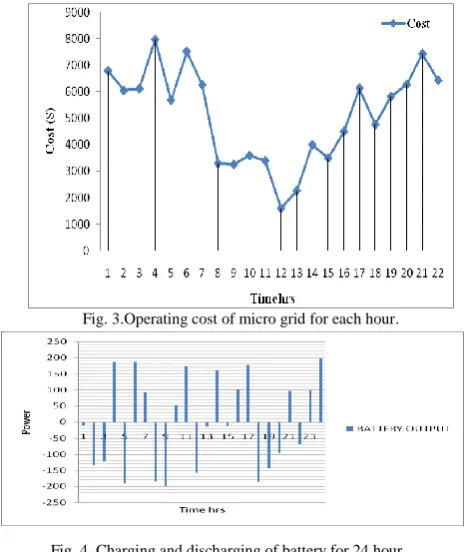
The operation of battery during 24 hour and the optimum solution to charge and discharge the battery is represented
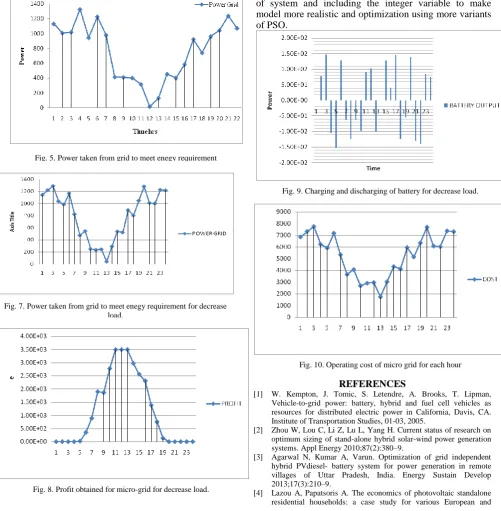
in Figure 4. The power taken from grid is minimum when and profit obtained at each time interval is dependent on generation, demand and selling price of energy and it is represented in Figure 3 and 6. power generation from solar and wind plant are at maximum level and it may sold to Fig. 2 Power generation from solar plant.
Fig. 3.Operating cost of micro grid for each hour. Fig. 1 Power generation from wind plant.
grid if power generation is more than demand and it is shown in Figure 4.
The obtained profit when demand decrease to its by 50% then profit, cost, power from grid and battery cycle is shown in Fig. 7-10.
V. CONCLUSION
In this paper, time varying acceleration coefficients particle swarm optimization is tested on the problem of optimal scheduling of battery and power purshased from grid. The output of simulation shows that it provide feasible solution for the input parameters of battery. This paper presented the continuous solution in terms of charging and discharging of battery. The test system used for the testing purpose is using one test system. Particle swarm optimization is a popular swarm based technique. A conventional PSO and its variants i.e. particle swarm
optimization and PSO is also discussed. The result obtained by implementation of PSO is provide in above section. This work can be continued to the larger number of system and including the integer variable to make model more realistic and optimization using more variants of PSO.
REFERENCES
[1] W. Kempton, J. Tomic, S. Letendre, A. Brooks, T. Lipman, Vehicle-to-grid power: battery, hybrid and fuel cell vehicles as resources for distributed electric power in California, Davis, CA. Institute of Transportation Studies, 01-03, 2005.
[2] Zhou W, Lou C, Li Z, Lu L, Yang H. Current status of research on optimum sizing of stand-alone hybrid solar-wind power generation systems. Appl Energy 2010;87(2):380–9.
[3] Agarwal N, Kumar A, Varun. Optimization of grid independent hybrid PVdiesel- battery system for power generation in remote villages of Uttar Pradesh, India. Energy Sustain Develop 2013;17(3):210–9.
[4] Lazou A, Papatsoris A. The economics of photovoltaic standalone residential households: a case study for various European and Fig. 5. Power taken from grid to meet enegy requirement
Fig. 6. Profit obtained for micro-grid
Fig. 7. Power taken from grid to meet enegy requirement for decrease load.
Fig. 8. Profit obtained for micro-grid for decrease load.
Fig. 9. Charging and discharging of battery for decrease load.
Mediterranean locations. Sol Energy Mater Solar Cells 2000;62:411–27.
[5] Yamegueu D, Azoumah Y, Py X, Zongo N. Experimental study of electricity generation by solar PV/diesel hybrid systems without battery storage for offgrid areas. Renew Energy 2011;36:1780–7. [6] Shaahid SM, Elhadidy MA. Prospects of autonomous/stand-alone
hybrid (photo-voltaic+diesel+battery) power systems in commercial applications in hot regions. Renew Energy 2004;29:165–77. [7] Kazem H, Khatib T, Sopian K. Sizing of a standalone
photovoltaic/battery system at minimum cost for remote housing electrification in Sohar, Oman. Energy Build 2013;61:108–15. [8] Abouzahr I, Ramakumar R. Loss of power supply probability of
stand alone wind electric conversion system. IEEE Trans Energy Convers 1990;5 (3):445–51.
[9] Elhadidy MA, Shaahid SM. Role of hybrid (wind+diesel) power systems in meeting commercial loads. Renew Energy 2004;29:109– 18.
[10] Elhadidy MA, Shaahid S. Optimal sizing of battery storage for hybrid (wind +diesel) power systems. Renew Energy 1999;18:77– 86.
[11] Yang H, Zhou W, Lu L, Fang Z. Optimal sizing method for stand-alone hybrid solar-wind system with LPSP technology by using genetic algorithm. Sol Energy 2008;82:354–67.
[12] Bhattacharjee S, Acharya S. PV-wind hybrid power option for a low wind topography. Energy Convers Manage 2015;89:942–54. [13] Tina G, Gaglianom S, Raiti S. Hybrid solar/wind power system
probabilistic modeling for long term performance assessment. Sol Energy 2006;80:578–88.
[14] Wu K, Zhou H, An S, Huang T. Optimal coordinate operation control for windphotovoltaic- battery storage power generation units. Energy Convers Manage 2015;90:466–75.
[15] Patil ABK, Saini RP, Sharma MP. Integrated renewable energy systems for off grid rural electrification of remote area. Renew Energy 2010;35(6):1342–9.
[16] [Singh J, Panesar BS, Sharma SK. Energy potential through agricultural biomass using geographical information system: a case study of Punjab. Biomass Bioenergy 2008;32:301–1
[17] U.K. Debnath, I. Ahmad, D. Habibi and A.Y. Saber, “Improving battery lifetime of gridable vehicles and system reliability in the smart grid” IEEE Sytsems Journal, vol. 9, pp. 989-999, 2015. [18] U.K. Debnath, I. Ahmad, D. Habibi and A.Y. Saber, “Energy
storage model with gridable vehicles for economic load dispatch in the smart grid” Electrical Power and Energy System, vol. 9, pp. 1017-1024, 2015.
[19] Clerc, M.; Kennedy, J., “The particle swarm-explosion, stability and convergence in a multidimensional complex space,” IEEE Transaction on evolutionary computation, Vol. 6, No. 2, pp. 58–73, Feb. 2002.
[20] Shi ,Y.; Eberhart ,R., “Parameter selection in particle swarm optimization” In Evolutionary programming VIZ Proc. EP98, New York: Springer Verlag, pp. 591-600, 1988.
[21] Saha, Suman; Rakshit, Ishita;Mandal, Durbadal; Kar, Rajib; Ghoshal, Sakti Prasad., “IIR system identification using particle
swarm optimization with constriction factor and inertia weight
approach,” IEEE Symposium on Humanities,
science and engineering research (SHUSER), pp. 367 – 372, 2012. [22] Yasuda, Keiichiro.; Iwasaki, Nobuhiro., “Adaptive Particle Swarm
Optimization using Velocity Information of Swarm,” IEEE conference on systems, man and cybernetics, Vol. 4, pp. 3475 – 3481, 2004.