1
CONJUGATE DOUBLE DIFFUSION IN A SQUARE CAVITY DIVIDED
INTO TWO SECTIONS
N. Ameer Ahammad
a*, Sarfaraz Kamangar
baDept. Of Mathematics, Faculty of Science, University of Tabuk, 71491, Kingdom Of Saudi Arabia. bDept. of Mechanical Engineering, University of Malaya, Kuala Lumpur, 50603, Malaysia.
A
BSTRACTThe current work discusses the heat and mass transfer due to a solid wall dividing the porous medium into two distinct sections. The left vertical surface of cavity is maintained at constant temperature Th and concentration Ch whereas rightvertical surface is kept at isothermal temperature Tc and iso-concentration Cc such that Th>Tc and Ch>Cc. Finite element method is used to solve the governing partial differential equations. The results discussed with respect to thermal conductivity ratio, solid width, buoyancy ratio, Lewis number etc.
Keywords: Conjugate double diffusion, Porous Cavity, FEM
1.
INTRODUCTION
Heat transfer in porous medium is one of the well-studied and documented areas of research for many decades. The passage of time has brought in more applications of porous medium compelling researchers to look into those new emerging areas encompassing porous medium. The various applications and issues pertaining to porous medium is well discussed in some of the popular books such as (Ingham and Pop, 1998; Pop and Ingham, 2001; Nield and Bejan, 2006; Vafai, 2000; Bejan and Kraus, 2003). Natural convection in porous medium refers to a case where fluid gets heated due to temperature gradient at different points and moves to areas of lower temperature due to thermal buoyancy. Such studies have been reported for different geometrical and physical parameters of porous fluid combination (Quadir et al. 2016; Yunus Khan et al. 2016; Badruddin et al. 2007; Badruddin et al. 2006; Prasad et al.
1984; Ahmed et al. 2011; Badruddin et al. 2012; Zheng et al. 2001;
Badruddin et al. 2006; Nik-Ghazali. et al. 2014).
The conjugate heat transfer in porous medium arises due to presence of a solid in the fluid flow path where the energy transfer is a complicated issue. Such phenomenon requires an additional equation to be considered for solid region with adequate boundary conditions that links the temperature at porous and solid region (Azeem et al. 2016; Ahmed et al.
2014; Badruddin et al. 2015; Sakakibara et al. 1987; Saeid, 2007;
Abdallah Al-Amiri et al. 2008; Inna et al. 2010; Pop et al. 2000; Ahmet Kaya et al. 2011; Higuera and Pop, 1997). The conjugate heat transfer in
porous medium is generally studied with respect to single diffusion or just heat transfer. However, there is not much information available for the case when double diffusion or heat and mass transfer occurs inside the porous medium with a solid wall dividing the domain. Most of the studies have addressed the conjugate heat transfer in terms of solid wall being placed at one end of the porous medium such as left of cavity (Saeid, 2007), bottom and top of cavity (Baytas et al. 2001) etc.
The current work is different from those available in literature in a way that the solid wall divides the porous cavity into two distinct regions. To the best of author’s knowledge, double diffusion in a square porous
*Corresponding author. Email: [email protected]
medium separated by solid wall is not yet reported. Thus, it is an attempt to understand the double diffusion in such situation.
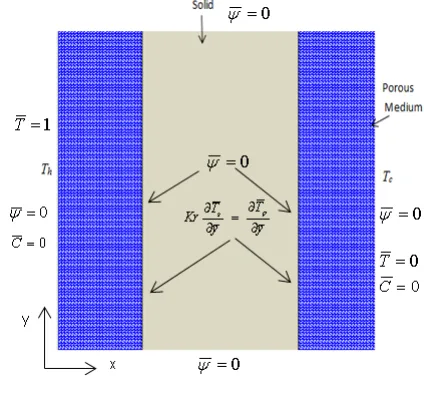
Fig. 1 Physical domain
2. MATHEMATICAL MODEL
Consider a square cavity having filled with saturated porous medium and a solid wall placed vertically at center of the cavity as illustrated in figure 1. The coordinates of domain are represented as x and y. The left vertical surface of cavity is maintained at higher temperature and concentration as compared to right vertical surface. The top and bottom surfaces of cavity are adiabatic. It is assumed that the Darcy law is applicable for porous cavity, the thermal equilibrium exists between fluid and solid phase of porous region, there is no phase change and the fluid properties are constant except the variation of density with temperature. The
Frontiers in Heat and Mass Transfer
governing equations for above mentioned problem can be given in non-dimensional form as:
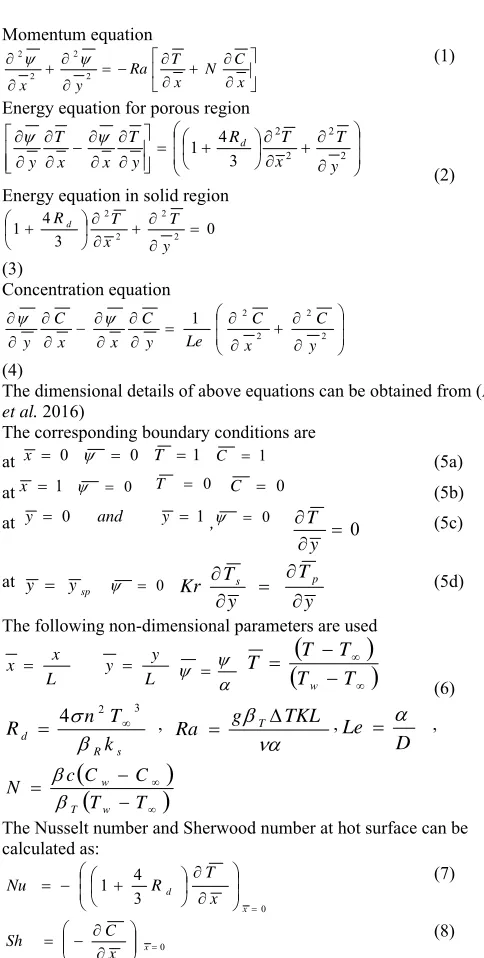
Momentum equation x C N x T Ra y x 2 2 2
2 (1)
Energy equation for porous region
2 2 2 2 3 4 1 y T x T R y T x x T y d (2) Energy equation in solid region
0 3
4
1 22 22 y T x T Rd (3) Concentration equation 2 2 2 2 1 y C x C Le y C x x C y (4)
The dimensional details of above equations can be obtained from (Azeem
et al. 2016)
The corresponding boundary conditions are
at x 0 0 T 1 C 1 (5a)
atx 1 0 T 0 C 0 (5b)
at y 0 and y 1, 0
0 y T (5c)
at y ysp 0
y T
y T
Kr s p
(5d)
The following non-dimensional parameters are used
L x x L y y
T
T
T
T
T
w (6)
s R d k T n R
2 34
,
TKLg
Ra T ,
D
Le
,
T T C C c N w T w
The Nusselt number and Sherwood number at hot surface can be calculated as: 0 3 4 1 x d x T R
Nu (7)
0 x x C
Sh (8)
The non-dimensional equations 1-4 are solved using finite element method with the help of 3-noded triangular elements. The application of finite element method resulted into large number of algebraic equations that are linked together thus they should be solved simultaneously. The algebraic equations are solved by assembling them into a global stiffness matrix subjected to boundary conditions 5. There are 4 equations which are coupled together thus they are solved in iterative manner by setting the tolerance limit of 10-7, 10-5, 10-5 as convergence criteria for
C and T ,
which represents the non-dimensional stream function, temperature and concentration respectively. A total of 2592 elements are selected in the current study which produced the results as given in table 1. The higher number of elements (4232) tested did not give much variation in the results but consumed almost 600% increase in solution time as compared to 2592 elements. The accuracy of present method is verified by comparing the results available in open literature. The comparison is shown in table 1 that shows that the current method has good accuracy in predicting the Nusselt number. The results of table 1corresponds to Sw=0 (solid width), Le=1(Lewis number) and N=0 (Buoyancy ratio).
Table 1: Nu Comparison of present method
Author Ra 10 Ra 100
Present 1.0821 3.2126
Walker and Homsy (1978) 3.097
Bejan (1979) 4.2
Gross et al. (1986) 3.141
Monolo and Lage (1992) 3.118
Beckerman et al. (1986) 3.113
Moya et al. (1987) 1.065 2.801
Baytas and Pop (1999) 1.079 3.16 Misirlioglu et al. (2005) 1.119 3.05
Badruddin et al.(2012) 1.079 3.200
Badruddin et al. (2012 1.0798 3.2005
3.
RESULTS AND DISCUSSION
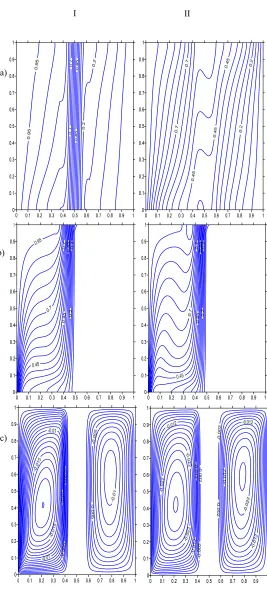
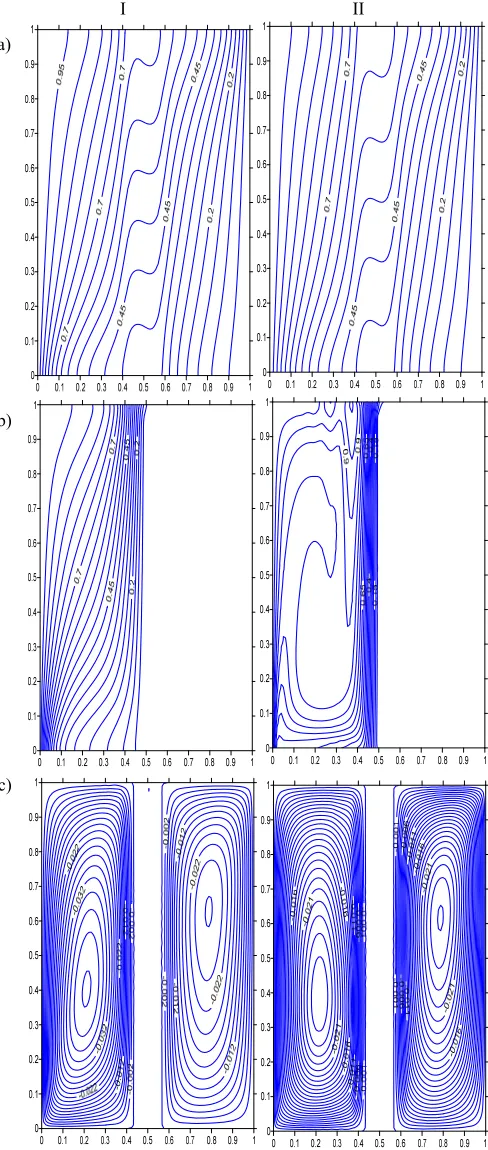
The heat and mass transfer in porous medium can be best observed by having the information of temperature lines, concentration lines and streamline distribution due to applied boundary condition. Thus, isotherms, iso-concentration and streamlines are plotted for various physical and geometric parameters such as, thermal conductivity ratio, width ratio, Buoyancy ratio and Lewis number. Fig.2 shows isotherms, iso-concentration and streamlines distribution when thermal conductivity ratio varied from 0.1 to 25. The other parameters for this figure are kept at Ra= 100 (Rayleigh number), N=0.5, Le=5, Sw=13% and Rd=1(Radiation parameter). The left column of Fig.2 belongs to Kr=0.1(Thermal conductivity ratio) and right column Kr=25. The
conductivity ratio highlights the relative thermal conductivity of solid wall to that of porous medium. It is seen that the isotherms are very much clubbed together inside the solid wall when thermal conductivity ratio is low but spread out when Kr is high. The higher thermal conductivity ratio
allows more thermal energy to be transferred across the solid wall thus increasing the thermal energy content of porous region on right side of cavity. The concentration lines indicate that the increased thermal conductivity ratio leads to increased concentration gradient at hot wall which is illustrated by iso-concentration lines moving to the left of cavity. The velocity of fluid increases when Kr is increased as indicated
by increased value of streamline.
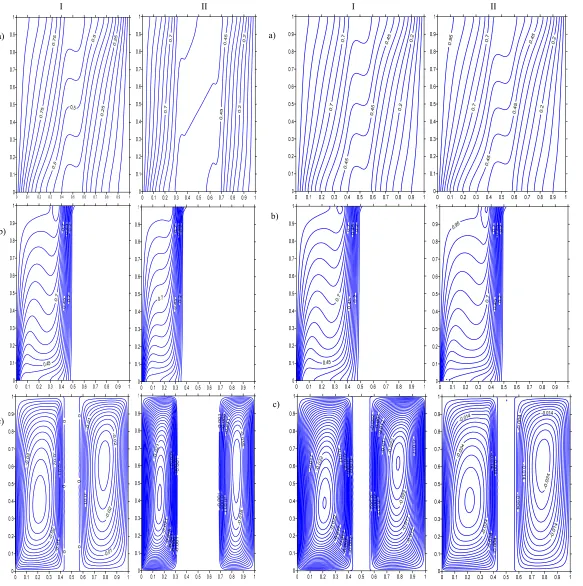
Fig.3 shows the effect of increasing the width of solid wall placed in porous medium. The left column corresponds to solid width Sw=13% and right column to 36% of cavity width. The other parameters are Ra= 100, N=0.5, Le5, Kr=10 and Rd=1. The increased solid width increases
the thermal resistance of whole domain that in turn reduces the convection effect in the porous region which is reflected in terms of reduced value of isotherms on right side of cavity. It is noted that the isotherms are comparatively straighter at higher Sw indicating that the conduction effect increase with increase in width ratio. The concentration lines are confined to a smaller region due to increase in width ratio. The magnitude of streamlines on left side of solid wall increases slightly where as it decreases on right side of solid wall. This happens because of the reason that the thermal energy is concentrated largely on left side of cavity as compared to right side due to higher thermal resistance introduced by wider solid that leads to increased velocity on the left side of solid wall.
Fig.4 shows the effect of buoyancy ratio on the heat and mass transfer in porous cavity. This figure corresponds to Ra= 100, Sw=13%,
3 cavity but brings it closer at lower section. This indicates that the heat transfer rate should increase at lower section of cavity and decrease at upper section. Similar trend can be observed for concentration lines that reflect that the mass transfer increases at lower section of cavity. This is further vindicated by increase in the fluid velocity as shown by increased magnitude of stream function that helps in increasing the heat and mass transfer rate. One of the important parameter that affects the mass transfer rate in porous medium is Lewis number as demonstrated in fig.5 that corresponds to Ra= 100, Sw=13%, N=0.5, Kr=10 and Rd=1. The isotherms are not much affected due to increase in Le from 1 to 25.
However, the iso-concentration lines have substantially changed in the left region of cavity due to increased Lewis number. The iso-concentration lines got pushed towards the hot surface at higher Le that
should increase the concentration gradient.
The isotherms, iso-concentration lines are plotted to show the thermal energy and concentration distribution inside the domain. However, the important information regarding heat and mass transfer can be inferred from Nusselt and Sherwood number which is reflection of heat and mass transfer rate at the hot surface. The following section is dedicated to discuss the heat and mass transfer with respect to various geometrical and physical parameters. Fig.6 shows the local Nusselt and Sherwood number variation along the height of cavity due to variation in thermal conductivity ratio between the porous and solid wall of domain. This figure is obtained at Ra= 100, Sw=13%, Le=5, N=0.5 and Rd=1. The Nusselt and Sherwood number decreases along the height of cavity. This is a result of hot fluid getting heated at bottom section that moves towards upward direction taking along with itself the thermal energy and helping in mass diffusion. As the fluid moves upwards, its direction shifts towards the right side of cavity that in turn reduces the thermal and concentration gradient leading to reduced Nusselt and Sherwood number at upper portion. The increase in thermal conductivity ratio increases the heat and mass transfer. This can be easily inferred from isotherms and iso-concentration of fig 2 which tends to move towards the hot surface leading to increased thermal and concentration gradient due to increase in Kr. The heat transfer is affected to greater extent due to change in Kr
as compared to mass transfer. Fig.7 corresponding to Ra= 100, Kr=10, Le=5, N=0.5, shows the influence of solid width ratio on the heat and
mass transfer behavior. It is found that the Nusselt number slightly decreases at bottom section of cavity due to increase in the width ratio but increase at the top section of hot surface. This can be attributed to decreased fluid velocity caused by limited space for fluid movement as the region occupied by solid wall increases with increased width ratio. Reverse trend as that of Nusselt number is observed for mass transfer where Sherwood number increases with solid width ratio at bottom part but decreases slightly at top section. The decreased porous width due to increase in Sw leads to higher concentration gradient thus increasing the Sherwood number at bottom section
The effect of buoyancy ratio on heat and mass transfer is shown in Fig.8, which is obtained by keeping the parameters as Ra= 100, Kr=10, Le=5, Sw=13%. The Nusselt and Sherwood number increases with increase in buoyancy ratio at bottom of cavity due to the fact that the positive value of N results into assisting flow when the thermal buoyancy and concentration buoyancy assist each other thus increasing the heat and mass transfer. However, the effect of buoyancy ratio diminishes as the height of cavity increases as indicated by merged lines for various values of N. Lewis number affects the mass transfer significantly as compared
to heat transfer as illustrated by fig.9 corresponding to the parameters
Ra= 100, Kr=10, N=0.5, Sw=13%. The mass transfer rate drops sharply from lower part until about 10% of cavity height from bottom and then decreases gradually due to increased concentration gradient at lower section of cavity as corroborated by iso-concentration lines of fig 5. The mass transfer rate is higher for higher Lewis number for any given height of cavity. The Nusselt number decreases slightly with increase in Lewis number which is further vindicated by straightened isotherms (Fig.5) at higher Lewis number.
Fig. 2 Effect of Thermal Conductivity Ratio I) Kr = 0.1 II) Kr = 25
a) Isotherms b) Iso-concentration c) Streamlines a)
b)
c)
Fig. 3 Effect of Solid Width Ratio I) Sw = 13% II) Sw=36%
a) Isotherms b) Iso-concentration c) Streamlines
Fig. 4 Effect of Buoyancy Ratio I) N = 0.1 II) N=1
a) Isotherms b) Iso-concentration c) Streamlines a)
b)
c)
a)
b)
c)
II II
5
Fig. 5 Effect of Lewis Number I) Le= 1 II) Le=25
a) Isotherms b) Iso-concentration c) Streamlines
Fig. 6 Local Nusselt and Sherwood number variation with respect to
Kr
Fig. 7 Local Nusselt and Sherwood number variation with respect to Sw
Fig. 8 Local Nusselt and Sherwood number variation with respect to N
0 0.1 0.2 0.3 0.4 0.5 0.6 0.7 0.8 0.9 1 0
5 10 15 20 25 30 35
__ y
N
u
and
S
h
Sh
Nu
Kr = 0.1 Kr = 1 Kr = 25
0 0.1 0.2 0.3 0.4 0.5 0.6 0.7 0.8 0.9 1 0
5 10 15 20 25 30 35 40
__ y
N
u
and S
h
Sh
Nu
W = 13.72 % W = 25.72% W = 36.24%
0 0.1 0.2 0.3 0.4 0.5 0.6 0.7 0.8 0.9 1 0
5 10 15 20 25 30 35 40 45
__ y
N
u
and
S
h
Sh
Nu
N = 0.1 N = 0.5 N = 1
c) b) a)
Fig. 9 Local Nusselt and Sherwood number variation with respect to Le
4.
CONCLUSION
The aim of this article is to investigate the heat and mass transfer characteristics in a square porous cavity having a solid wall placed at the center that divides the porous medium into two regions. Finite element method is used to solve the governing partial differential equations. The results discussed could help in the drying process such as different types of grains being segregated by a solid separator between them. Following conclusion is drawn from current study
The heat and mass transfer increases with increase in conductivity ratio
The Nusselt number slightly decreases at bottom section of cavity due to increase in the width ratio but increase at the top section. However, the reverse trend is observed for mass transfer.
The Nusselt and Sherwood number increases with increase in buoyancy ratio at bottom of cavity.
Mass transfer is affected to greater extent due to change in Lewis number.
NOMENCLATURE
C Species concentration
D Mass diffusivity
g Acceleration due to gravity (m/s2)
kp ,ks Porous and Solid thermal conductivity respectively (W/m-oC)
K Permeability of porous medium (m2)
Kr Conductivity ratio
L Height and length of cavity (m)
Le Lewis number
Nu Nusselt number
N Buoyancy ratio
qr Radiation flux (W/m2) d
R
Radiation parameterRa Modified Raleigh number Sh Sherwood number
Sw Solid width
T Temperature
y
x, Non-dimensional co-ordinates
Greek Symbols
α Thermal diffusivity (m2/s)
C
Coefficient of concentration expansion
T
Coefficient of thermal expansion
R
Absorption coefficient (1/m)
ρ Density (kg/m3)
v Coefficient of kinematic viscosity(m2/s)
Stephan Boltzmann constant (W/m2-K4) Non-dimensional stream function
Subscripts
h Hot c Cold p Porous s Solid
REFERENCES
Abdalla Al-Amiri, Khalil Khanafer, and Ioan Pop., 2008, “Steady-State Conjugate Natural Convection in a Fluid-Saturated Porous Cavity,”
International Journal of Heat and Mass Transfer, 51, 4260-4275.
https://doi.org/10.1016/j.ijheatmasstransfer.2007.12.026
Ahmed, N.J.S., Badruddin, I.A., Kanesan, J., Zainal, Z.A., and Ahamed, K.S.N., 2011, “Study of Mixed Convection in an Annular Vertical Cylinder Filled with Saturated Porous Medium, Using Thermal Non-Equilibrium Model,” International Journal of Heat and Mass Transfer,
54(17-18), 3822-3825.
https://doi.org/10.1016/j.ijheatmasstransfer.2011.05.001
Ahmed, N.J.S., Kamangar, S., Badruddin, I.A., Al-Rashed, A.A.A.A., Quadir, G.A., Khaleed, H.M.T. and Khan, T.M.Y., 2014, “Conjugate Heat Transfer in Porous Annulus,” Journal of Porous Media, 19(12), 1109-1119.
Ahmet Kaya., 2011, “Effects of Buoyancy and Conjugate Heat Transfer on Non-Darcy Mixed Convection About a Vertical Slender Hollow Cylinder Embedded in a Porous Medium with High Porosity,”
International Journal of Heat and Mass Transfer, 54, 818-825. https://doi.org/10.1016/j.ijheatmasstransfer.2010.10.021
Azeem, Irfan Anjum Badruddin, Mohd Yamani Idna Idris, Nik-Ghazali, N, Salman Ahmed N. J, Abdullah A. A. A. Al-Rashed., 2016, “Conjugate Heat and Mass Transfer in Square Porous Cavity,” Indian Journal of Pure & Applied Physics, 54, 1-10.
Badruddin I.A., Zainal, Z.A., Khan Z.A and Mallick, Z., 2007, “Effect of Viscous Dissipation and Radiation on Natural Convection in A Porous Medium Embedded Within Vertical Annulus,” International Journal of Thermal Sciences, 46(3), 221-227.
https://doi.org/10.1016/j.ijthermalsci.2006.05.005
Badruddin, I.A., Al-Rashed, A.A.A., Ahmed, N.J.S., Kamangar, S. and Jeevan, K., 2012, “Natural Convection in a Square Porous Annulus,”
International Journal of Heat and Mass Transfer, 55(23–24), 7175-7187. https://doi.org/10.1016/j.ijheatmasstransfer.2012.07.034
Badruddin, I.A., Ahmed N.J.S, Al-Rashed, A.A.A., Nik-Ghazali, N., Jameel, M., Kamangar, S., Khaleed, H.M.T., and Yunus Khan, T.M., 2015, “Conjugate Heat Transfer in an Annulus with Porous Medium Fixed between Solids,” Transport in Porous media, 109(3), 589-608. https://doi.org/10.1007/s11242-015-0537-2
Badruddin, I.A., Ahmed, N.J.S., Al-Rashed, A.A.A., Kanesan, J., Kamangar, S. and Khaleed, H.M.T., 2012, “Analysis of Heat and Mass Transfer in a Vertical Annular Porous Cylinder Using FEM,” Transport in Porous Media, 91(2), 697-715.
0 0.1 0.2 0.3 0.4 0.5 0.6 0.7 0.8 0.9 1 0
10 20 30 40 50 60
__ y
N
u
and
S
h
Le = 1 Le = 10 Le = 25
7
https://doi.org/10.1007/s11242-011-9867-x
Badruddin, I.A., Abdullah, A.A.A., Ahmed, N.J.S. and Kamangar, S., 2012, “Investigation of Heat Transfer in Square Porous-Annulus,”
International Journal of Heat and Mass Transfer, 55(7-8), 2184-2192.
https://doi.org/10.1016/j.ijheatmasstransfer.2011.12.023
Badruddin, I.A., Zainal, Z.A., Narayana, P.A. and Seetharamu, K.N., 2006, “Thermal Non-Equilibrium Modeling of Heat Transfer Through Vertical Annulus Embedded with Porous Medium”, International Journal of Heat and Mass Transfer, 49(25-26), 4955-4965. https://doi.org/10.1016/j.ijheatmasstransfer.2006.05.043
Badruddin, I.A., Zainal, Z.A., Narayana, P.A., Seetharamu, K.N., 2006, “Heat Transfer by Radiation and Natural Convection Through a Vertical Annulus Embedded in Porous Medium,” International Communications in Heat Mass Transfer, 33(4), 500-507.
https://doi.org/10.1016/j.icheatmasstransfer.2006.01.008
Baytaş, A. C., Liaqat, A., Groşan, T., and Pop, I., 2001, “Conjugate Natural Convection in a Square Porous Cavity,” Heat and Mass Transfer,
37, 467-473.
https://doi.org/10.1007/PL00013297
Bejan, A., 1979, “On the Boundary Layer Regime in a Vertical Enclosure Filled with a Porous Medium,” Letters of Heat Mass Transfer, 6, 93-102. https://doi.org/10.1016/0094-4548(79)90001-8
Bejan, A.D., Kraus, 2003, “Heat Transfer Handbook”, (Eds) Wiley, New York.
Bekermann, C., Viskanta, R. and Ramadhyani, S., 1986, “A Numerical Study of Non-Darcian Natural Convection in a Vertical Enclosure Filled with A Porous Medium,” Numerical Heat Transfer Part A, 10, 557-570. https://doi.org/10.1080/10407798608552524
Gross, R.J., Bear, M.R., Hickox, C.E., 1986, “The Application of Flux-Corrected Transport (FCT) to High Rayleigh Number Natural Convection in a Porous Medium,” in: Proceedings of 8th International Heat Transfer Conference, San Francisco, CA, USA.
Higuera, F.J. and Pop, I., 1997, “Conjugate Natural Convection Heat Transfer Between Two Porous Media Separated by a Vertical Wall,”
International Journal of Heat Mass Transfer, 40, 123-129. https://doi.org/10.1016/S0017-9310(96)00078-6
Ingham, D.B., Pop, I., 1998, “Transport Phenomena in Porous Media”, (Eds), Pergamon, Oxford.
Inna A. Aleshkova. and Mikhail А. Sheremet., 2010, “Unsteady Conjugate Natural Convection in a Square Enclosure Filled with a Porous Medium,” International Journal of Heat and Mass Transfer, 53,
5308-5320.
Manole, D.M. and Lage, J.L., 1992 “Numerical Benchmark Results for Natural Convection in a Porous Medium Cavity,” in: Heat and Mass Transfer in Porous Media, ASME Conference, HTD 216 55.
Misirlioglu, A., Baytas, A.C. and Pop, I., 2005, “Free Convection in a Wavy Cavity Filled with a Porous Medium,” International Journal of
Heat Mass Transfer, 48, 1840-1850. https://doi.org/10.1016/j.ijheatmasstransfer.2004.12.005
Moya, S.L., Ramos, E. and Sen, M, 1987, “Numerical Study of Natural Convection in a Tilted Rectangular Porous Material,” International Journal of Heat Mass Transfer, 30, 741-756.
https://doi.org/10.1016/0017-9310(87)90204-3
Nawaf H. Saeid., 2007, “Conjugate Natural Convection in a Porous Enclosure: Effect of Conduction in One of The Vertical Walls,”
International Journal of Thermal Sciences, 46, 531-539. https://doi.org/10.1016/j.ijthermalsci.2006.08.003
Nield, D.A. Bejan, 2006, “Convection in Porous Media”, 3rd ed., New
York, Springer Verlag.
Nik-Ghazali. N., Badruddin. I.A., Badarudin. A., and Tabatabaeikia. S., 2014, “Advances Dufour and Soret Effects on Square Porous Annulus,”
Advances in Mechanical Engineering, January-December. 6, 209753. https://doi.org/10.1155/2014/209753
Pop, I. and Na, T.Y., 2000, “Conjugate Free Convection Over a Vertical Slender Hollow Cylinder Embedded in a Porous Medium,” Heat and Mass Transfer, 36, 375-379.
https://doi.org/10.1007/s002310000124
Pop, I., 2001, “Convective Heat Transfer: Mathematical and Computational Modeling of Viscous Fluids and Porous Media”, Pergamon, Oxford.
Prasad, V., Kulacki, F.A., 1984, “Natural Convection in a Vertical Porous Annulus,” International Journal of Heat and Mass Transfer, 27(2), 207-219.
https://doi.org/10.1016/0017-9310(84)90212-6
Quadir, G.A., and Irfan Anjum Badruddin, 2016, “Heat Transfer in Porous Medium Embedded with Vertical Plate: Non-Equilibrium Approach - Part B,” AIP Conference Proceedings of 1738, 480125.
https://doi.org/10.1063/1.4952361
Sakakibara, Mikio, Shigeru Mori, and Akira Tanimoto, 1987, “Conjugate Heat Transfer with Laminar Flow in an Annulus,” The Canadian journal of chemical engineering, 65(4), 541-549. https://doi.org/10.1002/cjce.5450650403
Vafai, K., 2000, Hand Book of Porous Media, Marcel Dekker, New
York.
Walker, K.L. and Homsy, G.M., 1978, “Convection in a Porous Cavity,”
Journal of Fluid Mechanics, 87, 449-474. https://doi.org/10.1017/S0022112078001718
Yunus Khan, T.M., Irfan Anjum Badruddin, Quadir, G.A., 2016, “Heat Transfer in a Conical Porous Cylinder with Partial Heating,” IOP Conference Series: Materials Science and Engineering, 149, 012211,
Zheng, W., Robillard, L., Vasseur, P., 2001, “Convection in a Square Cavity Filled with an Anisotropic Porous Medium Saturated with Water Near 4°C,” International Journal of Heat and Mass Transfer,44(18), 3463-3470.