University of Kentucky University of Kentucky
UKnowledge
UKnowledge
Theses and Dissertations--Management Management
2013
A TALE OF TWO ENVYS: A SOCIAL NETWORK PERSPECTIVE ON
A TALE OF TWO ENVYS: A SOCIAL NETWORK PERSPECTIVE ON
THE CONSEQUENCES OF WORKPLACE SOCIAL COMPARISON
THE CONSEQUENCES OF WORKPLACE SOCIAL COMPARISON
Christopher M. Sterling
University of Kentucky, [email protected]
Right click to open a feedback form in a new tab to let us know how this document benefits you. Right click to open a feedback form in a new tab to let us know how this document benefits you.
Recommended Citation Recommended Citation
Sterling, Christopher M., "A TALE OF TWO ENVYS: A SOCIAL NETWORK PERSPECTIVE ON THE CONSEQUENCES OF WORKPLACE SOCIAL COMPARISON" (2013). Theses and Dissertations--Management. 5.
https://uknowledge.uky.edu/management_etds/5
STUDENT AGREEMENT: STUDENT AGREEMENT:
I represent that my thesis or dissertation and abstract are my original work. Proper attribution has been given to all outside sources. I understand that I am solely responsible for obtaining any needed copyright permissions. I have obtained and attached hereto needed written permission statements(s) from the owner(s) of each third-party copyrighted matter to be included in my work, allowing electronic distribution (if such use is not permitted by the fair use doctrine).
I hereby grant to The University of Kentucky and its agents the non-exclusive license to archive and make accessible my work in whole or in part in all forms of media, now or hereafter known. I agree that the document mentioned above may be made available immediately for worldwide access unless a preapproved embargo applies.
I retain all other ownership rights to the copyright of my work. I also retain the right to use in future works (such as articles or books) all or part of my work. I understand that I am free to register the copyright to my work.
REVIEW, APPROVAL AND ACCEPTANCE REVIEW, APPROVAL AND ACCEPTANCE
The document mentioned above has been reviewed and accepted by the student’s advisor, on behalf of the advisory committee, and by the Director of Graduate Studies (DGS), on behalf of the program; we verify that this is the final, approved version of the student’s dissertation including all changes required by the advisory committee. The undersigned agree to abide by the statements above.
University of Kentucky
UKnowledge
Theses and Dissertations--Management Management 2013
A TALE OF TWO ENVYS: A SOCIAL
NETWORK PERSPECTIVE ON THE
CONSEQUENCES OF WORKPLACE SOCIAL
COMPARISON
Christopher M. Sterling
STUDENT AGREEMENT:
I represent that my thesis or dissertation and abstract are my original work. Proper attribution has been given to all outside sources. I understand that I am solely responsible for obtaining any needed copyright permissions. I have obtained and attached hereto needed written permission statements(s) from the owner(s) of each third-party copyrighted matter to be included in my work, allowing electronic distribution (if such use is not permitted by the fair use doctrine).
I hereby grant to The University of Kentucky and its agents the non-exclusive license to archive and make accessible my work in whole or in part in all forms of media, now or hereafter known. I agree that the document mentioned above may be made available immediately for worldwide access unless a preapproved embargo applies.
I retain all other ownership rights to the copyright of my work. I also retain the right to use in future works (such as articles or books) all or part of my work. I understand that I am free to register the copyright to my work.
REVIEW, APPROVAL AND ACCEPTANCE
The document mentioned above has been reviewed and accepted by the student’s advisor, on behalf of the advisory committee, and by the Director of Graduate Studies (DGS), on behalf of the program; we verify that this is the final, approved version of the student’s dissertation including all changes required by the advisory committee. The undersigned agree to abide by the statements above.
Christopher M. Sterling, Student
Dr. Giuseppe ( Joe) Labianca, Major Professor
A TALE OF TWO ENVYS: A SOCIAL NETWORK PERSPECTIVE ON THE CONSEQUENCES OF WORKPLACE SOCIAL COMPARISON
DISSERTATION
A dissertation submitted in partial fulfillment of the requirements for the degree of Doctor of Philosophy in the
College of Business and Economics at the University of Kentucky
By
Christopher Michael Sterling
Lexington, Kentucky
Director: Dr. Giuseppe (Joe) Labianca, Professor of Management
Lexington, Kentucky
2013
ABSTRACT OF DISSERTATION
A TALE OF TWO ENVYS: A SOCIAL NETWORK PERSPECTIVE ON THE CONSEQUENCES OF WORKPLACE SOCIAL COMPARISON
My dissertation examines how individuals respond to workplace social comparisons. I measure the explicit set of referent others that individuals compare themselves against in order to evaluate their own level of performance. I examine how the social context of these comparisons impact discretionary performance related behaviors by examining how an individual’s position within a social network and the structural characteristics of an individual’s reference group influences the experience of discrete emotions. Specifically, I examine how malicious envy and benign envy mediate the relationship between social comparison and workplace behavior in a field setting. Results indicate that social network structure plays a significant role in motivating both productive and counterproductive responses to social comparison. Whether or not an employee responds to upward social comparisons by increasing their own work effort or engaging in deviant behavior is influenced by the experience of benign and malicious envy, which is in turn influenced by the network structure of reference groups. Furthermore, social network position plays a moderating role in the occurrence of workplace deviance by either enhancing or
limiting the opportunities an employee has to engage in deviant behavior.
KEYWORDS: Social Comparison, Social Network, Envy, Workplace Deviance, Discrete Emotions
Christopher Michael Sterling Student’s Signature
A TALE OF TWO ENVYS: A SOCIAL NETWORK PERSPECTIVE ON THE CONSEQUENCES OF WORKPLACE SOCIAL COMPARISON
By
Christopher Michael Sterling
Dr. Giuseppe (Joe) Labianca Director of Dissertation
Dr. Steve Skinner
Director of Graduate Studies
ACKNOWLEDGMENTS
The writing of a dissertation may be singular activity of endurance and
persistence but its ultimate completion would not be possible without the support and guidance of many. I would like to extend my warmest and most heartfelt thanks to my advisors, colleagues, and family who have supported me throughout this journey.
I am fortunate to have such an outstanding group of advisors and mentors in the Department of Management at the University of Kentucky. The amount of time that my advisor and dissertation chair, Dr. Joe Labianca, has spent developing and guiding not only myself but his entire cadre of doctoral students is truly remarkable. From running the doctoral student symposium to supporting graduate student research projects, he has greatly influenced my approach to research. Always patient and thoughtful when first approached with a new idea he is equally challenging and rigorous when it comes to cultivating and further developing those ideas. His support has been instrumental in the production of this dissertation and many other papers as well. I would also like to thank Dr. Dan Brass for teaching me, above all else, the importance of clarity in
communicating my research. An unstructured incoherent paper belies a messy mind and, the best ideas may fall on deaf ears if they cannot be clearly and succinctly
communicated. Thank you, Dr. Ajay Mehra for teaching me the importance distinguishing my own work from that which has been done previously incorporating several different fields, you have always challenged me to understand and identify what my unique contribution will be. Thank you, Dr. Steve Borgatti for giving me the opportunity to be involved in the Links Center Workshop on Social Network Analysis.
a very collaborative and supportive community of social network researchers. Thank you also for always being available to talk through any potential ideas and patiently explain any social network measure or analysis that I did not yet fully understand. Thank you, Dr. Richard Smith for introducing me to the fascinating world of envy. Your knowledge and enthusiasm on the topic surely made me consider the importance of emotions in the workplace. I would also like to thank my undergraduate advisor Dr. John Wade who first inspired me to consider academia as a career and who also encouraged me to see beyond my own narrow world view through studying and living abroad. The opportunity you provided me in this regard truly changed my life and gave me an entirely new
perspective.
To my fellow graduate student colleagues, thank you for providing a forum to discuss ideas and research and also for providing a community of support and
collegiality. My doctoral cohort of Ginny Lopez Kidwell, Josh Marineau, Travis Grosser, and Scott Soltis made me feel that I was never alone throughout my graduate studies, and you provided excellent constructive feedback on numerous projects. It looks like we all made it to the other side. I would also like to thank the doctoral students outside of my cohort, Brandon Ofem, Theresa Floyd, and Zack Edens for their helpful insight and feedback over many doctoral courses and research presentation sessions. I would like to thank Dr. Goce Andrevski, a senior doctoral student when I entered the program, thank you for providing sage advice for navigating graduate school and providing me with an excellent early career role model.
follow my dreams but they also provided a firm foundation by showing me that through hard work, perseverance, and the support of a loving family anything can be
TABLE OF CONTENTS
Acknowledgements………....iii
List of Tables………....viii List of Figures………...ix Chapter One: Introduction Social Comparison Perspective………...5
Discrete Emotion Theory & Behavioral Trajectories………..9
The Social Context of Emotional Experience………...10
Chapter Two: Literature Review Social Comparison Theory………13
The Social Comparison Process ………...………17
Individual Differences in Social Comparison ………..21
The Social Context of Social Comparisons ………..24
The Mediating Role of Emotion ………..29
Envy in the Workplace ………30
The Social Context of Emotional Experience………...33
Opportunity and Behavior………34
Conclusion………....35
Chapter Three: Theory and Hypotheses Distinguishing between two types of envy………..39
The High Road: Benign Envy and Positive Voluntary Behaviors...………...39
The Low Road: Malicious Envy and Negative Voluntary Behaviors…………..41
Context of Comparisons ………..43
Performance Reference Group……….………….………...45
Relative Performance Difference……….47
Performance Reference Group Structure……….49
Reference Group Size………...51
Reference Group Closure……….55
Organizational Context of Justice………56
The Mediating Role of Benign and Malicious Envy………...57
Social Structure and the Opportunity to Engage in Voluntary Workplace Behaviors……….58
Chapter Four: Method Setting………..61
Procedure……….62
Measures………..63
Chapter Five: Results
Results Model 1………...78
Results Model 2………...82
Results Model 3………...86
Chapter Six: Discussion Overview and Interpretation of Results…..………92
Theoretical Contributions………..101
Managerial Implications...……….105
Limitations……….107
Future Research ………....109
Conclusion……….110
References……….112
LIST OF TABLES
Table 4.1: Descriptive Statistics and Bivariate Correlation Matrix………....76
Table 5.1: Results for Hypothesis 1………....80
Table 5.2: Results for Hypothesis 2……….81
Table 5.3: Results for Hypotheses 3 & 15………..81
Table 5.4: Results for Hypothesis 4………82
Table 5.5: Results for Hypotheses 5,7,9,11.………85
Table 5.6: Results for Hypotheses 6,8,10,12……….………..……86
LIST OF FIGURES
Figure 1.1: Conceptual Model ...5
Figure 2.1: Dissertation Full Model………...13
Figure 4.1: Reference Group Size………...71
Figure 4.2: Reference Group Closure………..72
Figure 4.3: Whole Conceptual Model……….77
Figure 5.1: Model 1……….………...78
Figure 5.2: Model 2……….83
CHAPTER 1: INTRODUCTION
We are driven to understand the world around us and our place in that world by comparing ourselves to others. These relative comparisons are a prevalent source of information that helps us understand the validity of our thoughts and opinions, and our own social standing relative to others. Festinger’s (1954) theory on the process and consequence of social comparison recognized that individuals possess a fundamental need to compare their own abilities and opinions to the abilities and opinions of others. Comparing our own levels of ability and accomplishment to others is a pervasive practice that serves an important function of self-evaluation. This occurs within organizations as well, where an individual’s perceived performance, success and status is an important aspect of his or her life, and can have a profound influence on that individual’s sense of self worth. In most organizations performance is not completely objective, but is often socially constructed, reflecting the status of the individual within the organization and the access that individual has to organizational rewards, recognition, and the attention of top level decision makers (Judge & Ferris, 1993). Individuals are highly motivated to compare their own performance to the performance of peers to get a sense of how well they are doing and how they stack up in the social hierarchy of the organization. Anything that threatens an individual’s status within the organization should have a strong effect on that individual’s behaviors.
Given the extensive research on social comparisons in the field of social
response to social comparison within the boundaries of the organization? Individuals often compete for valued resources such as job promotions, recognition, and status. Even when not directly competing with other members of the organization, these others can still serve as a threat to our sense of self-worth and self-esteem through the process of social comparison. Social comparisons, and in particular upward comparisons
(comparisons to those that that out-perform us), can result in negative affective and behavioral consequences. Regardless of these potential consequences, organizations often use reward systems and recognition practices (e.g., employee-of-the-month awards) to implicitly induce upward comparisons in order to motivate employee performance (Stein, 2000). How then can we understand how employees will react to being outperformed by their peers? Will they be motivated to work harder in order to achieve their goals or will they direct their efforts at pulling down others in order to better their own social
standing? Take for example a recent study published in Science that explains the varied
possible reactions people can have after being outperformed by their peers:
“Discomfort arising from the other outperforming us in cherished domains can be resolved by reducing the relevance of the domain to us or changing relative performance. Students in our scenario might change their major or club at the university and, ultimately their goals in life. Alternatively, they might make an effort to improve their own performance or possession. On the contrary, they might wish that the other lacks advantages, or they may even obstruct the advantaged student (with malice).” (Takashi et al, 2009: 939)
organizational citizenship behaviors (behaviors that go above and beyond their role’s formal requirements in order to help others and their organization in general). This study will also examine counterproductive responses to the threat of upward comparisons, including organizational withdrawal and counterproductive workplace behaviors. I argue that the experience of emotions is an important motivating factor in determining the behavioral response to social comparisons in the workplace.
Social comparisons are strongly associated with affective responses, which can powerfully motivate behavior (van de Ven, Zeelenberg & Pieters, 2009). In general, negative affect has been associated with antisocial behaviors in organizations while positive affect is associated with prosocial behavior (Lee & Allen, 2002). Less is known about the effect of specific discrete emotions on organizational behavior, which can impact individual cognition judgment, behavior, and physiological responses differently (Lench, Flores & Bench, 2011) and can thus be useful for explaining different types of behavior (Elster, 2007). . Social comparison produces a variety of emotions and research has shown that individuals facing the same stimuli can experience not only different discrete emotions, but emotions that differ in valence (positive or negative) as well (Buunk, Collins, Taylor, Dakof & VanYperen, 1990). Understanding how discrete emotions are related to social comparison will help us understand the varied behavioral consequences of workplace social comparisons. This dissertation focuses on two specific discrete emotions that are inherent in social comparisons, benign envy and malicious envy.
larger social structures and these embedded patterns of relationships can shape actor perceptions influencing how individuals perceive the threat of social comparison (Burt, 2010). For example if a group of individuals are all concerned with comparing
themselves to one another, everyone is likely to be well informed about the latest progress and transgressions of each individual through third party gossip. Being
constantly inundated with comparison information, especially when one is not measuring up performance-wise, could greatly impact an individual’s emotional experience.
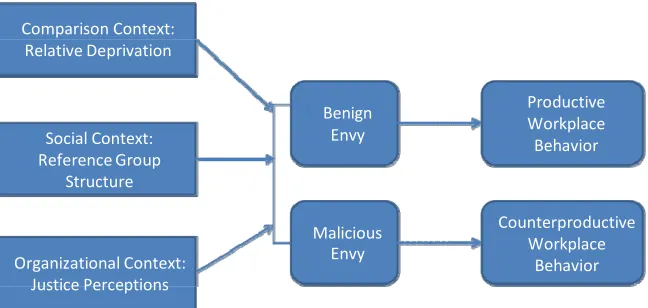
Comparisons also take place within the context of an organization. The organizational climate of justice can affect whether or not employees perceive the organization to be a fair one. As will be explained further, if individuals believe the organization’s procedures are fair, they are more likely to appraise comparisons in a more favorable light, believing that they too can reach high levels of achievement; conversely if they believe the procedures are biased or unfair, they will likely believe that no matter what they do, they cannot get ahead. As I will explain and demonstrate later in this dissertation, the organizational context of justice can affect how employees appraise social comparison information resulting in different discrete emotional reactions and ultimately in their performance-related behavior. In summary, this dissertation will investigate how the comparison context, social context, and organizational context
Figure 1.1: Conceptual Model
Comparison Context:
Relative Deprivation
Social Context:
Reference Group
Structure
Organizational Context:
Justice Perceptions
Benign Envy Malicious Envy Productive Workplace Behavior Counterproductive Workplace Behavior
Social Comparison Perspective
Social comparison is an integral part of organizational life. Employees gain a sense of their own identity and relative worth inside an organization by comparing themselves to others. More specifically employees make sense of their own performance levels, reward levels, job assignments, and career progression through the process of social comparison. Research on social comparison processes has a rich tradition starting with the work of Festinger (1954). We know a lot about how the process of social comparison can impact moods and an individual’s sense of self-worth. Although there is an abundance of research on social comparison in social psychology with insights derived from experimental
it important to explicitly study the social comparison process that occurs inside organizations? Employee recognition programs show us an example of how a lack of understanding of the social comparison process within organizations can lead to negative outcomes. “Employee of the Month” programs were once the predominant tools of employee recognition practices within organizations. The hope was that recognizing the accomplishments of outstanding individuals would not only reward them for their achievements, but also motivate other employees to aspire to the same levels of success. However, more often than not these programs do not achieve the desired aims. The award winners often feel uncomfortable due to their subsequent treatment by other employees, who accuse them of “brown-nosing” or “boot licking”. Rather than being motivated by the success of their peers, the non-winning employees question the award’s fairness, feel undervalued and unappreciated, and act with suspicion or disdain toward the winning employees. As a result, these programs that attempt to harness the motivating power of social comparison end up producing negative feelings and negative interpersonal behavior. Correspondingly, many organizations have moved toward using recognition programs that allow employees to nominate award winners among their peers; these programs seem to be much more successful. At the heart of the problem of the old recognition systems is a lack of attention paid to employees who actually choose to compare themselves to winners, and how the direction of this comparison impacts subsequent feelings and behaviors.
Traditional research on the direction of social comparisons often assumed that there may be a tendency for slight upward social comparisons (Suls & Miller, 1977). More recent research has painted a much more complex picture; individuals make upward or downward comparisons on the basis of comparison motives (Wood, 1989), affective moods (Wheeler & Miyake, 1992), and the nature of the task (Wheeler, Martin & Suls, 1997). In the workplace domain, there is some evidence to suggest that upward comparisons are more prevalent as organizations attempt to implicitly produce upward comparisons by recognizing and rewarding the highest achievers. Evidence also exists to suggest that the consequences of upward comparisons tend to be more varied and
extreme than the consequences of downward comparisons. It was formerly believed that upward comparisons generally resulted in negative self-evaluations, aversive affective consequences, or destructive behaviors (Suls, Martin & Wheeler, 2002), but more recent evidence has challenged this notion by showing that negative emotions can sometimes result in increased motivation, more so than even positive emotions (van de Ven, Zeelenberg & Pieters, 2011).
It remains an open question as to when upward comparisons negatively or
leads to positive outcomes while upward contrast leads to negative outcomes (Mussweiler, Ruter & Epstude, 2004). Of the few studies that have directly examined directional comparisons in the workplace, most evidence points to the fact that workplace
comparisons are more likely to elicit contrast effects due to the uncertain and competitive environments that exist in most contemporary organizational environments (Kay, Wheeler, Bargh, & Ross, 2004, Stapel & Koomen, 2005). Thus I consider situations that lead to upward comparisons in the organization of my study to also result in contrastive emotional responses such as envy.
Discrete Emotion Theory & Behavioral Trajectories
One promising avenue to explore in answering the question as to whether upward comparisons in organizations lead to productive performance behaviors or
counterproductive behaviors is to examine the discrete emotional outcomes produced by social comparison situations. There are many possible emotional reactions to upward social comparisons in organizations. Smith (2000) theorized that upward comparisons could lead to several different emotions: contrastive emotional reactions such as envy, shame, and resentment; and assimilative reactions such as inspiration, optimism, or admiration. While Smith cites the context of the comparison process itself as explaining resulting emotions, it is less clear how the social and organizational context lead to different discrete negative emotions.
network analysis to measure social referents, we are able to capture the residue that is left over from multiple comparison events. A high level of relative deprivation should mean that there have been multiple opportunities for upward comparisons to take place within a given timeframe. We can also capture the relative deprivation between an employee and multiple referents.
The Social Context of Emotional Experience
Approaches to studying emotions inside organizations rely primarily on intra- individual processes of appraisal which can lead to different reactions for different individuals (Scherer, Shorr & Johnstone, 2001); thus the appraisal of an upward comparison event will dictate the resultant emotional response. This study argues that social networks can affect the experience of emotions for individuals. Empirical work linking social networks with the experience of emotion typically focus on the mechanism of contagion to explain how individuals adopt the emotions of those they are tied to. Much less attention is paid to how social network position or embeddedness influences how individuals define social situations, and the effect that has on the appraisal of social comparisons.
Ron Burt (2010) offers clues to how social structure affects emotional experience. The social structure within which an individual is embedded can affect how an individual defines the situation and experiences emotions. This is especially true for social
that this event would produce a great deal of positive emotion and satisfaction for Jim. Now consider that Jim works in a department consisting of 8 people. They work closely together and are aware of each other’s successes and failures. Jim is the last person to be promoted out of his department – in fact a few other individuals have received multiple promotions in the time it took Jim to receive his first. In this situation, Jim’s experience of emotions is likely different from his experience when considered in isolation. The organizational event is exactly the same but its emotional impact differs when
considering the social structure that Jim is part of. For this reason, this study utilizes a social network approach to examine how social structure moderates the relationship between upward comparisons and experienced emotions.
Social network analysis is used in two primary ways: 1) to identify the social referents for each employee; and 2) to investigate the role social structure has on the experience of emotions. Using social network analysis further advances calls from scholars to empirically investigate the individuals who populate an employee’s reference group, thus creating the social context experienced by employees (Lawrence, 2006). By having employees explicitly define their reference groups, we can calculate a
CHAPTER 2: LITERATURE REVIEW
First I will review the literature on social comparison to establish the importance of contextual effects on the process of social comparisons in general. In reviewing the literature, I establish the important and often overlooked fact that social and
.1: Dissertation Full Model Figure 2.1 Dissertation Full Model
Comparison Context:
Relative Performance
Difference
Social Context:
Reference Group
Structure
Benign
Envy Greater Effort
Organizational Context:
Justice Perception
Malicious Envy Deviant Behavior Social Network Constraint
Social Comparison Theory
The prevalence of social comparison research in the area of social psychology however has become so extensive that it has been suggested that social comparison theory has evolved from a theory into a research field (Buunk & Gibbons, 2007). Thus it has been recognized that social comparison is a fundamental aspect of human existence. Empirical studies have demonstrated that the surrounding environment or contextual background in which comparisons are made have a major impact on the outcome of those comparisons, which is why many scholars have recognized the importance of social context in understanding social comparisons. The workplace is an environment that should be rife with social comparisons as employees seek meaning in new complex environments, seek to understand their social status in less hierarchical organizations, and size up
Both of these components have been shown to have different impacts on the nature of comparisons and the resultant outcomes.
This dissertation specifically examines workplace social comparisons using a field study and social network methodology to examine the actual referent others that
employees choose to pay attention to in the workplace. While we do know quite a bit about people’s referent choices and the impacts that different referent characteristics have on social comparison outcomes, we know relatively little about the social context of comparisons beyond the dyadic comparison relationships. Individuals do not compare themselves in a social vacuum; evidence has shown that employees can have several potential referents in the organization and these referent relationships tend to be quite stable (Kulik & Ambrose, 1992). Kulik and Ambrose propose that referent relationships in organizations should be relatively stable, citing previous empirical studies in social comparison theory that demonstrated three major factors related to referent choices: similarity, availability, and relevance. They argue that referents should be stable over time because personal characteristics primarily determine whether or not potential referents are seen to be relevant, and many of the most important personal characteristics that influence referent selection do not change, or change slowly over time (i.e. age, race, gender, tenure).
comparison process. Does the number of referent others an employee attends to affect their outcomes? Can third party relationships (that is, the relationships between referent others) also influence outcomes for the focal employees? If I am constantly hearing gossip about the feats of a common referent from a 3rd party will the negative experience
of an upward comparison be even more intense? Research in social network theory tells us that an individual’s structural position and the structure of groups are major
examining the social context of social comparisons by directly examining the social networks of employees to understand different work related behaviors.
The Social Comparison Process
Social comparison theory examines the process by which we compare our
opinions and abilities to others and the results of these comparisons (Miles, 2012). These comparisons are motivated for several different purposes including self-evaluation, self- enhancement, and self improvement (Wood, 1989). Comparisons allow individuals to assess the validity of their own attitudes and opinions, as well as the relative standing of their abilities. Following these assessments, individuals may have several different attitudinal, emotional or behavioral reactions. Traditionally research on social
comparison has focused on the effects that social comparisons have on an individual’s mood or self-concept, although several contemporary studies have begun to examine more distal behavioral manifestations of social comparison (Wood, 1989; Brown, et al., 2007). Empirical studies have produced several different outcomes associated with the process of social comparison, and several of these findings are conflicting and
contradictory. Social comparison has been demonstrated to result in both positive and negative mood states (Gibbons & Gerrard, 1989), increased and decreased job
satisfaction (Brown, et al., 2007), and both performance improvement and performance decrement (Willis, 1981; Buunk, Collins, Taylor, VanYperen, & Dakof, 1990). Given these conflicting findings, it suggests a need to understand the contingent nature of social comparison outcomes.
the comparison was upward, towards a better-off target, or downward towards a worse- off target. Directional comparisons initially explained much of the variance in
comparison outcomes, but early empirical studies primarily focused on moods as an outcome for social comparison (Wood, 1989). Upward comparisons were originally associated with primarily negative mood states while downward comparisons were originally associated with primarily positive mood states (Gibbons & Gerrard, 1989).
However, with further empirical evidence it became clear that the consequences of social comparison were not wholly dictated by the direction of the comparison. In a well-cited study, Buunk and colleagues (1990) demonstrated that cancer patients could
experience either positive or negative affect when involved in an upward comparison to a patient whose health status was better off. The results in this study were more contingent on individual differences in self-esteem and perceived control than on the direction of the comparisons. Similarly, Collins (1996; 2000) demonstrated that individuals sometimes make intentional comparisons with those that are better off to improve positive feelings about the self by focusing on some characteristic they have in common with the successful other. Similarly, social comparison theorists have noted that when experiencing upwards comparison, individuals may use this information to motivate themselves and provide inspiration by basking in the reflected glory of the successful target (Taylor & Lobel, 1989; Tesser & Collins, 1988). One explanation for these
involve someone with an ability level similar enough to the self to be perceived as a competitor.
Studies on the outcomes of directional social comparison have received much interest in social psychology, but relatively little attention in organizational studies (Brown et al., 2007, Michinov, 2005). Social comparison research in an organizational context typically accounts for the direction of social comparison in a uni-dimensional way, without accounting for the relative difference in the comparison category (Michinov, 2005). This dissertation focuses on a specific domain of comparison and performance that is relevant in an organizational context. It empirically examines the relative difference between an employee’s performance level and the performance level of their referent others. This will enable a direct investigation of whether or not the size of an individual’s relative deprivation will impact organizationally relevant behavior.
When an individual engages in a comparison to a referent other, the information obtained from the comparison is processed and forms an evaluative judgment concerning the relative standing of the individual. This evaluation can displace the individual away from the referent other, where the difference between the self and referent other is salient, resulting in a contrast effect. Conversely the evaluative judgment can involve the inclusion of the self with the referent other, which focuses on the similarity between the two
resulting in assimilation effects (Mussweiler et al., 2004). The occurrence of assimilation and contrast effects dictate whether or not an individual experiences positive or negative emotional consequences from social comparisons. Because I am interested in
Empirical research on assimilation effects in upward comparisons have shown that upward assimilation effects have existed outside of the organizational domain. Mussweiler (2003) demonstrated that contrast and assimilations effects are the result of a cognitive process that involves either similarity- or dissimilarity-testing where
individuals focus on either similarities between themselves and their targets or focus on distinguishing characteristics between themselves and their target. The question becomes: "In what situations is similarity or dissimilarity testing evoked?" Thus many recent studies on the consequence of social comparison have focused on situational moderators that result in assimilation or contrast effects to explain comparison outcomes.
Although there have been relatively few studies specifically focusing on
comparison and similarity testing to focus on individual and social contextual moderators of the social comparison process. This stream of research has focused on individual differences, referent characteristics, and environmental context as keys to understanding the outcomes of the social comparison process.
Individual Differences in Social Comparison
More recently, other individual differences in social comparison have been explored. Research has shown that individuals may differ in their tendency to engage in social comparisons. Gibbons and Buunk (1999) have developed an individual difference measure, social comparison orientation (SCO), to characterize individuals that are, by disposition, more likely to engage in comparisons and care more deeply about results of these relative comparisons. In general, individuals high in social comparison orientation have been shown to experience more negative outcomes from social comparisons, including higher levels of negative affect (Buunk, Ybema, Givvons & Ipenburg, 2001); however, these negative effects are mostly associated with downward comparisons. High SCO individuals tend to be empathetic, sensitive, and concerned that the misfortune that occurs to their peers can also easily happen to them; however, the relationship between SCO and upward comparisons is much more unclear. In several studies SCO moderated different outcomes associated with downward comparison but showed no relationship to outcomes associated with upward comparisons (Buunk, Zurriaga, Gonzalez-Roma & Subirats, 2003). On the other hand, a few studies did indicate that individuals higher in SCO experienced more negative emotions from upward comparisons than individuals lower in SCO (Buunk, Zurriaga, Piero, Nauta & Gosalvez, 2005).
perceived fairness) (Buunk & Gibbons, 2007). Additionally, there is some debate as to whether or not the frequency with which an individual engages in social comparisons is the result of a trait-like predisposition, or the result of being situated in a social context that makes comparisons more or less likely (Burt, 2010). Because of the fundamental impact that social context has on the outcome of the social comparison process, this dissertation will focus on contextual drivers in an effort to construct a more
contextualized theory of social comparison in organizations.
One criticism of the study of social comparison is that the importance of social context has been underemphasized when studying different outcomes of the comparison process. Social context can shape the way people acquire social information and affect the importance that individuals place on comparison information and relative standing (Wood, 1996). The social context of social comparisons has been approached primarily in one of two ways – by examining the environment in which comparisons take place or by examining the dyadic relationship between an individual and their referent. The three most commonly studied social settings that involve social comparisons are environments characterized by individual control and autonomy, fairness, and group context.
The Social Context of Social Comparisons
Social comparisons do not occur in a social vacuum, but occur within a climate of socially compared fairness and justice. Equity theory has a rich legacy within
organizational studies (Adams, 1965) and although separate from social comparison theory, is quite related in its focus. The basis of equity theory was to explore the relationship between unfairness and job dissatisfaction. Equity theory proposes that individuals compare themselves to others in organizations in terms of the inputs they provide and the outcomes they receive in assessing the fairness of their exchange relationships with the organization. Perceived inequity could result in a number of outcomes including dissatisfaction, anger, or guilt (Miner, 2007). While equity theory is decidedly comparative, it has been criticized for its lack of specificity regarding the inputs and outputs used for comparison, the determinant of outcomes of inequity, and the identification of referents involved in making the comparison of inputs and outputs (Mitchell, 1997).
fact this is why studies of procedural justice in organizations suggest that individuals can handle inequity in pay and other outcomes as long as the process by which organizational decisions are made are deemed fair (Brockner & Wiesenfeld, 1996). Perceptions of fairness similarly have the ability to exacerbate or mitigate negative consequences associated with comparisons. A study by Cohen-Charash and Mueller (2007)
demonstrates that when workers believe that a referent’s good fortune was undeserved, those workers were more likely to harm that referent employee. This perceived unfairness was measured as a characteristic of the referent, however, and not of the organization. This dissertation, in contrast, examines how the social context of procedural justice impacts the consequences of workplace social comparisons.
Group context is another aspect of the social environment that has been shown to affect the consequences of comparisons. Contrast and assimilation effects have been shown to vary by whether or not a referent was a member of an in-group or an out-group, with contrast effects most associated with out-group members and assimilation effects most associated with in-group members (Blanton, Crocker & Miller, 2000). Buunk and colleagues (2005) showed that groups characterized by a high level of competition are more likely to experience contrast effects and thus negative outcomes from social
highly interdependent and cooperative goal structures. This dissertation assumes that contrast effects are more likely in the organizations included in the empirical study. Social comparison theorists are increasingly discovering the importance of social context in relationship to comparison outcomes.
positive outcomes from upward comparisons, but when comparers are outperformed by friends on a highly self-relevant task, they have been shown to experience higher negative affect than when they are outperformed by strangers, an outcome that cannot be
attributed to assimilation effects (Tesser, Millar & Moore, 1988). Thus we cannot clearly attribute different social comparison outcome to a dyadic relationship between comparer and referent.
It is important to point out that the comparison of performance in organizations is a highly relevant and important comparison dimension to most employees and most employees are reasonably well informed about the performance of fellow employees (Molleman, Nauta & Buunk, 2007; Lam et al., 2011). Contrary to the way most empirical data on social comparison outcomes is gathered (e.g., by forcing comparisons to a novel unknown referent or having individuals reminisce about a single comparison event), performance comparison referents tend to be stable over time and comparers typically have more than one referent (Kulik & Ambrose, 1992). These referent choices are embedded with the social networks of the organization, suggesting that the performance comparison referent is a stable relationship that provides important social information to employees (Shah, 1998). Shah’s study focused on antecedents to referent choices within organizations and empirically demonstrated that employees compare themselves to multiple other referents in order to get a sense of their own relative performance level. This study did not explore the consequences of having different patterns of referents on organizational behavior, which is the focus of this dissertation.
comparisons. The concept of organizational reference groups was introduced by Barbara Lawrence (2006), who suggested the importance of explicitly identifying those
individuals at work that employees devote specific effort and attention to in understanding their social environment. She additionally points out that most
organizational scholars assume or infer who an individual is aware of at work on the basis of group membership. More recent studies in social comparison support the notion that it truly is a handful of individuals to whom we consciously devote attention that shape our resultant experiences from social comparisons – a phenomenon referred to as the “local dominance effect” (Zell & Alicke, 2010). Empirical work has demonstrated that individuals rely heavily upon a small group of proximate and available individuals when evaluating their relative status or performance. This holds even in the presence of multiple sources of comparison information, such as objective standards and average performance levels of larger collectives. For example, in a study by Zell and Alicke (2009), students were given a verbal reasoning test and received manipulated feedback scores. The feedback included the students’ relative standing in a small group with which they took the test or the entire school. The results showed that student self-evaluations were more affected by their relative standing in the local group than their relative standing in the school at large.
ranked schools (Marsh, 1987; Marsh & Hau, 2003; Zell & Alicke, 2009). In sum, the results for studies on the local dominance effect and the frog-pond effect demonstrate the importance of specifically identifying the group of people that employees are using as a reference group if one wishes to understand the reaction to their social comparisons. This is the approach that I will take in this dissertation.
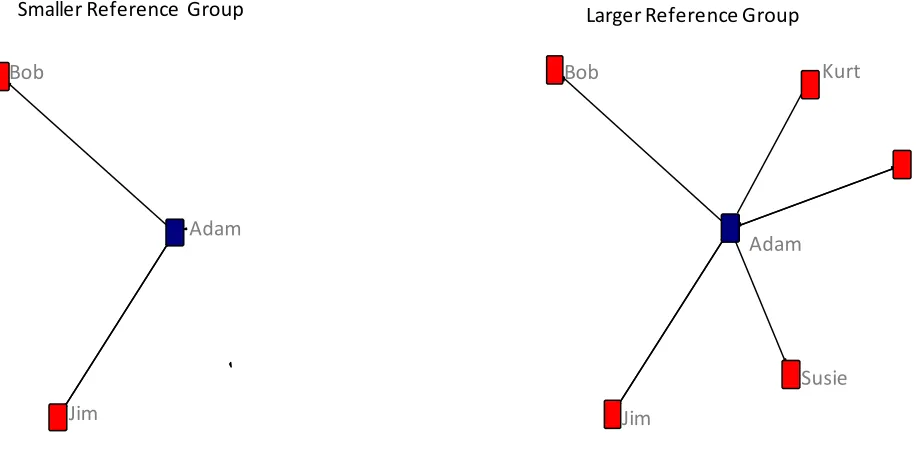
While identifying the reference group is essential, we also know virtually nothing about how the structure of these reference groups will affect the comparison process. These reference groups can vary widely in terms of size. Do the number of referent others an individual has impact the outcomes of the comparison process? These reference
groups can also vary on the density of comparison relationships within the group. Does it matter if an employee’s referents also compare themselves with one another? Social Network Theory tells us that the size and structure of relationships in a group are an important component of social context shaping group climate and impacting individual experience within the group. Examining the structural aspects of comparison reference groups will help to create a more contextualized theory of social comparison at the workplace and it is my assertion that this will help us better understand the varied consequences of workplace comparisons.
The Mediating Role of Emotion
of social comparisons impact organizationally relevant behavior. For this purpose I have chosen to focus on important performance-related behaviors that go beyond the
fulfillment of the task performance role. I will consider several types of behavior
including counterproductive workplace behavior, organizational citizenship behavior, and effort based performance. These seemingly distinct and separate behaviors have been unified under several different organizational constructs including voluntary workplace behaviors, extra-role behaviors, and discretionary behaviors (Spector & Fox, 2002). Consistent with these classifications is the notion that these behaviors go beyond the call of typical task fulfillment, require a good deal of effort and attention, as well as being highly motivated activities. What seems to be consistent in this line of inquiry is that emotions play a significant role in the enactment of voluntary workplace behaviors. I take the position that emotions are the key link between workplace social comparisons and exhibiting voluntary workplace behavior.
Envy in the Workplace
contrast/assimilation effect. Envy is the social comparison-based emotion that is most likely to occur with an upward comparison and the presence of a contrast effect. Empirical studies focusing on the consequences of workplace envy suggest a primarily destructive pattern (Duffy, Shaw & Schaubroeck, 2008). Workplace envy has been shown to erode the quality of workplace relationships (Duffy & Shaw, 2000), decrease positive workplace attitudes (Vecchio, 2000), and increase antisocial behavior (Vecchio, 2007).
but emotional events are further subject to reappraisal, which can affect their intensity and duration (Verduyn, Mechelen, & Tuerlinckx, 2011).
One challenge to understanding the effect that workplace envy has on voluntary workplace behaviors is to develop a simple assessment instrument that captures the full emotional experience of employees. Typical measures of envy (c.f. Cohen-Charash, 2009; Vecchio, 2000) tend to emphasize the destructive and hostile component of envy, which focuses on malicious envy (Smith & Kim, 2007). This emphasis conceptualizes envy as pain, and would necessitate the inclusion of several situational variables including the nature of relationships and the organizational climate in order to make predictions on the occurrence of productive or counterproductive reactions to envy. In contrast, this study attempts to separate out the experience of malicious from benign envy.
Thus far benign and malicious envy have been measured by using elicitation techniques, asking an individual to recall a time in which they felt particularly envious. Using recall to elicit feelings of envy typically forces participants to focus on one
voluntary workplace behavior. Accordingly, I have developed separate scales for measuring benign and malicious envy for this dissertation.
The Social Context of Emotional Experience
This literature review has already established the important role that social context can play in the social comparison process. In order to understand how social comparisons elicit different experiences of envy, it is important to understand how emotions are shaped by social context. Approaches to studying emotions inside
organizations rely primarily on intra-individual processes of appraisal, where emotions are thought to be generated by an individual’s store of representations of facts, cognitive schemas, and behavioral skills (Frijda, 2008). At its basic level, appraisal theories of emotion argue that emotions are generated by our evaluation of events and this in turn can lead to different reactions for different individuals (Scherer, Shorr & Johnstone, 2001), thus the individual’s appraisal of an upward comparison event will dictate the resultant emotional response. In contrast, this study argues that social structure is a significant factor in determining how we emotionally appraise social comparisons (Burt, 2010). This line of reasoning is consistent with sociological approaches to emotion that recognize that social context can affect how we define situations as well as our
Opportunity and Behavior
Thus far I have considered only how the social context might motivate voluntary behaviors (e.g., productive or counterproductive behavior) in organizations through discrete emotional responses such as envy. However, this emotional motivation alone may not be sufficient cause for engaging in voluntary workplace behavior. The
relationships an individual has and the social context of the organization may impact the
opportunity individuals have for engaging in voluntary workplace behavior. Engaging in
emotional experience of the actor), and through opportunity (by constraining an individual’s ability to engage in certain types of voluntary workplace behaviors).
In sum, this dissertation uses a motivation-opportunity framework to understand the consequences of workplace social comparisons on extra-role behavior, arguing that discrete emotions act as motivational forces. These forces are formed by a complicated interplay between social comparisons and the structure of referent groups existing in a broader climate of justice. Furthermore, social structure acts as an opportunity conduit, amplifying or diminishing the consequence of emotional motivation on behavioral reactions to the comparisons.
Conclusion
The literature reviewed in this chapter has identified several areas where a more contextualized theory of workplace social comparisons can contribute to our
understanding of how individuals will react to being outperformed by their peers in organizations. These contributions hopefully extend social comparison theory, affective events theory, the theory of discrete emotions, and how social networks shape emotional experience. It was acknowledged that social context plays an important role in
influencing the social comparison process for an individual. Social comparison theory will be extended to add more specificity to the exact nature of comparisons in the workplace.
reference groups vary among individuals and affect their emotional experiences. Secondly, this dissertation will explicitly measure the amount of relative deprivation an individual experiences based on their comparisons. This approach will show how the relative distance, in terms of performance differences, between an individual and their entire set of referent others will shape their social comparison-based emotional experience. Traditionally social comparison theory has considered comparison in a primarily dyadic way, as a comparison between two individuals. The direction of comparison upward or downward has largely been experimentally manipulated and treated as a categorical variable. This dissertation adds essential specificity to social comparison theory, revealing the importance of knowing the specific set of others an individual compares themselves to and the relative performance difference between the individual and these referents. By acknowledging that workplace social comparisons take place among a group of referent others we can examine how the social structure of these groups ultimately affects emotional and behavioral outcomes. This dissertation also integrates discrete emotion theory by examining how the same workplace comparison difference can trigger different discrete emotional responses when the social context surrounding these social comparisons differs.
This dissertation seeks to extend social network theory in its relation to emotions and voluntary workplace behavior. This dissertation shows that structure can also have a direct effect on emotional experience by shaping the access and opportunity individuals have for eliciting social comparison information. Lastly, this dissertation shows that social networks can influence organizational behavior through both motivation and
CHAPTER 3: THEORY AND HYPOTHESES
The literature review suggests that the social context of workplace social comparisons will have a significant impact on the behavioral consequences of these comparisons. I suggest that the structure of comparison relationships will shape emotional experience and that these emotions will motivate specific types of
organizational behavior. Reference group structure will alter an individual’s access to potentially harmful comparison – information which will in turn impact the amount of benign and malicious envy an individual experiences at the workplace. These two different types of envy will in turn motivate workplace behavior including workplace deviance, performance related effort, organizational citizenship behavior, and workplace withdrawal. The social networks within which an individual is embedded, which shape the opportunity individuals have for engaging in discretionary workplace behavior, moderate the relationship between the motivating forces of discrete emotional experience.
Distinguishing between two types of envy
Empirical studies focusing on the consequences of workplace envy suggest a primarily destructive pattern (Duffy, Shaw & Schaubroeck, 2008), workplace envy has been shown to erode the quality of workplace relationships (Duffy & Shaw, 2000), decrease positive workplace attitudes (Vecchio, 2000), and increase antisocial behavior (Vecchio,2007). However some recent work has focused on the positive and adaptive outcomes associated with envy such as emulation, desire to learn and increased
motivation to succeed (van de Ven, Zeelenberg, & Pieters, 2009). There is some debate as to why there have been contradictory findings on the behavioral consequences of envy. I contend that one important difference determining whether or not an individual reacts positively or negatively to social comparisons is contingent upon whether or not they experience benign or malicious envy from the comparison.
The High Road: Benign Envy and positive voluntary behaviors
admiration. Admiration may also lack the hostility associated with envious upward social comparisons, but does not result in improved motivation for self-improvement.
Benign envy seems to result in an increased focused on the self as opposed to a focus on the other that occurs with malicious envy. Empirical results show that the experience of benign envy was a far less frustrating experience than malicious envy. There was far less personal dislike and individuals were not motivated to harm or punish the other. Instead benign envy was associated with greater feelings of inspiration and a desire to focus on reaching one’s goals (van de Ven et al., 2009). Further experimental evidence demonstrates that after experiencing benign envy, students had a desire to study more and actually performed better on a task designed to measure intelligence and creativity (van de Ven et al., 2011).
Hypothesis 1: Benign envy will be positively related to greater work effort.
Hypothesis 2: Benign envy will be positively related to organizational citizenship behavior.
The Low Road: Malicious envy and negative voluntary behaviors
Malicious envy is also the result of upward comparison, but differs from benign envy by producing desire to pull down the better performing other rather than a desire to pull one’s self up (van de Ven, et al., 2009). Malicious envy most closely resembles envy as it has been traditionally studied and is associated with feelings of hostility and ill will (Smith & Kim, 2007). Malicious envy is a much more frustrating and negative
experience than benign envy, although the desire to close the gap between self and envied target is still present. While benign envy is associated with an increased focus on the self, malicious envy tends to sharpen the focus on the envied other. This “other focus” has been demonstrated in a series of experiments that show that envious individuals tend to more accurately recall information about their envied peers than the control group (Hill, DelPriore & Vaughan, 2011). These studies also showed that this redirection of attention to the other can deplete self-regulatory resources making it more difficult for individuals to reinterpret potentially harmful comparison information in a positive light. In addition to possible self-regulatory depletion the experience of malicious envy is associated with feelings of dislike toward the envied target, increased thoughts of injustice and unfairness, and a desire to take away from the envied individual (van de Ven, et al.,
injustice. This increases the probability that maliciously envious individuals will engage in actions harmful actions (Duffy et al., 2012), “evening the score” not through self improvement, but through undermining, hindering, or embarrassing envied others. A few studies have shown that envy can result in behavior specifically targeted at the envied other such as interpersonal harming and social undermining (Lam et al., 2011; Duffy, et al., 2012).
Malicious envy not only results in feelings of interpersonal dislike but also
results in thoughts of injustice and the notion that others are undeserving of their success. The organization may become a target of malicious envier’s retribution. Employees typically expect a fair workplace, one that is free of bias when it comes to handing out organizational rewards, and this constitutes a major dimension in an employee’s psychological contract (Coyle-Shapiro, 2002). However when an employee perceives organizational unfairness they are often motivated to punish the organization for psychological contract violation. Feelings of injustice or unfairness are most often associated with malicious envy (van de Ven et al., 2009). Therefore we expect that malicious envy will result in broader workplace deviance, a measure of deviant behavior that includes both interpersonal and organizationally directed deviance (Bennett,
Robinson, 2000).
Hypothesis 3: Malicious envy will be positively related to workplace deviance.
that deviates from norms (Scott, Colquitt & Paddock, 2009). Individuals who engage in workplace deviance may be subject to sanctions or punishment from their peers and the organization, and thus may not be able to act upon their motivations. These individuals are still subject to the experience of malicious envy, which is both unpleasant and
threatening to an individual’s identity and sense of self-worth. Faced with ego threatening upward comparisons, individuals may choose to withdraw physically or psychologically from the workplace in order to limit the amount of upward comparisons they are subject too. Vecchio (2000) found that individuals experiencing envy in the workplace had higher propensities to quit. Similarly we believe that employees experiencing malicious envy may seek out alternative forms of employment.
Hypothesis 4: Malicious envy will be positively related to turnover intentions.
Context of Comparisons
I do not imply, in this dissertation, to be the first to acknowledge the importance of context in determining whether or not social comparisons will result in envy. Alicke and Zell (2008) propose that several situational factors of social comparison should increase the experience of envy including relational closeness with the target, similarity with the target, and status differences between the individual and the target. These proposed situational factors are connected primarily to the context the comparison itself. As such the focus has been placed upon the nature of the relationship between an
coincides with a primarily experimental approach used to study the social comparison process and has yielded many interesting and important insights into the process itself.
We know, however, that individuals often compare themselves to multiple referent others and these comparisons tend to be quite stable over time. Because of this stable pattern of comparison relationships, a social network perspective should give further insight into how social context influences the relationship between workplace comparisons and envy. In addition to investigating the social context of comparisons, a field study of workplace comparisons allows that the investigation of organizational context can also influence the outcome of social comparisons. Although there have been few studies on the effects of organizational context there is some evidence that
perceptions of competitiveness and goal interdependence can impact how individuals react to upward comparisons (Stapel & Koomen, 2005). Perceptions of fairness and deservedness have been strongly linked to negative reactions and malicious envy, thus this dissertation will examine whether or not perceptions of justice within the
Performance Reference Group
Central to understanding the social context of social comparisons is the concept of reference group. Reference groups have a well established history in the area of sociology and the term reference group is often associated with the work of Merton and Rossi (1968). Reference groups are groups that serve as reference points for individual evaluations. They are the standards individuals use when comparing and evaluating the self. The standards of comparisons can be manifold as individuals will compare their own attitudes, role performance, income, and behavior to others. More recently Barbara Lawrence (2006) extends the notion of reference groups to specifically fit the context of organizations. Organizational reference groups are sets of individuals within the workplace environment that other individuals are aware of and pay attention to at work (Lawrence, 2006). Consideration of organizational reference groups as a distinct entity is an important contribution given that organizational scholars have tended to infer whom employees use as a basis of comparison based on proximity and group affiliation. By specifically identifying the constituents of the organizational reference group, the referent others, researchers can identify specifically who employees are aware of and pay
attention to.
Identifying specific referent others is important to understanding individual reactions to workplace comparisons. This is not to suggest that only conscious
whether or not conscious or unconscious comparisons have a greater effect on emotional experience and subsequent behavior is an interesting empirical question and one that is not dealt with in this dissertation. At its most basic level I am assuming that an individual experiences many events in the workplace, such as the promotion of a peer, a manager praising someone else’s work, an employee bragging about their new bonus, and third party gossip about the good fortune of another. Each of these events has the potential for evoking an envious reaction in an employee, however if the employee already devotes attention to a specific individual who is outperforming them they are at higher risk of experiencing one of these negative events and the event may hold greater weight given the salience of the referent other. This perspective is supported by the work of Shah (1998) who adopted a social network approach to examine the referent selection process in organizations. Shah (1998) directly identified those referents that employees compared themselves to when assessing their own level of performance. Her study showed that employees were significantly more likely to monitor performance referents and solicit information about them from 3rd parties than they were likely to do with other employees that were not identified as performance referents. Thus it stands to reason that employees will be much better informed about their performance referents and at higher risk of experiencing negative emotions when outperformed by them.
In this dissertation I adopt Shah’s (1998) approach for directly measuring an employee’s performance referent and integrate her approach with Lawrence’s conception of an organizational reference group. I focus on a specific type of organizational
reference group, a performance reference group. By integrating these two approaches I
1) Shah’s focus was placed upon the referent choice and the ways in which individuals seek information about their referents. In other words Shah examined whom employees choose as referents and how they gather information about them. I on the other hand focus on the consequences of the referent choices: how do employees react when they know with whom they compare themselves?
2) Using the concept of a performance reference group allows me to look beyond the comparison dyad that is predominantly used in experimental studies of the
comparison process. Employees tend to compare themselves with multiple stable and salient referent others and identifying them will allow us to better understand how
characteristics of this reference group may influence employee reactions to comparisons.
Relative Performance Difference