JOURNAL OF CHEMISTRY AND CHEMICAL SCIENCES An International Open Free Access, Peer
Journal of Chemistry and Chemical Sciences Vol. 4, Issue 2, 30 April, 2014 Pages (70
Drug Dissolution and
Sanjana Soni
1Dr C.V Raman University
2C.M.D. Collage
The scientific study of drug has been extending the physical condition of drugs to solid, liquid, and gaseous form. A drug is an agent used in diagnosis, cure and prevention of diseases in man or in animals. Drugs are the substance which changes the functionalities of human and animal bodies by once get into the bloodstream. Diversity in their action and effect in the subject body is the main important characteristic feature. In this regard, rate of dissolution of drugs in three conditions i.e. acid, basic and neutral is studied.
Keywords: Drug dissolution, rate of drug, dissolution ibuprofen
INTRODUCTION
Ibuprofen is the type of mostly used drugs. Ibuprofen is often used as a NSAID. NSAID is abbreviation for non steroidal anti - inflammatory drugs. It is prominent used to relief symptoms of arthritis or fever. Basically, Ibu
acts as an analgesic or pain reliever, it often comes in capsules, tablets, or powder form. Its effects are due to the inhibitory actions on cyclo
which are involved in the synthesis of prostaglandins. Prostaglandins have an important role in the production of pain, inflammation and fever.
ISSN 2229 ISSN 2319
Abbr: J. Chem. & Cheml. Sci. 2014, Vol.4 (2): Pg.98
JOURNAL OF CHEMISTRY AND CHEMICAL SCIENCES An International Open Free Access, Peer Reviewed Research Journal
www.chemistry-journal.org
Journal of Chemistry and Chemical Sciences Vol. 4, Issue 2, 30 April, 2014 Pages (70-117)
Drug Dissolution and it’s Effect
Sanjana Soni1 and Harsha Sharma2
Dr C.V Raman University, Kargi Road Kota, Bilaspur, C. G., INDIA.
C.M.D. Collage, Bilaspur, C. G., INDIA.
(Received on: April 7, 2014)
ABSTRACT
The scientific study of drug has been extending the physical condition of drugs to solid, liquid, and gaseous form. A drug is an agent used in diagnosis, cure and prevention of diseases in animals. Drugs are the substance which changes the functionalities of human and animal bodies by once get into the bloodstream. Diversity in their action and effect in the subject body is the main important characteristic feature. In this regard, rate of dissolution of drugs in three conditions i.e. acid, basic and neutral is studied.
rug dissolution, rate of drug, dissolution ibuprofen.
Ibuprofen is the type of mostly used drugs. Ibuprofen is often used as a NSAID. NSAID is abbreviation for non
inflammatory drugs. It is prominent used to relief symptoms of arthritis or fever. Basically, Ibuprofen acts as an analgesic or pain reliever, it often comes in capsules, tablets, or powder form. Its effects are due to the inhibitory actions on cyclo - oxygenases, which are involved in the synthesis of Prostaglandins have an important role in the production of pain,
In the year 1969, Ibuprofen is known as a carboxylic acid that was first found in the United Kingdom by Pure Drug Company in the name of Brufen.
IUPAC name of brufen is (2RS) – 1 [4 – (2 – methyl propyl) pheny] propionic acid. Ibuprofen comes in different forms as pain reliever and is seen under a variety of popular trademarks.
STRUCTURE:
ISSN 2229-760X (Print) ISSN 2319-7625 (Online) Abbr: J. Chem. & Cheml. Sci. 2014, Vol.4 (2): Pg.98-103
In the year 1969, Ibuprofen is known as a carboxylic acid that was first found in the United Kingdom by Boot in the name of
Fig.1 Structure of ibuprofen PREVENTION PRINCIPLE
These principles are intended to help parents, educators and community leaders think about, plan for deliever research drug abuse prevention programs.
RISK FACTORS AND PROTECTIVE
FACTORS
Principle-1: Prevention programs should enhance protective factors and reverse or risk factors.
• The risk of becoming a drug abuser
involves the relationship among the number and type of risk factors (eg deviant attitudes and behaviors) and protective factors (eg
support).
• Early intervention with risk factors often
has a greater impact than later intervention by changing a child’s life path away from problems an dtowards positive behaviour.
Principle-2: Prevention programs should address all form of drug abuse, alone or in combination, including the under age use of legal drug (eg – tobacco or alcohol) the use of illegal drugs (eg – heroin or marijuana)
Fig.1 Structure of ibuprofen PREVENTION PRINCIPLE
These principles are intended to help parents, educators and community leaders think about, plan for deliever research-based drug abuse prevention programs.
RISK FACTORS AND PROTECTIVE
Prevention programs should enhance protective factors and reverse or
The risk of becoming a drug abuser involves the relationship among the number and type of risk factors (eg – deviant attitudes and behaviors) and ctors (eg – parental
Early intervention with risk factors often has a greater impact than later intervention by changing a child’s life path away from problems an dtowards
Prevention programs should orm of drug abuse, alone or in combination, including the under age use of tobacco or alcohol) the use heroin or marijuana)
and the in appropriate use of legally obtained substances (eg –
prescription medication, or over the counter drugs.
Principle-3: Prevention program should address the type of drug abuse problem in the local community, target modifiable risk factors and strengthen identified protective factors.
Principle-4: Prevention program should included the effective training centre.
Principle-5: The reinforcing skills of drug are mostly interactive technique.
DRUG DISSOLUTION RATE
Dissolution is a process by which a compound goes from the solid state into solution in a solvent.
The rate of dissolution is a key target for controlling the duration of a drug's effect, and as such, several dosage forms that contain the same active ingredient may be available, differing only in the rate of dissolution. If a drug is supplied in a form that is not readily dissolved, the drug may be released more gradually over time with a longer duration of action. Having a longer duration of action may improve compliance since the medication will not have to be taken as often. Additionally, slow – release dosage forms may maintain concentrations within an
therapeutic range over a long period of time, as opposed is quick
dosage forms which may result in sharper peaks and troughs in serum concentrations.
and the in appropriate use of legally inhalants), ication, or over the counter
Prevention program should address the type of drug abuse problem in the local community, target modifiable risk factors and strengthen identified protective
revention program should be included the effective training centre.
he reinforcing skills of drug are mostly interactive technique.
DRUG DISSOLUTION RATE
is a process by which a compound goes from the solid state
The rate of dissolution is a key target for controlling the duration of a drug's effect, and as such, several dosage forms that contain the same active ingredient may be available, differing of dissolution. If a drug is supplied in a form that is not readily dissolved, the drug may be released more gradually over time with a longer duration of action. Having a longer duration of action may improve
Sanjana Soni, et al., J. Chem. & Cheml. Sci. Vol.4 (2), 98-103 (2014) 100
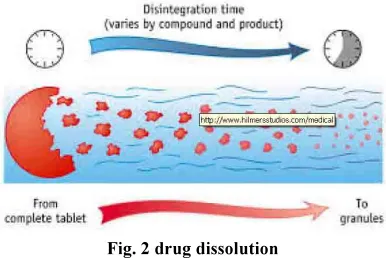
Journal of Chemistry and Chemical Sciences Vol. 4, Issue 2, 30 April, 2014 Pages (70-117) Fig. 2 drug dissolution
DISSOLUTION AS A PROCESS
Disintegration Disaggregation Tablets or Granules Fine
Capsules Aggregates Particles
Dissolution
Drug in Solution
DRUG DOSAGE
In solution dosage forms, the drug is already dissolved in the product, and is available for absorption immediately after administration to a patient. However, in other types of dosage forms (tablets, capsules, suspensions, and so forth), the drug is present as a solid. Before the drug can be absorbed or reach its target, it must be released from the dosage form; in other words, it must dissolve in the fluids at the site of absorption. Undissolved drug cannot be absorbed. Even if the drug product is intended for local action and does not require systemic absorption, dissolution is necessary for the drug molecules to reach
the site of action and interact with the target. If the drug does not dissolve completely, the amount of drug available for absorption or action will be less than the dose administered.
Dosage Form:
the form of the completed pharmaceutical product eg – tablet, capsules, injection etc.
Dissolution of drug
Drug dosage form drug solution
absorption
drug in system
Pharmacological response
Clinical efficacy
DRUG MOVEMENT
In pharmacology, absorption is the movement of a drug into the blood stream. In the most standard situation, a tablet is ingested and passes through the esophagus to the stomach. Aqueous environment of stomach tablet of Ibuprofen will dissolve first in body.
completely mixed. At the solid/liquid interface, the drug dissolves rapidly forming a saturated solution. The overall rate of dissolution is governed entirely by the diffusion of dissolved drug molecules through the stagnant layer from solid surface to the bulk liquid.
Thus absorption is a primary focus in drug development and medicinal chemistry. Since the drug must be absorbed before any medicinal effect can take place.
REQUIRED CHEMICALS
Tablet of ibuprofen, pH4 solution, pH9 solution, distilled water.
PROCEDURE
In physiological condition the tablet
is physiologically differ in mode of absorption. For controlling the duration of a drug effect rate of dissolution play the major role. This study focus on the rate of dissolution under acid, basic and neutral condition.
For this study first distilled water is taken in eight beakers. Now tablet of ibuprofen is crushed and measured in digital balance and put into the beakers containing distilled water. After each 30min. each beaker solution is filtered one by one. Then, filter papers are dried upto 24 hours. The undissoluted drug is measured by chemical balance and thus reading is observed.
Same process continued with pH4 and pH9 solution and it’s dissolution on them is observed.
OBSERVATION TABLE
I. Table for dissolute drug in case of distilled water
Name Wt. Before dissolution
Initial time
Final time Amount of drug Dissolute
wt. of drug undissolute
Rate of dissolute Tab1 0.532mg 10.00am 10.30am 0.426 0.143 74.86% Tab2 0.562mg 10.00am 11.00am 0.451 0.118 80.39% Tab3 0.532 mg 10.00am 11.30am 0.445 0.099 81.80% Tab4 0.554 mg 10.00am 12.00pm 0.436 0.101 81.19% Tab5 0.537 mg 10.00am 12.30pm 0.461 0.093 83.21% Tab6 0.544 mg 10.00am 01.00pm 0.434 0.098 81.57% Tab7 0.561 mg 10.00am 01.30pm 0.437 0.125 77.25% Tab8 0.569 mg 10.00am 02.00pm 0.443 0.089 83.27%
II. Table for dissolute drug in case of pH-4 solution
Name Wt. Before dissolution
Initial time
Final time
Amount of drug Dissolute
wt. of drug undissoluted
Sanjana Soni, et al., J. Chem. & Cheml. Sci. Vol.4 (2), 98-103 (2014) 102
Journal of Chemistry and Chemical Sciences Vol. 4, Issue 2, 30 April, 2014 Pages (70-117) III. Observation Table for wt. of drug diluted in case of pH-9 solution
Name Wt. Before dissolution
Initial time Final Time Amount of drug Dissolute
wt. of drug undissoluted
Rate of dissolute Tab1 0.479mg 10.00am 10.30am 0.212 0.267 44.26% Tab2 0.549 mg 10.00am 11.00am 0.248 0.301 45.17% Tab3 0.552 mg 10.00am 11.30am 0.225 0.327 40.76% Tab4 0.564 mg 10.00am 12.00pm 0.262 0.302 46.45% Tab5 0.564 mg 10.00am 12.30pm 0.242 0.322 42.91% Tab6 0.575 mg 10.00am 01.00pm 0.205 0.370 35.65% Tab7 0.550 mg 10.00am 01.30pm 0.238 0.312 43.27% Tab8 0.567 mg 10.00am 02.00pm 0.252 0.315 44.44%
CALCULATION
Weight of drug dissolute
Rate of dissolution = × 100 Total weight of drug (in solid state)
= Percentage of dissolution of drugs
GRAPH
drug dissolution rate
Time in hour
CONCLUSION AND DISCUSSION
The rate of dissolution of ibuprofen was seen highest in water, i.e. in neutral condition. which means ibuprofen strongly dissolves in duodenum (small intestine)
in human body. Where the pH changes to 7.0 – 8.5.
Dissolution of ibuprofen reaches 83% in duodenum. While in pH-4 and pH-9 solution it’s dissolution reaches 79% and 46% respectively.
It is followed by pH4 and pH9. Which indicates that it is dissolves better in neutral medium.
By this test we can also enhance the dissolution rate of ibuprofen by appropriate substance.
REFERENCES
1. Ali, A. & Sharma, S.N. Preparation and evaluation of solid dispersions of ibu-profen. Indian J. Pharm. Sci., 53, 233-236 (1991).
technique. Indian J. Pharm. Educ. Res.,
42, 373-378 (2008).
3. Burke A, Smyth E, FitzGerald GA. Analgesic-anti pyretic and anti inflammatory Agents; Pharmacotherapy of gout. In: Bruntom LL, Lazo JS and Parker KL (editors). Goodmans and Gilman’s the pharmacological basis of therapeutics. 11th ed., McGraw Hill, New York, P. 676-700 (2006).
4. Chowdari, K.P.R. & Srinivas, L. Physical stability and dissolution rate of ibuprofen suspension formulated employing solid dispersion. Indian J.
Pharm. Sci., 62,253-256 (2000).
5. Compreton EL, Glass RC, Hird ID. The pharmacokinetic of ibuprofen in elderly and young subjects. Boots research reports DT 84041 (1984).
6. Dabbagh, M.A. & Taghipour, B. Investigation of solid dispersion technique in improvement of physicochemical characteristics of ibuprofen powder.
Iranian J. Pharm. Sci., 3, 69-76 (2007).
7. Khan, G.M. & Jiabi, Z. Preparation, characterization, and dissolution studies of ibuprofen solid dispersions using polyethylene glycol (PEG), talc, and PEG-talc as dispersion carriers. Drug
Dev. Ind. Pharm., 24, 455-462 (1998).
8. Loganathan, S., Maimaran, S., Rajasekaran, A. & Sulaiman, A. The effect of solid dispersions on (solubility) dissolution rate of ibuprofen. Eastern
Pharmacist, 513, 115-116 (2000).
9. Sharma PK, Garg SK, Narang A. Pharmacokinetics of oral ibuprofen in premature infants. J Clin Pharmacol., 43(9):968-973 (2003).
10. Newa, M., Bhandaria, K.H., Oh, D.H., Kim, Y.R., Sung. J.H., Kim, J.O., Woo, J.S., Choi, H.G. & Yong, C.S.. Enhanced dissolution of ibuprofen using solid dispersion with Poloxomer 407.
Arch. Pharm. Res., 31, 1497-1507