135
Article Information
Abstract
Keywords
Perceived Usefulness Perceived Ease of Use Perceived Enjoyment Online Mapping
Technology Acceptance Model
The present article proposes a conceptual model to determine the travellers’ intention to use online mapping service application for travel purpose. Nowadays, many companies compete to design new technology with the intention to ease people within their everyday-life activities including when travelling and having vacation. Previously people were experiencing difficulties using traditional paper maps as information within the maps is not interactive and complicated. With the introduction of online mapping, travelling is more straightforward and can easily be guided. The proposed framework contributes to the body of knowledge by extending the original Technology Acceptance Model (TAM) with the inclusion of the perceived enjoyment construct. Understanding the relationship between each factor provides different point of view as to why travellers develop the intention to use online mapping service.
INTRODUCTION
Recently, there has been growing of interest in developing online map services such as Google Maps, Bing Maps and Waze. However, there are other modern-related technologies associated with mobile phones and other portable devices that are capable access maps for attractions around Malaysia. These are referred to as online mapping and are useful for tourists’ usage. Online mapping systems more often been utilized by tourists who prefer to ‘wonder around’ exploring possible interesting activities and well as attractions within a destination. These online mapping technologies guide tourist towards the right direction rather than simply supporting a pre-determined route. By using web map services, tourists can quickly, precisely and accurately find all travel information and organize their itineraries (Ilies & Ilies, 2006). Provided by these web map services are geographic locations that constitute numerous tourists’ attractions, these features motivate and inspire tourists to travel to the recommended places. Sigala and Marinidis (2009) highlighted that different online mapping services provide different levels of web map in terms of details. This is because of the different level of integration of web map services with tourism business operations. For example, web map services can be used from providing a simple digital representation of the location of a tourism firm up to measuring and managing the number and the flow of tourists at an environmental sensitive tourism destination. Nevertheless, the factor tourist use online mapping is not clearly justified beyond the factors mentioned. To fulfill this gap, we propose some other possible different ways on why people use the online mapping services. This study proposes a
The Role of Perceived Interactivity, Perceived Ease of Use, Perceived Usefulness, and
Perceived Enjoyment toward Intention to Use Online Mapping Service Applications
Muhammad Izzani Izzuddin Marzuki, Aina Natasya Rosly, Nurul Syazmin Roslan,
Dahlan Abdullah*, Saiful Bahri Mohd Kamal, Azila Azmi
Faculty of Hotel and Tourism Management, University Technology MARA Pulau Pinang, MALAYSIA
136
conceptual model by extending the original Technology Acceptance Model (TAM) developed by Davis (1989). Travelers’ perception on the interactivity of the online mapping service application is proposed as a predictor to their usage intention. The perceived interactivity construct is expected to influence travelers’ intention to use online mapping service applications through three mediators i.e. 1) perceived ease of use, 2) perceived usefulness, and 3) perceived enjoyment. Therefore, the objective of the conceptual paper is to investigate the role of these variables towards the intention to using online mapping service applications while travelling. The following sections will discuss the literature review of the study; this is followed by a discussion on the conceptual research model. Finally, the last section will discuss the conclusion for the study.LITERATURE REVIEW
Online Mapping
Since the launching of Google Maps in 2005, online mapping service applications have enriched the use of Internet. Based on Asynchronous JavaScript and XML (AJAX), an innovative client-server interaction was introduced in Google Maps to enable a constant client-server connection to allow immediate downloading of map information (Peterson, 2008). In addition, Google also provides Application Programming Interface (API) that can be used by a programmer using JavaScript, PHP or other scripting language (Udell, 2009). The latest API version does not require the key registration to use the Google Maps. It supports both traditional and mobile web browsers including Internet Explorer, Firefox, Safari, Chrome, Android, BlackBerry, Dolfin, Apple iPad and iPhone. Besides, other Maps APIs are also available for online mapping, including Yahoo! Maps API, Microsoft Bing Maps API, Nokia Ovi Maps API, and ESRI ArcGIS API (Hu & Dai, 2013). Lately, the interest towards using Google Maps API to implement web-based mapping services has increased. It includes the use of simple to advance applications to display location map information (Hu & Dai, 2013).
Technological Acceptance Model as Underlying Theory
The Technology Acceptance Model (TAM) provides an abstract frame of reference based on theories in social psychology (Davis, 1989). TAM introduced a causal model to clarify and foresee the acknowledgement of a likely hint technology by possible users (Hussain, Mkpojiogu, & Yusof, 2016). The pioneering TAM suggests that perceived usefulness and perceived ease of use are leads impact to consumer’s attitude into using a technology and verify their intention to use or to adopt the particular technology (Ha & Stoel, 2009). TAM model theorized that perceived ease of use describe variety in perceived usefulness (Hussain et al., 2016). TAM model contribute a better platform to identify consumers’ acceptance of interactive mobile maps (Ha & Stoel, 2009; Nguyen, 2015).
CONCEPTUAL FRAMEWORK AND RESEARCH PROPOSITION
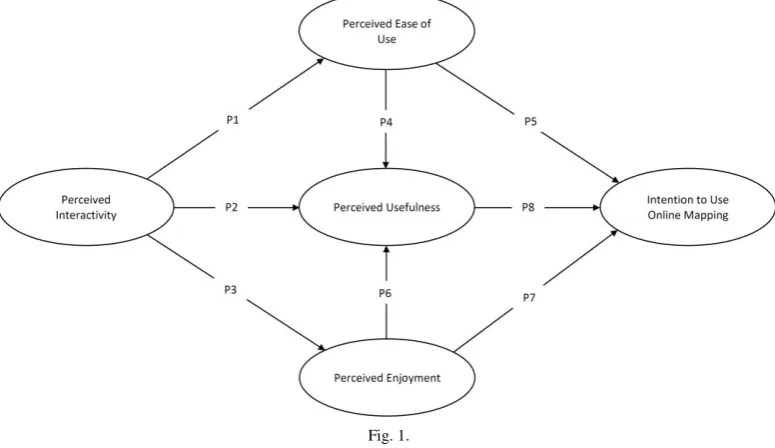
Figure 1 illustrates the proposed conceptual framework to understand the role of perceived interactivity, perceived ease of use, perceived usefulness and intention to use online mapping service application during travel. Perceived interactivity is believed to one of the influential predictors to online mapping usage intention. Whereby, perceived ease of use, perceived usefulness and perceived enjoyment act as mediating variables.
137
Perceived Interactivity
Since interactivity is an importance characteristic of marketing communication, hotel website interactivity is vital to attract customer attention towards online purchase or online booking. Therefore, customer perception on hotel website interactivity is among the most importance features associated with this medium. Abdullah, Jayaraman, and Kamal (2016) defined perceived interactivity as the degree of users’ capability to modify the form and content of a mediated environment in real time. Furthermore, the interactivity appears as an noticeable features to differential the web from the others traditional media (Wu, 1999). In their conceptual paper, Abdullah et al. (2016) proposed that perceived website interactivity influence customer perceived value, represented by the trade-off between monetary benefits, non-monetary benefits, and security and privacy as sacrifices. Perceived interactivity also relates to customers’ online trust and customers have higher intention to engagement with the media content when they trust it. In support, based on their empirical findings, Jeon, Jang, and Barrett (2016) found that perceived website interactivity influence repurchase intention through perceived utilitarian value and online trust. Therefore, we suggest the following propositions:
Proposition 1: Perceived interactivity has significant influence on perceived ease of use.
Proposition 2: Perceived interactivity has significant influence on perceived usefulness.
Proposition 3: Perceived interactivity has significant influence on perceived enjoyment.
Perceived Ease of Use
Perceived ease of use is defined as “the degree to which a person believes that using a particular system would be free of effort’’ (Davis, 1989, p. 320). The scholar theorizes that perceived ease of use positively influences perceived usefulness. The theory has been adopted by various scholars in their conceptual and empirical papers (D. Abdullah, Jayaraman, Shariff, Bahari, & Nor, 2016; F. Abdullah, Ward, & Ahmed, 2016; Cho & Sagynov, 2015; Lee, Tyrrell, & Erdem, 2013; Tong, 2010). F. Abdullah et al. (2016) reported a significant positive relationship between ease of use of e-portfolio using system and perceived usefulness of the technology. Besides, research on a group of meeting planners also shows the effects of ease of use on the usefulness of social media (Lee et al., 2013). Likewise, Cho and Sagynov (2015) and Tong (2010) found highly significant effects of perceived ease of use on perceived usefulness among online customers. Therefore, the following propositions are proposed:
Proposition 4: Perceived ease of use has significant influence on perceived usefulness.
Proposition 5: Perceived ease of use has significant influence on intention to use online mapping service.
Perceived Enjoyment
Hussain et al. (2016) stated that perceived amusement alludes to the area to which the report of a technology (like uncertain map) is peculiar to be enjoyable. Nguyen (2015) stated that some user particular about the feel that enjoyment and delight that they receive when using a new application or technology and this is one of the reasons that motivates them to switch quickly to these new technology. Davies et al. (1992) highlighted users who develop perceived enjoyment towards a new technology will develop higher intention use the new application. Igbaria et al. (1995) found that pleasure or perceived enjoyment is related with the timing of use. According to Moon and Kim (2001), joy and delight will generate greater expectations on the usage of a technology.
Proposition 6: Perceived enjoyment has significant influence on perceived usefulness.
Proposition 7: Perceived enjoyment has significant influence on intention to use online mapping service.
Perceived Usefulness
Perceived usefulness can be referred to as the extent to which a person believes that using a particular system would enhance the execution of his or her duties (Davis, 1989). Davis (1989) within his studies highlighted that most online map service users recognized that innovation within mobile map services more likely improved the chances of finding the location that they are looking for. Mobile map users regarded such innovation as very useful and helpful especially within the aspect of reducing the time to get where they wanted to go or moving from one location to another(Hussain et al., 2016).
138
Intention to Use Online Mapping
Online mapping is the compilation and publication of Web sites that provide exhaustive graphical and text information in the form of maps and databases. Online mapping services are used for tasks such as planning trips and determining geographical positions. Online mapping is an effective way to use maps that are available online rather that referring to traditional maps within books/papers that are not very detail and interactive. The advantage of online mapping is the ability to customize maps that suit individuals’ needs. Travelers can remove all unnecessary information and setup a simple, concise summary of his/her preferred route. In addition, online mapping services usually include text directions that provide additional guide pertaining to the setup route. These text directions are often displayed in conjunction with the map set previously by users and it can be printed. Unlike traditional maps, information and new features within online mapping services can be updated at any time.
CONCLUSION AND RECOMMEDATION
This conceptual paper proposes a framework that describe the factors that contribute towards the intention to use online mapping when travel. The TAM model suggests that when users are presented with a new technology, several factors influence their decision on how and when they will use the technology. In other word, TAM is a model that indicates how users come to accept and use a technology. The contribution of the study is the introduction of the variable ‘usability’ which previous been neglected. From the theoretical point of views, this study expands the TAM model by adding ‘perceived enjoyment’ as an additional factor that contribute towards intention to use online mapping. From the practical perspectives, the term ‘usability’ refers to the degree where travellers can use online mapping effectively. Hence, we can state that the more satisfied a tourist is with the information he/her received, the more tendency for him/her to subsequently acquire online mapping services. If the online mapping services have more functional within the application, the user will tend to use online mapping as it can help them while travelling. This conceptual paper proposes the factors that contribute towards the intention to use online mapping while traveling. Similar to other conceptual papers, this articles is conceptual in nature. Thus, further empirical testing is needed to validate the applicability of the proposed framework. Other than that, future research could also examine many other prominent factors that could influence technology adoption like user preference (D. Abdullah, Radzi, Jamaluddin, & Patah, 2010), electronic word-of-mouth (D. Abdullah, Hambali, Kamal, Din, & Lahap, 2016), user attitudes (Din et al., 2016), cooperation (Kamal, Zawawi, & Abdullah, 2016), and usage style (Azmi, Buliah, & Ismail, 2016) as additional predictors and consumer characteristics (Azmi, Sapi, & Rahman, 2015) as potential moderator in the study of online mapping adoption.
REFERENCES
Abdullah, D., Hambali, M. E. R. M., Kamal, S. B. M., Din, N., & Lahap, J. (2016). Factors influencing visual electronic word of mouth (e-WOM) on restaurant experience. In S. M. Radzi, M. H. M. Hanafiah, N. Sumarjan, & Z. Mohi (Eds.), Proceedings of the 3rd International Hospitality and Tourism Conference
(IHTC 2016) & 2nd International Seminar on Tourism (ISOT 2016). CRC Press.
Abdullah, D., Jayaraman, K., & Kamal, S. B. M. (2016). A Conceptual Model of Interactive Hotel Website: The Role of Perceived Website Interactivity and Customer Perceived Value Toward Website Revisit Intention.
Procedia Economics and Finance, 37, 170–175. http://doi.org/10.1016/S2212-5671(16)30109-5
Abdullah, D., Jayaraman, K., Shariff, D. N., Bahari, K. A., & Nor, N. M. (2016). The effects of perceived interactivity, perceived ease of use and perceived usefulness on online hotel booking intention: A conceptual framework. International Academic Research Journal of Social Science, 2(1). http://doi.org/10.1016/S2212-5671(16)00079-4
Abdullah, D., Radzi, S. M., Jamaluddin, M. R., & Patah, M. O. R. A. (2010). Hotel web site evaluation and business travelers’ preferences. ICETC 2010 - 2010 2nd International Conference on Education
Technology and Computer, 3, 485–488. http://doi.org/10.1109/ICETC.2010.5529493
Abdullah, F., Ward, R., & Ahmed, E. (2016). Investigating the influence of the most commonly used external variables of TAM on students’ Perceived Ease of Use (PEOU) and Perceived Usefulness (PU) of e-portfolios. Computers in Human Behavior, 63, 75–90. http://doi.org/10.1016/j.chb.2016.05.014 Azmi, A., Buliah, A. L., & Ismail, W. R. W. (2016). International tourist shopping styles in Kuala Lumpur. In
Proceedings of the 2nd International Social Science Conference 2016. Retrieved from
http://dsp-psd.pwgsc.gc.ca/Collection/En56-157-2000E.pdf
Azmi, A., Sapi, M. E. A., & Rahman, S. M. S. A. (2015). Factors Influencing Cross-Border Shopping. ESTEEM
Academic Journal, 11(2), 27–34.
Cho, Y. C., & Sagynov, E. (2015). Exploring factors that affect usefulness, ease of use, trust, and purchase intention in the online environment. International Journal of Management & Information Systems, 19(1), 21–36.
Davis, F. D. (1989). Perceived usefulness, perceived ease of use, and user acceptance of information
139
Davis, F. D., Bagozzi, R. P., & Warshaw, P. R. (1992). Extrinsic and Intrinsic Motivation to Use Computers inthe Workplace. Journal of Applied Social Psychology, 22(14), 1111–1132. http://doi.org/10.1111/j.1559-1816.1992.tb00945.x
Din, N., Rani, A. A., Ridzuan, F. H. F., Zulkifli, C. N., Tarmizi, S. A. A., Ghazali, N., … Kamal, S. B. M. (2016). Gauging students’ perception and attitudes towards Halal products and logos. In S. M. Radzi, M. H. M. Hanafiah, N. Sumarjan, & Z. Mohi (Eds.), Proceedings of the 3rd International Hospitality and
Tourism Conference (IHTC 2016) & 2nd International Seminar on Tourism (ISOT 2016). Bandung,
Indonesia: CRC Press.
Ha, S., & Stoel, L. (2009). Consumer e-shopping acceptance: Antecedents in a technology acceptance model.
Journal of Business Research, 62(5), 565–571. http://doi.org/10.1016/j.jbusres.2008.06.016
Hu, S., & Dai, T. (2013). Online map application development using google maps API , SQL database , and ASP.NET. Internaltional Journal of Information and Communication Technology Research, 3(3), 102– 110.
Hussain, A., Mkpojiogu, E. O. C., & Yusof, M. M. (2016). Perceived usefulness, perceived ease of use, and perceived enjoyment as drivers for the user acceptance of interactive mobile maps, (August), 20051. http://doi.org/10.1063/1.4960891
Igbaria, M., Guimaraes, T., & Davis, G. B. (1995). Testing the Determinants of Microcomputer Usage via a Structural Equation Model. Journal of Management Information Systems, 11(4), 87–114.
http://doi.org/Article
Ilies, G., & Ilies, M. (2006). Trends in 3D tourist mapping. Geographia Technica, 58(2).
Jeon, H., Jang, J., & Barrett, E. B. (2016). Linking Website Interactivity to Consumer Behavioral Intention in an Online Travel Community: The Mediating Role of Utilitarian Value and Online Trust. Journal of Quality
Assurance in Hospitality & Tourism, 0(0), 1–24. http://doi.org/10.1080/1528008X.2016.1169473
Kamal, S. B. M., Zawawi, D., & Abdullah, D. (2016). Entrepreneurial Orientation for Small and Medium Travel Agencies in Malaysia. Procedia Economics and Finance, 37(16), 115–120. http://doi.org/10.1016/S2212-5671(16)30101-0
Lee, W., Tyrrell, T., & Erdem, M. (2013). Exploring the behavioral aspects of adopting technology: Meeting planners' use of social network media and the impact of perceived critical mass. Journal of
Hospitality and Tourism Technology, 4(1), 6–22. http://doi.org/10.1108/17579881311302329
Moon, J., & Kim, Y. (2001). Extending the TAM for a World-Wide Web context. Information & Management,
38(4), 217–230.
Nguyen, D. (2015). Understanding Perceived Enjoyment and Continuance Intention in Mobile Games. Peterson, M. P. (Ed. . (2008). International Perspectives on Maps and the Internet: An Introduction. Springer. Sigala, M., & Marinidis, D. (2009). Exploring the Transformation of Tourism Firms’ Operations and Business
Models Through the Use. In European and Mediterranean Conference on Informatiion System (pp. 1–13). Tong, X. (2010). A cross-national investigation of an extended technology acceptance model in the online
shopping context. International Journal of Retail & Distribution Management, 38(10), 742–759. http://doi.org/10.1108/09590551011076524
Udell, S. (2009). Beginning Google Maps Mashups with Mapplets, KML, and GeoRSS. New York: NY: Apress. Wu, G. (1999). Perceived interactivity and attitude toward web sites. In … of the conference-American Academy