Available at www.ijsred.com
Replacement of Fine Aggregates in Self Compacting Concrete by Using
Brick Dust and Fly Ash
Manpreet Singh1, Satgur Singh2 1,2
Department of Civil Engineering
Swami Vivekanand Institute of Engineering & Technology, Banur (INDIA)
---
************************
---Abstract -
Self-compacting concrete principle is not new; special applications such as underwater concreting have always required concrete, which could be placed without the need for compaction. In such circumstances vibration was simply impossible. Early self- compacting concretes relied on very high contents of cement paste and, once supper plasticizers become available, they were added in the concrete mixes. The required specialized and well-controlled placing methods in order to avoid segregation, and the high contents of cement paste made them prone to shrinkage. The overall costs were very high and applications remained very limited. Compared to normal vibrated concrete (NVC), self-compacting concrete (SCC) possesses enhanced qualities and improves productivity and working conditions due to the elimination of compaction. SCC generally has higher powder content then NVC and thus it’s necessary to replace some of the cement by additions to achieve an economical and durable concrete. Japan has used self-compacting concrete (SCC) in bridge, building and tunnel construction since the early 1990's. In the last five year, a number of SCC bridges have been constructed in Europe. In the United States, the application of SCC in highway bridge construction is very limited at very limited at this time. However, the USA precast concrete industry is beginning to apply the technology to architectural concrete. SCC has high potential for wider structural applications in highway bridge construction. The application of concrete without vibration in highway bridge construction is practically admissible. In the present study, attempt has been made to compare the mechanical properties of self-compacting and normal concrete specimens. The criteria used in it based on 7days, 28 days and 56 days compressive, splitting tensile and flexure strength and of conventional and self-compacting concrete for five Fly ash & Brick dust ratios as a replacement to fine aggregate.Key Words: NVC; SCC; Fly ash; Brick dust
---
************************
---1. INTRODUCTION
Self-compacting concrete principle is not new. Special applications such as underwater concreting have always required concrete, which could be placed without the need for compaction. In such circumstances vibration was simply impossible. Every self-compacting concrete relied on very high contents of cement paste and, once super plasticizers became available, they were added in the concrete mixes. The mixes required specialized and well-controlled placing methods in order to avoid segregation, and the high contents of cement paste made them prone to shrinkage. The overall costs were very high and applications remained very limited [1].
The introduction of “modern” levelling concrete or self-compacting concrete (SCC) is associated with the drive towards better quality concrete pursued in Japan around 1983, where the lack of uniform and complete compaction had been identified as the primary factor responsible for poor performance of concrete structures (Dehn. Et al., 2000). Due to the fact that there were no practical means by which full compaction of concrete on a site was ever to be fully guaranteed, the focus therefore turned onto the elimination of the need to compact, by vibration or any other means. This led to the development of the first practicable SCC by
researchers Okampura and Ozawa, around (1986), at the University of Tokyo and the eminent Japanese contractors (e.g. Kajima Co., Maeda Co., Taesei Group Co., etc.) quickly took up the idea [2]. The contractors used their large in-house research and development facilities to develop their own SCC technologies. Each company developed their own mix designs and trained their own staff to act as technicians for testing on sites their SCC mixes. A very important aspect was that each of the large contractors also developed their own testing devices and test methods. In the early 1990’s there was only a limited public knowledge about SCC, mainly in the Japanese language [3]. The fundamental and practical know-how was kept secret by the large corporations to maintain commercial advantage. The SCCs were used under trade names, such as the NVC (Non-vibrated concrete) of Kajima Co., SQC (Super Quality Concrete) of Maeda Co. or the Bio concrete. Simultaneously with the Japanese developments in the SCC area, research and development continued in mix-design and placing of underwater concrete where new admixtures were producing SCC mixes with performance matching that of the Japanese SCC concrete (e.g. University of Paisley / Scotland, University of Sher Brooke / Canada) (Ferraris, 1999) [4].
©IJSRED: All Rights are Reserved Page 558 1.1 Advantages and Disadvantage of
Self-Compacting Concrete
Although the use of SCC has many technical, social, and overall economic advantages, its supply cost is two to three times higher than that of normal concrete depending upon the composition of the mixture and quality control of concrete producer. Such a high premium has somehow limited SCC application to general construction. SCC is specified only to areas where it is most needed. These include places where access to conventional vibration is difficult, or where there are congested reinforcements.
The majority difficulty which was faced in development of SCC was on account of contradictory factors that the concrete should be fully flow able but without bleeding or segregation. It is required that the cement mortar of the SCC should have higher viscosity to ensure flow ability while maintaining non-sedimentation of bigger aggregates. Drawbacks of Okamura’s method are that it requires quality control of paste and mortar prior to SCC mixing, while many ready-mixed concrete producers do not have the necessary facilities for conducting such tests and the mix design method and procedures are too implementation.
2. LITERATURE REVIEW
The widespread research and development of SCC in the past two decades has led to a substantial and increasing number of publications of all types. In this chapter those considered most relevant to the current study are reviewed and summarized here. A brief introduction to the fresh and hardened properties is followed by a discussion of test methods, constituent materials and mix designs. A detailed review of Fly Ash & Brick dust and silica fume as additions to concrete and SCC is demonstrated. Because this project focuses on laboratory experiments, concrete production and site practice are only briefly mentioned.
S Girish (2016) presented the results of an experimental
investigation carried out to find out the influence of paste and powder content on self-compacting concrete mixtures. Tests were conducted on 63 mixes with water content varying from 175 l/m3 to 210 l/m3 with three different paste contents. Slump flow, V funnel and J-ring tests were carried out to examine the performance of SCC. The results indicated that the flow properties of SCC increased with an increase in the paste volume. As powder content of SCC increased, slump flow of fresh SCC increased almost linearly and in a significant manner. They concluded that paste plays an important role in the flow properties of fresh SCC in addition to water content. The passing ability as indicated by J ring improved as the paste content increased [5].
Paratibha Aggarwal(2018) presented a procedure for the
design of self-compacting concrete mixes based on an experimental investigation. At the water/powder ratio of 1.180 to 1.215, slump flow test, V-funnel test and L-box test results were found to be satisfactory, i.e. passing ability; filling ability and segregation resistance are well within the limits. SCC was developed without using VMA in this study. Further compressive strength at the ages of 7, 28 and 90 days was also determined. By using the OPC 43 grade, normal strength of 25 MPa to 33 MPa at 28-days was obtained,
keeping the cement content around 350 kg/m3 to 414 kg/m3 [6].
Felekoglu (2005) has done research on effect of w/c ratio on
the fresh and hardened properties of SCC. According to the author adjustment of w/c ratio and super plasticizer dosage is one of the key properties in proportioning of SCC mixtures. In this research, fine mixtures with different combinations of w/c ratio and super plasticizer dosage levels were investigated. The results of this research show that the optimum w/c ratio for producing SCC is in the range of 0.84-1.07 by volume. The ratio above and below this range may cause blocking or segregation of the mixture [7].
Sri Ravindra rajah (2003) made an attempt to increase the
stability of fresh concrete (cohesiveness) using increased amount of fine materials in the mixes. They reported about the development of self-compacting concrete with reduced segregation potential. The systematic experimental approach showed that partial replacement of coarse and fine aggregate with finer materials could produce self-compacting concrete with low-segregation potential as assessed by the V-funnel test. The results of bleeding test and strength development with age were highlighted by them. The results showed that Fly ash & Brick dust could be used successfully in producing self-compacting high- strength concrete with reduced segregation potential. It was also reported that Fly ash & Brick dust in self-compacting concrete helps in improving the strength beyond 28 days [8].
Bouzoubaa and Lachemi (2010) carried out an
experimental investigation to evaluate the performance of SCC made with high volumes of fly ash. Nine SCC mixtures and one control concrete were made during the study. The content of the cementations materials was maintained constant (400 kg/m3), while the water/cementations material ratios ranged from 0.35 to 0.45. The self-compacting mixtures had a cement replacement of 40%, 50% and 60% by Class F fly ash. Tests were carried out on all mixtures to obtain the properties of fresh concrete in terms of viscosity and stability. The mechanical properties of hardened concrete such as compressive strength and drying shrinkage were also determined. The SCC mixes developed 28-day compressive strength ranging from 26 to 48 MPa. They reported that economical SCC mixes could be successfully developed by incorporating high volumes of Class F fly ash [9].
3. EXPERIMENTAL RESULTS
The aim of the experimental program is to compare the properties of Self-compacting concrete made with and without Fly ash & Brick dust, used as replacement of fine aggregate. The basic tests carried out on concrete samples are discussed in this chapter, followed by a brief description about mix design and curing procedure adopted. At the end, the various tests conducted and the material used on the specimens are discussed below:
3.1 Cement
Available at www.ijsred.com
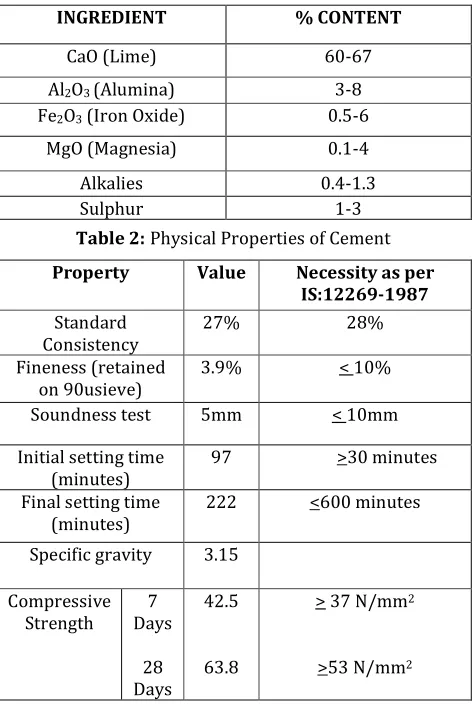
other materials together as the concrete hardens. The ordinary cement contains two basic ingredients namely argillaceous and calcareous. In argillaceous materials clay predominates and in calcareous materials calcium carbonate predominates. Basic component of cement is shown in Table 1; Grade 53 Ultra Tech cement was used for casting cubes and cylinders for all concrete mixes. The cement was of uniform colour i.e. grey with a light greenish shade and was free from any hard lumps. Summary of the various tests conducted on cement are as under given below in Table 2.
Table 1: Composition limits of Portland cement
INGREDIENT % CONTENT
CaO (Lime) 60-67
Al2O3 (Alumina) 3-8 Fe2O3 (Iron Oxide) 0.5-6
MgO (Magnesia) 0.1-4
Alkalies 0.4-1.3
Sulphur 1-3
Table 2:Physical Properties of Cement
Property Value Necessity as per
IS:12269-1987
Standard Consistency
27% 28%
Fineness (retained on 90usieve)
3.9% < 10%
Soundness test 5mm < 10mm
Initial setting time (minutes)
97 >30 minutes
Final setting time (minutes)
222 <600 minutes
Specific gravity 3.15
Compressive Strength
7 Days
28 Days
42.5
63.8
> 37 N/mm2
>53 N/mm2
3.2 Brick Dust
Brick dust as mineral admixture has the ability to react with lime in presence of moisture to form hydraulic products. As Portland cement liberates lime during hydration, in course of time, this liberated lime is leached out making the structure porous (Samanta et al., 1997). Due to acidic environment, CO2 reacts with Ca (OH) 2 and forms calcium carbonate and water, and then leeches out the whitish substance.
Portland cement + water C-H-S (Glue) + Ca (OH) 2 (Fast Reaction)
Ca (OH) 2 + CO2 CaCO3 +H2O
In cement, mineral admixture mixes with liberated time that in turn reacts with mineral admixture forming additional number of hydraulic compounds, reinforcing the hydraulic properties of cement itself. The reaction is as follows:
Pozzolana + Ca (OH) 2 + water C-H-S (Glue) (Slow reaction)
The slow rate of reaction between mineral admixture and liberated lime coupled with the decrease in the portion of cement affects the hydraulic properties in the early age. But in the course of time, the mineral admixture reaction products contribute their share to improve the rate of hydration and consequently the strength properties of the concrete.
3.3 Fly Ash
The pozzolanic activity of fly ash is highly influenced by the quantity and composition of the glassy phase present. The low calcium fly ash, a product of calcination of bituminous coal, containing alumina silicate glass seems to be a little less reactive than calcium alumina silicate glass, present in high calcium fly ash. The crystals of minerals typically found in fly ash low in calcium are quartz, mullite (3Al2O3.2SiO2), sillimanite (Al2O3.SiO2) hematite and magnetite. These minerals possess no pozzolanic property. The minerals crystals typically found in high calcium fly ash are quartz, tricalcium aluminate (3CaO. Al2O3), calcium sulphoaluminate (4CaO. 3Al2O3.SO3), anhydrite (CaSO4), free calcium oxide (CaO), free magnesium oxide (MgO) and alkali sulphates. With the exception of quartz and magnesium oxide, all mineral crystals present in the high calcium fly ashes are reactive. This explains why compared to low calcium fly ash, the high calcium fly ashes are more reactive. The physical properties of fly ash are listed in Table 3.
Table 3:Physical characteristics of Fly Ash
Test particulars Results
Specific Surface Area (Blaine Fineness)
320 to 360 (m2/kg)
Specific gravity 2.00 to 2.05
Bulk density 750 to 1800(kg/m3)
Colour Grey or Tan Physical form Powder form
Class F
3.4 Water
©IJSRED: All Rights are Reserved Page 560 change due to low water or by intermittent tap water is used
for casting.
3.5 Fine Aggregates
The sand used for the experimental program was locally procured and conformed to Indian Standard Specifications IS: 383-1970. The sand was first sieved through 4.75 mm sieve to remove any particles greater than 4.75 mm and then was washed to remove the dust. Properties of the fine aggregate used in the experimental work were tabulated in Table 4.
Table 4: Physical properties of Fine Aggregates
Property Value
Surface texture Crystalline
Specific gravity 2.62 Moisture content 0.8% Water absorption 3.8
Fineness modulus 2.56 Grading zone Zone III
The aggregates were sieved through a set of sieves to obtain sieve analysis and the same is presented in Table 5. The fine aggregates belonged to grading zone III.
Table 5:Sieve analysis of Fine Aggregates
Sr. No
Sieve size
Mass retained
Percentage retained
Cumulative percentage retained
Percent passing
1 4.75 mm
4.0 g 0.4 0.4 99.6
2 2.36 mm
75.0 g 7.50 7.90 92.1
3 1.18 mm
178.0 g 17.8 25.70 74.3
4 600 um
220.0 g 22.0 47.70 52.3
5 300 um
274.0 g 27.4 75.10 24.9
6 150 um
246.5 g 24.65 99.75 0.25
Total =256.55
Total weight taken= 1000 gm Fineness Modulus of sand=2.56
3.5 Coarse Aggregate
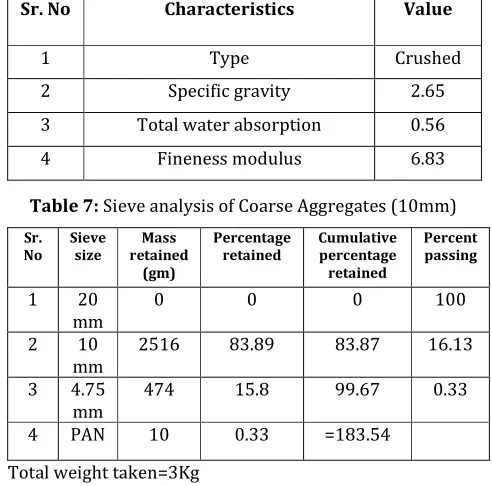
The material which is retained on IS sieve no. 4.75 is termed as a coarse aggregate. The crushed stone is generally used as a coarse aggregate. The nature of work decides the maximum size of the coarse aggregate. Locally available coarse aggregate having the maximum size of 10mm was used in our work. The aggregates were washed to remove dust and dirt and were dried to surface dry condition. The aggregates were tested as per IS: 383-1970.The results of
various tests conducted on coarse aggregate are given in table 6 and table 7 shows the sieve analysis results.
Table 6: Physical properties of Coarse Aggregates (10mm)
Sr. No Characteristics Value
1 Type Crushed
2 Specific gravity 2.65
3 Total water absorption 0.56
4 Fineness modulus 6.83
Table 7: Sieve analysis of Coarse Aggregates (10mm)
Sr. No
Sieve size
Mass retained
(gm)
Percentage retained
Cumulative percentage retained
Percent passing
1 20 mm
0 0 0 100
2 10 mm
2516 83.89 83.87 16.13
3 4.75 mm
474 15.8 99.67 0.33
4 PAN 10 0.33 =183.54
Total weight taken=3Kg
FM of 10 mm Coarse aggregate= [183.54 + 500] / 100=6.83
3.6 Admixture
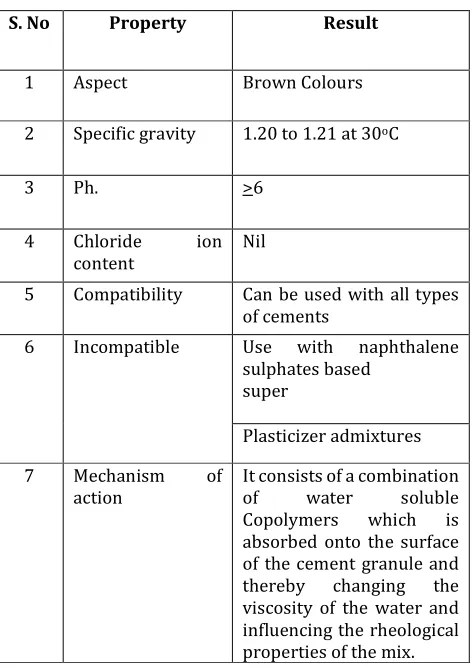
Conplast SP430 complies with IS: 9103:1979 and BS: 5075 Part 3 and ASTM-C-494 as a high range water reducing admixture. Conplast SP430 is based on sulphated naphthalene polymers and is supplied as brown liquid instantly dispersible in water and specially formulated to give high water reduction up to 25% without loss of workability, specific gravity 1.22 to 1.225 at 30oC.
Description Conplast SP430 (NEI) is supplied as a brown
liquid instantly dispersible in water. The properties are listed in table 3.10. Conplast SP430 (NEI) has been specially formulated to give high water reductions up to 25% without loss of workability or to produce high quality concrete of reduced permeability types of OPC and cement replacement materials such as PFA, GGBFS, Fly ash &Brick dust and micro silica.
Workability: can be used to produce flowing concrete that
requires no compaction. Some minor adjustments may be required to produce high workable mix without segregation.
Cohesion: Cohesion is improved due to dispersion of
cement particles thus minimizing segregation and improving surface finish.
Compressive strength: Conplast SP430 (NEI) is primarily
Available at www.ijsred.com
substantial water reduction resulting in a considerable increase in compressive strength.
Table 8: Admixture properties
S. No Property Result
1 Aspect Brown Colours
2 Specific gravity 1.20 to 1.21 at 30oC
3 Ph. >6
4 Chloride ion content
Nil
5 Compatibility Can be used with all types of cements
6 Incompatible Use with naphthalene sulphates based
super
Plasticizer admixtures
7 Mechanism of action
It consists of a combination of water soluble Copolymers which is absorbed onto the surface of the cement granule and thereby changing the viscosity of the water and influencing the rheological properties of the mix.
4. Mix Proportioning/Design mix for SCC
4.1Stipulations for proportioning
Grade designation: M-40 (Flow able concrete)
Type of cement: ULTRATECH OPC-53 conforming to IS 12269
Maximum nominal size of aggregate: 20 mm Minimum cement content: 320 kg/m3 Maximum water cement ratio: 0.40
Workability: flow able (after 60 min flow 650 mm) Exposure condition: severe (for congested reinforced concrete)
Method of concrete placing: pumping Degree of supervision: very good
Type of aggregate: crushed angular aggregate Characteristics flexural strength: 40 MPa Chemical admixture type: super plasticizer
4.2 Test data for materials
Cement used: ULTRATECH OPC-53 conforming to IS 12269 Specific gravity of cement: 3.15
Chemical admixture: super plasticizer conforming to IS 9103 Specific gravity
Coarse aggregate: 2.65
Fine aggregate: 2.62
4.3 Water absorption
Coarse aggregate: 1) 20 mm -0.42% (limit maximum 2%) 2) 10 mm -0.44% (limit maximum 2%)
Fine aggregate: 1.32% (limit maximum 2%)
Free surface moisture coarse aggregate: NIL, fine aggregate: NIL
Sieve analysis coarse aggregate: NIL
4.5 Target mean strength for mix proportioning
Where FCK=40 NN/mm2
Ft: Target avg. compressive strength at 28 days Ft =FCK +1.65S
=40+1.65*5 =48.25 MPa
4.6 Calculation of cement content
Select total cement content: 440 kg Cement content: 440 (approx.) Selection of water cement ratio Adopting W/C ratio=0.40
4.7 Mix calculations
Volume of concrete=m3
Volume of cement = (mass of cement/Sp. Gravity of cement) x (1/1000)
= (440.0/3.15) x (1/1000) =0.140 m3
Volume of water = (mass of water /Sp. Gravity of water) x (1/1000)
= (176/1) x (1/1000) = 0.176 m3
4.8 Volume of chemical admixture
Super plasticizer @ 1.25% percent by mass of cement = (mass of admixture /Sp. gravity of admixture) x (1/1000) = (5.5/1.1) x (1/1000) =0.005 m3
Volume of all in aggregate=1-(0.14 +.176+0.005) E=0.679
Mass of aggregate (CA) = e x volume of aggregate x specific gravity of coarse aggregate x 1000
= 0.679 x 0.40 x 2.65 x 1000 = 719.14 kg= 720kg
Mass of FA= e x volume of fine aggregate x specific gravity of fine aggregate x 1000
=0.679 x .6 x 2.62 x 1000 =1067 kg
5. CONCLUSION
©IJSRED: All Rights are Reserved Page 562 strength and compressive strengths are higher than those of
normal vibrated concrete.
• The properties such as slump flow, V-funnel flow
times, L-box, U-box. In terms of slump flow, all SCC’s exhibit satisfactory slump flows in the range of 590-740 mm, which is an indication of a good deformability.
• The compressive strength increased with an
increase in the percentage of fly ash & brick dust. An increase of about 37% strength at 7 days, 15% strength at 28 days and 8% at 56 days was observed with the increase of fly ash & brick dust content from 5% (SCC MIX 1) to 12% (SSC MIX 4).
• It was observed that the percentage increase in the
compressive stren2gth was more predominant at early ages.
• The strength was increased at later ages also but
not so quickly because the pozzolanic reaction of the fly ash is faster at early ages and the brick dust acts as a filler also along with pozzolanic activity against the fine aggregate which acts as a filler product only.
• The split tensile strengths of SCC after 7 days are
comparable to those obtained after 28 days for NC. This was possible because of the use of fly ash & brick dust as fine aggregate replacement, which usually tend to increase the early strength of concrete.
• The flexural strength was found to increase for all
mixes at all days in comparison to control mix.
REFERENCES
[1] Şahmaran, M., Christianto, H. A., & Yaman, İ. Ö. (2006). The effect of chemical admixtures and mineral additives on the properties of self-compacting mortars. Cement and concrete composites, 28(5), 432-440.
[2] Subaşı, S., Öztürk, H., & Emiroğlu, M. (2017). Utilizing of waste ceramic powders as filler material in self-consolidating concrete. Construction and Building Materials, 149, 567-574.
[3] Al Saffar, D. M., & Tayeh, B. A. (2018). Influence of Pottery Clay in Cement Mortar and Concrete Mixture: A Review. International Journal of Engineering & Technology, 7(4.20), 67-71.
[4] Ibrahim, M. W., Hamzah, A. F., Jamaluddin, N., Ramadhansyah, P. J., & Fadzil, A. M. (2015). Split tensile strength on self-compacting concrete containing coal bottom ash. Procardia-Social and Behavioral Sciences, 195, 2280-2289.
[5] Felekoglu, B. (2008). A comparative study on the performance of sands rich and poor in fines in self-compacting concrete. Construction and building materials vol: 22, pp. 646-654.
[6] Khatib, J.M. (2008). Performance of self-compacting concrete containing fly ash, constructions and building material vol: 22, pp. 1963-1971.
[7] Krieg, W. (2003). Self-compacting concrete: Definition, development, and applications, a technical paper presented in the meeting of the ACI, Saudi Arabia chapter, eastern province, October.
[8] Liu, M. (2010), self-compacting concrete with different levels of pulverized fuel ash, construction and building materials vol: 24, pp.1245-1252.