Jordan Ahli Bank's Commitment to Applying the Concept of
Strategic Management" Field Study
AMAL YASIN AL-MAJALI
Member of the faculty rank of participant professor Balqa Applied University
Email: [email protected]
HEBA JUBRAN SALEH SUNNA'A
Class Instructor UCMAS JordanEmail: [email protected]
Abstract
This study aimed to identify the extent to which Jordan Ahli Bank applied the concept of strategic management. In order to achieve the objectives of the study, the researchers maintained, developed and designed a questionnaire distributed to deliberate sample consist of (44) persons, then collected data analyzed using Statistical Package of Social Science SPSS 12. Many important results was reached by this study, the most notably are the following: 1. The majority of NCB staff has sufficient knowledge about the concept of strategic management. 2. The National Bank in Jordan took serious practices for strategic governance. The study recommends to continually follow the approach taken in Jordan Ahli Bank in the use and application of strategic management in the scientific sense.
Key Words: Strategic management, Banking sector in Jordan and Jordan Ahli Bank.
Introduction
The organization is part of its environment which affects it and affected by it. Organizations practice regardless of their sizes, types and geographical locations two types of activities: administrative, and technical or functional activities to achieve the purpose for which it was created. Organizations ability to achieve their objectives is determined by how they interact and respond to various environmental changes and developments in the local, regional and global market, making the organizations functions not easy task under changing environments. Their stay and remain on the market no longer depends on luck or chance it now depends mainly on the management methods of the organization.
The successful organizations are organizations using strategic management method which enables the Organization to adapt to the surrounding environment in line with its means to achieve its goals at the lowest cost, strategic management resort to administrative creative ,creativity solutions and improve the quality of decision-making where, strategic management helps organizations to develop goals and clarify directions for the future of the Organization to all employees, and also helps to assist in the allocation of resources and the creation of the senior leadership and skills development. The banking institutions intact as if other organizations have seen changes due to intense competition and technological development and changes in the economic environment and politics.
The banking business in Jordan has many developments as a result of the a policy of economic openness , the application of World Trade Organization, free trade agreements and at the same time there is legislation giving banks flexibility in application of the system of the Bank. On the other hand there are challenges facing the banking sector stem from globalization and developments in the local market and the creation of multiple targets financial institutions, increased competition , the emergence of financial innovations, new financial tools, working technology and prosperity so that, the banking institutions that operate under the
changed environment and work to satisfy their customers to be able to compete and adapted the surrounding environment and it will not be able to achieve this only if it pursued the strategic goal of governance, cost management, creating value for customers and profits.
Importance of the Study
The importance of this study lies in:
1. Upon the importance of the application of the concept of strategic management as a contemporary scientific concept in organizations that help organizations determine the capacity of the Organization and allocation of resources, greater efficiency and effectiveness, creating a high degree of integration and coordination between the administrative levels and harmonizing the Organization's internal environment and external environment in order to achieve its objectives.
2. The National Bank as the Bank seeks to continually improve its performance in order to survive and compete to provide the best service to the customers thus, became necessary for the NCB to apply the concept of strategic management.
3. The importance of the banking sector in Jordan and its impact on Jordan's economy hence this study come to demonstrate the extent of the application of Jordan Ahli Bank governance strategy.
The Study Objectives
Provide a theoretical framework illustrates the concept of strategic management and its components and the necessity of its application in Jordan Ahli Bank.
Diagnosis of the actual practice of strategic management in Jordan Ahli Bank Determine the phase of the NCB in the evolution of strategic thought.
To reach a series of proposals and recommendations that will improve the performance of Jordan Ahli Bank
Problem Statement
In the world today as a result of the rapid changes and rapid technological developments, market opening and strong competition, organizations and institutions have to be managed with meaningful management style and be able to move beyond the current reality and the environment surrounding organizations which characterized by continues changes in order to achieve the goals and tasks for which it was created, this method is the so-called strategic management.
This study shall mainly focus on and highlighting the commitment of the National Bank in Jordan in the application of strategic management and its modern management thought.
The problem of this study limits to the following questions:
1. Do the circumstances surrounding the NCB requiring use of strategic governance.
2. Do the National Ahli Bank’s managers have a good knowledge about the concept of strategic management and its components?
3. Does the National Ahli Bank in Jordan practice serious governance practices strategy.
Research Hypotheses
1. There are no significant differences in the level indication (α ≤ 0.05) with most of the Jordanian Bank staff know about the concept and components of strategic management.
2. There are no significant differences in the level indication (α ≤ 0.05) between the circumstances of the NCB and the circumstances surrounding the business organizations that call for the use of strategic governance of scientific concept.
3. There are no significant differences in the level indication (α ≤ 0.05) of how to develop strategic pillars applicable to National Bank and how to develop strategic pillars applicable scientific concept. The following hypothesis arises
3/1-There are no significant differences in the level indication (α ≤ 0.05) between both message properties of Ahli Bank and a good message
properties as a scientific concept to be applied.
3/2-There are no significant differences in the level indication (α ≤ 0.05) between the characteristics of the strategic objectives of the National Bank and the characteristics of good strategic objectives as the scientific concept to be applied.
4. There are no significant differences in the level indication (α ≤ 0.05) between how to analyze the internal and external environment in the Bank and how to analyze the environment as a scientific concept to be applied. The following hypothesis arises
4/1- There are no significant differences at the level indication (α ≤ 0.05) between how the external environment analysis applied to the Bank and how to analyze the external environment scientific concept to be applied.
4/2-There are no significant differences in the level indication (α ≤ 0.05) between how to analyze the internal environment applied in the Bank and how to analyze the internal environment as a scientific concept to be applied.
5. There are no significant differences in the level indication (α ≤ 0.05) between how to choose the strategies applied in the Bank and how to choose strategies with scientific concept to be applied. The following hypothesis arises
5/1-There are no significant differences in the level indication (α ≤ 0.05) -how to choose the organizational strategies applied in the Bank and how to choose strategies at the organizational level with the scientific concept to be applied.
5/2-There are no significant differences in the level indication (α ≤ 0.05) between how to choose the strategies at the functional level applied in the Bank and how to choose functional level strategies with scientific concept to be applied.
6. There are no significant differences in the level indication (α ≤ 0.05) requirements for design strategies in the National Bank and the requirements of the effective design of the scientific concept and strategies required
7. There are no significant differences in the level indication (α ≤ 0.05) between the process of implementing the strategies in the Ahli National Bank and the implementation of strategies with scientific concept to be applied and fertilizing the following premises.
7/1-There are no significant differences in the level indication (α ≤ 0.05) between the process of implementing the strategies applied in Ahli National Bank and implementation of corporate strategies with scientific concept to be applied.
7/2-There are no significant differences in the level indication (α ≤ 0.05) between the functional level strategies applied in the Ahli National Bank and the implementation of strategies on a functional level the scientific concept to be applied.
8. There are no significant differences in the level indication (α ≤ 0.05) between the process control strategies of Ahli Bank and process control strategies with scientific concept to be applied. The following hypothesis arises:
8/1-There are no significant differences in the level indication (α ≤ 0.05) between the control of organizational strategies applied in the NCB and process control strategies at corporate level the scientific concept to be applied.
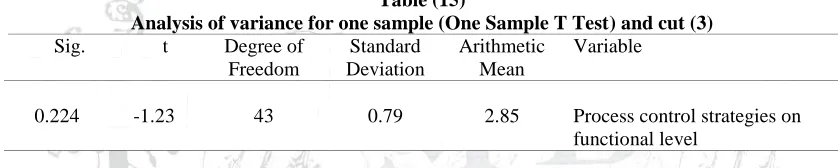
8/2-There are no significant differences in the level indication (α ≤ 0.05) between the control functional level strategies applied in the National Bank and the control strategies on a functional level the scientific concept to be applied.
9. There are no significant differences in the level indication (α ≤ 0.05) among managers’ opinion of adapting strategic management approach as a scientific concept in the researched organizations and the expected results of this scientific concept.
Literature Review and Previous Studies
Strategic Management Concept
Access to one definition and agreed on the meaning of strategic management is elusive, as the case in almost all other social sciences in General and in management in particular, the literatures have many definitions of strategic management according to different visions of management scholar including
Alfred Chandler (Chandler, 1962) defined strategic management “ determine the main purposes and long term objectives, prepare a number of alternatives and allocate the necessary resources to implement those goals” while Gleick said (Glueck, 1980, p.6) “group of behaviors and decisions that create effective strategies to achieve the goals of the organization” (Abu Guhuf, 1991, p: 336) see the strategic management as “a continuum of decisions and actions that lead to the development and creation of an effective strategy or objectives of the Organization” defined by (Hannagan, 1995, p:116) “action plan enables the Organization to move from a situation where it now to a self-development mechanism in future” where (peaceful, 1995, p:131) define strategic management as “ management style in an attempt to maximize the distinct who look to the organization in its entirety as overall look to Excel in the market Centre Strong competitive and occupied a competitive advantage” From the point of view of Khalil (Khalil, 1995, p: 40) “group of decisions and actions for the configuration and implementation of strategies for the achievement of the goals of the Organization” while Maher (Maher, 1996, p: 20) "style move to counter environmental threats or opportunities, which takes into account the internal strengths and weaknesses of the project, in order to achieve the organization’s mission and objectives”, while defined by Ghurab (Ghurab, 1997, p: 25)" in the strategic management the key decisions that have intrinsic effect on the organization’s future, the process of making those kind of decisions – usually called– strategic management " defined (Thompson and Strickland, 2003) “it is a process that includes determining the long-term direction for the Organization and development of strategies for achieving “, (Pearce and Robinson, 2007) “It's the set of decisions and activities related to the formulation and implementation of the strategy for achieving the objectives of the Organization, and this process includes planning, orienting, organizing and controlling decisions and activities related to the Organization's strategy".
Also Al-Thaher defined it (Al-Thaher , 2009) strategic management "as a future vision in the long term, and this perception makes it imperative for the Organization to design its mission, define its goals and objectives and the tools to achieve these objectives, and identify the image that will deal with the internal and external environment to identify strengths and weaknesses and the opportunities and challenges surrounding it, so you can make important and strategic decisions affecting the long term, review and evaluation of those decisions ".
Finally, Al-Gatameen defined it (Al-Gatameen, 2010) as "a set of important decisions derived from highly regulated management process for decision-making at the highest levels of management in the organization".
The researchers find that there are a large number of definitions concerning strategic management but these definitions coincide in one form or another that strategic management is:
_ A dynamic/flexible plan or strategic movements by the organization or pattern of decisions and acts necessary for the accomplishment of the end or purpose (goals, objectives, message facility).
_ Response or initiative by the organization to adjust its competitive position against behaviors and reactions of competitors to reach a better future.
_ Adjustment, harmonizing, or balance or acclimated for the exploitation of the resources of the organization (capacity and potential) in the face of external environment (opportunities and threats).
The importance of Strategic Management
Highlighting the importance of strategic management in the following points (Abawy, 2006):
Develop the ability of managers to think creatively (strategic) and make them more aware of the response to the variables.
Grant the organization access to certain and continuous competitive advantage where the 1990s (twentieth century) and later the competition increased among business organizations, economic (globalization) has changed apparently the limits of competition through constantly emergence of new competitors, and increase competition in various fields.
Determine the main characteristics that distinguish the organization from its other competitors. The allocation of available resources for alternative uses and increase efficiency and effectiveness. Create a high degree of integration and coordination of the regulatory environment include the participation of all levels of management.
Accurately predict the outcome of strategic behavior and estimation of future opportunities. Also, there are a number of benefits to organizations of because of its interest in strategic management, including a clear future vision and strategic decision-making, long-term environmental interaction, and achieve satisfactory economic and financial results, as well as increasing the chances of the ability to bring about change for the better.
The Objective of Strategic Management
The strategic management aims to exceed its competitors and increase the value of the Organization from the point view of customers, shareholders and society as a whole, for this purpose, it seeks to achieve the following objectives (Awath, 1999):
Organize itself (Organization) internally with the adjustments in the organizational structure, procedures, rules and regulations and the workforce to increase its ability to deal with the external environment efficiently and effectively.
Take an important and influential decisions to increase market share and increase client satisfaction and maximize the benefits for stakeholders of its existence, whether shareholders or society as a whole or sector.
Identification of priorities and relative importance to develop long-term objectives, annual targets, policies and resource allocation guided by these priorities.
Find the objective criteria to judge the efficiency of the Administration, the Administration fail to increase the value of the organization is a failed administration, whatever its alleged achievements and development within the organization.
Increase the effectiveness and efficiency of the decision-making processes, coordination, control, detect and correct deviations because of the existence of clear standards representing in strategic goals.
Focus on the market and the external environment, as opportunities and threats is the key criterion for the success of organizations.
Collect data about the strengths, weaknesses, opportunities and threats so that the Manager can detect problems early so he could take the lead rather than the decisions of the Director is a reaction to the decisions and strategies of the competitors.
A strategic management system consists of certain steps and procedures that enable its employees feel the importance of the scientific method in dealing with problems.
Encourage the participation of workers through a collective action or team work which, increase the commitment of employees to implement the plans that participated in the discussion and agreed to reduce resistance to change and increases their understanding of the fundamentals of performance evaluation and incentives within the organization.
Facilitate the communication process within the organization where there is a criterion declare the mysterious messages.
Facilitate the coordination process and the prevention of conflict and friction between the departments because of standards and clear objectives used to separate the opposing viewpoints.
The strategic management process model:
Dr. Al-Duri, Zakaria believes that strategic management process includes the following steps: (Al-Duri, 2005).
Formulate the Organization's mission and objectives. Strategic analysis.
Strategy formulation. Strategic selection.
Implementation of the strategy. Strategic correction.
Although the components or functions of the strategic management mentioned in series for ease of illustration however, these nested functions affect each other. The various components of the strategic management process are of great importance from either the intended strategies perspective or emergency strategies perspective. Although emergency strategies arise in the organization without prior planning, but the makers of Organization's strategies must evaluate these emergency strategies and this evaluation entails comparing each emergency strategy with the organization’s mission and objectives, the opportunities and threats in the external environment of the Organization as well as the strengths and weaknesses of the Organization. The object here representing in the appropriateness of the strategy to the needs and capacities of the Organization, managers need to be aware of things associated with emergency operations and be able to think strategically (Bader, 1994).
Determine the Organization's Mission:
The mission is a sentence or several sentences contain specific data to the Organization, distinguish it from other organizations, these data differ according to the type of organization but mostly revolves around three main elements:
1. Clearing the strategic vision of the Organization.
2. Statement indicates or refers to the Organization's core values. 3. Statement refers to the driving forces of the organization. (Rifai and Al-Said, 2001).
Identification of strategic objectives
After finishing from selecting the message of the Organization the next step coming is to establish the main objectives of the Organization and its purpose, which is precisely of what must be done if the Organization wants to achieve its mission (Abu Naem, 1993).
Strategic analysis of the environment
The strategic analysis process intended to review both of the external environment in order to identify major opportunities and threats facing the Organization, and the internal environment in order to identify the main strengths and weaknesses of the Organization, this process must be continuous to serve the strategy design (Arif, 2000). Strategic analysis is classified into three levels: Level one: the General external environment factors. Level two: Containing factors of the external environment (an activity). Level three: contains the internal environment factors.
Strategic analysis of the external environment:
The following key steps include:
Selection of main environmental variables.
Selection of main sources of the environmental information. Prediction of main environmental variables.
Evaluation of the available opportunities and threats of the organization (Al-Madi, 2003).
Strategic analysis of the external environment:
Achieving the effectiveness of strategic design required in depth strategic analysis of internal environment which pass through two steps:
Identification of strengths and weaknesses.
Assessment of the strengths and weaknesses of the organization. (Maher, 1996).
Strategic selection:
Strategic selection process means the process that includes the following phases:
1. Composition of the strategic alternatives in light of the analysis of internal and external of the Organization:
The various organizations can use in generating strategic alternatives important and necessary tools bearing in mind that the results must be taken with caution (Al-Madi, 2003), and most important and familiar of these tools are: Business Portfolio Analysis. SWOT matrix: matrix matching the strengths, weaknesses, opportunities and threats S: Strength W: Weakness O: Opportunities T: Threats, and core competencies and portfolio style.
2. Evaluation of strategic alternatives for choosing the appropriate conditions and achieve its objectives (Rifai and Al-Said, 2001).
Strategic implementation:
Implementation of the strategy phase is defined as “a set of activities and events for the development of strategies implemented through operational programs, financial budgets, and procedures”. For the successful implementation of the strategies chosen by the Organization a set of requirements must be provided, the most important: 1. consensus exists between strategy and organizational structure 2. organizational culture suitable for strategy 3. good policies friendlier or supporting to strategy 4-availability of skills required in managers for the implementation of the strategy. 5. provide administrative support systems for the application of strategic management.
(Al-Duri, 2005), (Yassin, 1998).
Strategic Control:
Previous views that control depends on comparing the results with previous standards identified after implementation and corrective actions but this portal is useful in taking strategic control cannot wait until the strategy is applied (this may take five years or more, for example), many changes may occur which may lead to endangering the success of the Organization and on the need to replace the traditional control strategy, so the strategic managers of the organization responsible for answering questions. The following are the assumptions of the basic directions of the Organization correction. Does the Organization moving in the right direction? Is there a need for corrective action?
How would you describe the performance, achieve goals? Are you required to take corrective action?
Strategic management functions :( Al-Selmi, 1995; Abdul Qader, 1992; David, 1999).
There are nine main functions of strategic management can be described as follows:
1. Strategic planning:-is one of the most important functions of strategic management. The Organization's strategy sets out how to enter the competition and to adapt to the surrounding environment. Strategic planning requires an analysis of the management of external and internal environment in order to develop a realistic strategy is sound.
You can define the internal and external environment of the organization as follows:
Internal environment is a group of human and material elements and morale within the organization, which interact to achieve the production to market, and works to accomplish the goals for which it came (Al-Shareef, 1997, p: 15).
The management of the Organization has the ability to control the internal environment. The internal environment represented by cultural and civil level of the organization.
External environment is all surrounded by established institutions and entities affect the work directly or indirectly. The external environment is divided into the General environment management and external environment activity: environment-political, economic and social aspects and competitors, suppliers and unions.
2. Marketing redesign:-this function is vital to the business because the market is first and last motive of its success and failure. The elements of this point are determine the optimum market for the company, the appropriate marketing mix, distinctive marketing of the organization.
3. The production redesign:-the production is associated with more than one item in particular, Marketing. Productive structure includes several activities including: research and development, design and production activities, productive capacities planning activities, production scheduling, and quality and production control.
4. Modify the structure of the workforce:-this requires a change in personnel in the organization commensurate with the change in the internal and external business environment. Restructuring the workforce through several activities, including disposal of surplus staff in certain skills, personnel training and skills development, modify systems dealing with manpower, and adjustment of performance appraisal systems.
5. Organizational design:-this is a comprehensive redesign of project activities to achieve substantial improvements in performance of the project. Redesigning the organizational structure includes: determine and planning activities and events, increase the use of information technology, design the systems of monitoring and evaluation.
6. Re-engineering of the financing structure:-This includes the restructuring of the financial system and planning of funding needs, examine and evaluate sources of finance, investment and rationalization of expenditure.
7. Design and ensure competitive advantage:-it focuses on a comparative advantage, is the essence of administrative work. Competitive advantage arises through the values created by the Department to its clients (Al-Selmi, 1995). Examples of strategies that support the Organization's competitive advantage: a renewed marketing and offers superior to competitors, innovation and technological improvements.
8. Redesign relations with surrounded environment:-this activity includes the identification and establishment of relations with customers, defining relationships with competition, design the relations with government personnel.
9. Confirm the endogenous capacity for r & d and innovation: in order to achieve the function of innovation and creativity to be bound by the following principles: continuous development and competing for staff serving at established, creating a spirit of initiative and foot between workers and strengthen the relationship with academic institutions and research centers.
The benefits of applying strategic management:
The advantage for the Organization and individuals when applying strategic management: (Abawi, 2007) Lead the Organization to perform its functions and responsibilities effectively.
Encourage administrators to look and accept multiple alternatives. Show and explain the future opportunities and threats and risks.
Provide the organization with a comprehensive system of making rather than stepwise decision-making.
Provide the organization with the basics of administrative functions such as how to use sources in an effective way.
Assist the director to make fundamental changes.
Development tendencies, point views, ways of thinking, decision-making and planning process that helps to make sound decisions.
Provide the organization with methods to measure achievement, creativity and motivation; and invent new ways of knowledge.
Levels of strategy and strategic alternatives:
Most researchers and those interested in the field of strategic management agree that there are three levels of strategy and these levels are: (corporate strategy, business unit strategy, and strategic functional level), and is interdependent and interacting among themselves to a large degree in order to ensure the success of the Organization in achieving its strategic goals, review, as follows: (Karim, 2009).
First: Corporate Strategy
These strategies focus on the way in which the organization achieves its mission and strategic objectives. The researchers classified strategies at this level into four main types:
5. Stability strategies.
6. Growth strategies
7. Strategies to shrink.
8. Compound strategies
II: Business Unit Strategy
The primary interest of the business strategy focuses to develop competitive advantage for the Organization and improve the competitive position of products and services offered by the unit in the market or in a specific sector.
The strategic study on the level of the business unit focused efficiently on how competition in the particular industry or specific sector of the market with a view to achieving the maximum possible profitability or competitive advantage, whereas business unit is organizing a special composition to serve a specific market range of interrelated products.
Where (Porter, 1996) ensure that each organization has a comprehensive strategy represents a mixture of objectives used by the business organization and the means to achieve these goals, it also stressed that the strategy is to build harmonization of the activities of the Organization and its environment, in the absence of harmonization, there is a distinct strategy, because the success of the strategy is based on integrating the activities of the Organization and its environment.
III: Functional Strategy
The functional strategy aimed to maximize the Organization's resources and the business unit to maximum, through pooling and coordinating activities and various skills within the career field to improve efficiency and provide support for business strategies and corporate strategy.
Strategic challenges:
The organizations facing several strategic challenges can be met and benefit only if the organization managed by strategic management, these challenges can be reviewed as follows (Awad, 1999).
• Increased rapid changes:
The changes rate of economic, social, political and technological is accelerating and it is what creates the opportunities and threats. developing strategies and deal with the opportunities and threats became as important and vital role in contemporary organizations compared to the importance of strategies in organizations that had been working on a more stable and consistent environment.
• Intensification of competition:
Competition between organizations is no longer limited to price and product quality, just as in the past, but many found the competition to cover all activities of the organization. It became necessary to track customer needs and competitors strategies so as to develop strategies to counter the strategies of competitors. What intensifying competition is the trend towards globalization the expansion of worldwide competition and the entry of giant corporations that conceder the potential market is part of the world. • Resource scarcity:
The struggle over energy resources, water and intellectual persons, became the era attribute, where as the company obliged to develop strategies that ensure the provision of resources to the extent necessary in specifications and on time. By the end of the era of abundance for many inputs and scarcity is the dominant feature governing the availability of resources.
• Caring for the environment:
The growing interest in environmental protection, stronger environmental protection groups and increasing their impact and their ability to influence organizations and political decision makers. Organizations are no longer able to challenge or ignore environmental laws but must develop strategies that guarantee not to raise these powerful groups representing the often significant threats to organizations.
• The changing structure of employment:
No longer working-based organizations adept can only do simple repeated works which are easy to train and move to another, as was the employment structure in the era of continuous production line where success was dependent on stereotypes and achieve economies of scale. The success of modern organizations depends on availability of experts with specialized knowledge in the production, marketing, finance and who have the knowledge and expertise that can contribute to the development of efficient and effective strategies to increase customer satisfaction of the Organization's products and services.
• Increased strategic importance:
It is clear that the success of modern organizations is the product of innovative strategies formulated by strategic persons at a high level of competence, organizations paying to them millions of dollars for their strategies only, their work is only strategic management of the Organization to win against competitors, increase customer satisfaction, and their rivalry has become serious because it became necessary to face global competition.
The Jordanian banking sector:
Jordan's banking sector has seen significant change over the past decade the quantitative and qualitative level, institutional and legislation and regulations and monetary policy, and as a result of those policies have several positive effects on the banking sector, including increased competition, lower case of concentration and diversification of services, and increased profits and lower doubtful debts.
The banking industry has made great strides in Jordan has seen rapid expansion over the years, which structural reforms that paved the way in the financial and banking system for commercial banks to play a greater role in the national economy and the strong performance of banks and a wide stage completed development, worked to prepare for domestic and foreign competition and come a long way in the field of modern banking technology and worked to expand and modernize services, financial and banking products to meet the diverse needs of customers.
During the past decades, Jordan has succeeded in creating an conducive environment to the work of the banks, creating appropriate legislation and adopt economic and fiscal policies and sound monetary, allowed such legislation and economic policies by creating multiple forms of banks in the Kingdom, including commercial banks, investment banks and specialized financial institutions for financing economic activity in both the productive and service sectors, the most important characteristic of the Jordanian banking system is that it is owned and managed by the private sector since its inception. There are a number of non-bank financial institutions check along with non-banking financial institutions draw features integrated financial and banking system in the Kingdom, and created a positive step on the road to maintain the safety and support of the methodology of banking supervision by the Central Bank of Jordan, is a guarantee of deposits and loans guarantee and exports credit and refinancing of housing loans.
Financial Performance
Despite the global financial crisis and political turmoil in the region, Jordanian banks were able to achieve positive results and play a vital role in pushing economic growth through mobilization of national savings and channeling them towards funding projects and diverse economic sectors, due to prudent policy of the Central Bank of Jordan, and Jordan's banking sector registered unprecedented development in terms of quantity and quality, since 2004, recording an average growth rate of the performance of banking in Saudi Arabia about 11.5 percent annually. The size and shape of banks (assets) average of about 165 percent to 175 percent of gross domestic product, annual rate coincided with the growth of the national economy are real and powerful in recent years. The consolidated budget of the Jordanian banks at the end of the first third of the year.
Assets
The banking sector, indicators showed the high value of the assets of the licensed banks operating in Jordan at the end of the first third of the year 2012 to about 38.2 billion Jordanian dinar and the growth of 1.4 percent from the end of last year, 2011, and the value of the assets of the banks in the Kingdom about 170 percent of GDP estimated according to current market prices for the year 2012 versus 175 percent for 2011.
Total assets included about 17.3 percent of assets in foreign currencies amounted to 6.6 billion dinars equal to 9,519 million, with assets in local currency to 31.6 billion debt and are accounted for 82.7 percent of the total.
The Central Bank said in its annual report that the budget for licensed banks at the end of 2011 rose by about 2.7 billion dinars, and grew about 7.8 percent from the registrar at the end of the previous year (2010) and reached the level of 37.7 billion dinars compared to the high reached three billion and a growth rate of 9.4 percent and about 2.2 billion dinars and the growth of 7.3 percent in 2010 and 2009, respectively
Loans and facilities
According to statistical data of the Central Bank, has increased the pace of growth in the movement of funds available to banks in Jordan through lending operations and banking facilities provided to all sectors of economic and trade activities in the Kingdom for up to about 68 percent of the total volume of liquidity available to them compared to the 64 percent at the end of 2010, and existing stocks rose credit facilities at the end of April of the year 2012 to reach about 16.8 billion dinars, an increase of 5.8 percent from the end of the year and 4 percent from the levels recorded at the end of 2010, and the balances of deposits at banks the most important primary source of funding for investment banks and funds have accounted for the money around 68 percent of the total amount of money available to banks, these levels are high compared with banking systems in many countries of the world, and these investments to achieve appropriate levels of profitability for banks, in addition to its critical role in driving economic growth in the Kingdom.
The structure of the banking sector
The Central Bank report said that licensed banks in the Kingdom expanded significantly during the year 2011
Through the expansion of banking services to cover all regions and governorates of the Kingdom and its banking activity increased by expanding the opening of new branches in various parts of the Kingdom, with the number of major banks operating in the Kingdom to (26) a major subsidiary banks (695) branches and around (75) representative offices, and included the major banks operating in the Kingdom (16) Jordanian banks licensed in the Kingdom (3) Islamic banks, (10) branches of foreign banks operating in Jordan, and that the index number of the population in the total number of bank branches in Jordan reached average (8.1) million for each branch of the bank branches until the end of 2011 and is a good indicator in comparison with international standards, as for the Jordanian bank branches outside the Kingdom (165) and (8) branch offices and (2) offshore unit (79) a Jordanian bank branches and branch offices (96) and (17) representative offices operate in various Palestinian areas, according to the statistics of the year 2011. Source: www.uabonline.org/magazine/magazine-article.php?pageid= 5 & issueid = 109 & Αid = 2,305
The concept of commercial banks:
The definition of commercial banks differs according to the method used by researchers and the perception of the functions performed by those banks, so varied a tariff that it is difficult to limit the definition of a commercial bank, but the evolution of the financial institutions in the communities and the emergence of new ones has clearly the concept of the Bank and makes it easy to identify the key features of its work and thus commercial banks can be defined as the Central Bank of Jordan from those attributes as “the banks that accept banking deposits, loans and discount cards Business or collection and open documentary credits, and may exercise such other actions non-bank, banks such as: participation in economic projects, buying and selling stocks and bonds.
Ghoneim has defined it (Ghoneim, 2006) as: banks that accept deposits payable on request or specific term, and practiced internal and external finance and service, in order to achieve the objectives of the development plan and to support the national economy, and savings operations, development and financial investment at home and abroad, including contributing to the completion of projects and required of banking operations.
But (Budeiri, 2003) believes it's non-profit facilities so as to contribute to the development of the national economy, commercial banks activity associated with the handling of funds in cash.
Types of banks:
Banks are divided into two types are commercial banks and non-banks: (Ghneim, 2006)
1. Commercial banks: banks that are routinely accepted deposits, payable at the request of the owners or after no more than a year, and granted loans for relatively short periods of less than one year and often for financing trade and hence the label and that the scope of financing of these banks has been extended to other industrial and economic sectors, which range from commercial banks to:
A. Banks with branches: these banks known as general commercial banks, which take the form of stock holder companies and introduce banking services through branches throughout the country and is managed by the decentralized approach where each branch manages its own affairs and not return to main centre only if necessary.
B. Local banks: only operate in a specific geographical area may be a city, village or County and are characterized by their small size.
C. Individual banks: small banks are owned by individuals or companies who are also small, and limited hiring resources on critical liquidity assets such as securities and commercial
D. Banks groups: similar to holding companies, set up several banks and own most of the capital and are supervised, and watching it. This kind group attributed of monopolistic nature.
E. Financial strings: operates by opening a series of sections be separated administratively. 2. Non-commercial banks are varied:
A. Specialized banks: banks are non-commercial and financial organizations engaged in banking operations that serve a specific type of economic activity in accordance with the decisions and activities of these banks need funding and particular expertise and knowledge of the nature of agricultural activity and industrial real estate.
B. Real estate: banks that specialize in financing real estate investments.
C. Agricultural banks: they specialize in financing agriculture and agricultural investment.
D. Business and investment banks: banks play an important role in trade financing of economic projects to follow up and monitor the implementation of projects, as well as operations related to the compilation and development of savings for investment in economic development plans, and all its operations mainly for trying to configure or renewal of fixed capital (factories, real estate, land suitable for agriculture. Etc.).
E. Islamic banks are financial institutions not dealing with interest bearing or tender and have special banking concept is accept deposits and investment deposits in accordance with the principle of participation in profit and not fixed rate select preset "and financing others under the principle of participation in profit" and not by a predetermined fixed rate or under other types of profitablization and speculating financing "and is specializing in trade finance or finance a specific activity of legal entity and possible to finance trade, agriculture and industry and properties for any duration according to their benefits structure.
Functions of commercial banks:
Commercial banks are credit institutions dealing with short-term credit and receive current deposits mostly, but commercial bank in order to bring the greatest possible economic operators, whether individuals or institutions providing a lot of services to respond to their needs. Dealers are looking for a reliable and safe to deposit their money keep them and use them when needed and are looking for a source they can meet their commitments and provide them with the financial resources to ensure their needs. The functions of commercial banks has grown by evolution Communities and economic need, divided into two parts (Hussein, 2000):
1. Traditional jobs: so named for the synchronized with the historical development of the Bank's work: A. Loans: this is the first investment and President job for commercial banks, where the different loans to customers with it despite a historic preference for short-term loans.
B. Accept deposits of different types: deposit form the bulk of the sources of funds available to commercial banks or approximately 75% of these banks, and commercial banks in Jordan are deposits of 22.2 billion Jordanian dinars in late October 2010. (Association of banks in Jordan, 2010).
2. Post modern: it was named so because of the precession of the emergence of traditional functions and also because of the different post and change with economic developments and communities created by different legislative environment which helped to appear or suppression, modern services group can be summarized as follows:
A. Asset rental activity.
B. Foreign currency investment. C. Issuance of securities
D. Management of the customer's account investments. E. Financial advice for Its customers.
F. Other secondary bank services.
It also aims to follow the principles of commercial banks to gain the confidence of its customers and developing and enhancing their dealings with these principles as follows (Ghneim, 2006).
1. Confidentiality: the work and customer transactions with banks and whatever these types of secrets for those customers to achieve absolute confidence between the banks and their customers, it is fully committed to the non-disclosure of any business secrets and these customers, but it should be the exception of the common good which endears individual interests with the Bank may be given data about the client if requested public control establishment in the State.
2. Good treatment: this is the basis on which the customer pays and gets to deal with the same bank as long as the services offered by all banks and convergent, to this end, the Bank always strives to intensive care in selecting personnel so that all properties and attributes them to carry out their work efficiently and effectively, and perhaps the most important of good manners, and the frankness of opinion of the client, and intelligence, and power of observation , And personal power, and civility, and tact when dealing and smiley that endeared the customers.
3. Speed: hurry customers naturally work with each client to leave the Bank as soon as possible after having received the services they want and therefore must seek all bank employees on the application of the principle of speed in performance so as not to fail to meet the demands of customers and serve them with due speed and with no wasted time those customers.
4. Comfort: in this regard, the banks are working to equip the appropriate places to greet customers for wait time, so provide them psychological atmosphere comfortable by providing a comfortable seating area and run the air conditioner as well as cleanliness and attention to the decorations and ornaments used in coating walls, which endears the bank customer and have a good reputation in their minds.
5. Geographical spread: banks seek to expand its activity through creates its units in the various geographical area hopes that activity covered by.
About Jordan Ahli Bank:
Jordan Ahli Bank is a leading Jordanian institution, with deep national history and heritage. It was founded in Amman in 1955, the National Ahli Bank is the first Bank of Jordanian origin. The first capital was when created: 350,000 dinars. Today, the Bank's regional presence in Lebanon, Palestine, Cyprus, and 19% share in JIB London). Jordan Ahli Bank has a leading role in the service of the people and the national economy as a whole. It is not just a financial institution but a non-profit organization designed to raise awareness among Jordanian citizens savings because savings culture remains weak. Jordan Ahli Bank was one of the first financial institutions in Jordan but is the first Jordanian Bank origin and since more than 50 years is still Jordan Ahli Bank serves individuals and corporations in the national economy with a series of other banks
Jordan Ahli Bank targets
Shareholders: the highest returns.
Staff and management: a stable and productive career, and rewards. Customers: new banking products, premium service and moderate prices.
Community: active participation in the economic, social and cultural development. Organizers: trustworthiness, honesty, and correspondence with Paz
Jordan Ahli Bank Mission
First phase: one of the largest financial groups in Jordan and most profitable. "More than just a bank" Phase 2: leadership recognized financial institution in the Middle East. "More than just a Jordanian institution"
Third stage: a major banking player in the world. "More than just Middle East Foundation.
The Bank's branch network
Within the framework of its strategy of expansion both geographically and to strengthen the network of its branches in vital areas in the Kingdom, the Jordan National Bank has a broad geographical spread throughout the Kingdom, with a network of 51 branches in Jordan and 9 branches in Lebanon and in Palestine and one branch in Cyprus, in addition, Jordan Ahli Bank has a wide network of offices in many other countries.
The Jordan National Bank owns along with its branch network in the Kingdom, a number of offices for the reception of clients and meet their needs. The Bank offers a variety of services and solutions and offers innovative and specialized banking as banking services for large corporations, small and medium-sized companies, and investment services, personal banking, private banking, insurance, leasing, and other services designed to harmonize the needs of the various sectors and segments.
Source: www.ahli.com/arabic/jordan_ahli_bank.shtml
Previous studies: Arabic studies:
Study of (Majali, 2012) entitled: "The impact of patterns of strategic directions on marketing performance for commercial banks operating in Jordan" this study aimed to identify the impact of strategic directions and marketing performance for commercial banks operating in Jordan, also sought to learn how similar or different commercial banks in strategic directions as well as determining the strategic directions of the Jordanian commercial banks operating in Jordan. The population of the study consisted of upper and middle management positions and the number of the sample was (138).
Study finds several results, most notably, a direct impact of statistical significance for both analytical and reactive orientation on the rate of profitability compared to competitors of banks.
Study of (Ezrigat et al., 2010) entitled: "the impact of cognitive network elements on the technological strategy in the Jordanian pharmaceutical industry organizations," the aim of this study is to identify the following elements of the knowledge network, which represents independent variables (research and development, and database, and intrinsic merit) on strategic technological dimensions, which are the dependent variables of the (creation of new products, processes, continuous improvement of products and processes, and developing markets). The population of the study consisted of all organizations in the pharmaceutical industry and medical material organization for 2006, which are (17) organizations, 10 of which have been selected by simple random sampling method, as an initial preview. Either the secondary sampling unit it represents all respondents in each organization, numbering (185) responsive, represention the population of the study, a simple random sample of size (75) responsive was taken, to be subjected to analysis of variance, multivariate analysis of variance.
The study concluded a positive relationship between cognitive network elements and technological strategy in the Jordanian pharmaceutical industry organizations.
Study (Mia et al., 2007), entitled "strategic management and its impact on business performance: an empirical study on industrial organizations in the Syrian coast”. The aim of this study is to review the concept of strategic management and its components, its application requirements, scientific and practical steps to be followed in the management strategies of business organizations, and find out the differences between them and the steps involved in the management of business organizations of general industrial strategies in the Syrian coast, in addition to knowledge of the results. The study tool was applied to a set of general industrial organizations on the Syrian coast numbered (13).
The results of the study indicated that a very limited number of organizations have information about the concept of strategic management and its components ,they has got this information from the lonely training course they intended, where this information is very limited. The results confirmed the presence of significant evident shortage in how to develop strategic pillars in organizations from how to put the scientific concept it has to be applied also, the results showed that there was a significant decrease in the proportion of compatibility between Characteristics of strategic objectives in the organizations and the good characteristics of the scientific concept which must be met.
Study of (Abu Doleh and Ebedat, 2007), entitled "The reality of strategic human resources management functions in banks of Jordan". This study targeted to explore the reality of strategic human resources management functions in banks in Jordan, through doing the strategic planning process to the bank as a whole, the extent of its strategic planning process for human resources management, the degree of application of different human resources management functions, and the ability of the Bank to link strategic planning and human resources management and the various functions. In addition to studying the most important constraints, which stands in front of Jordanian banks when it is in the process of adopting strategic Outlook for human resources management and various activities.
The population of the study consisted from the managers in the human resources department in banks in Jordan, where (51) questionnaires prepared for this purpose was distributed on a random sample.
One of the main results of this study is ) – majority of Jordanian banks prepared a strategic planning process for the bank as a whole, while a reasonable proportion showed that sectors of Jordanian banks have no documented and written strategic plan of the Bank as a whole. – Jordanian banks made strategic HR planning process and its functions, while half of the sample showed a presence of written and documented plan of human resources management. – study showed that Jordan's banking sector has a medium capacity on the link between human resources management and strategic planning of the Bank as a whole, it also has the ability of relatively medium to link strategic planning with human resources management functions – the study sample accepted moderately on the major obstacles facing the adoption of strategic human resource management.
As the study of (Al hyasat, 2007), entitled "Criteria for measuring the efficiency and effectiveness of the human resources management strategy and its relationship to organizational performance in the Jordanian press institutions from the point of view of managers". This study aimed to identify efficient and effective human resource strategies in the Jordanian press institutions and of human resources planning, recruitment, selection, performance evaluation, training of personnel and its relationship to organizational performance. The study population consisted of Jordan press institutions (21).The study sample selected the Press Foundation institutions that employs 50 or more employees, and published more than one publication, were there four organizations.
The study found the following results-there is a positive relationship between efficient and effective human resources planning strategies in the Jordanian press institutions and institutional performance-there is a positive relationship between the efficiency and the effectiveness of selection and recruitment strategies in the Jordanian press institutions and institutional performance-there is a positive relationship between the efficiency and the effectiveness of strategies to evaluate the performance of employees in institutions and institutional performance of Jordan press-there is a positive relationship between the efficiency and effectiveness of training strategies and institutional performance.
In the study of (Al-Tamimi and alkhshali, 2007) entitled: "The impact of the environmental uncertainty in determining strategic objectives" the study aims to assess the impact of environmental uncertainty (complexity and change) to determine strategic objectives (marketing, human resources, financial resources, material resources, profitability, productivity, and social responsibility) for pharmaceutical companies.
The study was conducted on a sample of 74 managers from different administrative levels, working in these companies. For the purposes of statistical analysis, multiple regression method was used. The following are the main findings of the study:
1. The Jordanian pharmaceutical companies operate in an environment that can be described as moderately feature of environmental uncertainty, and a good degree of interest by those companies which allows it to determine its strategic objectives.
2. Lack of significant effect of environmental complexity in identifying all kinds of strategic objectives in these companies, with the exception of the goals of social responsibility.
3. Significant impact of environmental change on all kinds of strategic objectives of the Jordanian pharmaceutical companies, with the exception of physical resources and goals of profitability and productivity.
And study (alkhshali, 2006) entitled: "The impact of higher management sources power in choosing the growth strategy" this study aimed to identify the effect of senior management power in Jordanian banks in selecting the growth strategy, for this purpose the study had been adopted the following senior management power sources: structural strength, property strength, experience strength. Regarding growth strategies, they have been divided into three strategies: focused growth strategy, diversification growth strategy, and growth strategy through joint ventures.
The study sample was made up of (113) managers working in the highest level of management (senior managers).
The results of the study indicated that the power of senior management relative to property and experience has significant effect in the selection of Jordanian banks for focus growth strategy. As this was not a significant effect relative to strength of structure and stature in selecting such a strategy.
Also, multiple regression results showed a significant effect to three sources of strength: senior management structure, property, and experience, in the selection of Jordanian banks to a diversification growth strategy.
Either, the strength of stature has no significant effect in selecting this strategy, and the results of the study pointed to the significant effect of the three sources of strength: senior management property, experience, and stature (reputation) in selecting banks to a strategy of growth through joint ventures, with no significant effect of structural strength to choose this strategy.
In the light of the results of the study, it assumed some recommendations, notably the need for balanced use of the various types of growth strategies rather than apply a focusing growth strategy only.
Study (Turkman, 2005): "Strategic control and its impact on the effective performance of the organizations" A comparative analytic study of control systems in each of Al- Assad University Hospital and the National Hospital in Al-Lathigia.
The study founded:
9. There is a relationship between the efficiency and the effectiveness of organizations and control system style used.
10. The efficiency and effectiveness of organizations increased when strategic control used.
11. There is a relationship between performance level and type of technology used to measure performance.
12. There is a relationship between the information system used and the effectiveness of control strategy. The study of (Al-khshali and Jawad, 2003) entitled: "The administrative work values by the strategic choice for managers" the aim of this study is to determine the impact of managerial work values on the strategic option. The questionnaire had been distributed to the members of the sample of research numbered (103) managers working in insurance companies in Jordan.
One of the most important findings of this study – the results of the study showed that there is a high conviction for managers in Jordanian companies with administrative work values – shows a positive attitude towards cost strategic and competence strategy– the results of the study did not show the existence of a relationship between personality characteristics and strategic choice.
The study was included number of recommendations focused on the need to link and harmonize administrative work values and the influence of the environmental conditions surrounding the selection of strategic alternative that can strengthen the competitive position of the company and achieve future goals. In the study of (Al Nuaimi, 2002) entitled: "Measurement of strategic risk (SRM) by using strategic nature financial indicators". This study discussed the concept of strategic risk which is one of the important concepts that contribute to successful strategies, support the competitive position of the Bank and achieve future goals.
The aim of the study was to measure strategic risk by using financial indicators and the impact of the risk on the financial performance of Sudanese banks, identifying internal and external environmental variables that influence it.
The study found a negative effect of strategic risk on the financial performance of banks, a good strategic and financial performance is achieved through organizational capabilities and development potential and implementation activities in an efficient and constructive engagement with the external environment, the sight of the financial performance in terms of return and risk revealed a sound vision of the course of the Bank Management action and helps to develop the right decisions on the exercise of the activities (Sayyah, 2001) entitled: "The impact of the power of senior directors management in identifying the strategic goals in Jordanian banks" this study aimed to investigate the effect of the power directors and their reflection on the Organization's strategic choices according to a cumulative prospective done in studying the opinion of (75) directors in the higher departments of commercial banks listed its shares on the financial market in Oman.
The results have proved the reliability of the managers’ power to explain the strategic goals of the Bank. In a study of (Rousan, 1999) entitled: "The impact of the strategic choice in competitive advantage", this study aimed to describe the impact of strategic choice on the competitive advantage in the field of Jordanian pharmaceutical companies, in order to manipulate the problem of weak understanding of the relationship between the strategic channel (choice and feature). The pharmaceutical sector in Jordan was chosen as Jordan's industry competitive interface. The most important results was adopting the strategic option representing in comprehensive leadership of cost and differentiation which cause to achieve competitive advantage and price advantage respectively.
Study of (Othman, 1993): "Strategic planning patterns and its impact on the efficiency and effectiveness of the textile industry". This stud used the concept of strategic planning as an approach to improve the efficiency and effectiveness of the institutions with dropping those concepts on the textile industry and concluded that strategic planning is not at senior management level but also at the functional level.
Foreign Studies:
Study of (Leonard & Rodney, 2002): "The strategic impact and Application of the business - Excellence Model”. Which aimed to define the role of the European model in measuring the performance of strategic and operational management and its relationship to training and management development, the population of the study consisted of (19) European company using the European model in measuring the performance of strategic management and the systems of total quality management. The most important result of this study was the presence of relationship between performance measurement and application of strategic management in operations, in addition to a new change in the organizations because of the focus on measuring performance through training and development.
The study of (Morgan and Strong, 2003) entitled: "Business Performance Dimensions of Strategic Orientation". Aimed to test the relationship between strategic orientation dimensions and performance of the of medium-sized and large industrial enterprises in the technology sector in Britain, the sample consisted of 181 Director working in these companies, the study found that both analytical orientation, and defensive orientation and future orientation is associated with the performance of the study sample with positive relationship.
Study of (Kroeger, 2007):"Firm Performance as a function of Entrepreneurial Orientation and Strategic Planning Practices ".
This study aimed to find the relationship between the Organization's environmental survey, planning and flexible planning and a focused business and organizational performance, also study the impact of the external environment on the performance of the organization. The sample consists of small business owners and managers in the northeast of Ohio in the United States. The study found multiple results, most notably a specific orientation to organizations which has a positive relationship to the performance of the Organization and there is a clear relationship between environmental uncertainties affecting the relationship between the Organization orientation and its performance.
Design and Methodology
Study Methodologies:
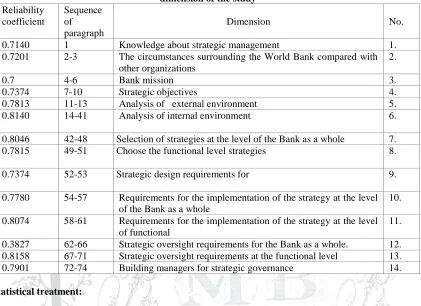
This study was depended the descriptive, field and analytic methodology. From descriptive methodology side research survey was conducted for administrative literature and viewing previous studies in order to build a theoretical framework for the study, as well as tool development. Based on analytical and applied approach which stems from the survey study and comprehensive survey procedures for data collection contained in the questionnaire and analysis of appropriate statistical methods, to answer the study questions and test hypotheses.
Study Population:
The study population consists of (75) persons allocated in the administration building of the National Bank, categorized throughout three categories: the Director, Deputy Director and Heads of Departments.
Sample:
The researchers chose a deliberate sample of the population of the study consisted of (55) personnel assigned randomly from the study population (75) people, the sample size is sufficient according to (Sekaran, 2003) and after the approval of the authorities in the National Bank, the researchers distributed (55) questionnaires, some bank employees refused to cooperate in filling out the questionnaires distributed to them, 50 questionnaires were returned, 6 ones excluded for incomplete information, thus the remaining questionnaires for statistical analysis 44 questionnaire formed 80% of the total number of distributed questionnaires.
Properties Sample
The following table (1) shows the distribution of study sample according to demographic variables: The sample of the study consisted of functional levels in senior management (Director, Deputy Director, head of Department) in the Ahli National Bank, demographic variables included the following: gender, age, qualification, experience and occupational category.
Table (1)
Describe the characteristics of the study sample
Categories of the variable number
percentage
Years of experience Less than 5 years
6 0.14
from 6 – less than 10 4
.09
From 10 – less than 15 17
0.39
More than 15 17
0.39
Job Title Manager
5 0.11
Deputy Director 6
0.14
Head of section 33
0.75