Matrix Completion from Noisy Entries
Raghunandan H. Keshavan [email protected]
Andrea Montanari∗ [email protected]
Sewoong Oh [email protected]
Department of Electrical Engineering Stanford University
Stanford, CA 94304, USA
Editor: Tommi Jaakkola
Abstract
Given a matrix M of low-rank, we consider the problem of reconstructing it from noisy observa-tions of a small, random subset of its entries. The problem arises in a variety of applicaobserva-tions, from collaborative filtering (the ‘Netflix problem’) to structure-from-motion and positioning. We study a low complexity algorithm introduced by Keshavan, Montanari, and Oh (2010), based on a com-bination of spectral techniques and manifold optimization, that we call here OPTSPACE. We prove performance guarantees that are order-optimal in a number of circumstances.
Keywords: matrix completion, low-rank matrices, spectral methods, manifold optimization
1. Introduction
Spectral techniques are an authentic workhorse in machine learning, statistics, numerical analysis, and signal processing. Given a matrix M, its largest singular values—and the associated singular vectors—‘explain’ the most significant correlations in the underlying data source. A low-rank ap-proximation of M can further be used for low-complexity implementations of a number of linear algebra algorithms (Frieze et al., 2004).
In many practical circumstances we have access only to a sparse subset of the entries of an m×n matrix M. It has recently been discovered that, if the matrix M has rank r, and unless it is too ‘structured’, a small random subset of its entries allow to reconstruct it exactly. This result was first proved by Cand`es and Recht (2008) by analyzing a convex relaxation introduced by Fazel (2002). A tighter analysis of the same convex relaxation was carried out by Cand`es and Tao (2009). A number of iterative schemes to solve the convex optimization problem appeared soon thereafter (Cai et al., 2008; Ma et al., 2009; Toh and Yun, 2009).
In an alternative line of work, Keshavan, Montanari, and Oh (2010) attacked the same problem using a combination of spectral techniques and manifold optimization: We will refer to their al-gorithm as OPTSPACE. OPTSPACE is intrinsically of low complexity, the most complex operation being computing r singular values (and the corresponding singular vectors) of a sparse m×n matrix. The performance guarantees proved by Keshavan et al. (2010) are comparable with the information theoretic lower bound: roughly nr max{r,log n}random entries are needed to reconstruct M exactly (here we assume m of order n). A related approach was also developed by Lee and Bresler (2009), although without performance guarantees for matrix completion.
The above results crucially rely on the assumption that M is exactly a rank r matrix. For many applications of interest, this assumption is unrealistic and it is therefore important to investigate their robustness. Can the above approaches be generalized when the underlying data is ‘well ap-proximated’ by a rank r matrix? This question was addressed by Cand`es and Plan (2009) within the convex relaxation approach of Cand`es and Recht (2008). The present paper proves a similar robust-ness result for OPTSPACE. Remarkably the guarantees we obtain are order-optimal in a variety of circumstances, and improve over the analogous results of Cand`es and Plan (2009).
1.1 Model Definition
Let M be an m×n matrix of rank r, that is
M=UΣVT. (1)
where U has dimensions m×r, V has dimensions n×r, andΣis a diagonal r×r matrix. We assume that each entry of M is perturbed, thus producing an ‘approximately’ low-rank matrix N, with
Ni j=Mi j+Zi j,
where the matrix Z will be assumed to be ‘small’ in an appropriate sense.
Out of the m×n entries of N, a subset E⊆[m]×[n]is revealed. We let NE be the m×n matrix that contains the revealed entries of N, and is filled with 0’s in the other positions
Ni jE =
Ni j if(i,j)∈E, 0 otherwise.
Analogously, we let ME and ZE be the m×n matrices that contain the entries of M and Z, re-spectively, in the revealed positions and is filled with 0’s in the other positions. The set E will be uniformly random given its size|E|.
1.2 Algorithm
For the reader’s convenience, we recall the algorithm introduced by Keshavan et al. (2010), which we will analyze here. The basic idea is to minimize the cost function F(X,Y), defined by
F(X,Y) ≡ min
S∈Rr×r
F
(X,Y,S), (2)F
(X,Y,S) ≡ 12(i,
∑
j) ∈E(Ni j−(X SYT)i j)2.
Here X∈Rn×r, Y ∈Rm×rare orthogonal matrices, normalized by XTX=mI, YTY =nI.
OPTSPACE( matrix NE )
1: Trim NE, and letNeE be the output;
2: Compute the rank-r projection ofNeE,Pr(NeE) =X0S0YT 0 ;
3: MinimizeFe(X,Y)through gradient descent, with initial condition(X0,Y0).
We may note here that the rank of the matrix M, if not known, can be reliably estimated from e
NE (Keshavan and Oh, 2009).
The various steps of the above algorithm are defined as follows.
Trimming. We say that a row is ‘over-represented’ if it contains more than 2|E|/m revealed entries (i.e., more than twice the average number of revealed entries per row). Analogously, a column is over-represented if it contains more than 2|E|/n revealed entries. The trimmed matrixNeE is obtained from NE by setting to 0 over-represented rows and columns.
Rank-rprojection. Let
e NE=
min(m,n)
∑
i=1σixiyTi ,
be the singular value decomposition ofNeE, with singular valuesσ1≥σ2≥. . .. We then define
Pr(NeE) =mn
|E| r
∑
i=1σixiyTi .
Apart from an overall normalization,Pr(NeE)is the best rank-r approximation toNeE in Frobenius norm.
Minimization. The modified cost functionF is defined ase
e
F(X,Y) = F(X,Y) +ρG(X,Y)
≡ F(X,Y) +ρ m
∑
i=1G1 k X(i)k2 3µ0r
! +ρ
n
∑
j=1G1 k Y(j)k2
3µ0r !
,
where X(i)denotes the i-th row of X , and Y(j)the j-th row of Y . The function G1:R+→Ris such
that G1(z) =0 if z≤1 and G1(z) =e(z−1)
2
−1 otherwise. Further, we can chooseρ=Θ(|E|). Let us stress that the regularization term is mainly introduced for our proof technique to work (and a broad family of functions G1would work as well). In numerical experiments we did not find any performance loss in settingρ=0.
One important feature of OPTSPACE is that F(X,Y) and Fe(X,Y) are regarded as functions of the r-dimensional subspaces of Rm andRn generated (respectively) by the columns of X and
Y . This interpretation is justified by the fact that F(X,Y) =F(X A,Y B) for any two orthogonal matrices A, B∈Rr×r(the same property holds forF). The set of r dimensional subspaces ofe Rm
is a differentiable Riemannian manifoldG(m,r)(the Grassmann manifold). The gradient descent algorithm is applied to the function F :e M(m,n)≡G(m,r)×G(n,r)→R. For further details on
1.3 Some Notations
The matrix M to be reconstructed takes the form (1) where U ∈Rm×r, V ∈Rn×r. We write U = [u1,u2, . . . ,ur]and V= [v1,v2, . . . ,vr]for the columns of the two factors, withkuik=√m,kvik=√n, and uTi uj=0, vTi vj=0 for i6= j (there is no loss of generality in this, since normalizations can be absorbed by redefiningΣ).
We shall writeΣ=diag(Σ1, . . . ,Σr)withΣ1≥Σ2≥ ··· ≥Σr>0. The maximum and minimum singular values will also be denoted byΣmax=Σ1andΣmin=Σr. Further, the maximum size of an entry of M is Mmax≡maxi j|Mi j|.
Probability is taken with respect to the uniformly random subset E ⊆[m]×[n]given|E|and (eventually) the noise matrix Z. Defineε≡ |E|/√mn. In the case when m=n,εcorresponds to the average number of revealed entries per row or column. Then it is convenient to work with a model in which each entry is revealed independently with probabilityε/√mn. Since, with high probability |E| ∈[ε√αn−A√n log n,ε√αn+A√n log n], any guarantee on the algorithm performances that holds within one model, holds within the other model as well if we allow for a vanishing shift inε. We will use C, C′etc. to denote universal numerical constants.
It is convenient to define the following projection operator
P
E(·)as the sampling operator, which maps an m×n matrix onto an|E|-dimensional subspace inRm×nP
E(N)i j=Ni j if(i,j)∈E, 0 otherwise.
Given a vector x∈Rn,kxkwill denote its Euclidean norm. For a matrix X∈Rn×n′,kXkF is its
Frobenius norm, andkXk2 its operator norm (i.e.,kXk2=supu6=0kX uk/kuk). The standard scalar product between vectors or matrices will sometimes be indicated byhx,yi orhX,Yi ≡Tr(XTY), respectively. Finally, we use the standard combinatorics notation [n] ={1,2, . . . ,n}to denote the set of first n integers.
1.4 Main Results
Our main result is a performance guarantee for OPTSPACEunder appropriate incoherence assump-tions, and is presented in Section 1.4.2. Before presenting it, we state a theorem of independent interest that provides an error bound on the simple trimming-plus-SVD approach. The reader inter-ested in the OPTSPACEguarantee can go directly to Section 1.4.2.
Throughout this paper, without loss of generality, we assumeα≡m/n≥1.
1.4.1 SIMPLESVD
Our first result shows that, in great generality, the rank-r projection of NeE provides a reasonable approximation of M. We defineZeE to be an m×n matrix obtained from ZE, after the trimming step of the pseudocode above, that is, by setting to zero the over-represented rows and columns.
Theorem 1.1 Let N=M+Z, where M has rank r, and assume that the subset of revealed entries E⊆[m]×[n]is uniformly random with size|E|. Let Mmax=max(i,j)∈[m]×[n]|Mi j|. Then there exists numerical constants C and C′such that
1 √
mnkM−Pr(Ne E)
kF ≤CMmax
nrα3/2 |E|
!1/2
+C′n √
rα |E| kZe
with probability larger than 1−1/n3.
Projection onto rank-r matrices through SVD is a pretty standard tool, and is used as first analysis method for many practical problems. At a high-level, projection onto rank-r matrices can be in-terpreted as ‘treat missing entries as zeros’. This theorem shows that this approach is reasonably robust if the number of observed entries is as large as the number of degrees of freedom (which is about(m+n)r) times a large constant. The error bound is the sum of two contributions: the first one can be interpreted as an undersampling effect (error induced by missing entries) and the second as a noise effect. Let us stress that trimming is crucial for achieving this guarantee.
1.4.2 OPTSPACE
Theorem 1.1 helps to set the stage for the key point of this paper: a much better approximation is obtained by minimizing the costFe(X,Y)(step 3 in the pseudocode above), provided M satisfies an appropriate incoherence condition. Let M=UΣVT be a low rank matrix, and assume, without loss of generality, UTU=mI and VTV =nI. We say that M is(µ0,µ1)-incoherent if the following conditions hold.
A1. For all i∈[m], j∈[n]we have,∑rk=1Uik2≤µ0r,∑rk=1Vik2≤µ0r. A2. For all i∈[m], j∈[n]we have,|∑r
k=1Uik(Σk/Σ1)Vjk| ≤µ1r1/2.
Theorem 1.2 Let N=M+Z, where M is a(µ0,µ1)-incoherent matrix of rank r, and assume that the subset of revealed entries E ⊆[m]×[n]is uniformly random with size|E|. Further, letΣmin=
Σr≤ ··· ≤Σ1=ΣmaxwithΣmax/Σmin≡κ. LetM be the output of Ob PTSPACE on input NE. Then there exists numerical constants C and C′such that if
|E| ≥ Cn√ακ2maxµ0r √α
log n ; µ20r2ακ4; µ21r2ακ4 , then, with probability at least 1−1/n3,
1 √
mnkMb−MkF≤C ′κ2n
√ rα |E| kZ
Ek2. (3)
provided that the right-hand side is smaller thanΣmin.
As discussed in the next section, this theorem captures rather sharply the effect of important classes of noise on the performance of OPTSPACE.
1.5 Noise Models
In order to make sense of the above results, it is convenient to consider a couple of simple models for the noise matrix Z:
Independent entries model. We assume that Z’s entries are i.i.d. random variables, with zero meanE{Zi j}=0 and sub-Gaussian tails. The latter means that
P{|Zi j| ≥x} ≤2 e−2x2σ2,
Worst case model. In this model Z is arbitrary, but we have an uniform bound on the size of its entries:|Zi j| ≤Zmax.
The basic parameter entering our main results is the operator norm ofZeE, which is bounded as follows in these two noise models.
Theorem 1.3 If Z is a random matrix drawn according to the independent entries model, then for any sample size|E|there is a constant C such that,
kZeEk2≤Cσ
|E|log n n
1/2
, (4)
with probability at least 1−1/n3. Further there exists a constant C′ such that, if the sample size is |E| ≥n log n (for n≥α), we have
kZeEk2≤C′σ
|E| n
1/2
, (5)
with probability at least 1−1/n3.
If Z is a matrix from the worst case model, then
kZeEk2≤ 2|E| n√αZmax, for any realization of E.
It is elementary to show that, if|E| ≥15αn log n, no row or column is over-represented with high probability. It follows that in the regime of|E|for which the conditions of Theorem 1.2 are satisfied, we have ZE=ZeE and hence the bound (5) applies tokZeEk2as well. Then, among the other things, this result implies that for the independent entries model the right-hand side of our error estimate, Eq. (3), is with high probability smaller thanΣmin, if|E| ≥Crαnκ4(σ/Σmin)2. For the worst case model, the same statement is true if Zmax≤Σmin/C√rκ2.
1.6 Comparison with Other Approaches to Matrix Completion
Let us begin by mentioning that a statement analogous to our preliminary Theorem 1.1 was proved by Achlioptas and McSherry (2007). Our result however applies to any number of revealed entries, while the one of Achlioptas and McSherry (2007) requires|E| ≥(8 log n)4n (which for n≤5·108 is larger than n2). We refer to Section 1.8 for further discussion of this point.
As for Theorem 1.2, we will mainly compare our algorithm with the convex relaxation approach recently analyzed by Cand`es and Plan (2009), and based on semidefinite programming. Our basic setting is indeed the same, while the algorithms are rather different.
0 0.2 0.4 0.6 0.8 1
0 100 200 300 400 500 600
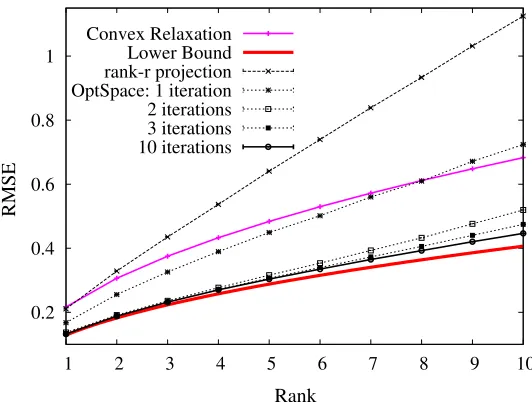
Convex Relaxation Lower Bound rank-r projection OptSpace : 1 iteration 2 iterations 3 iterations 10 iterations
|E|/n
R
M
S
E
Figure 1: Numerical simulation with random rank-2 600×600 matrices. Root mean square error achieved by OPTSPACE is shown as a function of the number of observed entries|E|and of the number of line minimizations. The performance of nuclear norm minimization and an information theoretic lower bound are also shown.
0.2 0.4 0.6 0.8 1
1 2 3 4 5 6 7 8 9 10
Convex Relaxation Lower Bound rank-r projection OptSpace: 1 iteration 2 iterations 3 iterations 10 iterations
Rank
R
M
S
E
0.0001 0.001 0.01 0.1 1
0 5 10 15 20 25 30 35 40 45 50 |E|/n=80, Fit error
RMSE Lower Bound |E|/n=160, Fit error RMSE Lower Bound
Iterations
E
rr
o
r
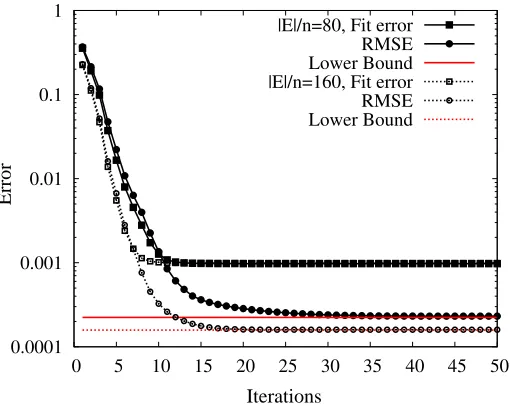
Figure 3: Numerical simulation with random rank-2 600×600 matrices and number of observed entries|E|/n=80 and 160. The standard deviation of the i.i.d. Gaussian noise is 0.001. Fit error and root mean square error achieved by OPTSPACE are shown as functions of the number of line minimizations. Information theoretic lower bounds are also shown.
2), from which we took the data points for the convex relaxation approach, as well as the informa-tion theoretic lower bound described later in this secinforma-tion. After a few iterainforma-tions, OPTSPACE has a smaller root mean square error than the one produced by convex relaxation. In about 10 iterations it becomes indistinguishable from the information theoretic lower bound for small ranks.
In Figure 3, we illustrate the rate of convergence of OPTSPACE. Two metrics, root mean squared error(RMSE) and fit errork
P
E(Mb−N)kF/p
|E|, are shown as functions of the number of iterations in the manifold optimization step. Note, that the fit error can be easily evaluated since NE=
P
E(N) is always available at the estimator. M is a random 600×600 rank-2 matrix generated as in the previous examples. The additive noise is distributed as Zi j∼N(0,σ2)withσ=0.001 (A small noise level was used in order to trace the RMSE evolution over many iterations). Each point in the figure is the averaged over 20 random instances, and resulting errors for two different values of sample size|E|=80 and|E|=160 are shown. In both cases, we can see that the RMSE converges to the information theoretic lower bound described later in this section. The fit error decays exponentially with the number iterations and converges to the standard deviation of the noise which is 0.001. This is a lower bound on the fit error when r≪n, since even if we have a perfect reconstruction of M, the average fit error is still 0.001.For a more complete numerical comparison between various algorithms for matrix completion, including different noise models, real data sets and ill conditioned matrices, we refer to Keshavan and Oh (2009).
(compared to our A1). Therefore the assumptions are not directly comparable. As far as the error bound is concerned, Cand`es and Plan (2009) proved that the semidefinite programming approach returns an estimateM which satisfiesb
1 √
mnkMbSDP−MkF ≤7
r n
|E|kZ E
kF+ 2 n√αkZ
E
kF. (6)
(The constant in front of the first term is in fact slightly smaller than 7 in Cand`es and Plan (2009), but in any case larger than 4√2. We choose to quote a result which is slightly less accurate but easier to parse.)
Theorem 1.2 improves over this result in several respects:(1)We do not have the second term on the right-hand side of (6), that actually increases with the number of observed entries;(2)Our error decreases as n/|E|rather than (n/|E|)1/2;(3) The noise enters Theorem 1.2 through the operator normkZEk2instead of its Frobenius normkZEkF ≥ kZEk2. For E uniformly random, one expects kZEkF to be roughly of orderkZEk2√n. For instance, within the independent entries model with bounded varianceσ,kZEkF =Θ(
p
|E|)whilekZEk2is of order p
|E|/n (up to logarithmic terms). Theorem 1.2 can also be compared to an information theoretic lower bound computed by Cand`es and Plan (2009). Suppose, for simplicity, m=n and assume that an oracle provides us a linear subspace T where the correct rank r matrix M=UΣVT lies. More precisely, we know that M∈T where T is a linear space of dimension 2nr−r2defined by
T ={UYT+XVT|X∈Rn×r,Y ∈Rn×r}.
Notice that the rank constraint is therefore replaced by this simple linear constraint. The minimum mean square error estimator is computed by projecting the revealed entries onto the subspace T , which can be done by solving a least squares problem. Cand`es and Plan (2009) analyzed the root mean squared error of the resulting estimatorM and showed thatb
1 √
mnkMbOracle−MkF≈ s
1 |E|kZ
Ek F.
Here≈indicates that the root mean squared error concentrates in probability around the right-hand side.
For the sake of comparison, suppose we have i.i.d. Gaussian noise with varianceσ2. In this case the oracle estimator yields (for r=o(n))
1
√mnkMbOracle−MkF ≈σ s
2nr |E|.
The bound (6) on the semidefinite programming approach yields
1
√mnkMbSDP−MkF ≤σ
7pn|E|+2 n|E|
.
Finally, using Theorems 1.2 and 1.3 we deduce that OPTSPACEachieves
1 √
mnkMbOptSpace−MkF ≤σ s
C nr |E| .
1.7 Related Work on Gradient Descent
Local optimization techniques such as gradient descent of coordinate descent have been intensively studied in machine learning, with a number of applications. Here we will briefly review the recent literature on the use of such techniques within collaborative filtering applications.
Collaborative filtering was studied from a graphical models perspective in Salakhutdinov et al. (2007), which introduced an approach to prediction based on Restricted Boltzmann Machines (RBM). Exact learning of the model parameters is intractable for such models, but the authors studied the performances of a contrastive divergence, which computes an approximate gradient of the likeli-hood function, and uses it to optimize the likelilikeli-hood locally. Based on empirical evidence, it was argued that RBM’s have several advantages over spectral methods for collaborative filtering.
An objective function analogous to the one used in the present paper was considered early on in Srebro and Jaakkola (2003), which uses gradient descent in the factors to minimize a weighted sum of square residuals. Salakhutdinov and Mnih (2008) justified the use of such an objective function by deriving it as the (negative) log-posterior of an appropriate probabilistic model. This approach naturally lead to the use of quadratic regularization in the factors. Again, gradient descent in the factors was used to perform the optimization. Also, this paper introduced a logistic mapping between the low-rank matrix and the recorded ratings.
Recently, this line of work was pushed further in Salakhutdinov and Srebro (2010), which em-phasize the advantage of using a non-uniform quadratic regularization in the factors. The basic objective function was again a sum of square residuals, and version of stochastic gradient descent was used to optimize it.
This rich and successful line of work emphasizes the importance of obtaining a rigorous under-standing of methods based on local minimization of the sum of square residuals with respect to the factors. The present paper provides a first step in that direction. Hopefully the techniques developed here will be useful to analyze the many variants of this approach.
The relationship between the non-convex objective function and convex relaxation introduced by Fazel (2002) was further investigated by Srebro et al. (2005) and Recht et al. (2007). The basic relation is provided by the identity
kMk∗=1
2 Mmin=XYT
kXk2F+kYk2F , (7)
wherekMk∗denotes the nuclear norm of M (the sum of its singular values). In other words, adding a regularization term that is quadratic in the factors (as the one used in much of the literature reviewed above) is equivalent to weighting M by its nuclear norm, that can be regarded as a convex surrogate of its rank.
1.8 On the Spectrum of Sparse Matrices and the Role of Trimming
The trimming step of the OPTSPACEalgorithm is somewhat counter-intuitive in that we seem to be wasting information. In this section we want to clarify its role through a simple example. Before describing the example, let us stress once again two facts: (i)In the last step of our the algorithm, the trimmed entries are actually incorporated in the cost function and hence the full information is exploited;(ii)Trimming is not the only way to treat over-represented rows/columns in ME, and probably not the optimal one. One might for instance rescale the entries of such rows/columns. We stick to trimming because we can prove it actually works.
Let us now turn to the example. Assume, for the sake of simplicity, that m=n, there is no noise in the revealed entries, and M is the rank one matrix with Mi j =1 for all i and j. Within the independent sampling model, the matrix ME has i.i.d. entries, with distribution Bernoulli(ε/n). The number of non-zero entries in a column is Binomial(n,ε/n) and is independent for different columns. It is not hard to realize that the column with the largest number of entries has more than C log n/log log n entries, with positive probability (this probability can be made as large as we want by reducing C). Let i be the index of this column, and consider the test vector e(i)that has the i-th entry equal to 1 and all the others equal to 0. By computingkMEe(i)k, we conclude that the largest singular value of ME is at least pC log n/log log n. In particular, this is very different from the largest singular value of E{ME}= (ε/n)M which isε. This suggests that approximating M with thePr(ME) leads to a large error. Hence trimming is crucial in proving Theorem 1.1. Also, the phenomenon is more severe in real data sets than in the present model, where each entry is revealed independently.
Trimming is also crucial in proving Theorem 1.3. Using the above argument, it is possible to show that under the worst case model,
kZEk2≥C′(ε)Zmax s
log n log log n.
This suggests that the largest singular value of the noise matrix ZE is quite different from the largest singular value ofE{ZE}which isεZmax.
To summarize, Theorems 1.1 and 1.3 (for the worst case model) simply do not hold without trimming or a similar procedure to normalize rows/columns of NE. Trimming allows to overcome the above phenomenon by setting to 0 over-represented rows/columns.
2. Proof of Theorem 1.1
As explained in the introduction, the crucial idea is to consider the singular value decomposition of the trimmed matrixNeE instead of the original matrix NE. Apart from a trivial rescaling, these singular values are close to the ones of the original matrix M.
Lemma 1 There exists a numerical constant C such that, with probability greater than 1−1/n3,
σεq−Σq
≤CMmax rα
ε +
1
εkZeEk2,
Proof For any matrix A, letσq(A)denote the qth singular value of A. Then,σq(A+B)≤σq(A) +
σ1(B), whence
σεq−Σq ≤
σq(MeE)
ε −Σq +
σ1(ZeE)
ε
≤ CMmax
rα
ε +
1
εkZeEk2,
where the second inequality follows from the next Lemma as shown by Keshavan et al. (2010).
Lemma 2 (Keshavan, Montanari, Oh, 2009) There exists a numerical constant C such that, with probability larger than 1−1/n3,
1 √mn M− √ mn
ε MeE
2≤CMmax rα
ε.
We will now prove Theorem 1.1.
Proof (Theorem 1.1) For any matrix A of rank at most 2r,kAkF≤ √
2rkAk2, whence 1
√
mnkM−Pr(Ne E)
kF ≤
√ 2r √ mn M− √ mn ε e
NE−
∑
i≥r+1σixiyTi 2 = √ 2r √ mn M− √ mn ε e
ME+ZeE−
∑
i≥r+1σixiyTi 2 = √ 2r √ mn M− √ mn
ε MeE
+
√ mn
ε ZeE−
∑
i≥r+1σixiyTi
! 2 ≤ √ 2r √mn M− √ mn
ε MeE
2+ √ mn
ε kZeEk2+
√ mn
ε σr+1
≤ 2CMmax r
2αr
ε +
2√2r
ε kZeEk2 ≤ C′Mmax
nrα3/2 |E|
!1/2
+2√2
n√rα |E|
kZeEk2.
where on the fourth line, we have used the fact that for any matrices Ai,k∑iAik2≤∑ikAik2. This proves our claim.
3. Proof of Theorem 1.2
Recall that the cost function is defined over the Riemannian manifoldM(m,n)≡G(m,r)×G(n,r). The proof of Theorem 1.2 consists in controlling the behavior of F in a neighborhood of u= (U,V)
(the point corresponding to the matrix M to be reconstructed). Throughout the proof we let
K
(µ)3.1 Preliminary Remarks and Definitions
Given x1= (X1,Y1) and x2 = (X2,Y2)∈M(m,n), two points on this manifold, their distance is defined as d(x1,x2) =pd(X1,X2)2+d(Y1,Y2)2, where, letting (cosθ1, . . . ,cosθr) be the singular values of X1TX2/m,
d(X1,X2) =kθk2.
The next remark bounds the distance between two points on the manifold. In particular, we will use this to bound the distance between the original matrix M=UΣVT and the starting point of the manifold optimizationMb=X0S0Y0T.
Remark 3 (Keshavan, Montanari, Oh, 2009) Let U,X ∈Rm×r with UTU =XTX =mI, V,Y ∈ Rn×r with VTV =YTY =nI, and M=UΣVT,Mb=X SYT forΣ=diag(Σ1, . . . ,Σr)and S∈Rr×r.
IfΣ1, . . . ,Σr≥Σmin, then d(U,X)≤√ π
2αnΣmink
M−MbkF , d(V,Y)≤
π
√
2αnΣmink
M−MbkF
Given S achieving the minimum in Eq. (2), it is also convenient to introduce the notations
d−(x,u)≡ q
Σ2
mind(x,u)2+kS−Σk2F, d+(x,u)≡
q
Σ2
maxd(x,u)2+kS−Σk2F. 3.2 Auxiliary Lemmas and Proof of Theorem 1.2
The proof is based on the following two lemmas that generalize and sharpen analogous bounds in Keshavan et al. (2010).
Lemma 4 There exist numerical constants C0,C1,C2 such that the following happens. Assume
ε≥C0µ0r√αmax{log n ; µ0r√α(Σmin/Σmax)4}andδ≤Σmin/(C0Σmax). Then, F(x)−F(u) ≥ C1nε
√α
d−(x,u)2−C1n √
rαkZEk2d+(x,u), (8) F(x)−F(u) ≤ C2nε
√αΣ2
maxd(x,u)2+C2n √
rαkZEk2d+(x,u), (9)
for all x∈M(m,n)∩
K
(4µ0)such that d(x,u)≤δ, with probability at least 1−1/n4. Here S∈Rr×r is the matrix realizing the minimum in Eq. (2).Corollary 3.1 There exist a constant C such that, under the hypotheses of Lemma 4
kS−ΣkF ≤CΣmaxd(x,u) +C √
r
ε kZEk2.
Further, for an appropriate choice of the constants in Lemma 4, we have
σmax(S)≤2Σmax+C √
r
ε kZEk2, (10)
σmin(S)≥ 1
2Σmin−C √
r
Lemma 5 There exist numerical constants C0,C1,C2 such that the following happens. Assume
ε≥C0µ0r√α(Σmax/Σmin)2max{log n ; µ0r√α(Σmax/Σmin)4}andδ≤Σmin/(C0Σmax). Then,
kgradFe(x)k2≥C1nε2Σ4min
d(x,u)−C2 √
rΣmax
εΣmin
kZEk2
Σmin 2
+
, (12)
for all x∈M(m,n)∩
K
(4µ0)such that d(x,u)≤δ, with probability at least 1−1/n4. (Here[a]+≡ max(a,0).)We can now turn to the proof of our main theorem.
Proof (Theorem 1.2). Letδ=Σmin/C0Σmaxwith C0large enough so that the hypotheses of Lemmas 4 and 5 are verified.
Call {xk}k≥0 the sequence of pairs (Xk,Yk)∈M(m,n) generated by gradient descent. By as-sumption the right-hand side of Eq. (3) is smaller than Σmin. The following is therefore true for some numerical constant C:
kZEk2≤ ε C√r
Σ min
Σmax 2
Σmin. (13)
Notice that the constant appearing here can be made as large as we want by modifying the constant appearing in the statement of the theorem. Further, by using Corollary 3.1 in Eqs. (8) and (9) we get
F(x)−F(u) ≥ C1nε √αΣ2
min
d(x,u)2−δ20,− , (14)
F(x)−F(u) ≤ C2nε √αΣ2
max
d(x,u)2+δ2
0,+ , (15)
with C1and C2different from those in Eqs. (8) and (9), where
δ0,−≡C √
rΣmax
εΣmin
kZEk2
Σmin
, δ0,+≡C √
rΣmax
εΣmin
kZEk2
Σmax .
By Eq. (13), with large enough C, we can assumeδ0,−≤δ/20 andδ0,+≤(δ/20)(Σmin/Σmax). Next, we provide a bound on d(u,x0). Using Remark 3, we have d(u,x0)≤(π/n√αΣmin)kM− X0S0Y0TkF. Together with Theorem 1.1 this implies
d(u,x0)≤CMmax Σmin
rα
ε
1/2
+C′
√ r
εΣmink e ZEk2.
Sinceε≥C′′αµ21r2(Σmax/Σmin)4 as per our assumptions and Mmax≤µ1√rΣmax for incoherent M, the first term in the above bound is upper bounded byΣmin/20C0Σmax, for large enough C′′. Using Eq. (13), with large enough constant C, the second term in the above bound is upper bounded by
Σmin/20C0Σmax. Hence we get
d(u,x0)≤ δ
10.
1. xk∈
K
(4µ0)for all k.First we notice that we can assume x0 ∈
K
(3µ0). Indeed, if this does not hold, we can ‘rescale’ those rows of X0, Y0that violate the constraint. A proof that this rescaling is possible was given in Keshavan et al. (2010) (cf. Remark 6.2 there). We restate the result here for the reader’s convenience in the next Remark.Remark 6 Let U,X∈Rn×rwith UTU=XTX=nI and U ∈
K
(µ0)and d(X,U)≤δ≤161. Then there exists X′∈Rn×rsuch that X′TX′=nI, X′∈
K
(3µ0)and d(X′,U)≤4δ. Further, such an X′can be computed from X in a time of O(nr2).Since x0∈
K
(3µ0) , Fe(x0) =F(x0)≤4C2nε√αΣ2maxδ2/100. On the other hand Fe(x)≥ρ(e1/9−1) for x6∈
K
(4µ0). SinceFe(xk) is a non-increasing sequence, the thesis follows provided we takeρ≥C2nε√αΣ2min.2. d(xk,u)≤δ/10 for all k.
Sinceε≥Cαµ21r2(Σmax/Σmin)6as per our assumptions in Theorem 1.2, we have d(x0,u)2≤
(C1Σ2min/C2Σ2max)(δ/20)2. Also assuming Eq. (13) with large enough C, we haveδ0,−≤δ/20 andδ0,+≤(δ/20)(Σmin/Σmax). Then, by Eq. (15),
F(x0)≤F(u) +C1nε√αΣ2min 2δ2 400.
Also, using Eq. (14), for all xk such that d(xk,u)∈[δ/10,δ], we have
F(x)≥F(u) +C1nε √αΣ2
min 3δ2 400.
Hence, for all xk such that d(xk,u)∈[δ/10,δ], we haveFe(x)≥F(x)≥F(x0). This contra-dicts the monotonicity ofFe(x), and thus proves the claim.
Since the cost function is twice differentiable, and because of the above two claims, the sequence {xk}converges to
Ω=x∈
K
(4µ0)∩M(m,n) : d(x,u)≤δ,gradFe(x) =0 .By Lemma 5 for any x∈Ω,
d(x,u)≤C √
rΣmax
εΣmin
kZEk2
Σmin
. (16)
Using Corollary 3.1, we have d+(x,u)≤Σmaxd(x,u) +kS−ΣkF≤CΣmaxd(x,u) +C(√r/ε)kZEk2. Together with Eqs. (18) and (16), this implies
1
n√αkM−X SY T
kF ≤C √
rΣ2maxkZEk2
εΣ2 min
,
3.3 Proof of Lemma 4 and Corollary 3.1
Proof (Lemma 4) The proof is based on the analogous bound in the noiseless case, that is, Lemma 5.3 in Keshavan et al. (2010). For readers’ convenience, the result is reported in Appendix A, Lemma 7. For the proof of these lemmas, we refer to Keshavan et al. (2010).
In order to prove the lower bound, we start by noticing that
F(u)≤1
2k
P
E(Z)k 2 F,which is simply proved by using S=Σin Eq. (2). On the other hand, we have
F(x) = 1
2k
P
E(X SYT−M−Z)k2 F
= 1
2k
P
E(Z)k 2 F+1
2k
P
E(X SYT−M)k2
F− h
P
E(Z),(X SYT−M)i (17) ≥ F(u) +Cnε√αd−(x,u)2−√2rkZEk2kX SYT−MkF,
where in the last step we used Lemma 7. Now by triangular inequality
kX SYT−Mk2F ≤ 3kX(S−Σ)YTk2F+3kXΣ(Y−V)Tk2F+3k(X−U)ΣVTk2F ≤ 3nmkS−ΣkF2 +3n2αΣ2max(1
mkX−Uk 2 F+
1
nkY−Vk 2 F)
≤ Cn2αd+(x,u)2, (18)
In order to prove the upper bound, we proceed as above to get
F(x) ≤1
2k
P
E(Z)k 2 F+Cnε√αΣ2
maxd(x,u)2+ √
2rαkZEk2Cnd+(x,u).
Further, by replacing x with u in Eq. (17)
F(u) ≥ 1
2k
P
E(Z)k 2F− h
P
E(Z),(U(S−Σ)VT)i≥ 12k
P
E(Z)k2F−√2rαkZEk2Cnd+(x,u). By taking the difference of these inequalities we get the desired upper bound.Proof (Corollary 3.1) By putting together Eq. (8) and (9), and using the definitions of d+(x,u), d−(x,u), we get
kS−Σk2F ≤C1+C2 C1
Σ2
maxd(x,u)2+
(C1+C2)√r C1ε k
ZEk2 q
Σ2
maxd(x,u)2+kS−Σk2F. Let x≡ kS−ΣkF, a2≡ (C1+C2)/C1
Σ2
maxd(x,u)2, and b≡ (C1+C2)√r/C1ε
kZEk2. The above inequality then takes the form
The singular value bounds (10) and (11) follow by triangular inequality. For instance
σmin(S)≥Σmin−CΣmaxd(x,u)−C √
r
ε kZEk2.
which implies the inequality (11) for d(x,u)≤δ=Σmin/C0Σmax and C0 large enough. An analo-gous argument proves Eq. (10).
3.4 Proof of Lemma 5
Without loss of generality we will assumeδ≤1, C2≥1 and √r
ε kZEk2≤Σmin, (19)
because otherwise the lower bound (12) is trivial for all d(x,u)≤δ.
Denote by t 7→ x(t), t ∈[0,1], the geodesic on M(m,n) such that x(0) =u and x(1) = x, parametrized proportionally to the arclength. Letwb =˙x(1) be its final velocity, withwb= (Wb,Qb). Obviouslywb∈Tx(withTxthe tangent space ofM(m,n)at x) and
1 mkWbk
2+1 nkQbk
2=d(x,u)2, because t7→x(t)is parametrized proportionally to the arclength.
Explicit expressions for w can be obtained in terms of wb ≡ ˙x(0) = (W,Q) (Keshavan et al., 2010). If we let W=LΘRT be the singular value decomposition of W , we obtain
b
W=−U RΘsinΘRT+LΘcosΘRT. (20)
It was proved in Keshavan et al. (2010) thathgrad G(x),wbi ≥0. It is therefore sufficient to lower bound the scalar producthgrad F,wbi. By computing the gradient of F we get
hgrad F(x),wbi = h
P
E(X SYT−N),(X SQbT+W SYb T)i= h
P
E(X SYT−M),(X SQbT+W SYb T)i − hP
E(Z),(X SQbT+W SYb T)i = hgrad F0(x),wbi − hP
E(Z),(X SQbT+W SYb T)i (21) where F0(x)is the cost function in absence of noise, namelyF0(X,Y) = min S∈Rr×r
( 1 2(i,
∑
j)∈E
(X SYT)i j−Mi j 2
)
. (22)
As proved in Keshavan et al. (2010),
hgrad F0(x),wbi ≥Cnε√αΣ2mind(x,u)2 (23) (see Lemma 9 in Appendix).
We are therefore left with the task of upper boundingh
P
E(Z),(X SQbT+W SYb T)i. Since X SQbT has rank at most r, we haveSince XTX=mI, we get
kX SQbTk2F = mTr(STSQbTQb)≤nασmax(S)2kQbk2F ≤ Cn2αΣmax+
√ r
ε kZEkF 2
d(x,u)2 (24)
≤ 4Cn2αΣ2maxd(x,u)2,
where, in inequality (24), we used Corollary 3.1 and in the last step, we used Eq. (19). Proceeding analogously forh
P
E(Z),W SYb Ti, we geth
P
E(Z),(X SQbT+W SYb T)i ≤C′nΣmax √rαkZEk2d(x,u).
Together with Eq. (21) and (23) this implies
hgrad F(x),wbi ≥C1nε √αΣ2
mind(x,u) n
d(x,u)−C2 √
rΣmax
εΣmin
kZEk2
Σmin o
,
which implies Eq. (12) by Cauchy-Schwartz inequality.
4. Proof of Theorem 1.3
Proof (Independent entries model ) We start with a claim that for any sampling set E, we have
kZeEk2≤ kZEk2.
To prove this claim, let x∗and y∗be m and n dimensional vectors, respectively, achieving the opti-mum in maxkxk≤1,kyk≤1{xTZeEy}, that is, such thatkZeEk2=x∗TZeEy∗. Recall that, as a result of the trimming step, all the entries in trimmed rows and columns ofZeE are set to zero. Then, there is no gain in maximizing xTZeEy to have a non-zero entry x∗i for i corresponding to the rows which are trimmed. Analogously, for j corresponding to the trimmed columns, we can assume without loss of generality that y∗j=0. From this observation, it follows that x∗TZeEy∗=x∗TZEy∗, since the trimmed matrixZeE and the sample noise matrix ZE only differ in the trimmed rows and columns. The claim follows from the fact that x∗TZEy∗≤ kZEk2, for any x∗and y∗with unit norm.
In what follows, we will first prove that kZEk2 is bounded by the right-hand side of Eq. (4) for any range of |E|. Due to the above observation, this implies that kZeEk2 is also bounded by Cσpε√αlog n, whereε≡ |E|/√αn. Further, we use the same analysis to prove a tighter bound in Eq. (5) when|E| ≥n log n.
First, we want to show that kZEk2 is bounded by Cσ p
ε√αlog n, and Zi j’s are i.i.d. random variables with zero mean and sub-Gaussian tail with parameterσ2. The proof strategy is to show that
EkZEk2
is bounded, using the result of Seginer (2000) on expected norm of random matrices, and use the fact thatk · k2is a Lipschitz continuous function of its arguments together with concentration inequality for Lipschitz functions on i.i.d. Gaussian random variables due to Talagrand (1996).
Note thatk · k2 is a Lipschitz function with a Lipschitz constant 1. Indeed, for any M and M′,
To bound the probability of large deviation, we use the result on concentration inequality for Lipschitz functions on i.i.d. sub-Gaussian random variables due to Talagrand (1996). For a 1-Lipschitz functionk · k2on m×n i.i.d. random variables Zi jE with zero mean, and sub-Gaussian tails with parameterσ2,
P kZEk2−E[kZEk2]>t≤expn− t 2 2σ2
o
. (25)
Setting t =p8σ2log n, this implies that kZEk
2≤EkZk2+ p
8σ2log n with probability larger than 1−1/n4.
Now, we are left to bound the expectationEkZEk2. First, we symmetrize the possibly asym-metric random variables Zi jE to use the result of Seginer (2000) on expected norm of random matrices with symmetric random variables. Let Zi j′’s be independent copies of Zi j’s, andξi j’s be independent Bernoulli random variables such thatξi j= +1 with probability 1/2 andξi j=−1 with probability 1/2. Then, by convexity ofEkZE−Z′Ek2|Z′E
and Jensen’s inequality,
EkZEk2
≤EkZE−Z′Ek2
=Ek(ξi j(ZEi j−Z′i jE))k2
≤2Ek(ξi jZi jE)k2
,
where(ξi jZEi j)denotes an m×n matrix with entryξi jZi jEin position(i,j). Thus, it is enough to show thatEkZEk2is bounded by Cσpε√αlog n in the case of symmetric random variables Zi j’s.
To this end, we apply the following bound on expected norm of random matrices with i.i.d. symmetric random entries, proved by Seginer (2000, Theorem 1.1).
EkZEk2≤CEmax
i∈[m]kZ E i•k
+Emax j∈[n]kZ
E •jk
, (26)
where ZEi•and Z•Ej denote the ith row and jth column of A respectively. For any positive parameter
β, which will be specified later, the following is true.
Emax
j kZ E •jk2
≤βσ2ε√α+
Z ∞
0 P max
j kZ E
•jk2≥βσ2ε √α
+zdz. (27)
To bound the second term, we can apply union bound on each of the n columns, and use the follow-ing bound on each columnkZ•Ejk2 resulting from concentration of measure inequality for the i.i.d. sub-Gaussian random matrix Z.
P
m
∑
k=1(Zk jE)2≥βσ2ε√α+z≤expn−3 8
(β−3)ε√α+ z σ2
o
. (28)
To prove the above result, we apply Chernoff bound on the sum of independent random vari-ables. Recall that Zk jE =ξ˜k jZk j where ˜ξ’s are independent Bernoulli random variables such that ˜
ξ=1 with probability ε/√mn and zero with probability 1−ε/√mn. Then, for the choice of
λ=3/8σ2<1/2σ2,
Ehexpλ
m
∑
k=1(ξ˜k jZk j)2i = 1−√ε mn+
ε
√ mnE[e
λZ2
k j]
m
≤ 1−√ε
mn+
ε
p
mn(1−2σ2λ) m
= expnm log1+√ε mn
o
where the first inequality follows from the definition of Zk j as a zero mean random variable with sub-Gaussian tail, and the second inequality follows from log(1+x)≤x. By applying Chernoff bound, Eq. (28) follows. Note that an analogous result holds for the Euclidean norm on the rows kZiE•k2.
Substituting Eq. (28) andP maxjkZ•Ejk2≥z
≤mP kZ•Ejk2≥zin Eq. (27), we get
Emax
j kZ E •jk2
≤βσ2ε√α+8σ
2m 3 e
−3 8(β−3)ε
√α
. (29)
The second term can be made arbitrarily small by takingβ=C log n with large enough C. Since
EmaxjkZ•Ejk
≤qEmaxjkZ•Ejk2
, applying Eq. (29) withβ=C log n in Eq. (26) gives
EkZEk2≤Cσ q
ε√αlog n.
Together with Eq. (25), this proves the desired thesis for any sample size|E|.
In the case when|E| ≥n log n, we can get a tighter bound by similar analysis. Sinceε≥C′log n, for some constant C′, the second term in Eq. (29) can be made arbitrarily small with a large constant
β. Hence, applying Eq. (29) withβ=C in Eq. (26), we get
EkZEk2≤Cσ q
ε√α.
Together with Eq. (25), this proves the desired thesis for|E| ≥n log n.
Proof (Worst Case Model ) Let D be the m×n all-ones matrix. Then for any matrix Z from the worst case model, we havekZeEk2≤ZmaxkDeEk2, since xTZeEy≤∑
i,jZmax|xi|DeEi j|yj|, which follows from the fact that Zi j’s are uniformly bounded. Further, DeE is an adjacency matrix of a corresponding bipartite graph with bounded degrees. Then, for any choice of E the following is true for all positive integers k:
kDeEk2k2 ≤ max x,kxk=1
xT((DeE)TDeE)kx
≤Tr ((DeE)TDeE)k≤n(2ε)2k.
Now Tr ((DeE)TDeE)k is the number of paths of length 2k on the bipartite graph with adjacency matrixDeE, that begin and end at i for every i∈[n]. Since this graph has degree bounded by 2ε, we get
kDeEk2k2 ≤n(2ε)2k. Taking k large, we get the desired thesis.
Acknowledgments
Appendix A. Three Lemmas on the Noiseless Problem
Lemma 7 There exists numerical constants C0,C1,C2 such that the following happens. Assume
ε≥C0µ0r√αmax{log n ; µ0r√α(Σmin/Σmax)4}andδ≤Σmin/(C0Σmax). Then,
C1√αΣ2mind(x,u)2+C1√αkS0−Σk2F≤ 1
nεF0(x)≤C2 √αΣ2
maxd(x,u)2,
for all x∈M(m,n)∩
K
(4µ0)such that d(x,u)≤δ, with probability at least 1−1/n4. Here S0∈Rr×ris the matrix realizing the minimum in Eq. (22).
Lemma 8 There exists numerical constants C0 and C such that the following happens. Assume
ε≥C0µ0r√α(Σmax/Σmin)2max{log n ; µ0r√α(Σmax/Σmin)4}andδ≤Σmin/(C0Σmax). Then kgradFe0(x)k2≥C nε2Σ4mind(x,u)2,
for all x∈M(m,n)∩
K
(4µ0)such that d(x,u)≤δ, with probability at least 1−1/n4.Lemma 9 Definew as in Eq. (20). Then there exists numerical constants Cb 0 and C such that the following happens. Under the hypothesis of Lemma 8
hgrad F0(x),wbi ≥C nε √αΣ2
mind(x,u)2,
for all x∈M(m,n)∩
K
(4µ0)such that d(x,u)≤δ, with probability at least 1−1/n4.References
P.-A. Absil, R. Mahony, and R. Sepulchrer. Optimization Algorithms on Matrix Manifolds. Prince-ton University Press, 2008.
D. Achlioptas and F. McSherry. Fast computation of low-rank matrix approximations. J. ACM, 54 (2):9, 2007.
J-F Cai, E. J. Cand`es, and Z. Shen. A singular value thresholding algorithm for matrix completion. arXiv:0810.3286, 2008.
E. J. Cand`es and Y. Plan. Matrix completion with noise. arXiv:0903.3131, 2009.
E. J. Cand`es and B. Recht. Exact matrix completion via convex optimization. arxiv:0805.4471, 2008.
E. J. Cand`es and T. Tao. The power of convex relaxation: Near-optimal matrix completion. arXiv:0903.1476, 2009.
A. Edelman, T. A. Arias, and S. T. Smith. The geometry of algorithms with orthogonality con-straints. SIAM J. Matr. Anal. Appl., 20:303–353, 1999.
M. Fazel. Matrix Rank Minimization with Applications. PhD thesis, Stanford University, 2002.
R. H. Keshavan and S. Oh. Optspace: A gradient descent algorithm on the grassman manifold for matrix completion. arXiv:0910.5260, 2009.
R. H. Keshavan, A. Montanari, and S. Oh. Matrix completion from a few entries. IEEE Trans. Inform. Theory, 56(6):2980–2998, June 2010.
K. Lee and Y. Bresler. Admira: Atomic decomposition for minimum rank approximation. arXiv:0905.0044, 2009.
S. Ma, D. Goldfarb, and L. Chen. Fixed point and Bregman iterative methods for matrix rank minimization. arXiv:0905.1643, 2009.
B. Recht, M. Fazel, and P. Parrilo. Guaranteed minimum rank solutions of matrix equations via nuclear norm minimization. arxiv:0706.4138, 2007.
R. Salakhutdinov and A. Mnih. Probabilistic matrix factorization. In Advances in Neural Informa-tion Processing Systems, volume 20, 2008.
R. Salakhutdinov and N. Srebro. Collaborative filtering in a non-uniform world: Learning with the weighted trace norm. arXiv:1002.2780, 2010.
R. Salakhutdinov, A. Mnih, and G. Hinton. Restricted Boltzmann machines for collaborative fil-tering. In Proceedings of the International Conference on Machine Learning, volume 24, pages 791–798, 2007.
Y. Seginer. The expected norm of random matrices. Comb. Probab. Comput., 9:149– 166, March 2000. ISSN 0963-5483. doi: 10.1017/S096354830000420X. URL http://portal.acm.org/citation.cfm?id=971471.971475.
N. Srebro and T. S. Jaakkola. Weighted low-rank approximations. In In 20th International Confer-ence on Machine Learning, pages 720–727. AAAI Press, 2003.
N. Srebro, J. D. M. Rennie, and T. S. Jaakola. Maximum-margin matrix factorization. In Advances in Neural Information Processing Systems 17, pages 1329–1336. MIT Press, 2005.
M. Talagrand. A new look at independence. The Annals of Probability, 24(1):1–34, 1996. ISSN 00911798. URLhttp://www.jstor.org/stable/2244830.