Copyright © 2016 by Academic Publishing House
Researcher
Published in the Russian Federation
European Journal of Economic Studies
Has been issued since 2012.ISSN: 2304-9669 E-ISSN: 2305-6282
Vol. 15, Is. 1, pp. 259-266, 2016
DOI: 10.13187/es.2016.15.259
www.ejournal2.com
UDC 33
European Union Trading Bloc: Motivation for East Asian Countries
Muhammad Imran
First Academy (Institute for Researchers), Multan, Pakistan E-mail: [email protected]
Abstract
European Union is extremely integrated market with more than 500 million consumers searching for quality goods. EU trading bloc is largest exporter to more than 80 countries and 71 per cent imports enter in EU region at reduced or sometimes at zero tariffs. Still EU has having motivated agenda with other world for a number of trade agreements in the pipeline. Basic idea behind this research study is, whether EU trading bloc has improved the performance of member countries or not? Research study finds that EU trading bloc has increased the production and welfare of the peoples in EU region. Now, it is suggestion for East Asian countries to make East Asian Trading Bloc (EATB) for improved performance and better wellbeing of the people in near future.
Keywords: European Union, EU trading bloc, East Asia, Performance.
1. Introduction
European Union has achieved a well-built position with one voice by acting together on the global state, rather than with 28 disconnected trade strategies. European Union is a composition of 28 member countries; most of the countries included from Central and Eastern Europe. EU member countries adopt common set of policies on social, economic and political issues. EU has regional development funds, possibly known as structural funds, having the second largest provision of budget (DG Regio, 2004b). EU member countries are a single market through which capital, goods and people can move freely with common trade and agriculture policies. European Union has become extremely integrated market into the globe. They have more than 500 million consumers searching for quality goods. EU is most open international market not only for developing but also for developed countries. EU is a single largest market of the world with transparent rules and regulations and also secures the legal investment framework. Know with modern transportation and communication, it is easier to produce, sell and buy products around the whole world.
Table 1: Share in world trade in goods and commercial services in 2012, Euro billions.
Country/Region Exports Imports
EU 1882 1956
United States 1358 1762
China 1319 1197
Japan 685 641
South Korea 417 392
Source: http://ec.europa.eu
Figure 1: Share in world trade in goods and commercial services in 2012, Euro billions (from table 1).
Source: http://ec.europa.eu
Big countries have natural advantage when they came for trade. EU member countries are as a single are better place for shaping rules and regulations for trading system globally and also influence the regulations and standards. EU trading policies have four themes; first: creating open and fair trade globally, second: creating opportunities for companies of EU and their workers so that trade would be increased for rest of the world, third: ensuring the fact that trade is for sustained development, fourth: making sure the play of other by rules of international trade.
EU trading bloc works for EU member countries. It is suggested for East Asian member countries to construct regional bloc like EU trading bloc. Development objectives include investment facilitation and labor movement freely (Timothy, 2001). East Asia region consist of highly populated countries like China. After constructing a trading bloc, East Asian member countries can utilize their population in a better way, where not only individual performance for member countries will increase but the overall performance of East Asia region would also be increased. This will increased the overall wellbeing of the people of East Asia region.
dynamic economy. Yu and Zhang in 2005 inspect the economic performance of EU member countries. Winter and Chang in 2005 uses effects of prices for examining the regional bloc consequences. Baldwin in 2008 makes a survey on theoretical issues for systematic effects of trading agreements. Femenia and Gohin in 2009 explore free trade and protection effects for agriculture as international trade. Lee and Mensbrugghe in 2009 explored the impacts for regional integration in North America, Asia and European Union.
2. Welfare effects for EU
Strict government controls can never provide optimal level of welfare. Barriers include the political and geographical fragmentation (Timothy, 2004). EU member countries work together for setting policies for collective interest through common institutions. Economic and trading bloc has ability to identify the issues and fill the gaps by increasing the production and welfare of the people. Members of EU have experienced a large rise after the mid of 20th century and still today. Some of
the welfare effects for members countries of EU are listed as; First: increased economies of scale and economies of scope, second: increased competition and market efficiency, third: free trade within the bloc, fourth: financial market integration, fifth: international risk sharing, sixth: more and increased foreign direct investment, seventh: more jobs and protection.
3. Data Collection
EU trading and economic bloc consists of 28 member countries but data is taken only for 13 member countries. For best explanation of data analysis those members are selected who have membership before 1996 except Luxemburg (Luxemburg is performing as an outlier). From East Asia countries data is also collected for only four countries (Japan, China, Korea and Mongolia). The data set consists of 20 years period from 1993 to 2012. Basic purpose of data analysis is to check whether EU trading and economic bloc have improved the performance of member countries or not?
4. Data Analysis
In global trade EU has prime position. EU is the largest economy with the GDP per capita of more than 25000 Euros. Data analysis is further divided into eight sub-sections which are presented below:
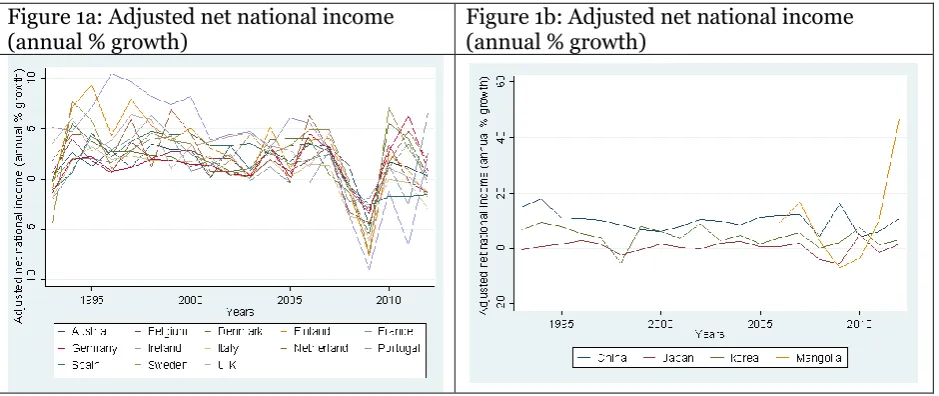
4.1 Net National Income (Figure 1a & 1b)
Net National Income (NNI) adjusted for Gross National Income is showing some even patterns for EU member countries but in East Asian countries only Mongolia is on increasing net national income from 2010 to onward which shows uneven patterns for NNI. Due to global financial crisis there is down turn in EU net national incomes for the period 2006-2009 while East Asian countries are less affected by global financial crisis as they all are not fully globalized.
Figure 1a: Adjusted net national income
(annual % growth) Figure 1b: Adjusted net national income (annual % growth)
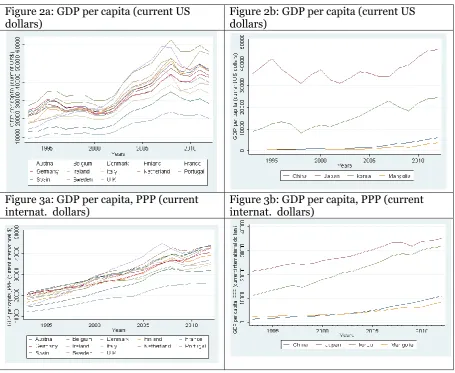
4.2 GDP per capita (Figure 2a, 2b & Figure 3a, 3b)
band. On the other hand GDP per capita for East Asian countries are not improved much, only Japan is at leading stage.
Figure 2a: GDP per capita (current US
dollars) Figure 2b: GDP per capita (current US dollars)
Figure 3a: GDP per capita, PPP (current
internat. dollars) Figure 3b: GDP per capita, PPP (current internat. dollars)
4.3 Inflation (Figure 4a & 4b)
Figure 4a: Inflation, consumer prices
(annual %) Figure 4b: Inflation, consumer prices (annual %)
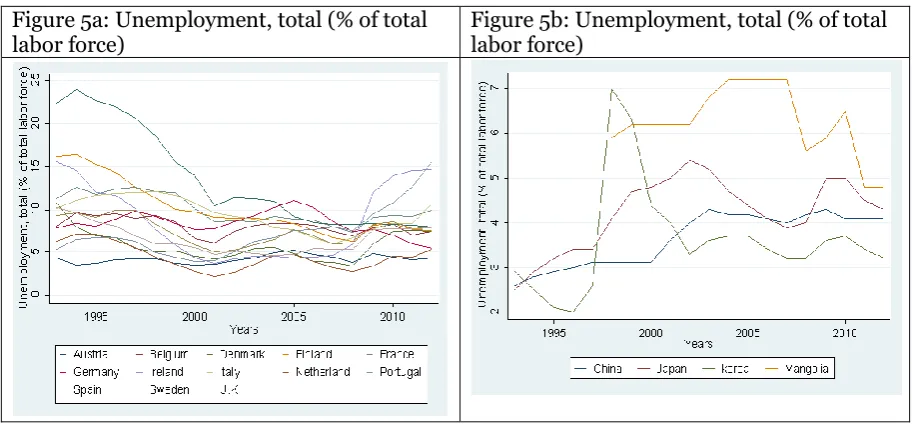
4.4 Unemployment (Figure 5a & 5b)
Unemployment refers to the labor force share without work but willing/seeking for employment. Unemployment rate is reducing in EU member countries with the passage of time frame, while East Asian countries still accounts for high and persistent unemployment which is not good for sustained economic growth and development.
Figure 5a: Unemployment, total (% of total
labor force) Figure 5b: Unemployment, total (% of total labor force)
4.5 Exports of Goods and Services (Figure 6a & 6b)
Figure 6a: Exports of goods and services
(annual % growth) Figure 6b: Exports of goods and services (annual % growth)
4.6 Military Expenditure (Figure 7a and 7b)
Military expenditures include expenditures on armed forces and other agencies of government engaged in projects of national defense. Different countries have different nature of expenditures for defense. Defense expenditures are unproductive expenditures which mean that these expenditures are the problem in the way of economic growth and development. From figure 7a, it can be seen that after EU bloc, military expenditures are going too decreased with every next year. But in East Asian region, large part of budget income of China and Korea is spent on military expenditure which is a great hurdle in the way of growth and development.
Figure 7a: Military expenditure (% of GDP) Figure 7b: Military expenditure (% of GDP)
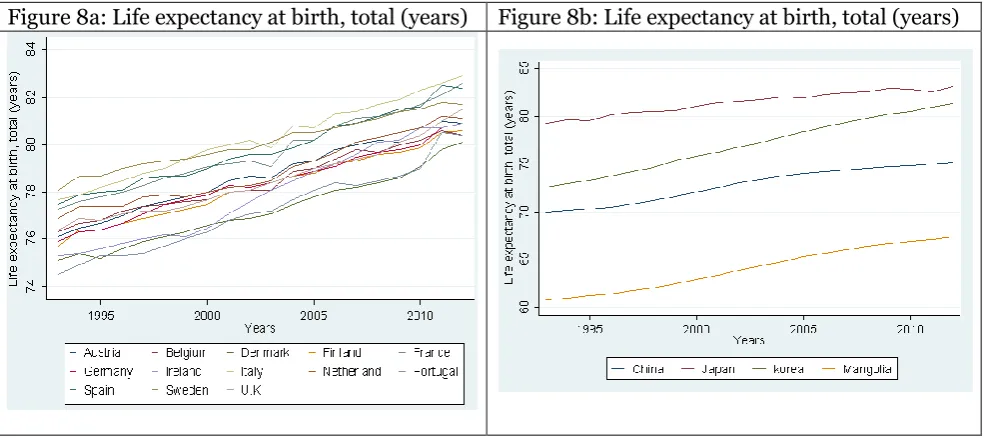
4.7 Life Expectancy at Birth (Figure 8a and 8b)
Figure 8a: Life expectancy at birth, total (years) Figure 8b: Life expectancy at birth, total (years)
4.8 Internet Users (Figure 9a and 9b)
Individuals those use internets via computer, mobile etc. from any location are included in internet users. Internet is a very big source of providing information. Numbers of internet users are increasing more rapidly in EU member countries as comparing with East Asian countries, due to easy transfer of technologies between the EU member countries.
Figure 9a: Internet users (per 100 people) Figure 9b: Internet users (per 100 people)
5. Conclusion
Trading bloc not only improves single country’s performance but it also increases the overall performance of the region. So trading bloc means regional growth and development. Trading bloc increases co-operation among the countries. After EU trading bloc the performance of every EU member country is increased, so here, a suggestion for East Asian countries to make East Asian Trading Bloc (EATB). In near future, this will not only improve the performance of member countries, it will also increase the performance and wellbeing of the people of whole East Asia region.
References:
1. Amuedo-Dorantes and Wheeler, M. (2001). An empirical analysis of the European Union's impact on Spanish economic performance. Applied Economics, 33 (8): 1001.
3. Femenia F., and Gohin, A. (2009). On the European Responsibility in the Agricultural Multilateral trade Negotiations: Modeling the Impacts of the Common Agricultural Policy, The World Economy, pp.1434-1467.
4. Grimwade, N. (1999). Developments in the Economies of European Union. Journal of Common Market Studies, 37: 135.
5. Islam, S. (2003). Expansions of the European Union and the NAFTA: Implications for New and Non-Member Countries, Applied Econometrics and International Development, 3(2), pp. 55-72.
6. Krueger, A. (1999). Trade Creation and Trade Diversion under the NAFTA, NBER Working Paper, Number 7429.
7. Lee H., and Mensbrugghe, D. (2009). Regional Integration in Asia and its Effects on the EU and North America, Journal of Asian Economics, 20, pp.240-254.
8. Room, G. (2005). Policy Benchmarking in the European Union: Indicators and Ambiguities. Policy Studies, 26 (2): 117.
9. Switky, B. (2000). The Importance of Trading Bloc: Theoretical foundations. In the Political Importance of Regional Trading Blocs, Kerramans B, Switky, B. (eds). Ashgate Publishing Ltd: Aldershot; 13-53.
10. Timothy, D. J. (2001). Tourism and Political Boundaries. Rout ledge: London.
11. Timothy, D. J. (2004). Tourism and Supranationalism in the Caribbean. In Tourism in the Caribbean, trends, Developments and Prospects, Duvalt (ed). Rout Ledge: London; 119-135.
12. Whalley, J. (1996). Why do Countries Seek Regional Trade Agreements, NBER Working Paper, Number 5552.
13. Winter, L., and Chang, W. (1995). Integration and Non-member Welfare: Measuring the Price Effects (Unpublished; Washington: World Bank).
14. Yu, T., and Zhang, M. (2005). Homogeneity of the Economic Performance of the Euro-Land: A Statistical Analysis. Review of Business, 26 (1), pp. 8-13.
15. http://ec.europa.eu/trade/policy/eu-position-in-world-trade/