195 Information Technology and Control 2019/2/48
Frequent Subgraph Mining
Based Collaboration Pattern
Analysis for Wikipedia
ITC 2/48
Journal of Information Technology and Control
Vol. 48 / No. 2 / 2019 pp. 195-210
DOI 10.5755/j01.itc.48.2.20028
Frequent Subgraph Mining Based Collaboration Pattern Analysis for Wikipedia
Received 2018/01/25 Accepted after revision 2019/04/10
http://dx.doi.org/10.5755/j01.itc.48.2.20028
Corresponding author: [email protected]
Zheng Hu
State Key Laboratory of Networking and Switching Technology, Beijing University of Posts and Telecommunications, Beijing 100876, China, e-mail: [email protected]
Zhonghu Zuo
State Key Laboratory of Networking and Switching Technology, Beijing University of Posts and Telecommunications, Beijing 100876, China, e-mail: [email protected]
Chunhong Zhang
Key Laboratory of Universal Wireless Communications, Ministry of Education, Beijing University of Posts and Telecommunications, Beijing 100876, China, e-mail: [email protected]
Xiaosheng Tang
Laboratory of Universal Wireless Communications (Beijing University of Posts and Telecommunications), Ministry of Education, Beijing 100876, China, e-mail: [email protected]
Yuqian Tang
State Key Laboratory of Networking and Switching Technology, Beijing University of Posts and Telecommunications, Beijing 100876, China, e-mail: [email protected]
Information Technology and Control 2019/2/48 196
Wikipedia revision histories are taken as the fundamental units to analyze the collaboration diversities from the subgraph properties such as size and topology. In contrast to the predefined static motifs adopted by the previous works, the collaboration subgraphs are directly found from Wikipedia dataset by a frequent subgraph mining algorithm GRAMI, which is able to capture the real dynamic collaboration patterns. Moreover, the rela-tionships between the co-authors in the subgraphs are also discriminated to further explore the collaboration patterns. The experiments exhibit the statistical properties of the collaboration subgraphs and the efficiency of them as the metrics for the article quality assessments. We conclude that a small group of editors with rela-tive frequent fixed collaboration patterns contribute more to the excellent article quality than the professional extents of arbitrary individuals in the collaboration group. This discovery confirms the common insight about collaboration that many heads are always better than one and concretely suggests a potential explanation for the increasing prevalence and success of the online knowledge collaborations.
KEYWORDS: collaboration, data mining, Wikipedia, article quality, social network analysis.
1. Introduction
With the widely spreading of the Internet, on-line collaboration has increasingly become a prevailing strategy by which information, contents and knowl-edge are created by a group of flat-organized people. The collaboration is inherently a self-organizing ac-tivity where arbitrary participant is allowed to con-tribute her or his specific efforts and interact with any others along the evolution process of the collabora-tion [3, 31]. One of the primary interesting quescollabora-tions arising from the web collaboration is the correlations between the variance of collaboration patterns and the expected targets of the collaboration activity. For instance, whether an expert is necessary for a suc-cessful collaboration or how the value of the aggregat-ed knowlaggregat-edge producaggregat-ed by a crowd of heterogeneous volunteers is influenced by the collaboration interac-tions among them?
To investigate the above problems, some research ef-forts have been carried out [4, 19, 23, 34]. Like many of them, we also take Wikipedia as the targeting open on-line collaboration system to study these problems [8, 32]. In Wikipedia, editors who may be not famil-iar with each other can collaboratively edit article arbitrarily. An article could be edited by thousands of editors, with its edition duration spanning even ten years. Hence Wikipedia is deemed to be a suitable subjective for researching on-line collaboration. Fur-thermore, the editors’ engagement and collaboration vary dramatically owing to their purpose, context and prior knowledge or other relevant attributes [7, 28, 32]. Taking the quality of user generated article in Wikipedia as the metric to evaluate the collabora-tion effects, researchers have found that the articles
197 Information Technology and Control 2019/2/48
the evolution process that contents are collaborative-ly created. And these collaboration patterns are likecollaborative-ly to determine the qualities of contents. However, re-searches on this aspect are not enough so far. There-fore, motivated by current insufficient researches on it, we conducted a series of experiments on Wikipedia to attempt to research collaboration and unveil the in-fluence of collaboration on the qualities of collabora-tive outcome.
Hence, the skeleton of our methodology is as follows. For an article in Wikipedia has a sequence of revi-sion histories [30], we can construct a collaboration network for the article from these revision histories. The collaboration network can capture structure and temporal dynamics which will emerge once one editor modifies an article which has been edited by a previous editor. In other words, the collaboration net-work can record various interactions among editors who have edited the same article. Because the col-laboration network can capture substantial complex interactions and dependencies among editors, it can model that an article was collaboratively revised by many authors. Utilizing the collaboration network, a structural approach, we can characterize collabora-tion patterns among editors in an effective way and insight to the global collaboration among all editors at a macro level. Furthermore, collaboration subgraphs mined from collaboration networks can reflect the feature of collaboration networks at a micro level and are representative of various collaboration patterns that appear frequently.
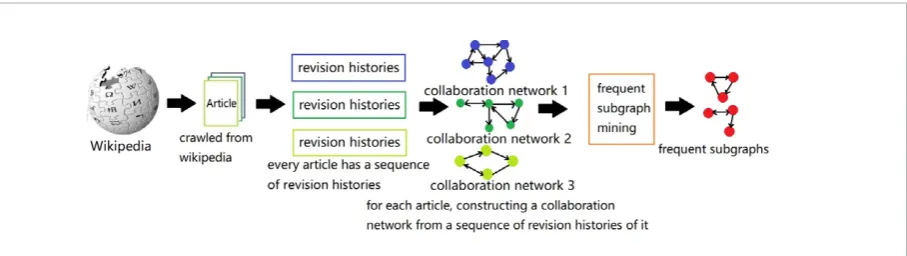
In short, the main process of our work can be sketched as follows. As can be seen in Figure 1, in the first step, articles are crawled from Wikipedia and a sequence Figure 1
The approach overview of our method
and unveil the influence of collaboration on the
qualities of collaborative outcome.
Hence, the skeleton of our methodology is as
fol-lows. For an article in Wikipedia has a sequence of
revision histories [30], we can construct a
collabo-ration network for the article from these revision
histories. The collaboration network can capture
structure and temporal dynamics which will
emerge once one editor modifies an article which
has been edited by a previous editor. In other
words, the collaboration network can record
vari-ous interactions among editors who have edited
the same article. Because the collaboration
net-work can capture substantial complex interactions
and dependencies among editors, it can model
that an article was collaboratively revised by many
authors. Utilizing the collaboration network, a
structural approach, we can characterize
collabo-ration patterns among editors in an effective way
and insight to the global collaboration among all
editors at a macro level. Furthermore,
collabora-tion subgraphs mined from collaboracollabora-tion
works can reflect the feature of collaboration
net-works at a micro level and are representative of
various collaboration patterns that appear
fre-quently.
Figure 1
The approach overview of our method.
In short, the main process of our work can be
sketched as follows. As can be seen in Figure 1, in
the first step, articles are crawled from Wikipedia
and a sequence of corresponding revision histories
are also crawled at the same time. In the second
step, we utilize a sequence of revision histories of
an article to construct a collaboration network. In
the final step, we apply frequent subgraph mining
algorithm to discover collaboration subgraphs
which appear frequently from these collaboration
networks. Through analyzing collaboration
sub-graphs, we discovered some interesting
experi-mental phenomena. The collaboration patterns of
which the topologies are stars usually produce
high quality articles. The influence of a successful
collaboration pattern on article quality is more
remarkable than that of anyone in a
collabo-ration pattern. Furthermore, some editors
constantly cooperate with each other in a
fixed collaboration pattern to produce high
quality articles. Finally, we also performed
some classification tasks to testify the
influ-ence of collaboration patterns on the qualities
of collaborative outcome. We found that the
results of the classification task were good.
Hence, the view that we construct
collabora-tion networks and mine collaboracollabora-tion
sub-graphs from them is worthwhile. The view
has been verified on Wikipedia by our work
and it also has some reference value to other
on-line collaboration systems.
In a word, we mainly apply the knowledge of
graph theory [26] and the approach of
fre-quent subgraphs mining to research
self-organization collaboration patterns among
editors. Our contributions are as follows.
1. Applying frequent subgraph mining to
re-search on-line self-organization collaboration.
2. Making up for the flaws of motifs.
3. Discovering various meaningful
collabora-tion patterns.
4. Proposing several metrics related to the
outcome of collaboration patterns.
The remainder of this article unfolds as
fol-lows. In the next section, we will introduce
some researches related with our work. In
Sect.3, we will explain how the collaboration
network is constructed in detail. In Sect.4, we
will introduce several algorithms we utilize
in experiments and some related basic
con-cepts. In Sect.5, we will exhibit experimental
results and corresponding analysis. In the
fi-nal section, we will discuss the influence of
collaboration on the outcome of collaboration
patterns and conclude our work with a
summary.
2. Related Work
The graph based approach has been long
ex-plored to represent the basic structures and
properties of the collaboration behaviours in
Wikipedia, which facilitates the
understand-ings of the collaborative activities from the
view point of interdependent relations
among the participants. Korfiatis et al. [16]
proposed a contributors network, where a
vertex represents an editor and an edge
rep-of corresponding revision histories are also crawledat the same time. In the second step, we utilize a se-quence of revision histories of an article to construct a collaboration network. In the final step, we apply frequent subgraph mining algorithm to discover col-laboration subgraphs which appear frequently from these collaboration networks. Through analyzing col-laboration subgraphs, we discovered some interesting experimental phenomena. The collaboration patterns of which the topologies are stars usually produce high quality articles. The influence of a successful collab-oration pattern on article quality is more remarkable than that of anyone in a collaboration pattern. Fur-thermore, some editors constantly cooperate with each other in a fixed collaboration pattern to produce high quality articles. Finally, we also performed some classification tasks to testify the influence of collabo-ration patterns on the qualities of collaborative out-come. We found that the results of the classification task were good.
Hence, the view that we construct collaboration net-works and mine collaboration subgraphs from them is worthwhile. The view has been verified on Wikipe-dia by our work and it also has some reference value to other on-line collaboration systems.
In a word, we mainly apply the knowledge of graph theory [26] and the approach of frequent subgraphs mining to research self-organization collaboration patterns among editors. Our contributions are as fol-lows.
1 Applying frequent subgraph mining to research on-line self-organization collaboration.
Information Technology and Control 2019/2/48 198
3 Discovering various meaningful collaboration pat-terns.
4 Proposing several metrics related to the outcome of collaboration patterns.
The remainder of this article unfolds as follows. In the next section, we will introduce some researches relat-ed with our work. In Sect.3, we will explain how the col-laboration network is constructed in detail. In Sect.4, we will introduce several algorithms we utilize in ex-periments and some related basic concepts. In Sect.5, we will exhibit experimental results and correspond-ing analysis. In the final section, we will discuss the influence of collaboration on the outcome of collabora-tion patterns and conclude our work with a summary.
2. Related Work
The graph based approach has been long explored to represent the basic structures and properties of the collaboration behaviours in Wikipedia, which facili-tates the understandings of the collaborative activi-ties from the view point of interdependent relations among the participants. Korfiatis et al. [16] proposed a contributors network, where a vertex represents an editor and an edge represents the sequence of their interactions, to evaluate the contribution importance of the collaborative editors working on the same ar-ticles. While the definition of the vertex keeps the same with ours, the edge of our collaboration graph represents the collaborative event between the edi-tors rather than the sequences. Similar to the contrib-utors-network mentioned above, Laniado and Tas-so [17] constructed a co-authorship network where nodes represent editors and edges represent co-au-thorship between editors. While inexperienced edi-tors whose contributions are too few will not appear in the co-author network, our work takes all editors into consideration. We construct a network for every article from revision histories of the articles. Our net-work, therefore, can reflect editors’ interactions on every specific article.
Except the form of network mentioned above, trajec-tory network is also widely used to research collabora-tion [15]. Iba et al. [12] constructed trajectory network for an article in Wikipedia, which can describe the development of the article. They focused on finding
different editor roles, namely egoboosters and cool-farmers, according to editing pattern presented in the network. In contrast, our work pays closer attention to various collaboration patterns among several editors rather than some featured editor. Furthermore, the editor-editor network proposed by Flöck and Acosta [11] is also a trajectory network, which is constructed dynamically over time. Through mining interactions from editor-editor network, interactions among edi-tors can be visualized as time has passed. Their work gives us a transparent and intuitive understanding of the dynamic collaboration among editors. While their work only takes the disagreement interactions among the editors into consideration, our work mainly fo-cuses on how the editors cooperating with each other can produce a good outcome.
199 Information Technology and Control 2019/2/48
results of their classification task will be when they classify articles into six classes.
There also exist non-graph-based studies. For in-stance, Adler and De Alfaro [1] proposed a con-tent-driven reputation system for Wikipedia editors. In their reputation system, if the edits that one ed-itor performed to Wikipedia articles are preserved by subsequent editors, then the editor will gain rep-utation otherwise reprep-utations of the editor will be re-duced. Hence, utilizing the characteristic that editors can influence and control each other, this system can apparently encourage editors to collaboratively write high-quality articles. Furthermore, one of prominent functions in the system is to predict the quality of a new article that has not yet been edited by others ac-cording to the reputation of its initial editor. In their [2] later work, after comparing seven methods to measure editor’s contributions, they found that edit longevity outperforms the six methods remaining. Dalip et al. [9] extracted 69 quality indicators from three aspects, namely textual feature, review feature and network feature. Based on a machine learning algorithm, they utilized these 69 indicators to assess the qualities of articles. Lipka and Stein [20] repre-sented an article as an n-dimensional vector of which each dimension is representative of a kind of trigram which is originally applied for writing style analysis. Then they utilized the n-dimensional vector, based on Support Vector Machine and Naive Bayes, to deter-mine whether an article is a featured article or not. As can be seen, they all researched article quality from the perspective of article content. Indeed, the content of an article is directly related to the quality of it. Nev-ertheless, collaboration is also an important factor that cannot be ignored. If collaboration among editors can be also taken into consideration, their experimen-tal results may be better.
3. Collaboration Network
In this section, we will elaborate how to construct a collaboration network from revision histories of an article. Jurgens and Lu[13] proposed a network per-spective that articles can be viewed as a sequence of revisions ordered by the edits times. A sequence of re-visions is fundamental elements for constructing our collaboration network. In our datasets, every revision history has been attached some edit information in-cluding not only title, revision id, parent revision id and minor but also editor name, editor id, timestamps and size. The information can be seen in the instance presented in Figure 2. Among this edit information, minor is a strange concept. In brief, a minor edit signi-fies that there are only superficial differences, such as typographical corrections, between the current ver-sions and the previous verver-sions. Conversely, a major edit should be reviewed for its acceptability to all con-cerned editors. Any changes affecting the meaning of an article are not a minor edit. For the sake of simplic-ity, we denote minor edit as 1 and major edit as 0.
Utilizing revision histories of an article mentioned above, we can construct a collaboration network for the article. For an article, firstly we establish a node representing the editor who created the first rever-sion of the article, and label the node with a unique number. Secondly, we establish the next node repre-senting the editor who has edited the article and then produced the second reversion, and we also label this node with another unique number. Thirdly, we es-tablish a directed edge pointing from the first node to the second one with the edge being labelled with 0 or 1 according to the edit type of this edit performed by the second editor. For the revision histories remain-ing, continue in this way. Then a collaboration net-work can be constructed completely. It is noteworthy
Figure 2
Edit information of seven revision histories of an article
Machine and Naive Bayes, to determine whether
an article is a featured article or not. As can be
seen, they all researched article quality from the
perspective of article content. Indeed, the content
of an article is directly related to the quality of it.
Nevertheless, collaboration is also an important
factor that cannot be ignored. If collaboration
among editors can be also taken into consideration,
their experimental results may be better.
3.
Collaboration Network
In this section, we will elaborate how to construct
a collaboration network from revision histories of
an article. Jurgens and Lu
[13] proposed a network
perspective that articles can be viewed as a
se-quence of revisions ordered by the edits times. A
sequence of revisions is fundamental elements for
constructing our collaboration network. In our
da-tasets, every revision history has been attached
some edit information including not only title,
re-vision id, parent rere-vision id and minor but also
editor name, editor id, timestamps and size. The
information can be seen in the instance presented
in Figure 2. Among this edit information, minor is
a strange concept. In brief, a minor edit signifies
that there are only superficial differences, such as
typographical corrections, between the current
versions and the previous versions. Conversely, a
major edit should be reviewed for its acceptability
to all concerned editors. Any changes affecting the
meaning of an article are not a minor edit. For the
sake of simplicity, we denote minor edit as 1 and
major edit as 0.
Utilizing revision histories of an article mentioned
above, we can construct a collaboration network
for the article. For an article, firstly we establish a
node representing the editor who created the first
reversion of the article, and label the node with a
unique number. Secondly, we establish the next
node representing the editor who has edited the
article and then produced the second reversion,
and we also label this node with another unique
number. Thirdly, we establish a directed edge
pointing from the first node to the second one
with the edge being labelled with 0 or 1 according
to the edit type of this edit performed by the
sec-ond editor. For the revision histories remaining,
continue in this way. Then a collaboration
net-work can be constructed completely. It is
notewor-thy that when constructing a collaboration
net-work for an article, self-loop edges are neglected
to avoid the case that an article was continuously
edited multiple times by the same editors. Figure 3
demonstrates the process of how the
collabo-ration network is constructed from the
in-formation in Figure 2.
As is shown in Figure 3, Hawkeye created a
new article. This is the first revision of the
ar-ticle. Then Anthony edited this arar-ticle. The
second revision consequently comes into
be-ing. For these two revisions, we establish two
nodes for them which are just the node H
and node A in Figure 3. Owing to the edit
performed by Anthony is a major edit, the
di-rected edge pointing from node H to node A
is labelled with 0. In the next time, Frietjes
edits the revision of Anthony and then the
directed edge pointing from node A to node
F is labelled with 1 for the edit performed by
Frietjes to the revision of Anthony is a minor
edit. Following Frietjes’s editing to the
revi-sion of Anthony, Yobot edited the revirevi-sion of
Frietjes. The label of the edge is 1 for the
same reason. Then Anthony returned to edit
the revision of Yobot with the edge being
la-belled with 0. The process for Dexbot and
Jarble is similar to previous editors and we
will not give unnecessary details here.
Figure 2
Edit information of seven revision histories
of an article.
Figure 3
A simple example which demonstrates the
process of constructing a collaboration
network from several revision histories of an
article. Each node label is the initial of
co-rresponding editor’ name.
infor-Information Technology and Control 2019/2/48 200
that when constructing a collaboration network for an article, self-loop edges are neglected to avoid the case that an article was continuously edited multi-ple times by the same editors. Figure 3 demonstrates the process of how the collaboration network is con-structed from the information in Figure 2.
As is shown in Figure 3, Hawkeye created a new article. This is the first revision of the article. Then Anthony edited this article. The second revision consequently comes into being. For these two revisions, we establish two nodes for them which are just the node H and node A in Figure 3. Owing to the edit performed by Anthony is a major edit, the directed edge pointing from node H to node A is labelled with 0. In the next time, Frietjes edits the revision of Anthony and then the directed edge pointing from node A to node F is labelled with 1 for the edit performed by Frietjes to the revision of Anthony is a minor edit. Following Frietjes’s editing to the revision of Anthony, Yobot edited the revision of Frietjes. The label of the edge is 1 for the same reason. Then Anthony returned to edit the revision of Yobot with the edge being labelled with 0. The process for Dexbot and Jarble is similar to previous editors and we will not give unnecessary details here.
It is noteworthy that the collaboration network does not contain complete time information. Although a sequence of revision histories is ordered chronolog-ically, our work mainly focuses on whether an editor interacts with another editor or not. We do not care the specific chronological sequence. In other words, it is unnecessary to know exactly which editor edited the article before which one.
For every article in our datasets, a collaboration net-work can be constructed according to the process Figure 3
A simple example which demonstrates the process of constructing a collaboration network from several revision histories of an article. Each node label is the initial of corresponding editor’ name
Machine and Naive Bayes, to determine whether
an article is a featured article or not. As can be
seen, they all researched article quality from the
perspective of article content. Indeed, the content
of an article is directly related to the quality of it.
Nevertheless, collaboration is also an important
factor that cannot be ignored. If collaboration
among editors can be also taken into consideration,
their experimental results may be better.
3.
Collaboration Network
In this section, we will elaborate how to construct
a collaboration network from revision histories of
an article. Jurgens and Lu
[13] proposed a network
perspective that articles can be viewed as a
se-quence of revisions ordered by the edits times. A
sequence of revisions is fundamental elements for
constructing our collaboration network. In our
da-tasets, every revision history has been attached
some edit information including not only title,
re-vision id, parent rere-vision id and minor but also
editor name, editor id, timestamps and size. The
information can be seen in the instance presented
in Figure 2. Among this edit information, minor is
a strange concept. In brief, a minor edit signifies
that there are only superficial differences, such as
typographical corrections, between the current
versions and the previous versions. Conversely, a
major edit should be reviewed for its acceptability
to all concerned editors. Any changes affecting the
meaning of an article are not a minor edit. For the
sake of simplicity, we denote minor edit as 1 and
major edit as 0.
Utilizing revision histories of an article mentioned
above, we can construct a collaboration network
for the article. For an article, firstly we establish a
node representing the editor who created the first
reversion of the article, and label the node with a
unique number. Secondly, we establish the next
node representing the editor who has edited the
article and then produced the second reversion,
and we also label this node with another unique
number. Thirdly, we establish a directed edge
pointing from the first node to the second one
with the edge being labelled with 0 or 1 according
to the edit type of this edit performed by the
sec-ond editor. For the revision histories remaining,
continue in this way. Then a collaboration
net-work can be constructed completely. It is
notewor-thy that when constructing a collaboration
net-work for an article, self-loop edges are neglected
to avoid the case that an article was continuously
edited multiple times by the same editors. Figure 3
demonstrates the process of how the
collabo-ration network is constructed from the
in-formation in Figure 2.
As is shown in Figure 3, Hawkeye created a
new article. This is the first revision of the
ar-ticle. Then Anthony edited this arar-ticle. The
second revision consequently comes into
be-ing. For these two revisions, we establish two
nodes for them which are just the node H
and node A in Figure 3. Owing to the edit
performed by Anthony is a major edit, the
di-rected edge pointing from node H to node A
is labelled with 0. In the next time, Frietjes
edits the revision of Anthony and then the
directed edge pointing from node A to node
F is labelled with 1 for the edit performed by
Frietjes to the revision of Anthony is a minor
edit. Following Frietjes’s editing to the
revi-sion of Anthony, Yobot edited the revirevi-sion of
Frietjes. The label of the edge is 1 for the
same reason. Then Anthony returned to edit
the revision of Yobot with the edge being
la-belled with 0. The process for Dexbot and
Jarble is similar to previous editors and we
will not give unnecessary details here.
Figure 2
Edit information of seven revision histories
of an article.
Figure 3
A simple example which demonstrates the
process of constructing a collaboration
network from several revision histories of an
article. Each node label is the initial of
co-rresponding editor’ name.
It is noteworthy that the collaboration
net-work does not contain complete time
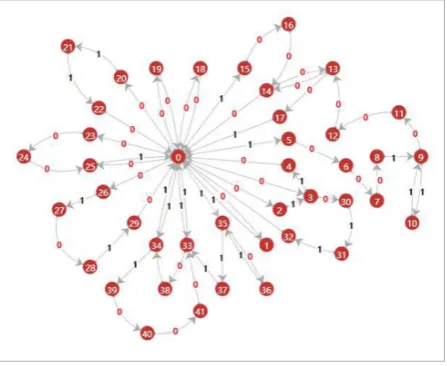
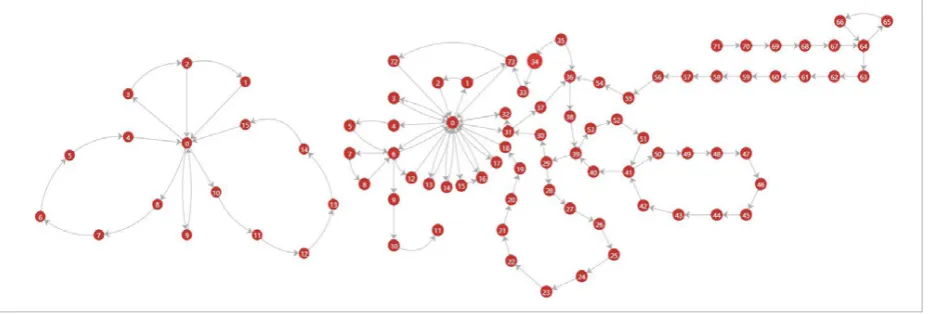
infor-mentioned above. Finally, we select a collaboration network from 3916 collaboration networks as an ex-ample, which is presented in Figure 4.
Figure 4
A complete collaboration network of a ”FA” article (Each label of a node is the id of the corresponding editor)
tories is ordered chronologically, our work mainly focuses on whether an editor interacts with anoth-er editor or not. We do not care the specific chron-ological sequence. In other words, it is unneces-sary to know exactly which editor edited the arti-cle before which one.
For every article in our datasets, a collaboration network can be constructed according to the pro-cess mentioned above. Finally, we select a collabo-ration network from 3916 collabocollabo-ration networks as an example, which is presented in Figure 4.
Figure 4
A complete collaboration network of a ”FA” arti-cle (Each label of a node is the id of the corre-sponding editor).
4. Algorithms
In this section, we will introduce two algorithms we utilize to accomplish our work smoothly and some basic concepts about frequent subgraphs mining. Assume that we have n articles denoted as
1
, , ,
2 na a
a
. for1
i n
, lete e
i1, , ,
i2
e
imbe the editors of corresponding revision histories.For each article, due to a sequence of revision his-tories are arranged chronologically in our datasets, the algorithm constructCollaborationNetwork na-ively iterates over a sequence of revision histories in order to establish nodes different from each other and edges pointing from one node con-structed from the previous revision history to a node constructed from the current one. Through the iteration process above, collaboration
net-works for every article can be constructed completely. It is noteworthy that in this algo-rithm there probably exist multiple edges appearing between two different nodes. Mul-tiple edges are also important, which may represent disputes between two authors or closed collaboration.
Finally, we will give a brief introduction to some basic concepts about frequent sub-graphs mining and the algorithm GRAMI by taking the specific problems in our work for example.
Figure 5
A simple example of frequent subgraph mi-ning.
4. Algorithms
In this section, we will introduce two algorithms we utilize to accomplish our work smoothly and some basic concepts about frequent subgraphs mining. As-sume that we have n articles denoted as a a1, , ,2 an.
for 1≤ ≤i n, let e ei1, , ,i2 eim be the editors of
corre-sponding revision histories.
201 Information Technology and Control 2019/2/48
algorithm constructCollaborationNetwork naively iterates over a sequence ofrevision histories in or-der to establish nodes different from each other and edges pointing from one node constructed from the previous revision history to a node constructed from the current one. Through the iteration process above, collaboration networks for every article can be con-structed completely. It is noteworthy that in this algo-rithm there probably exist multiple edges appearing between two different nodes. Multiple edges are also important, which may represent disputes between two authors or closed collaboration.
Finally, we will give a brief introduction to some basic concepts about frequent subgraphs mining and the algorithm GRAMI by taking the specific problems in our work for example.
tories is ordered chronologically, our work mainly focuses on whether an editor interacts with anoth-er editor or not. We do not care the specific chron-ological sequence. In other words, it is unneces-sary to know exactly which editor edited the arti-cle before which one.
For every article in our datasets, a collaboration network can be constructed according to the pro-cess mentioned above. Finally, we select a collabo-ration network from 3916 collabocollabo-ration networks as an example, which is presented in Figure 4.
Figure 4
A complete collaboration network of a ”FA” arti-cle (Each label of a node is the id of the corre-sponding editor).
4. Algorithms
In this section, we will introduce two algorithms we utilize to accomplish our work smoothly and some basic concepts about frequent subgraphs mining. Assume that we have n articles denoted as
1
, , ,
2 na a
a
. for1
i n
, lete e
i1, , ,
i2
e
imbe the editors of corresponding revision histories. For each article, due to a sequence of revision his-tories are arranged chronologically in our datasets, the algorithm constructCollaborationNetwork na-ively iterates over a sequence ofrevision histories in order to establish nodes different from each other and edges pointing from one node con-structed from the previous revision history to a node constructed from the current one. Through the iteration process above, collaborationnet-works for every article can be constructed completely. It is noteworthy that in this algo-rithm there probably exist multiple edges appearing between two different nodes. Mul-tiple edges are also important, which may represent disputes between two authors or closed collaboration.
Finally, we will give a brief introduction to some basic concepts about frequent sub-graphs mining and the algorithm GRAMI by taking the specific problems in our work for example.
Figure 5
A simple example of frequent subgraph mi-ning.
In short, frequent subgraph mining is the process of discovering in graph database or in a single large graph all subgraphs whose frequencies of occurrenc-es are no loccurrenc-ess than a specific throccurrenc-eshold previously set by users. The frequency of occurrences is called sup-port and denoted as supp. As is shown in Figure 5, there are three collaboration networks constructed
from revision histories of three articles. Six frequent subgraphs can be mined when the threshold equals 3. Currently, frequent subgraph mining technologies are rather mature and there are many algorithms for frequent subgraph mining such as CloseGraph, FSG, gSpan, GRAMI[10, 22]. Different frequent subgraph mining algorithms are applicable for different types of graphs and also different in performance. Taking above factors into consideration synthetically, we finally selected the last one. Furthermore, the algo-rithm GRAMI also possesses some merits mentioned below.
The algorithm GRAMI only finds the minimum set of instances of a candidate subgraph. That is to say, the algorithm will terminate the progress of discovering instances of a candidate subgraph as soon as the num-ber of instances of the candidate subgraph is no less than the support threshold. Hence, this feature of the algorithm can improve the performance of the algo-rithm. To handle single large graphs, the algorithm adopts two optimizations which improve the perfor-mance of the algorithm significantly. The first optimi-zation is to evaluate expensive nodes after evaluating lightweight ones. The second optimization is to prune the search space by utilizing the previous subgraph evaluations and the features of graph structure.
How to judge whether a subgraph is frequent is a basic problem for all frequent subgraph mining algorithms. The algorithm GRAMI adopts the support metric MNI which is an antimonotone support metric [6]. For example, in Figure 6 there are five valid solu-tions Figure 5
A simple example of frequent subgraph mining
tories is ordered chronologically, our work mainly
focuses on whether an editor interacts with
anoth-er editor or not. We do not care the specific
chron-ological sequence. In other words, it is
unneces-sary to know exactly which editor edited the
arti-cle before which one.
For every article in our datasets, a collaboration
network can be constructed according to the
pro-cess mentioned above. Finally, we select a
collabo-ration network from 3916 collabocollabo-ration networks
as an example, which is presented in Figure 4.
Figure 4
A complete collaboration network of a ”FA”
arti-cle (Each label of a node is the id of the
corre-sponding editor).
4. Algorithms
In this section, we will introduce two algorithms
we utilize to accomplish our work smoothly and
some basic concepts about frequent subgraphs
mining. Assume that we have n articles denoted as
1
, , ,
2 na a
a
. for
1
i n
, let
e e
i1, , ,
i2
e
imbe
the editors of corresponding revision histories.
For each article, due to a sequence of revision
his-tories are arranged chronologically in our datasets,
the algorithm constructCollaborationNetwork
na-ively iterates over a sequence of
revision histories
in order to establish nodes different from each
other and edges pointing from one node
con-structed from the previous revision history to a
node constructed from the current one. Through
the iteration process above, collaboration
net-works for every article can be constructed
completely. It is noteworthy that in this
algo-rithm there probably exist multiple edges
appearing between two different nodes.
Mul-tiple edges are also important, which may
represent disputes between two authors or
closed collaboration.
Finally, we will give a brief introduction to
some basic concepts about frequent
sub-graphs mining and the algorithm GRAMI by
taking the specific problems in our work for
example.
Figure 5
A simple example of frequent subgraph
mi-ning.
tories is ordered chronologically, our work mainly
focuses on whether an editor interacts with
anoth-er editor or not. We do not care the specific
chron-ological sequence. In other words, it is
unneces-sary to know exactly which editor edited the
arti-cle before which one.
For every article in our datasets, a collaboration
network can be constructed according to the
pro-cess mentioned above. Finally, we select a
collabo-ration network from 3916 collabocollabo-ration networks
as an example, which is presented in Figure 4.
Figure 4
A complete collaboration network of a ”FA”
arti-cle (Each label of a node is the id of the
corre-sponding editor).
4. Algorithms
In this section, we will introduce two algorithms
we utilize to accomplish our work smoothly and
some basic concepts about frequent subgraphs
mining. Assume that we have n articles denoted as
1
, , ,
2 na a
a
. for
1
i n
, let
e e
i1, , ,
i2
e
imbe
the editors of corresponding revision histories.
For each article, due to a sequence of revision
his-tories are arranged chronologically in our datasets,
the algorithm constructCollaborationNetwork
na-ively iterates over a sequence of
revision histories
in order to establish nodes different from each
other and edges pointing from one node
con-structed from the previous revision history to a
node constructed from the current one. Through
the iteration process above, collaboration
net-works for every article can be constructed
completely. It is noteworthy that in this
algo-rithm there probably exist multiple edges
appearing between two different nodes.
Mul-tiple edges are also important, which may
represent disputes between two authors or
closed collaboration.
Finally, we will give a brief introduction to
some basic concepts about frequent
sub-graphs mining and the algorithm GRAMI by
taking the specific problems in our work for
example.
Figure 5
A simple example of frequent subgraph
mi-ning.
tories is ordered chronologically, our work mainly
focuses on whether an editor interacts with
anoth-er editor or not. We do not care the specific
chron-ological sequence. In other words, it is
unneces-sary to know exactly which editor edited the
arti-cle before which one.
For every article in our datasets, a collaboration
network can be constructed according to the
pro-cess mentioned above. Finally, we select a
collabo-ration network from 3916 collabocollabo-ration networks
as an example, which is presented in Figure 4.
Figure 4
A complete collaboration network of a ”FA”
arti-cle (Each label of a node is the id of the
corre-sponding editor).
4. Algorithms
In this section, we will introduce two algorithms
we utilize to accomplish our work smoothly and
some basic concepts about frequent subgraphs
mining. Assume that we have n articles denoted as
1
, , ,
2 na a
a
. for
1
i n
, let
e e
i1, , ,
i2
e
imbe
the editors of corresponding revision histories.
For each article, due to a sequence of revision
his-tories are arranged chronologically in our datasets,
the algorithm constructCollaborationNetwork
na-ively iterates over a sequence of
revision histories
in order to establish nodes different from each
other and edges pointing from one node
con-structed from the previous revision history to a
node constructed from the current one. Through
the iteration process above, collaboration
net-works for every article can be constructed
completely. It is noteworthy that in this
algo-rithm there probably exist multiple edges
appearing between two different nodes.
Mul-tiple edges are also important, which may
represent disputes between two authors or
closed collaboration.
Finally, we will give a brief introduction to
some basic concepts about frequent
sub-graphs mining and the algorithm GRAMI by
taking the specific problems in our work for
example.
Figure 5
A simple example of frequent subgraph
mi-ning.
tories is ordered chronologically, our work mainly
focuses on whether an editor interacts with
anoth-er editor or not. We do not care the specific
chron-ological sequence. In other words, it is
unneces-sary to know exactly which editor edited the
arti-cle before which one.
For every article in our datasets, a collaboration
network can be constructed according to the
pro-cess mentioned above. Finally, we select a
collabo-ration network from 3916 collabocollabo-ration networks
as an example, which is presented in Figure 4.
Figure 4
A complete collaboration network of a ”FA”
arti-cle (Each label of a node is the id of the
corre-sponding editor).
4. Algorithms
In this section, we will introduce two algorithms
we utilize to accomplish our work smoothly and
some basic concepts about frequent subgraphs
mining. Assume that we have n articles denoted as
1
, , ,
2 na a
a
. for
1
i n
, let
e e
i1, , ,
i2
e
imbe
the editors of corresponding revision histories.
For each article, due to a sequence of revision
his-tories are arranged chronologically in our datasets,
the algorithm constructCollaborationNetwork
na-ively iterates over a sequence of
revision histories
in order to establish nodes different from each
other and edges pointing from one node
con-structed from the previous revision history to a
node constructed from the current one. Through
the iteration process above, collaboration
net-works for every article can be constructed
completely. It is noteworthy that in this
algo-rithm there probably exist multiple edges
appearing between two different nodes.
Mul-tiple edges are also important, which may
represent disputes between two authors or
closed collaboration.
Finally, we will give a brief introduction to
some basic concepts about frequent
sub-graphs mining and the algorithm GRAMI by
taking the specific problems in our work for
example.
Figure 5
Information Technology and Control 2019/2/48 202
highlighted with circles and a corresponding MNI table calculated according to these solutions. A valid solution is a mapping from S to a subgraph of G ac-cording to labels of nodes and edges. For all columns in the MNI table, the minimum size of all the columns is 5. So the support of S is 5. If the threshold is no more than 5, then S is a frequent subgraph of G.
5. Experiment
5.1. Datasets
According to Wikipedia article quality scale, articles in Wikipedia can be classified to seven classes as follows:
FA: these articles are the best and they are outstand-ing, thorough and professional.
A: these articles are pretty complete but to be promot-ed “FA”, some problems still nepromot-ed solving.
GA: these articles have no obvious problems and al-most every user thinks that these articles are useful.
B: these articles, in terms of content, are complete and have no major problems.
C: these articles are substantial while they miss the content of importance yet or contain much irrelevant material.
Start: these articles are incomplete and need to be perfected further.
Figure 6
A single graph G and its subgraph S
Table 1
The article distribution in our datasets
Class FA GA B C Start Stub #articles 316 437 611 715 1156 681 In short, frequent subgraph mining is the process
of discovering in graph database or in a single large graph all subgraphs whose frequencies of occurrences are no less than a specific threshold previously set by users. The frequency of occur-rences is called support and denoted as supp. As is shown in Figure 5, there are three collaboration networks constructed from revision histories of three articles. Six frequent subgraphs can be mined when the threshold equals 3.
Currently, frequent subgraph mining technologies are rather mature and there are many algorithms for frequent subgraph mining such as CloseGraph, FSG, gSpan, GRAMI [10, 22]. Different frequent subgraph mining algorithms are applicable for dif-ferent types of graphs and also difdif-ferent in per-formance. Taking above factors into consideration synthetically, we finally selected the last one. Fur-thermore, the algorithm GRAMI also possesses some merits mentioned below.
The algorithm GRAMI only finds the minimum set of instances of a candidate subgraph. That is to say, the algorithm will terminate the progress of discovering instances of a candidate subgraph as soon as the number of instances of the candidate subgraph is no less than the support threshold. Hence, this feature of the algorithm can improve the performance of the algorithm. To handle single large graphs, the algorithm adopts two optimiza-tions which improve the performance of the algo-rithm significantly. The first optimization is to evaluate expensive nodes after evaluating light-weight ones. The second optimization is to prune the search space by utilizing the previous sub-graph evaluations and the features of sub-graph struc-ture.
Figure 6
A single graph G and its subgraph S.
How to judge whether a subgraph is frequent is a basic problem for all frequent subgraph mining algorithms. The algorithm GRAMI adopts the support metric MNI which is an antimonotone support metric [6]. For exam-ple, in Figure 6 there are five valid solutions highlighted with circles and a corresponding MNI table calculated according to these solu-tions. A valid solution is a mapping from S to a subgraph of G according to labels of nodes and edges. For all columns in the MNI table, the minimum size of all the columns is 5. So the support of S is 5. If the threshold is no more than 5, then S is a frequent subgraph of G.
5. Experiment
5. 1. Datasets
According to Wikipedia article quality scale, articles in Wikipedia can be classified to sev-en classes as follows:
FA: these articles are the best and they are outstanding, thorough and professional.
A: these articles are pretty complete but to be promoted “FA”, some problems still need solving.
GA: these articles have no obvious problems and almost every user thinks that these arti-cles are useful.
B: these articles, in terms of content, are complete and have no major problems.
C: these articles are substantial while they miss the content of importance yet or contain much irrelevant material.
Start: these articles are incomplete and need to be perfected further.
Stub: these articles just describe some basic content of a topic.
Hence the ranking of these seven classes of articles, in terms of quality, is as follows:
FA A GA B C Start Stub
.Table 1
The article distribution in our datasets
Class FA GA B C Start Stub #articles 316 437 611 715 1156 681 In short, frequent subgraph mining is the process
of discovering in graph database or in a single large graph all subgraphs whose frequencies of occurrences are no less than a specific threshold previously set by users. The frequency of occur-rences is called support and denoted as supp. As is shown in Figure 5, there are three collaboration networks constructed from revision histories of three articles. Six frequent subgraphs can be mined when the threshold equals 3.
Currently, frequent subgraph mining technologies are rather mature and there are many algorithms for frequent subgraph mining such as CloseGraph, FSG, gSpan, GRAMI [10, 22]. Different frequent subgraph mining algorithms are applicable for dif-ferent types of graphs and also difdif-ferent in per-formance. Taking above factors into consideration synthetically, we finally selected the last one. Fur-thermore, the algorithm GRAMI also possesses some merits mentioned below.
The algorithm GRAMI only finds the minimum set of instances of a candidate subgraph. That is to say, the algorithm will terminate the progress of discovering instances of a candidate subgraph as soon as the number of instances of the candidate subgraph is no less than the support threshold. Hence, this feature of the algorithm can improve the performance of the algorithm. To handle single large graphs, the algorithm adopts two optimiza-tions which improve the performance of the algo-rithm significantly. The first optimization is to evaluate expensive nodes after evaluating light-weight ones. The second optimization is to prune the search space by utilizing the previous sub-graph evaluations and the features of sub-graph struc-ture.
Figure 6
A single graph G and its subgraph S.
How to judge whether a subgraph is frequent is a basic problem for all frequent subgraph mining algorithms. The algorithm GRAMI adopts the support metric MNI which is an antimonotone support metric [6]. For exam-ple, in Figure 6 there are five valid solutions highlighted with circles and a corresponding MNI table calculated according to these solu-tions. A valid solution is a mapping from S to a subgraph of G according to labels of nodes and edges. For all columns in the MNI table, the minimum size of all the columns is 5. So the support of S is 5. If the threshold is no more than 5, then S is a frequent subgraph of G.
5. Experiment
5. 1. Datasets
According to Wikipedia article quality scale, articles in Wikipedia can be classified to sev-en classes as follows:
FA: these articles are the best and they are outstanding, thorough and professional.
A: these articles are pretty complete but to be promoted “FA”, some problems still need solving.
GA: these articles have no obvious problems and almost every user thinks that these arti-cles are useful.
B: these articles, in terms of content, are complete and have no major problems.
C: these articles are substantial while they miss the content of importance yet or contain much irrelevant material.
Start: these articles are incomplete and need to be perfected further.
Stub: these articles just describe some basic content of a topic.
Hence the ranking of these seven classes of articles, in terms of quality, is as follows:
FA A GA B C Start Stub
. Stub: these articles just describe some basic content of a topic.Hence the ranking of these seven classes of articles, in terms of quality, is as follows:
Table 2
The sizes of six types of collaboration networks
Class FA GA B C Start Stub #nodes 1732
17 164317 299280 243191 97102 17876 #edges 3104
86 290131 494794 368404 128772 20829
FA A GA B C Start Stub . The datasets we select for our experiments consist of 3916 articles which were collected on February 20, 2016. These articles have totally 2364520 revi-sion histories. Table 1 shows the article distribu-tion in our datasets. By the way, the reason why “A” class articles are not included in our datasets is that these articles are too few in Wikipedia and we grouped “A” class articles with “GA” class ar-ticles. From Table 1, we can catch sight of that the quantity of high quality articles, generally speak-ing, is less than the quantity of less excellent arti-cles. In fact, it is similar to the articles distribution in Wikipedia as well. Anyone can get Wikipedia articles by aid of MediaWiki API help and API sandbox.
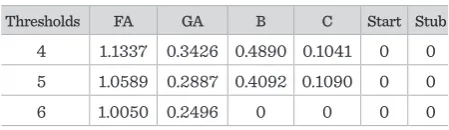
For the sake of simplicity, we divided the original datasets into six parts according to Table 1 and then constructed collaboration networks respec-tively. Finally, we mined collaboration subgraphs from these six types of collaboration networks separately. The sizes of these six types of collabo-ration networks are displayed in Table 2. It is noteworthy that thresholds set to mine collabora-tion subgraphs from six types of collaboracollabora-tion networks are in proportion to the number of cor-responding class articles in our datasets. Therefore, according to Table 1, the thresholds denoted as th for six types of collaboration networks satisfy the equation below:
316 437 611 715 1156FA GA B C Start 681Stub
th th th th
th = = th = = = .
For example, if the threshold of “FA” collabora-tion networks is 4, then the thresholds for the oth-er five types of collaboration networks are 6, 8, 10, 15 and 9, respectively. For the sake of simplicity, without specific explanations, we only give the threshold of “FA” collaboration networks later and the thresholds for the other five types of col-laboration networks can be easily got by this equa-tion.
5.2 Experimental Results and Analysis 5.2.1 Analysing Collaboration Patterns among Editors
As can be observed from Figure 7, collabora-tion subgraphs of “FA” collaboracollabora-tion net-works, in terms of size, are more diverse than those of the other five types of collaboration networks. Furthermore, the sizes 2, 3, 4, 5 or 6 are common. To be more specific, the col-laboration patterns that 2 to 6 people coau-thor articles in Wikipedia are very common. Moreover, compared to the other five classes of articles, frequent collaboration patterns in “FA” articles are more diverse and the scale of these frequent collaboration patterns is larger.
Figure 7
The distribution of collaboration subgraphs size. The threshold is 4. The quantity of nodes in a collaboration subgraph is the size of it here.
Figure 8
The distribution of collaboration subgraphs size at the thresholds 4, 5 and 6, respectively. The quantity of nodes in a collaboration sub-graph is the size of it here.
The datasets we select for our experiments consist of 3916 articles which were collected on February 20, 2016. These articles have totally 2364520 revi-sion histories. Table 1 shows the article distribution in our datasets. By the way, the reason why “A” class articles are not included in our datasets is that these articles are too few in Wikipedia and we grouped “A” class articles with “GA” class articles. From Table 1, we can catch sight of that the quantity of high quality articles, generally speaking, is less than the quantity of less excellent articles. In fact, it is similar to the ar-ticles distribution in Wikipedia as well. Anyone can get Wikipedia articles by aid of MediaWiki API help and API sandbox.
Table 1
The article distribution in our datasets
Class FA GA B C Start Stub
#articles 316 437 611 715 1156 681
For the sake of simplicity, we divided the original datasets into six parts according to Table 1 and then constructed collaboration networks respectively. Fi-nally, we mined collaboration subgraphs from these six types of collaboration networks separately. The sizes of these six types of collaboration networks are displayed in Table 2. It is noteworthy that thresholds set to mine collaboration subgraphs from six types of collaboration networks are in proportion to the num-ber of corresponding class articles in our datasets. Therefore, according to Table 1, the thresholds denot-ed as th for six types of collaboration networks satisfy the equation below:
Table 2
The sizes of six types of collaboration networks Class FA GA B C Start Stub #nodes 1732
17 16431 7 29928 0 2431 91
97102 1787 6 #edges 3104
86 290131 494794 368404 128772 20829
FA A GA B C Start Stub .
The datasets we select for our experiments consist of 3916 articles which were collected on February 20, 2016. These articles have totally 2364520 revi-sion histories. Table 1 shows the article distribu-tion in our datasets. By the way, the reason why “A” class articles are not included in our datasets is that these articles are too few in Wikipedia and we grouped “A” class articles with “GA” class ar-ticles. From Table 1, we can catch sight of that the quantity of high quality articles, generally speak-ing, is less than the quantity of less excellent arti-cles. In fact, it is similar to the articles distribution in Wikipedia as well. Anyone can get Wikipedia articles by aid of MediaWiki API help and API sandbox.
For the sake of simplicity, we divided the original datasets into six parts according to Table 1 and then constructed collaboration networks respec-tively. Finally, we mined collaboration subgraphs from these six types of collaboration networks separately. The sizes of these six types of collabo-ration networks are displayed in Table 2. It is noteworthy that thresholds set to mine collabora-tion subgraphs from six types of collaboracollabora-tion networks are in proportion to the number of cor-responding class articles in our datasets. Therefore, according to Table 1, the thresholds denoted as th for six types of collaboration networks satisfy the equation below:
316 437 611 715 1156FA GA B C Start 681Stub
th th th th
th = = th = = = .
For example, if the threshold of “FA” collabora-tion networks is 4, then the thresholds for the oth-er five types of collaboration networks are 6, 8, 10, 15 and 9, respectively. For the sake of simplicity, without specific explanations, we only give the threshold of “FA” collaboration networks later and the thresholds for the other five types of col-laboration networks can be easily got by this equa-tion.
5.2 Experimental Results and Analysis
5.2.1 Analysing Collaboration Patterns among Editors
As can be observed from Figure 7, collabora-tion subgraphs of “FA” collaboracollabora-tion net-works, in terms of size, are more diverse than those of the other five types of collaboration networks. Furthermore, the sizes 2, 3, 4, 5 or 6 are common. To be more specific, the col-laboration patterns that 2 to 6 people coau-thor articles in Wikipedia are very common. Moreover, compared to the other five classes of articles, frequent collaboration patterns in “FA” articles are more diverse and the scale of these frequent collaboration patterns is larger.
Figure 7
The distribution of collaboration subgraphs size. The threshold is 4. The quantity of nodes in a collaboration subgraph is the size of it here.
Figure 8
The distribution of collaboration subgraphs size at the thresholds 4, 5 and 6, respectively. The quantity of nodes in a collaboration sub-graph is the size of it here.