A Hybrid Algorithm for
Multi-Objective Optimization of
Minimizing Makespan and Total
Flow Time in Permutation Flow
Shop Scheduling Problems
ITC 1/48
Journal of Information Technology and Control
Vol. 48 / No. 1 / 2019 pp. 47-57
DOI 10.5755/j01.itc.48.1.20909
A Hybrid Algorithm for Multi-Objective Optimization of
Minimizing Makespan and Total Flow Time in Permutation
Flow Shop Scheduling Problems
Received 2018/06/08
Accepted after revision 2018/09/27
http://dx.doi.org/10.5755/j01.itc.48.1.20909
Corresponding author:
[email protected]
R. B. Jeen Robert
Faculty of Mechanical Engineering; AAA College of Engineering and Technology; Amathur, Sivakasi -626005,
India; phone: +91 9488081212; e-mail: [email protected]
R. Rajkumar
Faculty of Mechanical Engineering; Mepco Schlenk Engineering College; Sivakasi -626005, Virudhunagar Dist,
India; phone: +91 9486259435; e-mail: [email protected]
In this work, a hybrid algorithm has been proposed to solve bi-objective permutation flow shop scheduling
prob-lem. The primary concern of flow shop scheduling problem considered in this work is to obtain the best sequence,
which minimizes the makespan and the total flow time of all jobs. Bi-objective issues are comprehended by doling
out uniform weight to every objective function in view of its preference or determining every competent
solu-tions. In the flow shop scheduling environment, many meta-heuristic algorithms have been used to find optimal
or near-optimal solutions due to the computational cost of determining exact solutions. This work provides a
hy-bridization of genetic algorithm and simulated annealing algorithm (HGASA) based multi-objective optimization
algorithm for flow shop scheduling. The proposed HGASA algorithm is used to solve a bi-objective problem that
minimizes the makespan and the total flow time. The performance of the proposed algorithm is demonstrated by
applying it to benchmark problems available in the OR-Library. The test results show that the HGASA algorithm
performed better in terms of searching quality and efficiency than other meta-heuristic algorithms.
Information Technology and Control 2019/1/48
48
1. Introduction
In permutation flow shop scheduling, ‘
n
’ jobs must
be processed on ‘
m
’ machines in the same Order
se-quence. The operation succession is the same for all
jobs. The permutation flow shop scheduling (PFSSP)
has a broad foundation in assembling frameworks
and has pulled in numerous analysis consideration
by Johnson [10]. Numerous researches for single
ob-jective FSSPs result in a schedule to minimize the
makespan. The traditional ways to solve
single-objec-tive FSSP can be predominantly partitioned into two
classes, to be specific, exact and approximation
tech-niques. For a limited-wait constraints, complex
hy-brid flow-shop scheduling problem was solved with
discrete time exact arrangement approach by Gicquel
et al. [6], and a modified teaching–learning-based
op-timization algorithm has been used to solve
bi-objec-tive re-entrant hybrid flow shop scheduling by Shen
et al. [20]. Later, Jeen Robert and Rajkumar [8]
pro-posed a hybrid algorithm for minimizing makespan
in the PFSSP. Two-machine and three-machine flow
shop scheduling problem is solved using
branch-and-bound (B&B) algorithm [7]. Campbell et al. [4] built
up a heuristic algorithm for
n
-job m-machine
se-quencing problem with a goal of minimizing total flow
time. A general schedule for
n
jobs with m machines is
(n!)m
. In this situation, just
n!
schedules must be
con-sidered to stay away from job flow. The performance
measures of flow shop scheduling are makespan,
to-tal flow time and tardiness and so on. In flow shop
environment, solving a single objective problem is
very tedious one. Majority of studies for the flow shop
scheduling problem focuses to minimize makespan.
However, there are other important objectives than
makespan for the flow shop scheduling problem. For
example, the total flow time, the total machine idle
time are very important performance measures in
minimizing total scheduling cost. Hence, we consider
the flow shop scheduling problem with the objectives
of makespan and total flow time in this study. Weishi
et al. [23] described a self-guided differential
evolu-tion with a neighborhood search for permutaevolu-tion flow
shop scheduling. Rajendran [14] has developed a
heu-ristic algorithm with the objective of minimizing the
makespan and the total flow time for bi-objective flow
shop scheduling problem. Nagar et al. [11] developed a
combined hybrid algorithm to solve PFSSP with
bet-ter minimization of makespan and average total flow
Recently, Sanjeev Kumar et al. [19] developed a
mod-ified gravitational emulation local search (MGELS)
algorithm to minimize both makespan and total flow
time. The proposed methodology is carried out with
the flow shop benchmark problem, and the
execu-tion of MGELS algorithm is contrasted with CR
al-gorithm, HAMC1, HAMC2, HAMC3, CR (MC),
Mul-tiple Objective Adaptive Clonal Selection Algorithm
(MOACSA), GA, and DT algorithm. In this present
work, a hybrid algorithm is proposed that hybridizes
the Genetic Algorithm (GA) and the simulated
An-nealing (SA) algorithm. The Genetic algorithm acts
as local search scheme and the Simulated Annealing
algorithm acts as a global search scheme by accepting
some inferior count values. Moreover, in proposed
HGASA, the sub chromosomal level crossover and
mutation is implemented to get better results and
this seed is given to the SA algorithm to get further
improvements which avoids the worst solution. So it
is believed that HGASA can achieve satisfactory
im-provement for PFSSPs. Then the performance of the
proposed algorithm is tested with flow shop
schedul-ing benchmark problems. The results obtained by the
proposed HGASA are compared with earlier reported
results of CR algorithm, HAMC1, HAMC2, HAMC3,
CR (MC), MOACSA, GA, and DT algorithm. Test
re-sults show that the proposed algorithm is more
effi-cient than other algorithm and best suited for large
sized problems.
The rest of this paper is organized as follows: Section 2
presents the mathematical model of PFSP. Section 3
presents the flowchart and procedure of proposed
HGS-SA for PFSP. Section 4 shows the experimental results
and comparisons between HGSSA and other algorithms.
Section 5 summarizes the conclusions of this work.
2. Mathematical Model of PFSP
In the present paper, bi-objective optimization for
minimizing the makespan and total flow time for
es-tablished PFSP is considered. The detailed
explana-tion of PFSP is given in sub sequent secexplana-tion.
2.1. Permutation Flow Shop Scheduling
Problem (PFSP)
The main objective of the permutation flow shop
sched-uling problem is to find a suitable job sequence that
minimizes makespan and total flow time. The objective
of this work is to develop a HGASA and hence to find the
optimal or near optimal solution sequence in flow shop
scheduling by minimizing makespan and total flow
time. In PFSP, there are ‘
n’
independent jobs
(permuta-tion job set
j
= 1, 2,. . .n) that should be processed on ‘
m’
machines (
k
= 1,2,. . .m) and
B
kis an inter-mediate buffer
between two consecutive machines
.
All the machines
(
M
1, M
2,…..,M
m) follow the same job sequence till the
end of all operations. This means that, the
r
thtask of job
j
is executed by machine
M
rwith processing time
T(r, j),
where 1
≤
r
≤
m
, and 1
≤
j
≤
k.
Therefore, the completion
times of jobs on the machines, makespan and the total
flow time (TFT) of the jobs in the flow shop scheduling
can be intended as follows:
The following notations are used in PFSP:
T(r, j)
Processing time for job
r
on a given
ma-chine
j
(
r
=1, 2,…..n), (
j
= 1, 2…..m)
n
total number of jobs to be scheduled
m
total number of machines in the process
Cmax
makespan
r
the occupation sequenced in the
i
thposi-tion of a schedule
C(r, j)
the completion time of jobs
r
on machine
j
The multi-objective flow shop scheduling problem
consists of scheduling
n
jobs with given processing
time on m machines. The flow shop problem has a
fun-damental assumption, i.e.
n
jobs are processed on m
machines in the same order. The initial machine setup
time is not considered for determining the makespan
value calculation. The following equations are used to
find the completion time of the job schedule:
C(1, 1)=
T(1, 1)
(1)C(1, j)=
C(1, j-1)+ T(1, j)
(2)C(r, 1)=
C(r-1, 1)+ T(r, 1)
(3)C(r, j)=
Max(C(r,j-1), C(r-1,j))+T(r, j)
(4)TFT=
1
( , ) n
i= C i m
∑
.
(5)In Eq. (4),
T(r, j)
represents the finishing time of
r
thjob
of the
j
thwork on machine
M
Information Technology and Control 2019/1/48
50
the finishing time of the
i
thjob in the last machine ‘m’,
i.e. Total flow time (TFT) is the total completion time
of all jobs spent on the production system.
3. The Proposed Hybrid Algorithm
(HGASA)
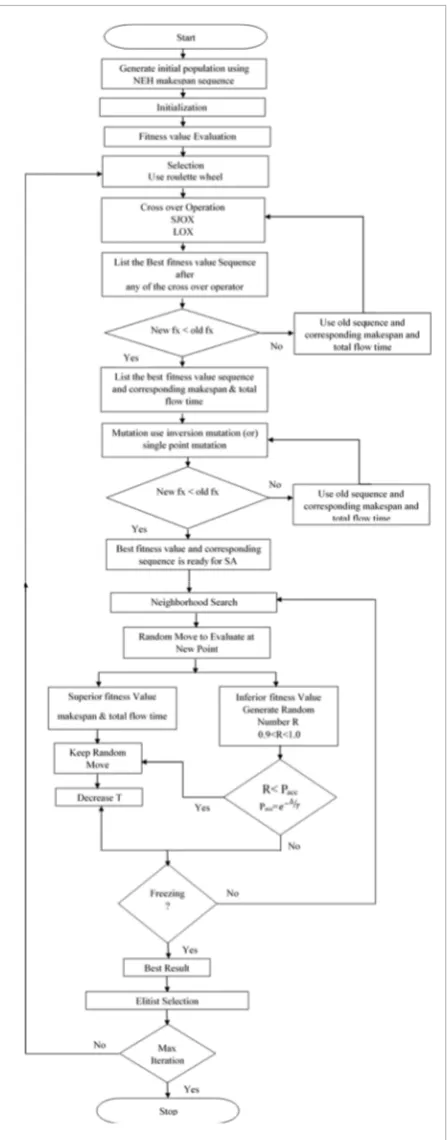
We proposed a hybrid (HGASA) meta-heuristic
al-gorithm, which can be used for the minimization of
makespan and total flow time in the PFSP.
Hybridiza-tion indicates combining of two or more algorithms
to solve a given complex problem. Our algorithm
hy-bridizes the Genetic Algorithm and the simulated
an-nealing algorithm to reach global best (gbest) or near
to global solution. In HGASA, Genetic Algorithm acts
as local search scheme, and the Simulated Annealing
algorithm acts as global search scheme by accepting
some inferior count values. Moreover, in the proposed
HGASA, the sub chromosomal level crossover and
mutation are implemented to get better results, and
this seed is given to SA algorithm to get further
im-provements by avoiding worst solution. As a result, it
is believed that HGASA can achieve satisfactory
im-provement in PFSPs. The framework for the HGASA
algorithm to the Permutation Flow Shop Scheduling
Problem is clearly illustrated in Fig. 1. for the
bi-ob-jective optimization of makespan and total flow time
minimization. The steps involved in the proposed
HGASA algorithm are stated below.
Step 1:
Generate an initial population using Nawaz et
al. [12] (NEH) algorithm.
Step 2:
Initialization; Define the size of population =
1500; number of generations =200; crossover
proba-bility=0.05; mutation probability=0.05.
Step 3: Evaluate the Fitness function value of each
chromosome by
max
1 ( )
1 (0.5 0.5 ) f x
C TFT
=
+ +
, where
C
max= makespan and TFT=
C(i, m)
.
Step 4:
Perform the following crossover
opera-tion: list the best
f(x)
sequence that minimizes both
makespan and total flow time.
Similar Job Order Crossover (SJOX)
SJOX crossover is based on the idea of identifying
and maintaining building blocks in the offspring.
In this way similar blocks or occurrences of jobs in
Figure 1
Table 1
Similar Job Order Crossover (SJOX)
Parent1 3 5 6 4 2 7 8 9 1
Offspring1 3 5 6 4 2 9 8 7 1
Offspring2 3 9 8 4 2 5 6 7 1
Parent2 3 9 8 4 2 5 7 6 1
cut point
Step 2.
Produce a proto-offspring by copying the
sub-section sequence into the corresponding positions of it.
Step 3.
Delete the operations which are already in the
subsequence from the second parent. The resulted
se-quence of operations contains the operations that the
proto-offspring needs.
Step 4.
Place the operations into the unfixed positions
of the proto-offspring from left to right according to
the order of the sequence to produce an offspring.
Step 5:
Mutation produces an offspring arrangement
by arbitrarily altering the parent’s qualities. In this
present algorithm, two different types of mutation
op-erators are introduced, namely inverse mutation and
single point mutation.
Inverse Mutation
In a sequence, two positions
i
and
j
are randomly
se-lected. The portion of the sequence between these
two positions is inverted to get a new mutated
se-quence. The new sequence represents the sequence
of operations after mutation. If the makespan of the
mutated sequence is less than the makespan of the
original sequence, the old sequence is replaced by
the new sequence. (Example. Mutation positions
be-tween 2 and 8).
Original Sequence
8 9 7 6 4 5 3
2 1
Mutated Sequence
8 4 3 2 7 9 6
5 1
Single Point Mutation
A random operation is selected in the sequence and
moved to another random position in the sequence.
If the makespan of the resulting sequence is less than
that of the previous one, it replaces the previous
se-quence.
Before single point mutation
8 9 7 6 4 5 3
2 1
After single point mutation
8 9 7 4 5 3 2
1 6
Step 6: Simulated annealing begins with a
neighbor-hood search by defining initial parameters.
both parents are passed over to child unaltered. If
there are no similar blocks in the parents the
cross-over operator will behave like the single-point order
crossover. The SJOX crossover operator can be
ex-plained as follows:
Step 1:
Both parents are examined on a
posi-tion-by-position basis. Identical jobs at the same
po-sitions are copied over to both offspring.
Step 2:
The offspring directly inherits all jobs from
the corresponding parents up to a randomly chosen
cut point. That is, Child1 inherits directly from
Par-ent1 and Child2 from Parent2.
Step 3:
Missing elements at each offspring are
cop-ied in the relative order of the other parent and it is
shown in Table 1.
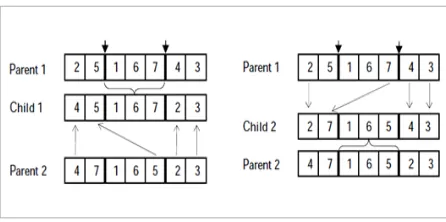
Linear Order Crossover (LOX)
Linear Order Crossover (LOX) tries to preserve both
the relative positions between genes as much as
pos-sible and the absolute positions relative to the
ex-tremities of parents and it is shown in Fig. 2.
Figure 2
Linear order crossover
Information Technology and Control 2019/1/48
52
Step 7: Random move to evaluate at the new point.
The obtained fitness function values are compared
with existing fitness function values. If the obtained
value is the superior one, then repeat the same
pro-cess to get further better results. The advantage of the
simulated annealing process is that the inferior
solu-tions are also accepted to get the global best value.
The probability of inferior value acceptance is
mea-sured by
Linear Order Crossover (LOX) tries to preserve both the relative positions between genes as much as possible and the absolute positions relative to the extremities of parents and it is shown in Fig. 2. Step 1. Select a subsequence of operations from one parent at random.
Step 2. Produce a proto-offspring by copying the subsection sequence into the corresponding positions of it.
Step 3. Delete the operations which are already in the subsequence from the second parent. The resulted sequence of operations contains the operations that the proto-offspring needs.
Step 4. Place the operations into the unfixed positions of the proto-offspring from left to right according to the order of the sequence to produce an offspring.
Figure 2 Linear order crossover
Step 5: Mutation produces an offspring arrangement by arbitrarily altering the parent’s qualities. In this present algorithm, two different types of mutation operators are introduced, namely inverse mutation and single point mutation.
Inverse Mutation
In a sequence, two positions i and j are randomly selected. The portion of the sequence between these two positions is inverted to get a new mutated sequence. The new sequence represents the sequence of operations after mutation. If the makespan of the mutated sequence is less than the makespan of the original sequence, the old sequence is replaced by the new sequence. (Example. Mutation positions between 2 and 8). Original Sequence
8 9 7 6 4 5
3 2 1
Mutated Sequence
8 4 3 2 7 9
6 5 1
Single Point Mutation
A random operation is selected in the sequence and moved to another random position in the
sequence. If the makespan of the resulting sequence is less than that of the previous one, it replaces the previous sequence.
Before single point mutation
8 9 7 6 4
5 3 2 1
After single point mutation
8 9 7 4 5
3 2 1 6
Step 6: Simulated annealing begins with a neighborhood search by defining initial parameters.
Step 7: Random move to evaluate at the new point. The obtained fitness function values are compared with existing fitness function values. If the obtained value is the superior one, then repeat the same process to get further better results. The advantage of the simulated annealing process is that the inferior solutions are also accepted to get the global best value. The probability of inferior
value acceptance is measured by
) (
T acc
P
=
e
−Δwhere ∆ is objective difference = (f(x’)-f(x)), where 𝑥𝑥𝑥𝑥𝑖𝑖𝑖𝑖𝑖𝑖𝑖𝑖 𝑡𝑡𝑡𝑡ℎ𝑒𝑒𝑒𝑒𝑐𝑐𝑐𝑐𝑐𝑐𝑐𝑐𝑐𝑐𝑐𝑐𝑐𝑐𝑐𝑐𝑒𝑒𝑒𝑒𝑐𝑐𝑐𝑐𝑡𝑡𝑡𝑡 𝑚𝑚𝑚𝑚𝑚𝑚𝑚𝑚𝑚𝑚𝑚𝑚𝑒𝑒𝑒𝑒𝑖𝑖𝑖𝑖𝑚𝑚𝑚𝑚𝑚𝑚𝑚𝑚𝑐𝑐𝑐𝑐, 𝑥𝑥𝑥𝑥′ 𝑖𝑖𝑖𝑖𝑖𝑖𝑖𝑖 𝑡𝑡𝑡𝑡ℎ𝑒𝑒𝑒𝑒 𝑐𝑐𝑐𝑐𝑒𝑒𝑒𝑒𝑖𝑖𝑖𝑖𝑛𝑛𝑛𝑛ℎ𝑏𝑏𝑏𝑏𝑏𝑏𝑏𝑏𝑐𝑐𝑐𝑐ℎ𝑏𝑏𝑏𝑏𝑏𝑏𝑏𝑏𝑜𝑜𝑜𝑜𝑏𝑏𝑏𝑏𝑜𝑜𝑜𝑜𝑥𝑥𝑥𝑥 and T is the temperature. In the proposed HGASA algorithm, the random number is generated in the range of 0.9 to 1.
Step 8: Check for freezer count by reducing the system temperature according to the cooling schedule.
Step 9: List the best fitness function value and corresponding sequence by indicating makespan and total flow time.
Step 10: The procedure is stopped when the temperature reaches the final set temperature or it reach the maximum number of iterations.
4.
Experimental Results and
Comparisons
In this article, the proposed HGASA algorithm is coded in Matlab 2009 programming tool and tried on an Intel Core i-3, 1.6 GHz with 4 GB RAM PC equipment. It has been tried with 28 flow shop benchmark problems, jobs sizes from 20, 50, and 100 and machines sizes from 5, 10, and 20. These benchmark problems are taken from Taillard [21]. Each instance can be characterized by the following parameters:
where
∆
is objective difference
=
(f(x’)-f(x)),
where
𝑥
𝑖𝑠
𝑡ℎ𝑒
𝑐𝑢𝑟𝑟𝑒𝑛𝑡
𝑚𝑎𝑘𝑒𝑠𝑝𝑎𝑛
,
𝑥
′
𝑖𝑠
𝑡ℎ𝑒
𝑛𝑒𝑖𝑔ℎ𝑏𝑜𝑟ℎ𝑜𝑜𝑑
𝑜𝑓
𝑥
and T is the temperature. In
the proposed HGASA algorithm, the random number
is generated in the range of 0.9 to 1.
Step 8:
Check for freezer count by reducing the
sys-tem sys-temperature according to the cooling schedule.
Step 9:
List the best fitness function value and
corre-sponding sequence by indicating makespan and total
flow time.
Step 10:
The procedure is stopped when the
tempera-ture reaches the final set temperatempera-ture or it reach the
maximum number of iterations.
4. Experimental Results and
Comparisons
In this article, the proposed HGASA algorithm is
cod-ed in Matlab 2009 programming tool and tricod-ed on an
Intel Core i-3, 1.6 GHz with 4 GB RAM PC equipment.
It has been tried with 28 flow shop benchmark
prob-lems, jobs sizes from 20, 50, and 100 and machines
sizes from
5, 10, and 20. These benchmark problems
are taken from Taillard [21]. Each instance can be
characterized by the following parameters: number of
jobs (
n
) and number of machines (
m
). Each instance
has been subjected for 200 iterations to find the best
fitness function value. The performance analysis of
the proposed HGASA algorithm is described in
Ta-ble 2. Equal weights are considered for each objective
(0.5, 0.5) as the MS and TFT objectives are
conflict-ing in nature. The equal weights are considered in
Yagmahan and Yenisey [22] and Balasundaram et al.
[3]. Considering makespan as an objective, 28
bench-mark problems have been solved. Out of these
prob-lems, HGASA algorithm produced 16 best makespan
solutions, whereas MGELS algorithm produced 8
best solutions. Decision Tree algorithm produced one
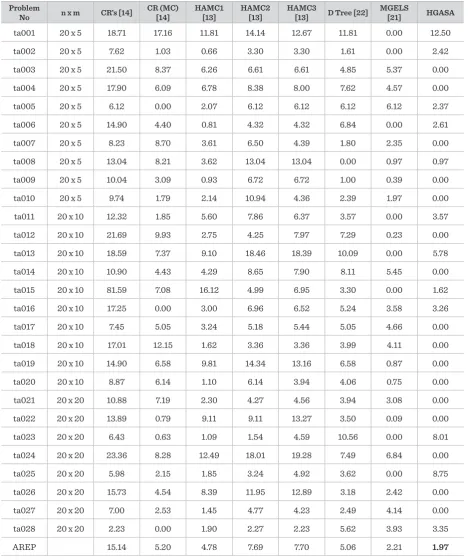
best solution, and CR (MC) produced three best
solu-tions. Table 3 gives the percentage improvement in
makespan value using HGASA over earlier literature
results. Moreover, the Average Relative Error
Per-centage (AREP) of the proposed HGASA algorithm
is (1.97) less than that of all different methodologies
such as MGELS, DT algorithm, HAMC3, HAMC2,
HAMC1, CR (MC), and CR in view of makespan
ob-jective and it is shown in Fig. 3. The performance of
the algorithms is given using Average Relative Error
Percentage (AREP) equation
max
1 ( )
1 (0.5 0.5 )
f x
C TFT
=
+ +
,
(6)where
C*
is the Best makespan.
Figure 3
A comparison of AREP of HGASA algorithm with other methods for makespan
Table 2
Performance analysis of the proposed HGASA algorithm method with the existing methods
Prob-lem No
CR’s [14] CR (MC) [14] HAMC1 [13] HAMC2 [13] HAMC3 [13] Decision Tree [22] MGELS [21] HGASA
MS TFT MS TFT MS TFT MS TFT MS TFT MS TFT MS TFT MS TFT
ta001 1377 14,361 1359 15,196 1297 14,274 1324 14,150 1307 14,193 1297 14105 1160 14220 1305 14199 ta002 1468 15,947 1378 18,204 1373 16,483 1409 15,386 1409 15,386 1386 15403 1364 15354 1397 15405 ta003 1379 14,261 1230 15,697 1206 13,858 1210 13,798 1210 13,798 1190 13759 1196 13464 1135 13973 ta004 1548 16,268 1393 17,037 1402 16,086 1423 15,770 1418 15,773 1413 15652 1373 15569 1313 16106 ta005 1387 19,884 1307 15,429 1334 14,897 1387 13,771 1387 13,779 1387 13726 1387 13660 1338 13619 ta006 1411 14,251 1282 15,030 1238 13,853 1281 13,389 1281 13,413 1312 13732 1228 13582 1260 13179 ta007 1381 13,972 1387 15,925 1322 14,215 1359 13,955 1332 13,959 1299 13872 1306 13838 1276 13867 ta008 1404 14,278 1344 15,716 1287 14,405 1404 14,269 1404 14,278 1242 14133 1254 14469 1254 14185 ta009 1425 14,907 1335 15,556 1307 15,823 1382 14,835 1382 14,835 1308 14863 1300 14660 1295 14600 ta010 1284 13,374 1191 14,622 1195 13,676 1298 13,204 1221 13,232 1198 13185 1193 13382 1170 13320 ta011 1887 22,526 1711 23,125 1774 22,427 1812 22,202 1787 22,234 1740 22078 1680 21298 1740 21327 ta012 2121 24,139 1916 26,526 1791 23,461 1817 23,003 1832 23,046 1870 22927 1747 23025 1743 23113 ta013 1786 20,654 1617 21,572 1643 21,818 1784 20,577 1783 20,608 1658 20600 1506 20156 1593 20148 ta014 1628 19,440 1533 20,761 1531 19,599 1595 19,276 1584 19,332 1587 19058 1548 18952 1468 19190 ta015 2693 34,484 1588 20,875 1722 19,740 1557 20,510 1586 19,463 1532 19373 1483 18975 1507 18875 ta016 1835 20,861 1565 21,109 1612 20,064 1674 19,751 1667 19,846 1647 19758 1621 19952 1616 19552 ta017 1659 19,422 1622 20,306 1594 19,268 1624 18,718 1628 18,992 1622 18967 1616 19007 1544 18850 ta018 1878 21,336 1800 23,991 1631 21,596 1659 20,958 1659 21,049 1669 20815 1671 21163 1605 20928 ta019 1851 20,859 1717 22,572 1769 21,595 1842 20,823 1823 20,851 1717 20903 1625 20767 1611 20972 ta020 1878 21,901 1831 25,034 1744 21,819 1831 21,541 1793 21,573 1795 21817 1738 20793 1725 21000 ta021 2700 35,405 2610 38,650 2491 36,027 2539 34,907 2546 35,159 2531 34830 2510 34638 2435 34404 ta022 2600 34,326 2301 35,426 2491 33,304 2491 33,304 2586 34,319 2363 32749 2285 32804 2283 32266 ta023 2550 33,519 2411 35,152 2422 33,556 2433 32,900 2506 33,411 2649 34328 2396 32857 2588 34411 ta024 2815 36,130 2471 37,081 2567 37,870 2693 35,475 2722 35,810 2453 32689 2438 32635 2282 31987 ta025 2518 33,729 2427 35,285 2420 35,029 2453 33,198 2493 33,682 2462 35735 2376 33137 2584 33320 ta026 2730 35,135 2466 37,142 2557 36,712 2641 34,742 2663 35,089 2434 34035 2416 34017 2359 33267 ta027 2582 33,025 2174 36,126 2448 34,389 2528 33,402 2515 33,484 2473 33615 2013 33362 2434 33569 ta028 2472 33,526 2418 34,076 2464 33,565 2473 33,479 2472 33,500 2554 33321 2513 33583 2499 33534
Information Technology and Control 2019/1/48
54
Table 3
Percentage improvement in makespan value using HGASA over earlier literature results
Problem
No n x m CR’s [14] CR (MC) [14] HAMC1 [13] HAMC2 [13] HAMC3 [13] D Tree [22] MGELS [21] HGASA
ta001 20 x 5 18.71 17.16 11.81 14.14 12.67 11.81 0.00 12.50
ta002 20 x 5 7.62 1.03 0.66 3.30 3.30 1.61 0.00 2.42
ta003 20 x 5 21.50 8.37 6.26 6.61 6.61 4.85 5.37 0.00
ta004 20 x 5 17.90 6.09 6.78 8.38 8.00 7.62 4.57 0.00
ta005 20 x 5 6.12 0.00 2.07 6.12 6.12 6.12 6.12 2.37
ta006 20 x 5 14.90 4.40 0.81 4.32 4.32 6.84 0.00 2.61
ta007 20 x 5 8.23 8.70 3.61 6.50 4.39 1.80 2.35 0.00
ta008 20 x 5 13.04 8.21 3.62 13.04 13.04 0.00 0.97 0.97
ta009 20 x 5 10.04 3.09 0.93 6.72 6.72 1.00 0.39 0.00
ta010 20 x 5 9.74 1.79 2.14 10.94 4.36 2.39 1.97 0.00
ta011 20 x 10 12.32 1.85 5.60 7.86 6.37 3.57 0.00 3.57
ta012 20 x 10 21.69 9.93 2.75 4.25 7.97 7.29 0.23 0.00
ta013 20 x 10 18.59 7.37 9.10 18.46 18.39 10.09 0.00 5.78
ta014 20 x 10 10.90 4.43 4.29 8.65 7.90 8.11 5.45 0.00
ta015 20 x 10 81.59 7.08 16.12 4.99 6.95 3.30 0.00 1.62
ta016 20 x 10 17.25 0.00 3.00 6.96 6.52 5.24 3.58 3.26
ta017 20 x 10 7.45 5.05 3.24 5.18 5.44 5.05 4.66 0.00
ta018 20 x 10 17.01 12.15 1.62 3.36 3.36 3.99 4.11 0.00
ta019 20 x 10 14.90 6.58 9.81 14.34 13.16 6.58 0.87 0.00
ta020 20 x 10 8.87 6.14 1.10 6.14 3.94 4.06 0.75 0.00
ta021 20 x 20 10.88 7.19 2.30 4.27 4.56 3.94 3.08 0.00
ta022 20 x 20 13.89 0.79 9.11 9.11 13.27 3.50 0.09 0.00
ta023 20 x 20 6.43 0.63 1.09 1.54 4.59 10.56 0.00 8.01
ta024 20 x 20 23.36 8.28 12.49 18.01 19.28 7.49 6.84 0.00
ta025 20 x 20 5.98 2.15 1.85 3.24 4.92 3.62 0.00 8.75
ta026 20 x 20 15.73 4.54 8.39 11.95 12.89 3.18 2.42 0.00
ta027 20 x 20 7.00 2.53 1.45 4.77 4.23 2.49 4.14 0.00
ta028 20 x 20 2.23 0.00 1.90 2.27 2.23 5.62 3.93 3.35
AREP 15.14 5.20 4.78 7.69 7.70 5.06 2.21 1.97
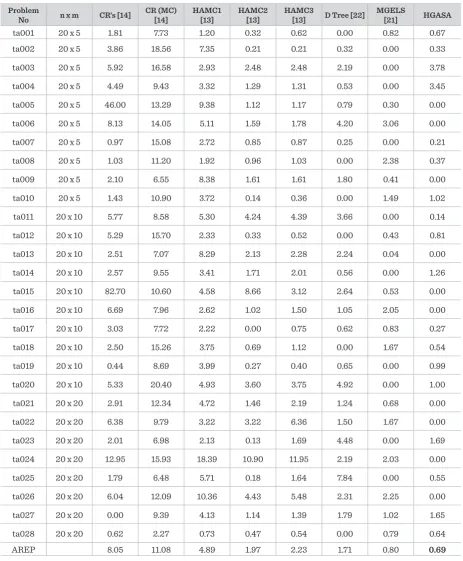
Table 4
Percentage improvement in total flow time value using HGASA over earlier literature results
Problem
No n x m CR’s [14] CR (MC) [14] HAMC1 [13] HAMC2 [13] HAMC3 [13] D Tree [22] MGELS [21] HGASA
ta001 20 x 5 1.81 7.73 1.20 0.32 0.62 0.00 0.82 0.67
ta002 20 x 5 3.86 18.56 7.35 0.21 0.21 0.32 0.00 0.33
ta003 20 x 5 5.92 16.58 2.93 2.48 2.48 2.19 0.00 3.78
ta004 20 x 5 4.49 9.43 3.32 1.29 1.31 0.53 0.00 3.45
ta005 20 x 5 46.00 13.29 9.38 1.12 1.17 0.79 0.30 0.00
ta006 20 x 5 8.13 14.05 5.11 1.59 1.78 4.20 3.06 0.00
ta007 20 x 5 0.97 15.08 2.72 0.85 0.87 0.25 0.00 0.21
ta008 20 x 5 1.03 11.20 1.92 0.96 1.03 0.00 2.38 0.37
ta009 20 x 5 2.10 6.55 8.38 1.61 1.61 1.80 0.41 0.00
ta010 20 x 5 1.43 10.90 3.72 0.14 0.36 0.00 1.49 1.02
ta011 20 x 10 5.77 8.58 5.30 4.24 4.39 3.66 0.00 0.14
ta012 20 x 10 5.29 15.70 2.33 0.33 0.52 0.00 0.43 0.81
ta013 20 x 10 2.51 7.07 8.29 2.13 2.28 2.24 0.04 0.00
ta014 20 x 10 2.57 9.55 3.41 1.71 2.01 0.56 0.00 1.26
ta015 20 x 10 82.70 10.60 4.58 8.66 3.12 2.64 0.53 0.00
ta016 20 x 10 6.69 7.96 2.62 1.02 1.50 1.05 2.05 0.00
ta017 20 x 10 3.03 7.72 2.22 0.00 0.75 0.62 0.83 0.27
ta018 20 x 10 2.50 15.26 3.75 0.69 1.12 0.00 1.67 0.54
ta019 20 x 10 0.44 8.69 3.99 0.27 0.40 0.65 0.00 0.99
ta020 20 x 10 5.33 20.40 4.93 3.60 3.75 4.92 0.00 1.00
ta021 20 x 20 2.91 12.34 4.72 1.46 2.19 1.24 0.68 0.00
ta022 20 x 20 6.38 9.79 3.22 3.22 6.36 1.50 1.67 0.00
ta023 20 x 20 2.01 6.98 2.13 0.13 1.69 4.48 0.00 1.69
ta024 20 x 20 12.95 15.93 18.39 10.90 11.95 2.19 2.03 0.00
ta025 20 x 20 1.79 6.48 5.71 0.18 1.64 7.84 0.00 0.55
ta026 20 x 20 6.04 12.09 10.36 4.43 5.48 2.31 2.25 0.00
ta027 20 x 20 0.00 9.39 4.13 1.14 1.39 1.79 1.02 1.65
ta028 20 x 20 0.62 2.27 0.73 0.47 0.54 0.00 0.79 0.64
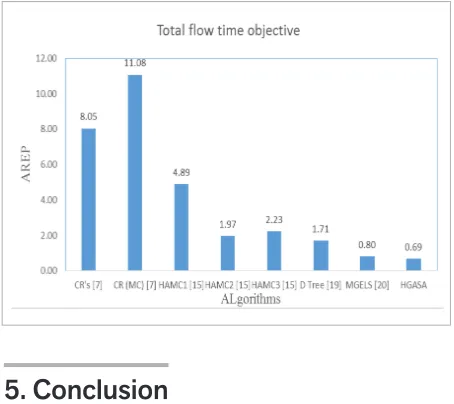
AREP 8.05 11.08 4.89 1.97 2.23 1.71 0.80 0.69
Information Technology and Control 2019/1/48
56
The performance of the algorithms is given using
Av-erage Relative Error Percentage (AREP) equation
AREP
(
min(
solutions C
C
*
)
*
) 100%
x
−
=
, (6)min(
)
*
(
) 100%
*
solutions D
AREP
x
D
−
=
, (7) (7)where
D*
is the Best flow time value.
Figure 4
A comparison of AREP of HGASA algorithm with other methods for Total flow time
5. Conclusion
In this work, HGASA based meta-heuristic approach
is presented for bi-criteria optimization of
minimiz-ing makespan and total flow time simultaneously. It
is a well-known combinatorial for permutation flow
shop problem. The proposed algorithm is tested with
28 benchmark problems available in the literature
and the results are compared. As a bi-criteria model,
the proposed approach gives the best solution
com-pared to the existing methods. Unlike the existing
algorithms available for PFSP, to reach the global
best solution, initially GA background is used to get
a local best solution in the proposed algorithm.
Lat-er, the solution obtained through GA is given as input
for SA algorithm, subjecting to neighborhood search
by accepting some inferior count values to reach the
global best solution. Measurable results of numerous
problems of different sizes have demonstrated that
the proposed technique meets or beats the other
algo-rithms available in the literature. Progressive
applica-tions, more information and characteristics are
gath-ered in shop floor control system and Hybrid Genetic
Algorithm and Simulated Annealing algorithm will
lead to better dispatching rules, while, it is difficult
to evoke every single important part of the planning
to alternate methodologies. The results of our
perfor-mance measurement also revealed that the proposed
HGASA algorithm outperformed the meta-heuristics
in minimizing the makespan and total flow time.
In future, it could be added with more objectives such
as machine idle time, total tardiness, total work load,
and so on. Moreover, to solve permutation flow shop
scheduling problems with other hybrid approaches
is also more interesting. In addition, the HGASA
al-gorithm could be applied to solve other combinatorial
problems such as layout problems, job shop
schedul-ing, flexible job shop scheduling and flexible
manu-facturing system scheduling problems.
References
1. Abdolrazzagh Nezhada, M., Abdullah, S. Robust Intelli-gent Construction Procedure for Job-Shop Scheduling. Information Technology and Control, 2014, 43(3), 217-229. https://doi.org/10.5755/j01.itc.43.3.3536
2. Allouche, M. A., Aouni, B., Martel, J. M. Solving Multi-Criteria Scheduling Flow Shop Problem Through Compromise Programming and Satisfaction Functions. European Journal of Operational Research, 2009, 192(2), 460-467. https://doi.org/10.1016/j.ejor.2007.09.038 3. Balasundaram, R., Valavan, D., Baskar, N. Comparison
of Two Heuristic Approaches for Solving the Produc-tion Scheduling Problem. InformaProduc-tion Technology and
Control, 2010, 40(2), 118-122. https://doi.org/10.5755/ j01.itc.40.2.426
4. Campbell, H. G., Dudek, R. A., Smith, M. L. A Heuristic Algorithm for the n-Job m-Machine Sequencing Prob-lem. Manage Science, 1970, 16(16), 630-637. https://doi. org/10.1287/mnsc.16.10.B630
5. Ding, J.-Y., Song, S., Wu, C. Carbon-Efficient Scheduling of Flow Shops by Multi-Objective Optimization. Eu-ropean Journal of Operational Research, 2016, 248(3), 758-771.https://doi.org/10.1016/j.ejor.2015.05.019 6. Gicquel, C., Hege, L., Minoux, M., Van Canneyt, W. A
Hy-brid Flow-Shop Scheduling Problem with Limited-Wait Constraints. Computers and Operations Research, 2012, 39(3), 629-636. https://doi.org/10.1016/j.cor.2011.02.017 7. Ignall, E., Schrage, L. Application of the Branch and
Bound Technique to Some Flow Shop Scheduling Problems. Operations Research, 1965, 13 (3), 400-412. https://doi.org/10.1287/opre.13.3.400
8. Jeen Robert, R. B., Rajkumar, R. A Hybrid Algorithm for Minimizing Makespan in the Permutation Flow Shop Scheduling Environment. Asian Journal of Research in Social Sciences and Humanities, 2016, 6(9), 1239-1255. https://doi.org/10.5958/2249-7315.2016.00867.4 9. Jeen Robert, R. B., Rajkumar, R. An Effective
Genet-ic Algorithm for Flow Shop Scheduling Problems to Minimize Makespan. Mechanika, 2017, 23(4), 594-603. https://doi.org/10.5755/j01.mech.23.4.15053
10. Johnson, S. M. Optimal Two- and Three-Stage Produc-tion Schedules with Setup Times Included. Naval Re-search Logistics Quarterly, 1954, 1(1), 61-68. https://doi. org/10.1002/nav.3800010110
11. Nagar, A., Heragu, S. S., Haddock, J. A Combined Branch-and-Bound and Genetic Algorithm Based Ap-proach for a Flow Shop Scheduling Problem. Annals of Operations Research, 1996, 63(3), 397-414. https://doi. org/10.1007/BF02125405
12. Nawaz, M., Enscore, E., Ham, I. A Heuristic Algo-rithm for the m-Machine, n-Job Flowshop Sequenc-ing Problem. Omega, 1983, 11(1), 91-95. https://doi. org/10.1016/0305-0483(83)90088-9
13. Rajendran, C., Ziegler, H. A Multi-Objective Ant-Col-ony Algorithm for Permutation Flow Shop Schedul-ing to Minimize the Makespan and Total Flow Time of Jobs. Computational Intelligence in Flow Shop and Job Shop Scheduling, 2009, 230, 53-99. https://doi. org/10.1007/978-3-642-02836-6_3
14. Rajendran, C. Heuristics for Scheduling in Flow Shop with Multiple Objectives. European Journal of Op-erational Research, 1995, 82(3), 540-555. https://doi. org/10.1016/0377-2217(93)E0212-G
15. Rajendran, C., Ziegler, H. Ant-Colony Algorithms for Permutation Flow Shop Scheduling to Minimize Makespan and Total Flow Time of Jobs. European Jour-nal of OperatioJour-nal Research, 2004, 155(2), 426-438. https://doi.org/10.1016/S0377-2217(02)00908-6 16. Rajkumar, R., Shahabudeen, P. An Improved Genetic
Al-gorithm for the Flowshop Scheduling Problem. Interna-tional Journal of Production Research, 2009, 47(1), 233-249. https://doi.org/10.1080/00207540701523041
17. Rajkumar, R., Shahabudeen, P. Bi-Criteria Improved Genetic Algorithm for Scheduling in Flowshops to Mi-nimise Makespan and Total Flowtime of Jobs. Interna-tional Journal of Computer Integrated Manufacturing, 2009, 22(10), 987-998. https://doi.org/10.1080/095119 2090299335318.
18. Ravindran, D., Noorul Haq, A., Selvakuar, S. J. Flow Shop Scheduling with Multiple Objective of Minimiz-ing Makespan and Total Flow Time. The International Journal of Advanced Manufacturing Technology, 2005, 25(9), 1007-1012. https://doi.org/10.1007/s00170-003-1926-1
19. Sanjeev Kumar, R., Padmanaban, K. P., Rajkumar, M. Minimizing Makespan and Total Flow Time in Permu-tation Flow Shop Scheduling Problems Using Modified Gravitational Emulation Local Search Algorithm. Pro-ceedings of the Institution of Mechanical Engineers, Part B: Journal of Engineering Manufacture, 2016. https://doi.org/10.1177/0954405416645775
20. Shen, J.-N., Wang, L., Zheng, H.-Y. A Modified Teach-ing–Learning-Based Optimization Algorithm for Bi-Objective Re-Entrant Hybrid Flowshop Scheduling. International Journal of Production Research, 2015, 54(12), 3622-3639. https://doi.org/10.1080/00207543. 2015.1120900
21. Taillard, E. Benchmarks for Basic Scheduling In-stances. European Journal of Operational Research, 1993, 64(2), 278-285. https://doi.org/10.1016/0377-2217(93)90182-M
22. Wang, L., Pan, Q. K., Fatih Tasgetiren, M. A Hybrid Harmony Search Algorithm for the Blocking Permu-tation Flow Shop Scheduling Problem. Computers & Industrial Engineering, 2011, 61(1), 76-83. https://doi. org/10.1016/j.cie.2011.02.013
23. Weishi, S., Dechang, Pi. A Self-Guided Differential Evolution with Neighborhood Search for Permutation Flow Shop Scheduling. Expert Systems with Applica-tions, 2016, 51(1), 161-176. https://doi.org/10.1016/j. eswa.2015.12.001
24. Yagmahan, B., Yenisey, M. A Multi-Objective Ant Colo-ny System Algorithm for Flow Shop Scheduling Prob-lem. Expert Systems with Applications, 2010, 37(2), 1361-1368. https://doi.org/10.1016/j.eswa.2009.06.105 25. Yeh, W. C. An Efficient Branch-and-Bound Algorithm