This is an open access journal, and articles are distributed under the terms of the Creative Commons Attribution-Non Commercial-ShareAlike 4.0 License, which allows others to remix, tweak, and build upon the work non-commercially, as long as appropriate credit is given and the new creations are licensed under the identical terms.
© 2018 Journal of Advanced Pharmacy Education & Research | Published by SPER Publication
36
Modeling Factors Influence Stay Duration in Unit Due to
Maxillofacial Fracture
Hamid Reza Khalkhali
1, Reza Samarei
2, Sajjad Kazem Alilu
3, Hossein Habibzadeh
4, Seyfolah
Rezaei
5*1Associate Professor in Biostatistics Inpatient’s Safety Research Center, Urmia University of Medical Sciences, Urmia, Iran, 2Department of Otolaryngologist,Urmia
University of Medical Sciences, Urmia, Iran, 3M.D, Patient Safety Research Center, Urmia University of Medical Sciences, Urmia, Iran, 4School of Nursuksing and
Midwifery, Urmia University of Medical Sciences, Urmia, Iran, 5Department of General Surgery, Urmia University of Medical Sciences, Urmia, Iran.
Correspondence: Seyfolah Rezaei, Department of General Surgery, Urmia University of Medical Sciences, Urmia, Iran, E_mail:rezaei _ sey @ yahoo.com
ABSTRACT
Introduction: Different causes such as accidents, physical collisions, falls from height can be a cause of fracture. In different communities, given the age range of patients, social issues, and the use of industrial supplies, the prevalence of fractures are different from each other. The purpose of this study was to determine the types, causes and location of the fractures and the relationships between demographic factors and the above factors. We also tend to examine factors affecting stay duration in inpatients. Methods: This is a Retrospective study. In this study, 1665 patients, in the period from March 2011 to March 2014, were suffered from maxillofacial trauma aged 10 years or more. The patients were admitted to maxillofacial unit of Imam Khomeini Hospital, Urmia. Results: In this study, there is a significant correlation between the type of fracture and fracture cause with sex. Also, the results obtained from the estimation of COX model with PH have shown that age, fracture cause and fracture types variables (mandibular, maxillary and orbit and other fractures) are significant in stay duration in the hospital that were hospitalized due to fracture. Conclusion: Vehicles, due to being faster and more powerful, have also more severe damage, which subsequently causes more hospitalization duration and more expenses incurred by the patient and the hospital.
Keywords: Stay duration, fracture, jaw, face
Introduction
In maxillofacial trauma, nasal bones, cheeks, upper and lower jaw are more hurt. The external nasal consists of cartilage and bone structures that bony part of the nose is made of two nasal bones, frontal appendages of the maxilla and nasal frontal bone and brushed nose [1,2]. Highlighted structure of the nasal bones in the face, causing the fracture of the bone has the most prevalent fractures in the human body and on the other hand fractures of the bones are important beautifully [3, 4]. Cheekbones are shaped, so that its outer posterior appendages are attached to the temporal bone and the chewing muscles are
attached to them and its upper and lower appendages covers inner and outer wall of eye sockets and its lower inner part forms lower wall of the eye sockets and attaches to the upper jaw [3]. The upper jaw bone is attached from the outside to the cheekbones and from inside to the nasal bones and covers the inner part of the lower wall of the eye sockets and anterior part of the eye sockets and protects the nasal bones [3, 4]. Lower jaw is located in one third of lower face and has two parts, which are symmetrically attached to the skull base. Its horseshoe shape and its attachment to both sides of the skull cause to absorb the forces well. For this reason, multiple fractures of the mandible, due to a single force, are unusual also mandibular ramus fracture other than sub-condylar part is uncommon [3, 5]. Different causes such as accidents, physical collisions, and falls from height can be a cause of breakage. In different communities given the age range of patients, social issues, and the use of industrial supplies, the prevalence of breakage are different from each other. In a study, the most fractures were due to accidents (52.5%) that among them motorcycle accidents consisted the most cases (42.26%) and
Access this article online
Website: www.japer.in E-ISSN: 2249-3379
How to cite this article:Hamid Reza Khalkhali, Reza Samarei, Sajjad Kazem Alilu, Hossein Habibzadeh, Seyfolah Rezaei. Modeling Factors Influence Stay Duration in Unit Due to Maxillofacial Fracture. J Adv Pharm Edu Res 2018;8(1):36-40.
Journal of Advanced Pharmacy Education & Research | Jan-Mar 2018 | Vol 8 | Issue 1 37 the second was fall from a height (24.4%) [6]. In a study, the
most face damages were related to males aged 21 to 30 years, also fractures were more because of accidents, falls and physical altercation and mandibular and nose fractures were more common [7]. In some societies, most fractures were in age range 13 to 18 years, which were more due to a physical altercation [8]. Various studies on the epidemiology of facial fractures provide information that can be used to perform necessary measures in order to reduce the human and financial costs incurred by the health centers. In this study we tend to examine the frequency of fractures, cause and location of fractures and the relationship between demographic characteristics with the above factors. We also tend to examine factors affecting the length of stay in inpatients due to fracture.
Materials and Methods
This is a retrospective Retrospective study. In this study, 1665 patients, in the period from March 2011 to March 2014, were suffered from maxillofacial trauma aged 10 years or more. The patients were admitted to maxillofacial unit of Imam Khomeini Hospital, Urmia. In the present study information about the types of fractures, including a broken nose, cheeks, and upper or lower jaw fracture and cause of fracture) such as different types of accidents such as car or bus or bicycle or motorcycle, fighting, falling from height, sports injuries and animal damages) and demographic characteristics of patients were extracted as a checklist from available files. The duration of hospitalization was also examined. The data on the frequency and location of the fracture and the length of stay and demographic data were expressed as frequency and were compared with each other. Finally, the collected data were analyzed by SPSS18 software .
Results
In this study, 1665 patients, in the period from March 2011 to March 2014 that were suffered from maxillofacial trauma, were examined.
The mean age of the participants in this study was 26.14±15.23 years and the mean length of stay for these patients was 4.08±3.7 days. Of 1665 patients studied, 1182 (71%) were male and 483 (29%) were female. Of which 737 (44.3%) were married, and 928 (55.7%) were single. Of these patients, 1276 (76.6%) due to a broken nose, and 153 (9.2%) due to mandibular and 101 (6.1%) due to maxillary, and 49 (2.9%) due to orbital and 152 (9.1%) due to face and the rest other cases were referred to Imam Khomeini Hospital and admitted to ENT department.
The frequency of fractures in 1665 patients is listed in full. That most frequency is related to fall and the lowest is related to bus accident.
Table 1: Frequency of fractures in patients studied
Fracture type Frequency Percentage
Passer 79 4.8
Cyclist 14 .9
Motorcycle 73 4.5
Car 241 14.7
Bus 6 .4
Fall 608 37.1
Strife 173 10.6
Collision 153 9.3
Not registered 206 12.6
Other 12 .7
Animal damage 74 4.5
Total 1639 100.0
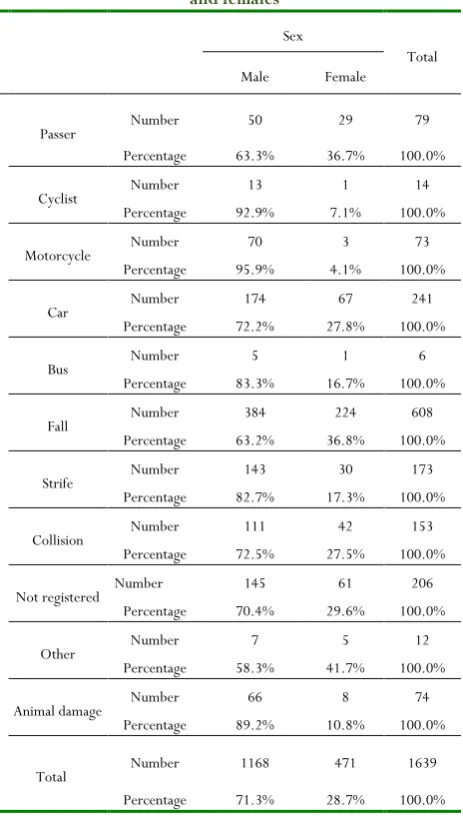
Also in Table 1, frequency distribution of fractures in both males and females have shown that the difference in frequency varies according to the Chi-square statistic and sex and fracture have statistically significant relationship (P-value <0.001).
Table 2 : Frequency distribution of fracture for both males and females
Sex
Total
Male Female
Passer Number 50 29 79
Percentage 63.3% 36.7% 100.0%
Cyclist Number 13 1 14
Percentage 92.9% 7.1% 100.0%
Motorcycle Number 70 3 73
Percentage 95.9% 4.1% 100.0%
Car Number 174 67 241
Percentage 72.2% 27.8% 100.0%
Bus Number 5 1 6
Percentage 83.3% 16.7% 100.0%
Fall Number 384 224 608
Percentage 63.2% 36.8% 100.0%
Strife Number 143 30 173
Percentage 82.7% 17.3% 100.0%
Collision Number 111 42 153
Percentage 72.5% 27.5% 100.0%
Not registered Number 145 61 206
Percentage 70.4% 29.6% 100.0%
Other Number 7 5 12
Percentage 58.3% 41.7% 100.0%
Animal damage Number 66 8 74
Percentage 89.2% 10.8% 100.0%
Total Number 1168 471 1639
38 Journal of Advanced Pharmacy Education & Research | Jan-Mar 2018 | Vol 8 | Issue 1
Table 2 shows distribution of fractures in two groups of males and females that the level of significance for each type of fracture is reported separately.
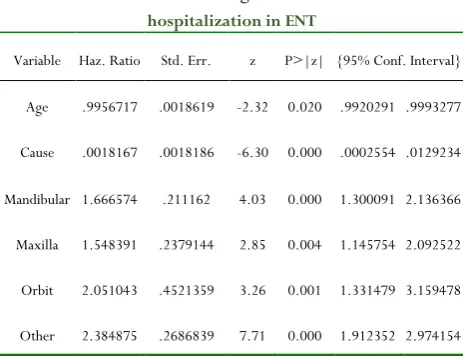
The results of COX model estimation assuming PH is shown in Table 4 that HR for age and cause of fracture and mandibular and maxilla, orbit and other fractures have been reported in it, which by increasing one year of age the ratio of risk of discharge from the hospital was equal to 0.996, while the ratio for those with non-accident hazard with vehicles to those who with vehicle accident is equal to 0.0018, also the ratio for patients, who are not admitted because of mandibular and maxilla fractures, orbit and other fractures, to those who are admitted for this purpose is shown in Table 3.
Table 3: COX model assuming PH for mean duration of hospitalization in ENT
Variable Haz. Ratio Std. Err. z P>|z| {95% Conf. Interval}
Age .9956717 .0018619 -2.32 0.020 .9920291 .9993277
Cause .0018167 .0018186 -6.30 0.000 .0002554 .0129234
Mandibular 1.666574 .211162 4.03 0.000 1.300091 2.136366
Maxilla 1.548391 .2379144 2.85 0.004 1.145754 2.092522
Orbit 2.051043 .4521359 3.26 0.001 1.331479 3.159478
Other 2.384875 .2686839 7.71 0.000 1.912352 2.974154
Discussion
In this study, we found that the ratio of male to female in Urmia is 2.4/1, which is similar to some studies {3.7/1 in Chennai [9], 2.8/1 in Osaka [10], 3.6/1 in Tokyo [11]}, but in contrast to some other studies {4.5/1 in Tehran [7], 11/1 in UAE [12], 4.7/1 in Nigeria [13]} is less. These different results in ratio of males to females can be due to this fact that in different communities the ratio of females who are exposed to maxillofacial trauma is different, but of all these studies it can be concluded that males are exposed to maxillofacial trauma more than females.
In the present study falling from height was the first cause of maxillofacial trauma and car accident was at the second rate. In Ryo sasaki et al. [11] study motorcycle accidents was the first cause of maxillofacial trauma and falls from height was ranked third. Also in Lida S et al. [10] study, accidents were ranked first and falls from height were second. In A. Leite cavalcanti [14] study, accidents were the most frequent cause of maxillofacial trauma injury, among them the motorcycle accident consisted the most cases and physical collision located at the second level of trauma. In this study, because the children were also studied
and since maxillofacial trauma of this group was largely due to a fall from height, it seems the difference in the most common cause of maxillofacial trauma between our study and other studies is because of this.
Based on the results of this study, there is a significant relationship between type of fracture and fracture cause and gender. In the present study, male patients suffered more from maxillofacial trauma because of falling, conflicts and collisions with cars while females suffered more because of falling. While in Allareddy V et al. [15] study, maxillofacial trauma was because of fall and motorcycle accident in females and in male patients was because of collision and assault. In this study, there was a significant association between gender and facial fracture that is similar to our study. In Thiago Bittencourt et al. study [16] also younger male patients were more exposed to maxillofacial trauma than other groups but most of them were due to the conflict between individuals. In Kamath RA et al. [17] study male patients were mostly exposed to maxillofacial trauma due to road accident which is similar to our study. The results of COX model assuming PH indicate that with increasing age and vehicle accidents the length of stay increases. Assuming PH showed that with increasing age and vehicle accident the length of stay increases. In the present study the mean hospital stay was 4.08 days. In our study, the patients who had nasal fracture, admitted one or two days, and the average value is 4 days that patients with nasal fractures and other fractures also had been hospitalized for a longer period. In Fabia Roccia et al. [18] study, the most length of stay was 5.7 days for patients aged over 60 years. In Jonathan A Zelken et al. [19] study, mortality and length of hospital stay in elderly patients was significantly increased (P <0.01), which is similar to our study. The length of stay in patients who were referred due to motor vehicle accident was more than other causes of maxillofacial trauma. In Serjio Monteiro et al. [20] study, it was found that a motorcycle accident hospitalization was more than patients who had a bicycle accident and had more damage severity, which was due to more damage intensity. In our study, patients who referred due to accidents with vehicles (cars, motorcycles) were more severely damaged that it can be the reason for more stay.
Journal of Advanced Pharmacy Education & Research | Jan-Mar 2018 | Vol 8 | Issue 1 39 had maxillofacial and other fractures had been more
hospitalized in the ENT department. In other words, moreover they hospitalized more time in the hospital; their stay up in other sectors was more than the ENT department. In a study by Edward Gray et al. [20] it was found that factors such as the severity of injury and complications during hospitalization (infectious, respiratory, blood) are of important predictors of length of stay in hospital. According to the above study and the results of the present study, it can be concluded that the more the severity, the more the length of stay, that this period affect other fractures of the maxillofacial fractures.
Conclusion
Motor vehicles, due to being faster and more powerful, have also more severe injury that will subsequently increase the hospitalization time. And accordingly, expenses incurred by the patient and the hospital increases. For this reason, it is recommended both invest in terms of culture for compliance and safety in the use of vehicles and strict regulation taken in order to force people to comply with the safety in the use of vehicles.
Acknowledgments
The authors acknowledge the Vice Chancellery of Research and Technology, Urmia University of Medical Sciences, that approved and financially supported this project .
Conflict Of Interest
The authors have no conflicts of interest to declare for this study.
References
1. Clinically Oriented Anatomy, Keith L. Moore, Arthur F. Dalley, fifth edition, 2006, page 1014.
2. Samarei R, Fatholahi N, causes of tinnitus in patients referred to ENT clinic of Imam Khomeini hospital in Urmia, 2012-2013. Global journal of health science, Volume 6, Issue 7, 2014, Pages 136-143.
3. Cummings Otolaryngology Head & Neck surgery, fifth edition,2010, volume 1, 496-597
4. Samarei R, Comparison of local and systemic ciprofloxacin ototoxicity in the treatment of chronic media otitis. Global journal of health science, Volume 6, Issue 7, 2014, Pages 144-149.
5. Niknejad E, Alinejad, Samarei R, The review of factors affecting the hospitalization period of patients with fractures under the age of 10. Research Journal of Medical Sciences, Volume 10, Issue 2, 2016, Pages 32-35.
6. Kazuhiko Yamamoto, Yumiko Matsusue, Satoshi Horita, Kazuhiro Murakami ,Tsutomu Sugiura, and Tadaaki Kirita, Clinical Analysis of Midfacial Fractures. Mater Sociomed. Feb 2014; 26(1): 21–25.
7. Zargar M, Khaji A, Karbakhsh M, Zarei MR. Epidemiology study of facial injuries during a 13 month of trauma registry in Tehran. Indian J Med Sci. 2004; 58:109-14.
8. Sang Hun Kim, Soo Hyang Lee, and Pil Dong Cho. Analysis of 809 Facial Bone Fractures in a Pediatric and Adolescent Population, Arch Plast Surg.Nov 2012;39(6):606-611.
9. Iida S., Kogo M., Sugiura T., Mima T., and Matsuya T.: Retrospective analysis of 1502 patients with facial fractures. Int. J. Oral Maxillofac Surg 30:286–290, 2001. 10. Ryo Sasaki, Hideki Ogiuchi, Akira Kumasaka, Tomohiro
Ando, Kayoko Nakamura, Terukazu Ueki, Yutaka Okada, Souichirou Asanami, Yoshiho Chigono,Yoshimi Ichinokawa, Takefumi Satomi, Akira Matsuo and Hiroshige Chiba Analysis of the Pattern of Maxillofacial Fracture by Five Departments in Tokyo. Oral Science International, May 2009, p.1-7
11. Ahmed H.E.A., Jaber M.A., Fanas S.H.A., and Karas M.: The pattern of maxillofacial fractures in Sharjah, United Arab Emirates: A review of 230 cases. Oral Surg Oral Med Oral Pathol Oral Radiol Endod 98:166–170, 2004. 12. Adebayo E.T., Ajike O.S., and Adekeye E.O.: Analysis of
the pattern of maxillofacial fractures in Kaduna, Nigeria. Br J. Oral Maxillofac Surg 41:396–400, 2003.
13. A. Leite Cavalcanti, P.K. Medeiros Bezerra, D. Moraes de Oliveira, A.F. Granville-Garcia, Maxillofacial injuries and dental trauma in patients aged 19-80 years, Recife, Brazil, Revista Española de Cirugía Oral y Maxilofacial, Volume 32, Issue 1, January–March 2010, Pages 11–16
14. Allareddy V, Itty A, Maiorini E, Lee MK, Rampa S, Allareddy V, Nalliah RP,Emergency department visits with facial fractures among children and adolescents: an analysis of profile and predictors of causes of injuries,J Oral Maxillofac Surg. 2014 Sep;72(9):1756-65.
15. Thiago Bittencourt Ottoni Carvalho,Launa Renata Londero Cancian,Caroline Gabriele Marques ,Vânia,Belintani Piatto,José Victor Maniglia,Fernando Drimel Molina, Six years of facial trauma care: an epidemiological analysis of 355 cases, Braz J Otorhinolaryngol, 2010;76(5):565-74.
16. Kamath RA, Bharani S, Hammannavar R, Ingle SP, Shah AG, Maxillofacial Trauma in Central Karnataka, India: An Outcome of 95 Cases in a Regional Trauma Care Centre, Craniomaxillofac Trauma Reconstr. 2012 Dec;5(4):197-204.
40 Journal of Advanced Pharmacy Education & Research | Jan-Mar 2018 | Vol 8 | Issue 1
Characteristics of maxillofacial trauma in females: A retrospective analysis of 367 patients, Journal of Cranio-Maxillofacial Surgery, Volume 38, Issue 4, June 2010, Pages 314–319.
18. Jonathan A. Zelken, Saami Khalifian, Gerhard S. Mundinger, Jinny S. Ha, Paul N. Manson, Eduardo D. Rodriguez, Amir H. Dorafshar, Defining Predictable Patterns of Craniomaxillofacial Injury in the Elderly: Analysis of 1,047 Patients, Journal of Oral and Maxillofacial Surgery, Volume 72, Issue 2, February 2014, Pages 352–361
19. Sergio Monteiro Lima Júnior, Saulo Ellery Santos, Leandro Eduardo Kluppel, Luciana Asprino, Roger William Fernandes Moreira, Márcio de Moraes, A Comparison of Motorcycle and Bicycle Accidents in Oral and Maxillofacial Trauma, Journal of Oral and Maxillofacial Surgery, Volume 70, Issue 3, March 2012, Pages 577–583