Ms. Reshma N Tendulkar
C. U. Shah College of Pharmacy, Mumbai Email: [email protected]
Address for correspondence
Access this article online www.japer.in
Molecular Docking studies of Novel Flavones as Cyclooxygenase- 2
(Cox 2) Inhibitors
INTRODUCTION
Cyclooxygenase (COX) is an enzyme that is responsible for the formation of prostanoids. The three main groups of prostanoids -- prostaglandins, prostacyclins, and thromboxanes - are each involved in the inflammatory response. [1] In the 1990s,
researchers discovered that two different COX enzymes existed, now known as COX-1 and COX-2. Cyclooxygenase-1 (COX-1) is known to be present in most tissues. In the gastrointestinal tract, COX-1 maintains the normal lining of the stomach. The enzyme is also involved in kidney and platelet function. Cyclooxygenase-2 (COX-2) is present at sites of inflammation. [2] While both COX-1 and COX-2
convert arachidonic acid to prostaglandin, resulting in pain and inflammation; their other functions make inhibition of COX-1 undesirable while inhibition of COX-2 is considered desirable.
Nonsteroidal anti-inflammatory drugs (NSAIDs), commonly prescribed to treat arthritis, work by inhibiting prostaglandins. [3] Traditional NSAIDs
(Ibuprofen, Naproxen), however, can cause gastrointestinal problems including ulcers. Traditional NSAIDs are considered nonselective because they inhibit both COX-1 and COX-2. The inhibition of COX-2 by traditional NSAIDs accounts for the anti-inflammatory effect of the drugs while the inhibition of COX-1 can lead to NSAIDs toxicity and associated side effects (ulcers, prolonged bleeding time, kidney problems). [3]
Flavones are the compounds belong to a widely distributed group of natural products called flavonoids with a variety of pharmacological activities including antioxidant, anticancer and anti-inflammatory activities. The anti-inflammatory activity is reported due to inhibition of lipooxygenase by the flavones. [4-5] Flavones are also known to
suppress COX-2 transcription. [6] Literature reports
that the anti-inflammatory and the anticancer activities of the flavones may be related to each other in view of the overexpression of COX-2 in some types of cancers. [7] In view of these literature findings, we
decided to dock a series of flavones into the active site of COX-2 and study the binding pattern. Luteolin is a compound showing COX-2 inhibitory activity, [8]
consisting of flavone moiety and SC-558 is selective Research Article
Cyclooxygenase (COX, prostaglandin endoperoxide synthase) enzymes catalyze the biological oxidation of arachidonic acid (AA) to prostaglandin H2. These enzymes are
biosynthesized in all tissues of the human body and elicit a variety of pharmacological effects. Some beneficial effects are the support of renal and platelet functions and gastrointestinal (GI) protection. Other non-beneficial effects are the pain, fever and symptoms associated with the inflammatory response. The enzyme COX-2 is an inducible form, expressed during inflammation. The aim of this study is to reveal the binding mode and hydrogen bond interactions of novel flavones with Cyclooxygenase- 2 enzyme. In the present study; we describe the molecular docking studies for a series of 25 novel flavones against COX-2 using Glide tool (Maestro ver. 9.10 of Schrodinger software). The docking results indicated that most of the compounds have shown hydrogen bond interactions with Tyr385,Tyr355,Trp387and Arg120and hydrophobic contacts with Val349,Leu352,Leu117,Tyr348 . Hence, the above docking study results indicate that the binding affinity and hydrogen bond interactions of these molecules with respect to amino acid residues can be supportive evidence to carry out further studies in designing structure-based newer molecules with COX-2 inhibitory activity.
Keywords: Cyclooxygenase-2(COX-2), Flavones, Maestro, Docking, Glide. ABSTRACT
Reshma N Tendulkar* Supriya S Mahajan C. U. Shah College of Pharmacy,
S. N. D. T. Women’s University, Santacruz(West),
Mumbai-400049
J. Adv. Pharm. Edu. & Res.
COX-2 inhibitor used as reference ligands in this study. [9]
The aim of the present study is to conduct the molecular docking studies on a series of novel flavones as COX-2 inhibitors. The interest of the molecular docking studies is to know the binding mode of the ligands on COX-2 and the structural requirements important for COX-2 inhibition. Molecular docking studies were carried out to a data set of 25 molecules using GLIDE 9.1.
MATERIALS AND METHODS
The Docking studies were carried out by using GLIDE (Maestro, version 9.10, Schrödinger, LLC) software. The crystal structure of the enzyme COX-2 complexed with SC-558 was obtained from Protein Data Bank (PDB code: 1CX2) and was used for the docking studies. The water molecules in the crystal were not considered in docking as none of them were found conserved within the binding zone of the ligand in the crystal structures. The crystal structure was ‘cleaned’ by deleting the ligand and the cofactors. This was followed by adding hydrogen atoms in their standard geometry, adjusting the bond orders and formal charges. The crystal structure was then refined and the geometries were optimized with the OPLS_2005 force field using standard protocol and parameters as included in GLIDE. The ligand structures were built, manipulated and adjusted for chemical correctness using Maestro 9.1 (Maestro, v9.1, Schrödinger LLC)
graphical user interface. The ligands were geometry minimized using the OPLS_2005 force field and to a gradient RMSD below 0.01 kJ/Ǻ.
Receptor Grid Generation
A grid was generated using the information on the crystal structure and docking information on the synthetic COX-1 and COX-2 inhibitors previously reported in the literature. Thus the active site comprised of His90 Arg120, Tyr355, Tyr385, Arg513, Val523
and Ser530. [10]
Ligand Docking
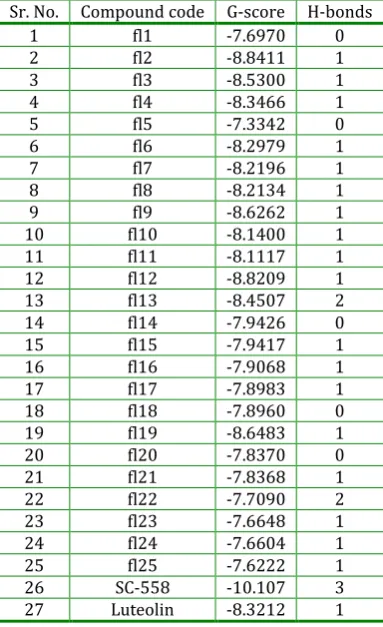
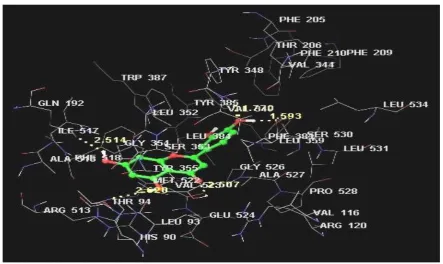
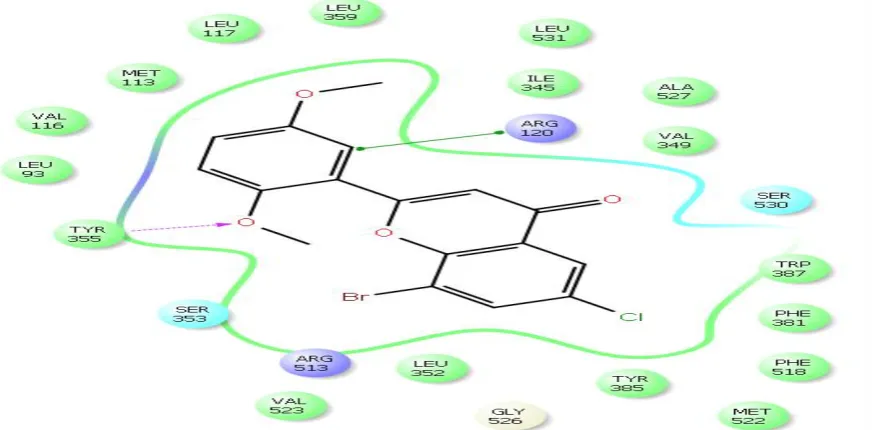
SC-558 was initially docked into the active site of the enzyme using the extra-precision mode. During the docking procedure, ligand was flexible whereas the receptor was held rigid. The best docked pose was saved. The rmsd between the crystal structure and the docked pose was 0.52, thereby validating the docking protocol. The ligands selected for the present study consist of two types, viz. Synthetic flavones and reference ligands. The structures of 25 synthetic flavones and reference ligands have been shown in Table I. Table II shows G-scores and H bonds of synthetic flavones and reference ligands. Table III shows amino acids of COX-2 enzyme making good VDW contacts with flavones, SC-558, Luteolin and the number of bad and ugly vdw contacts. Fig. I-II indicates amino acid profile of the docked images of SC-558 and Luteolin. Fig. III-VII indicates amino acid profile of the docked images of synthetic flavones.
Table 1: It shows structures of synthetic flavones and reference ligands
S. No. Compound Name and code Structure
1 2-(3,4-Dimethoxyphenyl) - 7, 8-dimethoxy-4-chromenone (fl1)
OCH3
H3CO O
O
OCH3
OCH3
2 2-(3,4-Dihydroxyphenyl)- 7, 8-dihydroxy-4-chromenone (fl2)
OH O
H O
O
3
2-(6-Chlorophenyl)- 6-chloro-7-methyl -4-chromenone (fl3) H3C
Cl
O
O
Cl
4 2-(6-Chlorophenyl)- 6,8-dichloro-4-chromenone (fl4)
O
Cl Cl
O
Cl
5 2-(4,5- Dimethoxyphenyl) - 7-dimethoxy-4-chromenone (fl5)
O
OCH3
OCH3
H3CO
O
6 2-(5-Methylphenyl)- 6-chloro,7-methyl-4-chromenone (fl6)
O C
H3
Cl
O
CH3
7 2-(2,5-Dimethoxyphenyl)-6-chloro-8-bromo-4-chromenone (fl7)
O
O
OCH3
H3CO
Br
Cl
8 2-(4-Methylphenyl)- 6-chloro-7-methyl-4-chromenone (fl8) O
O C
H3
Cl
CH3
9 2-(6-Chlorophenyl)- 6-chloro-8-bromo-4-chromenone (fl9) O
O Cl
Br
Cl
10 2-(6-Chlorophenyl)- 6-methyl-4-chromenone (fl10) O
O C
H3
Cl
11 2-(5-Chlorophenyl)-6-chloro-4-chromenone (fl11)
O
O
Cl Cl
12 2-(phenyl)- 5,7-dihydroxy-4-chromenone (fl12) O
O OH O H
13 2-(6-Bromophenyl)- 6-chloro-4-chromenone (fl13)
O
Cl
O Br
14
2-(6-Methylphenyl)- 6-bromo-4-chromenone (fl14) O
CH3
O Br
15
2-(4-Methylphenyl)- 6-methyl-4-chromenone (fl15) O
O C
H3
CH3
16 2-(6-Methylphenyl)- 6-chloro-4-chromenone (fl16) O
O Cl
CH3
17 2-(phenyl)- 7-methoxy-4-chromenone (fl17) O
O H3CO
18 2-(5-Nitrophenyl)-4-chromenone (fl18) O
O
NO2
19 2-(6-Hydroxyphenyl)-4-chromenone (fl19) O
O OH
20 2-(4-Fluorophenyl)-4-chromenone (fl20) O
O
F
21 2-(3,4,5-Trimethoxyphenyl)-4-chromenone (fl21) O
O
OCH3
OCH3
OCH3
22 2-(6-Bromophenyl)-4-chromenone (fl22) O
O Br
23 2-(5,6-Dichlorophenyl)-4-chromenone (fl23) O
O Cl
Cl
24 2-(4-Dimethylaminophenyl)-4-chromenone (fl24) O
O
N(CH3)2
25 2-(phenyl)-4-chromenone (fl25) O
O
26 SC-558
Br N
N CF
3
S N H2
O
O
27
Luteolin HO O
OH O
Table 2: It shows Glide score (g-score) and number of H-bonds of synthetic flavones and reference ligands
Sr. No. Compound code G-score H-bonds 1 fl1 -7.6970 0 2 fl2 -8.8411 1 3 fl3 -8.5300 1 4 fl4 -8.3466 1 5 fl5 -7.3342 0 6 fl6 -8.2979 1 7 fl7 -8.2196 1 8 fl8 -8.2134 1 9 fl9 -8.6262 1 10 fl10 -8.1400 1 11 fl11 -8.1117 1 12 fl12 -8.8209 1 13 fl13 -8.4507 2 14 fl14 -7.9426 0 15 fl15 -7.9417 1 16 fl16 -7.9068 1 17 fl17 -7.8983 1 18 fl18 -7.8960 0 19 fl19 -8.6483 1 20 fl20 -7.8370 0 21 fl21 -7.8368 1 22 fl22 -7.7090 2 23 fl23 -7.6648 1 24 fl24 -7.6604 1 25 fl25 -7.6222 1 26 SC-558 -10.107 3 27 Luteolin -8.3212 1
Table 3: It shows amino acids of COX-2 enzyme making good VDW contacts with flavones, SC-558, Luteolin and the number of bad and ugly vdw contacts.
Compound code Amino acids showing good vdw contacts with ligands No. of Bad vdw contacts No. of Ugly vdw contacts
fl1 Ser353,Leu531,Arg120,Val349,Leu352,Arg513, Leu531 3 0 fl2 Arg120,Leu531,Tyr355,Tyr385,Leu352,Ser353 0 0 fl3 Arg120,Val116,Ile345,Tyr355,Ser353,Met522, Leu384,Phe381 2 0 fl4 Arg120,Val116,Ser353,Leu352,Tyr385,Tyr348, Tyr355 2 0 fl5 Arg120,Tyr355,Leu352,Ser530,Ala527,Val349 2 0 fl6 Ser353,Arg120,Val349,Leu352,Leu117,Tyr355 1 0 fl7 Arg120,Tyr355,Tyr385,Leu352,Ser353,Arg513, Trp387 0 0 fl8 Arg120,Tyr355,Ser353,Leu352,Phe518,Met113, Leu117,Val349,Val523,Tyr38 3 0 fl9 Arg120,Val116,Ser353,Leu359,Tyr385,Leu352, Tyr348,Tyr355 1 0 fl10 Arg120,Tyr355,Leu352,Val116,Leu384,Phe381, Leu93 5 0 fl11 Trp387,Tyr385,Leu352,Gln192,Arg513,Tyr355, Val523,Ala527 7 0 fl12 Trp387,Leu384,Tyr385,Val349,Leu359,Arg120 1 0 fl13 Arg120,Val349,Tyr348Met522,Leu352,Phe381, Val116,Leu359 3 0 fl14 Arg120,Val349,Ser353,Leu384,Leu352,Leu359,Tyr355, Phe381,Val116 6 0 fl15 Arg120,Leu352,Ala527,Val349,Val116,Leu93 4 0 fl16 Ser353,Leu359,Arg120,Val116,Leu352,Leu384, 2 1 fl17 Arg120,Tyr355,Tyr385,Ser353Val349,Ala527 6 0 fl18 Arg120,Ser353,Leu352,Phe381,Gln192,Ala516,Arg513 3 0 fl19 Arg120,Val116,Leu359,Tyr385,Met113,Tyr355, Ile345,Leu531, 1 0 fl20 Arg120,Leu352,Ser353,Val116,Leu359,Phe381,Tyr385 4 0 fl21 Arg120,Tyr385,Leu352,Val116,Leu117,Met113 3 0 fl22 Arg120,Ile517,Ser353,Ala516,Ala527,Val349 7 0 fl23 Arg120,Ser353,Arg513,Ala516,Ala527,Val349,Tyr348 2 0
fl24 Arg120,Leu117,Val116,Leu352 1 0
fl25 Val349,Ala527,Phe381,Gly526,Leu384,Leu352, Arg120,Val116 2 0 SC-558 Tyr355,Arg120,Leu531,Val349,Tyr385 6 1 Luteolin Tyr385,Ser530,Leu384,Leu359 4 0
Fig.1: It shows SC-558 docked into the pocket of COX-2 enzyme
Fig. 2: It shows Luteolin docked into the pocket of COX-2 enzyme
Fig 4: It shows compound fl7 docked into the active site of COX-2 enzyme
Fig. 5: It shows compound fl11 docked into the pocket of COX-2 enzyme
Fig.7: It shows compound fl21 docked into the pocket of COX-2 enzyme
RESULTS AND DISCUSSION
The active site of COX-2 is divided into three important regions, [11] the first being a hydrophobic
pocket defined by Tyr385, Trp387, Phe518, Ala201, Tyr248
and Leu352; the second region being the entrance of
the active site lined with the hydrophilic residues Arg120, Glu524, Tyr355 and the third is a side pocket
lined by His90 Arg513 and Val523 . In case of the selective
COX-2 inhibitors such as SC-558, the phenyl ring was in the close vicinity of the hydrophobic pocket and the phenyl sulphonamide group occupied the side pocket and showed binding with Leu352, Ser353 and an
interaction with Arg513 which has also been identified
as an important residue in the binding of selective COX-2 inhibitors according to the site-directed mutagenesis data. The results are in accordance with the literature reports of docking of the selective COX-2 inhibitors. [12]
One of the keys to developing COX-2 selective drugs is the larger active site of COX-2, which makes it possible to make molecules able to fit the COX-2. [13] The larger
active site of COX-2 is partly due to a polar hydrophilic side-pocket that forms by Val523, Arg513, and Val434.
Val523 is less bulky which increases the volume of the
active site. Val434 allows the side-chain of Phe518 to
move back and make some extra space. This side-pocket allows for interactions with Arg513. The
side-chain of Leu384, at the top of the receptor channel is
oriented away from the active site and makes more space in the apex of the binding site in COX-2. [13, 14]
Within the hydrophilic side-pocket of COX-2, ‘A’ ring of the flavone group interacts with Arg120 and forms
hydrogen bonds. The synthetic flavones also interact with Tyr385,Tyr355and Trp387. The substituted phenyl
group at the top of the channel interacts with the side-chains of amino acid residues through hydrophobic and electrostatic interactions. Tyr385 makes for some sterical restrictions of this side of the binding site so a small substituent of the phenyl group makes for better binding. Degrees of freedom are also important for the binding. The central ring of the flavones decides the orientation of the aromatic rings and, therefore, the binding to COX-2 enzyme even though it often has no electrostatic interactions with any of the amino acid residues.
CONCLUSION
target COX-2 enzyme. These docking results precisely indicate that novel synthetic flavones have good hydrogen bond interactions with Tyr385, Tyr355, Trp387
and Arg120and hydrophobic contacts with Val349,
Leu352, Leu117, Tyr348 residues present at the catalytic
site of the COX-2 enzyme. The generated molecular docking model has given scope for the development of novel chemical entities with potent COX-2 inhibitory activity.
ACKNOWLEDGEMENT
The authors are thankful to S.N.D.T University for sanction of Research Project and to Schrodinger for extending the use of software.
REFERENCE
1. Smith RM., DeWitt DL., Garavito RM. Cyclooxygenases: structural, cellular and molecular biology. Ann Rev Biochem. 2000; 69:145–182. 2. Vane JR., Bakhle YS., Botting RM. Cyclooxygenases 1
and 2.Annu Rev Pharmacol Toxicol. 1998; 38:97– 120.
3. Smith CJ., Morrow JD., Roberts LJI., Marnett LJ. Differentiation of monocytoid THP-1 cells with phorbol ester induces expression of prostaglandin endoperoxide synthase-1 (COX-1). Biochem Biophys Res Commun. 1993; 192:787–793.
4. Ren W., Qiao Z., Wang H., Zhu L., Zhang L. Flavonoids: Promising Anticancer Agents. Medicinal Research Reviews. 2003;23(4):519–534.
5. Comalada M., Camuesco D., Sierra S., Ballester I., Xaus J., Galvez J., Zarzuelo A. In vivo quercitrin anti-inflammatory effect involves release of quercetin, which inhibits inflammation through down-regulation of the NF-kappa B pathway. Eur. J. Immunol. 2005; 35:584–592.
6. O’Leary KA., de Pascual-Tereasa S., Needs PW., Bao YP., O’Brien NM., Williamson G. Effect of flavonoid
and vitamin E on cyclooxygenase-2 (COX-2) transcription. Mutat. Res. 2004; 551:245–254. 7. Xie W., Robertson DL., Simmons DL.
Mitogen-inducible prostaglandin G/H synthase: a new target for nonsteroidal antiinflammatory drugs. Drug Dev Res. 1992; 25:249–265.
8. Marnett LJ., Kalgutkar A. Cyclooxygenase 2 Inhibitors: Discovery, Selectivity and the future. Trends Pharmacol. Sci. 1999; 20:465.
9. O’Leary KA., de Pascual-Tereasa S., Needs PW., Bao YP., O’Brien NM., Williamson G. Effect of flavonoid and vitamin E on cyclooxygenase-2 (COX-2) transcription. Mutat. Res. 2004; 551:245–254. 10. Price MLP., Jorgensen WL. Rationale for the observed
COX-2/COX-1 selectivity of celecoxib from Monte Carlo simulations. Bioorg. Med. Chem. Lett. 2001; 11:1541–1544.
11. Kiefer JR., Pawlitz JL., Moreland KT., Stageman RA., Hood WF., Gierse JK., Stevens AM., Goodwin DC., Rowilson SW., Marnett LJ., Stallings WC., Kurumbail RG. Structural insights into the stereochemistry of the cyclooxygenase reaction. Nature. 2000;405:97– 101.
12. Llorens O., Perez J., Palomer A., Mauleon D. Differential binding mode of diverse cyclooxygenase inhibitors. Journal of Molecular Graphics and Modelling. 2002; 20:359–371.
13. Xin Feng Zhang., Tran Manh Hung., Phuong Thien Phuong.: Anti-inflammatory activity of flavonoids from Populus davidiana. Arch Pharm Res. 2006; 29(12):1102–1108.
14. Moore and Simmons. COX-2 inhibition, apoptosis, and chemoprevention by nonsteroidal anti-inflammatory drugs. Current Med Chem. 2000; 7:1131–1144.
How to cite this article:Reshma N Tendulkar*, Supriya
S Mahajan; Molecular Docking studies of Novel Flavones as Cyclooxygenase- 2 (Cox 2) Inhibitors; J. Adv. Pharm. Edu. & Res. 2014: 4(3): 330-338.
Source of Support: Nil, Conflict of Interest: Nil