A VARIABLE SELECTION METHOD FOR PULVERIZING CAPABILITY
PREDICTION OF TUMBLING MILL BASED ON IMPROVED HYBRID
GENETIC ALGORITHM
Hui Cao, Lixin Jia
, Gangquan Si, Yanbin Zhang
State Key Laboratory of Electrical Insulation and Power Equipment, Electrical Engineering School Xi'an Jiao Tong University, Shaanxi Province, 710049, China
e-mail: {huicao, lxjia, gangquan, ybzhang}@mail.xjtu.edu.cn
Abstract. Tumbling mill of thermal power plant, grinding the raw coal for the boiler, has high energy consump-tion, and pulverizing capability is usually used for representing the efficiency of tumbling mill. In the paper, a variable selection method for pulverizing capability prediction of tumbling mill based on improved hybrid genetic algorithm is proposed. Based on the tradition GA, the proposed method adopts the multi-population mechanism, the elites sharing mechanism and the heterogeneity mechanism for avoiding the premature convergence. The support vector machine is used for building the prediction model of the pulverizing capability with the selected variables. The proposed method is performed on the real field data. The results of the experiments verify that the proposed method has faster convergence speed and the model of pulverizing capability built with the variables selected by the proposed method has higher prediction precision. In addition, the proposed method has been put into practice and the field operation curve verifies that the pulverizing capability could be predicted successfully.
Keywords: Tumbling Mill; Pulverizing Capability; Variable Selection; Improved Hybrid Genetic Algorithm.
Corresponding author
1. Introduction
Tumbling mill, pulverizing the raw coal for the boiler, is one of the major assistant equipments in a thermal power plant and has high energy consump-tion, which equals 15-25% of the whole consumption of the thermal power plant [1]. Therefore, ensuring the tumbling mill to be at the best efficiency is of impor-tant theoretical significance and practical motivation for the energy saving.
Pulverizing capability is usually used for represen-ting the efficiency of tumbling mill and the accurate measurement of pulverizing capability is the premise of realizing the control and optimization of tumbling mill. Some methods of measuring the concentration of pulverized coal are proposed for estimating the pulve-rizing capability [2, 3]. Because tumbling mill is a multi-variable, nonlinear and strong coupling system, for overcoming the lack of single signal measurement, the modeling approaches of pulverizing capability based on the multiple process variables of tumbling mill are presented [4,5]. Nevertheless, there may be some redundant or irrelevant variables for predicting the pulverizing capability. Hence, variable selection
being a common approach for solving the problem [6,7].
Variable selection approach could find the most representative process variables subset for building the prediction model of pulverizing capability, so the mo-del complexity would be reduced and the prediction accuracy would be improved. Moreover, variable se-lection could be seemed as a combinatorial problem, and various metaheuristics are proposed for the variable selection problem [8]. Genetic algorithm (GA) is an optimization search methodology based on the natural selection theory. Some applications of GA for variable selection are presented in [9-13]. How-ever, for mainly depending on the initial population, the traditional GA implementations would easily have the premature convergence, namely, fall into the local minima [14,15].
In the paper, we propose a variable selection me-thod for pulverizing capability prediction of tumbling mill based on improved hybrid genetic algorithm. The proposed method could determine the process vari-ables subset for representing the pulverizing capability of the tumbling mill based on the improved hybrid genetic algorithm(IHGA). The pulverizing capability would be predicted based on the support vector
Algorithm
machine (SVM) with the selected variables. The main idea of IHGA is that the traditional operation of GA, such as the selection operation, the crossover ope-ration and the mutation opeope-ration, are hybridized with the mulit-population mechanism, the elites sharing mechanism and the heterogeneity mechanism to improve the algorithm effectiveness. The multi-popu-lation mechanism lets the sub-popumulti-popu-lation search the whole space in parallel to improve the performance. The elites sharing mechanism exchanges the genetic information among the sub-populations to avoid the premature convergence. The heterogeneity mechanism could increase the diversity of the sub-population. The organization of this paper is as follows: Section 2 pro-vides some preliminaries and the problem statement. The proposed method is presented in detail in Section 3. In Section 4, the experiments are presented to verify
the effectiveness of the proposed method. Finally, Section 5 concludes the paper.
2. Preliminaries and Problem Statement
The schematic representation of a tumbling mill system is shown in Figure 1. The raw coal is fed into the tumbling mill and pulverized to the coal powder. At the same time, the hot air and the recycle air are blown into the mill to dry and deliver the coal powder. The coal powder is transferred into the coarse classifier and fine classifier. The unqualified powder is fed back into the ball mill for further pulverizing while the accepted powder is stored in the pulverized coal bunker finally. Furthermore, the mill exhauster provides the power for the flow process of the air-powder mixture and the recycle air is from the outlet of the mill exhauster.
Figure 1. Tumbling mill system
The rotation speed of the tumbling mill and the mill wall are directly related to the pulverizing capabi-lity, and they are fixed by the manufacturer in the de-sign process. Moreover, although the coal hardness would affect the pulverizing capability greatly, the
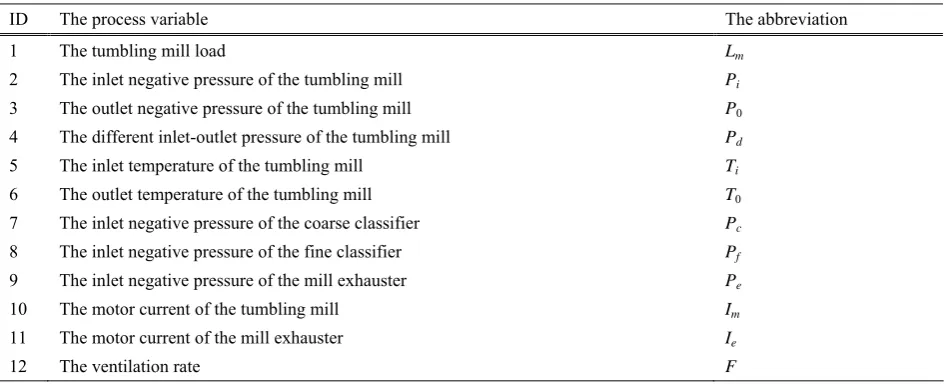
coal hardness only could be calibrated by the chemist-ry experiment. Therefore, there are twelve process va-riables that could be used for building the prediction mode of pulverizing capability. The twelve process va-riables and their abbreviations are listed in the Table 1. Table 1. The process variables and their abbreviations
ID The process variable The abbreviation
1 The tumbling mill load Lm
2 The inlet negative pressure of the tumbling mill Pi 3 The outlet negative pressure of the tumbling mill P0 4 The different inlet-outlet pressure of the tumbling mill Pd
5 The inlet temperature of the tumbling mill Ti
6 The outlet temperature of the tumbling mill T0
7 The inlet negative pressure of the coarse classifier Pc 8 The inlet negative pressure of the fine classifier Pf 9 The inlet negative pressure of the mill exhauster Pe
10 The motor current of the tumbling mill Im
11 The motor current of the mill exhauster Ie
The tumbling mill load is the ratio between the vo-lume of coal powder in the mill and the interstitial volume of the static ball charge. The measuring point of the ventilation rate is in the vertical pipe of mill outlet. Because the tumbling mill system is nonlinear and strong coupling, some of the variables are redun-dant or weakly correlate with the pulverizing capabi-lity, namely, adopting all the variables to build the prediction model of the pulverizing capability would not only increase the model complexity but also de-crease the prediction accuracy. Hence, for obtaining the accurate value of pulverizing capability, the vari-ables used for the prediction model should be selected correctly.
3. The Proposed Method
We present a variable selection method based on IHGA for building the prediction model of the pul-verizing capability of the tumbling mill. Based on the traditional GA, IHGA adopts the multi-population mechanism, the elites sharing mechanism and the heterogeneity mechanism for improving the algorithm effectiveness. The flowchart of the IHGA is shown in Figure 2 and the steps of IHGA are described in the following. Moreover, we assume that the number of sub-populations is m and the size of each sub-popu-lation is n.
Figure 2. The flowchart of the IHGA
Step 1: Encoding and multi-population Initiali-zation. For variable selection, IHGA uses the binary coding to encode the chromosomes and ‘1’ or ‘0’ indi-cates that the variable is selected or dropped, respec-tively. Each gene represents a process variable and the length of a chromosome equals the number of the
variables to be selected, namely, for the tumbling mill system, the length of a chromosome is twelve.
Algorithm
of the whole search space in parallel, the computatio-nal cost would be reduced. Nevertheless, for the same search space, the smaller population would lead to worse precision. For the proposed method, the size of sub-population is smaller than that of whole popula-tion, and we present the elites sharing mechanism to enhance the interaction between sub-populations for improving their cooperation for optimization. More-over, all sub-populations are randomly initialized with every chromosome in each sub-population encoding a candidate variables set.
Step 2: Fitness function. For a chromosome in any sub-population, according to the coding of the chromosome, the selected variables are determined and the prediction model of the pulverizing capability is built by SVM, which is one of the most competitive regression analysis methods for small samples [16]. The fitness function is determined as the prediction residual error sum of squares (PRESS) of the built prediction model, namely, the lower the PRESS, the better the prediction model.
Step 3: Elites sharing. The elites of a sub-popu-lation are defined as the chromosomes whose PRESS is top-k, where the PRESS of each chromosome of the sub-population being in ascending order and k is an integer. For each population, the elites of the sub-population and the elites of other sub-sub-populations are put into the next generation of the sub-population directly without performing any operations. By the elites sharing mechanism, the genetic information of various sub-populations could be exchanged and the search scope of the sub-population is guided in the direction of the global optimum. Meanwhile, the sub-populations through continuous exchange of genetic information could avoid the limitation of the searching process.
Step 4: Constructing heterogeneity. We construct a chromosome to be farthest away from all chromo-somes of a sub-population and the chromosome is named the heterogeneity for the sub-population. The heterogeneity is also put into the next generation of the sub-population. The heterogeneity mechanism would prevent the phenomenon of inbreeding, in-crease the diversity of the sub-population, and reduce the possibility of the sub-population finding the local optimum. In addition, for the heterogeneity mecha-nism, the Hamming distance is used as the distance measurement between two chromosomes.
Step 5: Selection. The selection operation deter-mines which parent individuals would be put into the next generation. For the proposed method, we use the roulette wheel strategy to perform proportional se-lection for determining the (n – m k – 1) parent chro-mosomes to be put into the offspring, where n > m k.
Step 6: Crossover. The crossover operation com-bines two chromosomes to create a new chromosome, which may be better than both of the two chro-mosomes if the new chromosome inherits the best characteristics from each of the two chromosomes.
For IHGA, according to a user-definable crossover probability, the chromosome would exchange the genes with its next neighbor chromosome. Further-more, the number of the exchanged genes is deter-mined randomly.
Step 7: Mutation. The mutation is an operator which realizes the diversity of each sub-population. IHGA choices some genes of each chromosome of a sub-population to be flipped based on the user-defin-able probability of mutation.
Step 8: Termination and output. For IHGA, when the number of generation is larger than the user-definable threshold, the evolution of each sub-popu-lation terminates and the chromosome with the lowest fitness value among all sub-populations, namely, the whole population, is output.
According to the best individual obtained by the proposed method, we could determine the process variables for the prediction model of the pulverizing capability and the model built with the selected va-riables would have higher accuracy. Since we present the multi-population mechanism, the elites sharing mechanism and the heterogeneity mechanism, the proposed method could have faster convergence speed and avoid the premature convergence under a certain extent. In the next section, we would use the experi-ment results to further verify the effectiveness of the proposed algorithm.
4. Experiment Results
XP Professional. In addition, the proposed method has
been put into practice in QinLing Thermal Power Plant and the running curve of pulverizing capability would be shown.
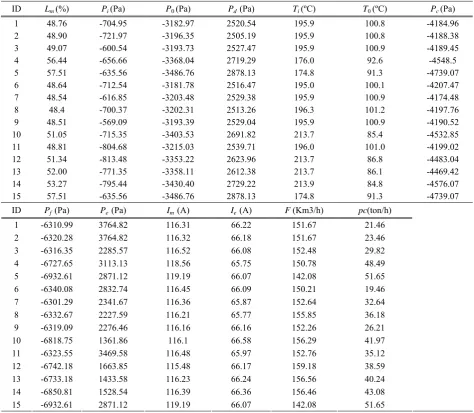
Table 2. The field dataset 1
ID Lm (%) Pi (Pa) P0(Pa) Pd (Pa) Ti (ºC) T0 (ºC) Pc (Pa)
1 48.76 -704.95 -3182.97 2520.54 195.9 100.8 -4184.96
2 48.90 -721.97 -3196.35 2505.19 195.9 100.8 -4188.38
3 49.07 -600.54 -3193.73 2527.47 195.9 100.9 -4189.45
4 56.44 -656.66 -3368.04 2719.29 176.0 92.6 -4548.5
5 57.51 -635.56 -3486.76 2878.13 174.8 91.3 -4739.07
6 48.64 -712.54 -3181.78 2516.47 195.0 100.1 -4207.47
7 48.54 -616.85 -3203.48 2529.38 195.9 100.9 -4174.48
8 48.4 -700.37 -3202.31 2513.26 196.3 101.2 -4197.76
9 48.51 -569.09 -3193.39 2529.04 195.9 100.9 -4190.52
10 51.05 -715.35 -3403.53 2691.82 213.7 85.4 -4532.85
11 48.81 -804.68 -3215.03 2539.71 196.0 101.0 -4199.02
12 51.34 -813.48 -3353.22 2623.96 213.7 86.8 -4483.04
13 52.00 -771.35 -3358.11 2612.38 213.7 86.1 -4469.42
14 53.27 -795.44 -3430.40 2729.22 213.9 84.8 -4576.07
15 57.51 -635.56 -3486.76 2878.13 174.8 91.3 -4739.07
ID Pf (Pa) Pe (Pa) Im (A) Ie (A) F (Km3/h) pc(ton/h)
1 -6310.99 3764.82 116.31 66.22 151.67 21.46
2 -6320.28 3764.82 116.32 66.18 151.67 23.46
3 -6316.35 2285.57 116.52 66.08 152.48 29.82
4 -6727.65 3113.13 118.56 65.75 150.78 48.49
5 -6932.61 2871.12 119.19 66.07 142.08 51.65
6 -6340.08 2832.74 116.45 66.09 150.21 19.46
7 -6301.29 2341.67 116.36 65.87 152.64 32.64
8 -6332.67 2227.59 116.21 65.77 155.85 36.18
9 -6319.09 2276.46 116.16 66.16 152.26 26.21
10 -6818.75 1361.86 116.1 66.58 156.29 41.97
11 -6323.55 3469.58 116.48 65.97 152.76 35.12
12 -6742.18 1663.85 115.48 66.17 159.18 38.59
13 -6733.18 1433.58 116.23 66.24 156.56 40.24
14 -6850.81 1528.54 116.39 66.36 156.46 43.08
15 -6932.61 2871.12 119.19 66.07 142.08 51.65
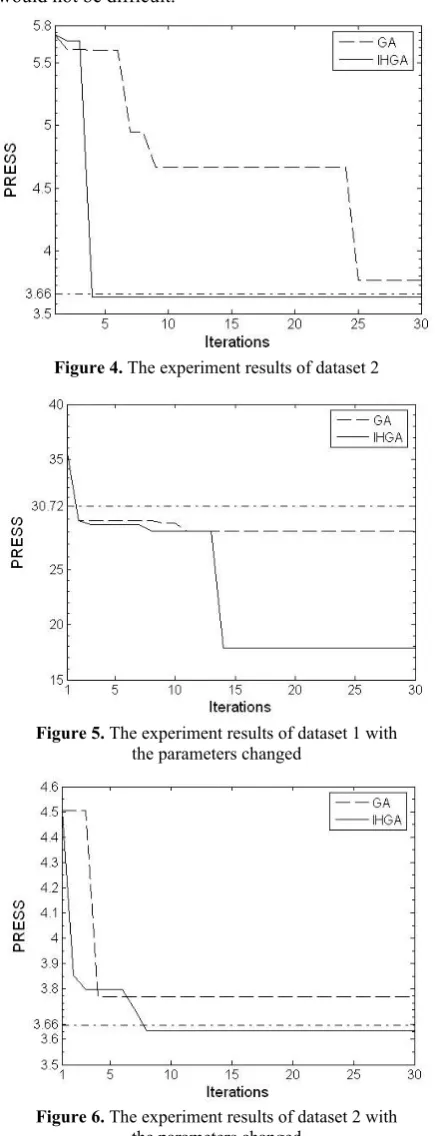
For IHGA, m, n and k are set to be 3, 10 and 1, respectively. The population number of GA is set to be 30 and the number of iterations is 30. The experiment results of dataset 1 are shown in Figure 3, where 30.72 is the PRESS value of the prediction model with all twelve variables for dataset 1. After the searching process is finished, the PRESS value of IHGA is 17.92 and the corresponding chromosome is 111101110111, namely, Ti and Pe are weakly related with the pulverizing capability. Moreover, the PRESS value of GA is 28.51 and the corresponding chromosome is 111110111111, namely, T0 is irrelevant variable for pulverizing capability. However, according to the knowledge of experts, T0 would represent the drying capability of tumbling system, namely, if the outlet temperature is lower, the drying may not be sufficient with the coal feed increasing and the pulverizing capability would be decreased [17]. Hence, GA may fall into the local minima, and IHGA has higher effectiveness for dataset 1.
Algorithm
capability would become lower. If the coal storage is larger, the falling height of steel balls would be lower and the pulverizing capability would be lower also. Therefore, Lm should not be seemed as the irrelevant variable for pulverizing capability and GA may fall into the local minima for dataset 2. Since the
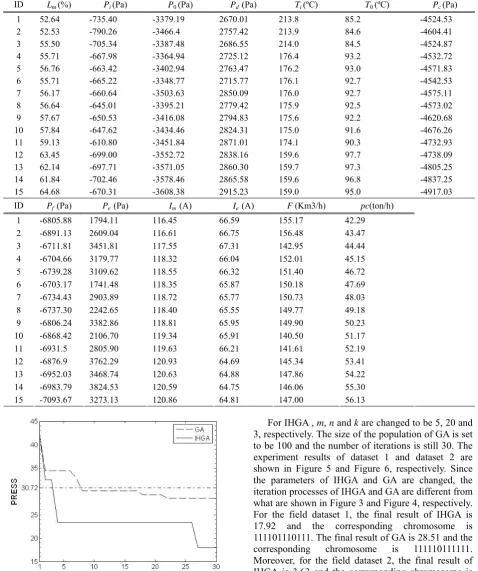
hetero-geneity mechanism would let the searching scope of IHGA be larger sometimes, the PRESS values of IHGA are still relatively larger before the third tion, and IHGA begins convergence after the 4th itera-tion. The results of the experiments show that IHGA has faster convergence speed and higher effectiveness. Table 3. The field dataset 2
ID Lm (%) Pi (Pa) P0(Pa) Pd (Pa) Ti (ºC) T0 (ºC) Pc (Pa)
1 52.64 -735.40 -3379.19 2670.01 213.8 85.2 -4524.53
2 52.53 -790.26 -3466.4 2757.42 213.9 84.6 -4604.41
3 55.50 -705.34 -3387.48 2686.55 214.0 84.5 -4524.87
4 55.71 -667.98 -3364.94 2725.12 176.4 93.2 -4532.72
5 56.76 -663.42 -3402.94 2763.47 176.2 93.0 -4571.83
6 55.71 -665.22 -3348.77 2715.77 176.1 92.7 -4542.53
7 56.17 -660.64 -3503.63 2850.09 176.0 92.7 -4575.11
8 56.64 -645.01 -3395.21 2779.42 175.9 92.5 -4573.02
9 57.67 -650.53 -3416.08 2794.83 175.6 92.2 -4620.68
10 57.84 -647.62 -3434.46 2824.31 175.0 91.6 -4676.26
11 59.13 -610.80 -3451.84 2871.01 174.1 90.3 -4732.93
12 63.45 -699.00 -3552.72 2838.16 159.6 97.7 -4738.09
13 62.14 -697.71 -3571.05 2860.30 159.7 97.3 -4805.25
14 61.84 -702.46 -3578.46 2865.58 159.6 96.8 -4837.25
15 64.68 -670.31 -3608.38 2915.23 159.0 95.0 -4917.03
ID Pf (Pa) Pe (Pa) Im (A) Ie (A) F (Km3/h) pc(ton/h)
1 -6805.88 1794.11 116.45 66.59 155.17 42.29
2 -6891.13 2609.04 116.61 66.75 156.48 43.47
3 -6711.81 3451.81 117.55 67.31 142.95 44.44
4 -6704.66 3179.77 118.32 66.04 152.01 45.15
5 -6739.28 3109.62 118.55 66.32 151.40 46.72
6 -6703.17 1741.48 118.35 65.87 150.18 47.69
7 -6734.43 2903.89 118.72 65.77 150.73 48.03
8 -6737.30 2242.65 118.40 65.55 149.77 49.18
9 -6806.24 3382.86 118.81 65.95 149.90 50.23
10 -6868.42 2106.70 119.34 65.91 140.50 51.17
11 -6931.5 2805.90 119.63 66.21 141.61 52.19
12 -6876.9 3762.29 120.93 64.69 145.34 53.41
13 -6952.03 3468.74 120.63 64.88 147.86 54.22
14 -6983.79 3824.53 120.59 64.75 146.06 55.30
15 -7093.67 3273.13 120.86 64.81 147.00 56.13
Figure 3. The experiment results of dataset 1
IHGA also has faster convergence speed and higher effectiveness. Therefore, the searching results of IHGA are not affected by the parameters setting great-ly, namegreat-ly, determining the parameters of IHGA would not be difficult.
Figure 4. The experiment results of dataset 2
Figure 5. The experiment results of dataset 1 with the parameters changed
Figure 6. The experiment results of dataset 2 with the parameters changed
The results of the experiments verify that the pro-posed method not only could realize the variables selection correctly but also has higher effectiveness. Moreover, the proposed method has been put into practice in QinLing Thermal Power Plant. The running
curve of the prediction value of pulverizing capability for half an hour is shown in Figure 7. During 1200~1400sec., since the prediction value of the pul-verizing capability is almost not changed, the tumb-ling mill system could be seemed to be in the steady state, which is marked with a dotted rectangle in Figure 7. Although the real value of the pulverizing capability could not be measured directly, it is usually represented by the quantity of pulverized coal powder per unit of time and the tumbling mill system fulfills the rules of indestructibility of matter for steady-state operation, namely, the coal feed per unit of time ap-proximately equals the quantity of pulverized coal powder per unit of time in the steady state. During 1200~1400sec., the coal feed per unit of time is 44.6ton/h and the average of the prediction values of the pulverizing capability is 44.46ton/h. Hence, it shows that the pulverizing capability could be pre-dicted successfully.
Figure 7. Running Curves in Real Thermal Power Plant
5. Conclusion
Algorithm
will use some advanced implementation schemes to further improve the effectiveness of the proposed method.
Acknowledgement
This work is supported by the National Natural Science Foundation of China (61005058). The authors also gratefully acknowledge the helpful comments and suggestions of the reviewers, which have improved the presentation.
References
[1] Heng Wang, Min-ping Jia, Peng Huang, Zuo-liang Chen. A study on a new algorithm to optimize ball mill system based on modeling and GA. Energy Con-version and Management, Vol.51, No.4, 2010, 846-850.
[2] Quansheng Duan, Jizhen Liu, Zhifang Wu. Design and experimental study on the pulverized coal con-centration sensor based on γ-ray absorption method. Proceedings of 2008 IEEE Pacific-Asia Workshop on Computational Intelligence and Industrial Application (PACIIA 2008), Wuhan, China, December 19-20, 2008, 901-906.
[3] Chen, Xia, Hu, Hongli, Liu, Zhihong. A pulverized coal concentration measurement system based on ca-pacitance sensor. Proceedings of 2009 International Technology and Innovation Conference (ITIC 2009), Xi’an, China, October 12-14, 2009, 1-4.
[4] Su Zhi-gang, Wang Pei-hong, Yu Xiang-jun, Lü Zhen-zhong. Soft sensor modeling for on-line monito-ring the capacity of coal pulverizing system. Procee-dings of the CSEE, Vol.27, No.29, 2007, 90-95. [5] Hao Yongsheng, Yu Xiangjun, Zhao Gang, Lü
Zhenzhong. Optimization for ball mill operation based on improved particle swarm optimization algo-rithm. Journal of Southeast University (Natural Science Edition), Vol.38, No.3, 2008, 419-423.
[6] Vita Špečkauskienė, Arūnas Lukoševičius. A data mining methodology with preprocessing steps. Infor-mation Technology and Control, Vol.38, No.4, 2009, 319-324.
[7] A. Unler, A. Murat. A discrete particle swarm opti-mization method for feature selection in binary clas-sification problems. European Journal of Operational Research, Vol.206, No.3, 2010, 528-539.
[8] Yumin Chen, Duoqian Miao, Ruizhi Wang. A rough set approach to feature selection based on ant colony optimization. Pattern Recognition Letters, Vol.31, No.3, 2010, 226-233.
[9] Ran Li, Jianjiang Lu, Yafei Zhang, Tianzhong Zhao. Dynamic Adaboost learning with feature selec-tion based on parallel genetic algorithm for image annotation. Knowledge-Based Systems, Vol.23, No.3, 2010, 195-201.
[10] Xinping Song, Yongsheng Ding, Jingwen Huang, Yan Ge. Feature selection for support vector machine in financial crisis prediction-a case study in China. Expert Systems, Vol.27, No.4, 2010, 299-310.
[11] A.L.I. Oliveira, P.L. Braga, R.M.F. Lima, M.L. Cornélio. GA-based method for feature selection and parameters optimization for machine learning regres-sion applied to software effort estimation. Information and Software Technology, Vol.52, No.11, 2010, 1155-1166.
[12] M. Bhattacharya, A. Das. Genetic algorithm based feature selection in a recognition scheme using adap-tive neuro fuzzy techniques. Int. J. of Computers, Communications & Control, Vol.5, No.4, 2010, 458-468.
[13] Shijin Li, Hao Wu, Dingsheng Wan, Jiali Zhu. An effective feature selection method for hyperspectral image classification based on genetic algorithm and support vector machine. Knowledge-Based Systems, Vol.24, No.1, 2010, 40-48.
[14] Yongming Li, Sujuan Zhang, Xiaoping Zeng. Research of multi-population agent genetic algorithm for feature selection. Expert Systems with Applica-tions, Vol.36, No.9, 2009, 11570-11581
[15] A.M. Kuczapski, M.V. Micea, L.A. Maniu, V.I. Cretu. Efficient generation of near optimal initial populations to enhance genetic algorithms for job-shop scheduling. Information Technology and Control, Vol.39, No.1, 2010, 32-37.
[16] J. Han, M. Kamber. Data mining, Concepts and Techniques (Secend Edition). Morgan Kaufmann, San Francisco, USA, 2006.
[17] Tianyou Chai, Heng Yue. Multivariable intelligent decoupling control system and its application, Acta Automatica Sinica, Vol.31, No.1, 2005, 123-131.