GENOME REPORT
Comparative genomic analysis
of
Clostridium difficile
ribotype 027 strains
including the newly sequenced strain
NCKUH-21 isolated from a patient in Taiwan
Haruo Suzuki
1,2, Masaru Tomita
1,2, Pei‑Jane Tsai
3, Wen‑Chien Ko
4, Yuan‑Pin Hung
5,6, I‑Hsiu Huang
7*and Jenn‑Wei Chen
7*Abstract
Background: Clostridium difficile is a Gram‑positive anaerobe and the leading cause of antibiotic‑associated diarrhea worldwide. The emergence of ribotype 027 (RT027) strains is associated with increased incidence of infection and mortality. To further understand the relationship between C. difficile NCKUH‑21, a RT027 strain isolated from a patient in Taiwan, and other RT027 strains, we performed whole‑genome shotgun sequencing on NCKUH‑21 and compara‑ tive genomic analyses.
Results: The genome size, G+C content, and gene number for the NCKUH‑21 strain were determined to be similar
to those for other C. difficile strains. The core genome phylogeny indicated that the five RT027 strains R20291, CD196, NCKUH‑21, BI1, and 2007855 formed a clade. A pathogenicity locus, tcdR‑tcdB‑tcdE‑orf‑tcdA‑tcdC, was conserved in the genome. A genomic region highly similar to the Clostridium phage ϕCD38‑2 was present in the NCKUH‑21
strain but absent in the other RT027 strains and designated as the prophage ϕNCKUH‑21. The prophage ϕNCKUH‑21
genes were significantly higher in G+C content than the other genes in the NCKUH‑21 genome, indicating that the prophage does not match the base composition of the host genome.
Conclusions: This is the first whole‑genome analysis of a RT027 C. difficile strain isolated from Taiwan. Due to the high identity with ϕCD38‑2, the prophage identified in the NCKUH‑21 genome has the potential to regulate toxin produc‑
tion. These results provide important information for understanding the pathogenicity of RT027 C. difficile in Taiwan.
Keywords: Clostridium difficile, Ribotype 027 strain NCKUH‑21, Genome, Phylogeny, Prophage, Horizontal transfer
© The Author(s) 2017. This article is distributed under the terms of the Creative Commons Attribution 4.0 International License (http://creativecommons.org/licenses/by/4.0/), which permits unrestricted use, distribution, and reproduction in any medium, provided you give appropriate credit to the original author(s) and the source, provide a link to the Creative Commons license, and indicate if changes were made. The Creative Commons Public Domain Dedication waiver (http://creativecommons.org/ publicdomain/zero/1.0/) applies to the data made available in this article, unless otherwise stated.
Background
Clostridium difficile is a Gram-positive, endospore-form-ing obligate anaerobe and the current leadendospore-form-ing cause of antibiotic-associated diarrhea (AAD) within hospital set-tings worldwide [1]. Estimates have revealed that C. dif-ficile infections (CDI) are responsible for 15–25% of all AAD cases [2]. Onset of CDI can be engendered by dis-ruption of the hosts’ gut microbiota by broad-spectrum
antibiotic treatments. Aging, prolonged stay in health care settings, and proton-pump inhibitor use all con-tribute to increased risk of CDI [3]. Although C. dif-ficile has been characterized for decades, it first gained prominence in 2003 when an outbreak in North America was found to be caused by a strain with toxin hyperpro-duction capabilities [4]. The rapid spread of C. difficile
NAP1/BI/027 strain (PCR ribotype 027 or RT027), which is the same strain characterized with different methods has resulted in outbreaks worldwide, although cases in Asia and Latin America were less reported compared with Europe and North America.
Open Access
*Correspondence: [email protected]; [email protected]
7 Department of Microbiology and Immunology, College of Medicine,
According to a previous case report, NCKUH-21 is the strain isolated from the first severe RT027 CDI in Taiwan, and it contains a deletion of 18 base pairs and a truncated mutation (D117A) in tcdC [5]. To further understand the relationship between NCKUH-21 and other RT027 strains including historic strains and hypervirulent strains, we determined the genome sequence of the C. difficile strain NCKUH-21 (the accession numbers: BDSN01000001– BDSN01000094) and compared it with other sequenced RT027 strains. We assessed the presence of virulence and antibiotic resistance genes for the NCKUH-21 genome. We also compared the genome sequences of the NCKUH-21 strain with its close relatives to investigate the genome synteny, reconstruct the phylogenetic tree, and identify NCKUH-21 strain-specific genes.
Methods
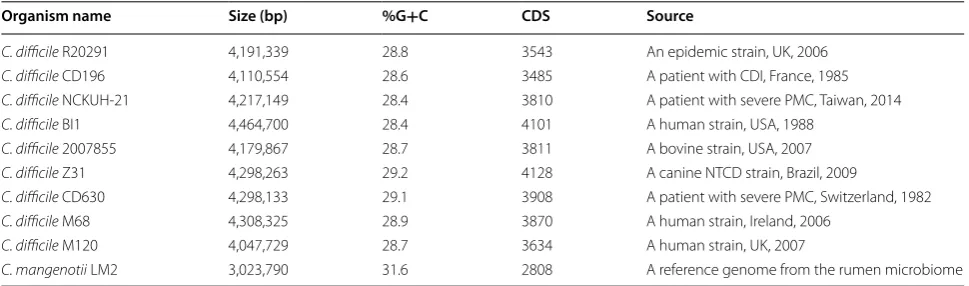
Genome sequencing, assembly, and annotation for the strain NCKUH-21, as well as comparative genomics of nine C. difficile strains (Table 1), were performed as described in Additional file 1: Materials and methods.
Quality assurance
Genomic DNAs were purified from a pure culture of a single bacterial isolate of NCKUH-21. A BLAST search against a nonredundant database revealed no potential contamination of the genomic libraries.
Results and discussion
Genomic features
Illumina MiSeq sequencing was performed to deter-mine the genome sequence of the C. difficile strain NCKUH-21. The de novo assembly contained 94 con-tigs of length 4,217,149 bp, with a G+C content of 28.4%
with sequencing coverage of 1611×. Genome annotation yielded a total of 3810 protein-coding sequences (CDSs).
Among the C. difficile strains analyzed in this paper, the genome size (Mb) ranged from 4.05 to 4.46, G+C content ranged from 28.4 to 29.2%, and CDS number ranged from 3485 to 4128 (Table 1). The general genomic features for the NCKUH-21 strain were thus similar to those of the other C. difficile strains.
Phylogeny
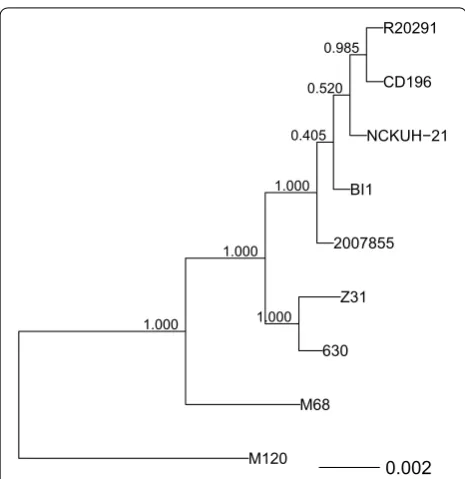
Clostridium difficile strains with the same PCR ribotype were reported to cluster together in the phylogenetic trees for the conserved genes [6]. The Roary pipeline pro-duced a total of 8775 homologous groups of genes (“pan-genome”), of which 69 were shared by all the strains used in this study (“core-genome”). The core genome phylog-eny indicated that the RT027 strains (R20291, CD196, NCKUH-21, BI1, and 2007855) formed a monophy-letic group or clade, joined by the Z31 and 630 strains, followed by the M68 strain, and finally the M120 strain (Fig. 1).
Synteny
The Mauve Contig Mover (http://darlinglab.org/mauve/ user-guide/reordering.html) was used to reorder the contigs of NCKUH-21 relative to the complete genome of C. difficile CD196. The genomes of the nine C. difficile
strains were aligned using progressiveMauve, and this alignment was visualized using genoPlotR to investigate genomic rearrangement (Fig. 2). The genome synteny was determined to be conserved among all but one of the strains. An exception was the Z31 strain with large-scale genomic rearrangement, which had not been previously reported [7].
Table 1 Analysis of the genomic features of Clostridium strains
%G+C= 100 × (G+C)/(A+T+G+C)
CDS number of protein-coding DNA sequences, PMC pseudomembrane colitis, NTCD non-toxigenic C. difficile
Organism name Size (bp) %G+C CDS Source
C. difficile R20291 4,191,339 28.8 3543 An epidemic strain, UK, 2006
C. difficile CD196 4,110,554 28.6 3485 A patient with CDI, France, 1985
C. difficile NCKUH‑21 4,217,149 28.4 3810 A patient with severe PMC, Taiwan, 2014
C. difficile BI1 4,464,700 28.4 4101 A human strain, USA, 1988
C. difficile 2007855 4,179,867 28.7 3811 A bovine strain, USA, 2007
C. difficile Z31 4,298,263 29.2 4128 A canine NTCD strain, Brazil, 2009
C. difficile CD630 4,298,133 29.1 3908 A patient with severe PMC, Switzerland, 1982
C. difficile M68 4,308,325 28.9 3870 A human strain, Ireland, 2006
C. difficile M120 4,047,729 28.7 3634 A human strain, UK, 2007
Antibiotic resistance and virulence genes
Antibiotic resistance and virulence genes were searched using ABRicate. Homologous DNA sequences for the binary toxin genes cdtA and cdtB listed in the Viru-lence Factors Database (accessions of AAF81760 and AAF81761, respectively) were detected in the
NCKUH-21 genome [8]. Homologous DNA sequences for the
antibiotic resistance genes cdeA, vanRG, and vanG listed in the Comprehensive Antibiotic Resistance Database (accessions of AJ574887.1:371–1697, DQ212986:2259– 2967, and DQ212986:5985–7035, respectively) were detected in the 21 genome. Although NCKUH-21 showed the genetic potential for becoming resistant to antibiotics, this strain was shown to be susceptible to moxifloxacin (minimum inhibitory concentration 0.5 μg/ mL), metronidazole (0.094 μg/mL), and vancomycin (0.5 μg/mL) [5].
The genetic organization of the pathogenicity locus (PaLoc) of the CD630 strain is tcdR-tcdB-tcdE-orf
-tcdA-tcdC (locus_tag: CD630_06590, CD630_06600, CD630_06610, CD630_06620, CD630_06630, and
CD630_06640) [9]. The gene order was conserved
in the NCKUH-21 genome (the accession num-ber: BDSN01000011; locus_tag: NCKUH21_00647, NCKUH21_00648, NCKUH21_00649, NCKUH21_00650, NCKUH21_00651, and NCKUH21_00652). Moreo-ver, another sequence similar to tcdE (CD630_06610) was found in the NCKUH-21 genome (locus_tag: NCKUH21_03847) with 83% amino acid identity. The genes tcdB and tcdA encoding Toxin B and Toxin A (locus_tag: CD630_06600 and CD630_06630; 2366 and 2710 amino acids in length), respectively, of the CD630 PaLoc were determined to be homologous with 48% amino acid identity; additionally, these two genes partly
matched a sequence encoding “N
-acetylmuramoyl-l-alanine amidase LytC” (the accession number: BDSN01000021; locus_tag: NCKUH21_02692; 644 amino acids in length) in the NCKUH-21 genome with 177 and 226 alignment length and 32 and 34% amino acid iden-tity values, respectively. The PaLoc gene homologues may contribute to the virulence and pathogenicity for the C. difficile strain NCKUH-21.
NCKUH‑21 strain‑specific genes
To identify NCKUH-21 strain-specific genes, we searched the NCKUH-21 strain’s protein homologues in the genome sequences of all C. difficile strains by using the gene screen method with TBLASTN in the large-scale blast score ratio (LS-BSR) pipeline. Of the 3810 pro-tein-coding genes identified in NCKUH-21, 3579 were M120
M68 630
Z31 2007855
BI1
NCKUH−21 CD196 R20291
1.000
1.000
1.000 1.000
0.405 0.520
0.985
0.002
Fig. 1 Phylogenetic tree obtained from a concatenated nucleotide sequence alignment of the core genes for the Clostridium difficile
strains. The horizontal bar at the base of the figure represents 0.002 substitutions per nucleotide site. The FastTree branch support values are indicated
500 kb R20291
CD196
NCKUH-21
BI1
2007855
Z31
630
M68
M120
conserved in all the other RT027 strains (R20291, CD196, BI1, and 2007855), and 2832 were conserved in all the C. difficile strains used in this study. Among the strains, the largest numbers of NCKUH-21 genes were conserved in the RT027 strains (R20291, CD196, BI1, and 2007855), ranging from 3592 to 3655, followed by other C. difficile
strains (Z31, 630, M68, and M120), ranging from 3153 to 3431, and finally the outgroup LM2 (761).
A total of 140 protein-coding genes were present in the NCKUH-21 strain but absent in the other strains (Addi-tional file 2: Table S1). The NCKUH-21 strain-specific genes could have been gained on the branch leading to the NCKUH-21 strain, and they could thus be linked to its specific phenotype (e.g., virulence and pathogenic-ity). Of the 140 NCKUH-21 strain-specific genes, 50 were encoded on the 40,525-bp-long contig sequence of the NCKUH-21 genome (the accession number: BDSN01000034), which showed a 99% identity match to the Clostridium phage ϕCD38-2 (GenBank
acces-sion: HM568888). The genomic region highly similar to the Clostridium phage ϕCD38-2 was designated as the
prophage ϕNCKUH-21.
Prophage ϕNCKUH‑21
The prophage ϕNCKUH-21 detected in the draft genome
for the C. difficile strain NCKUH-21 was further confirmed by phage induction examination and electron microscope imaging (data not shown). A previous study suggested that lysogenic ϕCD38-2 replicates as a circular plasmid
and boosts toxin production in C. difficile [10]. The high sequence identity between ϕNCKUH-21 and ϕCD38-2
sug-gests that these prophages have a similar role in C. difficile. Reports have revealed that bacterial phages tend to be lower in G+C content than their hosts and that viruses match the G+C content of their hosts [11, 12], including the C. difficile bacteriophage ϕCD119 [13]. Base
compo-sition statistics for the NCKUH-21 genes were calculated as the relative frequency of G+C at third codon posi-tions (GC3). The median GC3 value for the prophage ϕ
NCKUH-21 genes (0.21) was higher than that for the other genes (0.14) in the NCKUH-21 genome. A Wilcoxon rank sum test, which compared the GC3 values between the two groups of genes, was highly significant (P < 2.2e−16). This suggests that the prophage ϕNCKUH-21 does not
match the base composition of the host genome and may thus have been acquired by horizontal transfer based on the hypothesis of genome amelioration [14].
Concluding remarks
From 2013 to 2014, three RT027 C. difficile strains were isolated from patients in Taiwan [5, 15, 16]. Among them, NCKUH-21 is the first strain to have a whole-genome sequence for genome comparison. Whether the other
two RT027 isolates also carry a complete prophage, what their phylogenetic relation with NCKUH-21 is, and what the relative toxin production level is between the three isolates are all topics for further research.
Authors’ contributions
HS conducted the bioinformatics analyses and drafted the manuscript. MT managed bioinformatics environments and helped write the manuscript. JWC performed the laboratory experiments and wrote the manuscript. IHH provided experimental suggestions and wrote the manuscript. PJT, WCK, and YPH provided the isolate and clinical characterizations. All authors read and approved the final manuscript.
Author details
1 Institute for Advanced Biosciences, Keio University, Tsuruoka, Yamagata,
Japan. 2 Faculty of Environment and Information Studies, Keio University, Fuji‑
sawa, Kanagawa, Japan. 3 Department of Medical Laboratory Science and Bio‑
technology, National Cheng Kung University, Tainan, Taiwan. 4 Department
of Medicine, College of Medicine, National Cheng Kung University , Tainan, Taiwan. 5 Department of Internal Medicine, Tainan Hospital, Ministry of Health
& Welfare, Tainan, Taiwan. 6 Department of Internal Medicine, National Cheng
Kung University Hospital, Tainan, Taiwan. 7 Department of Microbiology
and Immunology, College of Medicine, National Cheng Kung University, 1 University Road, Tainan 70101, Taiwan.
Acknowledgements
Computational resources were provided by the Data Integration and Analysis Facility, National Institute for Basic Biology, Japan.
Competing interests
The authors declare that they have no competing interests.
Availability of data and materials
Nucleotide sequence accession numbers: The whole‑genome shotgun sequencing data have been deposited in DDBJ/EMBL/GenBank under the accession numbers BDSN01000001–BDSN01000094 (94 entries).
Consent for publication
Not applicable.
Ethics approval and consent to participate
Not applicable.
Funding
This work was supported in part by research funding from Keio University and from Yamagata Prefecture and Tsuruoka City, Japan, and Ministry of Science and Technology, Taiwan, Grants (103‑2320‑B‑006‑028‑MY2 to JC, 106‑2633‑B‑ 006‑002‑ to IH).
Publisher’s Note
Springer Nature remains neutral with regard to jurisdictional claims in pub‑ lished maps and institutional affiliations.
Received: 13 October 2017 Accepted: 21 November 2017 Additional files
Additional file 1. Materials and methods.
• We accept pre-submission inquiries
• Our selector tool helps you to find the most relevant journal
• We provide round the clock customer support
• Convenient online submission
• Thorough peer review
• Inclusion in PubMed and all major indexing services
• Maximum visibility for your research
Submit your manuscript at www.biomedcentral.com/submit
Submit your next manuscript to BioMed Central
and we will help you at every step:
References
1. Ananthakrishnan AN. Clostridium difficile infection: epidemiology, risk fac‑ tors and management. Nat Rev Gastroenterol Hepatol. 2011;8(1):17–26. 2. Bartlett JG, Gerding DN. Clinical recognition and diagnosis of Clostridium
difficile infection. Clin Infect Dis. 2008;46(Suppl 1):S12–8.
3. Jump RL. Clostridium difficile infection in older adults. Aging Health. 2013;9(4):403–14.
4. O’Connor JR, Johnson S, Gerding DN. Clostridium difficile infec‑ tion caused by the epidemic BI/NAP1/027 strain. Gastroenterology. 2009;136(6):1913–24.
5. Hung YP, Cia CT, Tsai BY, Chen PC, Lin HJ, Liu HC, Lee JC, Wu YH, Tsai PJ, Ko WC. The first case of severe Clostridium difficile ribotype 027 infection in Taiwan. J Infect. 2015;70(1):98–101.
6. Kurka H, Ehrenreich A, Ludwig W, Monot M, Rupnik M, Barbut F, Indra A, Dupuy B, Liebl W. Sequence similarity of Clostridium difficile strains by analysis of conserved genes and genome content is reflected by their ribotype affiliation. PLoS ONE. 2014;9(1):e86535.
7. Pereira FL, Oliveira Junior CA, Silva ROS, Dorella FA, Carvalho AF, Almeida GMF, Leal CAG, Lobato FCF, Figueiredo HCP. Complete genome sequence of Peptoclostridium difficile strain Z31. Gut Pathog. 2016;8:11.
8. Gerding DN, Johnson S, Rupnik M, Aktories K. Clostridium difficile binary toxin CDT: mechanism, epidemiology, and potential clinical importance. Gut Microbes. 2014;5(1):15–27.
9. Monot M, Eckert C, Lemire A, Hamiot A, Dubois T, Tessier C, Dumoulard B, Hamel B, Petit A, Lalande V, et al. Clostridium difficile: new insights into the evolution of the pathogenicity locus. Sci Rep. 2015;5:15023.
10. Sekulovic O, Meessen‑Pinard M, Fortier LC. Prophage‑stimulated toxin production in Clostridium difficile NAP1/027 lysogens. J Bacteriol. 2011;193(11):2726–34.
11. Rocha EP, Danchin A. Base composition bias might result from competi‑ tion for metabolic resources. Trends Genet. 2002;18(6):291–4. 12. Cardinale DJ, Duffy S. Single‑stranded genomic architecture constrains
optimal codon usage. Bacteriophage. 2011;1(4):219–24.
13. Govind R, Fralick JA, Rolfe RD. Genomic organization and molecular char‑ acterization of Clostridium difficile bacteriophage PhiCD119. J Bacteriol. 2006;188(7):2568–77.
14. Lawrence JG, Ochman H. Amelioration of bacterial genomes: rates of change and exchange. J Mol Evol. 1997;44(4):383–97.
15. Liao TL, Lin CF, Chiou CS, Shen GH, Wang J. Clostridium difficile PCR ribotype 027 emerges in Taiwan. Jpn J Infect Dis. 2015;68(4):338–40. 16. Lai MJ, Chiueh TS, Huang ZY, Lin JC. The first Clostridium difficile ribotype