The Genomic Standards Consortium
Non-contiguous finished genome sequence and description
of
Songling Zhu1,2, Hong-Liang Wang3, Chunxiao Wang1,2, Le Tang1,2, Xiaoyu Wang1,2, Kai-Jiang Yu3*, Shu-Lin Liu1,2,4,*
1Genomics Research Center of Harbin Medical University, Harbin, China
2Genetic Detection Center of First Affiliated Hospital, Harbin Medical University, Harbin, China
3Department of Critical Care Medicine, The Second Affiliated Hospital of Harbin Medical University, Harbin, China
4Department of Microbiology and Infectious Diseases, University of Calgary, Calgary, Canada
*Corresponding author: Prof. Shu-Lin Liu ([email protected]) and Prof. Kai-Jiang Yu ([email protected])
Keywords:houtenae, genome.
serovar 16:z4, z32:-- str. RKS3027 was isolated from a human in Illinois, USA is a facultative aerobic rod-shaped Gram-negative bacterium. Here we describe the features of this organism, together with the draft genome sequence and annotation. The 4,404,136 bp long genome (97 contigs) contains 4,335 protein-coding gene and 28 RNA genes.
Introduction
animal pathogens [1], and more than 2,600 differ-ent serovars have been described. Currdiffer-ently, the
genus
seven subspecies: I (also called subspecies
enterica), II (also called subspecies salamae), IIIa
(also called subspecies arizonae), IIIb (also called
subspecies diarizonae), IV (also called subspecies
houtenae), VI (also called subspecies indica), and
VII [3]. Most of
disease in warm-blooded animals and humans [4]. Other serovars were usually isolated from cold-blooded organisms and the environment, but could also cause human disease occasionally. In
contrast with
information is available regarding pathogenicity of the other subspecies. When infecting humans, these serovars usually cause an intestinal infec-tion (e.g., diarrhea), but previous reports in the literature [5] have shown that the serovars of
serious infections, including septicemia and ab-scesses. There has been an increase in case re-ports on extraintestinal infections caused by these subspecies [6]. serovar
16:z4,z32:-- str. RKS3027 is a human isolate. This strain is of interest because of its pathogenicity as well as its divergent phylogenetic position among
Classification and features
Few 16S rRNA sequences o
are available exceptenterica.
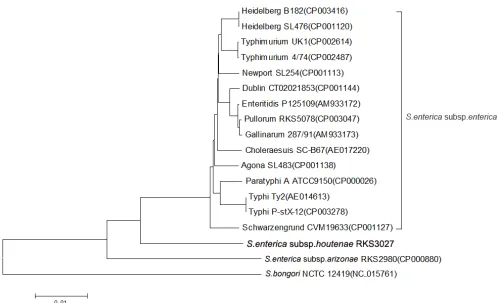
Meanwhile, it is increasingly commonplace to con-struct the phylogenetic tree by using the whole-genome sequence for higher precision and ro-bustness [7,8]. Therefore we used a total of 2,500 orthologs of 18 strains of
ing a genome-scale phylogenetic tree. Genetic re-latedness of strain
RKS3027 to other
was shown in Figure 1. On the tree, all
subsp. enterica strains were clustered together,
and RKS3027
posi-tioned betweenenterica and
The
family
flagellated, and motile. They grow within the op-timal temperature range 35 °C - 37 °C and within an optimal pH range of 7.2-7.6. is salicin-positive and able to grow in
KCB medium, two distinguishing characteristics when compared withenterica.
The strain is deposited in the
Stock Centre (SGSC), University of Calgary, Canada as RKS3027 (= SGSC
3086).
Genome sequencing information
Genome project history
This organism was selected for sequencing on the basis of its phylogenetic position and its serious virulence in humans compared to the reptiles. This Whole Genome Shotgun project has been deposited at DDBJ/EMBL/GenBank under the accession ANHR00000000. The version described in this paper is the first version, ANHR01000000, and the sequence consists of 97 large contigs.
Ta-ble 2 presents the project information and its as-sociation with MIGS version 2.0 compliance [12].
Growth conditions and DNA isolation
strain RKS3027 was
grown Luria Broth (LB) medium at 37°C. The DNA was extracted from the cell, concentrated and pu-rified using the Qiamp kit (Qiagen), as detailed in the manual for the instrument.
Genome sequencing and assembly
The genome of
RKS3027 was sequenced using the Illumina se-quencing platform by the paired-end strategy (2×100bp). The details of library construction and sequencing can be found at the Illumina web site [26]. The final coverage reached 100-fold for an estimated genome size of 4.5 Mb. The sequence data from Illumina HiSeq 2000 were assembled with SOAPdenovo v1.05. The final assembly con-tained 97 large contigs (>3000 bp) in 59 scaffolds generating a genome size of 4.4 Mb.
Figure 1. Phylogenetic tree highlighting the position of strain RKS3027 relative to the other
types and strains of
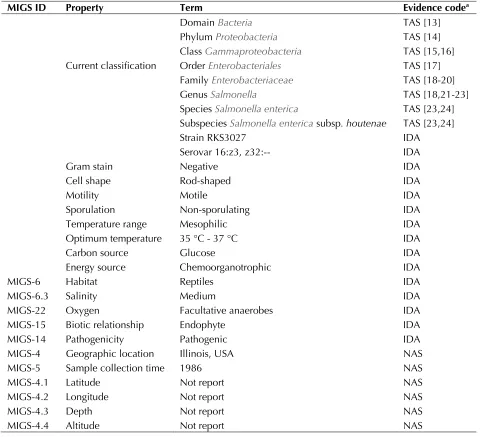
Table 1. Classification and general features o RKS3027 according to the MIGS recommendations [12]
MIGS ID Property Term Evidence codea
Domai TAS [13]
Phylum TAS [14]
Cla TAS [15,16]
Current classification Orde TAS [17]
Family TAS [18-20]
Genu TAS [18,21-23]
Species TAS [23,24]
Subspecies. houtenae TAS [23,24]
Strain RKS3027 IDA
Serovar 16:z3, z32:-- IDA
Gram stain Negative IDA
Cell shape Rod-shaped IDA
Motility Motile IDA
Sporulation Non-sporulating IDA
Temperature range Mesophilic IDA
Optimum temperature 35 °C - 37 °C IDA
Carbon source Glucose IDA
Energy source Chemoorganotrophic IDA
MIGS-6 Habitat Reptiles IDA
MIGS-6.3 Salinity Medium IDA
MIGS-22 Oxygen Facultative anaerobes IDA
MIGS-15 Biotic relationship Endophyte IDA
MIGS-14 Pathogenicity Pathogenic IDA
MIGS-4 Geographic location Illinois, USA NAS
MIGS-5 Sample collection time 1986 NAS
MIGS-4.1 Latitude Not report NAS
MIGS-4.2 Longitude Not report NAS
MIGS-4.3 Depth Not report NAS
MIGS-4.4 Altitude Not report NAS
a) Evidence codes - IDA: Inferred from Direct Assay; TAS: Traceable Author Statement (i.e., a direct report ex-ists in the literature); NAS: Non-traceable Author Statement (i.e., not directly observed for the living, isolated sample, but based on a generally accepted property for the species, or anecdotal evidence). These evidence codes are from the Gene Ontology project [25].
Table 2. Project information
MIGS ID Property Term
MIGS-31 Finishing quality Draft
MIGS-28 Libraries used Illumina Paired-End library MIGS-29 Sequencing platforms Illumina HiSeq 2000 MIGS-31.2 Fold coverage 100 ×
MIGS-30 Assemblers SOAPdenovo v1.05
MIGS-32 Gene calling method RAST
Genbank ID ANHR00000000
GOLD ID Gi21447
Genome annotation
Genes were predicted using RAST (Rapid Annota-tion using Subsystem Technology) [27] with gene caller GLIMMER3 [28] followed by manual curation. The predicted bacterial protein sequenc-es were compared with the annotated gensequenc-es from four available
subsp. enterica Typhi P-stx-12,.
enterica Heidelberg B182, .
enterica Typhimurium UK-1 and.
enterica Typhimurium 4/74 and searched against
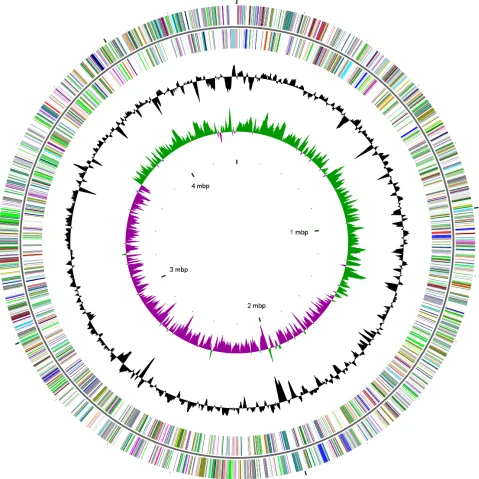
the Clusters of Orthologous Groups (COG) data-bases using BLASTP. The BLAST results were fil-tered with the following parameters: identities >90% and compared length >70%. CGViewer was used for visualization of genomic features [29].
Genome properties
The genome of
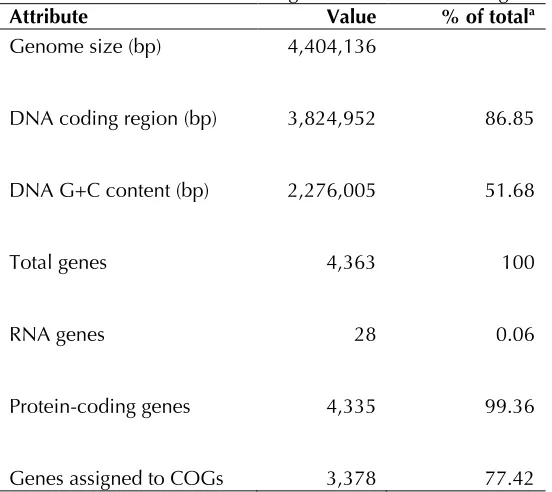
RKS3027 is 4,404,136 bp long (97 contigs) with a 51.68% G + C content (Table 3 and Figure 2). Of the 4,363 predicted genes, 4,335 were protein-coding genes, and 28 were RNAs (1 5S rRNA gene and 27 predicted tRNA genes). A total of 3,378 genes (77.42%) were assigned a putative function. The remaining genes were annotated as hypothet-ical proteins. The properties and statistics of the genome are summarized in Table 3. The distribu-tion of genes into COGs funcdistribu-tional categories is presented in Table 4.
Table 3. Nucleotide content and gene count levels of the genome
Attribute Value % of totala
Genome size (bp) 4,404,136
DNA coding region (bp) 3,824,952 86.85
DNA G+C content (bp) 2,276,005 51.68
Total genes 4,363 100
RNA genes 28 0.06
Protein-coding genes 4,335 99.36
Genes assigned to COGs 3,378 77.42
Table 4. Number of genes associated with the 25 general COG functional categories Code Value %agea Description
J 163 3.76 Translation
A 1 0.02 RNA processing and modification K 281 6.48 Transcription
L 176 4.06 Replication, recombination and repair B 0 0.00 Chromatin structure and dynamics D 32 0.74 Cell cycle control, mitosis and meiosis
Y 0 0.00 Nuclear structure V 48 1.11 Defense mechanisms
T 103 2.38 Signal transduction mechanisms M 235 5.42 Cell wall/membrane biogenesis N 95 2.19 Cell motility
Z 0 0.00 Cytoskeleton
W 0 0.00 Extracellular structures
U 41 0.95 Intracellular trafficking and secretion
O 138 3.18 Posttranslational modification, protein turnover, chaperones C 254 5.86 Energy production and conversion
G 343 7.91 Carbohydrate transport and metabolism E 319 7.36 Amino acid transport and metabolism F 77 1.78 Nucleotide transport and metabolism H 131 3.02 Coenzyme transport and metabolism
I 89 2.05 Lipid transport and metabolism
P 175 4.04 Inorganic ion transport and metabolism
Q 47 1.08 Secondary metabolites biosynthesis, transport and catabolism R 318 7.34 General function prediction only
S 312 7.20 Function unknown - 957 22.08 Not in COGs
a) The total is based on the total number of protein coding genes in the annotated genome.
Acknowledgments
This work was supported by grants of the National
Natural Science Foundation of China (NSFC30970119, 81030029, 81271786, NSFC-NIH 81161120416) to SLL.
References
1. Grassl GA, Finlay BB. Pathogenesis of enteric Curr Opin Gastroenterol 2008; 24:22-26
2. Reeves MW, Evins GM, Heiba AA, Plikaytis BD, Farmer JJ, III. Clonal nature of and its genetic relatedness to other salmonellae as shown by multilocus enzyme electrophoresis, and
proposal ofJ Clin
Microbiol 1989; 27:313-320 3. Boyd EF, Wang FS, Whittam TS, Selander RK.
Molecular genetic relationships of the salmonel-lae. Appl Environ Microbiol 1996; 62:804-808
Inv/Spa invasion proteins of Proc Natl Acad Sci USA 1995; 92:7252-7256
5. Weiss SH, Blaser MJ, Paleologo FP, Black RE,
McWhorter AC, Asbury MA, Carter GP, Feldman RA, Brenner DJ. Occurrence and distribution of serotypes of the Arizona subgroup of strains in the United States from 1967 to 1976. J Clin Microbiol 1986; 23:1056-1064 6. Abbott SL, Ni FC, Janda JM. Increase in
extraintestinal infections caused by Emerg Infect Dis 2012;
18:637-639
7. Luo Y, Fu C, Zhang DY, Lin K. BPhyOG: an
inter-active server for genome-wide inference of bacte-rial phylogenies based on overlapping genes. BMC Bioinformatics 2007; 8:266 8. Jiang LW, Lin KL, Lu CL. OGtree: a tool for creating
genome trees of prokaryotes based on overlap-ping genes. Nucleic Acids Res 2008;36(Web Server issue):W475-80.
9. Katoh K, Kuma K, Toh H, Miyata T. MAFFT ver-sion 5: improvement in accuracy of multiple se-quence alignment. Nucleic Acids Res 2005;
33:511-518
10. Tamura K, Peterson D, Peterson N, Stecher G, Nei M, Kumar S. MEGA5: molecular evolutionary genetics analysis using maximum likelihood, evo-lutionary distance, and maximum parsimony methods. Mol Biol Evol 2011; 28:2731-2739
11. Ewing WH. Edwards and Ewing’s identification of Co., New York, NY. 1986.
12. Field D, Garrity G, Gray T, Morrison N, Selengut J, Sterk P, Tatusova T, Thomson N, Allen MJ, Angiuoli SV, et al. The minimum information about a genome sequence (MIGS) specification. Nat Biotechnol 2008; 26:541-547
13. Woese CR, Kandler O, Wheelis ML. Towards a natural system of organisms: proposal for the
do-mainsEucarya.Proc Natl
Acad Sci USA 1990; 87:4576-4579
14. Garrity GM, Bell JA, Lilburn T. Phylum XIV. DJ, Krieg NR, Staley JT (eds), Bergey's Manual of Systematic Bacteriology, Second Edition, Volume 2, Part B, Springer, New York, 2005, p. 1. 15. Validation of publication of new names and new
combinations previously effectively published outside the IJSEM. List no. 106. Int J Syst Evol Microbiol 2005; 55:2235-2238.
16. Garrity GM, Bell JA, Lilburn T. Class III.
Brenner DJ, Krieg NR, Staley JT (eds), Bergey's Manual of Systematic Bacteriology, Second Edi-tion, Volume 2, Part B, Springer, New York, 2005, p. 1.
17. Garrity GM, Holt JG. Taxonomic Outline of the Castenholz RW (eds), Bergey's Manual of System-atic Bacteriology, Second Edition, Volume 1, Springer, New York, 2001, p. 155-166. 18. Skerman VBD, McGowan V, Sneath PHA.
Ap-proved Lists of Bacterial Names. Int J Syst Bacteriol 1980; 30:225-420.
19. Rahn O. New principles for the classification of
bacteria. Zentralbl Bakteriol Parasitenkd Infektionskr Hyg 1937; 96:273-286.
20. Judicial Commission. Conservation of the family nam genus, and designation of the type species OPINION NO. 15. Int Bull Bacteriol Nomencl Taxon 1958; 8:73-74.
21. Lignieres J. Maladies du porc. Bulletin of the Soci-ety for Central Medical Veterinarians 1900; 18:389-431.
22. Le Minor L, Rohde R. Genus IV Lignieres 1900, 389. In: Buchanan RE, Gibbons NE (eds), Bergey's Manual of Determinative Bac-teriology, Eighth Edition, The Williams and Wil-kins Co., Baltimore, 1974, p. 298-318.
23. Judicial Commission of the International Commit-tee on Systematics of Prokaryotes. The type spe-cies of the genus 1952) Le Minor and Popoff 1987, with the type strain LT2, and conservation of the epithet enterica in epithets that may be applied to this species. Opin-ion 80. Int J Syst Evol Microbiol 2005; 55 :519-520
24. Le Minor L, Popoff MY. Request for an Opinion. Designation o rev., as the type and only species of the genus Int J Syst Bacteriol 1987; 37:465-468. 25. Ashburner M, Ball CA, Blake JA, Botstein D,
But-ler H, Cherry JM, Davis AP, Dolinski K, Dwight SS, Eppig JT, et al. Gene ontology: tool for the unification of biology. The Gene Ontology Con-sortium. Nat Genet 2000; 25:25-29
26.
http://www.illumina.com/technology/sequenci ng_technology.ilmn
27. Aziz RK, Bartels D, Best AA, DeJongh M, Disz T, Edwards RA, Formsma K, Gerdes S, Glass EM, Kubal M, et al. The RAST Server: rapid annota-tions using subsystems technology. BMC Ge-nomics 2008; 9:75
28. Delcher AL, Bratke KA, Powers EC, Salzberg SL.
Identifying bacterial genes and endosymbiont DNA with Glimmer. Bioinformatics 2007;
23:673-679
29. Stothard P, Wishart DS. Circular genome visuali-zation and exploration using CGView. Bioinfor-matics 2005; 21:537-539