Reviewed v1 Research Idea
The project EcoNAOS: vision and practice towards
an open approach in the Northern Adriatic Sea
ecological observatory
Annalisa Minelli, Alessandro Oggioni, Alessandra Pugnetti, Alessandro Sarretta,
Mauro Bastianini, Caterina Bergami, Fabrizio Bernardi Aubry, Elisa Camatti,
Tiziano Scovacricchi, Giorgio Socal
‡ CNR-ISMAR, Venezia, Italy § CNR-IREA, Milano, Italy | CNR-ISMAR, Bologna, Italy
Corresponding author: Annalisa Minelli ([email protected])
Received: 04 Feb 2018 | Published: 06 Feb 2018
Citation: Minelli A, Oggioni A, Pugnetti A, Sarretta A, Bastianini M, Bergami C, Bernardi Aubry F, Camatti E, Scovacricchi T, Socal G (2018) The project EcoNAOS: vision and practice towards an open approach in the Northern Adriatic Sea ecological observatory. Research Ideas and Outcomes 4: e24224.
https://doi.org/10.3897/rio.4.e24224
Abstract
Background
The Open Science approach delineates high and inspiring principles. In order to really root them into the scientific community, a cultural shift must occur that can be fostered and achieved mainly through the development of practical case studies. This is particularly relevant in the field of ecology, a highly multidisciplinary science, where the Open Science issue has become a matter of discussion only in very recent years. In particular, in the context of term ecological research, enabling open sharing of in-situ and derived long-term ecological data is required to advance research and education in the European and global networks.
‡ § ‡ ‡
‡ | ‡ ‡
‡ ‡
New information
The creation of marine ecological observatories, able to arrange and maintain integrated, harmonized and coherent long-term ecological observations, is stressed as a relevant step at the European level, for sustaining European marine policies. The Italian national flagship project RITMARE (“Italian research for the sea”, http://www.ritmare.it/en/) fostered the development of a marine ecological observatory in the Northern Adriatic Sea (NAS), one of the 25 research parent sites belonging to the Italian Long-Term Ecological Research Network (LTER-Italy, http://www.lteritalia.it), through a dedicated research line. Within this context, we developed a specific task, aimed at testing and applying the Open Science approach to the NAS ecological observatory: “EcoNAOS - Ecological Northern Adriatic Open Science Observatory System”. We present our plans and ideas for the application of the Open Science principles, starting from the 50-year ecological dataset of plankton and related biogeochemical parameters collected in the NAS, mainly in the Gulf of Venice. We introduce each of the different steps needed for “opening science”: research ideas statement, raw data collection, data harmonization (structural, syntactic and semantic), ancillary data collection/recovery and metadatation, data and metadata publication, software publication, publication of results, and data citation. In order to share different expertise and include different points of view as essential outcomes themselves, researchers from the field of LTER and data management were involved in EcoNAOS since its start. Our final goal is to demonstrate that a change of vision is possible, leading from “publishing ASAP” to “sharing data and information and collaborating ASAP”.
Keywords
LTER-Italy, Northern Adriatic Sea, Open Science, marine ecological data, Open Access, Research project lifecycle
Introduction
concerning the sea are fundamentally biological and socio-ecological, since they are related to its role as a source of food, health and human well-being.
The Northern Adriatic Sea (NAS) is a significant geographical zone for the establishment of a marine ecological observatory, due to the concomitant presence of high degree of biodiversity, sensitive habitats and ecosystems, numerous on-going monitoring and research activities, as well as of heavy and diversified human pressures and economic interests, based on the marine resources of the area. It is one of the 25 parent sites belonging to the LTER-Italy (Long-Term Ecosystem research) network: it is composed by 4 LTER research sites (Fig. 1, https://data.lter-europe.net/deims/site/lter_eu_it_012), where meteo-oceanographic and biological data, mainly on plankton, are gathered through both fixed point observatories and oceanographic cruises. LTER is based on gathering and analysing multi-decadal ecological observations and data to support understanding and managing the environment. It provides a sound basis of data and knowledge that is particularly important in our rapidly changing world, where processes like climate change, land and sea exploitation, and global trade are dramatically affecting the environment, altering ecosystem structure and functioning, which are at the base of the ecosystem services we depend on (e.g. provision of food and water, air and water quality, and the aesthetic value of a landscape). LTER is organised in networks of sites at the national, regional (LTER-Europe) and the global level (ILTER). LTER-Italy, a formal member of LTER-Europe and LTER-International since 2006, consists of 79 research sites belonging to terrestrial, freshwater, transitional and marine ecosystems, managed and coordinated by public research, monitoring Institutions and Universities.
Figure 1.
The Italian national flagship project RITMARE (“Italian research for the sea”), funded by the Italian Ministry of University and Research, dedicated a Research Line to the establishment of a marine ecological observatory in the NAS: building on the existing facilities, infrastructures and long-term ecological data, it aims at enhancing and aligning the marine observational capacities and at activating synergies among the main conservation management questions and key ecological and oceanographic variables.
Along this process, it is crucial to start the implementation of the Open Access and Open Science principles, by creating an open research lifecycle, which involves sharing each step of the process, including not only results (scientific papers) but also data (raw and processed), metadata, methods and software. We introduce here each of the different steps planned for “Opening Science” in this context: research ideas statement, raw data collection, data harmonization (structural, syntactic and semantic), ancillary data collection/ recovery and metadatation, data and metadata publication, software publication, publication of results, and data citation. The whole process of application of the Open Science principles to the NAS ecological observatory will be referred in the text, from now on, as the project "EcoNAOS” (Ecological Northern Adriatic Open Science Observatory System).
Science (European Commission 2016a). Klump et al. 2006 affirmed that data should follow Open Access principles and, in recent times, the European Union, with the program Horizon 2020, stated that all the European research must be “Open by Default”. This means that not only outcomes and results of the research must be accessible to everyone, but also data, code and tools, in order to make science Findable, Accessible, Interoperable and Reproducible (F.A.I.R., Wilkinson et al. 2016, Moedas 2016).
Open Science is actually also one of the key thematic elements of RRI - Responsible Research and Innovation (Owen et al. 2012), which recognizes that making research results more accessible contributes to better and more efficient science and to innovation in the public and private sectors. Open Science is actually the route towards a democratic way of making freely available, for every researcher or stakeholder, research ideas, data, metadata, tools and outcomes of the research itself.
From the researchers point of view, open practices can give advantage to gain more citations, media attention, potential collaborators, job and funding opportunities (McKiernan et al. 2016).
In the field of ecology, the Open Science issue is a matter of interest and discussion only in quite recent years (Reichman et al. 2011). Actually, ecology, being a highly multidisciplinary science, will surely benefit from the Open Science revolution. However, the cultural shift from "data ownership to data stewardship" is not yet widely accomplished and data sharing standards, both from technical and ethical point of view, still have to be established. An overview on Open Science practices in ecology was recently given by Hampton et al. (2015). In the LTER context, enabling open sharing of in-situ and derived long-term ecological data is important in order to advance research and education. LTER data are characterised by long and continous time series; therefore data consistency and integrity is crucial, in order to make the scientists able to identify reliable trends. Since observations' technologies, precisions and methods are changing over long periods in LTER networks, the maintenance of these datasets is a challenge addressed also at the European and international level. LTER data must currently be recognized as a research output with formal citation links, to promote data reuse and acknowledgement of originators, in agreement with the F.A.I.R. principles for data management and Open Science (European Commission 2016b).
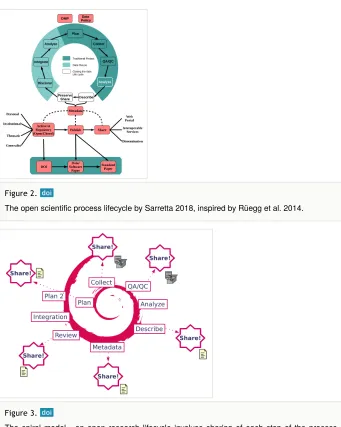
3) needed for “opening science”: research ideas statement, raw data collection, data harmonization (structural, syntactic and semantic), ancillary data collection/recovery and metadatation, data and metadata publication, software publication, publication of results, data citation. Our final goal is to demonstrate that a change of vision is possible, leading from “publishing ASAP” to “sharing data and information and collaborating ASAP” (Moedas 2015). The whole process involved, since its start, both LTER and data management researchers in a joint partnership, in order to share and give value to the different points of view and expertise and include, as essential parts and outcomes of the process itself, also cultural resistances and practical challenges.
Figure 2.
The open scientific process lifecycle by Sarretta 2018, inspired by Rüegg et al. 2014.
Figure 3.
Rationale and Data Description
Publishing and sharing the different phases of the research process involves not only results, but also ideas, data collection and elaboration, metadata and tools construction. Many possible integrations, reuse and different implementations in the frame of Open Science could lead to growth, improvement, and widening of the research process as a whole. Starting from the circular model conceived by Rüegg et al. (2014) to describe research life cycle, and integrating the key role of metadata and Open Science, it is possible to rethink the life cycle of data within a growing spiral mode (Fig. 3). A representation of the open scientific process lifecycle explained in Sarretta 2016 is given in the Fig. 2.
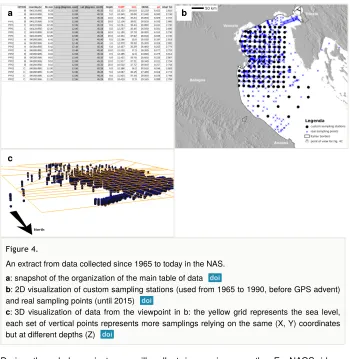
The spiral model can be applied to many different research topics, because it follows the entire lifecycle of the research, from data collection to results publication. We used as input a specific dataset: 50 years of data on abiotic parameters, phytoplankton and zooplankton, gathered from 1965 until 2015 at the LTER-Italy parent site NAS, prevalently in the Gulf of Venice, from oceanographic cruises and, more recently, fixed observation points. The dataset has been produced by the Institute of Marine Sciences of the National Research Council of Italy (ISMAR-CNR), located in Venice, using different methodologies, which changed according to sampling and laboratory instruments and technologies available in different times or to research interests. The data is composed by parameters quite heterogeneous in type, number, geographical distribution and semantics. An example is reported in Fig. 4a, b, c. The parameters are both abiotic and biotic: water temperature, transparency (Secchi Disk), pH, dissolved oxygen, dissolved macronutrients, phytoplankton chlorophyll-a, phytoplankton and zooplankton abundance.
The data have been stored in paper registries and in spreadsheets. Old data have been recovered from paper registries and transcribed. Due to its relatively small dimension (about 60.000 records) the dataset currently is managed as a unique spreadsheet. A lot of raw (coming directly from sensors), semi-elaborated (first pruned data, e.g. from on board instruments) and elaborated data (e.g. coming from laboratory analysis) are available.
The elaboration of the datasets will be worked out by a small group of plankton ecologists and data management experts, with the aim of sharing and harmonizing as well the different experiences, needs and points of view. This collaboration is an important step to contribute overcoming cultural differences, barriers and fragmentation that might represent an obstacle for Open Science. The inclusion of the different attitudes and specificities allows flexibility and fosters finding jointly proper solutions and incentives.
Implementation
suggestions and evaluations at each step of EcoNAOS, driven by the spiral model and described in detail in the following paragraphs. The concepts and the outcomes of EcoNAOS will be tested on its applicability involving researchers from the LTER-Italy network in order to verify, within a wider but related community, the opening process effectiveness, its limits and strengths. In fact, it is important to understand perceptions and barriers (technical or cultural) with regard to Open Science and in particular Open Access applied to data, in order to find the right way to communicate Open Science and try to overcome existing obstacles.
During the whole project, we will collect impressions on the EcoNAOS ideas and development through workshops, involving institutions and research groups dealing with similar data at the LTER research sites of the NAS and at another LTER-Italy research site in the Tyrrhenian Seas (LTER Marechiara site). In these workshops we plan also to propose to our colleagues testing the opening process by the calculation of some relevant environmental quality indicators that could be executed by each institution/group using its own LTER dataset.
a b
c
Figure 4.
An extract from data collected since 1965 to today in the NAS.
a: snapshot of the organization of the main table of data
b: 2D visualization of custom sampling stations (used from 1965 to 1990, before GPS advent) and real sampling points (until 2015)
EcoNAOS will be organized in six main steps:
First step - Harmonization of the database. A complete harmonization, aimed to a real
interoperability, includes standardisation of semantic, schemes and structure of a database (Kwok 2010). This harmonization will be carried out as much as possible automatically. This implies the implementation of appropriate tools in order to clean up, re-order and organize (where necessary) the database. Procedures will be developed in order to automatically harmonizing semantic and structure of sampling stations. The clean dataset will be used both for research and management purposes, by research institutions and environmental agencies.
Second step - Description of data through the collection of all the available metadata, such as information about the specific sampling cruise, the used instruments and probes, the involved researchers and operators, and so on. These metadata are supposed to be found in papers or digital archives and the aim of this specific task is not only to better describe and enrich the information related to specific data, but also to build up fundamental and affordable tools for the successive quality and consistency data check phases, and the reliability and the actual meaning of each sampled datum.
Fourth task (crosscutting all the others) - Publication of ideas, results, tools, data and metadata after an accurate Open Science framing. In this particular phase, it is important to choose the best tools in relation to the principles that guide our work and to the structure of our data. It is primarily important to us that everything could be published as soon as possible and in an Open Access environment (preferably gold road Open Access). Some solutions have already been studied: an example is the choice of RIO journal to publish these research ideas. We took this decision because it is Open Access and has a fully open and citable review process; another preferable choice appears to be the use of Githu b platform to share the code written from time to time. Some others solutions are still under discussion.
Fifth step - Implementation of a proper data citation system dealing also with the dynamic character of long-term data and versioning. So the issue of citing a dynamic and growing dataset (or portions of it) soon will arise. Querying an oceanographic database temporally, semantically or in relation to one or more numerical parameters is not yet a standard process, no specific rules or protocols have been created purposely (Belter 2014) and this reflection opens a wide and interesting perspective for research in the field of oceanographic data science. On more generic scientific data, a remarkable attempt of standardization has been done by the data citation working group of the Research Data Alliance (RDA). We will start, in particular, from the 14 rules defined by RDA to support accurate citation of data subjected to change in order to ensure the efficient processing and permanent linking of data (Rauber et al. 2016).
Sixth step - Development of guidelines aimed to better explain the whole opening process. The guidelines development can only be carried on after all the others steps and it is useful to clarify each step for future applications, summarize strengths and weaknesses of EcoNAOS and express a final opinion on the efficiency/utility of the whole process. These guidelines will categorize interventions in two main principal groups: (i) interventions aimed to open the process (data policy, software, publication, citation) and (ii) interventions aimed to create F.A.I.R. data (e.g. database structure, semantic harmonization, efforts on interoperability, services available).
Expected Impact
EcoNAOS can deliver an effective contribution to the application of the Open Science in marine ecology since:
1. It involves scientists from different research areas, fields and institutions, and data management experts, thus representing an example of cooperation under the Open Science principles;
2. It aims to introduce a set of best practices, based on a practical case study, for research and data sharing in marine ecology again under the Open Science principles.
This activity is fully in line with the data management plan of the LTER networks, at the national, European and global level, since one of the LTER mandates is actually to foster open sharing of LTER data, in order to advance socio-ecological research and education (Mirtl 2010, Mirtl et al. 2018). The ultimate impact of EcoNAOS on the LTER and on the wider community of marine ecologists will be related to a process of gradual change in the perspective of the opening research process. We aim to demonstrate that the model of Open Science works for static and dynamic datasets; that the data sharing does not represent a threat to data integrity or attribution but, on the contrary, it could lead to qualitative and quantitative integration of the dataset. Supporting the view that an Open Access work has bigger scientific resonance than a closed access one (Swan 2010). From this perspective, it is interesting to test the strength and the limits of the Open Access approach, and this is important not only to make data available for everyone, following the Open Science principles, but also to understand which barriers (if any) are present. For example, a crucial point could be the release of sensitive data, or the release of an evolving database. To this respect, a data policy must be conceived and shared among involved parts at the beginning and during the whole process.
Lastly, this pilot project is not aimed to force the complete opening of any on-going and future research process. Instead, it has the goal to provide an overview on the current situation, as detailed as possible, on data opening and to test the feasibility of the process, identifying perspectives on the short and long-term, existing obstacles and solutions. EcoNAOS will offer as well a support to researchers in data management, using an integrated approach and stimulating cooperation among all the researchers involved , collecting their requests, doubts and observations on the wider Open Science principles applied to LTER marine themes.
Funding program
The RITMARE ("La ricerca Italiana per il Mare" - "The Italian Research for the Sea") Flagship Project is one of the National Research Programmes funded by the Italian Ministry of University and Research. The funding period for the present work is 2017-2018. Funds have already been allocated.
Conflicts of interest
The authors declare that there are no conflicts of interest regarding the publication of this article.
References
Vianello A (2015) The LTER site Gulf of Venice and the project RITMARE: a case study for the recovery, search, view and sharing of long term ecological marine research data. AIOL - Associazione Italiana Oceanografia e Limnologia, Verbania Pallanza.
• Belter C (2014) Measuring the Value of Research Data: A Citation Analysis of Oceanographic Data Sets. PLOS ONE 9 (3): e92590‑e92590. https://doi.org/10.1371/ journal.pone.0092590
• Berners-Lee T (1989) Information Management: A Proposal. https://www.w3.org/ History/1989/proposal.html
• David P (1998) Common Agency Contracting and the Emergence of ‘Open Science’ Institutions. The American Economic Review 88 (2): 15‑21. URL: www.jstor.org/ stable/116885.
• David P (2003) The economic logic of “open science” and the balance between private property rights and the public domain in scientific data and information: a primer. In: National Academies Press The role of the public domain in scientific and technical data and information. 238 pp. [ISBN 030908850X, 9780309088503].
• EASAC, JRC (2016) Marine sustainability in an age of changing oceans and seas.
https://ec.europa.eu/jrc/en/event/conference/marine-sustainability-age-changing-oceans-and-seas
• European Commission (2016a) Open innovation, open science, open to the world - a vision for Europe. [email protected] [ISBN 978-92-79-57346-0]
https://doi.org/10.2777/061652
• European Commission (2016b) H2020 Programme - Guidelines on FAIR Data
Management in Horizon 2020. http://ec.europa.eu/research/participants/data/ref/h2020/ grants_manual/hi/oa_pilot/h2020-hi-oa-data-mgt_en.pdf
• Fugazza C, Basoni A, Menegon S, Oggioni A, Pavesi F, Pepe M, Sarretta A, Carrara P (2014) RITMARE: Semantics-aware Harmonisation of Data in Italian Marine Research. Procedia Computer Science 33: 261‑265. https://doi.org/10.1016/j.procs.2014.06.041
• G7 Science Ministers (2016) Recommendations – G7 expert workshop on future of the oceans and seas Background. Trends in the Sciences 21 (8): 8_84‑8_87. https:// doi.org/10.5363/tits.21.8_84
• Hampton S, Anderson S, Bagby S, Gries C, Han X, Hart E, Jones M, Lenhardt WC, MacDonald A, Michener W, Mudge J, Pourmokhtarian A, Schildhauer M, Woo K, Zimmerman N (2015) The Tao of open science for ecology. Ecosphere 6 (7): 1‑13.
https://doi.org/10.1890/ES14-00402.1
• Klump J, Bertelmann R, Brase J, Diepenbroek M, Grobe H, Höck H, Lautenschlager M, Schindler U, Sens I, Wächter J (2006) Data publication in the open access initiative. Data Science Journal 5 https://doi.org/10.2481/dsj.5.79
• Kwok C (2010) Harmonisation of Geodata. http://cartography.tuwien.ac.at/wordpress/ wp-content/uploads/2010/07/Harmonisation_of_Geodata_presentation.pdf
• McKiernan EC, Bourne PE, Brown CT, Buck S, Kenall A, Lin J, McDougall D, Nosek BA, Ram K, Soderberg CK, Spies JR, Thaney K, Updegrove A, Woo KH, Yarkoni T (2016) How open science helps researchers succeed. eLife 5 https://doi.org/10.7554/ elife.16800
• Minelli A, Pugnetti A, Sarretta A, Oggioni A (2018) The LTER-Italy parent site "Northern Adriatic Sea". Zenodo. Release date: 2018-1-24. URL: https://doi.org/10.5281/
zenodo.1158675
• Mirtl M (2010) Introducing the Next Generation of Ecosystem Research in Europe: LTER-Europe’s Multi-Functional and Multi-Scale Approach. Long-Term Ecological Research. https://doi.org/10.1007/978-90-481-8782-9_6
• Mirtl M, Borer E, Djukic I, Forsius M, Haubold H, Hugo W, Jourdan J, Lindenmayer D, McDowell WH, Muraoka H, Orenstein D, Pauw J, Peterseil J, Shibata H, Wohner C, Yuk X, Haase P (2018) Genesis, goals and achievements of Long-Term Ecological
Research at the global scale: A critical review of ILTER and future directions. Science of the total Environment.
• Moedas C (2015) Freedom is absolutely necessary for scientific progress. https:// ec.europa.eu/commission/commissioners/2014-2019/moedas/announcements/freedom-absolutely-necessary-scientific-progress_en
• Moedas C (2016) H2020 Programme Guidelines on FAIR Data Management in Horizon 2020. http://ec.europa.eu/research/participants/data/ref/h2020/grants_manual/hi/ oa_pilot/h2020-hi-oa-data-mgt_en.pdf
• Network Services Drafting Team - EU (2007) INSPIRE - Infrastructure for Spatial Information in Europe. INSPIRE Technical Architecture - Overview. http:// inspire.ec.europa.eu/reports/ImplementingRules/network/
INSPIRETechnicalArchitectureOverview_v1.2.pdf
• Oggioni A, Tagliolato P, Fugazza C, Pepe M, Menegon S, Pavesi F, Carrara P (2017) Interoperability in Marine Sensor Networks through SWE Services: The RITMARE Experience. http://services.igi-global.com/resolvedoi/resolve.aspx?
doi=10.4018/978-1-5225-0700-0.ch009 200‑223. https:// doi.org/10.4018/978-1-5225-0700-0.ch009
• Owen R, Macnaghten P, Stilgoe J (2012) Responsible research and innovation: From science in society to science for society, with society. Science and Public Policy 39 (6): 751‑760. https://doi.org/10.1093/scipol/scs093
• Pavesi F, Basoni A, Fugazza C, Menegon S, Oggioni A, Pepe M, Tagliolato P, Carrara P (2016) EDI – A Template-Driven Metadata Editor for Research Data. Journal of Open Research Software 4 (1). https://doi.org/10.5334/jors.106
• Rauber A, Amsi A, Uytvanck Dv, Pröll S (2016) Identification of Reproducible Subsets for Data Citation, Sharing and Re-Use. Bulletin of IEEE Technical Committee on Digital Libraries, Special Issue on Data Citation URL: http://www.ieee-tcdl.org/Bulletin/v12n1/ papers/IEEE-TCDL-DC-2016_paper_1.pdf
• Raymond E (1999) The Cathedral & the Bazaar. O'Reilly Media, 241 pp. URL: http:// www.catb.org/~esr/writings/cathedral-bazaar/ [ISBN 1-565-92724-9]
• Reichman OJ, Jones MB, Schildhauer MP (2011) Challenges and Opportunities of Open Data in Ecology. Science 331 (6018): 703‑705. https://doi.org/10.1126/ science.1197962
• Ross J, Harlan M. Krumholz (2013) Ushering in a new era of open science through data sharing: the wall must come down. Jama 309 (13): 1355‑1356. https://doi.org/10.1001/ jama.2013.1299
management in macrosystems ecology research. Frontiers in Ecology and the Environment 12 (1): 24‑30. https://doi.org/10.1890/120375
• Ruttenberg S (1992) The ICSU world data centers. Eos, Transactions American Geophysical Union 73 (46): 494‑494. https://doi.org/10.1029/91EO00365
• Sarretta A (2016) Open Acceess and RRI. In: Figshare (Ed.) RRI: sfide e opportunità per il mondo della ricerca. Milano, 27/04/2016. https://doi.org/10.6084/
m9.figshare.3203452.v3
• Sarretta A (2018) Research Data Life Cycle. Zenodo. Release date: 2018-1-16. URL:
http://doi.org/10.5281/zenodo.1149049
• Stallman R (1998) The GNU project. https://www.gnu.org/gnu/thegnuproject.html
• Swan A (2010) The Open Access citation advantage: Studies and results to date. Technical Report, School of Electronics & Computer Science, University of Southampton..
• Tagliolato P, Oggioni A, Fugazza C, Pepe M, Carrara P (2016) Sensor metadata blueprints and computer-aided editing for disciplined SensorML. IOP Conference Series: Earth and Environmental Science 34 (1): 012036‑012036. https:// doi.org/10.1088/1755-1315/34/1/012036
• Tessarolo G, Ladle R, Rangel T, Hortal J (2017) Temporal degradation of data limits biodiversity research. Ecology and Evolution 7 (17): 6863‑6870. https://doi.org/10.1002/ ece3.3259
• Various Authors (2003) Berlin Declaration on Open Access to Knowledge in the Sciences and Humanities. https://openaccess.mpg.de/Berlin-Declaration