Volume 2, Issue 3, March 2013
Page 258
A
BSTRACTThis paper presents the early warning evaluating method and decision mechanism for uncertain city emergency in which the risk factors are easily assessed by intuitionistic fuzzy value. By using the proposed intuitionistic fuzzy entropy we calculate the occurring probability of each risk factor. In the process of fuzzy risk analysis, the severity of loss and the grade of each risk factor are evaluated by intuitionistic fuzzy numbers rather than the real numbers. By computing the similarity between the fuzzy comprehensive risk value and the given risk grade, the early warning degree of the city significant emergency can be determined for urgent emergency decision-making.
Keywords: city emergency, similarity measure, entropy, warning degree, decision making
1.
I
NTRODUCTIONWith the development and expansion of city, the frequency and strength of significant emergencies are increasing in many cities. So city significant emergency index analysis and early warning become very important research issues in emergency management. As is well known, many uncontrolled index factors easily incur the city emergency. Simultaneously, the city emergency inevitably affects many aspects of city including city economy recession, safety of environment and property, and casualties. In the past decades, Zhang [1] proposed the methods of index selecting and weighting for emergency. The authors [2-6] have proposed some urgent decision making approaches for city significant emergency. Also some early warning management methods for city incidents have been introduced [7-15]. However, most of the existing early warning mechanisms and decision methods can only deal with the city emergency under precise condition. In fact, due to the increasing complexity of the socio-economic environment and the lack of knowledge about the problem domain, most of the real-world problems, such as city emergency decision analysis and emergency warning degree evaluation, are involved variety of uncertainty like fuzzy value and intuitionistic fuzzy value. Especially, in the warning degree evaluation process of city significant emergency it will inevitably involve some uncertain factors including the serious economy depression, the wicked environment destroy, the improper emergency broadcasting, the enormous casualties, and the critical traffic jam, as well as the inadequate emergency rescue facilities, etc. Also, the values of above risk factors are easily expressed by intuitionistic fuzzy linguistic values. As is well known, the unexpected and uncontrolled uncertain risks easily incur the city significant emergency. So, in order to decrease the possibility of city significant emergency, there is much need to analyze and control the risk of City significant emergency. And, it is a necessitous task for the city government department decision-maker to adopt the corresponding strategy to avoid and reduce the occurrence of significant emergency in city zone according to the evaluated intuitionistic fuzzy comprehensive risk value.
Recently, many researchers studied the risk analysis of emergency in [18-21], but the fuzzy risk factor was not considered. Although Zhong [22] employed fuzzy entropy and comprehensive judgment method to calculate the occurring probability of risk, it has some drawbacks since it is based on traditional Shannon entropy. And Li [23] discussed the fuzzy comprehensive risk judgment of HR outsourcing, but the method is unable to determine the accurate risk grade. In fact, most of the existing fuzzy risk computing methods can not effectively cope with the risk evaluating and warning degree determining involved intuitionistic fuzzy risk factors. Thus, in this paper we aim to propose an intuitioinstic fuzzy risk evaluation approach for city emergency in the uncertain environment.
The Early Warning Evaluation and Urgent
Decision Mechanism for City Significant
Emergency in Uncertain Environment
Qiansheng Zhang1, Yirong Huang2
1
School of Informatics, Guangdong University of Foreign Studies, Guangzhou 510420, P.R.China,
2
Volume 2, Issue 3, March 2013
Page 259
2.
P
RELIMINARIESIntuitionistic fuzzy set(IFS) introduced by Atanassov [24] is a useful generalization of the ordinary fuzzy set, which has been proved to be more suitable way for dealing with uncertainty. Particularly, the information entropy [25], similarity measure and distance measure of IFSs play very important roles in the application areas like pattern recognition, medical diagnosis, and decision-making [26].
Definition 1[24]. An intuitionistic fuzzy set A in the universe X {x1,x2,,xn} is defined as ,
{(xi
A tA(xi),fA(xi))/xiX}, i.e.,A(xi)[tA(xi),1fA(xi)] and the condition 0tA(xi)+ fA(xi)1 must hold for anyxiX , where tA(xi), fA(xi)are called the membership degree and non-membership degree of elementxi
to the intuitionistic fuzzy setA, respectively; ) ( ) ( 1 )
( i A i A i
A x t x f x
is called the hesitation degree of xito the IFS A. We denote by IF(X)the family of all the intuitionistic fuzzy sets in universeX.
Definition 2. A mapping E from IF(X) to interval [0,1] is named as intuitionistic fuzzy entropy, if it satisfies the following extension of DeLuca-Termini axioms:
(p1)E(A)=0, if
A
is a crisp set, i.e., A(xi)0,1 or1,0, for all xiX ;(p2)E(A)=1, iff tA(xi) fA(xi) for all xiX ;
(p3)E(A*) E(A), ifA*A, i.e., A*is a sharpened version of A defined as
). ( ) ( ), ( ) ( ) ( ) ( ); ( ) ( ), ( ) ( ) ( ) ( * * * * i A i A i A i A i A i A i A i A i A i A i A i A x f x t for x f x f and x t x t x f x t for x f x f and x t x t
(p4) E(A) E(Ac), where Acis the complement set of IFSA.
One can easily see that the formula E(A)=
n
i A i A i A i
i A i A i A x x f x t x x f x t
n 1 ( ) ( ) 0.5 ( ) ) ( 5 . 0 ) ( ) ( 1
, (1)
is an information entropy measure of intuitionistic fuzzy set A.
Definition 3. The function S:IF(X)IF(X)[0,1] is defined as the similarity between IFSs if the following conditions hold.
(1)S(A,B)0, for all A,BIF(X); (2)S(A,B)1, iff AB.
(3) ifABC, then S(A,C)S(A,B) and S(A,C)S(B,C).
Definition 4. For any two intuitionistic fuzzy sets A{(xi,tA(xi),fA(xi))/xiX}, and ,
{(xi
B tB(xi),fB(xi))/xiX}, a similarity measure between them is defined as
] ) ( ) ( ) ( ) ( ) ( ) ( [ 1 ) ,
( 2 2 2
1 2 1 i B i A i B i A i B i A n i
n t x t x f x f x x x
B A
S
, (2)
For convenience, according to the work of Xu [27], we call a~a,ban intuitionistic fuzzy number (IFN), if 1
0ab .
Definition 5. Let ~a1 a1,b1 and ~a2 a2,b2 be two IFNs, two intuitionistic fuzzy aggregation operators are defined as
2 1 2 1 2 1 2
1 ~ ,
~ a a a a a bb
a (3)
a w bw a
w~1 1 (1 1) , 1 , w0.
3.
E
ARLYW
ARNINGE
VALUATIONM
ETHOD ANDD
ECISIONM
ECHANISM FORC
ITYE
MERGENCYVolume 2, Issue 3, March 2013
Page 260
term, we can conveniently represent the possibility and the severity of loss of each risk factor. Through the fuzzy risk analysis method, we can correctly estimate the risk grade of city significant emergency.
Generally, by questionnaire survey and statistical analysis from some field experts and emergency managers we can easily get some important risk factors of city significant emergency. As we know, the risk factors that incur the city significant emergency mainly include the economy risk, the environment risk, the humanity risk, and the traffic jam risk, public health risk, as well as the emergency facility risk, etc. Suppose the set of all risk factors of city significant emergency is denoted by U{u1,u2,,um}. Generally, the risk factor is intuitionistic fuzzy concept, for example, serious economic recession, severe environment pollution, wicked emergency broadcasting, bad public health, incomplete emergency facility, and so on. As we are aware, the accurate values of the severity of loss and the occurring probability of each risk factor are difficult to measure in uncertain setting. On the contrary, government managers and related field experts tend to evaluate the possibility and the severity of loss of the above uncertain risk factors in city significant emergency by using intuitionistic fuzzy language terms like P= {Very Low, Low, Medium, High, Very High} and R= {Critical, Serious, Medium, Weak, Neglectful} rather than by using accurate real numbers.
In order to simplify the treatment of judgment expression, a unified set of linguistic variables is predetermined in this paper, which can be adapted to every risk factor of city significant emergency from the satisfaction perspective as shown in Table 1.
Table 1: Linguistic terms for rating the severity of loss of the risk factors in city significant emergency
Linguistic terms IFNs
Critical (C) <0.9, 0.1> Serious (S) <0.7, 0.2>
Medium (M) <0.5, 0.4>
Weak (W) <0.3, 0.6> Neglectful (N) <0.1, 0.9>
where each linguistic term is assigned as an intuitionistic fuzzy number, for example, W=<0.3, 0.6> represents the membership is 0.3 and non-membership is 0.6, indicating the degree of strength lies in interval [0.3, 0.4], That is to say, the severity of the loss of the risk factor is weak.
In order to determine the risk grade of city significant emergency and provide early warning in time, we should set the different risk grades firstly. For convenience, the five risk grades of city significant emergency are pre-established and characterized by the following intuitionistic fuzzy linguistic terms as listed in Table 2.
Table 2: Linguistic terms for rating the warning grade of city significant emergency
Linguistic terms IFNs
Extremely high (EH) <0. 9, 0. 1 > Very high (VH) <0. 8, 0. 2> Fair high (FH) <0. 6, 0..3> Medium (M) <0. 4, 0. 5> Low (L) <0. 2, 0. 7>
Here, we denote all the five risk grades by the set G{G1(EH),G2(VH),G3(FH),G4(M),G5 (L)}. Based on the above risk analysis and the previous formulae, here we give the intuitionistic fuzzy comprehensive risk evaluation process for the city significant emergency involved intuitionistic fuzzy risk evaluation value under uncertain environment.
Step 1. Let U be the set of all fuzzy risk factors {u1,u2,,um} of city significant emergency, and given the judgment set V {v1,v2,,vn} for risk occurring probability, vj(j1,2,,n) denotes the different probability grade
of the occurrence of each risk factor. Assume the fuzzy judgment matrix is D(~rij)mn ~
, r~ is the intuitionistic fuzzy ij
membership value of risk factor ui with respect to the judgment criteria vj, which can be given by the knowledge and
experience of field experts.
Step 2. By using entropy formula (1), we can compute the entropy of each intuitionistic fuzzy value in the intuitionistic fuzzy judgment matrix and get the entropy matrix of this judgment matrix as D(hij)mn, where
ij
h =E(~rij).
Step 3. Normalize the entropy values in the above decision matrix by using the following equation
ij j ij
h h ij
Volume 2, Issue 3, March 2013
Page 261
And the normalized entropy matrix is expressed asD(hij)mn.
Step 4. Calculate the occurring probability of each risk factor uiby applying formula
ij n
j m
i ij n
j
h m
h
i w
1 1
1
1
, i1,2,,m. (5)
Step 5. Calculate the fuzzy comprehensive risk value according to the above probability and the severity of loss of each risk factor in city significant emergency by the following formula
i i m
i w R R
1
(6)
where Ri is the severity of loss of the risk factor ui.
Step 6. Calculate the similarity measure S(R,Gj)between the intuitionistic fuzzy comprehensive risk valueRand each pre-established risk grade Gj, whereGjis the jth risk grade in the pre-established risk grade set
{
G G1(EH),G2(VH),G3(FH),G4(M),G5(L) }.
Step 7. Determine the risk grade of the unexpected city significant emergency.
By means of the similarity degree calculated, we can determine the risk grade of the uncertain city significant emergency. If kargmaxj{S(R,Gj)/1 j5}, then the unexpected city significant emergency should belong to the
given risk gradeGk.
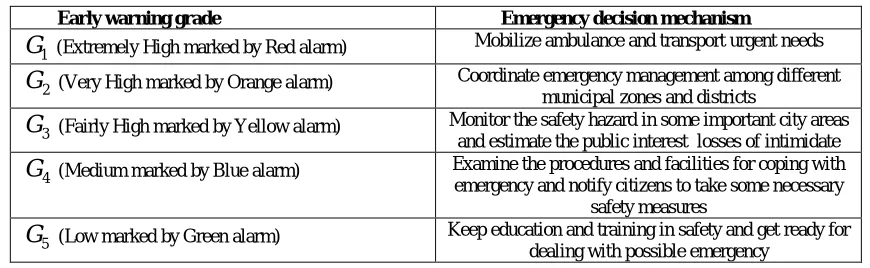
Step 8. According to the estimated early warning grade, we can design the decision mechanism and adopt the corresponding emergency response or strategy to avoid the occurrence of city emergency or decrease the losses of city significant emergency as following Table 3.
Table 3: Decision mechanism for the corresponding early warning grade of city significant emergency
Early warning grade Emergency decision mechanism
1
G
(Extremely High marked by Red alarm) Mobilize ambulance and transport urgent needs2
G
(Very High marked by Orange alarm) Coordinate emergency management among different municipal zones and districts3
G
(Fairly High marked by Yellow alarm) Monitor the safety hazard in some important city areas and estimate the public interest losses of intimidate4
G
(Medium marked by Blue alarm) Examine the procedures and facilities for coping with emergency and notify citizens to take some necessarysafety measures
5
G
(Low marked by Green alarm) Keep education and training in safety and get ready for dealing with possible emergency4.
N
UMERICALE
XAMPLERecently, emergency managers and field experts usually tend to employ intuitionistic fuzzy values to evaluate the uncertain city emergency with respect to various earning indexes. In this section, we give a numeric example to illustrate the application of the proposed intuitionistic fuzzy information entropy measure and similarity measure in early warning degree evaluation and decision making for uncertain city significant emergency.
Example 1. Now suppose the city government try to design an emergency decision mechanism and carry out some emergency rescue measures, it requires the emergency management monitor all the uncertain index information of possible city emergency and evaluate the comprehensive risk value of city emergency. Assume the set of risk factors
U ={u1(serious environment disruption and bad public health condition), u2(disloyal disaster report), u3(incomplete
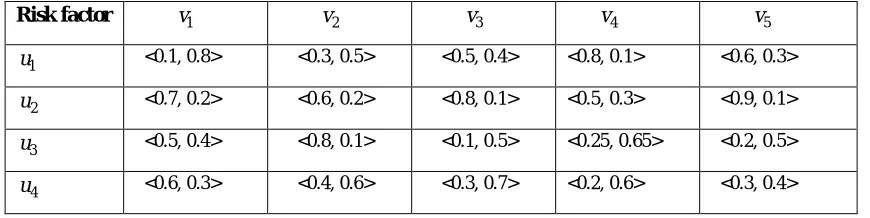
emergency facility), u4(severe traffic jam)} must be taken into account for the city significant emergency. And the occurring probability of each risk factor is unknown, but may be evaluated by the intuitionistic fuzzy judgment criteria in V {v1(Very Low), v2(Low), v3(Medium),v4( High), v5( Very High)}. The evaluating results are expressed by an intuitionistic fuzzy comprehensive judgment matrix, wherevj(1 j5) denotes the different occurring possibility
Volume 2, Issue 3, March 2013
Page 262
Table 4: Intuitionistic fuzzy judgment of the occurring probability of risk factors in city significant emergencyRisk factor v1 v2 v3 v4 v5
1
u <0.1, 0.8> <0.3, 0.5> <0.5, 0.4> <0.8, 0.1> <0.6, 0.3>
2
u <0.7, 0.2> <0.6, 0.2> <0.8, 0.1> <0.5, 0.3> <0.9, 0.1>
3
u <0.5, 0.4> <0.8, 0.1> <0.1, 0.5> <0.25, 0.65> <0.2, 0.5>
4
u <0.6, 0.3> <0.4, 0.6> <0.3, 0.7> <0.2, 0.6> <0.3, 0.4>
Our main task is to determine the early warning grade of the city significant emergency involved intuitionistic fuzzy value. That is to decide which risk grade, out of the five gradesG1,G2,,G5, the unexpected city emergency belongs to. In what follows we employ the intuitionistic fuzzy entropy measure to calculate the occurring probability of each fuzzy risk factor and the total risk value of city significant emergency, and then help the related city emergency management department adopt the corresponding decision mechanism to control and decrease the comprehensive risk of city emergency.
First, we regard Table 4 as the intuitionistic fuzzy comprehensive judgment matrix (~)45 ~
rij
D of risk factors
with respect to all the judgment criteria, where r~ represents the intuitionistic membership value of risk factorij uiwith
respect to probability grade vj, for example, r~21 0.8,0.1represents the true membership and the false membership
of risk factor u2 belong to the occurring probability grade v1 are 0.8 and 0.1, respectively.
By using the entropy formula (1), we can compute the information entropy of each intuitionistic fuzzy value in the above judgment matrix and get the following entropy matrix
8182 . 0 4286 . 0 4286 . 0 , 6667 . 0 5385 . 0 5385 . 0 4286 . 0 4286 . 0 1765 . 0 8182 . 0 1579 . 0 6667 . 0 1765 . 0 4286 . 0 3333 . 0 5385 . 0 1765 . 0 8182 . 0 6667 . 0 1765 . 0 ) (hij 4 5
D .
With formula (4), we transform the above entropy matrix to the normalized entropy matrix below.
. 0000 . 1 5238 . 0 5238 . 0 8148 . 0 6582 . 0 6582 . 0 5238 . 0 5238 . 0 2157 . 0 0000 . 1 2368 . 0 000 . 1 2647 . 0 6429 . 0 4999 . 0 6582 . 0 2157 . 0 000 . 1 8148 . 0 2157 . 0 ) ( 4 5
hij D
Then, by the formula (5) we can compute the occurring probability of each risk factor of the city emergency by the
formula ij j i ij j h h i w
5 1 4 1 5 1 4 1, i1,2,,4.
Thus, the probability vector of all the risk factors of city significant emergency are obtained as W =( 0.238, 0.206, 0.241, 0.315).
Next, according to the given severity of loss of each risk factor, we get {
) , , ,
(R1 R2 R3 R4 Serious, Medium, Weak, Critical, }
Volume 2, Issue 3, March 2013
Page 263
From the previous formulae (3), (6), we calculate the intuitionistic fuzzy comprehensive risk value as
i i i wR R
4
1
= 0.238R10.206R20.241R30.315R4
= 0.7108,0.2417.
Then, according to the similarity formula (2) between intuitionistic fuzzy values, we calculate the similarity measures between the calculated fuzzy comprehensive risk value and each given risk grade in
{
G G1(EH),G2(VH),G3(FH),G4(M),G5(L) } as follows.
S(R,G1)=0.8295, S(R,G2)=0.9227, S(R,G3)=0.904, )
, (R G4
S =0.7118, S(R,G5)=0.5133.
Since S(R,G2)>S(R,G3)>S(R,G1)>S(R,G4)>S(R,G5), i.e., 2argmaxj{S(R,Gj)/GjG},
then the comprehensive risk of city significant emergency should belong to G2 grade (the second serious grade), and the risk of this city significant emergency may be “Very High” and marked by orange alarm. That is to say, the unexpected city significant emergency will undertake some risk of gradeG2. The related city emergency management department will raise the corresponding warning and take emergency mechanism and strategy to coordinate all kinds of urgent management facilities among different municipal zones and districts to decrease the “very high” occurrence of the unexpected city emergency before implementing some emergency response.
5.
C
ONCLUSIONIn this paper, we propose an intuitionistic fuzzy entropy measure to calculate the occurring probability of each risk factor, it is then used to compute the fuzzy comprehensive risk value of city significant emergency. Finally, according to the similarity measure between the evaluated intuitionistic fuzzy comprehensive risk value and each given risk grade, we can assign the city significant emergency to the proper warning grade, which can help the related city emergency management department make the correct decision mechanism in accord with the early warning evaluation result.
A
CKNOWLEDGEMENTThis work is supported by the Humanities and Social Sciences Research Youth Foundation of Ministry of Education of China (No. 12YJCZH281), the Guangzhou Social Science Planning Project “The study of early warning index selection and urgent decision mechanism for city significant emergency in uncertain environment” (No. 2012GJ31), the National Statistical Science Research Planning Project (No. 2012LY159), the National Natural Science Foundation (Nos. 61202271, 60974019, 61273118, 61070061, 60964005), the Guangdong Province Natural Science Foundation (No. S2012040007184, S2012010010570, 9451009001002686 ), the Youth Project of Humanities and Social Sciences Research of Ministry of Education of China (No. 10YJC790104 ), the Fundamental Research Funds for the Central Universities in China, and the Guangdong Province High-level Talents Project.
R
EFERENCES[1] W.P. Zhang, “ Study on the index selecting and weight evaluation for emergency early warning,” Journal of Chinese People's Public Security University, 6, pp. 80-89, 2008.
[2] L. He, B.Y. Lu, “Study on urban emergency aided decision model “1+1” ”, Science and Technology Management Research, 21, pp. 216-219, 2010.
[3] J. Gao, “Analysis on the coordinative governance of the urban sudden events, ” Journal of Fujian Adminstration Institute, 6, pp. 29-32, 2010.
[4] L.D. Zhao, “Theory study of city coordinative emergency decision generation,” Journal of Southeast University, 1, pp. 49-55, 2009.
[5] C, Zhou, Y. Zhang, “The construction of urgent decision system of chinese city emergency during the Transitional Period,” Journal of Chongqing City Management Vocational College, 6 (4), pp. 34-37, 2006.
[6] Y. M. Sun, “Research on construction of emergency response mechanism and platform for domestic urban incidents,” Journal of Chongqing University of Posts and Telecommunications , 19 (1), pp. 59-65, 2007.
Volume 2, Issue 3, March 2013
Page 264
[8] G.R. Ye, “ Early warning mechanism of the urban emergency: the connotation and system,” Contemporary Economy and Management, 29 (2), pp. 69-72, 2007.
[9] J. Zhi, Y. Gan, F. Guo, “Study on the application of transport system in dealing with city emergency,” Software Guide, 8 (11), pp. 106-107, 2009.
[10] W.Q. Tang, “Study on city emergency response pattern in China,” Chinese Administration, 3, pp. 79-82, 2008. [11] L.Z. Yang, J.D. Ding, “Discussion on emergency management of city incidents,” Informatics Sciences, 27(3), pp.
351-355, 2009.
[12] P.J. Lang, “The operation mechanism of modern city emergency prediction and early warning,” Urban Management, 2, pp. 21-24, 2011.
[13]C. Wang, “ Study on early warning management model of society significant emergency, ” Journal of Wuhan University of Technology, 18 (1), pp. 26-29, 2005.
[14]Y. Ma, L. She, C.Wang, “The construction and operation of domestic city traffic emergency early warning management system,” Journal of Wuhan University of Technology, 28 (1), pp. 67-70, 2006.
[15] Z.Q. Wen, X.R. Bian, “The emergency management of city incidents: Challenge and strategy,” Journal of College of Disaster Prevention Techniques, 8 (2), pp. 15-19, 2006.
[16] S.W. Chen, “Enforce the construction of emergency management ability of chinese city incidents,” Journal of Tianjin Administration Institute, 9(2), pp. 34-36, 2007.
[17]N. Wen, T. M. Liu, “Study on dynamic evolving model of city significant emergency,” Chinese Safety Production Science and technology, 7(1): 10-13.
[18]J.K. Liu, G. L.Yuan, “The risk management investigation of critical emergency,” Journal of College of Railway Police,1, pp. 35-39, 2006.
[19] P. Wang, J.P. Lin, “The evaluation system investigation of emergency in the main railroad,” Railway Computer Applications, 18 (9), pp. 1-3, 2009.
[20] K.H. Xiao, “The risk early warning model study of emergency in supply chain ,” Journal of Henan University of Technology,8 (1), pp. 54-57, 2012.
[21] J.Z. Ye, L. She, “Risk analysis and management of network emergency: a suggested framework,” Soft Science, 25 (12), pp. 59-67, 2011.
[22] R.Q. Zhong, Y.J. Xie, “Application of fuzzy risk assessment and entropy coefficient in the software outsourcing,” Science Technology and Engineering, 11, pp. 2625-2628, 2011.
[23] L. Li, “The Risk Analysis of HR Epiboly Based on the Fuzzy Integrated Evaluation,” Journal of Zhongnan University of Economics and Law, 4, pp. 35-40, 2007.
[24] K. Atanassov, “ Intuitionistic fuzzy sets. Fuzzy Sets and Systems, 20 (1), pp. 87-96, 1986.
[25] P. Burillo, H. Bustince, “Entropy on intuitionistic fuzzy sets and on interval-valued fuzzy sets,” Fuzzy Sets and Systems, 78, pp. 305-316, 1996.
[26] Z.S. Xu, “ Some similarity measures of intuitionistic fuzzy sets and their applications to multiple attribute decision making,” Fuzzy Optimal and Decision Making, 6, pp. 109-121, 2007.
[27] Z. S. Xu, “Intuitionistic fuzzy aggregation operators,” IEEE Transactions on fuzzy systems, 15 (6), pp.1179-1187, 2007.
AUTHOR
Qiansheng Zhang born in Jiangxi province on July 31, 1975, received his Ph D in Mathematics in 2004 from School of Mathematics and Computation Sciences, Zhongshan University, Guangzhou, Guangdong province, China. His major field of study is fuzzy control and decision making. His research interests include intelligent information processing, statistical inference and decision. He is now working at Guangdong University of Foreign Studies, and he is a professor in school of Informatics, Guangdong University of Foreign Studies, Guangzhou, China. He has published more than twenty journal papers in the related area. The current research field is fuzzy reasoning , risk management and decision making, as well as intelligent computing.