“Proceedings of the 2005 ASEE/AAEE 4th Global Colloquium on Engineering Education Copyright © 2005, Australasian Association for Engineering Education”
Orienting Students to Studio Learning
Jocelyn Armarego, Lynne Fowler
School of Engineering Science Murdoch University
{jocelyn, lynne}@eng.murdoch.edu.au
Abstract
Murdoch University has instituted a shift to Studio Learning within 3rd and 4th years of all its undergraduate Engineering programs This is driven by industry demands for graduates who integrate and function effectively into organisations, developments in education theory towards considering education as active engagement and the learning expectations of current students. Considered a paradigm shift, Studio Learning involves confronting learners with situations modelled on professional practice. It is a group-based approach that requires the assistance of academics working as facilitators to provide guidance in a richer, holistic learning environment.
In order to effect a ‘cultural change’ towards learning the relevant students were involved in a Studio orientation, providing students with the opportunity to learn about Studios by
undergoing a Studio learning experience. A key component of the program was
documentation of the process and the outcomes by way of an individual journal/diary indicating tasks, outcomes and times spent.
Preliminary evidence indicates that students who were at Murdoch Engineering prior to the Studio week were better able to make the shift to Studio Learning. However, articulation students and (international) students joining the School on exchange programs found the learning model dis-orienting and confronting. Their reticence was replaced by increasing involvement as the week progressed, spurred on by the enthusiasm of other group members. Groups gelled as each student’s discipline strengths came into play.
Students demonstrated their engagement with this learning model: the quality of the final presentations and diversity of solutions emphasised their ability to be self motivated independent learners.
1. Why change how we teach?
Education today requires a paradigm change – for teachers, who face a student body with different motivations from those of 20, if not 10 years ago, as well as for students. This change is driven by multiple forces:
• industry demands for graduates who can integrate and function effectively in complex organisational contexts
• developments in education theory towards considering education as active
“Proceedings of the 2005 ASEE/AAEE 4th Global Colloquium on Engineering Education Copyright © 2005, Australasian Association for Engineering Education” 1.1. Industry needs
Practitioner studies, both in Australia and overseas, have investigated the expectations of industry with regards to employing graduates. The following act as examples only: the literature in this area is extensive.
Scott and Yates 1 report on the experience with Engineering graduates. One of these studies sought to identify:
• the most important capabilities for successful early career practice
• the extent to which the participating universities focused on these capabilities
• key ways of improving the content, delivery, support and assessment of the undergraduate programs in Engineering in the light of the study’s findings.
Respondents noted that learning profession-specific content provides the ‘scaffold’ for the important task of career-long professional learning: the skills to undertake this are of great importance, with the ability to know when and when not to deploy technical expertise, and how to continuously update it, the keys to successful professional practice.
The supervisors in the study acknowledged that a high level of technical expertise is
necessary but not sufficient for successful practice, giving emphasis to the individual's ability to diagnose what is really causing a problem and to testing solutions in action.
Lee looked at the long-term professional development of young engineers as technologists, in studies reported in the late 1980s and early 1990s 2-5. Lee starts from the premise that the primary focus of university education and industrial work requirements were different (conceptual understanding versus accomplishment of specific tasks). These studies explored on-the-job learning and information seeking behaviours and found no correlation between academic achievement and job performance. Instead, what was found to have significance was:
• challenging work
• approach to information seeking in order to keep up with the relevant changes in knowledge and information requirements
• the success of the transition from an academic environment and the formation of social ties with veteran colleagues.
These results indicate that the effective preparation of young engineers involves far more than just a fixed set of academic subjects. The work of Lee (specifically 6) suggests there is an underlying ‘socialisation’ requirement for a graduate to achieve ‘working professional’ status,
1.2. Developments in education theory
In general engineering education is based on a normative professional education 7 (or ‘engineering science’) model, in which students first study basic science, then the relevant applied science, with the addition of either a capstone project or an industry-based placement (typically towards the completion of the qualification) to address practitioner concerns. However, while project or placements are of value, they are presented as neat cases in which knowledge gained formally can be applied, and do little to model encountering the real world of ill-structured problems in organisational contexts.
“Proceedings of the 2005 ASEE/AAEE 4th Global Colloquium on Engineering Education Copyright © 2005, Australasian Association for Engineering Education”
dealing with complexity and reasoning about uncertainty, framing for decision-making and negotiating for collective (ie team) efficacy.
From a different perspective, Schön looks to an alternative epistemology of practice “in which the knowledge inherent in practice is understood as artful doing”9. Practitioners apply tacit knowledge-in-action, and when their messy problems do not yield to it, they ‘reflect-in-action,’ in the languages specific to their practices. Schön’s view of professional practice as design has three implications:
• it is learnable but not didactically or discursively teachable: it can be learned only in and through practical operations
• it is holistic: its parts cannot be learned in isolation. It must be learned as a whole because all components of a situation have meaning
• designing depends upon the ability to recognise desirable and undesirable qualities of the discovered world. But novice students do not possess this ability, and it cannot be conveyed to them by verbal descriptions, only in the operational context of the task.
Emulating the experience of practice, and actively engaging students in that experience, has led to major changes in education pedagogy. One learning environment that embraces these ideas is Problem-based Learning (PBL). It integrates the learning of content and skills in a collaborative environment, and emphasises ''learning to learn'' by placing greater
responsibility for learning on the learner 10. PBL is recognised for its shift from focusing on the teacher to a student-centred education with process-oriented methods of learning 11. The primary objective of PBL is to create an environment that allows students to become life-long learners.PBL also emphasises understanding concepts and thinking critically, with self-direction and reflection key contributors to the process 11-13 and synthesis and review necessary to complete the process.
It is also suggested 14 that PBL addresses the key issue of transfer: the ability to adapt and apply knowledge to new contexts. Dym reports on research that suggests improved retention, student satisfaction and enhanced design thinking as outcomes of applying Studio and PBL-based courses.
1.3. Student expectations
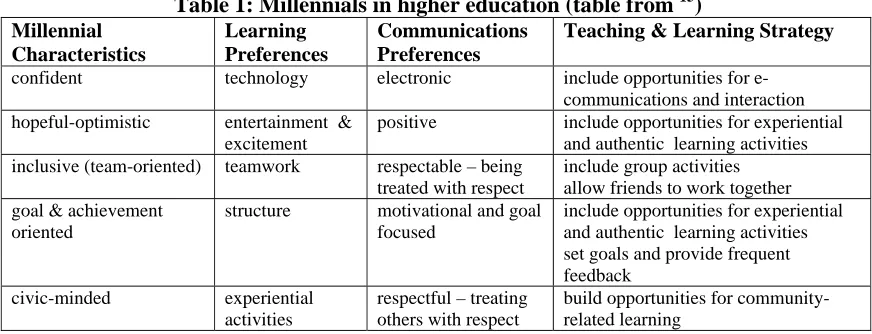
By 2006 the majority of students in higher education in Australia are likely to be millennial generation students (born after 1982). As discussed by Jonas-Dwyer & Pospisil 15
Table 1: Millennials in higher education (table from 15) Millennial
Characteristics
Learning Preferences
Communications Preferences
Teaching & Learning Strategy
confident technology electronic include opportunities for e-communications and interaction hopeful-optimistic entertainment &
excitement
positive include opportunities for experiential and authentic learning activities inclusive (team-oriented) teamwork respectable – being
treated with respect
include group activities allow friends to work together goal & achievement
oriented
structure motivational and goal focused
include opportunities for experiential and authentic learning activities set goals and provide frequent feedback
civic-minded experiential activities
respectful – treating others with respect
“Proceedings of the 2005 ASEE/AAEE 4th Global Colloquium on Engineering Education Copyright © 2005, Australasian Association for Engineering Education” millennials exhibit distinct learning preferences. These include preferring teamwork,
experiential activities, structure and the use of technology. Millennials are also goal oriented and pressured, worried about their security and sleep deprived while at secondary school. Researchers suggest that higher education institutions should get ready for “students who have a lot and expect a lot” (16 cited in 15). In Table 1 Jonas-Dwyer & Pospisil map the findings of researchers in an attempt to identify practical examples of teaching and learning that may appeal to these students.
These characteristics align with new educational theory that considers education as active engagement, both with the curriculum and with others in the learning environment.
2. Setting the stage for Studio Learning
Murdoch University has instituted a shift to Studio Learning in the final years of all its undergraduate Engineering programs. Based on Problem (and as a hybrid approach, Project)-based learning (PBL), Studio Learning confronts learners with situations modelled on professional practice. It is a group-based learning approach that requires academics working as facilitators to provide guidance in a richer, holistic learning environment. These
characteristics enable the theory-practice gap 17 to be bridged and exposes the curriculum to be learnt in contexts in which it will be utilised. Albanese and Mitchell 18 suggest students are more likely to retain the information and are better prepared to handle life and its challenges when presented with this type of learning environment.
In order to effect a ‘cultural change’ towards learning, students coming into 3rd year of engineering (and for 2005, 4th year students) were involved in an orientation programme.
The objectives of this week-long activity included: • modelling Studio Learning
• establishing the roles and responsibilities of students and academics within this model • providing an introduction to the necessary support services made available with the
learning environment. These were achieved through:
• a small-scale design task (designing the automation of a solar sausage BBQ) as a means of identifying and exposing the phases in the Studio approach to teaching and learning • an introduction to generic tools, techniques, methods and processes that might otherwise
have to be duplicated in each Studio.
All students completed the program successfully – success being measured in terms of both the product (task adequately designed) and the process (group process established, PBL process applied).
Students were required to complete both a set of learning styles instruments 19, 20 and an Approaches to Study Inventory 21 prior to commencement. These act as benchmarks, and will be one of the bases for ongoing evaluation of the learning approach.
“Proceedings of the 2005 ASEE/AAEE 4th Global Colloquium on Engineering Education Copyright © 2005, Australasian Association for Engineering Education” 3. Results
Initial observation indicates that students who were at Murdoch Engineering prior to the Studio week were better able to make the shift to Studio Learning – it is, in fact pre-empted in several units already running. However, articulation students and (international) students joining the School on exchange programs found the learning model dis-orienting and confronting.
3.1. Characteristics of student approaches to study
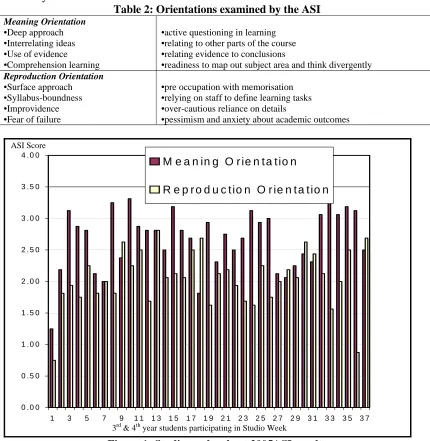
The benchmarking undertaken at the commencement of the Studio week is a mechanism for gaining an appreciation of the learning strategies adopted by the cohort under investigation. Table 2 provides a summary of the orientations examined by the Approaches to Study Inventory.
Table 2: Orientations examined by the ASI
Meaning Orientation
•Deep approach •Interrelating ideas •Use of evidence •Comprehension learning
•active questioning in learning •relating to other parts of the course •relating evidence to conclusions
•readiness to map out subject area and think divergently
Reproduction Orientation
•Surface approach •Syllabus-boundness •Improvidence •Fear of failure
•pre occupation with memorisation •relying on staff to define learning tasks •over-cautious reliance on details
•pessimism and anxiety about academic outcomes
0 . 0 0 0 . 5 0 1 . 0 0 1 . 5 0 2 . 0 0 2 . 5 0 3 . 0 0 3 . 5 0 4 . 0 0
1 3 5 7 9 1 1 1 3 1 5 1 7 1 9 2 1 2 3 2 5 2 7 2 9 3 1 3 3 3 5 3 7 M e a n in g O r ie n t a t io n
R e p r o d u c t io n O r ie n t a t io n
Figure 1: Studio week cohort 2005ASI results
The results of the ASI undertaken by (most) students on Day 1 (Figure 1) of the Studio week show that this student cohort, while slightly leaning towards a deep approach (as should be
“Proceedings of the 2005 ASEE/AAEE 4th Global Colloquium on Engineering Education Copyright © 2005, Australasian Association for Engineering Education”
evident at this stage in their undergraduate progress), are not overly oriented towards Meaning (mean 2.62, standard deviation 0.54) compared to Reproduction (mean2.06 sd 0.48).
Unfortunately, after further analysis of the data, there is no evidence that the 4th year students in this cohort favour meaning above reproduction – the indications are that this is an
individual trait.
3.2. Characteristics of student learning
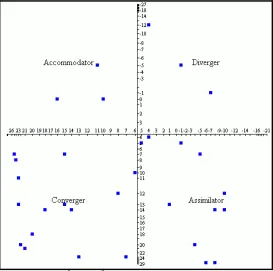
The learning style inventories we apply (Kolb, Felder [19-20]) evaluate the way a person learns and how they deal with day-to-day situations in their life. An understanding of learning styles and how individuals differ enables a person to take positive control over their learning processes. Consequently, if we can help our students to be aware of their own and others’ learning styles, this will aid them, particularly when working in a Studio Learning
environment. Our aim is for students to be aware of each others strengths and weaknesses and appreciate that a different approach to a problem is not only acceptable but viable and that a combined approach may have greater benefits. The challenge for students is to see a problem and solution from different angles and perspectives.
It also follows that academic staff can be sensitive to and address the divergences between student and staff learning styles, and can use this awareness to develop material and teach in a greater variety of ways. Students whose learning styles are compatible with the teaching style adopted within a course tend to retain information better, obtain better grades and maintain a greater interest in the course 22. Our staff exhibits mainly assimilator/converger learning styles 23. The greater diversity of learning styles in our students (Figure 2) suggests that flexibility in teaching style is of considerable importance. By adopting Studio Learning this flexibility can be encouraged.
“Proceedings of the 2005 ASEE/AAEE 4th Global Colloquium on Engineering Education Copyright © 2005, Australasian Association for Engineering Education” Our results show that students on our programs no longer conform to the traditional
engineering profile with converger type learning styles dominating [20]. The assumption that there is a ‘typical’ learning style for a modern engineer has been challenged in many studies and the variety of learning styles amongst engineering students reinforced by Mills et al24. It is an encouraging sign that we are attracting a greater diversity of students, and can address their learning processes, potentially leading to improved student retention and readiness for industry.
3.3. On reflection
The following narratives are excerpts from the reflective journal undertaken during the Studio week, and speak for themselves (Frazer, Konrad, Sam, Dorian, Morris):
• on Design Learning - I am trying to keep an open mind and am going to put my best effort in, even though it is a new style of teaching or presentation, as you only get out of something what you put in. Went home for lunch but had ideas running through my head about the design studio. I think I am going to like the idea as I think that I learn best this way from past experiences. (M)
• on Groups - I was glad that we had a number of different types of people in the group (K) ; Formed groups, good to grab people with other areas of expertise Very interesting, amazing what related inventions people have come up with.(S) Tensions are high, people want to thump other people in the group, for wasting time. (D) Everyone has their own individual style and it was a case of the most liked (not necessarily the best) idea that was chosen (M)
• on Journal - Journal began. Noticed that it is a good way to watch how time is used. The Journal provided a useful tool to relate all aspects of the project and worked to sooth my mind to ensure all is going well (K) Good reflection for how I behave, self awareness leading to personal improvement, that sort of thing (S)
• on Keeping Minutes - We’ve actually used past minutes throughout the week to clarify decisions, documentation is time consuming but useful… imagine that!!! - Interesting to look back and have a record of time I have spent and how my group’s project has progressed and come together throughout the week (S) • on the Tasks - Took too long, browsing the web with Gateway on is no good, as there is always the
possibility of you checking your Mail (no discipline on my side here)(F) Individual research spent in the library. The most important thing to come from this particular exercise is that in the design studies, this independent research will be a crucial part of what I have to individually use. So, I think I might see if there are any library courses available to help me improve my efficiency in finding things as this will save me a lot of valuable time (M)
• in Summary - Having a project run over 1 week is very neat. There is pressure to get tasks completed however there is closure because we don’t have to touch it again after this week…. or do we? We could focus on the group processes involved instead of focussing too much on the technical detail of the project (S) These sessions are good as I have definitely learnt that you can’t take things personally. Also I realize that the project is too big for one person to do properly and hence I have to rely on other people, which I often have a problem of doing as I like to think (like I’m sure most people do!!!) that I can do the best job. However, due to the nature of the project and skills of the group members I realize that this is not the case. This is a bit liberating in a sense as I can now solely concentrate on my area – tracking, and this is great as I have a well defined problem and boundary to work within (M)
3.4. On further reflection
As part of the normal feedback requested of Engineering students during the semester, the 4th years were asked to comment of the Studio week. As noted above, by this stage students had been actively engaged in Studio Learning for approximately 6 weeks (and therefore teething problems should have been addressed). The students were asked (italics indicate sample comments):
(i) if they thought an orientation programme is required for the Design Studios YES - it was important to understand what was required to get the most out of the Design Studio process
“Proceedings of the 2005 ASEE/AAEE 4th Global Colloquium on Engineering Education Copyright © 2005, Australasian Association for Engineering Education” (ii) to comment on anything in general that you like in the week
good to have intro and reasons behind it (Design Studio); working with people outside of my discipline
(iii) to comment on anything in general that you didn't like in the week
no marks allocated for work that was being done and there was 1 week less of semester
(iv) to make suggestions about such an orientation
maybe could be part of 1st week alongside normal subjects, or extra week tacked in the front
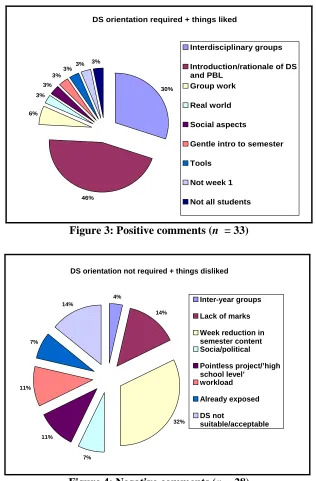
All comments were categorised and recoded to produce the following charts (Figures 3 & 4):
DS orientation required + things liked
30%
46% 6%
3% 3%
3%
3% 3%
3%
Interdisciplinary groups
Introduction/rationale of DS and PBL
Group work
Real world
Social aspects
Gentle intro to semester
Tools
Not week 1
Not all students
Figure 3: Positive comments (n = 33)
Figure 4: Negative comments (n = 28) DS orientation not required + things disliked
4%
14%
32%
7% 11%
11% 7%
14% Inter-year groups
Lack of marks
Week reduction in semester content Socia/political
Pointless project/’high school level’
workload
Already exposed
DS not
“Proceedings of the 2005 ASEE/AAEE 4th Global Colloquium on Engineering Education Copyright © 2005, Australasian Association for Engineering Education” 4. Conclusion and significance
Students demonstrated their engagement with this learning model: the quality of the final presentations and diversity of solutions emphasised their ability to be self motivated independent learners.
Employers are looking for and demanding a more flexible and diverse graduate who is technically competent but also able to work within teams with a range of personnel. Our industrial partners, who have given students seminars on what they look for in job interviews, emphasise not the technical competencies but the individual traits such as diversity, team player, flexibility, attitude and character. It is therefore of paramount importance for us to incorporate the development of these attributes within our teaching.
The Studio Learning model represents a change from the current practice in Engineering at Murdoch: however we have small sized classes, generally run by full time and skilled staff or by sessional practicing professionals. Nevertheless, it provides a new framework and will enable a number of opportunities that have been otherwise limited by the conventional Murdoch teaching models and teaching organisation. Some of these (such as assessment mechanisms) are currently being explored; others require further experience within the learning framework.
While there is still a lot to learn, the reported experiences appear to be positive and offer some confidence that the changes will be successful. In particular our outcomes are expected to be: • improved learning outcomes for students in areas such as project management, problems
solving, group and co-operative work skills and communication skills • an increased focus on design content within each discipline area
• a closer match to professional requirements and the potential to integrate into employment positions upon graduations.
By applying the Studio model of learning our aim is to enable our graduates to meet the dramatic changes of a transforming industry.
References
1. Scott, G. and W. Yates, Using successful graduates to improve the quality of undergraduate engineering programs. European Journal of Engineering Education, 2002. 27(4): p. 60-67.
2. Lee, D.M.S., Academic achievement, task characteristics, and first job performance of young engineers.
IEEE Transactions on Engineering Management, 1986. EM-33(3): p. 127-133.
3. Lee, D.M.S., Job challenge, work effort, and job performance of young engineers: a causal analysis.
IEEE Transactions on Engineering Management, 1992. 39(3): p. 214-226.
4. Lee, D.M.S., Social ties, task-related communication and first job performance of young engineers.
Journal of Engineering and Technology Management, 1994. 11: p. 203-228.
5. Lee, D.M.S., Educating engineers in the era of computers-integrated operations. Engineering Education, 1989. 79(1): p. 31-35.
6. Lee, D.M.S., Organizational entry and transition from academic study: examining a critical step in the professional development of young IS workers, in Strategies for Managing IS/IT Personnel, M. Igbaria and C. Shayo, Editors. 2004, Idea Group: Hershey (PA). p. 113-141.
“Proceedings of the 2005 ASEE/AAEE 4th Global Colloquium on Engineering Education Copyright © 2005, Australasian Association for Engineering Education”
8. Dym, C.L., et al., Engineering design thinking, teaching, and learning. Journal of Engineering Education, 2005. 94(1): p. 103-120.
9. Schön, D.A., The Reflective Practitioner: How Professionals Think in Action. 1983, New York: Basic Books.
10. Wilson, B.G. and P. Cole, Cognitive teaching models, in Handbook of Research for Educational Communications and Technology, D.H. Jonassen, Editor. 1996, Simon & Schuster Macmillan: New York. p. 601-621.
11. Dahlgren, M.A., Portraits of PBL: course objectives and students’ study strategies in computer engineering. Instructional Science, 2000. 28(4): p. 309–329.
12. Butler, S., Catalysing student autonomy through action research in a problem centered learning environment. Research in Science Education, 1999. 29(1): p. 127–140.
13. MacKinnon, M.M., CORE elements of student motivation in problem-based learning. New Directions for Teaching and Learning, 1999. 78: p. 49–58.
14. Bransford, J.D., A.L. Brown, and R.R. Cocking, eds. How People Learn: brain, mind, experience and school. 1999, National Academy Press: Washington (DC).
15. Jonas-Dwyer, D. and R. Pospisil. The millennial effect: implications for academic development. in
Transforming Knowledge into Wisdom: holistic approaches to teaching and learning. Proceedings of HERDSA (The Higher Education Research and Development Society of Australasia) Conference. 2004. Miri Sarawak: Research and Development in Higher Education.
16. Howe, N., Presidents Institute: understanding the millennial generation. 2003, Council of Independent Colleges.
17. Dutson, A.J., et al., A review of literature on teaching design through project-oriented capstone courses.
Journal of Engineering Education, 1997. 76(1): p. 17-28.
18. Albanese, M. and S. Mitchell, Problem-based learning: a review of the literature on its outcomes and implementation issues. Academic Medicine, 1993. 68(1): p. 52-81.
19. Soloman, B. and R. Felder, Index of Learning Styles (ILS),. 1999.
20. Kolb, D.A., Experiential Learning Experience as the Source of Learning and Development,. 1984: Prentice-Hall.
21. Richardson, J.T.E., Mature students in higher education: II an investigation of approaches to studying and academic performance. Studies in Higher Education, 1995. 20: p. 5 - 17.
22. Felder, R., Reaching the Second Tier: Learning and Teaching Styles in College Science Education.
Journal of College Science Teaching, 1993. 23(5): p. 286 - 290.
23. Fowler, L., et al. Quantitative Learning Conversations: constructivism and its application to learning in an engineering environment. in Quality Conversations: Proceedings of the Annual International HERDSA Conference. 2002. Perth (WA): Edith Cowan University.
24. Mills, J., et al., Learning About Learning Styles: Can This Improve Engineering Education?
MountainRise, 2005. 2(1).
Biographical Information
JOCELYN ARMAREGO is currently senior lecturer in Software Engineering with the School of Engineering Science, Murdoch University. She worked in industry as a Requirements Engineer before moving into academia. Teaching Software and Engineering has led her to develop an interest in education for professional practice and to actively pursue strategies for supporting a holistic approach to creative learning in these areas.
LYNNE FOWLER Lynne is currently senior lecturer in Software Engineering with the School of Engineering Science, Murdoch University. She started her career as a teacher of mathematics and chemistry, but then her path turned and she worked for over 10 years as a software professional in industry, working for a variety of