9
Copyright © 2017. Vandana Publications. All Rights Reserved.
Volume-7, Issue-5, September-October 2017
International Journal of Engineering and Management Research
Page Number: 9-13
A Parametric Study on Outer Layer of Helmet using ABAQUS
M.N.V.Krishna Veni1, G.Sitaram2, M.Amareswari Reddy3
1,2,3Mechanical Engineering, ANITS College of Engineering, INDIA
ABSTRACT
With the development of national highways for rapid transport system and also with the increase in the engine capacity of two wheeler to a great extent, there has been an increase in the rate of accidents on road. The Indian scenario in road safety is minimal and many accidents are either fatal or rider undergoes a traumatic brain injury. To avoid the brain injury, helmet plays a vital role in the safety of the rider. Generally the outer most layer of helmet is absorbed more impact than the other two layers. So, in this study main motive is to design a safety helmet. For designing of helmet two materials are taken into consideration. The materials which are generally used to produce helmet outer layer like ABS (Acrylo nitrile Butadiene Styrene) and PC (poly carbonate). The helmet is modeled in CATIA with BIS standards and Explicit dynamic analysis is carried out in ABAQUS software. The stress, strain and displacement for the ABS and PC materials are compared. In this process the polycarbonate (PC) material obtain better results.
Keywords—Helmet, ABS, PC, ABAQUS, CATIA
I.
INTRODUCTION
Road accidents are one of the major causes of death in the world. About 31 thousand people die and 1.6 million people are injured every year. Motorcyclists are less protected against road accidents than the users of some other vehicles because they have the safety helmet as the most effective means of protection, while car occupants, for example, are protected by safety belts, airbags and even by the body structure of the car.
Mostly in low–income and middle-income countries as well as cresting enormous social costs for individuals, families and communities .The cost to countries ,possibly already struggling with other development concerns, may well be 1-2 of their gross national product. As motorization increases, road traffic crashes are becoming a fast-growing problem, particularly in developing countries. If present trends continue unchecked, road traffic injuries will increase dramatically
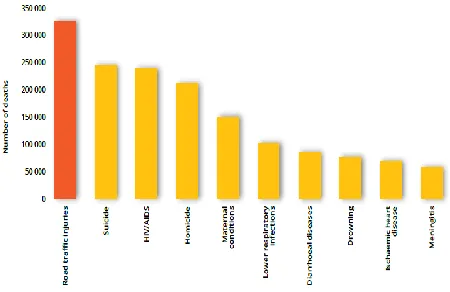
in most parts of the world over the next two decades, with the greatest impact falling on the most vulnerable citizens. In September 2015, heads of state attending the United Nations General Assembly adopted the historic Sustainable Development Goals (SDGs). One of the new SDG targets is to halve the global number of deaths and injuries from road traffic crashes by 2020. Inclusion of such an ambitious road traffic fatality target is a significant advance for road safety. It is a reflection of the growing reco\gnition of the enormous toll exacted by road traffic injuries – road traffic crashes are a leading cause of death globally, and the main cause of death among those aged 15–29 years (see Figure 1).
Fig 1 Top 10 deaths causes different stituation.
10
Copyright © 2017. Vandana Publications. All Rights Reserved.
encouraging the need for countries and the international community to galvanize greater and faster action.
The number of road traffic deaths 1.25 million in 2013 has plateau since 2007 (see Figure 2) despite the global increase in population and motorization and a predicted rise in deaths.
Fig 2 Numberof traffic deaths worldwide
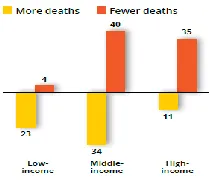
This suggests that interventions implemented over the past few years to improve global road safety have saved lives. Around 68 countries have seen a rise in the number of road traffic deaths since 2010, of which 84% are lower middle-income countries. Seventy-nine countries have seen a decrease in the absolute number of deaths, of which 56% are low- and middle-income (see Figure 3).
Fig 3 Countries showing changes in the number of road traffic deaths.
However, low-income countries have fatality rates more than double those in high-income countries and there are a disproportionate number of deaths relative to these countries’ level of motorization: 90% of road traffic deaths occur in low and middle-income countries, yet these countries have just 54% of the world’s vehicles (see Figure 4).
Fig 4 Population,road traffic deaths and registered motorized vehicles.
Almost half of all deaths on the world’s roads are among those with the least protection motorcyclists (23%), pedestrians (22%) and cyclists (4%). However, the likelihood of dying on the road as a motorcyclist, cyclist or pedestrian varies by region. This partly reflects the level of safety measures in place to protect different road users and the predominant forms of mobility in different regions.
1.2 ABAQUS
Abaqus FEA (formerly ABAQUS) is a software
suite for finite element analysis and computer-aided engineering originally released in 1978. The name and logo of this software are based on the abacus calculation tool. The Abaqus product suite consists of five core software products:
1) Abaqus/CAE, It is a software application used for both the modeling and analysis of mechanical components and assemblies (pre-processing) and visualizing the finite element analysis result. A subset of Abaqus/CAE including only the post-processing module can be launched independently in the Abaqus/Viewer product.
2) Abaqus/Standard, a general-purpose Finite-Element analyzer that employs implicit integration scheme (traditional).
3) Abaqus/Explicit, a special-purpose Finite-Element analyzer that employs explicit integration scheme to solve highly nonlinear systems with many complex contacts under transient loads.
4) Abaqus/CFD,a Computational Fluid Dynamics so ftware application which provides advanced computational fluid dynamics capabilities with extensive support for preprocessing and post processing provided in Abaqus/CAE.
5) Abaqus/Electromagnetic, a Computational electro magnetics software application which solves advanced computational electromagnetic problems.
6) Abaqus is used in the automotive, aerospace, and industrial products industries. The product is popular with non-academic and research institutions in engineering due to the wide material modeling capability, and the program's ability to be customized. Abaqus also provides a good collection of multi physics capabilities, such as coupled acoustic-structural, piezoelectric, and structural-pore capabilities, making it attractive for production-level simulations where multiple fields need to be coupled.
11
Copyright © 2017. Vandana Publications. All Rights Reserved.
produces Abaqus for CATIA for adding advanced processing and post processing stages to a pre-processor like CATIA.
II.
HELMET MODELLING
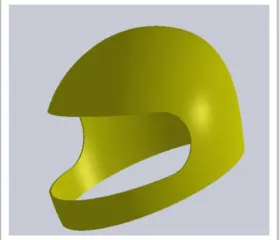
The BIS standard helmet has been created in the modeling software”CATIA” and then it is imported to the ABAQUS software for analysis. Fig 5 shows the outer most layer of helmet with 3mm thickness.
Fig 5.Outer most layer of helmet with 3mm thickness
III.
EXPERIMENT
First select create model database with Standard/Explicit model.
Import the CATIA model of helmet.
Fig 6 3D model helmet imported from CATIA to ABAQUS
Now give material properties in which they are to be used namely as ABS and PC.
Now assign the material with shell and homogenous and place a thickness of 3mm and place ok.
After that section is assign to the model.
And draw an analytical rigid body as shown in fig 7, at the top surface of the helmet. And placed an reference point at the middle of the rigid body for boundary condition.
Fig 7 Analytical rigid body
Now assembly in which instances assign the both the parts as shown in the fig 8.
Fig 8 Assembly of helmet and rigid body
Mesh the helmet as shown in the fig 9. And assign the material to be shell and place explicit to the model.
Set the time period for the helmet hitting(step function)
Fig 9 Meshing
Boundary conditions are placed in which the rigid body is encastre (u,v,w are zero)
12
Copyright © 2017. Vandana Publications. All Rights Reserved.
Fig 10 Predefine velocity of 30m/sec
Now interaction properties are placed as contact and give the penalty and place the friction value 0.5.
Interactions in which general contact and the global property assignment is placed as intprop
Job is created
Rename the job and submit.
IV.
RESULTS
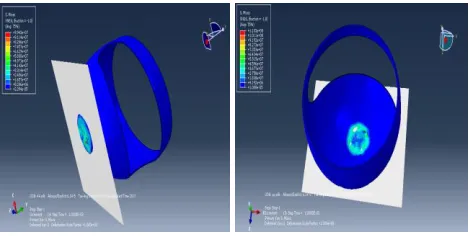
In the analysis the stresses are obtained when the helmet is impact with the velocity of 30m/sec for the ABS the stress is 99.43Mpa and for PC is 110.3Mpa.
Fig 11 Von Mises Stress for ABS and PC
The strain obtained for ABS is 4.958e-2 and for PC is 3.73e-2.
Fig 12Strains for ABS and PC
Displacement is obtained for ABS is 31.41mm and for the PC is 31.42mm.
Fig 12 Displacement for ABS and PC
V.
CONCLUSION
In this paper the outer most layer of the helmet is designed and impact analysis in vertical direction with 30m/s velocity in the explicit dynamics in ABAQUS are applied on the helmet. The stress, strain and displacement are obtained. For the polycarbonate the stress value is 110.3mpa, strain is 3.73e-2 and the displacement is 31.24mm. For the Acrylonitrile butadiene styrene the stress values are 99.43mpa, strain is 4.958e-2 and the displacement is 31.41mm.
Thus it is concluded that the PC material had obtain better results comparing to that of ABS material.
REFERENCES
[1] Mazdak Ghajari and Ugo Galvanetto. Virtual and experimental testing of helmets MRTN CT-2006-035965 MYMOSA.
[2] The development of next generation test standards for helmets. Peter Halldin and Sven Kleiven, Proceedings of the 1st International Conference on Helmet Performance and Design February 15, 2013, London, UK HPD-2013-1. [3] The impact attenuation test of motorcycle helmet standards. Mazdak Ghajari, Gaetano Davide Gaetano Davide Galvanetto. Proceedings of the 1st International Conference on Helmet Performance and Design February 15, 2013, London, UK HPD-2013-2.
[4] Model based head injury criteria for head protection optimization. Rémy Willinger and Caroline Deck. Proceedings of the 1st International Conference on Helmet Performance and Design February 15, 2013, London, UK HPD-2013-3.
13
Copyright © 2017. Vandana Publications. All Rights Reserved.
[6] Speculation on the future of military helmet technology. Alexander R. Haley. Proceedings of the 1st International Conference on Helmet Performance and Design February 15, 2013, London, UK HPD- 2013-5. [7] Evaluation of blunt impact protection in a military helmet designed to offer blunt and ballistic impact. protection. Peter Halldin, Daniel Lanner, Richard Coomber and Sven Kleiven. Proceedings of the 1st International Conference on Helmet Performance and Design Febr vuary 15, 2013, London, UK HPD-2013-6.
[8] Finite element modelling of a honeycomb reinforced helmet. Gaetano Davide Caserta, Mazdak Ghajari, Ugo Galvanetto and Lorenzo Iannucci. Proceedings of the 1st International Conference on Helmet Performance and Design February 15, 2013, London, UK HPD-2013-7. [9] Performance analysis of motor cycle helmet under static and dynamic loading by V.C.Satish Gandhi.
[10] Modeling and exploration of an active helmet design by David.G.Meyer and John Hauser.