Volume 2, Issue 7, July 2013
Page 125
Abstract
In this paper, a compact low-voltage CMOS analog multiplier is proposed. It is based on the square-law characteristics of the MOS transistor. The proposed circuit is obtained by rearranging circuit topology of a recently reported multiplier which is unpractical since the circuit topology itself needs an ideal voltage reference to form a multiplication function. By doing so, the ideal voltage reference is no longer required leading to achieve a new multiplier circuit with real compactness. Simulated results using TSPICE for 0.045µ CMOS process show that main performances of the proposed modulator including power consumption, noise, delay and bandwidth are successfully improved.
Keywords: CMOS, Analog Multiplier.
1.
I
NTRODUCTIONFour-Quadrant analog multipliers are very useful building blocks in many circuits such as adaptive filters, frequency-shifters, and modulators. These applications are required to operate in low voltage environment for improving their power efficiency and incorporating with mixed signal systems to be used in portable applications [1]. According to [2], a four quadrant analog multiplier can be realized in many ways and it is also suggested by [3] that using saturated MOSFET in strong inversion is more practical than any other means. Recently, based on a square-law relation of saturated MOSFET, various compact multiplier architectures have been proposed [5]-[7].
In this paper, we report a four-quadrant analog multiplier circuit which is based on a similar technique [4] which has been realized in CMOS technology. This multiplier relies on the quadratic drain-current/ gate-voltage characteristics of MOS transistors operated in saturation. The proposed multiplier has been simulated in TSPICE by using model parameter for 0.045 µ CMOS process. The results show that power consumption, noise, delay of the proposed circuit is better than those of the circuit in [4].
2.
BASIC
CONCEPT
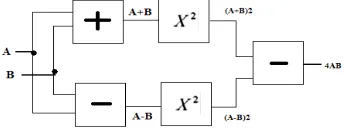
A CMOS four-quadrant multiplier can be used to multiply two bipolar signals, ±x and ±y. The multiplier circuit is a very useful building block and can be applied to any analog signal processing as well as analog filter, frequency doublers, modulator etc. Fig 1 [2] shows the basic block diagram of multiplying two inputs.
Figure 1Block Diagram Of Multiplier Operation
The Quarter-Square Algebraic Identity as shown above is a famous method for an implementation of multiplier operation. There are 3 steps of this logic as described below:
1. Sum and Subtraction of both inputs A and B. 2. Take their results and square them.
3. Subtract the two squared output. So the final output becomes:
1 22 2 1 2 2 1
0 V V V V 4VV
V
(1)
An excellent source of information on CMOS multipliers that operate in a multitude of modes such as saturation, triode, weak inversion, and others can be found. Here, operation in saturation seems to be preferable to the triode mode
High Performance CMOS Four Quadrant
Analog Multiplier in 45 nm Technology
Saradindu Panda1, Supriyo Srimani2, Prof. Bansibadan Maji3, Prof. Asish Kumar Mukhopadhyay4
1,2
Dept. of Electronics and Communication Engineering, Narula Institute of Technology, Kolkata, India 3
Professor & Head, Dept. of Electronics and Communication Engineering, NIT, Durgapur, India 4
Volume 2, Issue 7, July 2013
Page 126
because there are more options for multiplier topologies in saturation logic. A multiplier operation in saturation is possible only two transistors. This enables it to be used for low-voltage operations.3.
CIRCUIT
DESCRIPTION
SQUARE
ROOTING
CIRCUIT
3.1 Circuit Operation
An excellent source of information on CMOS multipliers that operate in a multitude of modes such as saturation, triode, weak inversion, and others can be found. Here, operation in saturation seems to be preferable to the triode mode because there are more options for multiplier topologies in saturation logic. A multiplier operation in saturation is possible only two transistors. This enables it to be used for low-voltage operations.
Another method is using a cross-coupled transistor pairs and floating voltage sources which also work in low-voltage. The circuit is based on the ideal square-law behavior of the MOS transistor in the saturation region, given by the expression
2
) ( GS t d K V V
I
(2)
with
K
=L
W
C
ox n.
.
.
5
.
0
,I
Dthe drain is current,V
GSis the gate-to-source voltage,V
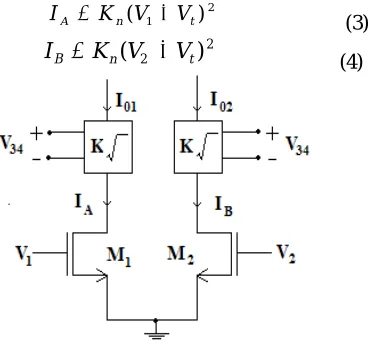
Tis the threshold voltage. Realizing an analog multiplier and the multiplier in [7] is based on a similar approach showing in Fig. 1. It comprises a pair of common source amplifier (M1 and M2), which acts as input transistors to provide output currents in term of squaring functions of input voltages (V1 and V2), and two identical square root blocks. Injecting the output currents of the input transistors into the square root blocks, a differential output current of the overall circuit will become a multiplication function of two input signals V12 and V34.Assuming the MOSFET M1 and M2 are biased in active region and neglecting channel length modulation effect, the current IA and IB can be respectively found as
2
1 )
( t
n A K V V
I
(3) 2 2 ) ( t n
B K V V
I
(4)
Figure 2Realization of a four quadrant analog multiplier. WhereKn=
L W Cox n. .
. 5 .
0 is a Trans conductance parameter of each MOSFET and Vt is the threshold voltage of NMOS
transistor. From (3) and (4), the relationship between the current IA and IB and the differential input voltage V12 = V1
-V2 can be given by
IA IB V12 Kn
(5) The drain currents IAand IBare fed into the square root blocks controlled by V34, results in
Iout I01 I02 KV34
IA IB
(6) WhereK is the gain of the square root blocks. Substituting (5) into (6), yieldsIoutK KnV34V12 (7)
It can be seen that an output current appeared in (7) is in form of a multiplication function between two input signals
V12 and V34. Based on this approach, both linear transconductor and four-quadrant analog multiplier have been
proposed.
Volume 2, Issue 7, July 2013
Page 127
In the next section, the improved square root circuit which is more suitable for realizing an analog multiplier will be described.3.2 Square Rooting Circuit
Figure 3The square rooting circuit.
A square rooting circuit which is improved from Fig 2 is shown in Fig 3. Using square-law relation of saturated MOSFET in strong inversion and setting M3-M8 to be identical, the currents Ic and ID are found to be
2
34
B A p
C
K I V
K I
(8)
2
34
B B p
D
K I V
K I
(9)
Where
K
p is a transconductance parameter of each PMOS transistor and V34 = V3-V4 is a differential control voltage.Considering (6) and (7) in conjunction with the fact that IA+ ID= Io1 and IB+ IC= Io2 leading to
I KpV V34 Kp IA IAIB
2 34
01 2
(10)
I
K
pV
V
34K
pI
B
I
A
I
B 234
02
2
(11) Subtracting (10) and (11), results in
Iout I01 I02 2 KpV34
IA IB
(12)
It is obvious that the output current of the improved square root circuit is a function of a square root of IA and IB and its gain can be adjusted by the voltage V34 and transconductance parameter Kp
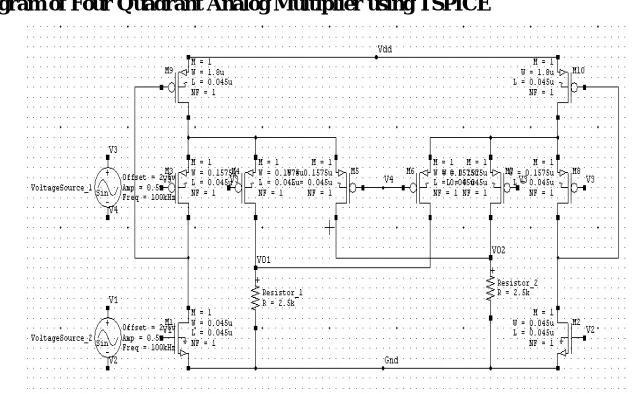
3.3 Schematic Diagram of Four Quadrant Analog Multiplier using TSPICE
Volume 2, Issue 7, July 2013
Page 128
Fig.4.3 shows the proposed multiplier circuit which is constituted by substituting the square rooting circuit in Fig.4.2 into the square root blocks of Fig.4.1. Focusing on the differential output voltage we have found that
V
out
V
01
V
02
R
I
01
I
02
(13) Substituting (16) into (17), differential output voltage can be found asVout 2RV34 K p
IA IB
(14) Finally, substituting (5) into (14) yields
V
out
2
R
K
pK
nV
34V
12 (15) Now, we have an output offset-free four quadrant analog multiplier and its gain can be adjusted by the load resistor Rand the dimensions of each MOSFET.
4.
SIMULATION
RESULT
The multiplier circuit in Fig.4 is designed and simulated by using TSPICE for 45 nm CMOS process. The input voltage
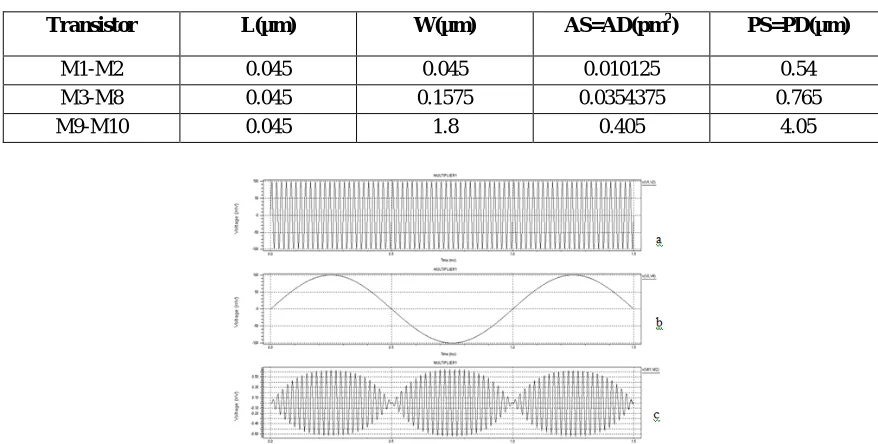
V12 and V34 are set to be balance with common mode voltages, respectively and supply voltage VDD is set at 0.1V. Trying to avoid channel length modulation and short channel effects, the channel parameters of all transistors are set accordingly. Transistor parameters are listed in Table 1. The load resistors R are chosen to be 2.5 k. The power consumption, delay and noise have been listed in Table 2.
A 0.1V, 25 kHz sinusoidal carrier signal V12 shown in Fig.5(a) is multiplied by a 0.1V, 1 kHz sinusoidal modulating
signal V34 shown in Fig. 5.(b). A resulting waveform is shown in Fig. 5.(c). Fig.6 shows simulated DC transfer
characteristics of the proposed multiplier, when V12 was swept continuously from -0.3V to 0.1V while V34 was varied
from -0.3V to 0.1V with0.1V step size. It can be observed that the linear range of V12is approximately +0.4V.
Table.1: Transistor Parameters
Figure 5 Schematic Diagram of Four Quadrant Analog Multiplier (a) V12 sinusoidal carrier signal (b) V34 sinusoidal
modulating signal (c) Output waveform of amplitude modulator
Figure 6 DC Transfer Characteristic Figure 7 Flicker Noise Characteristic
Transistor L(µm) W(µm) AS=AD(pm2) PS=PD(µm)
M1-M2 0.045 0.045 0.010125 0.54
M3-M8 0.045 0.1575 0.0354375 0.765
Volume 2, Issue 7, July 2013
Page 129
Figure 8 Total Output Noise Characteristic Figure 9 Thermal Noise Characteristic
Table.2: Output Data of Noise, Power and Delay in 45 nm Technology
5.
Conclusion
A new square rooting circuit can be used for realizing a CMOS four-quadrant analog multiplier has been presented. The resulting multiplier circuit is improved to be more compact than the previous work. As a result, the proposed multiplier provides low noise, low delay and low static power consumption. Simulation results are given to verify the multiplier circuit performances.
References
[1.]KLAAS BULT AND HANS WALLINGA,, “A CMOS Four-Quadrant Analog Multiplier,” IEEE JOURNAL OF SOLID-STATE CIRCUITS, VOL. SC-21, NO. 3, JUNE 1986
[2.]Pipat Prommee Montri Som dunyakanok and Kobchai Dejhan1, “Single Low-Supply Current-mode CMOS Analog Multiplier Circuit: A Tutorial,” IEEE Trans. Circuits Syst. II, vol. 45, no. 12, 2006.
[3.]R. G. Cavajal, J. Ramirez-Angulo, A. J. Lopez Matin, A. Torralba, J. A. Gomez Galan, A. Carlosena, and F. M. Chavero, “The flipped voltage follower: a useful cell for low-voltage low-power circuit design,” IEEETrans. Circuits Syst. I, 2005, 52,(7), pp. 1276-1291.
[4.]J. Ramirez-Angulo, R.G.Carvajal, and J. Martinnez-Heredia,“1.4V supply, wide swing, high-frequency CMOS analogue multiplier with high current efficiency,” Proc IEEE ISCAS, May 2000, Geneva Switzerland, Vol. V, p.553-536.
[5.]J. Ramirez-Angulo, R.G. Carvajal, and J. Martinnez-Heredia, “1.4V supply, wide swing, high-frequency CMOS analogue multiplier with high current efficiency,”Proc IEEE ISCAS, May 2000, Geneva Switzerland, Vol. V, p. 553-536.
[6.]A. Demosthenous, and M. Panovic, “Low voltage MOS linear transconductor/squarer and four-quadrant multiplier for analog VLSI,” IEEE Trans on Cir. and Syst. I: Regular paper, vol. 52, no. 9, pp. 1721- 1731, 2005.
[7.]A. Hyogo, Y. Fukutomi and K. Sekine, “Low voltage four quadrant analog multiplier using square-root circuit based on CMOS pair,” Proc.of IEEE ISCAS’99, pp. II 274-277, 1999.
[8.]C. Sawigun, N. Kiatwarin and W. Ngamkham, “A low voltage MOS linear transconductor with constant input linear range,” ECTI 2006, vol. 1, pp. 167-170, UbonRatchathani, Thailand, 2006.
AUTHOR:
Saradindu Panda received M.Tech from Jadavpur University in 2007 in VLSI Design and Microelectronics Technology. He is pursuing his PhD at NIT, Durgapur, West Bengal, India. Presently, he is involved in design and management of low-power and high speed integrated circuits with Solid State Devices in Nano Regime. He is now faculty in ECE Department at Narula Instutute of Technology, Kolkata, India. He has more than 15 publications in different International and National Journals and Conference Proceedings.
Chann el Length
Average Power Consumed
(Watt)
Delay (Sec)
Flicker Noise (sq V/ Hz)
Thermal Noise (V)
Total Output Noise
(V)
45 nm 6.006875x10⁻¹⁴ 5.3155 x 10⁻⁶
Volume 2, Issue 7, July 2013
Page 130
Supriyo Srimani is pursuing B.Tech in ECE, Narula Institute of Technology, Kolkata, India. His research interest in the area of VLSI Low Power Design, Image Processing, Signal Processing.Prof. (Dr.) Bansibadan Maji is now a senior Professor of ECE Department in NIT, Durgapur, West Bengal, India. He is now Head of The Department of ECE at NIT. His main research area on Microwave, Antenna, VLSI Design and Low power Device and Circuits. He has more than 56 publications in different International and National Journals and Conference Proceedings.