Sikander et al. World Journal of Pharmaceutical and Life Sciences
MICROBIAL TRANSFORMATION OF STEROIDS: A FOCUS ON TYPES AND
TECHNIQUES
Zuriat Jabbar, Hannana Maryam, Sana Maqsood and Sikander Ali*
Institute of Industrial Biotechnology (IIB), Government College University, Lahore Pakistan.
Article Received on 30/05/2017 Article Revised on 15/06/2017 Article Accepted on 30/06/2017
INTRODUCTION
Steroids comprise of a broad range of naturally abundant compounds with many important physiologically active derivatives. These chemical compounds include sterols, like ergosterol and cholesterol, bile acids, as well as a variety of steroid hormones.[1] They are extensively found in nature as thousands of different steroid compounds are known to be present in the living beings. About more than 250 sterols and derivatives exist in insects (e.g., ecdysteroids), plants (e.g., phytosterols, diosgenin), vertebrates (e.g., cholesterol; corticosteroids: glucocorticoids, mineralocorticoids; sex hormones: androgens, estrogens; bile acids, vitamin D; neurosteroids), and lower eukaryotes: yeasts and fungi (e.g., ergosterol, ergosteroids).[2]
In some instances of fermentation, by using microbial cells, a compound can be catalytically converted into another compound which is similar to the structure but has more profitable and financial value. Fermentation processes like these are called as the processes of transformation, biotransformations or bioconversions. The catalyzed reactions include hydroxylation, oxidation, dehydration and condensation, amination and deamination, dehydrogenation, decarboxylation and
isomerization.[3] The manufacture of steroid drugs as well as steroid hormones by the biotransformation process present an excellent example of the outstanding use of microbial technology at an industrially large scale.
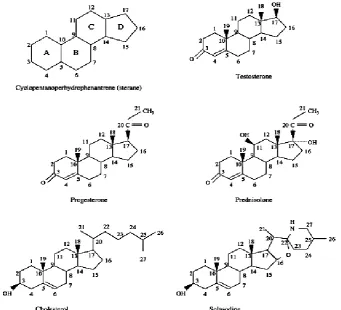
Structurally, steroids are the derivatives of sterane (cyclopentanoperhydrophenantrene) (Figure 1). The efforts in research in this area were started in about 1950, when the pharmacological effects of two endogenous steroids i.e. progesterone and cortisol, were discovered, and the 11α-hydroxylation activity of a species of
Rhizopus was identified;[4] this was considered to be a crucial point in the advancement of the practical steroid synthesis having important biological activity. Increasing numbers of steroid biotransformations using microorganisms, chiefly emphasizing on the steroid biotransformation types of Δ1-dehydrogenation, hydroxylation and side-chain cleavage, have been described.[5] Industrialists and researchers are now able to make huge amounts of steroids and derivatives using different biotransformation reactions and by combining these reactions with the chemical methods of steroid synthesis.[6] Because there is no need for isolating, purifying and stabilizing the pure enzymes, the cost of steroid manufacture can be reduced by using whole-cell for steroid bioconversion.[7]
World Journal of Pharmaceutical and Life Sciences
WJPLS
www.wjpls.org SJIF Impact Factor: 4.223
*Corresponding Author: Sikander Ali
Institute of Industrial Biotechnology (IIB), Government College University, Lahore Pakistan.
ABSTRACT
Steroids are widespread in nature and are important compounds present in living systems. These compounds include different sterols, bile salts and steroid hormones like estrogen, androgens, testosterones etc. and have numerous therapeutic applications. Microbial biotransformation of steroids is one of the applications of microorganisms in the large-scale industries and it also have certain advantages over the chemical processes of steroid production. For biotransformation process, precursor steroids are required which are transformed in to valuable intermediates as well as the final transformed product. Different types of biotransformation reactions are used for the process of microbial biotransformation which include hydroxylation, dehydrogenation, side-chain degradation, ring A aromatization and reduction. Biotransformation of steroids can be done by different techniques and approaches like biotransformation in aqueous medium, biotransformation using immobilized cells and enzymes, biotransformation using free enzymes and biotransformation in biphasic systems. Different biotransformation facilitators are also used for enhancement of product yield. Alternate Biotransformation systems using liposomes and microemulsions are also being used for microbial steroid biotransformation.
The manufactured steroids exhibit a wide variety of therapeutic uses, such as immunosuppressive, anti-inflammatory, progestational, anabolic, diuretic and contraceptive agents.[8] They have also been successfully used for treating a few kinds of prostate and breast cancer as well as osteoporosis, for treating adrenal deficiencies by acting as replacement agents, for preventing the coronary heart disease,[9] and for inhibiting HIV integrase, for treatment as well as prevention of HIV infection and for treating the declared AIDS. They have also been used as active ingredients in anti-obesity agents and anti-fungal agents.[10]For the bioconversion of exogenous compounds, bacteria and fungi are the most frequently chosen microorganisms due to certain historical reasons. Plant cell cultures have also been used for studying the biotransformation process.[11]
Biotransformation can also be done by microalgae but it had not been studied enough until 1986.[12] Researchers are continuously doing efforts to not only discover more steroids for useful purposes but also to screen and identify more different microorganisms that would be capable of performing the aimed biotransformations. Many different techniques have been used by means of which, biotransformation of steroids can be done. Such techniques include biotransformation in aqueous medium, biotransformation using immobilized cells and
by using free and immobilized enzymes,
biotransformation in bi-phasic systems and cloud-point systems, biotransformation using liposomes and microemulsion, by using different methods for altering cell wall permeability etc.
Figure 1: Sterane, which is the parent ring structure of steroid compounds withe structures of some representative steroids.
Comparison of Chemical Synthesis and Preparation Through Biotransformation
Chemical transformation and synthesis may disturb the structural stability of the steroid, as it requires many steps and reagents that may result in the degradation of one or more of the steroid rings. These chemicals may also be harmful for health and may cause serious environmental problems.[13] Compared to the chemical transformation, the conversion of precursor steroids through microorganisms is cheaper, less time consuming and nontoxic and since they are not using hazardous reagents, they are safer for the environment and for
working staff. Enzymes produced by these
Precursor Steroids/Raw Material For Steroid Biotransformation
Steroidal compounds that are pharmacologically active have natural sources that are rare, economically unfeasible as stereo-chemical considerations restrict the use of compounds derived from one animal as drugs in another. On the other hand, an immense number of naturally occurring, extractable steroidal compounds cannot be used as drugs owing to their complex side chains. Cholesterol, steroidal alkaloids, steroidal sapogenins and phytosterols are the plentifully available steroid precursors. Cholesterol can easily be isolated from the waste blood collected from slaughter houses. Plant derived steroids are extracted from parts of plants cultivated for the purpose and from press mud generated from edible oil extraction units.[13]
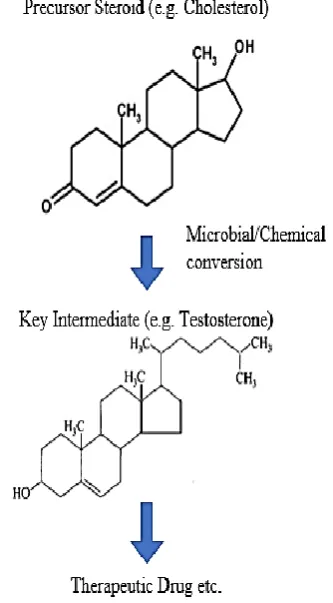
For the steroid industry, natural steroid sapogenin, diosgenin is one of the significant raw materials and it can be used for the microbial production of some new steroids of useful therapeutic action.[15] Natural sterols, typically, steroid 3β-alcohols are the alternative raw materials for the industry. Cholesterol is called as animal sterol; stigmasterol, campesterol, sitosterol and brassicosterol are abundantly found in plants and hence are the ample plant sterols. The phytosterols are plant sterols mixtures which are mainly of soya origin, or produced from tall oil or pitch. The important sterol of fungi and yeast is the ergosterol.[5] Sterol-containing wastes of food, agricultural and cellulose manufactures can be used for production of valuable steroid compounds without deep purification of phytosterols. The production of key intermediates and then the final product from the precursor steroid compound is depicted in Figure 2.
Production of key intermediates from sterols
The key intermediates produced microbially are some C-17 and C-22steroids. The most notable intermediates are AD and ADD required for the industrial manufacture of compounds like corticosteroids, oral contraceptives, and other pharmaceutical steroids. Sterol-transforming actinobacteria were also applied for single-step production of testosterone.[16] Boldenone is being produced from phytosterol and has been reported to include two steps via intermediate obtaining of AD using
Mycobacteria followed by 1-dehydrogenation of AD by
Fusarium sp.[17]
A recent study showed the possibility of single-step production of derived androst-5,7-diene-17-one from 3-substituted ergosterol.[18] This intermediate is one of important precursors for synthesis of vitamin D derivatives. 3β-hydroxyandrosta- 5,7-diene-17β-carboxylic acid can be used for the purpose of inhibiting the division of normal keratinocytes as well as of malignant and normal melanocytes. It can be used for condition-dependent regulation of fibroblast proliferation and also in leukemia cell differentiation as a stimulator.[19]
Apart from C-19 steroids, valuable 23,24-dinorcholane derivatives were obtained from sterols microbially.[20] These compounds are the important precursors for corticosteroid syntheses. For sterol biotranformations, various strains of microorganisms have been defined as biocatalysts, e.g., Arthrobacter spp. (Arthrobacter oxydans 317 AL, Arthrobacter rubbelus),
Brevibacterium spp., Pseudomonas spp., and
Rhodococcus spp., but their application requires addition of inhibitors to prevent steroid nucleus degradation.[8] Over the recent decade, attempts have been made to discover organisms capable of efficient conversion of phytosterols to key steroid precursors.
Figure 2: General Scheme for the production of key intermediates from precursor steroid and finally the production of therapeutically active drug.
Types of Steroid Biotransformation
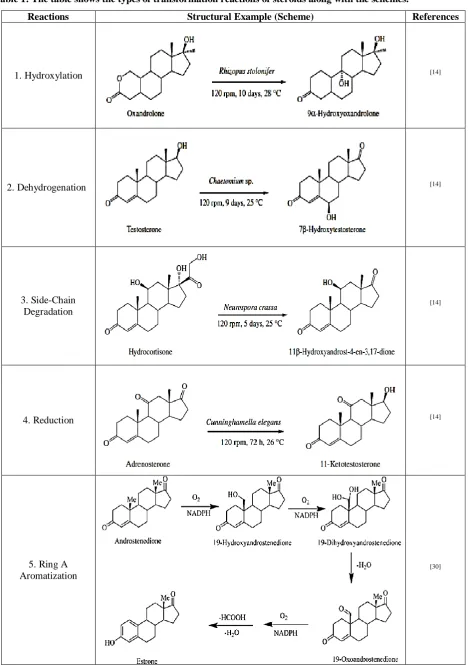
There are different reactions that are done in order to carry out the biotransformation of the steroids. Major sites of the biotransformation reactions on a steroid molecule is shown in the Figure 3.[14] The schemes of different types of biotransformation reactions is shown in the Table 1.
Hydroxylation
most common type of steroid biotransformation. Using this reaction, the intermediates can be produced for further synthesis by chemical method, by providing access to the otherwise inaccessible sites in the molecule, or to change the structure of steroid molecule in such a way that it can become therapeutically useful. In the synthesis of corticosteroids, α-hydroxylation is a necessary step. Presently in the industry, 11α-, 11β-, 15α and 16α-hydroxylations are the developed processes[21] chiefly to manufacture the adrenal cortex hormones as well as their analogues. 11α -, 11β- and 16 α-hydroxylations are generally carried out by the use of
Rhizopus spp. or Aspergillus spp., Curvularia spp. or
Cunninghamella spp., and Streptomyces spp., respectively.[8] Fungi are the most active microorganisms that give hydroxylation reactions. However, some bacteria especially the Bacilli, Streptomyces and
Nocardia show fairly exceptional activity.
Dehydrogenation
Derivatives of cortisone and hydrocortisone showing improved anti-inflammatory characteristics and reduced unwanted side-effects can be produced by introducing 1-2 double bonds in their ring A structure. Fungi and Bacteria are able to dehydrogenize the secondary alcohol group of steroids and generate their corresponding carbon derivatives. Microbial whole cells can generally perform ∆1
-dehydrogenation. Because dehydrogenation is a co-factor-dependent process, the essential co-factor is constantly regenerated by the active metabolism of the cell. An example of dehydrogenation in bacteria is ∆1 -Dehydrogenation of 6α-methyl-cortisol to 6α-methyl prednisolone by resting cells of Arthrobacter globiformis.[22] Scheme 2 in the table 1 is the dehydrogenation reaction using a fungal species.[14]
Side-chain Degradation
Using chemical methods, the removal of side chains in saturated sterols, compared to that of the unsaturated sterols, is not easy. Therefore, making use of the microbial method have gained huge consideration and successful production of 17-ketosteroids at industrial scale has been achieved owing to some of these methods.[23] Such reactions are described for different bacteria for example in Actinobacteria. In
Actinobacteria, the basic step of the side-chain oxidation of sterols (andother 27 steroids) is hydroxylation at C-26 (or C-27). Aliphatic side-chain is degraded by an array of β-oxidation reactions. The terminal hydroxylation of C-27sterol is catalyzed by an enzyme known as cytochrome P450 125 (which is also known as steroid 26-monooxygenase). Various actinomycetes such as Rhodococcus jostii[24] produce this enzyme from where it was purified and characterized.Further cleavage of the alkyl sterol side chain at C-17 was shown to proceed by the fatty acid β-oxidation process,[25] and the genes responsible for this process in actinobacteria
constitute part of the sterol catabolic gene cluster.[26] Side-chain degradation of hydrocortisone is shown in scheme 3 in table 1.
Reduction
This type of biotransformation includes the reduction of ketones and aldehydes to alcohols. Along with the Bacteria and Fungi, algal species quite commonly undergo the reduction of exogenous compounds. The most agreeable position for reduction is 17-carbonyl among the other positions. Some important androgens can be produced by making use of these processes.[27] Moreover, 3-carbonyl[28] and 20-carbonyl[29] reduction have been reported. Microorganisms including microalgae can also reduce the steroidal double bonds. Hydrogenation of Δ,[1] Δ[4] and Δ[16] positions is included in the hydrogenation of the ring. Bioconversion of prednisone to cortisone, and prednisone to cortisol with
Bacillus megaterium is involved in the process.
Ring A Aromatizationn
Ring A aromatization of suitable substrates by microorganisms forms aromatic compounds. For example, steroids like estrogens and estrones can be produced by ring A Aromatization of steroid precursors or intermediates.[30] Estrogen is not only a major component in orally administered contraceptives drugs but also plays a vital role in treating the menopause by replacement therapy. Estrone can be produced by the transformation of 19-nor-testosterone by cell free extracts of Pseudomonas testosteroni and a small amount of estradiol-17β is also produced in this reaction.
Table 1: The table shows the types of transformation reactions of steroids along with the schemes.
Reactions Structural Example (Scheme) References
1. Hydroxylation [14]
2. Dehydrogenation [14]
3. Side-Chain Degradation
[14]
4. Reduction [14]
5. Ring A Aromatization
Tecniques and Methods for the Microbial Steroid Transformations
Different techniques and methods are used for microbial steroid transformation.
Biotransformation in aqueous medium and biotransformation facilitators
One of the approaches to perform microbial steroid biotransformation is the use of aqueous medium and biotransformation facilitators to overcome certain limitations that can hinder the transformation process. For example, in the steroid biotransformation using fungi, the considerable hindrances are poor solubility in water, powder aggregation and dispersibility.[31] To overcome these limitations, certain approaches have been considered to increase the permeability of viable cells using fed-batch systems, substrate micronization, increasing the cell wall permeability using certain compounds like surfactants, antibiotics, cyclodextrins (which form inclusion complexes for solublization), and organic solvents.[32] Following are discussed some of the approaches used for solublization the steroids and for increasing the cell wall permeability.
Increasing the cell wall permeability
The cell envelope acts as a permeability barrier, which can be considered as a disadvantage for the uptake of sterol and its bioconversion. Cell wall permeability for sterol can be improved by making use of several agents, such as m-fluorophenylalanine and D, L-norleucine, antibiotics, lecithin, glycine. Cell sensitization to agents leads to higher quantity of AD(D) formed per biomass.[33] According to Fernandes et al. (2003), with the help of Mycobacteriumvaccae or derived strains, the sterol penetration across the cell envelope can be enhanced when compounds like vancomycin,[34] glycine,[35] lecithin and polycations, such as protamine, polymyxin B nonapeptide, were added to the fermentation medium. Regardless of the effect of added chemical compound on the structure of the cell wall, it acts on the cell envelope and disrupts the stability and moisture content of the bilayer. The yield of 17-ketosteroids produced from β-sitosterol was enhanced by this method.[36]
Substrate Micronization
Biotransformation in aqueous medium may be done by the technique of substrate micronization in which, supposed “wet” disintegration of steroid particles based on ultrasonic wave together with the detergents can assist the contact between whole-cell biocatalyst and the substrate.[16,18]
Cyclodextrins (CD)
Cyclodextrins are the solubilizing agents which form substrate inclusion complexes and increase water-solubility of lipophilic compounds. Many different mechanisms of CD-mediated intensification of conversion of steroids include steroid solublization as well as increase of cell wall permeability.[37] Formation
of the complex between cyclodextrins and steroid drugs leads to the reduction of the steroid hydrophobicity.
Liquid polymer based systems
Liquid polymers may be present as components of the bioconversion media (polypropylene glycol, silicon oil etc.). They can be useful for sterol solubilization and for speeding up the aggregation of steroid.[38]
Special adsorbents
Different adsorbents, for example amberlite XAD resin, are often used for the purpose of increasing the yield of steroids. These adsorbents work by absorbing toxic products.[39]
Biotransformation using immobilized cells
Bio-transformations can be repeatedly done by making use of immobilized cells. Moreover, the same cells can be used again and again. Different biotransformations involving single or multistage reactions are actually achieved by using immobilized cells e.g. commercial manufacture of malic acid and L- alanine. The use of immobilized microbial cells have certain advantages which include the minimization of the deactivation of biocatalyst, regulation of the reactions time, cell recycle for various cycles of reaction and reducing the overall production cost of cell mediated reactions. Viable immobilized cells also have advantages over traditional methods of fermentation, including volumetric reaction rates, advantageous downstream processing, increased storage as well as operational strengths, recycling of immobilized biocatalysts, and more yield gain of product.[40] The most conspicuous advantage of the immobilization approach is its ability of continuous cycling due to which, it can be used in continuous processing with high biomass maintenance in the reactor to attain fast reaction rates. Different immobilization techniques, including adhesion to solid surfaces of carriers, entrapment and microencapsulation, are used for whole-cell bioconversion by algae and bacteria.[41] Synthetic polymers such as resins which are photo-crosslinked, polyurethane foams, silicon-based polymers, and calcium-alginate beads with a coating of polyurea layer have been used.[42] However, lower productivity of immobilized systems and limited mass transfer are the chief limitations of this technique. Moreover, due to the fact that it requires special equipment and often complicates the flow of the process, it can barely be recommended for scaled processes. Utilization of immobilized whole cells together with detergents and two-phase aqueous/organic system can facilitate bioconversion.[43,44,45]
Biotransformation using free and immobilized enzymes
Cell-free enzyme systems in the form of immobilized
enzymes are most commonly used in
barrier across the cell membrane is there for the product or substrate and (iv) product isolation and recovery is easier and simpler. Different immobilized enzyme systems have been established for bioconversions such as penicillin acylase and glucose isomerase. While also being selective, biotransformation enzymes are safer for the environment, are less time consuming and are cheaper. Therefore, it would not be wrong to consider them as suitable alternatives for the manufacture of pharmaceutically active components.[46]
There are six classes of enzymes and out of these, many enzymes are important in the biocatalysis. These classes of enzymes are oxidoreductases, transferases, hydrolases, lyases, isomerases, and ligases. As discussed earlier,
steroids undergo various reactions during
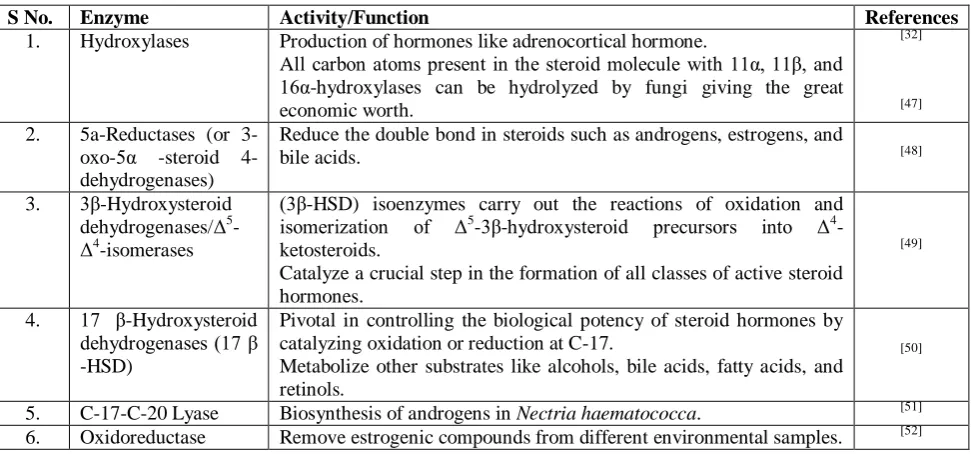
biotransformation like hydroxylation, isomerization, reduction, dehydrogenation etc. so many different enzymes from the six classes of enzyme classification are used to carry out these biotransformation reactions. Some of the enzymes used in fungal steroid transformation are listed (Table 2).[14]
Table 2. Some of the enzymes that carry out steroid biotransformation along with some of their functions.
S No. Enzyme Activity/Function References
1. Hydroxylases Production of hormones like adrenocortical hormone.
All carbon atoms present in the steroid molecule with 11α, 11β, and 16α-hydroxylases can be hydrolyzed by fungi giving the great economic worth.
[32]
[47]
2. 5a-Reductases (or 3-oxo-5α -steroid 4-dehydrogenases)
Reduce the double bond in steroids such as androgens, estrogens, and
bile acids. [48]
3. 3β-Hydroxysteroid dehydrogenases/Δ5- Δ4
-isomerases
(3β-HSD) isoenzymes carry out the reactions of oxidation and isomerization of Δ5
-3β-hydroxysteroid precursors into Δ4- ketosteroids.
Catalyze a crucial step in the formation of all classes of active steroid hormones.
[49]
4. 17 β-Hydroxysteroid dehydrogenases (17 β -HSD)
Pivotal in controlling the biological potency of steroid hormones by catalyzing oxidation or reduction at C-17.
Metabolize other substrates like alcohols, bile acids, fatty acids, and retinols.
[50]
5. C-17-C-20 Lyase Biosynthesis of androgens in Nectria haematococca. [51]
6. Oxidoreductase Remove estrogenic compounds from different environmental samples. [52]
Enzymes expressed in heterologous hosts
Some enzymes that are industrially important for steroid biotransformation are now being expressed in heterologous hosts. E. coli has been engineered to express 17β –HSD which allows the usage of purified enzyme or whole cells for specific 17-ketosteroids reduction e.g. in the synthesis of androgenic anabolic molecules. Vico et al., (2002) expressed a mammalian hydroxylase in Saccharomyces cerevisiae for
stereospecific hydroxylation of
dehydroepiandrosterone.[53]
Biotransformation in bi-phasic systems
One of the main difficulties in the bioconversion of steroids is the weak substrate solubility in aqueous medium solution, which renders extremely poor productivity. Thus, aqueous/organic solvent two-liquid-phase systems can be used for the improvement of substrate solubility, for allowing operation at high concentration of substrate and for aiding subsequent recovery of product. In biphasic system, the organic phase contains dissolved steroid and the cells are present in the aqueous phase and this is thought to be an ideal set up (this is done in aqueous organic bi-phasic system).[13] In whole-cell bioconversion, for overcoming the problem of poor product and substrate solubility in water and also
to eliminate their inhibitory effects on the biocatalyst, biphasic processes are used. Steroid biotransformation in two-phase systems is more frequently employed for bacteria as well as the microalgae, then by fungi.[38] There are different types of bi-phasic systems including the aqueous organic bi-phasic system, water miscible organic co-solvents, Ionic Liquid/Aqueous Biphasic Systems as well as some unique bi-phasic systems.
Aqueous organic two-phase (or bi-phasic) systems
Organic solvent should essentially be non-toxic to the biocatalyst during the provision of conditions for high water solubility of product and substrate otherwise the biocatalyst would become inactivated. Organic–aqueous two-liquid phase systems have been employed in multi-enzyme steroid biotransformations, in which, bioconversion of sitosterol to 17- ketosteroids is done by resting Mycobaterium sp. NRRL B-3805 cells.[58] These biotransformations are generally done in simple agitated containers.
Researchers are now designing new solvent systems for replacing the conventional ones in order to eliminate environmental concerns that could be dangerous for both the ecosystem and the humans. In such an effort, super critical fluid technology is being employed in transformation reactions.[59]
Water-miscible organic co-solvents
One of the traditional techniques involves the substrates fed in water-miscible solvents in the form of saturated solutions, such as methanol,[60] 1,2-propanediol,[61] dimethylformamide[62] or acetone. These organic solvents are useful in reducing the weak steroid substrate/product solubility and thus intensify the yield.
Ionic liquid/aqueous biphasic system
In this system, the 15α-Hydroxylation of 13-ethyl-gon-4-en-3, 17-Dione by Penicillium raistrickii has been reported.[63] For the reaction of 15α-hydroxylation, ionic liquids (ILs) that are available commercially were used in a bi-phasic system. After 72 hours, the yield was 70% in comparison to a yield of 30 % in a monophonic aqueous system.[13] This proposes the promising application of biphasic systems based on the ILs industrially for steroid bioconversion.
Two phase system based on PEG and MSG
A unique aqueous two phase system involving monosodium glutamate (MSG) and polyethylene glycol (PEG) has been tried for the 1-dehydrogenation of hydrocortisone-based substrates.[64] Higher substrate solubility and degree of biocatalyst-steroid separation was achieved when this system was compared to the other alternate systems. Successful biphasic systems using multiple enzymes for complex biotransformations have been scarcely reported in the literature.
Biotransformation in a cloud point system
Cloud point systems (CPS) were considered as unique bi-phase partitioning systems which can be applied for steroid solublization and phase separation in whole-cell bioconversion. Nonionic surfactants are used to make these systems. This system guarantees the cell viability as well as their enzymatic activity by providing a micro-aqueous environment. Biocatalysts contained in the water vesicles are scattered uniformly in the continuous phase which is surfactants-rich and hence, substrate inhibition, the organic phase and toxicity are essentially lowered. Bioconversion occurs inside these water vesicles having biocatalysts, eliminating the inhibition of
substrate and product and also prohibiting the product degradation.[65] With Mycobacterium spp. NRRL B 3683, Wang et al. (2004) studied the cholesterol bioconversion to androst-1,4-diene-3,17-dione and androst- 4-ene-3,17-dione in a CPS.[66] Studies on bioconversions by fungi in these systems are limited.
Alternative biotransformation systems: liposomes and microemulsion
In organic media, the viability of the cell can be lost and interfacial mass transfer area can be low and both of these can restrict the biotransformation. Microemulsions are the alternatives for the biphasic systems to solve the problem of interfacial area mass transfer by significantly increasing it. However, productivity may be lowered due to reduced activity of cells owing to long exposure to the organic solvent inside the microemulsion. Liposomes can be used to remove this detrimental side effect related with the organic solvent and hence, liposomes become a good alternative to give high productivity during steroidal biotransformations by encapsulating the steroids.[67]
CONCLUSION
Steroids are compounds that are found widely in nature. Many steroids are used for different therapeutic purposes like for the manufacture of drugs etc. Steroids can be formed as result of the process of biotransformation and bioconversion. Industrially, steroids can be formed by chemical process as well as by microbial process. However, microbial transformation offers certain advantages over the chemical transformation. Microorganisms like bacteria, fungi and microalgae as well are commonly used for microbial steroid transformation. Different techniques are used for the enhancement of the microbial biotransformation process and a lot of work has been done to improve this process.
REFRENCES
1. Faramarzi MA, Adrangi S, Yazdi MT. Microalgal biotransformation of steroids. J Phycol, 2008; 44(1): 27-37.
2. Fernandes P, Cabral JMS. Phytosterols: applications and recovery methods. Biores Technol, 2007; 98: 2335-2350.
3. Sameera V. Novel Techniques in the Production of Industrially Imperative Products. J Microbial
Biochem Technol, 2011; R1:003. doi:
10.4172/1948-5948. R1-003.
4. Hogg JA. Steroids, the steroid community, and Upjohn in perspective: a profile of innovation. Steroids, 1992; 57(12): 593-616.
5. Donova MV, Egorova OV. Microbial steroid transformations: current state and prospects. Appl Microbiol Biotechnol, 2012; 94(6): 1423-1447. 6. Liu HM, Li H, Shan L, Wu J. Synthesis of steroidal
7. Riva, S. 2001. Biocatalytic modification of natural products. Curr. Opin. Chem. Biol., 5: 106-111. 8. Mahato SB, Garai S. Advances in microbial steroid
biotransformation. Steroid, 1997; 62: 332-45. 9. Walsh G. Biopharmaceuticals: biochemistry and
biotechnology. Chichester; Wiley, 1998.
10. Chung SK, Ryoo CH, Yang HW, Shim J-Y, Kang, MG, Lee KW. Synthesis and bioactivities of steroid derivatives as antifungal agents. Tetrahedron, 1998; 54: 15899-914.
11. Giri A, Dhingra V, Giri CC, Singh A, Ward OP, Narasu ML. Biotransformations using plant cells, organ cultures and enzyme systems: current trends and future prospects. Biotechnol Adv., 2001; 19: 175-199.
12. Abul-Hajj YJ, Qian X. Transformation of steroids by algae. J Nat Prod, 1986; 49:244-248.
13. Rao SM, Thakkar K, Pawar K. Microbial transformation of steroids: current trends in cortical side chain cleavage. Quest, 2013; 1(2): 16-20. 14. Nassiri-Koopaei N, Faramarzi MA. Recent
developments in the fungal transformation of steroids. Biocatal Biotransfor, 2015; 33(1): 1-28. 15. Wang F-Q, Li B, Wang W, Zhang CG, Wei D-Z.
Biotransformation of diosgenin to nuatigenin-type steroid by a newly isolated strain, Streptomyces virginiae IBL-14. Appl. Microbiol Biotechnol, 2007; 77: 771-777.
16. Egorova OV, Nikolayeva VM, Sukhodolskaya G, Donova MV. Transformation of C19-steroids and testosterone production by sterol-transforming strains of Mycobacterium spp. J Mol Cat B: Enzym, 2009; 5: 198-203.
17. Kutney JP, Herrington EJ, Spassov G. Process for fermentation of phytosterols to androstadiendione. WO2003064674A2, 2003.
18. Dovbnya DV, Egorova OV, Donova MV. Microbial side-chain degradation of ergosterol and its 3-substituted derivatives: a new route for obtaining of deltanoids. Steroids, 2010; 75: 653-658.
19. Kim T-K, Chen J, Lib W, Zjawionyc J, Miller D, Janjetovic Z, Tuckey RC, Slominski A. A new steroidal 5,7-diene derivative, 3β-hydroxyandrosta-5,7-diene-17β-carboxylic acid, shows potent anti-proliferative activity. Steroids, 2010; 75(3): 230-239.
20. Andor A, Jekkel A, Hopwood DA, Jeanplong F, Ilkoy E, Konya A, Kurucz I, Ambrus G. Generation of useful insertionally blocked sterol degradation pathway mutants of fast-growing mycobacteria and cloning, characterization, and expression of the terminal oxygenase of the 3-ketosteroid 9α-hydroxylase in Mycobacterium smegmatis mc2 155. Appl Envir Microbiol, 2006; 72(10): 6554-6559. 21. Jekkel A, Ilkoy E, Horvath G, Pallagi I, Suto J,
Ambrus G. Microbial hydroxylation of 13β-ethyl-4-gonene-3,17-dione. J Mol Catal B: Enzym, 1998; 5: 385-387.
22. Arinbasarova AYu, Karpov AV, Fokina VV, Medentsev AG, Koshcheyenko KA. Kinetic
characteristics of 1-en-dehydrogenation of 6α-methylhydrocortisone by cells of Arthrobacter globiformis 193. Enzyme Microb Technol, 1996; 9: 501-506.
23. Mahato SB, Mukherjee A. Steroid transformation by microorganisms. Phytochemistry, 1984; 23: 231-54. 24. Capyk JK, Kalscheuer R, Stewart GR, Liu J, Kwon
H, Zhao R, Okamoto S, Jacobs WR, Eltis LD, Mohn
WW. Mycobacterial cytochrome P450 125
(Cyp125) catalyzes the terminal hydroxylation of C27-steroids. J Biol Chem, 2009; 284: 35534-35542.
25. Szentirmai A. Microbial physiology of sidechain degradation of sterols. J Ind Microbiol Biotechnol, 1990;6: 101-115.
26. Wilbrink MH, Petrusma M, Dijkhuizen L, van der Geize R. FadD19 of Rhodococcus rhodochrous
DSM43269, a steroidcoenzyme a ligase essential for degradation of C-24 branched sterol side chains. Appl Envir Microbiol, 2011; 77(13): 4455-4464. 27. DellaGreca M, Previtera L, Fiorentino A, Pinto G,
Pollio A. Prednisolone biotransformation by the green alga T76 Scenedesmus qudricauda. Tetrahedron Lett, 1997; 53: 8273-80.
28. Fiorentino A, Pinto G, Pollio A, Previtera L. Biotransformation of 5α-androstane-3,17-dione by microalgal cultures. Bioorg Med Chem Lett, 1991; 1: 673-4.
29. Ghasemi Y, Tabatabaei Yazdi M, Dehshahri A, Niknahad H, Shokravi S, Amini M, Ghasemian A,
Faramarzi MA. Algal transformation of
hydrocortisone by the cyanobacterium Nostoc ellipsosporum. Chem Nat Comp, 2006; 42: 702-705. 30. Yadav MR, Barmade MA, Tamboli RS, Murumkar PR. Developing steroidal aromatase inhibitors-an effective armament to win the battle against breast cancer. Eur J Med Chem, 2015; 105: 1-38.
31. Goetschel R, Bar R. Formation of mixed crystals in
microbial conversion of sterols and
steroids. Enzyme Microb Technol, 1992; 14(6): 462-469.
32. Ni Y, Chen RR. Accelerating whole-cell biocatalysis by reducing outer membrane permeability barrier. Biotechnol Bioeng, 2004; 87(6): 804-811. 33. Zehentgruber D, Dragan C-A, Bureik M, Lutz S.
Challenges of steroid biotransformation with human cytochrome P450 monooxygenase CYP21 using resting cells of recombinant Schizosaccharomyces pombe. J Biotechnol, 2010; 146(4): 179-185. 34. Lisowska K, Korycka M, Hadlaw-Klimaszewska o,
Ziolkowski A, Sedlaczek L. Permeability of mycobacterial cell envelopes to sterols: peptidoglycan as the diffusion barrier. J Basic Microbiol, 1996;36: 407-19.
36. Rumijowska A, Lisowska K, Ziotkowski A, Sedlaczek L. Transformation of sterols by
Mycobacterium vaccae: effect of lecithin on the permeability of cell envelopes to sterols. World J Microbiol Biotechnol, 1997; 13(1): 89-95.
37. Zhang L, Wang M, Shen Y, Ma Y, Luo J. Improvement of steroid biotransformation with
hydroxypropyl-β-cyclodextrin induced
complexation. Appl Biochem Biotechnol, 2009; 159: 642-654.
38. Carvalho F, Marques MPC, de Carvalho CC, Cabral JMS, Fernandes P. Sitosterol bioconversion with resting cells in liquid polymer based systems. Bioresour Technol,2009; 100: 4050-4053.
39. Lam KS. Application of whole-cell
biotransformation in the pharmaceutical industry. In: Tao J, Lin G-Q and Liese A (eds.). Biocatalysis for the pharmaceutical industry: discovery, development, and manufacturing, New York; Wiley, 2010; 213-227.
40. Mogharabi M, Faramarzi MA. Laccase and laccase mediated systems in the synthesis of organic compounds. Adv Synth Catal, 2014; 356: 897-927. 41. Saab HB, Fouchard S, Boulanger A, Llopiz P,
Neunlist S. Performance of Luffa cylindrica as an immobilization matrix for the biotransformation of cholesterol by Mycobacterium species. Biocatal Biotransform, 2010; 28: 387-394.
42. Leon R, Fernandes P, Pinheiro H, Cabral J. Whole cell biocatalysis in organic media. Enzyme Microb Technol, 1998; 23: 483-500.
43. Junter G, Jouenne T. Immobilized viable microbial cells: from the process to the proteome or the cart before the horse. Biotechnol Adv, 2004; 22: 633-658.
44. Amin HAS, El-Hadi AA, Mohamed SS.
Immobilization of Mycobacterium sp. NRRL B-3805 cells onto radiation crosslinked PVA/PVP hydrogels for production of androstenones from beta-sitosterol. Austral J Basic Appl Biosci, 2010; 4(8): 2196-2205.
45. Peart PC, Chen ARM, Reynolds WF, Reese PB. Entrapment of mycelial fragments in calcium alginate: a general technique for the use of immobilized filamentous fungi in biocatalysis. Steroids, 2012; 12: 85-90.
46. Manosroi J, Saowakhon S, Manosroi A. A novel one-step biotransformation of cortexolone-21-acetate to hydrocortisone acetate using
Cunninghamella blakesleeana ATCC 8688a. Enzyme Microb. Technol, 2007; 4: 322-325.
47. Fernandes P, Cruz A, Angelova B, Pinheiro HM, Cabral JMS. Microbial conversion of steroid compounds: recent developments. Enzyme Microb Technol, 2003; 32(6): 688-705.
48. Cabeza MS, Gutierrez EB, Garcia GA, Avalos AH, Hernandez MAH. Microbial transformations of testosterone to 5α-dihydrotestosterone by two species of Penicillium: P. chrysogenum and P. crustosum. Steroids, 1999; 64: 379-384.
49. Hunter AC, Coyle E, Morse F, Dedi C, Dodd HT, Koussoroplis SJ. Transformation of 5-ene steroids by the fungus Aspergillus tamarii KITA: mixed molecular fate in lactonization and hydroxylation pathways with identification of a putative 3β-hydroxy-steroid dehydrogenase/Δ5-Δ4 isomerase pathway. Biochem Biophys Acta, 2009; 1791: 110-117.
50. Adamski J, Jakob FJ. A guide to 17β-hydroxysteroid dehydrogenases. Mol Cell Endocrinol,2001; 171: 1-4.
51. Ahmed F, Williams RAD, Smith KE. Microbial transformations of steroids. X. Cytochromes P-450 11 α -hydroxylase and C17-C20 lyase and a 1-ene dehydrogenase transform steroids in Nectria haematocca. J Steroid Biochem Mol Biol, 1996; 58: 337-349.
52. Tamagawa Y, Yamaki R, Hirai H, Kawai S, Nishida T . Removal of estrogenic activity of natural steroidal hormone estrone by ligninolytic enzymes from white rot fungi. Chemosphere, 2006; 65: 97-101.
53. Vico P, Cauet G, Rose K, Lathe R, Degryse E. Dehydroepiandrosterone (DHEA) metabolism in
Saccharomyces cerevisiae expressing mammalian steroid hydroxylase CYP7B: ayr1p and Fox2p display 17 β-hydroxysteroid dehydrogenase activity. Yeast, 2002; 19: 873-886.
54. Arabi H, Yazdi MT, Faramarzi MA. Application of organic mono-phase and organic- Aqueous two-liquid-phase systems in microalgal conversion of androst-4-en-3,17-dione by Nostoc muscorum. Biocatal Biotransform, 2009; 27: 219-225.
55. Heipieper HJ, Neumann G, Cornelissen S, Meinhardt F. Solvent-tolerant bacteria for biotransformations in two-phase fermentation systems. Appl Microbiol Biotechnol, 2007; 74: 961-973.
56. El Refai HA, IS Abd-elslam. Enhancement of β-sitosterol bioconversion by Fusarium solani using aqueous-organic solvent system. Aust J Basic Appl Sci, 2010; 4(9): 4107-4112.
57. He J-Y, Wang P, Yang Y-F, Xie S-L. Enhanced whole-cell biodehydrogenation of 11β-hydroxyl medroxyprogesterone in a biphasic system containing ionic liquid. Biotechnol Bioproc Eng, 2011; 16: 852-857.
58. Cruz A, Fernandes P, Cabral J, Pinheiro H. Whole-cell biotransformation of β-sitosterol in aqueous-organic two-phase systems. J Mol Catal B Enzym, 2001; 11: 579-585.
59. Brandenbusch C, Sadowski G. Supercritical phase behavior for biotransformation processing. J Supercrit Fluids,2010; 55: 635-642.
61. Wang J, Chen C, Li B, Zhang J, Yu Y. Production of Hydrocortisone from Cortexolone-21-Acetate by Immobilized Absidia orchidis in Cosolvent-Containing Media. Enzyme Microb Technol, 1998; 22: 368-373.
62. Znidarsic P, Komel R, Pavko A. Studies of a pelleted growth form of Rhizopus nigricans as a biocatalyst for progesterone 11 α-hydroxylation. J Biotechnol, 1998; 60: 207-216.
63. Mao S, Hu X, Hua B, Wang N, Liu X, Lu F.. 15α-Hydroxylation of a steroid (13-ethyl-gon-4-en-3,17-dione) by Penicillium raistrickii in an ionic liquid/aqueous biphasic system, Biotechnol Lett, 2012; 34(11): 2113-2117.
64. Santos R, Calideira J, Pinheiro H, Cabral J. Steroid bioconversion in a novel aqueous two-phase system, Biotechnol Lett, 1991; 13(5): 349-354.
65. Wang Z, Xu J-H, Chen D. Whole cell microbial transformation in cloud point system. J Ind Microbiol Biotechnol, 2008; 35: 645-656.
66. Wang Z, Zhao F, Hao X, Chen D, Li D. Model of bioconversion of cholesterol in cloud point system. Biochem Eng J, 2004; 19: 9-13.