Akole et al. World Journal of Pharmaceutical and Life Sciences
OLIGODYNAMIC ACTION OF COPPER AND SILVER ON WATERBORNE
PATHOGENS
Puja Rajput, Archana Vagare and Dr. Sukhada Akole*
Department of Microbiology, Progressive Education Society’s Modern College Of Arts, Science And Commerce, Shivajinagar, Pune-411005.
Article Received on 15/04/2017 Article Revised on 04/05/2017 Article Accepted on 25/05/2017
INTRODUCTION
Almost 70.9% of earth’s surface contains water. On Earth, 96.5% of the planet's water is found in oceans, 1.7% in groundwater, 1.7% in glaciers and the ice caps of Antarctica and Greenland, a small fraction in other large water bodies, and 0.001% in the air as vapor, clouds (formed of solid and liquid water particles suspended in air), and 2.5% of the Earth's water is fresh-water, and 98.8% of that water is in ice and groundwater. Less than 0.3% of all freshwater is in rivers, lakes, and the atmosphere, and an even smaller amount of the Earth's freshwater (0.003%) is contained within biological bodies and manufactured products. This less quantity of fresh water makes us think of utilizing it in a better manner.
Around 70℅ of the total requirement of water of any city is fulfilled through closed conduit and 30℅ is through open channels. Source water can also become contaminated by opportunistic pathogens (e.g., P. Aeruginosa, Legionella pneumophila, Aeromonas,
Mycobacterium, Flavobacterium, Naegleriafowleri, Acanthamoeba spp.) To avoid this contamination, the Municipal Corporation uses many methods such as filtration, settling etc. followed chlorine treatment. This treated water then finally reaches our homes.Industrialization and population explosion are two important factors for water pollution.
Water may be called polluted when the following parameters reach beyond a specified concentration in water: 1) Physical parameters: Colour, odour, turbidity, taste, temperature and electrical conductivity constitute the physical parameters and are good indicators of contamination.2) Chemical parameters: These include the amount of carbonates, sulphates, chlorides, fluorides, nitrates, and metal ions. These chemicals form the total dissolved solids, present in water.3) Biological parameters: The biological parameters include matter like algae, fungi, viruses, protozoa and bacteria.To remove these pollutants, the water is treated and then used. One of the ways to treat water at the consumer end is the use of domestic water purifiers.
World Journal of Pharmaceutical and Life Sciences
WJPLS
www.wjpls.org SJIF Impact Factor: 4.223
*Corresponding Author: Dr. Sukhada Akole
Department of Microbiology, Progressive Education Society’s Modern College Of Arts, Science And Commerce, Shivajinagar, Pune-411005.
ABSTRACT
Though there has been improvement in providing safe drinking water in developing nations such as India, the adverse impact of unsafe water continues. Today, inadequate access to clean drinking water and sanitation are among the biggest environmental problems of India, threatening both urban and rural populations. Microbially unsafe water is still a major concern world over. Although many water-purification methods exist, these are expensive and beyond the reach of many people, especially in rural areas. Copper and silver have been used as disinfectants since ancient times and recent research has demonstrated that antimicrobial copper and silver surfaces may have practical applications in healthcare and related areas. Therefore, the objective of this study was to evaluate the effect of copper and silver vessels against important diarrhoegenic bacteria including Escherichia coli, enteropathogenicSalmonella typhi. When drinking water was stored in copper vessels, the concentration of copper released in the water after 24h of storage was found to be 0.862 mg/L. When the drinking water was contaminated with 108 cfu/ml of Salmonellatyphi and Escherichia coli, they were observed to be completely inhibited at different temperatures (4oC, 37oC, 45oC) of storage after an average time period of 21h. The isolates (Salmonella typhi and Escherichia coli) were found to be multi drug resistant in nature. The physico-chemical properties of drinking water were observed to remain unchanged after storage in the respective vessels. Thus, copper and silver vessels hold promise as a point-of-use solution for storage of drinking-water, especially in developing countries.
A large number of commercial water purifiers are available in the market these days.These purifiers work on different technologies such as Reverse Osmosis, UV purification, Silver impregnated Activated Carbon purification, etc. As the technology goes on advancing so does the cost of the product. Also these filters need to change their filtration candles or the membranes or the UV lamps often, which also adds on to the cost of the filter maintenance.
Ours is a developing country. Most of the population lives near or below poverty line. Therefore, they are unable to use such costly filters. And one of the solutions to this problem is the use of copper or silver vessels for storing the drinking water.Storing water in copper and silver pots is also recommended in Ayurveda. As we progressed, we shifted to stainless steel and plastic instead of copper and silver, which has no antimicrobial properties of its own(Faúndez et al. 2004).
Thus, it becomes very important to disinfect the drinking water and make it safe for the people.
Disinfection of water can be done in many ways such as by using chlorine, chloride dioxide, UV rays, etc. Use of chemical disinfectants can harm the human body along with killing the microorganism. Oligodynamic metals, such as silver and copper, have long been utilized as disinfectants for non-spore-forming bacteria and viruses (Collart et. al, 2006; Shreshtha et al, 2009).
MATERIALS AND METHODS
Bacteria and growth media
Pure cultures of E. coli and Salmonella typhi were maintained on Nutrient Agar (NA) slants and preserved at 4oC with sub culturing every fortnight.
Enumeration of bacteria
Enumeration of bacteria was done using spread plate technique. Various dilutions of the sample were spread on the media and the bacterial colonies were counted after incubation at 370C for 24h (Sharan et al. 2010).
Effect of storage time and temperature on the survival of the test organisms
The effect of storage time (0, 1, 3, 6, 18, 21 and 24 h) and temperature (4,37,45 o C) was seen by storing bacterial suspensions in four different vessels for the above mentioned time and temperature. Samples from all vessels were taken at and serial dilutions were prepared to cover the dilution range of 10-1–10-8. Plates of nutrient agar were used to plate the culture by spread plate method. The assay was done in duplicates with 0.1ml of culture suspension distributed on the plate. The plates were incubated overnight and the number of colonies were counted.
absorption spectrophotometer (AAS) at the geology department of Savitribai Phule Pune university.
Physico-chemical analysis of water samples
Water sample was measured before and after storage in copper and silver vessels for changes in its physico-chemical properties, including alkalinity, hardness, biological oxygen demand, chemical oxygen demand, total solid, total suspended solid, total dissolved solid, salinity as per the protocols of the Bureau of Indian Standards (Sudha et al. 2012;Lin et al. 2002;eplantscience.com).
RESULT AND DISCUSSION
Effect of storage time and temperature on the survival of the test organisms
India is a very large country in terms of area. Therefore, there is a considerable difference in the temperatures throughout. Thus, the present study was carried out to establish the effects of varied temperatures on inactivation of Salmonella typhi and Escherichia coli in water stored in copper and silver vessels. Not only pure metals but there alloys also show antimicrobial activities. Studies conducted by Sasahara et. al.(2007) and Wilks et al. (2005), show that the antimicrobial activity of the alloys decrease as the amount of copper decrease in them.
The oligodynamic effect was discovered in 1893 as a toxic effect of metal ions on living cells, algae, molds, spores, fungi, viruses, prokaryotic and eukaryotic microorganisms, even in relatively low concentrations.This antimicrobial effect is shown by ions of copper as well as mercury, silver, iron, lead, zinc, bismuth, gold, and aluminum.Copper can interact with lipids, causing their peroxidation and opening holes in the cell membranes, thereby compromising the integrity of cells.This can cause leakage of essential solutes, which in turn, can have a desiccating effect.Copper damages the respiratory chain in Escherichia coli cells and is associated with impaired cellular metabolism. Therefore, supporting the observation of no growth after 21h in copper and silver vessels. Currently, researchers
believe that the most important antimicrobial
mechanisms for copper are as follows:
Elevated copper levels inside a cell causes oxidative stress and the generation of hydrogen peroxide. Under these conditions, copper participates in the so-called Fenton type reaction -a chemical reaction causing oxidative damage to cells. Excess copper causes a decline in the membrane integrity of microbes, leading to leakage of specific essential cell nutrients, such as potassium and glutamate. This leads to desiccation and subsequent cell death.
function of the protein, and/or breakdown of the protein into non-functional portions.
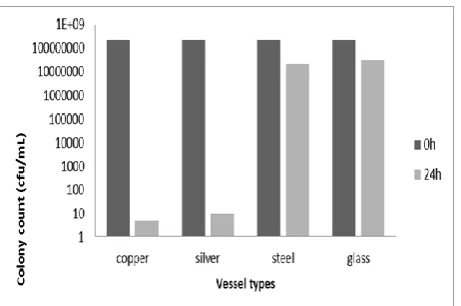
When the drinking water contaminated with the pathogens was stored in copper and silver vessels, a steep decrease in the number was seen. No viable organisms were isolated on the Nutrient Agar plate after 21hr of storage. Shrestha et al., (2009) tested two types of traditional pots i.e. copper and silver against Escherichia coli and Salmonella typhi and found them to be very efficient in killing the pathogens. It can be seen that glass and steel vessels, which are used regularly now a days, were unable to kill pathogens even after 21hr of storage, suggesting their inefficiency in killing of the pathogens (Figure 1and 2).
Escherichia coli show more inhibition on copper and silver vessel as compared to Salmonella typhi. There are two factors temperature and metal ions, acting on the organism and thus inhibiting its growth. There was little inhibition on the glass and steel surfaces. Similar results were obtained by Dhanlakshmi and Rajendran in 2013. It can be seen from Figures 3,4,5 and 6 that the decrease in number of organisms in glass and steel is the effect of temperature.
Figure 1: Effect of Contact Time on Salmonella typhi.
Figure 2: Effect of Contact Time on Escherichia coli.
Figure 3: Effect of Temperature (40C) on Salmonella typhi.
It was seen that E. coli was more sensitive towards temperature change as compared to S. typhi.
Figure 4: Effect of Temperature (40C) on E.coli.
Figure 6: Effect of Temperature (450C) on E coli.
Determination of copper content in water after storage in copper vessels
Copper affects enzyme activity, both as a co-factor and as an allosteric component of several cupro-enzymes. The copper content in water was determined by atomic absorption spectrophotometry. It was found that 0.813 mg/L copper was sufficient to kill all the bacteria present in the water in 21h. The copper content was found 0.862 mg/L, at the end of 24hr. Therefore, it can be said that
the minimum inhibitory concentration of copper required in this case was 0.813 mg/L (Table1).
Table 1: Copper content in Water Stored for 24h in copper Vessels.
Sr. No. Time (h) Copper content (mg/L)
1 0 0.154
2 1 0.592
3 3 0.597
4 6 0.617
5 18 0.789
6 21 0.831
7 24 0.862
Physico-chemical analysis of water samples
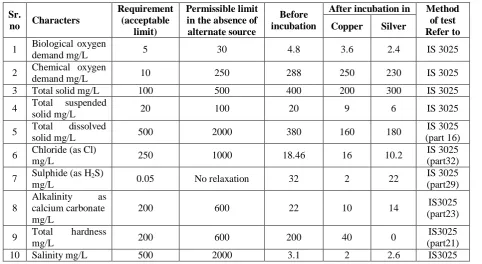
It is very essential to check the water parameters of drinking water before and after its storage in copper and silver vessels as this water can be used by humans for drinking purposes. Also it is very important to compare the results obtained with that of the standards given by the World Health Organization and the Bureau of Indian Standards (Table.2).
Table 2: Physico- chemical Parameters of Water.
Sr.
no Characters
Requirement (acceptable
limit)
Permissible limit in the absence of alternate source
Before incubation
After incubation in Method of test Refer to Copper Silver
1 Biological oxygen
demand mg/L 5 30 4.8 3.6 2.4 IS 3025
2 Chemical oxygen
demand mg/L 10 250 288 250 230 IS 3025
3 Total solid mg/L 100 500 400 200 300 IS 3025
4 Total suspended
solid mg/L 20 100 20 9 6 IS 3025
5 Total dissolved
solid mg/L 500 2000 380 160 180
IS 3025 (part 16)
6 Chloride (as Cl)
mg/L 250 1000 18.46 16 10.2
IS 3025 (part32)
7 Sulphide (as H2S)
mg/L 0.05 No relaxation 32 2 22
IS 3025 (part29)
8
Alkalinity as calcium carbonate mg/L
200 600 22 10 14 IS3025
(part23)
9 Total hardness
mg/L 200 600 200 40 0
IS3025 (part21)
10 Salinity mg/L 500 2000 3.1 2 2.6 IS3025
Ref: (Second Revision of IS 10500)
It was found that the parameters which were checked remained within the prescribed limits. Therefore, it can be said that the water as such remains unchanged only the microbial load decreases as seen earlier.
CONCLUSION
economical but also environmental friendly has to be implemented.
Thus the most suitable approach being the use of vessels made out of metals which show oligodynamic action (copper and silver) for killing the pathogens (Shrestha et al. 2009). It can be seen from the study that these metals have a very high anti-microbial activity and can be used as disinfectants. The antibacterial effect of copper and silver is always seen with respect to time and temperature. No viable organism can be recovered from silver and copper vessels after 21h.
Even if these simple things are kept in mind and worked upon, then these metals could help us get rid of various pathogens which have acquired multiple drug resistance.
Thus, suggesting that copper and silver vessels are safe for humans. One more thing which should be kept in mind while dealing with drinking water is its quality, its physico- chemical properties. It should not change even after storing water in the copper and silver vessels (Sudha et al. 2012), because if they change, then the water might detrimental to human health. It was found that the physico- chemical properties of water did not change even after storing them in copper and silver. Experiments have shown that stainless steel and plastic, the two most used substances in various industries, have no effect on microorganisms.
REFERENCES
1. Arslan H, GulayBorekci ND, Ozer CK and Akbay C.Molecules, 2009; 14: 519-527.
2. Gadi B and Jeffrey G, Current Chemical Biology, 2009; 3: 272-278.
3. Barnhill AE, Weeks KE, Xiong N, Day TA, Carlson SA. Applied and Environmental Microbiology, 2010; 76: 2687-2680.
4. Bitton Gabriel. Copper Alloys for Human Infectious Disease Control PA Copper for the 21st Century Symposium, 2005.
5. David C, Kepner B, Mehrabi S, Robinson L, Eric A, Mintz. J. Water Health, 2006; 1–9.
6. Dhanalakshmi T. and Rajendran S. Int. J. Sci. Technol. Res., 2013; 2(1): 115-119.
7. Gadi B, Jeffrey G, Current Chemical Biology, 2009; 3: 272-278.
8. Mukherjee B, Environmental Management Basic and Applied Aspect of Management of Ecology and Environmental system, 2005.
9. Faúndez G, Troncoso M, Navarrete P. Int. J. Food Microbiol., 2004.
10. Firoozeh F, Shahcheraghi F, ZahraeiSalehiT, Karimi V, AslaniIranian Journal of Microbiology, 2011; 3: 112-117.
11. Lansdown A B G, J Wound Care, 2002; 115: 173. 12. Michels HT, Wilks SA, Noyce JO and Keevil CW,
Copper Alloys for Human Infectious Disease Control PA Copper for the 21st Century Symposium, 2005.
13. Mukharjee, Environmental Management Basic and Applied Aspects of Management of Ecological Environmental Systems, Hydrabad, Vikas Publishing House Pvt Ltd.
14. Pal Sukdeb, Tak YK, Joon MS, 2007Applied and Environmental Microbiology, 2007; 73(6): 1712– 172.
15. Pal S, TakYK, Song JM,Applied and environmental microbiology, 2007; 73(6): 1712-20.
16. Rao RR, MRSuseela,Vetiveriazizanioides (linn.) National Botanical Research Institute, 439-442. 17. Riti S, Chhibber S, AttriS, Robert H, effects of
temperature and pH, Antonie van Leeuwenhoek, 2010; 97: 91–97.
18. ShresthaR. et al, Molecular Microbiology, 2009; 10: 189-193.
19. Sharan R, Chhibber S, Reed RH, BMC infectious diseases, 2011; 11(1): 204. Available at: http://www.pubmedcentral.nih.gov/articlerender.fcgi ?artid=3160999andtool=pmcentrezandrendertype=a bstract [Accessed January 23, 2012].
20. Sudha VBP et al,Resuscitation, 2012; 30(0).
21. SharanR, Chhibber S, AttriS, ReedRH, J. Environ. Res. Public Health, 2011; 8: 21-36.
22. SharanR, Chhibber S, AttriS, Reed RH, Antonie van Leeuwenhoek, 2010; 97: 91–97.
23. Sharan R, Chhibber S, Reed RH, BMC infectious diseases 2011; 11(1): 204. Available at: http://www.pubmedcentral.nih.gov/articlerender.fcgi ?artid=3160999andtool=pmcentrezandrendertype=a bstract [Accessed January 23, 2012].
24. Shrestha R. et al, Molecular Microbiology, 2009; 10: 189-193.
25. Sasahara T, Nanako Niiyama, Presented at Materials Science and Technology Conference, 2005; 25-28. 26. Wilks et al. Copper Alloys for Human Infectious