Volume 2, Issue 4, April 2013
Page 339
ABSTRACT
The photoelectrochemical properties of cadmium chalcogenide (CdS1-xSex) active photo electrode (of optimized materials composition, x = 0.1 and thickness, t = 1863 nm) / electrolyte interface have been examined. The active photo electrode was prepared using a chemical bath deposition technique from the basic ingredients. The photoelectrochemical solar cells have been devised and then characterized through their electrical and optical properties. These properties were evaluated through its various performance parameters as usual. As a result of deposition of window layer of ZnSe (photosensitive material having wide band gap energy of 2.67 eV) material on this active photoelectrode (optimized materials composition, x = 0.1 and thickness, t = 1863 nm), the cell performance was enhanced from 0.59 % to 0.67%. The incremental changes in the performance parameters and consequently the enhancement in the cell performance have been explained on the basis of the deposition of window layer.
Keywords: Solution grown, Cd (S, Se) thin films, PEC, window layer.
1. INTRODUCTION
The previous studies revealed that the optimum composition for best performance of a photo electrochemical cell with CdS1-xSex photo electrode is x = 0.1, which is found to be dependent on the photosensitive electrode properties. Although the photoelectrochemical cell comprising electrode with materials composition, x = 0.1 showed highest conversion efficiency, but it is below the reported values in the literature. i.e. photoelectrochemical cells formed with CuInS2, CuInSe2, CuIn(S,Se)2 etc. One of the major factors affecting the conversion efficiency of a photoelectrochemical cell is the form of the photoelectrode material in which it has been used in a photoelectrochemical cell. In general, photoelectrochemical cell electrodes could be fabricated in different forms: single crystal, thin films, thick films or pellets etc. Single crystal electrodes are known to yield the highest conversion efficiency for a given material [1]-[4].
This is because, amongst the other factors, thickness and the grain boundaries of the material are important parameters influencing the quantum efficiency. Generally, the thickness of the electrode material should be approximately equal to the wavelength of the light corresponding to the band gap of the material. This gives rise to maximum absorption of the light without any recombination [1]-[4]. A fundamental limitation on the efficiency of a photoelectrochemical cell also arises due to a considerable amount of transmission of incident light through the electrode material [5]-[7]. The larger the band gap of the material, the smaller is the part of the incident solar energy that can be utilized, since photons with the energy less than band gap energy of a semiconductor do not have a sufficient photon-electron interaction and are transmitted through the photoelectrode material [2], [4]-[8]. To avoid this loss due to transmitted low energetic photons, a small gap material is deposited before the higher band gap material and can be used as a photoelectrode in the photoelectrochemical cell [2], [4]-[8].
When light is made to incident on such a junction from the high-energy side, photons of energy between two energy gaps pass freely through the wide gap material and are absorbed in the low energy gap material. i.e. the outer material with the larger band gap allows the lower energy photons to penetrate into the inner lower band gap semiconductor [2], [4]-[6]. When absorbed, such photons create additional electron hole pairs contributing to maximize the open circuit voltage Voc and the short circuit current Isc and the difference of the photon energy and the band gap energy is lost almost as a heat in the photon-phonon interaction [2], [4]-[6]. Thus the photoelectrode with window material forms two junctions when dipped into an electrolyte to form a PEC cell and it suffers a lesser loss in place of individual losses due to the materials [2], [4]-[5]. This paper presents an exhaustive account of the effect of window layer on the performance of a photoelectrochemical cell through its various performance parameters.
This is because, amongst the other factors, thickness and the grain boundaries of the material are important parameters influencing the quantum conversion efficiency. Generally, the thickness of the electrode material should be
EFFECT OF WINDOW LAYER ON Cd (S,
Se)
THIN FILM PHOTOELECTRODES FOR PEC
CELLS
PUJARI V. B.
Volume 2, Issue 4, April 2013
Page 340
approximately equal to the wavelength of the light corresponding to the band gap of the photosensitive material. This gives rise to maximum absorption of the light without any recombination [1]-[3]. As a general approximation, the thickness of the electrode material should not be too large, that causes loss of photo generated carriers and in turn a loss of the photocurrent. This decreases the conversion efficiency [1]-[3]. On the other hand, thickness should not be too small, because there would be an incomplete absorption of the incident photons by the material resulting in lower conversion efficiency [1]-[3]. Thus there will be an optimum thickness for which absorption of incident photons by the electrode material will be maximum. Further, an important criterion for achieving high conversion efficiency from the solar radiations is to have a photoelectrode material with large crystallite size, preferably in a hexagonal crystalline phase [2]-[4].Increase in thickness not only enhances the crystallite size but can cause a phase transition from cubic to hexagonal, especially for chalcogenides of cadmium [2]-[4]. The larger crystallites inhibit photo-carrier losses due to grain boundary recombination and hexagonal phase has a higher photo-absorption and provides required stability against corrosive electrolytes in the photoelectrochemical cell configurations [2]-[4]. This paper presents an exhaustive account of the effect of photoelectrode thickness on the performance of a photoelectrochemical cell through its various performance parameters.
2. MATERIALS AND METHODS
2.1 Deposition of the window layer
CdS1-xSex (x=0.1) thin film electrodes of optimized thickness (topt = 1863 nm) was deposited onto the glass as well as stainless steel substrates by closely following the deposition procedure given earlier [1]-[2], [4]-[5]. For absorption of the fraction of the incident light, which was getting transmitted through the photo electrode material, a higher band gap material (such as ZnSe, Eg = 2.67 eV) has to be deposited as a window layer on the low band gap material. A layer of 486 Ao of the window material (ZnSe, Eg = 2.67 eV, studied earlier [2],[4],[7],[9] was therefore grown over the photoelectrode (CdS1-xSex) of optimized material composition and thickness (x = 0.1 and t = 1863 nm).
For deposition of ZnSe as a window layer, 10 ml (1M) Zinc Sulphite and 33 ml (0.3M) sodium selenosulphide refluxed were complexed with a sufficient quantity of TEA. NaOH and liquid ammonia were added into the reaction mixture to adjust the pH= 11 ± 0.2 and to increase adherence of the layer respectively. As-deposited photo electrodes of CdS1-xSex (x=0.1, t = 1863 nm) were dipped into the reaction mixture. The temperature of the reaction mixture was then raised to 55 oC. The speed of the substrate rotation was kept 70 ± 2 rpm. After 75 minutes, the films were taken off. The films were washed with double distilled water several times and preserved.
2.2 Fabrication of photoelectrochemical cells
First, photoelectrochemical cells of the configuration CdS1-xSex/electrolyte/C were fabricated with these photo electrodes of varying thicknesses as discussed earlier [1], [3], [4]. A graphite rod was sensitized in a medium concentrated CoS solution for 24 hours and then employed as a counter electrode. The distance between a photoelectrode and a counter electrode was of the order of 0.3 cm. A rubber cork was used to air tighten the cell and to support both counter electrode and photoelectrode. A common epoxy resin was used to define the active area of the sample to be exposed to the radiations. Second, the Photoelectrochemical cells comprising the photo electrodes ZnSe and the stacked configuration ZnSe/CdS1-xSex/electrolyte/C were fabricated as earlier in order to study the effect of window layer.
2.3 Measurements on the photoelectrochemical cell properties
The photoelectrochemical cells comprising photo electrodes of various thicknesses were characterized through their I-V and C-V characteristics in dark and cell power output characteristics as reported earlier [1]. The various performance parameters of these PEC cells viz. nd, Id, nL, Voc, Isc,
spectral responsivity and photo responsivity etc were also examined [1], [3]-[4]. The PEC cells employing photo electrodes of ZnSe, CdS1-xSex and stacked configuration ZnSe/CdS1-xSex were characterized through their electrical and optical properties as earlier. The effect of window layer on the various performance parameters of the PEC cell and its spectral selectivity and photo responsivity etc were also examined. The cell performance was evaluated as usual.
3. RESULTS AND DISCUSSION
In these investigations, we have grown a higher gap material ZnSe (Eg = 2.67 eV) as a window layer over the CdS1-xSex (x = 0.1 and t = 1863 nm) electrode and studied the effect of the window layer on the detector performance through the electrical characteristics such as current-voltage, capacitance – voltage and potential barrier etc. The various detector responses such as power output curves, photo responsivity and spectral selectivity were examined as usual [3]-[4],[6]-[12].
Volume 2, Issue 4, April 2013
Page 341
The PEC cells were formed independently with the ZnSe, CdS1-xSex and ZnSe/CdS1-xSex (x=0.1, 1863 nm) as the active photo electrodes and an electrolyte redox couple. I-V characteristics in dark were studied as usual. It is found that the nature of the I-V curves is similar to that of the earlier cell configurations. The values of dark current (Id) and nd were also determined from the variations of log I vs. V and are listed in Table 1.Table 1 Effect of the window layer on the performance parameters of PEC cell formed with CdS1-xSex (x = 0.1, t =1863 nm) electrode.
Photo- electrode
nd Id
A/cm2
nL Vfb
mV Voc
mV ZnSe 2.71 1.23 1.78 - 656 263
CdS0.9Se0.1 1.76 0.65 1.34 - 823 364
ZnSe / CdS0.9Se0.1
1.59 0.48 1.29 - 976 427
Table 1 Continued
Photo- electrode
Isc
A/cm2
% ff% Rs Rsh
K
ZnSe 296 0.36 53.7 235 1.25
CdS0.9Se0.1 487 0.59 55.8 167 1.63
ZnSe / CdS0.9Se0.1
523 0.67 58.7 156 1.78
3.1Capacitance - voltage characteristics
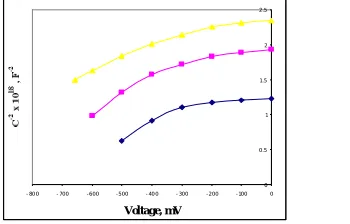
The capacitance-voltage measurements were done on these cells to evaluate the flat band potential. The M-S plots were then constructed for PECcells of different electrode thicknesses as shown in Figure 1.
0 0.5 1 1.5 2 2.5
- 80 0 - 700 - 600 - 500 - 40 0 - 300 - 200 - 100 0
Voltage, mV
Figure 1. Mott-Schottky plots of: a) ZnSe ( ), b) CdS1-xSex ( ) and c) ZnSe/ CdS1-xSex ( film photo electrodes.
The magnitudes of flat band potentials (Vfb) were determined as earlier and Vfb is found to be improved. Its values
are listed in Table 1. From the M-S plots it appear that the plots tend to depart more from the linearity (compared to earlier cases), probably because of the increased surface states due to window layer.
3.2 Power output curves
The PEC cells were then fabricated with the ZnSe, CdS1-xSex and ZnSe/CdS1-xSex (x=0.1, t = 1863 nm) as photo
Volume 2, Issue 4, April 2013
Page 342
0 100 200 300 400 500 600
0 100 200 300 400 500
Voltage, mV
Figure 2. Power output curves of: a) ZnSe ( ), b) CdS1-xSex ( ) and c) ZnSe/ CdS1-xSex ( film photo electrodes.
The PEC cell output is found to be much improved for ZnSe / CdS1-xSex stacked electrode cell. Typically, Voc and Isc
are 427mV and 523 A/cm2, respectively. The cell formed with CdS
1-xSex (x = 0.1, t = 1863 nm)alone gave Voc and Isc
equal to 364mV and 487 A/cm2,respectively. The additional voltage and current developed in case of the photo electrode having ZnSe as window material is due to the series character of the two junctions namely, ZnSe /electrolyte and ZnSe/CdS1-xSex (x = 0.1, t = 1863 nm)and a considerable light absorption by the window layer.
Similar results are reported by Wagner and Shy for n-CdS/n-GaAs/electrolyte cell [8] and Deshmukh and Pawar for n+-CdS:In/n-CdS cell configurations [6]-[7]. The quantum conversion efficiency obtained from this window based PEC cell is 0.67%, which exceeds the efficiency of a PEC cell formed with CdS1-xSex (x = 0.1, t = 2360 nm)electrode alone.
The fill factor has also been improved from 56% to 58.7% .The typical values of Rs and Rsh are 156 and 1.78 k .
3.3 Spectral selectivity
In order to study the effect of window layer on the spectral selectivity of the material, the cell consisting of photo electrode of window layer was illuminated. The wavelength of the incident radiations was then varied from 260 nm to 950 nm (20 mW/cm2) and the corresponding photocurrents were measured. This is shown in Figure 3.
From this, it is seen that, the photocurrent increased with incident wavelength and then decreased for higher wavelengths. It is higher for a photoelectrochemical cell of window-layered electrode and the response seems to be broadened [4], [6]-[8].
0 100 200 300 400 500 600 700 800
0 100 200 300 400 500 600 700 800 900
Wavelenght, lambda
Figure 3. Spectral response of: a) ZnSe ( ), b) CdS1-xSex ( ) and c) ZnSe/ CdS1-xSex ( film photo electrodes.
3.4 Photosensitivity
In order to understand the effect of window layer on the photo responsivity of the photoelectrochemical cell, the cell was illuminated as usual. It is found that Iph varied linearly, whereas Vph logarithmically with the incident light
intensity. This is similar to the previous results [3]-[4]. The lighted quality factor (nL) of the junctions were computed
from the variation of the Vph vs ln Iph and are given in Table 1. The nL for the detector cell devised with window layered
electrode is smallest [4], [6]-[8].
3.5 Thin film materials properties
Volume 2, Issue 4, April 2013
Page 343
(a) ZnS e
0 10 2 0 3 0 4 0 5 0 6 0 7 0 8 0 9 0 10 0
0 10 2 0 3 0 4 0 50 60 7 0 8 0
2 Theta
(b) CdS1 -xS ex
-20 0 20 40 60 80 100 120 140
0 10 20 30 40 50 60 70 80
2 Th e ta
(c) ZnSe /CdS1-xSex
0 20 40 60 80 100 120 140
0 10 20 30 40 50 60 70 80
2 The ta
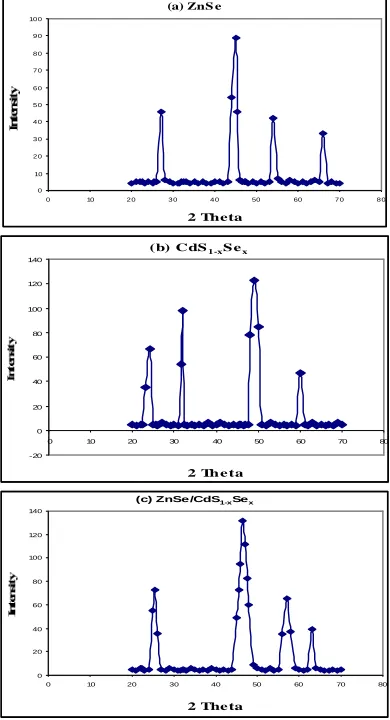
Figure 4. X-ray diffractograms of: a) ZnSe, b) CdS1-xSex and c) ZnSe/ CdS1-xSex thinfilm photo electrodes.
From these diffractograms, it is seen that there exists separate phases of ZnSe in addition to CdS1-xSex phases. The peak
intensities and the average crystallite sizes were calculated as usual [5]-[7], [9]-[12]. The peak intensity is found to be increased in case of material consisting of the window layer. The crystallite sizes are found to be increased from 423 Ao to 935 Ao and are listed in Table 2.
Table 2. Influence of window layer on various materials properties of CdS1-xSex (x = 0.1, t = 1863 nm) electrode.
Photo-
electrode
R.T. Conductivity ,
-1 cm-1
Sensitivi ty S =( L
-d)/ d
Crystallite
Size, D
Dar k
( d),
x 10
-5
Light
( L),
x 10-3
XR D A.U. SE M A.U.
ZnSe 6.34 0.35 4.53 438 486
CdS0.9Se0.1 84.3 23.35 26.7 879 938
ZnSe / CdS0.9Se0.1
Volume 2, Issue 4, April 2013
Page 344
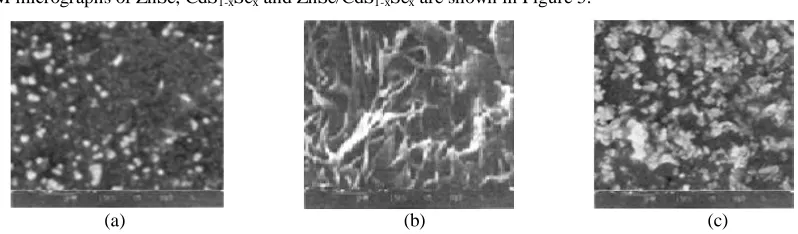
The SEM micrographs of ZnSe, CdS1-xSex and ZnSe/CdS1-xSex are shown in Figure 5.
(a) (b) (c)
Figure 5. SEM micrographs of: (a) ZnSe, (b) CdS1-xSex (x = 0.1, t = 1863 nm) and (c) ZnSe/CdS1-xSex (x = 0.1, 1863
nm) window layer photo electrodes.
As far as SEM’s are concerned, micrograph (a) is of ZnSe (486Ao) and micrograph (b) is of CdS1-xSex (x = 0.1, 1863
nm). The crystallites of ZnSe are spherical in shape with larger intergrannular spicing. Some sort of over growth has also been observed. Micrograph (c) is of ZnSe (486 Ao) / CdS
1-xSex (x = 0.1, 1863 nm). It has been seen that the
micrograph consists of crystallites of both ZnSe and CdSSe. The crystallite sizes are listed in Table 2.
The room temperature d. c. electrical conductivities in dark ( d ) for all the three electrode materials were measured.
These electrodes were illuminated by a white light of intensity 20 mW/cm2, and the corresponding photocurrents were measured as earlier. It is observed that the photocurrent is enhanced for window-layered electrode than others. From these photocurrents, the photoconductivity ( L) values were calculated for three electrodes and values are listed in Table
2. Further, the materials sensitivities were also calculated and it is seen that sensitivity enhanced with the deposition of window layer on the active photoelectrode material. The higher value of s for ZnSe/CdS1-xSex electrode, at this moment,
can be ascribed to the additional generation of photoelectrons by the window layer [4].
Depending on the aforesaid experimental findings, I would like to propose a model to account for the changes those have been observed in these cells. The proposed energy level diagram before and after contact to electrolyte can be modeled and if we imagine a case wherein the initial Fermi levels of n-CdS1-xSex and n-ZnSe are above the Fermi level
of an electrolyte, then after contact, lining up of Fermi levels occur by transfer of electrons from n-CdS1-xSex to n-ZnSe
and n-ZnSe to electrolyte [2],[5]-[6],[8]. This results in a positive space charge layer in the n-CdS1-xSex and n-ZnSe
respectively. This equilibration of the Fermi levels causes the valence and conduction bands of the semiconductors to bend near their surfaces, offering a potential barrier against further electron transfer into the electrolyte and n-ZnSe, respectively [2],[5]-[6],[8].
The origin of the photo potentials upon illumination of the ZnSe/electrolyte and CdS1-xSex / ZnSe junctions can be
understood by considering the changes that occur at respective interfaces. The illumination of these junctions produces electron hole pairs in the space charge regions. The electrons are promoted to the bulk of the semiconductor, while the holes arriving at the surface of the semiconductor are captured by the electrolyte redox species [5]-[6],[8]. The amount of light transmitted by the n- ZnSe is absorbed in the CdS1-xSex interface thereby inducing the additional electron hole
pairs. This results in the development of the new Fermi levels, which are no longer equal to the Fermi level of a redox electrolyte (EF, redox). The difference between these two Fermi levels (E’FN+ EFN) and EF, redox is equal to the total photo
potential obtainable from the PEC cell. Thus
Voc = Voc1 + Voc2
where Voc1 the difference between EFN and EF redox and Voc2 is the difference between the E’FN and EF redox.
4. CONCLUSIONS
The photo electrode thickness has a great impact on the PEC cell performance. It is seen that changes in the materials properties such as photoconductivity, crystallite size, carrier density, and mobility etc. act like a useful boost for the improved performance of an electrochemical cell. Deposition of a window layer over the active photo electrode material results into a series diode type PEC cell structure. A novel feature of this device is that it boosts up the open circuit voltage (Voc) as well as the short circuit current (Isc), which in turn enhances the quantum conversion efficiency ( %)
significantly reducing lower energy photon losses.
Volume 2, Issue 4, April 2013
Page 345
Author is thankful to the authorities of Mumbai University, Mumbaifor sanctioning and funding partially the minor research project. I am also thankful to Hon. Prin. Dr. Arvind Burungale, Secretary, Rayat Shikshan Sanstha, Satara for his moral support and generous help rendered throughout this project tenure.References
[1] M. Sharon, in ‘Photo electrochemical Solar Cells’, (eds) K. S. V. Santhanam and M. Sharon, UNESCO Training Workshop, p-6, 1986.
[2] V. B. Pujari, B. A. Patil, D. J. Dhage, E. U. Masumdar and L. P. Deshmukh, in Proc. ‘National Seminar on Science and Technology of Thin Films’, Rajarshi Shahu Mahavidyalaya, Latur, M.S., India, p-154-163, 2004. [3] V. B. Pujari, Ph. D.Thesis, Shivaji University, Kolhapur, M.S, India, 2004.
[4] D. P. Amalnerkar, N. R. Pavaskar, S. K. Date and A. P. B. Sinha, Ind. J. Pure & Appl. Phy., 539, 23, 1985. [5] L. P. Deshmukh, Ph.D. Thesis, Shivaji University, Kolhapur, M.S, India, 1985.
[6] S. H. Pawar and L. P. Deshmukh, Mat. Res. Bull, 127, 7, 1983. [7] L. P. Deshmukh and V. S. Sawant, Solar Cells, 186, 31, 1991. [8] S. Wagner and J. L. Shay, Appl. Phys. Lett., 446, 31, 1977.
[9] L. P. Deshmukh, C. B. Rotti and K. M. Garadkar, Mat. Chem. Phys., 45, 50, 1997. [10] G. S. Shahane and L. P. Deshmukh, Mat. Chem. Phys., 112, 70, 2001.
[11] R. C. Kainthla, J. F. McCann and D. Haneman, Sol. Ener. Mat., 903, 7, 1983.