Volume 3, Issue 3, March 2014
Page 388
Abstract
The human eye is the organ which reacts to light and gives us the sense of sight. The eye emits or reflects the light to interpret the colors, shapes, and dimensions of objects in the world. Retina plays a major role in the human vision system. Many important eye diseases manifest themselves in the retina. While some other anatomical structures contribute to the process of vision in eye, this review focuses on retinal image and image analysis. The causes are Retinopathy of Prematurity, Diabetic Retinopathy, Hypertensive Retinopathy, and Obstruction of arterial Circulation, Sickle Cell Retinopathy and Obstruction of the venous Circulation. This work aims to detect some abnormalities in the retinal image and to classify those using ANFIS. The methodology is used to Preprocessing, Candidate Extraction, Feature Extraction, Classification and Performance analysis. This paper gives the idea about the Preprocessing. The results are obtained by using MATLAB software.
Keywords: Retina, Retina Diseases, ANFIS, Biomedical image processing, Preprocessing.
1.
I
NTRODUCTIONThe human eye is the organ which reacts to light and gives us the sense of sight. Rod and cone cells in the retina allow conscious light perception and vision including color differentiation. The human eye can distinguish about 10 million colors. Many important eye diseases manifest themselves in the retina. While a number of other anatomical structures contribute to the process of vision in eye, this review focuses on retinal image and image analysis [1]. Our aim is to classify the diseases of retina like Hypertensive Retinopathy, Diabetic Retinopathy, Retinopathy of Prematurity, Sickle Cell Retinopathy, Obstruction of arterial Circulation, and Obstruction of the venous Circulation using one of the artificial intelligence technique.
Hypertensive Retinopathy
This may occur under four circumstances. In simple hypertension without sclerosis, as seen in young patients, the retinal signs are few: a generalized constriction of the arterioles which appear to be pale and unduly straight with acute-angled branching, additional superficial, flame-shaped hemorrhages and cotton-wool spots may occur and hard exudates are absent [9].
Diabetic Retinopathy
Diabetic retinopathy is the most common diabetic eye disease and a leading cause of blindness. It is caused due to changes in the blood vessels of retina. In some people blood vessels may leak fluid on the retinal surface due to diabetic retinopathy. In other people, new blood vessels grow on the surface of the retina. The retina is the Light-sensitive part at the back of the eye. A long term diabetic retinopathy can get worse and cause loss of vision. Diabetic retinopathy affects both the eyes [9].
Retinopathy of Prematurity
The retinal manifestations of this disease are generally noted some weeks after birth in premature infants who have been given high concentration of oxygen. The earliest signs are dilatation of the retinal veins and the appearance of hazy white patches in the periphery of the retina, which soon show an indefinite proliferation into the vitreous. This is due to the formation of new vessels in the retina itself, which bud into the vitreous. Their appearance is followed by the development of fibrous tissue, which eventually proliferates to form a continuous mass behind the lens, appearing as a type of Pseudoglioma [9].
Sickle Cell Retinopathy
Sickle cell hemoglobin is abnormal hemoglobin found mainly but not exclusively in people of African origin. When it is deoxygenated it becomes insoluble and distorts the normally discoid red cell into a characteristic sickle shape. Such suckled red cells tend to obstruct capillaries and this leads to infraction, particularly in the periphery of the retina [9]. Obstruction of Arterial Circulation
Central Retinal Artery Occlusion (CARO) is nearly always at the lamina cribrosa, where the vessels normally become slightly narrowed. Such as accident causes sudden and complete retinal ischemia and this tissue rapidly die. The eye becomes suddenly blind [9].
Obstruction of the Venous Circulation
Design Strategies for Classification of
Abnormalities in Retinal Images Using ANFIS
Manisha P. Waghmare 1, Dr. S. D. Chede2, Prof. S. M. Sakhare3
1
Student M. Tech, Department of Electronics, Suresh Deshmukh College of Engineering Selukate Wardha
2Principal, Om College of Engineering Wardha
3
Volume 3, Issue 3, March 2014
Page 389
In Central Retinal Vein Occlusion (CRVO), all the veins of the retina become enormously engorged with blood and extremely tortuous, and the retina is covered with hemorrhages. In many cases bunches of tortuous new vessels are formed upon the optic disc; in others a collateral circulation is effected by similarity tortuous new vessels in the retina [9]. In this paper, we detect this abnormality by using preprocessing method.
2.
PROBLEM
DEFINITION
Huge work has been done on retinal images for detection of abnormalities or diseases such as Hypertensive Retinopathy, Diabetic Retinopathy, Retinopathy of Prematurity, Sickle Cell Retinopathy, Obstruction of arterial Circulation, and Obstruction of the venous Circulation. Most of the work is done on preprocessing on images or detection of single diseases. None of the existing work has targeted for a classification of more than one retinal disease. Hence the sophisticated technique for classification of retinal diseases/abnormalities is to be investigated.
Through this work we are going to propose a solution for a classification of disease from retinal images like Hypertensive Retinopathy, Diabetic Retinopathy, Retinopathy of Prematurity, Sickle Cell Retinopathy, Obstruction of arterial Circulation, and Obstruction of the venous Circulation using one of the artificial intelligence technique.
3.
PREPROCESSING
Preprocessing is a method which is used to remove the noise and enhance the image quality. Poor quality image is due to patient movement, poor focus, bad positioning, reflections and inadequate illumination. Preprocessing improve the automated abnormality detection. The retinal images collected from the data base are color images. Then the color images are converted to gray scale images. Because the retinal abnormalities have better visualization in the gray scale when compared to others. Then the preprocessing techniques are applied to the gray scale image.
4.
EXPERIMENTAL
RESULT
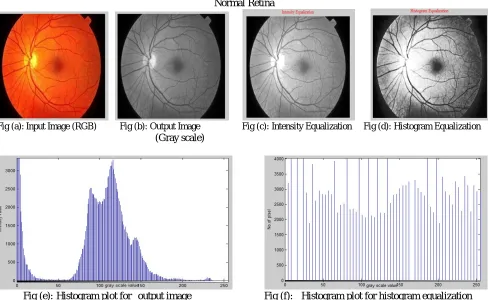
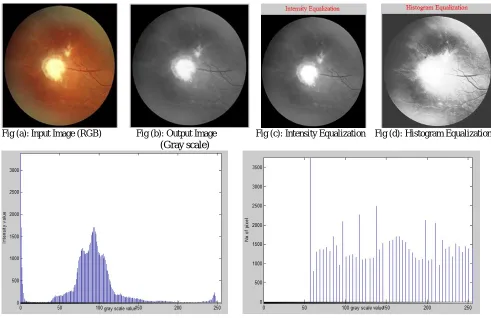
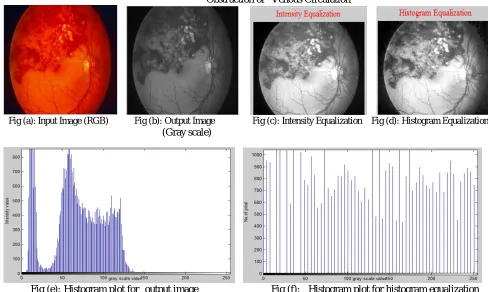
The experimental results of preprocessing methods are Intensity Equalization and Histogram Equalization.
Gray Scale Image: Grayscale digital image is an image in which the value of each pixel is a single sample that is it carries only intensity information. Gray scale gives the better visualization as compared to the other. Gray scale images as shown in fig (b) & Histogram plot for gray scale as shown in fig (e).
Intensity Equalization: The contrast in a low contrast grayscale image by remapping the data values to fill the entire intensity range [0,255].Intensity equalization images as shown in fig (c).
Histogram Equalization: Histogram equalization is the technique by which the dynamic range of the histogram of an image is increased. It improves contrast of an image. Histogram equalization images as shown in fig (d) and Histogram plot for histogram equalization as shown in fig (f).
Normal Retina
Fig (a): Input Image (RGB) Fig (b):Output Image Fig (c):Intensity Equalization Fig (d):Histogram Equalization
(Gray scale)
Fig (e):Histogram plot for output image Fig (f): Histogram plot for histogram equalization
Volume 3, Issue 3, March 2014
Page 390
Diabetic Retinopathy
Fig (a): Input Image (RGB) Fig (b):Output Image Fig (c):Intensity Equalization Fig (d):Histogram Equalization
(Gray scale)
Fig (e):Histogram plot for output image Fig (f): Histogram plot for histogram equalization
Hypertensive Retinopathy
Fig (a): Input Image (RGB) Fig (b):Output Image Fig (c):Intensity Equalization Fig (d):Histogram Equalization
(Gray scale)
Fig (e):Histogram plot for output image Fig (f): Histogram plot for histogram equalization
Volume 3, Issue 3, March 2014
Page 391
Retinopathy of Prematurity
Fig (a): Input Image (RGB) Fig (b):Output Image Fig (c):Intensity Equalization Fig (d):Histogram Equalization
(Gray scale)
Fig (e):Histogram plot for utput image Fig (f): Histogram plot for histogram equalization
Sickle Cell Retinopathy
Fig (a): Input Image (RGB) Fig (b):Output Image Fig (c):Intensity Equalization Fig (d):Histogram Equalization
(Gray scale)
Volume 3, Issue 3, March 2014
Page 392
Obstruction of Arterial Circulation
Fig (a): Input Image (RGB) Fig (b):Output Image Fig (c):Intensity Equalization Fig (d):Histogram Equalization
(Gray scale)
Fig (e):Histogram plot for output image Fig (f): Histogram plot for histogram equalization
Obstruction of Venous Circulation
Fig (a): Input Image (RGB) Fig (b):Output Image Fig (c):Intensity Equalization Fig (d):Histogram Equalization
(Gray scale)
Fig (e):Histogram plot for output image Fig (f): Histogram plot for histogram equalization
5.
CONCLUSION
Volume 3, Issue 3, March 2014
Page 393
of preprocessing method. Now the next step in classification of abnormalities in retinal images using ANFIS is to perform the candidate extraction so as to extract the main infected area. A defected retina is compared with normal retina. In a Diabetic Retinopathy, changes in the blood vessels of retina. In a Hypertensive Retinopathy, flame-shaped hemorrhages and cotton-wool spots may occur and hard exudates are absent. In a Retinopathy of Prematurity, dilatation of the retinal veins and the appearance of hazy white patches in the periphery of the retina. In a Sickle Cell Retinopathy, this leads to infraction, particularly in the periphery of the retina. In a Obstruction of Arterial Circulation, vessels normally become slightly broaden. In a Obstruction of the Venous Circulation, bunches of tortuous new vessels are formed upon the optic disc.
References
[1] T.Yamuna and S.Maheswari “Detection of Abnormalities in Retinal Images”, IEEE International Conference on Emerging Trends in Computing, Communication and Nanotechnology (ICECCN 2013).
[2] G.S. Annie Grace Vimala and S. Kaja Mohideen “Automatic Detection of Optic Disk and Exudate from Retinal Images Using Clustering Algorithm” IEEE Proceedings of7'h International Conference on Intelligent Systems and Control (ISCO 2013)
[3] Sina Hooshyar, Rasoul Khayati “Retina Vessel Detection Using Fuzzy Ant Colony Algorithm” 2010 IEEE Canadian Conference Computer and Robot Vision.
[4] Alireza Osareh, Bita Shadgar, and Richard Markham “A Computational-Intelligence-Based Approach for Detection of Exudates in Diabetic Retinopathy Images”, IEEE TRANSACTIONS ON INFORMATION TECHNOLOGY IN BIOMEDICINE, VOL. 13, NO. 4, JULY 2009.
[5] M. I. Iqbal1, A. M. Aibinu2, M. Nilsson1, I. B. Tijani2, and M. J. E. Salami “Detection of Vascular Intersection in Retina Fundus Image Using Modified Cross Point Number and Neural Network Technique”, Proceedings of the International Conference on Computer and Communication Engineering 2008 IEEE.
[6] Ms. Rupa V. Lichode, Prof. P. S. Kulkarni “Automatic Diagnosis of Diabetic Retinopathy by Hybrid Multilayer Feed Forward Neural Network”, International Journal of Science, Engineering and Technology Research (IJSETR) Volume 2,Issue 9, September 2013.
[7] Neera Singh, Ramesh Chandra Tripathi “Automated Early Detection of Diabetic Retinopathy Using Image Analysis Techniques”, International Journal of Computer Applications (0975 – 8887) Volume 8– No.2, October 2010.
[8] Asha Gowda Karegowda, Asfiya Nasiha and M.A.Jayaram “Exudates Detection in Retinal Images using Back Propagation Neural Network”, International Journal of Computer Applications (0975 – 8887) Volume 25– No.3, July 2011.
[9] Parson’s text book of Ophthalmology
AUTHOR
Miss Manisha P. Waghmare received the bachelor degree B.E in Electronics Engg. From R.T.M.N.U Nagpur
university in the year 2011.Currently she is working as Research scholer for pursuing M.Tech in Electronics (Communication Engineering) at SDCE,Selukate,Wardha,Maharashtra,India
Dr.Santosh D. Chede received the bachelor degree B.E in Industrial Electronics from Amravati university in the year 1990.Also he has received his master’s degree M.E in electronics Engg. From Amravati university in the year 2000.In year 2010 he received his Doctor of Philosophy from VNIT,Nagpur.Currently he is working as Principal, Om college of Engg,Inzapur, Wardha, Maharashtra,India.