Urban Extension: Aligning with the Needs of Urban Audiences
Through Subject-Matter Centers
Brad Gaolach Michael Kern Christina Sanders Washington State University
The educational program model is the principle approach Extension uses to deliver on its mission of “taking knowledge to the people.” However, with county-based faculty fully engaged in long-term program delivery, they may have little or no capacity to address emerging issues faced by urban communities. Urban governments often seek the research capacity of a university in addition to, or instead of, the traditional Extension programming model but sometimes turn first to other urban-serving universities. Washington State University Extension has addressed these challenges by establishing subject-matter centers. This article examines how subject-matter centers can add capacity to traditional Extension offices in order to be responsive to emerging local needs, suggesting models that other university Extension programs may use or adapt to their local communities. These models also foster more community engagement and articulate greater public value for the institution as a whole.
Keywords: metropolitan, public policy, short-term projects, building capacity, responsiveness, programming, public value
Introduction
Since its inception over a century ago, Extension has fulfilled its mission of “taking knowledge gained through research and education and bringing it directly to the people to create positive changes” (U.S. Department of Agriculture, n.d.) through nonformal education and learning activities–often referred to as programs (Peterson, 2015). While variation exists across the Extension network, Extension programs are comprised of the key attributes of planning, design, implementation, evaluation and stakeholder involvement (Franz, Garst, & Gagnon, 2015).
Franz et al. (2015) provided a comprehensive review of approaches to and the evolution of Extension programs, including Boone, Saftrit, and Jones’ (2002) assessment that program development is complex and technical. Franz et al. (2015) noted that most Extension
professionals directly or indirectly utilize the program development model articulated by Seevers and Graham (2012) comprised of planning, design and implementation, and evaluation.
However, Franz et al. (2015) presented additional program development models with more steps—one with 15 steps (Boyle, 1981) and an interactive, nonlinear model with 10 concepts (Caffarella & Ratcliff Daffron, 2013); as well as models from differing foci—a systems approach for organizational improvement (Boone et al., 2002), lifelong learning (Boyle, 1981), people-centered (Cervero & Wilson, 2006), and adult education (Caffarella & Ratcliff Daffron, 2013).
The development, delivery, and implementation of a program are not enough; it must “create positive change” in order for Extension to deliver on its mission (Kalambokidis, 2014). Historically, Extension professionals have worked to provide value to the lives of rural
stakeholders and community members by developing programs that fit the specific needs of the communities they serve. This direct impact on the lives of program participants is a private value of Extension’s work. Historically, articulation of these direct benefits has been sufficient for Extension and its traditional audiences (Kalambokidis, 2014). In tracing the evolution of needs assessments (an integral piece of traditional program development), Garst and McCawley (2015) reinforced that the U.S. Congress created Extension primarily to help meet the needs of rural communities and assist farmers in providing the amount of food needed throughout the country as populations continued to grow, linking the private value (assisting farmers) with the public value (ensuring an adequate food supply) of Extension. While implicitly articulated in Extension’s past, it is only recently that Extension has begun to focus on articulating its public value (Franz, 2011; Franz et al., 2015; Kalambokidis, 2014), which is defined by Kalambokidis and Bipes (2007) as “the value of a program to those who do not directly benefit from the program” (p. 12).
As addressed later in this article, articulating Extension’s public value may be even more
important in urban or metropolitan communities. For this article, the terms urban, metropolitan, or city are used interchangeably to refer to central cities, metropolitan and suburban areas that surround these cities, and other highly populated counties. Metropolitan communities are often comprised of multijurisdictional networks of city, county, and regional governments and agencies along with numerous community- or faith-based organizations and nongovernmental organizations that often have overlapping missions with Extension. As metropolitan
communities expand and grow, tensions are created around growth management and
interjurisdictional cooperation. A high degree of ethnic and racial diversity both enriches and challenges metropolitan communities (Gaolach, McDaniel, & Aitken, 2015) with their own communication patterns and knowledge centers (Fehlis, 1992; Webster & Ingram, 2007).
Although populations and their needs have changed over time, Extension has evolved in many ways to be able to continue to meet those needs, yet collaborative development and delivery of customized programming to assist community members and other stakeholders remain
the types of services offered through Extension, the method in which those services are delivered, and the choice of tools or resources accessed and developed by Extension professionals to better serve a shifting demographic.
Serving Urban Constituents–Is It as Easy as Putting “Urban” in the Title?
Extension’s need, approach, and ability to serve urban constituents has been discussed in numerous venues and across decades (e.g., Argabright, McGuire, & King, 2012; Borich, 2001; Gould, Steel, & Woodrum, 2014; Krofta & Panshin, 1989; National Urban Extension Task Force, 1996; Webster & Ingram, 2007). The National Urban Extension Task Force (1996), while documenting the migration of residents to urban communities and examples of early urban programming, commented that Extension “followed the people” with programming. Both the language of this report and the examples provided show a marked propensity to take existing educational programs developed to serve rural communities and follow people to the cities with these programs. There are very few examples of developing programming with the urban constituent in mind from the beginning.
This penchant for adaptation over creating new programs was reinforced when the Western Extension Directors Association (WEDA) requested that the Western Regional Program
Leadership Committee (WRPLC) examine how Extension was serving urban constituents and if new approaches were needed. After conducting a literature review and surveying the Western states, the WRPLC concluded that (a) most Extension programming in Western metropolitan areas is adapted from rural experiences and not from an urban perspective; (b) Extension nationally does not include an urban agenda; and (c) as a result, Extension programs of the past and even present offer few lessons for the development of a new urban model (WEDA, 2008).
While metropolitan and rural areas share common social issues such as poverty, homelessness, public safety, and health, addressing these issues in metropolitan areas requires approaches that recognize the multiple jurisdictions and the complex political environments. Uniquely, large metropolitan areas necessitate significant and complex infrastructure investments such as
multimodal transportation systems, wastewater treatment facilities, and stormwater and pollutant management systems (Gaolach et al., 2015). These all raise unique challenges and prevent mere adaptation of existing programming.
In 2015, the National Urban Extension Leaders (NUEL) identified four common themes where urban communities represent unique challenges and opportunities for Extension: (a) positioning, (b) programs, (c) personnel, and (d) partnerships (NUEL, 2015). Other articles in this special Journal of Human Sciences and Extension issue examine positioning, personnel, and
partnerships. Each of these themes intersects with how programming is developed and
The Need for Greater Capacity and Responsiveness–Does This Call for a New Model?
As the front door of the university to our communities, it is essential that Extension is responsive to community needs. Yet the public’s expectation for the rate at which Extension should respond appears to exceed Extension’s own perception of the need (Extension Committee on Policy [ECOP], 2002). Often, once Extension offices perceive the need to respond to emerging issues, they lack the capacity to respond because they are fully engaged in subject-matter-based
programming. Additionally, while the cost associated with developing and delivering traditionally-based programs has increased, revenue streams have continually decreased (Argabright et al., 2012) making it even more difficult to add capacity.
In its seminal report, Extension in the Urban West (WEDA, 2008), WEDA concluded that a new model for metropolitan Extension should emphasize
applied research and engaged scholarship driven by the complex issues faced by urban communities,
strategies to work with urban decision makers as a mechanism for increased impact,
staffing approaches that emphasize flexibility and responsiveness while engaging in contractual applied research projects instead of longer-term educational programs, and
enhanced access to degree programs and experiential learning.
Argabright et al. (2012) echoed the perspective of WEDA when they called for innovation over “fixing” problems of the past and gave examples of creative and innovative processes and activities Extension could pursue; several of which aligned with WEDA’s report.
Subject-matter centers have long been used for applied, multidisciplinary research and practice at universities (e.g., Bozeman & Boardman, 2003; Ikenberry & Friedman, 1972; Stahler & Tash, 1994). For Extension, what do subject-matter centers allow that more traditional, county office-based approaches struggle to deliver?
Subject-matter centers emphasize projects over programs. In this context, projects are time-bound with a defined start and end date, have defined project deliverables (e.g., reports, legislation, regulations, events, etc.) separate from academic
scholarship, and are extramurally funded. In contrast, programs imply long-term duration with dedicated staffing and consistent programs or activities, such as Extension legacy programs 4-H and Master Gardeners.
Centers employ a relatively small, nimble staff that emphasize project management.
Centers engage new stakeholders. Project-based, applied research centers can address the needs of government officials and decision makers to support policy, system, and environment changes, impacting more individuals by working upstream from the end-user of information (Extension’s more traditional audience).
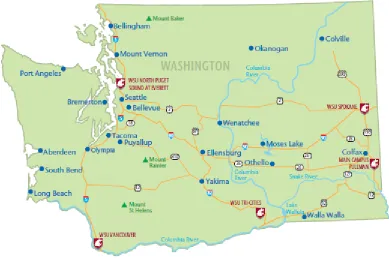
The next section provides a basic overview of three WSU Extension Centers; all work statewide (see Figure 1 for reference to specific office locations):
1) Division of Governmental Studies and Services (DGSS), operating for more than 50 years focusing on applied quantitative and qualitative social science research and evaluation (offices in Pullman and Olympia);
2) William D. Ruckelshaus Center (Ruckelshaus Center), 12 years old and focusing on collaborative public policy (offices in Seattle and Pullman); and
3) Metropolitan Center for Applied Research and Extension (Metro Center), newly created and focusing on metropolitan applied research (offices in Everett and Seattle).
A more detailed description of each center’s operational logistics, in-reach to campus-based research faculty and students, and local capacity building follow.
Is Project-Based Extension the Answer?
Experience and Reflections from Three Washington Centers
Division of Governmental Studies and Services (DGSS)
Founded in 1964, the Division of Governmental Studies and Services is jointly sponsored by WSU Extension and the College of Liberal Arts to apply social science approaches to issues of public policy in order to support good governance, improve citizen-government relationships, and enhance community resilience and quality of life in Washington and the Pacific Northwest. In 2001, the College of Liberal Arts and WSU Extension reached an agreement that combined two separate entities into a jointly-sponsored university outreach unit. Under this agreement, DGSS and the Program for Local Government Education (a program funded by the W. K. Kellogg Foundation and housed in WSU Extension) were merged and retained the title Division of Governmental Studies and Services, resulting in an expanded mission, a broadened scope of activities, and substantial growth in staff and applied social science research assets.
DGSS serves the people of Washington as the political science outreach arm of the University, linking academic campus resources to real-world initiatives to help address pressing issues and challenges. In this capacity, DGSS provides high-quality, applied research and training to tribal, federal, state, and local government agencies in the Pacific Northwest. Because of its
co-sponsorship by the College of Arts and Sciences and WSU Extension and its strong connections to a number of academic units, DGSS has a long history of cross-disciplinary activities.
In addition to significant on-campus connections, DGSS has a broad array of client and partner relationships off campus that contribute to its success in extramural entrepreneurship; its reputation as a trusted source of expertise to bring data to bear on controversial issues; and its capacity to assist other WSU units with outreach, research, and innovative problem-solving. DGSS is affiliated with or has provided several training programs through the years to the Northwest Municipal Clerks Institute, the Western Regional Institute for Community Oriented Public Safety (WRICOPS) and the Natural Resources Leadership Academy (NRLA).
DGSS faculty and staff represent expertise in program evaluation and applied social science, policy-focused research, technology applications for community development and governance, facilitation, and conflict management. Because DGSS is based on the main WSU campus, personnel often work with other departments and units within the university, such as the Edward R. Murrow College of Communication; the Department of Criminal Justice and Criminology; the School of Politics, Philosophy, and Public Affairs; and the Department of Civil and
regionally and nationally make DGSS a strong, interdisciplinary partner that lends considerable strength to competitive grants and contracts. In addition, DGSS engages students on a regular basis, providing research and internship opportunities for undergraduate and graduate students that not only supports their acquisition of strong applied research skills but also provides data for thesis and dissertation development.
As an applied research and outreach unit at Washington State University, DGSS has extensive experience in evaluation research methodology, analysis, facilitation, and training to enhance organizational capabilities. DGSS has worked on numerous cutting-edge projects with a strong publication record in topics such as biased policing, community sustainability, community policing, and social capital.
William D. Ruckelshaus Center1
The William D. Ruckelshaus Center (Ruckelshaus Center) is a joint effort of WSU and the University of Washington (UW) that fosters collaborative public policy in the State of
Washington and Pacific Northwest. This unique partnership between Washington’s two research universities was established in response to requests from prominent local, state, and regional leaders, many of whom now serve on its advisory board. It is hosted at UW by the Evans School of Public Policy and Governance and at WSU by Extension’s Community and Economic
Development unit, which also provides its administrative home. The Center was founded in 2004 and renamed in 2006 after William D. Ruckelshaus–the first and fifth administrator of the U.S. Environmental Protection Agency, a longtime public and private sector leader, and a 2015 recipient of the Presidential Medal of Freedom. Ruckelshaus is the Center’s founder and advisory board chair.
Dedicated to assisting public, private, tribal, nonprofit, and other community leaders in their efforts to build consensus and resolve conflicts around difficult public policy issues, the Center’s services include situation assessment, collaborative process design, facilitation and mediation of collaborative processes, development of collaborative capacity, and establishment of a common information base. Scholars and practitioners refer to this field as collaborative governance, collaborative public policy, or public policy conflict resolution, among other terms (e.g., Ansell & Gash, 2008; Dukes, 1996; Emerson, Nabatchi, & Balogh, 2012). The Center has helped resolve challenges and conflicts on large and small issues involving natural resource
management, disaster response, healthcare, economic development, good governance, and other topics (Kern, 2013).
Funding for the Center is a mix of public and private sources, including modest core funding from the UW and WSU, fee-for-service contracts for specific projects, and private philanthropy.
The Ruckelshaus Center seeks to establish project teams that involve its core faculty and staff, as well as faculty, staff, students, and practitioners affiliated with both of its universities. The Center’s four-member core faculty have more than 75 years of collective experience in public policy conflict resolution and collaborative policy-making, as well as have advanced degrees in relevant fields such as public policy, marine affairs, law, and land use planning. Since 2010, the Center has engaged more than 60 WSU, UW, and other faculty and practitioners in projects. In some situations, private sector practitioners are also involved.
Because of its emphasis in “on the ground” and “in the community” application of academic expertise, WSU Extension attracts university-based experts from public policy, business, law, and many other disciplines. The Ruckelshaus Center’s Collaborative Capacity Building and Training program helps develop conflict resolution expertise among Extension faculty and others. The Center’s student internship program seeks to create collaborative competence among the next generation of policy leaders. Community-based Extension faculty and staff are also a good source of project opportunities, since they are integrated into the fabric of their
communities and know what public policy challenges would benefit from the Center’s services.
The Center’s unique structure as a joint WSU/UW center led to the creation of a separate 501(c)3 Ruckelshaus Center Foundation to accept charitable gifts; neither university felt its foundation should solely represent the Center. The Center’s advisory board guidelines established a development committee responsible for “establishing and executing a plan for Center resource development that results in a balanced portfolio of funding sources…that will be seen as neutral” (William D. Ruckelshaus Center, 2015, p. 5). In addition to core funding and fee-for-service, that portfolio includes Board giving, other major donors (including a Chairman’s Circle of more than 70 individuals and organizations who give $1,000+ each year), foundation grants, events, small and medium donors, and expendables from an endowment. The committee raised over $310,000 from those sources in fiscal year 2015 and over $675,000 in fiscal year 2016. The Ruckelshaus Center Endowment for Excellence has grown from just more than $1 million in 2010 to more than $4 million by the end of 2016 (the largest endowment at WSU Extension) toward a $5 million goal.
Metropolitan Center for Applied Research and Extension
greater name recognition than WSU with its main campus located 300 miles away. For WSU Extension, the complex sociopolitical landscape of Washington’s metropolitan counties, the unique character of their issues, the competition from other educational service providers, and the staffing limitations in current metropolitan county Extension offices required a new university engagement model in the metropolitan Puget Sound (Gaolach et al., 2015).
WSU Extension responded to these changing conditions by creating the Metropolitan Center for Applied Research and Extension (Metro Center), officially adopted by the WSU Regents in January 2016. The Metro Center was established to strengthen Puget Sound metropolitan communities through collaboration, innovation, action-oriented research, and outreach designed to contribute to the resiliency of local economies and strengthen the region’s governmental and nonprofit sectors. In the tradition of Extension, the subject matter is community-driven, but the Metro Center breaks from tradition by being solely project-driven and working across a variety of subject matters within metropolitan communities.
The Metro Center makes a clear distinction between projects and programs. Extension’s tradition is to build long-term, educational-based, community-delivered programs. Examples include 4-H community and school clubs, Master Gardener volunteer programs, SNAP-Ed community nutrition programs, and forestry education. The Metro Center only conducts projects defined as being time-bound (months to a few years) with a clear start and end date, having a defined set of deliverables, and being extramurally funded.
The Metro Center has a small core staff and assembles WSU faculty, staff, and students into short-term, project-based teams to address specific, externally-funded initiatives. This gives the Metro Center the necessary flexibility to respond quickly to new opportunities and emerging metropolitan issues. Currently, the Metro Center is comprised of a full-time director, one and one-half project specialists, and a half-time operations manager; all are 100% funded by the university. However, WSU expects the Metro Center to engage in projects that fully fund all expenses involved.
The Metro Center is not meant to replace county Extension offices; instead, it brings new
capacity with a complimentary focus. There is great value in metropolitan communities for both traditional Extension activities and for accessing the research capacity of the University through project-oriented centers. While not a requirement, most Metro Center projects have both applied research and Extension outreach components. The Metro Center works closely with county Extension offices, WSU Research and Extension Centers, and academic departments to transfer projects with potential for long-term research or educational programming to these units. The Metro Center defines applied research within the broader designation of action-oriented research, which also includes classic action research, participatory research, and grounded action research (Toscano, n.d.). The Metro Center was designed to add that applied research capacity to the local University Extension mix into which metropolitan decision makers can tap.
Projects, Programs, County Offices, and Centers–New Models?
Projects, programs, county Extension offices, and centers are not mutually exclusive. They can and should be designed to function together as they provide complementary services to
metropolitan communities while demonstrating the breadth of Land-Grant Universities.
Combined, they bring the long-term educational programs that are a hallmark of Extension along with the applied, action-oriented research capacity of a university. How they are combined can and should vary across Land-Grant Universities as evidenced by programs such as Colorado State University’s CSU in the City Extension program in Denver (http://metroextension.wsu.edu/ csu-hotshots/), which straddles both city and county government.
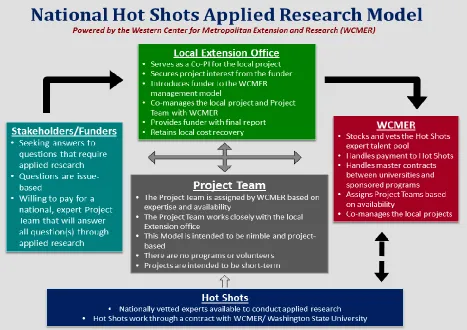
The value of an applied research portfolio within urban Extension has gained regional and national interest. The Western Center for Metropolitan Extension and Research (WCMER) (http://metroextension.wsu.edu/), a collaboration of seven primarily western Land-Grant
Universities with its administrative home in WSU’s Metro Center, developed the Hot Shot model (see Figure 2) to provide a vehicle for an Extension contact to identify an applied research
Figure 2. Schematic of the WCMER Host Shot Model as Applied at the National Level Through the National Urban Extension Leaders (NUEL) Network
For the majority of projects, WSU’s three centers target local decision makers, especially those who make, adopt, or interpret policy. Working upstream at the policy, systems, and environment level has several benefits for urban Extension programs. It can overcome the numbers
What This Means for Extension Faculty–Opportunities for Collaboration, Service, and Scholarship
Subject-matter centers that engage in project-based, applied research activities help demonstrate the public value of Extension and Land-Grant Universities to external stakeholders. Internally, the value of this work needs to be documented through scholarly activities. Extension
professionals have established outlets to communicate the results and impacts of their work. For example, several Extension professional organizations host annual conferences with scholarly presentations, and most Extension programs publish fact sheets, bulletins, and publications, some with double-blind peer review. As more Extension programs provide opportunities for
promotion, tenure, or permanent status, a greater premium is placed on peer-reviewed
publications targeting Extension professionals instead of the end user (e.g., the general public or business professional) of the information. The applied and time-bound nature of subject-matter centers provides opportunities for Extension professionals to be a co- or lead author on peer-reviewed publications.
The combination of subject-matter centers and local Extension offices are valuable assets to campus-based research faculty and institutions as public value, engaged scholarship, and
integrated research are at a premium for funders and evaluation of institutions. Franz, Childers, and Sanderlin (2012) discovered that faculty wanting to demonstrate public value of their research are looking for assistance in engaging with communities and how to work effectively with communities. The faculty surveyed in this research reported interest in a campus center to help faculty engage with the community. The Carnegie Foundation recently announced an additional 240 U.S. college and university recipients for its Community Engagement
Classification for 2015, joining 121 institutions recognized in 2010 (New England Resource Center for Higher Education, n.d.). This is a designation for which universities voluntarily apply, indicating the value and importance of this distinction. The Academy of Community Engagement Scholarship (2012) defines engaged scholarship as “active collaboration with participating community partners…has a positive impact on complex societal needs and issues.” (p. 1). An Extension-based, subject-matter center working closely with local Extension offices supports campus-based faculty working in communities while increasing the value and impact of such research. By partnering with campus-based faculty, Extension professionals will have increased opportunities to add value to their communities, lead or co-author peer-reviewed journal articles, and lead related Extension-based scholarly products in collaboration with other team members.
Conclusions/Summary
While Extension has a long tradition in a program development model based on needs
opportunities and complexities in metropolitan communities suggest the need for a nimbler approach. In metropolitan communities, Extension offices are often faced with very small staff sizes relative to the large populations they are expected to serve; they operate amongst numerous agencies, nonprofit organizations, and nongovernmental organizations that provide similar services while competing for funding and visibility; and they face a very complex
multijurisdictional set of governments who often look to Extension to bring the entirety of the university to help address the multidimensional issues of metropolitan communities. Existing program models alone are ill-prepared to handle these demands (see Table 1).
Table 1. Contrasting Elements of a More Traditional Program-Based Extension Model Compared to a Project-Based Extension Model
(Adapted from Collins, 2016)
Program-Based Extension Project-Based Extension
Staffed by county/area/regional agents who focus on program development (assessment, planning, design, implementation, and evaluation) and deliver a series of activities over the course of several years; they are local, subject-matter experts.
They generally have a long tenure in a county; emphasizing long-term engagement and impact within the county through their programming.
Staffed by center-based faculty who emphasize project management; not necessarily subject-matter experts, but may be practitioners within subject matter. They work with numerous governmental and community organizations as dictated by specific projects.
University faculty serve as project specific subject-matter experts and may work only a few times in any specific jurisdiction or with any given stakeholder.
Utilize volunteers to multiply impact. Develop short-term teams comprised of experts
and students to address specific, one-time projects.
Deliver programs and curriculum developed by faculty specialists and external stakeholders for statewide use.
Co-create project scope of work and deliverables amongst a project team and community
stakeholders; designed uniquely for the specific project or situation.
Focuses primarily on end-user of information (individual-level impacts emphasized).
Focuses primarily on policy, systems, or
environmental change by working with decision makers (community or population level impacts emphasized).
Values long-term funding relationships through a county contract or agreement to support a stable workforce in local office.
Seeks short-term funding relationships to provide project-based funding for subject-matter
specialists and to support a small core staff. Delivers a traditional blend of program offerings
comprised of 4-H youth development; nutrition education, agricultural production, natural resource stewardship, horticulture, community vitality, etc.; derived primarily from expertise within a college of agriculture.
Subject-matter centers can provide Extension programs and local offices with additional
resources and the nimble and flexible staff necessary to address emerging, time-sensitive issues that faculty fully engaged in long-term educational programming do not have the capacity to address. WSU Extension has successfully developed several such centers, three of which were reviewed here. In addition to providing capacity and flexibility, these centers also act as
conduits between local Extension offices and campus-based resources, including deploying both graduate and undergraduate students on real-world issues; engaging campus-based faculty in off-campus, applied research opportunities; and generating additional resources for all parties through new funding sources. By deploying the university’s resources on urban policy, systems, or environmental change projects, Extension increases the public value and community
engagement metrics for the participating faculty and the institution as a whole.
Subject-matter centers are not without challenges in operating within the construct of a Land-Grant University that prioritizes research, teaching, and service. The three subject-matter centers featured in this article specialize in fee-for-service opportunities to conduct applied research and address community-based issues. While each center has an allocation of base funding, these resources primarily support basic infrastructure and gap financing for core staff when they are not covered by project-based billing. This creates a tension between practice (external projects) and research (publications). It is challenging to meet existing project responsibilities and keep new projects in the pipeline while also fulfilling peer-review publication expectations for faculty promotion. Similarly, it is important to evaluate past and current projects undertaken at subject-matter centers, but this is difficult to accomplish when evaluation takes time and money, and few funders are willing to invest to support such activity. Additionally, similar to more traditional approaches to Extension work, Extension based subject-matter centers struggle to gain attention, recognition, or support within their universities which often directly or indirectly structure reward systems to favor research and teaching performed by campus-based faculty.
The three subject-matter centers operate independently from local Extension offices but work cooperatively within the geographic boundaries of any given county Extension office.
Therefore, it is critical for the centers and the county offices to coordinate so stakeholders see one Extension, similar to the importance of state specialists fitting within a single Extension perspective for stakeholders. Because all three of these WSU centers are administratively housed in WSU Extension’s Community and Economic Development Unit
(http://ced.cw.wsu.edu/), county-based faculty and center-based faculty interact on a regular basis, allowing for relationship building, easier integration and the sharing of outcomes and impacts with stakeholders. In addition, there is a natural interaction between centers focusing on short-term projects and county Extension focusing more on longer-term programs. Consider the following examples.
A county-based program can be the impetus for a short-term project which county faculty do not have the capacity or expertise to address; they can reach out to the appropriate subject-matter center to respond to this issue. The center works through the county office (almost like a subcontractor to the local office) to conduct the work. To the stakeholder, it is the county office that brings this additional Extension
resource as an additional value to the long-term relationship between the county and the county Extension office.
While a subject-matter center is working on a time-bound project, a long-term
educational program may be a logical outcome of the work. Such an opportunity can be “transferred” to the county Extension office as a natural progression from project to program, all within the same Extension organization.
Project teams can and often do include county-based Extension faculty and staff.
It is possible that similar centers already exist in a given university, and county Extension offices only need to establish a working relationship with them by highlighting the opportunities of working together. If none exist, or even if they do, Extension leaders can establish their own centers, similar to WSU Extension’s approach, which will require new funding or repurposing existing funding. While this can be difficult, WSU Extension was able to establish the new Metro Center through reallocation of existing funding to respond to the opportunities
metropolitan communities offered while still supporting traditional-based county programs. The WSU Metro Center was established with a core staff of 2.5 employees, which is a minimal investment to serve a multiple-county geographic area which encompasses more than half of the state’s population and nearly three-quarters of the state’s legislative districts.
References
Academy of Community Engagement Scholarship. (2012). Concept paper. Retrieved from http://academyofces.org/upload/2%20pager%20ACES_Concept_Paper%20with%20Foun ding%20Members.pdf
Ansell, C., & Gash, A. (2008). Collaborative governance in theory and practice. Journal of Public Administration Research and Theory, 18(4), 543–571.
doi:10.1093/iopart/mum032
Argabright, K., McGuire, J., & King, J. (2012). Extension through a new lens: Creativity and innovation now and for the future. Journal of Extension, 50(2), Article 2COM2. Retrieved from https://www.joe.org/joe/2012april/comm2.php
Boone, E., Safrit, D., & Jones, J. (2002). Developing programs in adult education: A conceptual programming model (2nd ed.). Long Grove, IL: Waveland Press.
Boyle, P. G. (1981). Planning better programs. New York, NY: McGraw-Hill.
Bozeman, B., & Boardman, P. C. (2003). Managing the new multipurpose, multidiscipline university research center: Institutional innovation in the academic community. Arlington, VA: IBM Center for the Business of Government. Retrieved from
http://www.businessofgovernment.org/sites/default/files/UniversityResearchCenter.pdf Caffarella, R. S., & Ratcliff Daffron, S. (2013). Planning programs for adult learners: A
practical guide (3rd ed.). San Francisco, CA: Jossey-Bass.
Cervero, R., & Wilson, A. (2006). Working the planning table: Negotiating democratically for adult, continuing, and workplace education. San Francisco, CA: Jossey-Bass.
Collins, R. (2016). Unpublished data.
Dukes, E. F. (1996). Resolving public conflict: Transforming community and governance. Manchester, UK: Manchester University Press.
Emerson, K., Nabatchi, T., & Balogh, S. (2012). An integrative framework for collaborative governance. Journal of Public Administration Research and Theory, 22(1), 1–29. doi:10.1093/iopart/mur011
Extension Committee on Organization and Policy (ECOP). (2002). The Extension system: A vision for the 21st century. Washington, DC: National Association of State Universities and Land-Grant Colleges.
Fehlis, C. P. (1992). Urban Extension programs. Journal of Extension, 30(2), Article 2FEA3. Retrieved from http://www.joe.org/joe/1992summer/a3.php
Franz, N. (2011). Advancing the public value movement: Sustaining Extension during tough times. Journal of Extension, 49(2), Article 2COM2. Retrieved from
http://www.joe.org/joe/2011april/comm2.php
Franz, N., Childers, J., & Sanderlin, N. (2012). Assessing the culture of engagement on a university campus. Journal of Community Engagement and Scholarship, 5(2), 29–40. Retrieved from http://jces.ua.edu/assessing-the-culture-of-engagement-on-a-university-campus
Franz, N., Garst, B. A., & Gagnon, R. J. (2015). The Cooperative Extension program
development model: Adapting to a changing context. Journal of Human Sciences and Extension, 3(2), 3–12. Retrieved from https://media.wix.com/ugd/c8fe6e_e41e14ca280 a4722a8699690c2c52dfd.pdf
Gaolach, B., McDaniel, R., & Aitken, M. (2015). WSU Metropolitan Center for Applied Research and Extension. Proposal to the Faculty Senate, Washington State University, WSU Extension (College of Agricultural, Human, and Natural Resource Sciences), Pullman, WA.
Gould, F. I., Steel, D., & Woodrum, W. (2014). Cooperative Extension: A century of innovation. Journal of Extension, 52(1), Article 1COM1. Retrieved from
http://www.joe.org/joe/2014february/comm1.php
Hall, W., & Kern, M. (2017). The public sector as mediator: The role of public institutions in environmental collaboration and conflict resolution. In A. Georgakopoulos (Ed.), The mediation handbook: Theory, research, and practice (pp. 282–289). New York, NY: Routledge Publishing.
Ikenberry, S. O., & Friedman, R. C. (1972). Beyond academic departments: The story of institutes and centers. London, England: Jossey-Bass.
Kalambokidis, L. (2014). Creating public value with tax and spending policies: The view from public economics. Public Administration Review, 74(4), 519–526.
doi:10.1111/puar.12162
Kalambokidis, L., & Bipes, T. (2007). Building Extension’s public value: Presenter’s guide. St. Paul, MN: University of Minnesota Extension.
Kern, M. A. (2013). Fostering collaborative solutions to environmental conflicts on the ground: The William D. Ruckelshaus Center. Signal (International Association for Conflict Management), 28(3), 9–10. Retrieved from http://ruckelshauscenter.wsu.edu/wp-content/uploads/2013/06/Kern_Signal_2013_Volume_28_Issue_03_0-1.pdf
Krofta, J., & Panshin, D. (1989). Big-city imperative: Agenda for action. Journal of Extension, 27(3), Article 3FEA1. Retrieved from http://www.joe.org/joe/1989fall/a1.php
National Urban Extension Leaders (NUEL): De Ciantis, D., Fox, J., Gaolach, B., Jacobsen, J., Obropta, C., Proden, P., . . . Young, J. (2015). A national framework for urban Extension: A report from the national urban Extension leaders. Retrieved from
http://media.wix.com/ugd/c34867_668cd0780daf4ea18cb1daddad557c72.pdf National Urban Extension Task Force. (1996). Urban Extension: A national agenda.
Washington, DC: United States Department of Agriculture. Retrieved from
http://district4.extension.ifas.ufl.edu/UrbanExtension/PDF/Urban%20Extension,%20A% 20National%20Agenda.pdf
New England Resource Center for Higher Education. (n.d.). Carnegie community engagement classification. Retrieved from http://nerche.org/index.php?option=com_content&view= article&id=341&Itemid=618
Peterson, D. J. (2015). Editor’s introduction to this special issue. Journal of Human Sciences and Extension, 3(2), 1–2. Retrieved from https://media.wix.com/ugd/c8fe6e_bf7809f19ebf40 b5b26a37f16dc4bc50.pdf
Seevers, B., & Graham, D. (2012). Education through Cooperative Extension (3rd ed.). Fayetteville, AR: University of Arkansas.
Stahler, G. J., & Tash, W. R. (1994). Centers and institutes in the research university: Issues, problems, and prospects. Journal of Higher Education, 65(5), 540–544.
Toscano, P. M. (n.d.). Praxis inquiry: Action oriented research: Grounded theory and grounded action. Retrieved from http://home.earthlink.net/~edreforum/id1.html
U.S. Department of Agriculture. (n.d.). Extension. Retrieved from http://nifa.usda.gov/extension Webster, N., & Ingram, P. (2007). Exploring the challenges for Extension educators working in
urban communities. Journal of Extension, 45(3), Article 3IAW3. Retrieved from https://www.joe.org/joe//2007june/iw3.php
Western Center for Metropolitan Extension & Research. (n.d.). Hot shot model. Retrieved from http://metroextension.wsu.edu/appliedresearch/hot-shot-model
Western Extension Directors Association (WEDA). (2008). Extension in the urban west. Retrieved from http://extension.oregonstate.edu/weda/secure/files/documents/Extension InTheUrbanWest_070208Final_000.pdf
William D. Ruckelshaus Center. (2015). Advisory board guidelines. Seattle, WA: William D. Ruckelshaus Center.
Brad Gaolach,PhD, is the founding director of both the WSU Metropolitan Center for Applied Research and Extension and the Western Center for Applied Research and Extension. Prior to these roles, he spent more than a decade as the Extension County Director in King and/or Pierce Counties, the two most populous counties in Washington State. He has served in various leadership roles, including helping to establish the National Urban Extension Leaders network. He began his career with Extension in 2001 as the agriculture and natural resource agent in King County, WA.
Michael Kern, MPA,is the Director of the William D. Ruckelshaus Center. He has 25 years of experience in helping diverse groups reach common ground on public policy issues in
Washington and the Pacific Northwest. Prior to joining the Ruckelshaus Center as its Director and Associate Professor of Extension at WSU, he was a Senior Associate at Triangle Associates Inc., providing facilitation, mediation, public involvement, strategic planning, project
management, and other services. He has also provided these services at nonprofit and academic institutions for the North Cascades Initiative, Hatchery Reform Project, and Hanford Openness Workshops among others.
Acknowledgements