Extension in the City: Meeting the Challenges of Scale
Jennifer Sarah Tiffany Cornell University
The urban share of the United States and global population has been climbing steadily since well before the inception of Extension. As of the 2010 census, more than four out of five U.S. residents lived in urban areas, with 71% of the total U.S. population living in cities with more than 50,000 residents, and 10% living in smaller urban clusters. Cornell University established Cooperative Extension offices in New York City (CUCE-NYC) well after the Extension system was
developed in rural and suburban counties throughout New York State. NYC is the largest city and part of the largest metropolitan area in the U.S., creating
significant challenges of scale for Extension programming. The ratio of NYC residents to CUCE-NYC staff is roughly 125,000:1. CUCE-NYC works to mobilize limited resources to create large and positive impacts on individuals, families, communities, and institutions. Strategies to achieve these goals include partnership development, community recruitment, leadership development, and ecological efforts to foster setting-level change. Key CUCE-NYC strategies are grounded in sustained, intensive connections to communities, organizations, and other human ecological contexts. Geospatial mapping of program activities enables assessment and improvement of program reach and impact.
Keywords: New York City, ecological approach, system-level change, community engagement, partnership, multipliers, geospatial mapping, demographic transition
Background
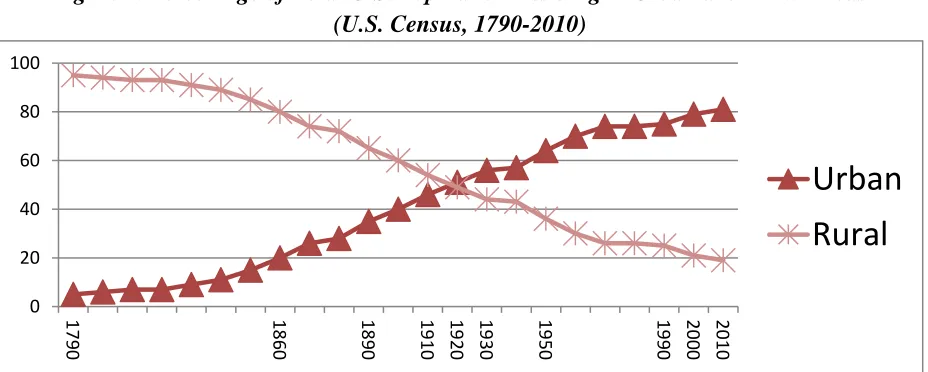
Satellite images show the high degree of urbanization in North America and many other sections of the globe (see Figure 1). The urban share of the U.S. and global population has been climbing steadily since before the inception of Extension (see Figure 2). The first national census of the U.S. population in 1790 reported about 1 person in 20 lived in urban areas. When the Morrill Act passed in 1862, approximately 1 in 5 U.S. residents lived in cities. By the 1887 Hatch Act, more than 1 in 4 residents lived in urban areas. By 1890, when the Second Morrill Act passed, 35% of the U.S. population was urban. When the Smith-Lever Act passed in 1914, urban residents comprised nearly half of the population. When the Evans-Allen Act and National Agricultural Research, Extension, and Teaching Policy Act passed in 1977, about 74% of the U.S. population lived in urban areas. By 1994, when the University of the District of Columbia and Tribal Land-Grant institutions were established, over 75% of the U.S. population was urban.
Figure 1. The Earth at Night
(Image Credit: NASA/GSFC/Craig Mayhew and Robert Simmon)
As of the 2010 census, more than 4 out of 5 U.S. residents lived in urban areas, with 71% of the total U.S. population living in cities with more than 50,000 residents and 10% living in smaller urban clusters (U.S. Census Bureau, 2010). The demographic transition from 80% rural in 1860 to 81% urban in 2016 creates challenges and opens up vast possibilities for Extension educators serving U.S. communities. Extension work that is characterized by strong understandings of urban and rural contexts, that grasps the many implications of the rural to urban demographic transition, and that prioritizes both urban Extension work and rural-urban collaborations can assist in addressing equity-related challenges in communities and within the Extension system (Lee & Keys, 2013).
Figure 2. Percentage of Total U.S. Population Residing in Urban and Rural Areas (U.S. Census, 1790-2010)
0 20 40 60 80 100
17
90 1860 1890 1910 1920 1930 1950 1990 2000 2010
Cornell University established Extension offices in New York City (NYC) in 1948, initially specializing in providing nutrition programs and later expanding to focus on urban agriculture, family and 4-H youth development, workforce development, urban environment, and other program areas. This article offers a snapshot of the current challenges and opportunities Cornell University Cooperative Extension’s NYC (CUCE-NYC) programs face and the strategies used in serving NYC’s dynamic and diverse communities.
Challenges of Scale
NYC is the largest city in the United States, with more than 8.5 million residents as of mid-2015 and a recent rate of population growth stronger than any seen since the 1920s (City of New York-Planning, 2016a). The largest metro area in the country (U.S. Census Bureau, 2015), it is at the core of a multistate metropolitan area with more than 20 million residents and lies at the heart of the Northeast’s profoundly urbanized I-95 corridor connecting communities along the east coast. Residents of NYC hail from across the globe, with more than 200 languages spoken. Along with English, languages most frequently spoken include Spanish, Chinese, and French Creole. Half of NYC residents speak a language other than English at home (City of New York-Planning, 2016b). More than 37% of current NYC residents were born outside of the United States (U.S. Census Bureau, 2016a). Population groups who are potentially underrepresented within and underserved by institutions like Extension comprise the majority of NYC residents. More than 25% of NYC residents are African American; 29% are Hispanic or Latino; 13% are Asian; 33% are White, non-Hispanic; and 1% are American Indian, Alaska Native, Native Hawaiian, or Pacific Islander (U.S. Census Bureau, 2016a). With more than 111,000 American Indian and Alaska Native residents, NYC has the largest First Nations population of any city in the United States (Indian Country Media Network, 2013).
NYC is a city rich in innovation and social capital, presenting a complex mix of assets for Extension programming on which to build when addressing challenges. Although food deserts are common and rates of adults who eat five or more servings of fruits and vegetables daily are lower than elsewhere in the state, NYC has the lowest rate of adult overweight or obesity of all regions in New York State (New York State Department of Health [NYSDOH], 2016a, 2016b). Harsh disparities are all too common, and many residents of the city face the health and social impacts of poverty. Forty three percent of children in the Bronx and 33% of children in
NYC has a powerful history of community engagement and institutions to support popular education and political voice, from settlement houses to community boards. Community-based organizations, governmental institutions, and private sector firms provide unique partnership opportunities and contexts for Extension education. Extension programming benefits from the city’s strong and easily accessible data infrastructure, such as neighborhood-level community health profiles (City of New York-Health, 2016b) and maps (City of New York-Health, 2016a).
Extension in New York City
Urban Extension work can be organized in multiple ways. CUCE-NYC is a medium-sized, program-based Extension organization, specializing in nutrition and health; family and youth development (including 4-H); urban agriculture and food systems; and fostering translational research collaborations involving faculty, students, and NYC communities. The staffing
structure is oriented toward program delivery and partnership development. Two administrative positions, one information technologies position, and two data entry positions support
approximately 60 program delivery staff including community educators, Extension and research support specialists, program leaders, and Extension associates. The staff are demographically diverse and offer programming in multiple languages; workshops in Spanish slightly outnumber those conducted in English. Organizations like CUCE-NYC are bridges linking Land-Grant Universities with urban communities, connecting research science with community-generated insights and practice, and ideally, fostering collaboration and dialog between rural and urban communities and constituencies.
CUCE-NYC is embedded in the unique New York State Extension System. Outside of NYC, local Extension associations work under the guidance of Cornell University but are incorporated not-for-profit organizations legally governed by local boards of directors. The broad state legislative charge to the Cornell University Cooperative Extension system is “extending to the people of the state of New York, not enrolled in such colleges, the educational programs of the New York State College of Agriculture and Life Sciences and the New York State College of Human Ecology at Cornell University and subjects related thereto” (New York State County Law 224(8)(b)).
directing the Community Engagement in Research component of Weill Cornell Medicine’s NIH-funded Clinical and Translational Sciences Center, a unique mobilization of Land-Grant and Extension resources in support of clinical research, medical science, and health care access.
How can an organization with a staff of 60 educators who provide direct programming for tens of thousands of participants make a significant and sustained impact on the largest city in the United States? The challenges of scale faced in NYC are not unique—most Extension work mobilizes limited resources to create large and positive impacts on individuals, families, communities, and institutions. The strategies used in NYC to accomplish these include partnership development, community recruitment, leadership development, and ecological efforts to foster setting-level change (changes in organizations, families, communities, and policies). The overall ethic informing CUCE-NYC programs prioritizes intensive, sustained engagement of participants and of organizational partners.
Strategies
Key CUCE-NYC strategies are grounded in sustained, intensive connections to communities, organizations, and other contexts that social-ecological theory identifies as significant for supporting families and promoting human health and development (Bronfenbrenner, 1979, 2005). Strategies for meeting the challenges of scale often overlap and complement one another. For example, community recruitment of program participants relies on and fosters ongoing partnerships with the schools, agencies, or other organizations that serve them. Also,
organizations that have witnessed and hosted Extension workshops often seek staff training to conduct similar workshops or to integrate skills into their ongoing operations, multiplying the reach and resonance of Extension efforts. Examples of these complementary strategies follow.
Community Recruitment of Staff and Participants
Expanded Food and Nutrition Education Program(EFNEP). EFNEP is one of the cornerstones of CUCE-NYC programming and is a model for community recruitment of staff and participants. Frequently, educators first engage EFNEP as program participants. Core to EFNEP’s approach since its founding in 1969 is “the goal of hiring educators from the
communities in which they work. Educators are trained and supervised by nutrition
often the communities where they reside. Languages include Spanish, English, French Creole, Chinese, Korean, and others. With support from supervisors, educators are charged with arranging workshops, sustaining organizational partnerships (e.g., with schools and child care centers), recruiting participants, and gathering pre/post-education evaluation documents.
Workshop sites and organizational partnerships are relatively stable, and over the long-term many cycles of eight-session workshop series are conducted in a given location. Because of the consistent integration of data gathering for research and evaluation into EFNEP activities, all educators complete training in research involving human participants and are certified by
Cornell’s Institutional Review Board for Human Participants to serve as research team members. The EFNEP team collaborates closely with campus-based faculty who direct the statewide
program, support research activities in NYC, and offer training in evidence-based curricula, facilitation, and effective educational practices. During the most recent fiscal year (2016), 4,566 adults and 4,817 youth completed EFNEP workshops in NYC; collectively, EFNEP educators offered 114,427 noncredit instructional activity contact hours.
4-H. Like EFNEP, 4-H programming relies on community recruitment of staff and program participants. NYC 4-H has developed a systematic approach (including a career ladder within the organization) for program participants interested in deepening their involvement in program delivery efforts. One of the distinctive features of 4-H in NYC is its ability to engage
adolescents, while other 4-H locations in the state see a drop in participation as youth grow older. NYC 4-H offers a range of activities, including one-time events like National Youth Science Day. School-based clubs, offered during school time as well as after school, are led jointly by youth with support from adult teachers. A Youth Leadership Academy (YLA) meets at CUCE-NYC’s main office to teach youth the hands-on learning activities and facilitation skills they use and refine in their local clubs. The YLA offers a chance for discussion, community building, and general skill development. Internships and temporary staff positions enable 4-H youth to further hone their skills at the same time they support program efforts, with some 4-H youth participants also returning to join the CUCE-NYC staff.
Youth who “age out” of 4-H frequently stay connected through a youth-organized and led Collegiate 4-H group that draws graduates of the NYC 4-H program together even while they attend colleges and universities. One of the missions of Collegiate 4-H is to assist other NYC youth to understand college application processes and to navigate the challenges of going to college, a support that is particularly important since many youth are the first in their families to attend college.
two part-time program aides can be multiplied by embedding clubs and activities within schools and organizations where they draw on local talent for leadership.
Partnerships
Juntos. The 4-H program and other youth development activities such as the Assets Coming Together (ACT) for Youth Center of Excellence demonstrate the importance of building sustained partnerships as another strategy for addressing the challenges of scale. Juntos, a 4-H program aimed at preparing Latino students for educational advancement and college attainment, is an example of a partnership involving multiple parties. Juntos connects Latino youth and families in the Bronx with resources that will support their academic success. Partners include the National 4-H Council, North Carolina State University (the developer of the Juntos
approach), CUCE-NYC, New York Life (the insurance company that provides both funding support and a pool of committed volunteers), a NYC Department of Education middle school (site of the intervention where the principal, vice principal, social worker, guidance counselor, and parent coordinator are members of the Juntos team), and the 60 eighth grade students and their families who participate in the program.
The Juntos program involves one-on-one coaching, family workshops, and a 4-H club focusing on academic success and public speaking as well as life skills, and field trips. In the past year, Juntos students have successfully navigated the intensive NYC high school selection and application process, and 20 have applied to specialized high schools emphasizing mathematics, science, and the arts and performance. Parents report feeling the program opened doors of opportunity and increased their connection with their children as well as increased their involvement with their children’s educations.
Volunteers from New York Life conducted My Financial Future workshops with Juntos students and carried out multiple other roles, including participating in the family graduation ceremony. The testimonies of parents and the experience of volunteers strengthened New York Life’s commitment to on-going partnerships with 4-H. Juntos is staffed by one full-time Extension support specialist with support from the CUCE-NYC family and youth development program leader (a senior Extension associate), a 4-H Extension associate, and 4-H program aides. Partnership and volunteer engagement are critical to its success and to the potential for multiplying the activities and approaches in future initiatives.
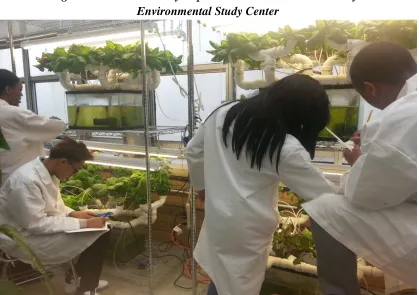
Figure 3. CUCE-NYC Hydroponics Mini-units at the Brooklyn Environmental Study Center
Figure 4. CUCE-NYC Hydroponics Program Sites Throughout NYC (blue dots)
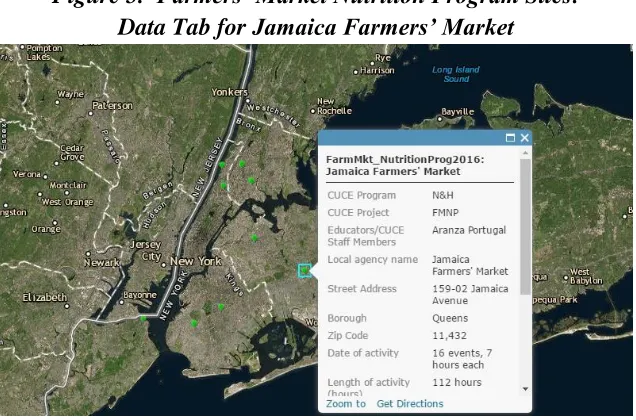
The Farmers’ Market Nutrition Program (FMNP). FMNP offers yet another model in which partnerships sustain programming. The state Department of Agriculture and Markets supports the program, which has sites throughout New York State as well as in NYC. A faculty member in Cornell’s Division of Nutritional Sciences serves as principal investigator and her staff provides strong program support. CUCE-NYC staff sustain partnerships with farmers’ markets throughout the city, coordinating information distribution and cooking demonstrations with market managers and engaging visitors to the markets in educational activities. Further, the FMNP provides an excellent context and learning experience for dietetic interns from a number of colleges and universities (Boscia, 2016). The FMNP engaged 18,161 visitors to NYC
farmers’ markets in food demonstrations and nutrition education during FY 2016 (see Figure 5).
Parenting Education Program. Partnerships sustained by CUCE-NYC’s Parenting Education Program are based on the understanding that to engage parents and other adults responsible for raising children, it is most effective to offer workshops in locations that are safe and familiar to them. The same is true for other programs. Many participants face obstacles ranging from lack of transportation to lack of time or lack of trust, meaning that Extension educators need to go the extra mile to make programs accessible. CUCE-NYC’s parenting education program is small, staffed by one part-time, high-expertise Extension support specialist. With the majority of workshops conducted in Spanish or a fluid combination of Spanish and English, the program works in partnership with schools, child care centers, churches, and community-based
organizations to provide intensive, interactive parenting workshops that address issues identified by participants as high priorities. The average workshop involves 11, two-hour sessions in the workshop series. They are repeated in partnership sites as frequently as feasible, usually annually or every two to three years. This model of partnership overlaps closely with community recruitment of participants. In 2016, 142 parents, the plurality of whom were immigrant, Spanish-speaking women, participated in the workshops (3,814 noncredit instructional activity contact hours).
Translational research partnerships with faculty have recently enabled CUCE-NYC to develop new parenting education programming. Supported by a donor interested in boosting family literacy and grounded in research on young children’s acquisition of language and spatial skills (Casasola, Bhagwat, Doan, & Love, in press), the program engages low-income families in NYC child care centers in activities that build the foundation for their young children’s lifelong
literacy. The team developing this project includes faculty, undergraduate students, Extension educators, community outreach workers, and staff of early child care centers. Activities during 2016 included recruitment of two child care centers to participate in the pilot project, training of undergraduate students in the teaching and assessment activities aimed at boosting language acquisition and spatial skills development among young children, identification and recruitment of parents to participate in the expansion of the project (moving from researcher-conducted interventions to child care-provider interventions to family-based interventions), and development of curriculum materials in English and Spanish. Initial field testing of those materials took place in January 2017. Data gathering and intervention among low income urban families complemented earlier research with higher income families near Ithaca and low income families in rural upstate New York counties.
Training of Trainers and Leadership Development
conducted on a fee-for-service basis and are designed in collaboration with the organizations sponsoring them. Rather than advertising topical workshops open to all via individual enrollments, CUCE-NYC generally provides workshops for networks of people who already share an organizational context or who are part of an existing network. This aligns with the emphasis on taking ecological approaches that foster setting and system-level change to promote optimal human development.
Fostering Setting- and System-Level Change
All of the previously summarized strategies rely on ecological approaches in which individuals are seen in the context of the settings in which they live and work. Recruiting staff and program participants in the context of their communities and with sensitivity to their shared circumstances promotes individual learning and growth at the same time as it fosters contextual supports for the behavioral changes that sustain learning and growth. Long-term partnerships enable
organizations to develop and change during the course of program delivery, and training of trainers enhances the integration of Extension knowledge and skills into increasing numbers of organizational settings and into the core practices of an increasing number of professionals.
Program Mapping for Planning and Evaluation
There are numerous ways to keep track of Extension programs and partnerships, including maintaining inventories of collaborations and contacts, documenting the social network
relationships of Extension educators and campus-based faculty, and conducting program-specific evaluation activities. All of these are of value. One key planning and evaluation strategy used by CUCE-NYC involves creating interactive maps of program activities throughout the city.
Geographic Information Systems (GIS) technology is increasingly user-friendly and university infrastructures provide technical support for geospatial mapping. Maps provide a powerful visual tool for assessing program reach and intensity, relationships among programs and community characteristics, and opportunities for enhanced program delivery. Maps also spark candid discussion and creative thinking by program staff and organizational partners.
The program mapping project relies on a partnership between university faculty including a GIS specialist from the City University of New York’s School of Public Health and staff from each of CUCE-NYC’s program areas. Data and interactive maps of program activities are housed at Cornell’s Institute for Resource Information Services (IRIS), which supports Extension Geospatial Mapping projects.
activity (such as a one-time event, a multi-session workshop series, a semester-long high school internship program, or a teacher-training program), with each column capturing specific
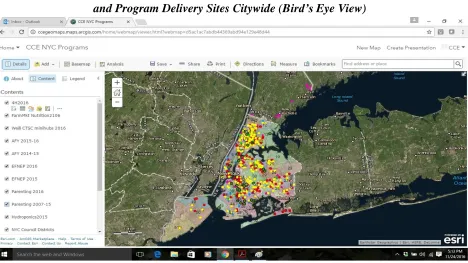
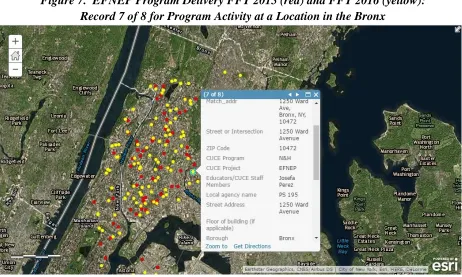
information such as the activity’s location, the staff member responsible, the contact at the community partner organization, and the number of youth and adult participants. The data are then geocoded and added to an interactive desktop geodatabase to produce an interactive map (see Figure 6).
Figure 6. Screenshot of Interactive CUCE-NYC Program Map Showing Content Options and Program Delivery Sites Citywide (Bird’s Eye View)
Multiple program activities might take place in the same location, drawing on the same
Figure 7. EFNEP Program Delivery FFY 2015 (red) and FFY 2016 (yellow): Record 7 of 8 for Program Activity at a Location in the Bronx
To summarize, CUCE-NYC’s current uses of interactive program maps to address the challenges of scale include
tracking and planning program delivery,
identifying and addressing gaps in coverage,
identifying opportunities for cross-program collaboration,
developing partnerships, and
communicating with elected representatives.
The interactive program maps enable the CUCE team to see areas where program delivery is strong and to see gaps in program delivery. Clear understanding of programmatic strengths and weakness is a key component of CUCE’s efforts to make a significant and sustained impact on the largest city in the United States.
Challenges of History—Mapping the Future
The United States Cooperative Extension System was constructed when the majority of the U.S. population lived in rural contexts; however, at the earliest moments of Extension’s development, the demographic transition of the United States from predominantly rural to predominantly urban was well underway. Meeting the challenges of this demographic transition can inform and strengthen Extension overall—in rural contexts as well as in urban communities. Rural-urban polarization is neither optimal nor inevitable. Extension programming and research in NYC demonstrates many complementary interests of rural and urban residents.
A wealth of information is available to inform programming that addresses differences and similarities between rural and urban conditions. The U.S. Census Bureau recently published
Rurality Matters, a direct comparison of population characteristics in mostly urban, mostly rural, and completely rural U.S. counties. This information is useful in understanding the importance of the demographic transition for Extension programming in urban as well as rural contexts (U.S. Census Bureau, 2016b).
Extension programs, exchanging programmatic insights and practices that strengthen and transform Extension education across contexts, and building political support for urban Extension activities.
In particular, mapping programs and community characteristics offers a starting point for
assessing and integrating urban Extension opportunities in current Extension contexts. Extension programs and organizations that have historically served rural constituencies and addressed what are framed as rural concerns might be able to use maps to visualize census and health data. This will help identify how the rural to urban demographic transition is unfolding within specific service areas. Educators and Extension faculty can readily use census data to explore questions that can inform Extension program planning. If GIS technology is unavailable, marking a
printed map can show program delivery locations. Either a digital or a paper map will contribute to discussions about Extension program delivery. Are the locations of currently offered
programs easily accessible to all? If not, additional locations for conducting Extension activities can be identified as well as the potential community partnerships that will help to sustain them. Are population densities changing, with some locations losing population and other locations experiencing increased density? What languages other than English do people speak at home, and are Extension educators and/or volunteers fluent in those languages?
When program activities are mapped, it becomes easy to see how well Extension services reach potential participants. What does the distribution of mapped events illustrate about the reach of Extension programs or about gaps in Extension services? Extension systems have created a wealth of programs that can address the interest of participants that are currently not fully engaged. Juntos, the overall 4-H growth strategy, and the Farm Services Agency’s urban outreach initiative are examples. Professional development initiatives like Opening Doors (http://diversity-project.org) can help to build staff capabilities.
The strategies used in NYC work in other contexts as Extension seeks to mobilize limited resources to create large and positive impacts with individuals, families, communities, and institutions. Systematically fostering and assessing partnership development, community recruitment, and leadership development, as well as working to promote setting-level change in organizations, families, communities, and policies are key to this effort. These are strategies that help to meet the challenges of scale faced throughout the Extension system and create the
foundation for relevance, adaptability, and success. Each of these strategies can be monitored and evaluated. Key factors evidencing success in partnerships include duration and
is intensive Extension programming with communities not yet reached. Social network analysis can be used to document the number and characteristics of collaborations between Extension educators and research faculty. Interactive data sharing methods will help to ensure Extension educators and leaders draw on monitoring and evaluation findings in adapting and developing their programs. As CUCE-NYC’s program mapping project develops, story maps
(https://storymaps.arcgis.com) will offer an additional way to visualize, assess, and spark creative discussion about partnerships within and beyond the city.
Extension is uniquely positioned to bridge rural-urban interests and to foster equity for all. In order to accomplish this in a context where 81% of the population lives in urban areas, programs and funding streams must increasingly prioritize urban needs and capabilities as well as urban-rural linkages. The urban-rural to urban demographic transition has been unfolding since the 1800s. Strengthening urban Extension resources will aid Extension overall in seizing unique
opportunities for fielding creative programs that serve the increasingly diverse, increasingly connected 21st century U.S. population.
References
Boscia, T. (2016). Supporting NYC: Extension brings human ecology’s land-grant mission to the boroughs. Human Ecology Magazine, 44(2) 12–17. Retrieved from https://issuu.com/hum ec_comm/docs/hemag_fall2016?e=5110236/41414809
Bronfenbrenner, U. (1979). The ecology of human development: Experiments by nature and design. Cambridge, MA: Harvard University Press.
Bronfenbrenner, U. (2005). Making human beings human: Bioecological perspectives on human development. Thousand Oaks, CA: Sage.
Casasola, M., Bhagwat, J., Doan, S., & Love, H. (in press). Getting some space: Infants’ and caregivers containment and support constructions during play. Journal of Experimental Child Psychology.
City of New York-Health. (2016a). Map gallery. Retrieved from https://www1.nyc.gov/site/doh/ data/health-tools/maps.page
City of New York-Health. (2016b). New York City community health profiles. Retrieved from https://www1.nyc.gov/site/doh/data/data-publications/profiles.page#bx
City of New York-Planning. (2016a). Current and projected populations. Retrieved from https://www1.nyc.gov/site/planning/data-maps/nyc-population/current-future-populations.page
Dollahite, J. S., Pijai, E. I., Scott-Pierce, M., Parker, C., & Trochim, W. (2014). A randomized controlled trial of a community-based nutrition education program for low income parents. Journal of Nutrition Education and Behavior, 46(2), 102–109.
doi:10.1016/j.jneb.2013.09.004
Indian Country Media Network. (2013). Top five cities with the most Native Americans.
Retrieved from https://indiancountrymedianetwork.com/news/top-5-cities-with-the-most-native-americans/
Lee, J. M., & Keys, S. W. (2013). Land-grant but unequal: State one-to-one match funding for 1890 land-grant universities. The Office for Access and Success [3000-PB1]. Washington, DC: Association of Public and Land-grant Universities. Retrieved from
http://www.aplu.org/library/land-grant-but-unequal-state-one-to-one-match-funding-for-1890-land-grant-universities/file
New York State County Law § 224 (1951). Optional appropriations and contracts for public benefit services.
New York State Department of Health (NYSDOH). (2016a). Age adjusted percentage of adults eating 5 or more fruits or vegetables per day. Retrieved from https://www.health.ny.gov/ statistics/chac/general/g77.htm
New York State Department of Health (NYSDOH). (2016b). Age adjusted percentage of adults overweight or obese (BMI 25 or higher). Retrieved from https://www.health.ny.gov/ statistics/chac/general/g74.htm
New York State Department of Health (NYSDOH). (2016c). Percentage of children aged <18 years below poverty. Retrieved from https://www.health.ny.gov/statistics/chac/general/ g99.htm
New York State Department of Health (NYSDOH). (2016d). Percentage of high school drop out. Retrieved from https://www.health.ny.gov/statistics/chac/general/g103.htm New York State Department of Health (NYSDOH). (2016e). Total asthma death rate per
1,000,000. Retrieved from https://www.health.ny.gov/statistics/ny_asthma/data/a21.htm U.S. Census Bureau. (2010). 2010 census urban and rural classification and urban area criteria.
Retrieved from https://www.census.gov/geo/reference/ua/urban-rural-2010.html
U.S. Census Bureau. (2015). New Census Bureau estimates reveal metro areas and counties that propelled growth in Florida and the nation. Retrieved from http://www.census.gov/ newsroom/press-releases/2015/cb15-56.html
U.S. Census Bureau. (2016a). Quick facts New York City, New York. Retrieved from http://www.census.gov/quickfacts/table/PST045215/3651000
U.S. Census Bureau. (2016b). Random samplings: Rurality matters. Retrieved from http://blogs.census.gov/2016/12/08/rurality-matters
Ecology; and Director of Community Engagement in Research for the Clinical and Translational Sciences Center at Weill Cornell Medicine. She holds a Ph.D. in City and Regional Planning from Cornell University.
Acknowledgements