Introduction of Research Articles in Applied Linguistics by
Indonesian and English Academics
UDI SAMANHUDI1
Abstract
This study was an exploratory study focusing on the textual analysis of the rhetorical structure of ten preliminary samples of research article introductions (five research article introductions for each) in the area of applied linguistics written by Indonesian and English academics. The analysis of ten research article introduction sections written by both Indonesian and English writers refers to the procedures as suggested by Dudley-Evans (1994). The results of analysis on rhetorical moves as suggested in the Create a Research Space (CARS) model proposed by Swales (1990) in the article journal introduction section of Indonesian and English writers. This study presented the results of analysis of the rhetorical structure as found in the ten Introduction sections of research articles written by Indonesian and English academics. In general, the results showed similarities in terms of Move structure in which all Moves (1, 2 and 3) are identified in the ten articles written by writers from the two different language backgrounds.
Keywords
Research articles, applied linguistics, create a research space
Introduction
Recently, research article (RA) is one type of the academic writing that is much investigated (Wannaruk & Amnuai, 2016; Yang, 2016). Studies on research articles so far focus on, for example, the discourse features of component parts like introductions, methods, and discussions (e.g., Arsyad, 2013; Chalal, 2014; Hirano, 2009; Hopkins & Dudley-Evans, 1988; Kanoksilapatham, 2005, 2007; Lim, 2012; Wannaruk & Amnuai, 2016; Yang & Aloson, 2003). Current attention, however, is dominantly given to the introduction section of the research article because it is considered as an essential part used by the writers to attract the readers (Arsyad, 2013; Lim, 2012; Swales & Najjar, 1987; Swales, 1990, 2004) and to capture their interest toward the research topic discussed in the research article (Lim, 2012). Consequently, Lim (2012) further argued, an introduction section of the research article must be written in an interesting, argumentative and convincing way (Wannaruk & Amnuai, 2016). It must provide the readers with information about the research article and must give logical reasons for the article to be written (Bruce, 2014).
This study was an exploratory study that focuses on investigating rhetorical styles of
the introduction part of ten research articles with complete
introduction-method-result-discussion (IMRD) format written by Indonesian and English academics as published in the Indonesian Journal of Applied Linguistics (IJAL), an Indonesian international reviewed journal indexed in the Scopus database. In particular, this small-scale study examines whether the Create a Research Space (CARS) model by Swales (1990) is applied to the ten examined research article introductions (RAIs). Additionally, this study also identifies similarities and differences between those introduction sections written by Indonesian and English academics. Thus, the findings of this study is expected to clarify a similar study conducted previously by Arsyad (2013) reporting that research article introduction sections (RAIs) written by Indonesian academics today tend to have similar rhetorical structure as those written by western academics.
Literature Review
Introduction section in research articles
rhetorical pattern being determined by a certain discourse community open for a wider possibility for the research articles to be rejected (Wannaruk & Amnuai, 2012, 2016; Arsyad, 2013; Adnan, 2005).
Current studies on the RAs have shown the importance of a good organisational structure of the introduction section to help readers get sufficient information about the topic of the research being discussed (Arsyad, 2001, 2013; Swales & Najjar, 1987; Swales, 1981) and to be convinced on the importance of the topic being reported (Pho, 2010). Additionally, the importance of the introduction section in a RA is due to the persuasive value it carries for the entire research article (Bruce, 2014). In this part, the writer will need to argue that the research that is reported is useful and will need to ‘provoke readers to read it’ (Bruce, 2014., p. 3). Therefore, it is vital that the introduction part shows a knowledge gap left from previous studies at the same topic or field (Hunston, 1994) and provides a strong reason for why the study is important (Lim, 2012).
However, studies reported that writing an introduction part in an article journal is not always easy especially for those whose native language is not English (Wannaruk & Amnuai, 2016; Arsyad, 2013; Suryani et al., 2013; Lim, 2012; Adnan, 2005; Mirahayuni, 2002). It is reported, for example, that writing an introduction part in an article journal is much influenced by the writer’s native language which makes it even harder for non-native English writers to write in the expected discourse pattern (e.g., Arsyad, 2013; Adnan, 2005). In his study, Adnan (2005) found that most non-native speakers such as Indonesian academics find it difficult to write this introduction section in an English rhetorical style as they still bring with them the rhetorical style of writing in their own native language (Indonesian language). In response to this issue, Swales (1990) admitted that writing an introduction section is even harder because the writers are required to provide the right amount of information necessary for a certain group of readers in order to help them understand the topic of the research. He also said that writing the research article introduction is challenging because it should be convincingly argumentative, persuasive and informative (Arsyad, 2013; Pho, 2010).
Current studies on rhetorical structure of the research article introductions
Researchers on scientific discourse focus their attentions into how writers organize their ideas in an introduction section of research (e.g., Bruce, 2014; Arsyad, 2001; Adnan, 2005; Mirahayuni, 2002). Arsyad (2001) in his study of the idea organisation in 30 introduction sections of RAIs by Indonesian writers reported a different way of Indonesian writers use in organising their ideas as those in the CARS model suggested by Swales (1990) which is a typical of the western academics discourse style (Chalal, 2014). Specifically, Arsyad (2001) concluded that 1) Indonesian writers employ more Moves in their Introduction section than English writers; 2) in move 1 realisation (establishing a territory), the Indonesian writers tend to refer to current government policy to show the urgency of the research being conducted and 3) in move 2 (establishing a niche) the Indonesian writers tend to mention that the research conducted is important without further logic justification to convince the readers as mostly found in the ones written by the English writers (see Adnan, 2005).
found a significant difference between the RA introductions written by Indonesian as EFL writers with those by English writers in terms of ideas organisation. The most important finding is on the way the researchers justify their study (establishing a niche). She said that the English writers tend to justify their study by relating it to the current study at the same topic while the Indonesian writers tend to relate it to the current problem in the local community allowing for the study to be only addressed to a small readership. Another interesting finding to note is the benefit of the research found in the introduction section written by the Indonesian writers which is not found in the English writers introduction section and CARS model Swales (1990) suggested (Arsyad, 2013).
In another EFL context, a similar finding is also reported. For example, Jaroongkhongdach et al., (2012) reported that Thai PhD students found it difficult to write both introduction and discussion sections in their dissertation due to their lack of knowledge in terms of rhetorical structures and skills in writing academic English (Hirano, 2009;
Kanoksilapatham, 2005, 2007, 2012). Specifically, these writers encountered problems in providing evaluative and critical comments in their writings (Pojanapunya & Todd, 2011). They are also unable to clearly state the research background, purposes and significant of the study due to the lack of critical writing abilities and skills (Thongrin, 2000). In addition, it is argued that this difficulty is caused by these EFL writers’ cultural barriers in that most Thai people adopt the loss-of-face phenomenon and the seniority system which, to some extent, also affect the L2 writing (Pupipat, 1998).
However, a more recent study on the same issue by Arsyad (2013) reported that there is no more significant difference of rhetorical styles found between Indonesian and English writers especially in dealing with Move use in their Introduction section (Suryani et al., 2013). Arsyad (2013) argued that this tendency of similar use of Moves between the Indonesian and English academics is due to intensive exposures of article writing that adopts a rhetorical structure that is used in the international journal among Indonesian scholars. Today, Arsyad (2013) said, Indonesian academics have gone through various trainings focused on the improvement of their abilities and skills in academic English for international journal publication. A similar trend is also reported in other EFL contexts such as in Thailand by Wannaruk and Annuai who found that Thai academics tend to perform a similar discourse or rhetorical style as those English academics for almost similar reasons (Wannaruk & Annuai, 2016). All these studies suggest a trend in terms of similar rhetorical styles in Introduction parts especially by Indonesian academics as it is applied by their western academic counterparts due to a systematic exposure in dealing with academic writing for international journal publications (Arsyad, 2013).
The create a research space (CARS) model
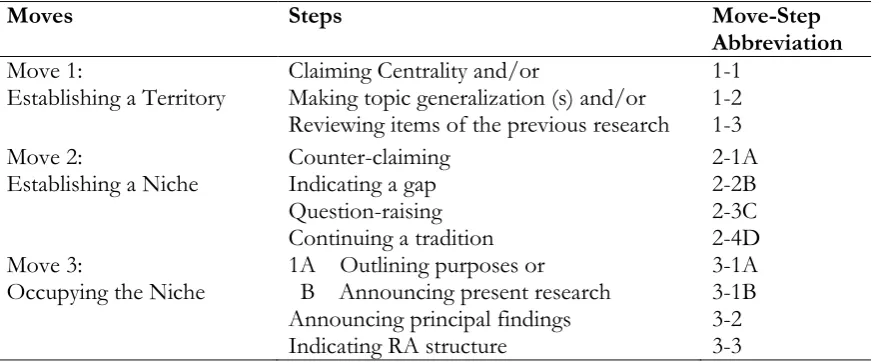
examine and to describe academic discourse. Mirahayuni (2002) strongly argued that Swales’ theory on Create a Research Space (CARS) model as illustrated in Table 1 is one that is able to provide a clear picture of the textual characteristics of RA introduction.
Table 1.The CARS model by Swales (1990)
Moves Steps Move-Step
Abbreviation
Move 1:
Establishing a Territory
Claiming Centrality and/or
Making topic generalization (s) and/or Reviewing items of the previous research
1-1 1-2 1-3 Move 2:
Establishing a Niche Counter-claiming Indicating a gap Question-raising Continuing a tradition
2-1A 2-2B 2-3C 2-4D Move 3:
Occupying the Niche 1A Outlining purposes or B Announcing present research Announcing principal findings Indicating RA structure
3-1A 3-1B 3-2 3-3
Moreover, Chalal (2014) said that the CARS model by Swales especially the Swales’ 1990 version as clearly shown in Table 1 employs an ‘ecological metaphor’ (p.2). This term is used to describe the content schema structure (Move/Step) of research article introductions. According to CARS model, a writer begins an introduction section by establishing a territory (Move 1). This is then followed by establishing a niche within that territory (Move 2) and by occupying that niche (Move 3).
In addition to Move, CARS model also suggests that each move consists of at least one component of steps. For example, Move 1 can be realized through a centrality claim (Move 1- Step 1) and/or topic generalizations (Move 1- Step 2). Additionally, Move 1 can also be realized through reviewing items of the literature (Move 1- Step 3). Arsyad (2013) contended that the steps within each move are characterized by certain linguistic clues especially cohesive devices such as conjunction (Swales, 1990; Joghtong, 2001). Furthermore, Move 2 can be established through the use of Step 1 in which the writer indicates a counter-claiming of the existing theory or research finding (Move 2- Step 1) or through the use of Step 2 where the writer shows a gap in the literature (Move 2- Step2). Finally, this Move 2 is sometimes realized through the use of Step 3 (question raising) and Step 4 (continuing a tradition). Like Steps within each Move, Chalal (2014) said that a shift from Move 1 to Move 2 in an Introduction section can be signed linguistically through the use of devices such as adverse sentence connectors (e.g., ‘however’ and ‘nevertheless’) and negative quantifiers (e.g., ‘no’ and ‘little’).
& Najjar, 1987). Swales & Najjar (1987) emphasized that this possibility may occur in a longer introduction section and this cycle form of move structure presentation is very common to be found in the field of applied linguistics as a divergent field (Swales, 1990) which has various focuses (Yang, 2016).
Research Method
Research design
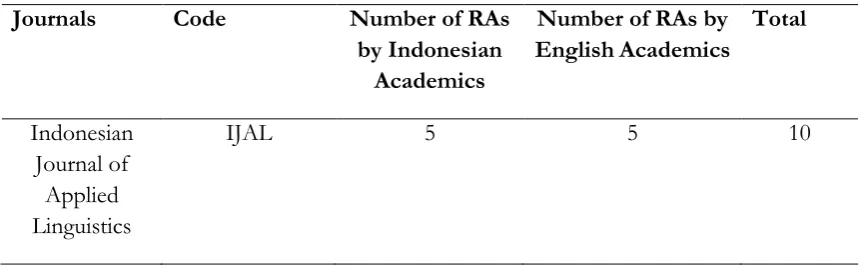
This study was an exploratory study focusing on the textual analysis of the rhetorical structure of ten preliminary samples of research article introductions (five research article introductions for each) in the area of applied linguistics written by Indonesian and English academics. This study adopted a qualitative approach based on a small number of texts and textual units therein (Arsyad, 2013). Biber et al. (2007) said that discourse analysis in general and move analysis in particular, has typically been a qualitative approach to analyzing discourse, with studies focusing only on few texts. Therefore, this study does not make claims as to the size, frequency and representativeness of the data or the generalizability of the findings beyond the scope of the examined articles. Rather, the detailed textual analysis of a small number of introductions may serve as a preliminary indication of some trends displayed in RAI writing in the area of applied linguistics as observed in the examined texts (Bruce, 2014). Therefore, future research is needed to validate these findings across purposefully designed corpora containing more sizable and diverse compilations of applied linguistics texts (Lim, 2012).
Table 2. The distribution of RAs in the corpus of this Study
Journals Code Number of RAs
by Indonesian Academics
Number of RAs by English Academics
Total
Indonesian Journal of
Applied Linguistics
IJAL 5 5 10
Data analysis
The analysis of ten research article introduction sections written by both Indonesian and English writers refers to the procedures as suggested by Dudley-Evans (1994) below:
1) The abstracts and key terms were read in order to get an initial insight of the RA to analyse;
3) Each RA introductions was read intensively and recursively to examine the texts in relation to the application of CARS theory by Swales (1990) through the linguistic and the discourse clues available in the texts;
4) The Move analysis applied in the texts as suggested by Swales (1990) is used to analyse the discourse style in each introduction section of the ten research articles analysed in this study;
Finally, the identification of Moves structure in the introduction sections analyzed in this study was done through the use of particular lexical items, cohesive markers and other kinds of discourse clues including the sub-section titles and paragraphs within the text. In Section 4 to follow, results and discussions of this study is presented.
Results
The results of analysis on rhetorical moves as suggested in the Create a Research Space (CARS) model proposed by Swales (1990) in the article journal introduction section of Indonesian and English writers are presented in Table 3.
Table 3. Rhetorical moves structure of introduction section by Indonesian and English academics
No Moves Indonesian
Academics
English Academics
1 M1: Establishing a Territory 5 (100%) 5 (100%)
2 M2: Establishing a Niche (citation possible) 5 (100%) 5 (100%)
M3: Occupying the Niche 5 (100%) 5 (100%)
Table 3 shows that all moves (Move 1, 2 and 3) are used in the discourse structure of the ten introduction sections written by both Indonesian and English writers analysed in this study. This finding, in general, clearly shows that there is no difference between Indonesian and English academics in terms of Move used in their introduction sections. This correlates with what Arsyad (2013) said that the Indonesian academics today are well trained to academic convention especially in dealing with research article writing which adopts a rhetorical structure that is used in the international journal. This could be a reason for this similarity of Move realisation in the introduction section to take place by the writers from these two academic backgrounds (Wannaruk & Annuai, 2016; Suryani et al., 2013).
Discussion
Move 1: Establishing a territory of the RAIs by Indonesian and English academics
Move 1, as shown in Table 4, is found in all ten introduction sections (100%) written by both Indonesian and English writers analysed in this study. This Move 1, Swales (1990) argued, is used to introduce the research topic and to show the boundary of the research. In Move 1, the writers usually refer to relevant previous studies in order to support their claims. This use of reference also functions to assure that the claim that is made is stronger and is therefore worth investigating (Arsyad, 2013). In addition, according to CARS (Swales, 1990, 2004), RAIs typically begin with the writer’s efforts of showing the significance of the research under study. This is done, for example, by showing that the topic is interesting and important (claiming the centrality of the topic). Additionally, showing the significance of the study is also conducted by making a topic generalisation through relating it to the field’s state of knowledge or other existing previous studies (Chahal, 2014). The following are examples of Move 1 as found in the ten articles analysed in this study.
Table 4. Examples of move 1 by Indonesian academics
Text Example of Move 1
1IA Curriculum in public schools is always changing along with what occurs in the society (Move 1 Step 2)
2IA People usually have tendency to air their feeling, plans, intuition and views in communication with other people. In addition to speaking that is usually used to express the tendency, writing also becomes the means to transform the tendency into action (Move 1 Step 2)
3IA Language is one of natural basic abilities granted to human beings (Move 1 Step 2) 4IA Stories have been an essential part of Indonesian cultures. It is reflected in the
country’s motto “Bhineka Tunggal Ika” (unity in diversity) that was taken from a 14th century old Javanese epic poem (Move 1 Step 1)
5IA English in Indonesia is considered as a Foreign Language, and according to the government’s directive, English is started to be taught as early as possible (Move 1 Step 2)
Table 5. Examples of move 1 by English academics
Text Example of Move 1
1EA The repetitious study of a pre-determined list of items has repeatedly been shown to have great advantages for long-term memory formation within both SLA research and other related fields (Move 1 Step 3)
2 EA An increasing attention has been given to the concept of genre because of the shifting views that language is shaped by context to achieve social purposes (Move 1 Step 1)
4 EA Teachers’ knowledge base relies on the input of new research information (Move 1 Step 2)
5 EA Fluency in language use is an integral part of language learner development (Move 1 Step 2)
Tables 4 and 5 demonstrate that Move 1 in the Introductions sections written by both Indonesian and English writers is mainly realised through the use of Step 1-2, where the writers provide readers with general information about the topic of the research and with statements about challenging phenomena. Move 1 is also presented by the writers through highlighting the significance of the study. This is realised by primarily use of lexical items such as “always” (1IA), “essential” (4IA), “usually” (2IA), “considered as” (5IA), and ‘constantly’ (3EA). In addition, the ten RAIs analysed in this study also employ reviewing of the existing previous studies (Step 3) in order to establish the territory of the research (1EA). This is done by showing findings of the previous studies leading to a conclusion that the present study is worth examining to further inform the field or discipline. Another characteristic of the ten research article introductions analysed in this study is by showing the relevance of the research topic in answering current problems happening in the field of the study. Swales (1990) said that this use of Move 1-Step 1 as found in 4IA (Indonesian academics) and 2EA (English academics) is common especially in a divergent field such as applied linguistics that ‘has an interdisciplinary focus’ (Bruce, 2014., p.3). Therefore, any claims related to the research topic in this discipline is important to be explicitly presented (Chahal, 2014; Lim, 2012).
Move 2: Establishing a niche of the RAIs by Indonesian and English academics
Table 6. Move 2-step 2 by Indonesian academics
1 However, no prior research, particularly in the Indonesian context, yet observes the possible patterns of corrective feedback in the interactions of EFL classrooms which adopt Communicative Language Teaching (CLT) approach (Text 3IA)
2 However, it seems that there are a few studies investigating this issue in the context of teaching and learning English as a foreign language (Text 4IA).
The examples in Table 6 clearly show that the Indonesian writers try to show limitations of the previous studies and directly suggest that the present research is worth doing for the current contribution into the field (Wannaruk & Annuai, 2016). They also show that the study that is conducted would be valuable to both enrich the existing theory of the field and to improve certain products/models (Arsyad, 2013; Adnan, 2005). Similar to Indonesian academics, the English academics also use indicating gap to establish the niche as can be seen in Table 7.
Table 7. Move 2-step 2 by English academics
1 Few studies have attempted to directly determine where these points may occur; however, most memory studies focus instead on the structure and limits of the working memory and/or the transition to long-term memory storage (text 1EA)
2 Very few studies were conducted to examine the dynamics of interview in a broadcast media context (text 2EA)
3 Writing emerged as a distinct area of concern and discussion in the field of English as a second language learning and teaching in the post-World War II era United States, where a growing number of international students were enrolling in higher education institutions (text 5EA)
Move 3: Occupying a niche of the RAIs by Indonesian and English academics
To fill the gap that is previously raised in Move 2, it is common that research article writers offer information about reasons for why the present study is conducted which is labelled as Move 3 in the CARS model by Swales (1990). This Move includes a statement of research purpose (Step 1A), principal findings of the research (Step 2) and/or the structure of the research (Step 3). In the ten research article introductions written by both Indonesian and English writers, it is found that Move 3-Step 1A (highlighting the aim of the research) is dominantly used. The realisation of this Move 3-Step 1 is indicated by the use of lexical items like “to focus on” (1IA), ‘to address’ (3IA), ‘ to contribute’ (5IA), as in, ‘this study attempts to contribute to the knowledge base by examining corrective feedback patterns provided by teachers in the interactions of Indonesian university classrooms which adopt CLT ….’ (2IA). Another example of the use of Move 3-Step 1A is also found in the introduction section written by the English writers as in, ‘the present study focuses on analyzing the written discourse (i.e. printed mode) of the interviewing style of Oprah Winfrey, specifically, the phases of Oprah’s interviewing procedures, the typology of the questions she used in her interviews, and the transitional strategies she executed….’ (EA2). The dominant use of this Move 1-Step 1 by both Indonesian and English writers as found in this study may indicate the writers’ awareness of the clear goal of the research to make it in line with the research methodology being applied in the study (Yang, 2016; Mirahayuni, 2002).
Additionally, this study also found another step used in Move 3 by the Indonesian writer that is Step 3B (announcing the present research) as in, ‘this paper reports on an action research that investigates the role of mentor coaching in helping pre-service teachers of English as a Foreign Language design lesson plans to prepare themselves in facing their teaching practices and how they respond to the technique’ (5IA). This is used, as Arsyad (2013) said, to provide a clear ‘outcome of the research conducted’ (p. 57) by the writer.
Finally, it is interesting to note that the analysis of the ten articles in this study found an additional step of Move 3 which is not mentioned in the Move structure as proposed by Swales (1990). One out of five research article Introductions written by Indonesian academics have Move 3 that is identified as the implications of the research given mostly at the end of the introduction section as illustrated in the following example.
It is expected that the findings of this study will put forward salient points for the development and promotion of LA in Indonesian contexts, which in turn will be beneficial for the improvement of effective teaching and learning process to promote better learning outcomes (text 1IA).
Showing the future implications of the present study, one that is not found in the research article introductions written by the English academics, seems to be used by the researchers to show that the research offers real values and practical applications in the real life (Adnan, 2005; Arsyad, 2013). In other words, they put the emphasis on the results of the study rather than the procedure or the structure of the research (Lim, 2014).
Conclusion, Implications, and Limitations
and 3) are identified in the ten articles written by writers from the two different language backgrounds. Move 1 is realised mainly through Step 1 and 2. This means that the writers provide readers with general information about the topic of the research and with statements about challenging phenomena. Other Steps used include Step 1 (showing the relevance of the topic under study in answering current problems happening) and Step 3 (showing findings of the previous studies leading to a conclusion that the present study is worth examining to further inform the field under study). This study also found that Move 2 is mostly realised through the use of Step 2 (indicating a gap) in the ten articles analysed in this study. This is done by showing the complete absence, limited studies, and distinctness of research in the field conducted by both Indonesian and English writers. Finally, in Move 3 for realisation, a similar trend is shown by both Indonesian and English writers in which Step 1A (outlining the purposes of the study) is dominantly used. Apart from an additional Step provided by Indonesian writer (showing the implications of the study, Step 4) which is not found in CARS model by Swales (1990), dominant Steps used in Move 3 by both Indonesian and English writers are Step 2 (announcing a principal finding) and Step 3B (announcing the present research). All these suggest that there are no more significant differences of Move-Steps realisation by writers of both Indonesian and English as also reported by Arsyad (2013) and Suryani et al., (2013).
The findings of the present study may have essential implications especially in the design of the ESP program in the area of English language teaching (ELT) in Indonesia. For example, the results of this study may inform the curriculum design or text book materials of English for Academic Purposes (EAP) programme especially those related to academic writing. In this case, teachers as book writers, for example, may provide detailed explanations regarding moves-steps concept as suggested in the CARS model by Swales (1990). Additionally, this finding is also important for ESP development specialised for Indonesian scholars who may need to publish their research in the international journal in that this brings them a sense of awareness that Swales’ rhetorical structure model has been one that is deserved to follow in order to be accepted in the English journal.
However, the findings of this study are based on a small and limited number of research article introductions. In addition, in this study no comparative analysis of the texts by raters was provided. Therefore, the results from this small-scale study need further validation through larger numbers of RAIs especially in the area of applied linguistics corpora before any generalisation is made and this result of this study can only be considered to be indicative.
References
Adnan, Z. (2009). Some potential problems for research articles written by Indonesian
academics when submitted to international English language journals. The Asian EFL Journal Quarterly, 11(1), 107-125.
Amalia, L.L., & Imperiani, E. (2013). Mentor coaching to help pre-service teachers in designing an effective lesson plan. Indonesian Journal of Applied Linguistics, 2(2), 275-280.
Arsyad, S. (2013). A genre-based analysis on discussion section of research articles in Indonesian written by Indonesian speakers. International journal of linguistics, 5(4), 50-70. Barrot, J. (2012). The written discourse of interviewing style for a magazine
interview. Indonesian Journal of Applied Linguistics, 2(1), 93-103.
Barrot, J. (2015). A sociocognitive-transformative approach to teaching writing. Indonesian Journal of Applied Linguistics, 4(2), 113-122.
Biber, D., Connor, U., & Upton, T.A. (2007). Discourse on the move: Using corpus analysis to
describe discourse structure. John Benjamins Publishing.
Bruce, I. (2014). Expressing criticality in the literature review in research article introductions in applied linguistics and psychology. English for Specific Purposes, 36, 85-96.
Chahal, D.(2014). Research article introductions in cultural studies: A genre analysis exploration of rhetorical structure. Journal of Teaching English for Specific and Academic Purposes, 2(1), 1-20.
Chang, P., & Schleppegrell, M. (2011). Taking an effective authorial stance in academic writing: Making the linguistic resources explicit for L2 writers in the social sciences. Journal of English for academic purposes, 10(3), 140-151.
Dudley-Evans, T. (1994). Variations in the discourse patterns favoured by different disciplines and their pedagogical implications. Academic listening: Research perspectives, 146-158.
Damayanti, I.L. (2017). From storytelling to story writing: The implementation of reading to learn (r2l) pedagogy to teach English as a foreign language in Indonesia. Indonesian Journal of Applied Linguistics, 6(2), 232-245.
Hirano, E. (2009). Research article introductions in English for specific purposes: A comparison between Brazilian Portuguese and English. English for specific purposes, 28(4), 240-250.
Holmes, R. (1997). Genre analysis, and the social sciences: An investigation of the structure of research article discussion sections in three disciplines. English for specific Purposes, 16(4), 321-337.
Hopkins, A., & Dudley-Evans, T. (1988). A genre-based investigation of the discussion sections in articles and dissertations. English for Specific Purposes, 7(2), 113-121.
Jogthong, C. (2001). Research article introductions in Thai: Genre analysis of academic
writing (Doctoral dissertation, West Virginia University).
Kanoksilapatham, B. (2012). Research article structure of research article introductions in three engineering sub-disciplines. IEEE Transactions on Professional
Communication, 55(4), 294-309.
Kanoksilapatham, B. (2005). Rhetorical structure of biochemistry research articles. English for Specific Purposes, 24(3), 269-292.
Kanoksilapatham, B. (2007). Writing scientific research articles in Thai and English: Similarities
and differences. Silpakorn University International Journal, 7, 172-203.
Kitchen, M., Jeurissen, M., Gray, S., & Courtney, M. (2017). Teacher engagement with academic reading in a post-service tesol course. Indonesian Journal of Applied Linguistics, 6(2), 260-270.
Lengkanawati, N.S. (2017). Learner autonomy in the Indonesian EFL settings. Indonesian Journal of Applied Linguistics, 6(2), 222-231.
Liskinasih, A. (2016). Corrective feedbacks interaction in CLT-adopted classrooms. Indonesian Journal of Applied Linguistics, 6(1), 60-69.
Lubold, S.L., Forbes, S., & Stevenson, I. (2016). The effect of topic selection on writing fluency among Japanese high school students. Indonesian Journal of Applied Linguistics, 5(2), 231-241.
Mirahayuni, N.K. (2002). Investigating generic structure of English research articles: Writing strategy differences between English and Indonesian writers. TEFLIN Journal, 13(1), 22-57.
Oberg, A. (2012). Receptive and productive vocabulary acquisition: examining processing time
and memory threshold. Indonesian Journal of Applied Linguistics, 2(1), 23-39.
Ruiying, Y., & Allison, D. (2003). Research articles in applied linguistics: Moving from results to conclusions. English for specific purposes, 22(4), 365-385.
Septiana, A.R., Sulistyo, G.H., & Kadarisman, A.E. (2016). Corrective feedback and writing accuracy of students across different levels of grammatical sensitivity. Indonesian Journal of Applied Linguistics, 6(1), 1-11.
Stoller, F.L., & Robinson, M.S. (2013). Chemistry journal articles: An interdisciplinary approach to move analysis with pedagogical aims. English for Specific Purposes, 32(1), 45-57.
Suryani, I. and Rahim, A., (2016) ‘A genre analysis of the introduction section of computer science
research articles by Malaysian researchers’ (Doctoral dissertation, Universiti Utara
Malaysia).
Swales, J., &Najjar, H., (1987) ‘The writing of research article introductions’. Written communication, 4(2), 175-191.
Swales, J. (1990).Genre analysis: English in academic and research settings. Cambridge University Press.
Suryani, I., Kamaruddin, H., Hashima, N., Yaacob, A., Rashid, S.A., & Desa, H., (2013). Rhetorical structures in academic research writing by non-native writers’. International Journal of Higher Education, 3(1), 29.
Suntara, W., & Usaha, S. (2013). Research article abstracts in two related disciplines: Rhetorical variation between linguistics and applied linguistics. English Language Teaching, 6(2), 84.
Biographical note