A CASE STUDY ON MAC DESIGN USING
HIGH-PERFORMANCE NIKHILAM –
SUTRA VEDIC MULTIPLIER
KEERTHI MADDAMSETTI
Department of Electronics and Communication Engineering Lendi Institute of Engineering & Technology Jonnada, Vizianagaram- 535005, Andhra Pradesh, India.
RAJAN BABU MALLAVARAPU
Department of Electronics and Communication Engineering Lendi Institute of Engineering & Technology Jonnada, Vizianagaram- 535005, Andhra Pradesh, India.
Abstract
As of late progressed computerized process requests
more refined parameters, for example, throughput, power
and territory. It is extremely hard to keep up high
throughput while keeping up ideal power utilization and
cell territory. In the vast majority of the advanced
frameworks multipliers are choosing their execution as far
as above parameters. In the present work rapid Vedic
multipliers are composed with pipeline innovation. As the
MAC speed is chosen by Vedic Multiplier, in the present
paper Multiplier and Accumulator (MAC) is outlined with
two-way pipeline innovation to meet high throughput. Vedic
Multipliers are utilized as a part of outlining MAC unit as
they are quick multipliers and further improving the
information speed. This article explores on the performance
analysis MAC using Nikhilam sutra multiplier which is the
fast multiplier among the other vedic multiplication
algorithms. The MAC unit was designed using Nikhilam
sutra multiplier and the adder was implemented using
various design methods. The performance comparison of
each MAC design implemented with different adders was
described below. The MAC was implemented in both ASIC
and FPGA design flows.
Keywords: Multiply – Accumulate Unit (MAC),
Nikhilam sutra multiplier, Parallel Prefix Adder, Vedic
Multiplier .
I. INTRODUCTION
Arithmetic operations, for example, expansion, subtraction and augmentation are conveyed in
different advanced circuits to accelerate the procedure of calculation. Number juggling rationale unit is likewise actualized in different processor designs like RISC [2], CISC and so forth., when all is said in done, number-crunching operations are performed utilizing the stuffed decimal organization. This implies the fields are first changed over to pressed decimal organization before playing out the number juggling operation, and after that changed over back to their predefined design (if important) preceding putting the outcome in the outcome field.
Vedic science has turned out to be the strongest strategy for number juggling operations. Interestingly, traditional methods for increase give huge measure of postponement in equipment usage of n-bit multiplier. Besides, the combinational postponement of the outline corrupts the execution of the multiplier. Equipment construct increase for the most part relies on engineering choice in FPGA or ASIC.
The hardware resource usage of Vedic multiplier utilizing barrel shifter adds to satisfactory change of the speed with a specific end goal to accomplish high outturn.
Section II provides an abrupt introduction of Vedic sutras and modified Nikhilam sutra architecture. Section III describe about the Fast Adders architectures. And the Section IV explains about the MAC design followed by the simulation results and design analysis of basic Conventional multipliers and proposed design in the Section V along with the conclusion.
II. VEDIC MULTIPLIER
Vedic Sutras apply to and cover practically every branch of Mathematics. They apply even to complex issues including a substantial number of scientific operations. Use of the Sutras spares a considerable measure of time and exertion in taking care of the issues, contrasted with the formal strategies directly in vogue. Despite the fact that the arrangements seem like enchantment, the utilization of the Sutras is impeccably consistent, and level headed. The calculation made on the PCs takes after, as it were, the standards basic the Sutras. The Sutras give strategies for estimation, as well as methods for deduction for their application.
Utilization of the Sutras enhances the computational aptitudes of the students in a wide region of issues, guaranteeing both speed and precision, entirely in light of level headed and legitimate thinking. Use of the Sutras to particular issues includes level headed considering, which, all the while, enhances instinct that is the base - line of the authority of the scientific virtuosos of the past and the present, for example, Aryabhatta, Bhaskaracharya, Srinivasa Ramanujan, and so forth.,
Multiplier execution utilizing FPGA has just been accounted for utilizing distinctive multiplier structures however the execution of multiplier was enhanced in proposed plan. By utilizing Vedic multiplier utilizing adjusted "Nikhilam
Navatascaramam Dasatah" sutra. The design in [1] is changed utilizing barrel shifter by which noteworthy measure of clock cycles are lessened by ideals of which the speed increments. The execution of the proposed multiplier is contrasted and the beforehand actualized multipliers on FPGA. The "Vedic science" is contained sixteen straight forward numerical formulae from the Vedas.
1. Ekadhikena Purvena
2. Nikhilam navatascaramam Dasatah 3. Urdhva - tiryagbhyam
4. Paravartya Yojayet
5. Sunyam Samya Samuccaye 6. Anurupye - Sunyamanyat 7. Sankalana - Vyavakalanabhyam 8. Puranapuranabhyam
9. Calana - Kalanabhyam 10. Ekanyunena Purvena 11. Anurupyena
12. Adyamadyenantya - mantyena
13. Yavadunam Tavadunikrtya Varganca Yojayet 14. Antyayor Dasakepi
15. Antyayoreva Gunita Samuccayah
Proposed Multiplier Architecture Design:
Expect that the multiplier is 'X' and multiplicand is 'Y'. Despite the fact that the assignment of the numbers is unique, yet the engineering executed is same to some degree for assessing both the numbers. The mathematical expression for modified nikhilam sutra is given below.
P=X*Y= (2^k2) *(X+Z2*2^(k1-k2))+Z1*Z2. – (1) Where k1, k2 are the maximum power index of input numbers X and Y respectively. Z1 and Z2 are the residues in the numbers X and Y respectively. The hardware deployment of the above expression is partitioned into three blocks.
I. Base Selection Module
The base selection module (BSM) is utilized to choose the greatest base concerning the information numbers. The second sub-module control list determinant(PID) is utilized to separate the power file of k1 and k2. The multiplier contains base selection module (BSM), Power Index determinant (PID), subtractor, barrel shifter, snake/subtractor as sub-modules in the design.
a) BASE SELECTION MODULE:
The base selection module has control list determinant (PID) as the sub-module alongside barrel shifter, viper, normal determinant, comparator and multiplexer.
Operation: An information 8-bit number is encouraged to control file determinant (PID) to decipher most extreme energy of number which is bolstered to barrel shifter and snake. The yield of the barrel shifter is 'n' number of movements as for the viper yield and the info based to the shifter. Presently, the yields of the barrel shifter are given to the multiplexer with comparator contribution as a determination line. The yields of the normal determinant and the barrel shifter are fed to the comparator. The required base is obtained in accordance with the multiplexer inputs and its corresponding selection line.
Fig. 1(a) Base Selection Module
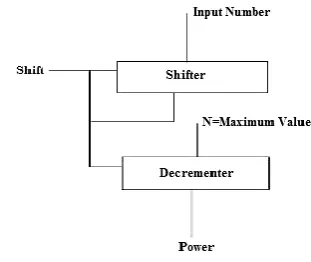
Fig. 1(b) Power Index Determinant Module
The info number is nourished to the shifter which will move the information bits by one clock cycle. The shifter stick is relegated to shifter to check whether the number is to be moved or not. In this power list determinant (PID) the consecutive seeking has been utilized to look for initial '1' in the info number beginning from MSB. In the event that the pursuit bit is '0' at that point the counter esteem will decrement up to the discovery of info look bit is '1'. Presently the yield of the decremented is the required power record of the information number.
b) Multiplier Architecture
The base choice module and the power file determinant frame indispensable piece of multiplier engineering. The engineering figures the numerical articulation in equation1.Barrel shifter utilized as a part of this design. The two information numbers are bolstered to the base choice module from which the base is gotten. The yields of base choice module (BSM) and the info numbers 'X' and 'Y' are encouraged to the subtractors. The subtractor squares are required to remove the leftover parts z1 and z2. The contributions to the power file determinant are from base choice module of particular information numbers.
determinant are encouraged to the third subtractor that sustains the contribution to the barrel shifter. The info number 'X' and the yield of barrel shifter are rendered to first snake/subtractor and its yield is connected to the second barrel shifter which will give the middle of the road esteem. The last sub-area of this multiplier engineering is the second snake/subtractor which will give the required outcome.
Fig. 2 Nikhilam sutra Multiplier Architecture
III. FASTADDERS
There are several fast adder architectures were available. The main idea in this article is to implement the MAC unit with different fast Adders architectures and compare their performance.
I. CARRRY SELECT ADDER:
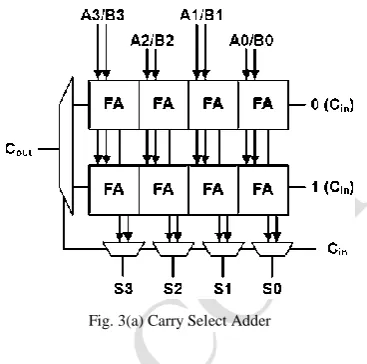
The convey select viper for the most part comprises of two swell convey adders and a multiplexer. Including two n-bit numbers with a convey select snake is finished with two adders (in this manner two swell convey adders). So as to play out the computation twice, one time with the supposition of the convey in being zero and the other expecting it will be one. After the two outcomes are figured, the
right entirety, and in addition the right complete, is then chosen with the multiplexer once the right convey in is known.
Fig. 3(a) Carry Select Adder
The quantity of bits in each convey select piece can be uniform, or variable. In the uniform case, the ideal deferral happens for a bit size. Whenever variable, the piece size ought to have a postponement, from expansion inputs An and B to the complete, equivalent to that of the multiplexer chain driving into it, with the goal that the do is figured without a moment to spare. The delay is gotten from uniform estimating, where the perfect number of full-snake components per piece is equivalent to the square base of the quantity of bits being included, since that will yield an equivalent number of MUX delays.
II. CARRY LOOK-AHEAD ADDER:
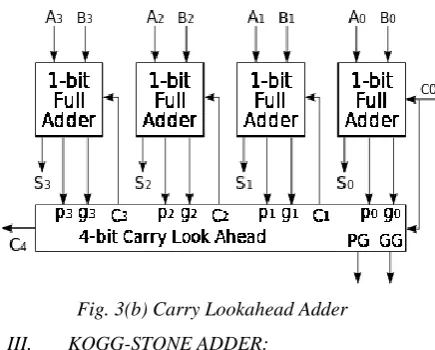
the holdup time to compute the consequence of the bigger esteem bits of the viper.
Fig. 3(b) Carry Lookahead Adder
III. KOGG-STONE ADDER:
Kogge-Stone structure is extremely appealing for fast applications. In any case, it comes at the cost of region and power. The deferral of the structure is given by log2 n. This structure has [(n) (log2 n)-n+1]
calculation hubs. The Kogge-Stone plan tends to the issue of fanout by presenting a recursive multiplying calculation. It utilizes idempotency property to restrict the sidelong fan-out, yet at the cost of an emotional increment in the quantity of sidelong wires at each stage. This is on the grounds that there, is a huge cover between the prefix sub-terms being pre-processed.
Fig. 3(c) Kogg-stone Adder
IV. BRUNT-KUNG ADDER:
The fig. shows the Brunt -Kung adder. A less difficult tree structure could be shaped, if just the convey at each energy of two positions is figured as proposed by Brent and Kung. A converse convey tree is added to figure transitional conveys. Its wire
unpredictability is considerably less than that of a Kogge-Stone viper. The deferral of the structure is given by [(2) (log2 n)-2]2n. The convey is gotten
from the spot administrator arrange talked about before, and the selective of An and B is really the engender flag itself. Consequently, the entirety 'S’. Using the over three phases, the total design is manufactured.
Fig. 3(d) Brunt Kung adder
IV. DESIGN OF MACUNIT
In multiplier the adders will entirety the fractional items one by one in consecutive request, however in MAC the total of the halfway item will be input to the snake through an aggregator. The MAC lessens the overhead about the flood and enhances the information getting rates.
Fig 4. MAC Architecture
V. CONCLUSION
different performance results suggesting CSLA adder based MAC unit will be the most suitable for the high-speed applications.
Fig. 5. Delay analysis of MAC using various adders
VI. REFERENCE
1) Pavan Kumar U.C.S, and A. Radhika, “FPGA Implementation of high speed 8-bit vedic multiplier using Barrel shifter,” IEEE. Trans., ISBN: 978-1-4673-6150-7, pp. 14-17, April 2013.
2) Prabir Saha, Arindam Banerjee, Partha Bhattacharyya, Anup Dandapat, “High speed ASIC design of complex multiplier using vedic mathematics” , Proceeding of the 2011
IEEE Students' Technology Symposium 14-16 January, 2011, lIT Kharagpur, pp. 237-241.
3) Shamsiah Suhaili and Othman Sidek, “Design and implementation of reconfigurable alu on FPGA”, 3rd International Conference on Electrical & Computer Engineering ICECE 2004, 28-30 December 2004, Dhaka, Bangladesh, pp.56-59.
4) Sumit Vaidya and Deepak Dandekar, “Delay-power performance comparison of multipliers in vlsi circuit design”, International Journal of Computer Networks & Communications (IJCNC), Vol.2, No.4, July 2010, PP.47-56. 5) P. Mehta, and D. Gawali, "Conventional versus
Vedic mathematical method for Hardware implementation of a multiplier," in Proceedings IEEE International Conference on Advances in Computing, Control, and Telecommunication Technologies, Trivandrum, Kerala, Dec. 28-29, 2009, pp. 640-642.