Status and Prospect of Research and
Development in Agriculture in India
Vikas Kumar and Kunal Sinha, PhD
Central University of Gujarat, Centre for Studies in Science, Technology & Innovation Policy, School of Social Sciences, Sector 30, Ganghinagar, India
Corresponding author: [email protected]
Executive Summary
The objective of this paper is to investigate and summarize issues that are critical for agricultural Research and Development (R&D) and economic growth in the Republic of India. Specifically, the paper explores the role played by R&D in the modernization process and the interactions between agriculture and other economic sectors, the determinants of the Green Revolution and the foundations of agricultural growth, issues of income diversification by farmers, approaches to rural development, which have been at the root of the crisis in agricultural commodity volatility in recent years. Due to the scarcity of public funds for research in India, there is paradigm shift in agricultural R&D. The countries with a strong research system where various actors and networks are involved like India have initiated a number of reforms with an objective to diversify the sources of funding and increase research efficiency. Competitive funding, commercialization of technologies, strengthened intellectual property rights, facilitating regulations and flexible extension approach are some of the major reforms undertaken. This paper examines the outcomes of these reforms and draws lessons for other developing countries.
I. Introduction
At the beginning of the twentieth century, Indian agriculture was in a techno-‐economic quagmire and relatively stagnant. To illustrate this, the growth of agriculture was 0.37 percent per annum in 1901-‐4 yet it accelerated 2.68 percent per annum during 1949-‐50 to 1996-‐97 (Blyn, 1966). More specifically, there have been several ups and downs in terms of the agricultural sector’s contribution to the overall economy. In fact, the first five year plan emphasized
agriculture but later plans shifted to industrialization (First Five Year Plan, 1951-‐1956 and Second Five Year Plan, 1956-‐1961 Cited in Planning Commission Report, Government of India, 2014).
The importance of agriculture cannot be exaggerated as it is having a wider role in society at large. Agriculture is an important sector of the Indian economy as it contributes about 17% to the total GDP and provides employment to over 60% of the population (GOI, 2011). Food grain production has increased from 51 million tonnes (MT) in 1950-‐51 to 250 MT during 2011-‐12; the highest ever since national independence. The production of oilseeds (nine-‐major oilseed) has also increased from 5 MT to 28 MT during the same period (GOI, 2011). This rapid growth has helped Indian agriculture mark its presence at the global level. India stands among the top three nations in terms of production of various agricultural commodities like paddy, wheat, pulses, groundnut, rapeseeds, fruits, vegetables, sugarcane, tea, jute, cotton, tobacco leaves, etc. (GOI, 2011). Thus, agriculture has been seen as a source of food, labor, and finance to supply a growing urban and industrial sector on which sustained growth in incomes will depend. Realizing this transition depends on achieving increase in productivity that would check the food prices along with both industrial growth and poverty reduction.
electrical and chemical industries. Then in the
Second World War, R&D became established as the most essential activity for advancing military technology. This led to overall knowledge enhancement and Government increases in R&D expenditures. But most strikingly, the aftermath of Second World War ushered in a proliferation of specialized R&D branches of manufacturing in the leading countries, although R&D strength continued to vary enormously between various sectors i.e. agriculture, chemical industry, electronic industry etc. (Freeman, 2010). R&D has been seen as a production process where research inputs such as R&D spending i.e. equipment, manpower etc. are transformed into research outputs such as invention, innovation and diffusion (Ray & Bhaduri, 2001).
Similarly, with this context many authors (Alston et al 2000; Fan et al 1999 and Fan et al 2002) argue that R&D plays an important role in the growth of agriculture and also helped in reducing poverty. However, the agriculture sector failed to attract significant public funding in the recent past because of the low economic growth of agriculture and its limited contribution to GDP as well as due to factors relating to R&D. With this point R&D has been studied for a long time within various contexts. R&D has been accelerated to the economics of develop and developing countries during the period of 1950s to present. Although, the perspective of R&D
processes have been changing over time. Many scholars have attempted to describe the last 50 years of evolution within the R&D (Roussel, 1991, p. 39; Rothwell, 1994; Miller and Morris, 1998, p. 19; and Chiesa, 2001 p.12)
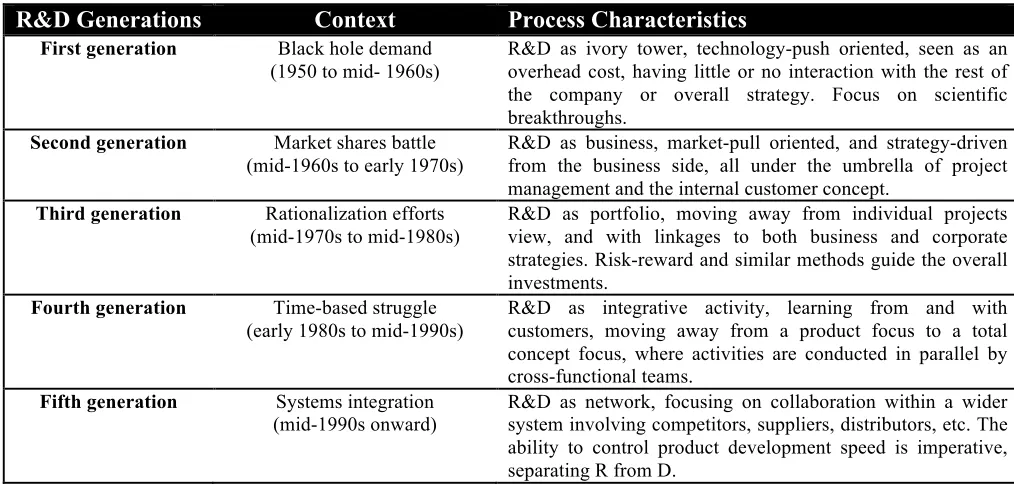
The period of 1950s to 1960s was the first generation of R&D, where new industries emerged and technology was generally seen as the remedy for all ailments (Plez, & Andrews, 1966). It was assumed that more R&D would provide more products. Similarly, the second generation was from the mid-‐ 1960s to early 1970s, where more emphasis was on the sale of products, because at that time the supply and demand were almost equal (Rothwell, 1994). In this period, ideas originated from the market and were refined and developed by R&D. Moreover, the period of the mid-‐1970s to mid-‐1980s was the third generation when the economy was fluctuating with high rates of inflation and demand saturation (Rothwell, 1994). The next period was from the early 1980s to mid-‐1990s, where R&D provided a multiproduct platform, basically it shifted from developing products to putting the products in a total business concept (Miller & Morris, 1998). Finally, the fifth generation starts from the 1990s to present where R&D activities increased global competition, rapid technological change, and the need for sharing heavy technology investments (Rothwell, 1994).
Table 1. Generations of Research and Development from 1950s onwards. Source: Source: Roussel, 1991, p. 39; Rothwell, 1994; Miller and Morris, 1998, p. 19; and Chiesa, 2001, p. 12 cited in Nobelius, D. 2003.
R&D Generations
Context
Process Characteristics
First generation Black hole demand (1950 to mid- 1960s)
R&D as ivory tower, technology-push oriented, seen as an overhead cost, having little or no interaction with the rest of the company or overall strategy. Focus on scientific breakthroughs.
Second generation Market shares battle (mid-1960s to early 1970s)
R&D as business, market-pull oriented, and strategy-driven from the business side, all under the umbrella of project management and the internal customer concept.
Third generation Rationalization efforts (mid-1970s to mid-1980s)
R&D as portfolio, moving away from individual projects view, and with linkages to both business and corporate strategies. Risk-reward and similar methods guide the overall investments.
Fourth generation Time-based struggle (early 1980s to mid-1990s)
R&D as integrative activity, learning from and with customers, moving away from a product focus to a total concept focus, where activities are conducted in parallel by cross-functional teams.
Fifth generation Systems integration (mid-1990s onward)
Thus, there is need to study R&D structure in
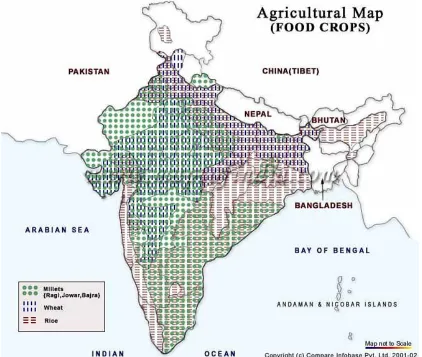
current phenomena in particular agriculture and the impacts on crop farming in India. Figure 1 indicates geographical areas of major crops grown in India.
The green circles plotted in map represents millets crop (Jowar, Bajra, Ragi), similarly, horizontal and vertical dashes represent rice and wheat, respectively.
Figure 1.
Agricultural Map of India. Source: Google India
The paper has been structured in four parts: 1) deals with the development of agriculture research systems in India; 2) examines the challenges before the Agriculture R&D Community; 3) discusses the R&D scenario of India compared with other countries; and 4) addresses the impacts of R&D in agriculture. Finally, the last section summarizes all the arguments. Presently the Indian public agricultural research system has been based on two tiers: the first tier is at the central level which is known as Indian Council for Agricultural Research (ICAR). This institution played a major role in the movement known as the “Green Revolution” and has
the second level consists of a system of state
agricultural universities (SAUs) which deliver state-‐ specific research and education (Pal; Rahija; and Beintema, 2012).
II. Evolution of the Indian Research System for Agriculture
In the period of 19th century the first organization was set up with the establishment of the Department of Revenue, Agriculture, and Commerce in the imperial and provincial Governments, together with a bacteriological laboratory and five veterinary colleges. Then in 1905, the Imperial Agricultural Research Institute (IARI) was established which now known as Indian, along with six agricultural colleges. After that, many commodity committees were formed to develop commercial crops from 1921 to 1958. In 1965, ICAR was the main body of coordination and promoted agriculture research in India. Subsequently, the Department of Agricultural Research and Education (DARE) came under the central Ministry of Agriculture which provided linkages between many institutions i.e., ICAR and the central and state Governments and with foreign research organizations. Moreover, in 1960, the first state university was opened at Pantnagar in the state of Uttar Pradesh which is now in Uttarakhand. These universities received funding from respective states. Though, many public agriculture institutions are now established which play a crucial for crop farming development.
2.1. The Current Structure of the Public Research System
Currently, the Research and Education system on agriculture belongs to the ICAR with various institutes and state agriculture university. ICAR provides funds and builds a network for research on agriculture related issues. In addition, ICAR manages a large number of AICRPs, which draw scientists from both ICAR institutions and the SAUs. Most of India’s coordinated research projects (AICRPs) centres are located on SAU campuses under the administrative control of the respective SAUs. In 2000, ICAR had 5 national institutes (including an academy for agricultural research management), 42 central research institutes, 4 national bureaus, 10 project directorates, 28 NRCs, and 82 AICRPs which has also increased with 99 ICAR institutes and 53 agricultural universities spread across the country;
this is one of the largest national agricultural systems in the world (ICAR, 2013).
Further, National agriculture research system (NARS) which is part of ICAR or SAU system i.e. there are non-‐agricultural universities and organizations that support or conduct agricultural research either directly or indirectly. For example, the departments of biotechnology (DBT), science and technology (DST), and scientific and industrial research (DSIR) under the Ministry of Science and Technology support and conduct agricultural research at their institutes and sometimes fund research in the ICAR/SAU system. The emergence of public institutions led to the increase in profits of the Indian economy and consequently, the private sector invested and benefited from innovation through development of institutions.
2.2. Private-Sector Development
Historically, few private companies invested in agriculture inputs i.e., pesticides, fertilizers and machinery which comes under the product development. Although, after the Green Revolution during the period of 1980s the situation has changed because of liberalized policies to support private sector development, the growing availability of trained scientists, rapid expansion of markets for agricultural inputs and processed foods. Now the private companies have been developed supplying more than 50% of agriculture inputs. These companies have focused on hybrid seed, biotechnology, pesticides, fertilizer, machinery, animal health, poultry, and food processing. The cause of this investment is because the Government provided strong incentives in the form of tax exemptions on research expenditures and venture capital, and liberal policies on the import of research equipment to encourage participation of the private sector in research.
Pal, and Morris 1995; Pray, Ramaswami, and Kelley
2001), and companies with some foreign ownership account for about one-‐third of this market (Pray and Basant 2001). Similarly, participation of private non-‐ profit organizations in agricultural research has also increased. There are now a few private foundations, as well as NGOs, actively engaged in agricultural research. In particular, the M. S. Swaminathan Research Foundation and Mahyco Research Foundation have developed considerable research capacity with a national presence and are working in close collaboration with the ICAR/SAU system. In addition, many small, regional, and local NGOs are engaged in agricultural research, such as those managing some ICAR-‐sponsored KVKs.
III. Indian R&D in A Global Context
Developing countries like India, China and Brazil where the economy is based on agriculture have
become major forces in the global agricultural economy. It is therefore useful to compare Indian agricultural R&D investment trends with those in these two other emerging economies. India’s recent spending growth in public agricultural R&D was impressive at 25 percent during 2000–07, but comparison with China provides relative perspective as China’s spending almost doubled during the same period. Similarly, Brazil has one of the most well established and well-‐funded research systems in the developing world, although spending levels there have fluctuated over the past two decades. Rapid growth, particularly in China, has meant that investments by the three countries combined accounted for at least half of the developing world’s total public investment in agricultural R&D in 2000 (Beintema and Stads 2010). From the table, India invested $0.40 for every $100 of AgGDP in 2008. This is less than the comparative figure for China,
Table 2. Public agricultural R&D spending and intensity ratio, 2000 and 2008. Source: Pal, Rahija and Beintema, 2012.
Year
2000
2008
2000
2008
Countries/Regions
Billion 2005 prices
$ per $100 of Ag GDP
India
1.5
2.3
0.36
0.40
Brazil
1.2
1.3
1.86
1.80
China
1.7
3.4
0.38
0.50
Australia
0.8
0.6
4.57
3.56
Japan
2.6
2.7
4.06
4.75
South Korea
0.6
0.7
1.60
2.30
which invested $0.50 for every $100 of AgGDP in 2008; it is also less than the average of $0.56 for developing countries in 2000. In contrast, Brazil and Asia’s high income countries invested much larger shares of their AgGDP in R&D, ranging from $1.80 for Brazil to $4.75 for Japan. Though, investment in R&D depends on availability of funding and Government policy. The current national agricultural policy anticipates that market forces will guide future agricultural growth through domestic market reforms, an increasing role for the private sector, and removal of price distortions. For example, the policy intervention targeting public distribution of food grains to the poor can have substantial effects on the food grain market. Thus, there is a need to study the cross functional interactions between the
R&D team as well as the marketing and sales team. Additionally, the legal team has to ensure that IP due diligence has been complied with, i.e., patents, trademarks, copyright and designs have been filed, appropriate non-‐compete and confidentiality agreements have been executed, deed of assignments are executed, etc.
3.1. Human Resources in the Indian Research and Development
education, research and extension. It is roughly
estimated by Pal et.al., (1997), and Ramaswamy and Selvraj (2007) that the number of scientists working in the ICAR/SAU system during the late 1980s was approximately 4,189 scientists in ICAR and 14,851 scientists in the SAUs, giving a total scientific strength of 19,040. The number of scientists remained steady in the ICAR during the 1990s (4,092 in 1998) and increased to 4609 in 2005-‐ 2006 (DARE/ICAR, 2006). However, the numbers decreased significantly in the SAUs. It has declined by 24 percent in the last decade (Ramaswamy and Selvraj, 2007) because of non-‐replacement of retiring faculty and restrictions on recruitment.
Adjusting the number of scientists by share of research expenditure relative to extension and education (for ICAR) and percent time spent on research (for SAUs), the number of full-‐time scientists in the late 1990s was 2,999 in ICAR and 8,132 in SAUs, giving a total of 11,131 full-‐time researchers in the country and making it one of the largest agricultural Research and Development (R&D) systems in the world. In 2005-‐2006 the agricultural scientists of the ICAR institutes were supported by a large technical staff (7355), administrative staff (4705) and supporting staff (9067). However, the ICAR as well as the SAUs are downsizing the administrative staff to balance the ratio of scientific staff to supporting staff.
To provide experience-‐based and skill-‐oriented hands-‐on training to students, 19 Experimental Learning Units were added in 51 universities to the existing 264 units. Operational guidelines for the National Professorial Chairs and National Fellowships were revised for more functional autonomy and efficient execution, and 16 new ICAR National Fellows were appointed. Three universities (Sri Venkateswara Veterinary University, Tirupati; Shere-‐ Kashmir University of Agriculture and Technology, Jammu; and Navsari Agricultural University, Navsari) were accredited. Niche Areas of Excellence were supported to achieve global competence in agricultural research, teaching and consultancy in the specific fields. In order to reduce inbreeding, 1,763 students in the undergraduate level and 2,076 students in the postgraduate level were admitted through centralized admission by the ICAR. Besides, the ICAR International Fellowships,
the India-‐Africa Fellowship and India-‐Afghanistan Fellowship programmes were continued for higher studies in the Indian Agricultural Universities.
All-‐India Entrance Examination for Admission to UG and PG: For admission up to 15% seats in agriculture and allied subjects other than veterinary sciences, 16th All-‐India Entrance Examination for Admission to undergraduate degree programmes (AIEEA-‐UG-‐2011) including the award of National Talent Scholarships (NTS) was conducted on 16 April 2011. In this examination, 34,741 candidates appeared and a record number of 1,763 candidates were finally recommended for admission in 49 Universities through counseling. All the candidates who joined a university falling outside their State of domicile were awarded NTS of 1,000 Rupees per month. For admission to 25% seats in PG programmes at 56 Universities, including award of ICAR Junior Research Fellowships, AIEEAPG-‐ 2011 examination was conducted on 17 April 2011. A total of 19,413 candidates appeared in the examination and admissions were recommended to 2,076 candidates, out of which 472 students were awarded JRF in 20 major subject groups. A total of 186 Senior Research Fellowships were awarded and 561 candidates were declared qualified for Ph.D. admission without fellowship in 13 major subject groups and 56 sub-‐subjects through an examination held on 12 December 2010 (ICAR, 2013).
IV. Impact of R&D on Agriculture in India
Table 3. Trends in notified varieties of major field crops. Source: Pray & Nagarajan. 2012.
Number of notified varieties and hybrids by decade Crop
1980-‐
1989 1990-‐1999 2000-‐2010
Rice 198 188 303
Wheat 84 66 112
Maize 43 64 113
Pearl millet 38 45 51
Sorghum 55 49 55
Cotton 72 78 95
Total 490 490 729
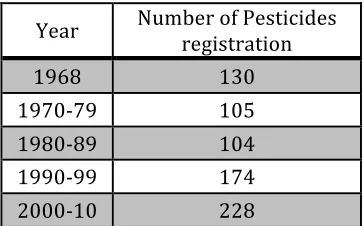
Similarly, pesticides registrations have increased rapidly since the 1980s. Twice as many pesticides were registered in the first decade of the 21st century as were registered in the 1980s below figure. These registrations, all by private companies, are primarily new formulations of active ingredients, but some new active ingredients and formulations for new crops, especially horticulture crops, have been developed.
Table 4. New pesticide registrations by decade, 1968–2010. Source: Pray & Nagarajan. 2012.
Year Number of Pesticides registration
1968 130
1970-‐79 105
1980-‐89 104
1990-‐99 174
2000-‐10 228
Other innovations in the seed industry were primarily developed by the private sector. Varieties of other crops such as cotton, maize, pearl millet, and sorghum, which are all hybrids in India, primarily come from the private sector (Table 5).
Table 5. Numbers of field crop varieties by public-‐ and private-‐sector institutions in India, 2005–2010. Source: Pray & Nagarajan. 2012.
Crops Hybrids Private Notified Public Varieties
2005-‐2010 2005-‐2010
Rice 79 240
Wheat 40 95
Maize 136 87
Pearl millet 97 48
Sorghum 75 46
Cotton 255 70
Total 603 346
V. Factors for the Growth of R&D in public and private sector
The growing demand for agricultural products and the need to ensure food security are major factors inducing R&D growth and innovation in India. These also have effects on the market structure. For instance, increases in per capita income have increased demand for food, especially high-‐quality food such as vegetables, fruit, milk, and meat. Increased income and urbanization have also increased the demand for processed and fast foods. Hence, to meet the growing demand for food, there is a need to increase R&D.
Table 6. Size of the market and research intensities of private agribusiness. Source: Pray and Nagarajan, 2012.
% Research
intensity
Sector
Market Size
2009 (in
millions of
2005 $US)
1990 2009
Seed andBiotechnology 1,300
3.5-3.8 6.9
Pesticides 3,200
0.8-0.9 1.1
Fertilizers 13,732 0.22 0.1
Agricultural
machinery 2,100 1.0 1.2
Poultry and feeds 1,010 1.0 0.8
Animal health 325 NA 5.7
Food, beverages, processing, and
plantations
5650 NA 0.5
The table demonstrates that research intensity has been increased from 1990 to 2009 in mostly all the sectors except fertilizers and poultry and feeds. One of the reasons for the decreasing growth in fertilizers is due to environmental concerns. Within this context, the organic farming concept has become important. One can see from the table that seed and biotechnology research has been increased rapidly. The reason of increment in research intensity is the liberalized policy of the Indian Government and success of the Green Revolution which has attracted investors in the field of agriculture. Moreover, the strengthening of the laws
governing appropriate benefits of new technology has encouraged more R&D in innovation. The agricultural sector increasing its research intensity the most is seeds/biotech which has the second-‐ highest number of agricultural patents and also protects its innovations with plant variety restrictions. Pesticide research has the most agricultural patents, which may account for some of the growth and intensity of research in that industry. In addition to market size and somewhat stronger IPRs, other major factors contributing to growth of private agricultural R&D in India are rapid advances in basic biological research and information technology, and growth of public sector R&D. Biotechnology spread to the agricultural sector in India through both private-‐ and public-‐sector research laboratories, and the private seed industry has disseminated the technology to farmers. This has continued to be an extremely important factor in the growth of R&D in India in the last decade.
VI. Conclusion
India has substantially increased its public funding of agricultural research since the late 1990s and this trend will likely continue in coming years. Nonetheless, India’s research intensity ratio, measured as public agricultural R&D spending as a share of agricultural output, continues to be relatively low. In its upcoming twelfth five-‐year plan, the Indian Government seeks to address this deficiency by committing a significant percentage of AgGDP to agricultural R&D. ICAR and the SAU system are making a concerted effort to better target research and to improve coordination of programs across the various institutions. Deliberate efforts are also being made to foster partnership with the farming community and with other stakeholders to accelerate the diffusion of technology.
natural resources and agricultural production
systems which are unlikely to get private attention. Even for the areas where the private sector is active, public research will be required to promote competitiveness of technology markets. Commercialization of agricultural technologies originating from the public sector is another option often mentioned to augment research funding. Products and services of applied research are easy to commercialize, but it requires strong relationships
between networks and actors. The public research system should also keep a balance between upstream strategic research and applied research, and the former should not be a victim of the process of resource generation. Nevertheless, public research organizations can use commercialization processes for fostering linkages with end-‐users of technology and other clients and thereby make the research agenda demand driven.
References
Alston, J M. et.al., (2000): “A Meta-‐Analysis of Rates of Return to Agricultural R&D: Ex Pede Herculem”,
International Food Policy Research Institute., Research Report 113.
Beintema, N. & Stads, G.J. (2010): “Public agricultural R&D investments and capacities in developing countries:
Recent evidence for 2000 and beyond”, Background note
for the Global Conference on Agricultural Research for Development, Montpellier, France, March 28–31.
Blyn, G. (1966). Agricultural Trends in India 1891-1947,
Output Availability and Productivity. Philadelphia: University of Pennsylvania Press.
Fan, S., Haselt, P. & Thorat, S. (1999): “Linkages between Government Spending, Growth and Poverty in Rural
India”, International Food Policy Research Institute,
Washington DC.
Fan, S., Shang, L. & Shang, X. (2002): “Growth, Inequality
and Poverty in Rural China”, Research Report 125,
International Food Policy Research Institute, Washington DC.
Freeman, C. (2010). “Formal Scientific and Technical
Institutions in the National System of innovations. In:
Benget-‐Ake Lundvall (ed.). National System of Innovation:
Toward a Theory of Innovation and Interactive Learning. Anthem Press, UK and USA.
GOI (Government of Inida). (2011). Agricultural Statistics at a glance. Ministry of Agriculture, New Delhi.
(http://agricoop.nic.in/).
ICAR (Indian Council of Agricultural Research). (2013): “ICAR Vision 2020”. New Delhi: ICAR.
ICAR. (2001): Annual report 2000/2001. New Delhi: ICAR.
Miller, WL.,& Morris, L. (1998): “Fourth generation R&D”.
New York: Wiley.
Pal, S., and A. Singh. (1997): “Agricultural research and extension in India: Institutional structure and
investments”, Policy Paper 7, New Delhi: National Centre
for Agricultural Economics and Policy Research.
Pal., Rahija., & Beintema, (2012): “Recent Development in
Agriculture Research”, Agriculture Science and Technology
Indicators.
Pelz, DC. & Andrews, FM. (1966): “Scientists in
organizations”, New York: Wiley.
Pray, C. E., Ramaswami, B. & Kelley, T. (2001): “The impact of economic reforms on research by the Indian
seed industry”. Food Policy 26: 587–598.
Pray, C.E., & Nagarajan, L. (2012): “Innovation and
Research by Private Agribusiness in India”, International
Food Policy Research Institute, Discussion Paper 01181.
Ray, A.S., and Bhaduri, S. (2001). “R&D and Technological Learning in Indian Industry: Econometric Estimation of
the Research Production Function”. Oxford Development
Studies, vol: 29, No:2.
Ramasamy C. and Selvaraj, K. N. (2007): “Prioritizing
Agricultural Research and Extension”, INRM Policy Brief
No. 15, Asian Development Bank.
Rothwell, R. (1994): “Towards the fifth-‐generation
innovation process”, International Market Review, 11(1):7
31.
Roussel, P. (1984): “Technological maturity provides a
valid and important concept”, Res Manage, 27(1).
Singh, R. P., Pal, S., & Morris, M. (1995): “Maize research, development and seed production in India: Contributions
of the public and private sectors”, Economics Working
Paper 953. Mexico City: International Maize and Wheat
Centre. Accessed from
http://www.ids.ac.uk/ids/env/PDFs/Dhar%20India.pdf
Vikas Kumar, enrolled in Ph.D. in Science,
Technology and Innovation Policy, School of Social Sciences, Central University of Gujarat. His study area is Agriculture Innovation Policy. There, he works on Innovation Policy, Agricultural Innovation, Intellectual Property Rights, Research and Development, Technological Forecasting and Environment and Development. Vikas have completed M.Phil. in Science, Technology and Innovation Policy. His dissertation title is Challenges and Prospects of Agriculture Innovation in Bihar with Special Reference to Rice and Wheat.
Dr. Kunal Sinha is presently associated with Central University of Gujarat as an Assistant Professor in the Centre for Studies in Science, Technology and Innovation Policy, School of Social Sciences. He has BA (HONS) degree in Political Science from Delhi University followed by MA degree in Social Systems from Jawaharlal Nehru University, New Delhi and MPhil and PhD degree in Science Policy from Jawaharlal Nehru University, New Delhi. He specializes in diversified thematic areas of science, technology and innovation policy and teaches papers such as Science, Technology and Development, Innovation and Socio-‐economic Change, History of Science and Technology in India, Technology Futures Analysis, Intellectual Property Rights and Development.