w w w . a a s s j o u r n a l . c o m
ISSN (Online): 2322-4479
Annals of Applied Sport Science 1(1): 28 – 33, 2013
Original Article
Received: 30/10/2012 Accepted: 10/11/2012
Comparing Self-esteem and Self-concept of Athletic and Non-Athletic
Students and Finding a Relationship between these two Variables
1
Seyedeh Khadije Asady
,
2Zahra Tasaddoghi,
2Mohadeseh Tavakoli
1. Faculty of Physical education and sport science, Islamic Azad University-Sari Branch, Mazandaran, Sari, Iran.
2. Learning and Education Office, Mazandaran, Amol, Iran.
Abstract
This study aims to compare and determine a relationship between self-concept and self-esteem of female and male
athletic and non-athletic students in Sari branch Islamic Azad University. For this reason, 200 students (100 athletic
and 100 non-athletic) were selected randomly and tested by Eysenck’s self-esteem questionnaire and Rogers’s self
-concept one. Research findings implied that there is no significant relationship between self-esteem of athletic
students and athletic ones. However, there is a significant relationship between self-esteem of female
non-athletic students and male non-non-athletic ones.
Keywords:
self-esteem, self-concept, athletic students, non-athletic students.Corresponding Author: Seyedeh Khadije Asady E-mail:[email protected]
Introduction
Mental health is an aspect of overall concept of health. It should be noted that sport not only improve physical health, but also promote mental health( . In1) this regard, dealing with sport constructive dimensions/solid features is imperative in physical, mental, societal and cultural health of the new generation, especially students. Self-esteem and self-concept also play an important role in this area since these are regarded as one of mental health factors.(2)
Individual’s concept about his/her own personality is determinant of his/her own notion about his/her surrounding environment. It also organizes their behavior. Self-concept or self-percept refers to individual’s notion about himself/herself. Self-esteem is self-evaluation component. Individuals’ self -concept – as a fundamental factor – generalize their personality as well as their thrilling behaviors and play an important role in individuals’ mental health, while self-esteem is influenced by criteria which individuals select as they evaluate themselves( .3)
Thinkers believe that major part of individual’s personality, nature and behavioral characteristics depend on the notion he/she perceive about himself/herself on his/her minds. Rogers believes that all of us have a positive personal acceptance, i.e. self-esteem, about ourselves which is created along with our growth as well as our knowledge and recognition. In recent years, sport psychologist have emphasized on influential factors on self-concept and self-esteem. This issue is highly important for professionals who work in this area ( . Successful experiences in3) various aspects can lead to development/growth of individuals’ self-concept and self-esteem. This issue can be a typical idealistic personality which individual adopt to adjust with the society; moreover it can provide appropriate context in which he/she can be more successful ( . Taylor performed a research4) on university athletes and non-athletes about self-esteem. Results of his research showed that participating in exercise activities of the university is one of many experiences in the university which will increase self-esteem( . Several researches have been5) done in this context:
Motamedi (1995) in a study called“Investigating and Comparing Self-esteem of Male and Female Athletic and non-athletic Students of Ghouchan High School” used Eysenck self-esteem questionnaire and found a significant relationship between self-esteem of athletic and non-athletic students( .6)
Yousefi (2004) in a research called“Investigating and Comparing self-esteem rate and Weekly Absence Hours of Male Athletic and non-athletic Students of Tehran” used Cooper Smith questionnaire. He
observed that self-esteem of athletic students is highly significant compared to non-athletic ones( .5)
Sarvi (2008) in a research called “Comparing Self-esteem of Male Athletic and non-athletic Students of Jahrom Branch Islamic Azad University”
used Cooper Smith questionnaire. He stated that there is a significant relationship between self-esteem of athletic and non-athletic students( .7)
Aghdasi (2008) in a research called “Comparing Anxiety and Self-concept Rate of Athletic and non-athletic Students of Orumiye University” used Beck self-conception and Charles Spielberg self-assertiveness questionnaires. He notified that there is a significant relationship between self-concept of male athletic and non-athletic students and even female non-athletic ones. Furthermore, he found a significant relationship between self-concept of female athletes and male non- athletes as well as female non-athletes( .1)
Kaji (1995) notified that females have lower self-esteem as well as self-concept compared to males. Moreover, findings of a research on gender and self-esteem by Harper and Marshall (1991) showed that self-esteem of male is higher than female individuals
) 8
( . Wu and Smith (1997) stated in their research that young male individuals were more self-confident regarding their physical abilities( .9)
Scalonand and Passer (1979) concluded in their research that young female individuals who do physical exercise have higher self-esteem (4).
Jalali (1998) stated in his research that Baron and Greenberg had shown in their research that the lower is one’s self-concept; the lower is his/her self-esteem
) 2 ( .
So many researches were performed regarding effects of a variety of sports, physical activities and exercises on psychological factors. For instance, Kharazi (2008) stated in his research that a study had observed self-concept will improve in harmony with strength development/increase after 12 weeks strengthening training ( . He also mentioned that in4) another study had mentioned in their research that dumbbell workout has the highest effect, aerobic exercise had the lowest effect and combined exercises has interstitial effect on improvement and development/increase of self-concept( .4)
Goni and Zulaika (2002) found a significant relationship between physical education of secondary school students and their self-concept development/increase(10).
In this regard, investigating exercise effects on individuals’ self-concept and self-esteem as well as studying the relationship between these two variables can provide lots of information for people who want to work in this field. On one hand, findings of
mentioned researches were somewhat disorganized and on the other hand, such researches have not been performed much in our country’s universities, so some researches should be done in this regard. Since self-concept and self-esteem are considered among mental health factors and have influential effects on mental health and human being evolution, findings of this research can provide broad perspectives about mental health and sport affairs for professions who work in this field, so that they can create a great evolution in mental health through physical activities and exercises(11).
Materials and Methods
Sample: Statistical population of this research consists of all female and male students of Sari branch Islamic Azad University who were studying in forth semester as well as higher semesters in 1997-1998 in which 2500 individuals were selected. Sample size was 200 individuals who were equally selected from female and male athletic and non-athletic students of Sari branch Islamic Azad University who were studying in bachelor degree. Age range of these statistical samples was between 20 to 28 years old.
Research tool. Research tool included a set of Eysenck’s self-esteem questionnaire–consisting of 30 questions– and Rogers’s self-concept questionnaire– consisting of 25 questions. These tests are one of the self-esteem and self-concept questionnaire tools which implementation and scoring is simple.
Statistical analysis. In this section, after samples were selected randomly, Eysenck’s self-esteem questionnaire and Rogers’s self-concept questionnaire were distributed among 50 female physical education students, 50 male physical education students, 50
female physical education students, 50 male non-physical education students. Then, answer sheets were investigated and scored. After calculation, each individual’s score were noted in bottom of the answer sheets without considering their names and personal details.
First, question data were collected and categorized based on their frequency. Then they were compared with each other. Moreover, frequencies - as percent frequencies - which were obtained from different orders and classes of self-esteem and self-concept forms were statistically calculated. Mann-Whitney U nonparametric independent groups was used in order to test research objective hypotheses. Spearman rank correlation was also used in order to determine the type of relationship between two factors of self-esteem and self-concept. Significance inα ≤0.05level of confidence was acceptable. In the end of each section, answers were discussed and anlyzed. Finally they were all summerized and represented.
Results
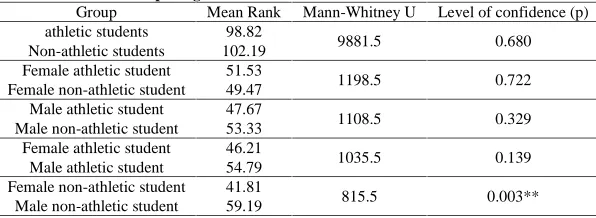
There is no significant relationship between self-esteem of athletic students and non-athletic ones (p=0.680) (table 1). There is no significant relationship between self-esteem of female athletic students and female non-athletic ones (p=0.772) (table 1). There is no significant relationship between self-esteem of male athletic students and male non-athletic ones (p=0.329) (table 1). There is no significant relationship between self-esteem of female athletic students and male athletic ones (p=0.139) (table 1). There is a significant relationship between self-esteem of female non-athletic students and male non-athletic ones (p=0.003) (table 1).
Table 1. comparing self-esteem of athletic and non-athletic students
Group Mean Rank Mann-Whitney U Level of confidence (p) athletic students 98.82
9881.5 0.680
Non-athletic students 102.19 Female athletic student 51.53
1198.5 0.722
Female non-athletic student 49.47 Male athletic student 47.67
1108.5 0.329
Male non-athletic student 53.33 Female athletic student 46.21
1035.5 0.139
Male athletic student 54.79 Female non-athletic student 41.81
815.5 0.003**
Male non-athletic student 59.19
**: significance in p≤0.01 level
There is no significant relationship between self-concept of athletic students and non-athletic ones (p=0.088) (table 2). There is a significant relationship between self-concept of female athletic students and female athletic ones (p=0.042) and female non-physical students are superior (table 2). There is no
significant relationship between self-concept of male athletic students and male non-athletic ones (p=0.888) (table 2). There is a significant relationship between self-concept of female athletic students and male athletic ones (p=0.011) (table 2) and male athletic students are superior. There is no significant
relationship between self-concept of female non-athletic students and male non-non-athletic ones (p=0.694)
(table 2).
Table 2. comparison of self-concept of physical education and non-physical education students
Group Mean Rank Mann-Whitney U Level of confidence (p)
athletic students 93.53
4302.5 0.088
Non-athletic students 107.48 Female athletic student 44.6
955.0 0.042*
Female non-athletic student 56.4
Male athletic student 50.09
1229.5 0.888
Male non-athletic student 50.91 Female athletic student 43.13
1193.0 0.011*
Male athletic student 57.87
Female non-athletic student 49.36
815.5 0.694
Male non-athletic student 51.64
*: significance in p≤0.05
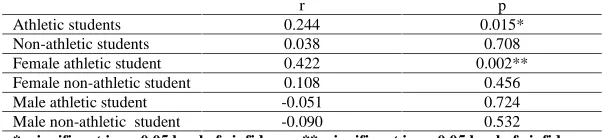
There is a significant relationship and positive correlation between self-esteem and self-concept of athletic students (p=0.015) (table 3). There is no significant relationship but a positive correlation between self-esteem and self-concept of non-athletic students (p=0.708) (table 3). There is a significant relationship and positive correlation between self-esteem and self-concept of female athletic students (p=0.002) (table 3). There is no significant
relationship but a positive correlation between self-esteem and self-concept of female non-athletic students (p=0.456) (table 3). There is no significant relationship and a negative correlation between self-esteem and self-concept of male athletic students (p=0.724) (table 3). There is no significant relationship and a negative correlation between self-esteem and self-concept of male non-athletic students (p=0.532) (table 3).
Table 3. correlation relationship between self-esteem and self-confidence of students
r p
Athletic students 0.244 0.015*
Non-athletic students 0.038 0.708
Female athletic student 0.422 0.002**
Female non-athletic student 0.108 0.456
Male athletic student -0.051 0.724
Male non-athletic student -0.090 0.532
*: significant inα≤0.05 level of cinfidence. **: significant in α≤0.05 level of cinfidence
Discussion
There is no significant relationship between self-esteem of athletic students (mean=98.82) and non-athletic ones (mean=102.19). There is no significant relationship between self-esteem of female athletic students (mean=51.53) and female non-athletic ones (mean=49.47). There is no significant relationship between self-esteem of male athletic students (mean=47.67) and male non-athletic ones (mean=53.33). There is no significant relationship between self-esteem of female athletic students (mean=46.21) and male athleticl ones (mean=54.79). These results contradict with most of observations in above- mentioned researches.
There is a significant relationship between self-esteem of female non-athletic students (mean=41.81) and male non-athletic ones (mean=59.19) (p=0.003) and male non-athletic students are superior. In this regard Kaji (1995) stated that female individuals have
lower self-esteem and self-concept compared to male individuals. Moreover, findings of a research on self-esteem and gender by Harper and Joliet (1991) showed that male individuals’ self-esteem is higher than female individuals’ one. Wu Yi and Smith (1997) stated in their research results that young male individuals’ self-confidence regarding their physical abilities was higher compared to young female individuals’ one (6,11).
There is no significant relationship between self-concept of athletic students (mean=93.53) and non-athletic ones (mean=107.48). There is a significant relationship between self-concept of female athletic students (mean=44.6) and female non-athletic ones (mean=56.4) (p=0.042) and female non-athletic students are superior. There is no significant relationship between self-concept of male athletic students (mean=50.09) and male non-athletic ones (mean=50.91). There is a significant relationship
between self-concept of female athletic students (mean=43.13) and male athletic ones (mean=57.87) (p=0.011) and male athletic students are superior (table 2). There is no significant relationship between self-concept of female non-athletic students (mean=49.36) and male non-athletic ones (mean=51.64). Borbar et al (2007) conducted a study in which they compared self-concept of athletic and non-athletic students same as our study. Their observations are as follows:
1. There is a significant relationship between self-concept of athletic and non-athletic students in 0.01 level of confidence (α=0.01).
2. There is no significant relationship between self-concept of athletic female and male students.
3. There is no significant relationship between self-concept of non-athletic female and male students. 4. There is a significant relationship between self-concept of female athletic and non-athletic students in 0.05 level of confidence (α=0.05).
5. There is a significant relationship between self-concept of male athletic and non-athletic students in 0.05 level of confidence (α=0.05).
6. There is a significant relationship between self-concept of male and female students in 0.05 level of confidence (α=0.05).
7. There is no significant relationship between students’self-concept and their age.
Finally they noted that exercising and physical activities can be an influential factor on positive self-concept of students (3). However, observation of present study is both paralleled and unparalleled with above-mentioned studies. In other words, there is still contradictory between these observations.
There is a significant relationship (p=0.015) and positive correlation (correlation coefficient=0.244) between self-concept and self-esteem of athletic students. There is no significant relationship but a positive correlation (correlation coefficient=0.038) between self-concept and self-esteem of non-athletic students. There is a significant relationship (p=0.002) and positive correlation (correlation coefficient=0.422) between concept and self-esteem of female athletic students. There is no significant relationship but a positive correlation (correlation coefficient=0.108) between self-concept and self-esteem of female non-athletic students. There is no significant relationship and a negative correlation (correlation coefficient=-0.051) between self-concept and self-esteem of male physical education students. There is no significant relationship and a negative correlation (correlation coefficient=-0.090) between concept and self-esteem of male non-athletic students. Baron and Greean (1990) showed in a research that the lower is the self-concept of an individual; the lower is his/her self-esteem.
Nowadays, students’ physical and mental health discussion is a determinant factor in realization of their educational goals. In today’s world, students – as ones who make future of the society – play an important role in development programs (12). Meanwhile, sport activities are among factors which can promote the notion an individual perceive about himself/herself. Furthermore, it makes a society which is more efficient and productive (13,14).
References
1. Aghdasi MT, Ahmadi A, editors. Comparing Anxiety and Self-concept Rate of Athletic and non-athletic Students of Orumiye University. First International Scientific-Sports Conference of Universities of Islamic World; 2008; Islamic Azad University-Sport Research Center, Tehran Islamic Azad University [Proceeding in Farsi].
2. Jalali J, Sardroodi. Investigating Sport Effects on Mental-Motional Skills as well as Social Adjustment of 8 to 9 Years Olds Young male Individuals in Tehran. Tehran: Tarbiat Modares University; 1998 [Thesis in Farsi]. 3. Borbar A, Keshtidar M, Peymanizad HAaotFICoNPEaSSA, P editors. Comparing Self-concept Rate of Athletic
and non-athletic Students. First International Congress of New Perspective and Innovations in Physical Education and Sport Sciences; 2007; Islamic Azad University-Sport Research Center-Tehran: Islamic Azad University [Proceeding in Farsi].
4. Kharazi P, Mohammadzade H, Seyed-Ameri M, editors. First National Conference on Motional Behavior and Sport Psychology; 2008; Islamic Azad University-Kermanshah Branch, Kermanshah: Islamic Azad University [Proceeding in Farsi].
5. Yousefi M, editor. Investigating and Comparing Self-esteem Rate and Weekly Absence Hours of Male Athletic and non-athletic Students of Tehran - 2002. First Scientific Conference on Sport and Physical Education Development Strategies in Mazandaran Schools; 2004; Mazandaran-Sari [Proceeding in Farsi].
6. Motamedi B. Investigating and Comparing Self-esteem of Male and Female Athletic and non-athletic Students of Ghouchan High School. Tehran: Tarbiat Moalem University; 1994 [Thesis in Farsi].
7. Sarvi AA, Afrooze M, Afrooze MS, editors. Comparing Self-esteem of Male Athletic and non-athletic Students of Jahrom Branch Islamic Azad University. First International Scientific-Sports Conference of Universities of Islamic World; 2008; Islamic Azad University-Sport Research Center, Tehran [Proceeding in Farsi].
8. Harper JF, Marshall E. Adolescents' problems and their relationship to self-esteem. Adolescence. 1991;26(104):799-808.
9. Wu Y-J, Smith DE. Self-esteem ofTaiwanese children. Child Study Journal. 1997;27(1):1-19.
10. Goni A, Zulaika L. Relationships between Physical Education Classes and the Enhancement of Fifth Grade Pupils' Self-Concept. Perceptual and Motor Skills. 2000;91(1):246-50.
11. Nourbakhsh P. A Comparison between Athlete and Non-Athlete Students Stressors and Their Relationship with Their Mental Health. Olympic. 2004;12(1):69-79 [Article in Farsi].