Volume 20, Number 2, pp. 349–364. http://www.scpe.org
ISSN 1895-1767 c
⃝2019 SCPE
TRUST FACTOR BASED KEY DISTRIBUTION PROTOCOL IN HYBRID CLOUD ENVIRONMENT
VELLIANGIRI S. ∗, RAJAGOPAL R. †, AND KARTHIKEYAN P. ‡
Abstract. In the Hybrid cloud deployment model, security is essential to restrict access while using resources such as virtual machine, platform, and application. Many protocols were developed to provide security via the cryptography technique, but these protocols rarely considered the trust factor which is an essential factor for cloud security. The existing Elliptic Curve Cryptography and Diffie Hellman key distribution mechanism failed to stress the trust factor, and further, they have provided not only higher complexity but also lower security and reliability. The proposed method comprised two stages: first stage, Group Creation using the trust factor and develop key distribution security protocol. It performs the communication process among the virtual machine communication nodes. Creating several groups based on the cluster and trust factors methods. The second stage, the ECC (Elliptic Curve Cryptography) based distribution security protocol is developed. The proposed Trust Factor Based Key Distribution Protocol reduced error rate, improve the key computation time and maximize resource utilization.
Key words: Cloud Computing, Elliptic Curve Cryptography, Clustering, Trust Factors, Key Distribution
AMS subject classifications. 94A60, 68M14
1. Introduction. Cloud computing has emerged as a pivoted new field, differentiated from conventional computing by its focus on software as services, platform as services and infrastructure as services, these services are implemented by Cloud deployment models such as public cloud, private cloud or hybrid cloud. Cloud computing has added to the advances in computational and correspondence innovations - making financially achievable the combination of various clusters of heterogeneous network resources and services which, thus, have prompted the improvement of extensive large scale distributed system. A group key exchange protocol permits a set of people to agree upon a shared secret session key over an internet network [1, 2].
Cloud computing virtual resource can be characterized into three types such as compute, storage and network. Compute resource permit you to start virtual machines on cloud infrastructure. The main challenges of task scheduling in compute clouds are its highly dynamic environment, where the computing resources have their availability, access policies, security, reliability, etc. [3, 4]. Cloud computing has often jointly supported collaborative computing projects on the internet. Maximum of these projects have stringent security requirements. The capabilities for cloud systems and networks, such as broadband capabilities and distributed intelligence can greatly enrich reliability and efficiency, but they might also create much vulnerability if not deployed with the appropriate security controls. Providing security for such a large system may seem an unfathomable task, and if done incorrectly, can leave utilities open to cyber-attacks [5, 6].
Communicate among the group of members in securely and tried to reduce the complexity of informing the group key. The secure communications in the group or large group are more complex than Peer-to-peer communication because of the adaptability issue of the group key. Specifically, the expense of key establishment and renovating are generally pertinent to the size of the group and consequently turns into a performance bottleneck in attain scalability. To address this issue, our proposed approach named as the trust factor based key distribution protocol that combines the features of ECC key exchange protocol with the trust factor. ECC and Diffie Hellman key exchange protocols do not consider the trust factor in that which is relating to a ”firm belief ” with a treat like trustworthiness, reliability, and ability of the element for multicast communication in distributed computing [7, 8].
The primary goal of a cloud environment is increasing the domain to domain interactions, a secure envi-ronment and to ensuring the confidentiality of others. To achieve this ”trust,” notion needs to be considered so that the trustworthiness makes the geographically distributed method more reliable and attractive. The trust
∗Department of Computer Science and Engineering, CMR Institute of Technology, Hyderabad - 501401, Telangana, India ([email protected]).
†Department of Computer Science and Engineering, Vel Tech Multi Tech Dr. Rangarajan Dr. Sakunthala Engineering College, Avadi -600062, Chennai, Tamilnadu, India ([email protected]).
‡Department of Computer Science and Engineering, Karunya Institute of technology and Sciences, Coimbatore - 641114, Tamil-nadu, India ([email protected])
factor is an essential factor for cloud security. The above issues were resolved by using our proposed method of trust-based cloud security. In our proposed method has considered the priority of trust factor for enhancing the parameters of reliability and security. Hence to reduce this drawback in the existing protocols like ECC and Diffie Hellman key exchange, the trust factor based distribution security protocol using ECC is proposed, these trust factors based on key distribution security protocol, have been utilized to select the group leader among the communication nodes.
After that, the ECC method has been exploited in the secure communication process among group members. When compared to ECC and Diffie Hellman key exchange, the proposed method has given high performance in security. The proposed system provides improved scalability due to the trust factor Key Computation [9, 10].
Main contributions of this research work are summarized below:
• Trust Factor Based key distribution protocol is designed that helps the decision making during the key distribution.
• Trust Factor Based key distribution protocol performances are evaluated based on the theoretical anal-ysis and experimental analanal-ysis.
• The objective of the research work is to minimize the error rate and computation time and maximize the resource utilization using Trust Factor Based key distribution protocol
The remainders of the paper are structured as follows, in section 2 crucial secure exchange protocol are reviewed. Section 3 we discussed the proposed system and implementation. In Section 4, we analyze and prove the correctness and safety of the proposed protocol and comparative study also reported in this section. Finally, we conclude the paper in Section 5.
2. Related Works. This section provides various recent related works regarding the secure key exchange protocol are reviewed. Wei et al. proposed a compiler which changes over secure group key exchange protocol into a secure passive keyless entry protocol. This method uses the labeled signature, public key encryption, the hash function. The proposed compiler is the main provably secure compiler without irregular prophets. As far as efficiency, the proposed protocol simply improved the two rounds of communications to the unique group key exchange protocol, which suggests that the derived password-authenticated group key exchange protocol is a static-round protocol as long as the secret group key exchange protocol is a static-round protocol [11]. Gonzales et al. proposed the model of security assessment for Infrastructure as a Service; this plan is confined to the single cloud service model, infrastructure as a service. The layers of the software stack underneath the guest operating system are coming under the control of the Infrastructures as service cloud service providers, key exchange security important in the software as service cloud service model [12].
Li et al. [13] introduced the blockchain based security model for centralized cloud storage. They found that the model has been contrasted with other two existing traditional model in respect of network transmission delay and security. Moreover, the system performance of conventional cloud design has been enhanced by the modified evolutionary algorithm which decreases the expenses on transmitting and replicas scheduling. Additionally, the proposed architecture has lower transmission delay compare with the genetic algorithm. Recently various exchange protocol proposed in a cloud environment concerning the healthcare environment. Challa et al. introduced a novelty of Secure Authentication Scheme (SAS) for healthcare in wireless sensor networks. To figure out the drawbacks in the LiuChung’s existing method [14], the proposed framework enables a lawful client to modify/update the biometrics and password without prior communicating the trusted third party authority. Besides, it also permits a revocation scheme for disobeying nodes in the wireless sensor network. The proposed system uses BurrowsAbadiNeedham logic as well as the random oracle model. Additionally, the proposed scheme prevents replay attacks with the help of the widely-used AVISPA tool. The low communication costs and computation and along with high security make the proposed method fit for an extensive range of healthcare projects [15, 16].
know-ing the information that cloud data owner shares with query cloud client notwithstandknow-ing the encoded data [18]. Trapero et al. [19] have described sec Service Level Agreement (SLA) model created on defining a set of measurements for each security metric with which the cloud service providers can evaluate the strength of guaranteed service level objectives. For each service level objective, they have recognized a set of violations and detectable alerts, and they considered not only how to forecast, prevent, and eradicate secSLA violations, but also how to handle remedial and responsive activities in order to get-out producing more destruction, In the proposed secSLA trust factor is not included in the cloud consumers viewpoints. Kerberos is an authentication server whose main function is to authenticate client to server and server to client, the main security challenge in Kerberos is a key exchange between client and server. Talkhaby et al. proposed a new protocol with the power-ful Diffie Hellman-DSA Key Exchange algorithm and the client’s unique fingerprint impression tests. Biometric information utilized in the scheme comprehends the confinement of password-based authentication. In this work, using strong Diffie Hellman-DSA Key Exchange were performed as a Hard Key Exchange (HKE) mech-anism with mutual authentication helped them to tackle the password predicting attack weakness in Kerberos version 5 protocols [20]. Nicanfar et al. proposed a Multilayer Consensus ECC-Based Password Authenticated Key-Exchange (MCEPAK) protocol, which allows secure communications between different layers of the smart grid control system and a home appliance. This method takes benefit of elliptic curve cryptography to provide a high-security level with a small key size while directing the possible resource limitations in the devices connected and they showed that proposed method decreases the security burden while giving elasticity against most of the attacks. Related to the X.1035 protocol, MCEPAK gains a lower load for the generation of the required passwords and hash function [21].
Hafizul et al. mentioned that ECC-based improves the security of key exchange of Peyravian-Zunic’s secret key authentication method as well as expels the security defects Zhu et al.’s [22] method like clock synchronization issue and Identification and prevention of impersonation attack, etc. In this work, the proposed method enriches the computation of the symmetric key. It is used for private interchange of plaintext utilizing a symmetric key encryption algorithm. The performance examines of the proposed method is endorsed that the protection of data against impersonation attacks [23]. Murali et al. proposed a framework based on both traditional and quantum cryptography for cloud computing. This proposed method simplifies both the quantum channel and data channel for exchanging key and information correspondingly. The security framework based on quantum cryptography key distribution. The framework aims to support vital Quantum essential distribution communications with the cloud. This method is not suitable for the real cloud environment since the error rate is not an acceptable level of the cloud services providers [24].
Kumar et al. proposed a protocol that is based upon an RSA key distribution named as efficient centralized group key distribution protocol which is helpful from multiple points of view. It drastically decreases the computation load of the critical server by reducing the number of arithmetic operations needs to perform during crucial exchange and updating. However, the proposed method is not trusted for the cloud environment since it is considering the trust factor of cloud service providers [25].
Table 2.1
Comparison of the different key exchange protocol
Ref Year Technique Advantage Disadvantage
[11] 2018 Group key exchange High Efficiency Protocol simply improved
protocol the two rounds of communications
[12] 2015 key exchange security Efficiency and Reliability Security provides only a single cloud service model
Infrastructure as a service (IaaS) [13] 2018 Blockchain-based security Lower Transmission delay It increases the computational load [14] 2017 Secure Authentication High Efficiency The Biometrics and password
Scheme (SAS) without prior communicating
the trusted third party authority [15][16] 2018 Biometric key authentication Low communication cost It prevents only replay attacks [17] 2017 Crucial session based Efficiency and Reliability Increases the computational load
key exchange protocol
[19] 2017 Service Level Agreement The strength of guaranteed The error rate is not (SLA) service level objectives an acceptable level of the
cloud services cloud consumers [20] 2016 Strong Diffie-Hellman Efficiency and Reliability Mutual authentication helped
Key Exchange them to tackle for password
predicting attack only. [21] 2013 MCEPAK Transmission delay The trust factor is
not included in the
cloud consumers viewpoints. [22][23] 2009 Peyravian-Zunic’s password Efficiency Clock synchronization issue and
2013 authentication Identification and prevention
of impersonation attack [24] 2016 Quantum cryptography key Low communication cost The error rate is not an
distribution acceptable level of the
cloud services providers [25] 2018 Centralized group key Efficiency and Reliability The trust factor is not
distribution protocol included in the cloud consumers’s viewpoints.
to follow the exercises occurring over his private information [28].
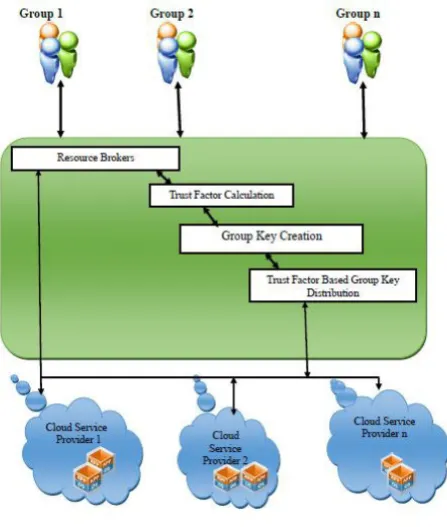
3. Trust Factor Based Key Distribution Protocol. Cloud users submit a security demand(SD) to the resource broker to find the trust index (TI) of a cloud service providers, and resource brokers collect the truthfulness value from the cloud service providers, The resource Brokers map the task to the cloud service providers only if satisfies the following conditions (T I >=SD). The first difficulty in the group key commu-nication is that interoperability between private cloud and public cloud. Data are passed across a multiple cloud deployment model. The second difficulty is establishing the trust relationship between the different cloud deployment models. To build a trust relationship between public cloud and private cloud, we introduced the method called Trust Factor Based Key Distribution Protocol (TFKD).
Fig. 3.1.Structure of Trust Factor Based Key Distribution Protocol
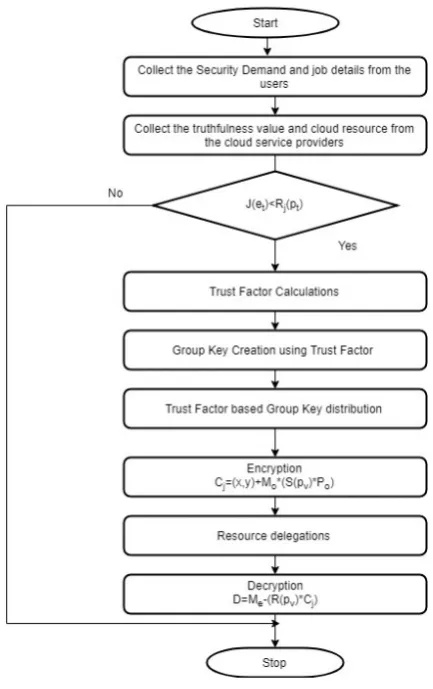
resource allocation, we have checked two conditions as stated below: 1. J(et)< Rj(pt)
2. J(et)> Rj(pt)
The jobs execution time, less than the corresponding allocated resource processing time means that we can avoid the job failure otherwise the job will be failed before it completes the operation. If condition (1) is satisfied, we can allocate the resources to the similar jobs. If the condition (2) is satisfied, we cannot do the resource allocation and go for other resources. Based on both the conditions (1) and (2) we allocate the resources to the jobs.
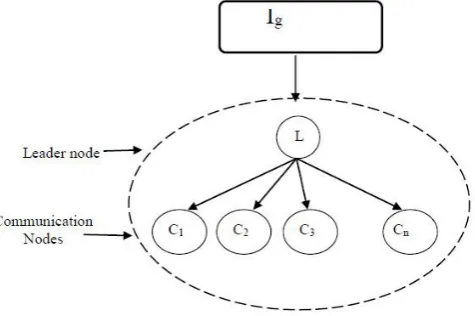
3.1. Group Creation Using Trust Factor. To perform the time-based clustering, we can create a database D, which contains joining time and the identification number of the communication node. Based on the time in the database, the virtual machine communication nodes are clustered. The clustered communication nodes are presented as L={l1, l2, l3, ..., lg} whereg is a number of clustered groups and each cluster group lg has a number of communication nodes.
Ig= {
ci, ci(jt)> tg
0, Otherwise (3.1)
In Eq. 3.1, ci is the virtual machine communication node, ci(jt) is the joining time of the virtual machine communication node ci andtg is the time threshold value of the groupg.
Trust factors: In cluster group lg a leader node is selected based on three trust factors. Here we have considered three trust factors namely: (RU), (RE), (RC).
1. Resource Utilization (RU): Resource utilization is calculated by checking the virtual machine commu-nication node resource utilization time, i.e., which virtual machine commucommu-nication node has utilized the maximum resource time.
Fig. 3.2.Cluster Model
3. Recommendation (RC): the job completion time is calculated for all virtual machine communication nodes. The computed value is utilized as a node recommendation value.
Thus the created cluster group model with the group leader and members is shown in Fig. 3.2. The leader node is selected by averaging three trust factor values as,
alg
i = RUlg
i +RE lg
i +RC lg
i
3 i= 1to n (3.2)
whereRUlg
i ,RE lg
i andRC lg
i are the resource utilization, reliability, and recommendation of the virtual machine communication node, i from the cluster group lg and a
lg
i represent the average value of the virtual machine communication node i. Based on these above mentioned three trust factors and the computed average value, a leader node is to be selected from each cluster group. Next, the secure communication process is performed within the group members, and key distribution process is also explained in the next section.
3.2. Developing Trust Factor Based Key Distribution Protocol using ECC. We have utilized an ECC method for creating a private and public key for the group members. Based on the created public key, the group key is also generated for all cluster groups by the leader. The generated group key is updated when the new group member joins or leaves from the cluster group. The group members private and public keys are produced by the ECC method makes communication among the group’s members more secure and also the generated keys are robust.
3.2.1. Key Generation by ECC. We generate keys to the group members by the elliptic curve cryp-tography. Elliptic Curve Cryptography (ECC) is also called public key cryptography, where each user or the device participating in the communication usually has a couple of keys: a public key and a private key, and these keys are used do the cryptographic function. Small key size is the main advantage of ECC.
The function of the ECC method is defined over two finite fields: Binary field and Prime field. The field is selected with a finite number of points for cryptographic algorithm function. Here, we used prime field function by picking a prime number P, and finitely enormous numbers of points are created on the elliptic curve, such that the created pointsb are between 0 toK. Then, we have arbitrarily chosen one basic pointP0(x0, y0) for key exchange function and this point satisfies the equation of the elliptic curve on a prime field, which is defined as
y2mod P =x3+ax+b mod P (3.3)
complete the key exchange process, we need to select a private keyPv on the sender side, which is a randomly selected integer less than P and generate a public keyPu =Pv∗P0. Now each cluster grouplg members has individual private Pv and public keysPu. By using these public keys, a group key is to be generated for each cluster group by the leader which is explained in the following subsection.
Group Key Creation: Secure communication is established within or between the group members we need a key identification and a secure key among the members. The group members are communicated with each other by their privatePv and publicPukeys and also exchange the information. Within the cluster group lg, a group key is created for providing authentication between/within the group members. Thus the created group key is updated when any of the single members leaves or joins from or within the group and group members leave or join from or within the group.
Group Key: Each cluster group has the group leader and group members. The group key is created by using the group members public keys. The group key formation equation is stated as,
(Gk)lg =nlg
n ∑
i=1 (pui)
lg (3.4)
where (Gk)lg is denoted as group key of a cluster group lg, n is the total number of communication nodes
(members) in the group lg and (pui)
lg is the public key of the ith virtual machine communication node in
cluster grouplg.
Updating Group Key: The created group key is updated when a new member joins or leaves from the group. The process of key updating is given below,
(i) A single member joins into the cluster grouplg it means the group key is updated by using the equation as described as,
(Gk)lg
new= (Gk)lg + (n∗pui+1) (3.5)
(ii) When a single member leaves from the cluster group lg it means the group key is updated by using the equation as stated below,
(Gk)lg
new= (Gk)lg−(n∗pui−1) (3.6)
By using these, a group, private and public keys, the communication process is performed among group members. The public and the private keys created by the ECC technique make our proposed technique attain more secured communication and also the group key is used to authenticate the members within the groups. The Fig. 3.3 depict the Process of Trust Factor Based Key Distribution Protocol.
Encryption and Decryption: Subsequently the communication process is carried between the group members and the leader nodes by using the ECC technique. The leader node encrypts the messages by using ECC and sends that encrypted message to their group members.
The encrypted plain text is sent in the form of,
e= (Me, Cj) (3.7)
Me=M0∗p0 (3.8)
Cj= (x, y) +M0∗(S(pv)∗p0) (3.9)
In Eq. 3.7, Me is encrypted plain text which is computed by an Eq. 3.8 i.e., the multiplication of the original messageM0with the basic pointp0andCj is evaluated by an Eq. 3.9. In Eq. 3.9,S(pv) is the private key of the sender. This messageeis sent to the receiver. The receiver receives the messageeand decrypts the message by the following formula,
d=Me−(R(pv)∗Cj) (3.10)
Fig. 3.3. Process of Trust Factor Based Key Distribution Protocol
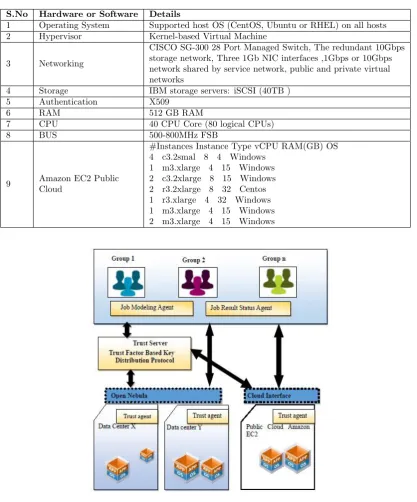
3.3. Implementation of Trust Factor Based Key Distribution Protocol. The proposed protocol is implemented by using Open Nebula. Open Nebula is open source software for building cloud computing infrastructures and services. Open Nebula can be used to build public, hybrid and private cloud deployment model, and open nebula supports to integrate the existing cloud infrastructures [29] [30] [31]. Implementation of hardware and software details is listed in Table 3.1.
Table 3.1
Implementation of hardware and software details
S.No Hardware or Software Details
1 Operating System Supported host OS (CentOS, Ubuntu or RHEL) on all hosts
2 Hypervisor Kernel-based Virtual Machine
3 Networking
CISCO SG-300 28 Port Managed Switch, The redundant 10Gbps storage network, Three 1Gb NIC interfaces ,1Gbps or 10Gbps network shared by service network, public and private virtual networks
4 Storage IBM storage servers: iSCSI (40TB )
5 Authentication X509
6 RAM 512 GB RAM
7 CPU 40 CPU Core (80 logical CPUs)
8 BUS 500-800MHz FSB
9 Amazon EC2 Public
Cloud
#Instances Instance Type vCPU RAM(GB) OS 4 c3.2smal 8 4 Windows
1 m3.xlarge 4 15 Windows 2 c3.2xlarge 8 15 Windows 2 r3.2xlarge 8 32 Centos 1 r3.xlarge 4 32 Windows 1 m3.xlarge 4 15 Windows 2 m3.xlarge 4 15 Windows
Fig. 3.4.Integrated Key Distribution Protocol in Hybrid Cloud
Fig. 3.5.Open Nebula user account types
the private cloud and public cloud to ensure cloud consumers can access virtual machines in the hybrid cloud. Trust agent collects the job success rate, virtual machine utilization, response capabilities, Reliability from the private cloud or public cloud and the transferred cumulative information to the Trust server to calculate the trust factor. If any virtual machine goes down, Trust agent generates the alarm signal and sent it to the Trust server for necessary action to be performed.
The Open Nebula and cloud interface permits a single point of entry to the hybrid cloud which consists of a trust agent and Datacenter. It secures authentication and authorization to the user. After authenticating the users private key, the server passes the job to the virtual machine communication node in the data center. Datacenter consists of Network Task Manager (NTM) and Target Method Interface (TMI). NTM receives job and starts to execute it. In the interim, NTM sends a response to JMA. After this, the cloud consumer can leave the system or surrender to another job. Throughout the execution, a Virtual space is formed to store all the information, including those wanted for execution and the files created by Abstract Job. NTM translates the Abstract Job into a collection of instructions that can be executed by Target Method Interface (TMI). For the duration of this conversion method, conversion tables in the incarnation database are used to map the abstract demonstrations to real instructions. TMI accepts incarnated job mechanisms from the NTM, and permits them to the confined batch schemes for execution. When the work is completed the virtual space is deleted.
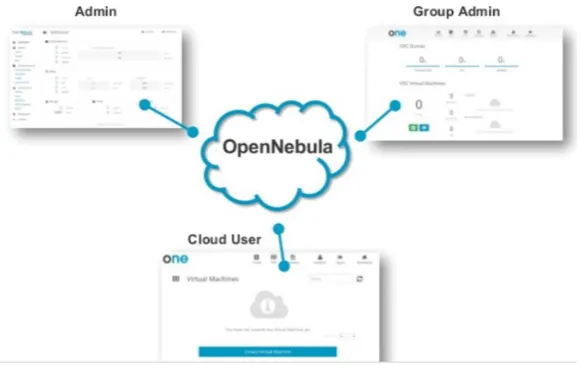
The Open Nebula supports three types of account. All the account function is summarized below. The account interaction is illustrated in Fig. 3.5.
One admin: Special administrative account. User: An OpenNebula user account.
Group: A group of Users.
4. Results and Discussion. The performance of the Trust Factor Based Key Distribution protocol is compared with the existing ECC and Diffie Hellman key exchange technique. In cloud hybrid cloud model; initially, we allocate the resources to each virtual machine communication nodes to complete their operations.
The resource allocation and their job completion performance are evaluated under three different number of communication nodes. The results that are obtained under these different job dataset sizes are given in Table 4.1.
Table 4.1
Different Communication Nodes Job Completion Time with varying communication nodes
Virtual machine Number of Jobs Job completion
Communication nodes allocation respectively time in seconds
10 4,5,10,10,8,8,10,4,6,5 38
20 2,2,6,4,2,2,5,1,9,3,3,3,4,1,2,5,4,5,6,2 18
30 1,3,3,2,1,5,2,3,4,3,4,3,1,4,1,4,3,2,3,1,1,1,3,1,2,3,4 13
Table 4.2
Time Based Clustering Results
Virtual machine
Communication Clustered Results
Nodes 1 2 3 4
10 {2,3,7} {4,8} {9,1} {5,6,10}
20 {12,13,3,6,8,1} {11,7,2,15} {4,9,14,18} {5,10,17,20}
30 {14,21,27,28,11,8,13} {0,4,12,17,20,24,15,23} {3,6,10,19,22,25,29} {1,2,7,9,11,16}
In each cluster group, a leader node is selected based on the trust factors namely, (i) Resource utilization (RU) (ii) Recommendation (RE) and (iii) Reliability (RC). These three trust factors are calculated for all cluster group communication nodes. The sample calculated trust factors for the three cluster group results are given in Table 4.3.
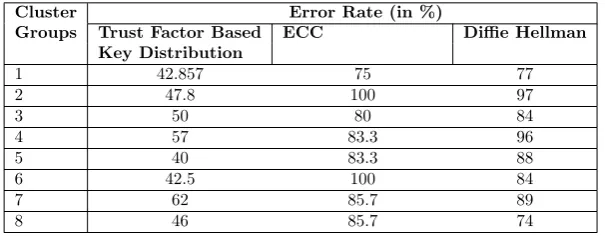
Subsequently, in each cluster group, private keys and public key are generated by using the ECC technique whereas the group key is calculated by using these generated public keys and the private key of the group members. The security between the communications nodes is evaluated by creating random keys and measuring the security performances within the cluster group. The proposed and the existing methods error rate for the cluster groups is illustrated in above Table 4.4. The error rate is computed by the following formula:
ErrorRate=An Tn
X100 (4.1)
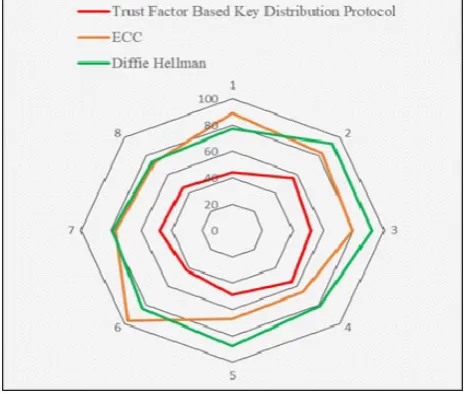
where An is number of bits received and Tn is total number of bits in the original message. As it is seen from Fig. 4.1, our proposed technique has given a lower error rate than the ECC and Diffie Hellman algorithm. The existing algorithm obtains 40% average error rate performance in the communication within the cluster groups. Fig. 4.2 depict the rate of precision for man-in middle attack. The outcomes reveal that on categorization the information set with all the characteristics the average rate of error 89%, 83%, 79%, 66%,67%,97%,77% and 73% is acquired for ECC. Based on the usage of Diffe Hellman the error rate is increased. The error rate is decreased in Trust Factor Based Key Distribution Protocol is described during the usage of cluster formation with hybrid trust factor scheme.
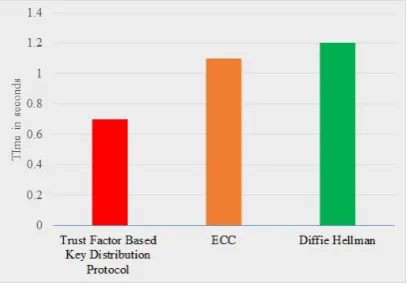
From the Fig. 4.3, we can infer that key Renewal Computation time of proposed method provides 50 percentage lesser than the ECC and Diffie Hellman algorithm, this is because since the node is trusted, the computation virtual machine need not wait to assign new value while generating the key. Hence it is proved that our proposed technique provides more secure communication between the communication nodes than the existing method. Fig. 4.4 depict the Comparison of Key Renewal Computation time with different cluster size. Fig. 4.5 depicts the comparison of Response time. The x-axis represents the different protocol and y-axis represents the response time in seconds. Response time is the length of time taken for a communication node to react to a given request or another communication node that is present in the different clusters. From Fig. 4.5, we can understand that the proposed method takes very less response time than ECC and Diffie Hellman protocol. This result is due to the management of the trust. The proposed approach enables efficient group communication.
Fig. 4.1.Radar chart Representation of the Proposed and Existing Methods Performance in terms of Error Rate
Fig. 4.2.Error Rate for Man-in-Middle attack
Table 4.3
Trust Factors for Three Cluster Groups Communication Nodes and their Leader Nodes
Clusters Virtual Machine Resource Recommendation Reliability Communication Utilization
Nodes
2 1 24 13.33
1 3 0 34 9.88
7 1 45 15.22
2 4 3 36 7.77
8 3 57 10.33
3 9 0 52 11.44
1 1 28 12.11
5 0 31 11.66
4 6 3 39 18.0
10 3 75 15.33
Table 4.4
Performance of Proposed and existing techniques Error Rate within the Cluster Groups
Cluster Error Rate (in %)
Groups Trust Factor Based ECC Diffie Hellman Key Distribution
1 42.857 75 77
2 47.8 100 97
3 50 80 84
4 57 83.3 96
5 40 83.3 88
6 42.5 100 84
7 62 85.7 89
8 46 85.7 74
communicating with each other in the clusters.
Fig. 4.7 shows the communication overhead evaluation of Trust Factor Based Key Distribution Protocol with ECC and Diffie helman algorithm. Communication overhead time comparison, we consider that the user identity, virtual machine communication node identity, timestamp info, nonce , hash digest and Elliptic Curve Cryptography point P = (Px, Py) are 256 bits, 128 bits, 64 bits, 32 bits correspondingly. Proposed method reduce commutation time between requester and virtual machine communication node compared to ECC and Diffie Hellman method. The reducing in the communication overhead time is suitable as the security is enhanced to an excessive point in the Trust Factor Based Key Distribution Protocol. The over-all investigational results confirm that the proposed protocol is efficient in terms of Communication overhead.
Fig. 4.4. Comparison of Key Renewal Computation time with different cluster size
Fig. 4.5. Comparison of Response Times
REFERENCES
[1] Aleksandar Hudic, Paul Smith, and Edgar R Weippl. Security assurance assessment methodology for hybrid clouds.Computers & Security, 70:723–743, 2017.
[2] Ashish Singh and Kakali Chatterjee. Cloud security issues and challenges: A survey. Journal of Network and Computer Applications, 79:88–115, 2017.
[3] Shadi A Aljawarneh, Ali Alawneh, and Reem Jaradat. Cloud security engineering: Early stages of sdlc. Future Generation Computer Systems, 74:385–392, 2017.
[4] Gansen Zhao, Chunming Rong, Martin Gilje Jaatun, and Frode Eika Sandnes. Reference deployment models for eliminating user concerns on cloud security.The Journal of Supercomputing, 61(2):337–352, 2012.
[5] Mehedi Masud and M Shamim Hossain. Secure data-exchange protocol in a cloud-based collaborative health care environment. Multimedia Tools and Applications, pages 1–15, 2018.
[6] Antonio Celesti, Maria Fazio, Antonino Galletta, Lorenzo Carnevale, Jiafu Wan, and Massimo Villari. An approach for the secure management of hybrid cloud–edge environments.Future Generation Computer Systems, 90:1–19, 2019.
[7] Perumal Pandiaraja, Pandi Vijayakumar, Varadarajan Vijayakumar, and Raman Seshadhri. Computation efficient attribute based broadcast group key management for secure document access in public cloud. J. Inf. Sci. Eng., 33(3):695–712, 2017.
[8] Flora Amato, Francesco Moscato, Vincenzo Moscato, and Francesco Colace. Improving security in cloud by formal modeling of iaas resources.Future Generation Computer Systems, 87:754–764, 2018.
[9] Maryam Farajzadeh Zanjani, Seyed Masoud Alavi Abhari, and Alexander G Chefranov. Group key exchange protocol based on diffie-hellman technique in ad-hoc network. InProceedings of the ACM 7th International Conference on Security of Information and Networks, page 166, 2014.
[10] Y. Tan, J. Zheng, Q. Zhang, X. Zhang, Y. Li, and Q. Zhang. A specific-targeting asymmetric group key agreement for cloud computing. Chinese Journal of Electronics, 27(4):866–872, 2018.
[11] Fushan Wei, Neeraj Kumar, Debiao He, and Sang-Soo Yeo. A general compiler for password-authenticated group key exchange protocol in the standard model.Discrete Applied Mathematics, 241:78–86, 2018.
Fig. 4.6.Comparison of Resource Utilization
Fig. 4.7.Comparison of Communication overhead with different cluster size
model for infrastructure as a service (iaas) clouds. IEEE Transactions on Cloud Computing, 5(3):523–536, 2017. [13] Jiaxing Li, Jigang Wu, and Long Chen. Block-secure: Blockchain based scheme for secure p2p cloud storage. Information
Sciences, 465:219–231, 2018.
[14] Chia-Hui Liu and Yu-Fang Chung. Secure user authentication scheme for wireless healthcare sensor networks.Computers & Electrical Engineering, 59:250–261, 2017.
[15] Rajat Chaudhary, Anish Jindal, Gagangeet Singh Aujla, Neeraj Kumar, Ashok Kumar Das, and Neetesh Saxena. Lscsh: Lattice-based secure cryptosystem for smart healthcare in smart cities environment. IEEE Communications Magazine, 56(4):24–32, 2018.
[16] Sravani Challa, Ashok Kumar Das, Vanga Odelu, Neeraj Kumar, Saru Kumari, Muhammad Khurram Khan, and Athanasios V Vasilakos. An efficient ecc-based provably secure three-factor user authentication and key agreement protocol for wireless healthcare sensor networks. Computers & Electrical Engineering, 69:534–554, 2018.
[17] Subhas Barman, Samiran Chattopadhyay, Debasis Samanta, and Gaurang Panchal. A novel secure key-exchange protocol using biometrics of the sender and receiver. Computers & Electrical Engineering, 64:65–82, 2017.
[18] Lu Zhou, Youwen Zhu, and Aniello Castiglione. Efficient k-nn query over encrypted data in cloud with limited key-disclosure and offline data owner. Computers & Security, 69:84–96, 2017.
[19] Ruben Trapero, Jolanda Modic, Miha Stopar, Ahmed Taha, and Neeraj Suri. A novel approach to manage cloud security sla incidents.Future Generation Computer Systems, 72:193–205, 2017.
[20] Hamid Roomi Talkhaby and Reza Parsamehr. Cloud computing authentication using biometric-kerberos scheme based on strong diffi-hellman-dsa key exchange. InProceedings of IEEE International Conference on Control, Instrumentation, Communication and Computational Technologies (ICCICCT), pages 104–110, 2016.
[21] Hasen Nicanfar and Victor CM Leung. Multilayer consensus ecc-based password authenticated key-exchange (mcepak) protocol for smart grid system. IEEE Transactions on Smart Grid, 4(1):253–264, 2013.
[22] Lu Zhu, Sheng Yu, and Xing Zhang. Improvement upon mutual password authentication scheme. InProceedings of IEEE International Seminar on Business and Information Management, volume 1, pages 400–403, 2008.
[23] SK Hafizul Islam and GP Biswas. Design of improved password authentication and update scheme based on elliptic curve cryptography. Mathematical and Computer Modelling, 57(11-12):2703–2717, 2013.
[24] G Murali and R Sivaram Prasad. Cloudqkdp: Quantum key distribution protocol for cloud computing. InProceedings of IEEE International Conference on Information Communication and Embedded Systems (ICICES), pages 1–6, 2016. [25] Vinod Kumar, Rajendra Kumar, and SK Pandey. A computationally efficient centralized group key distribution protocol for
and Information Sciences, 2018.
[26] Sahil Mehta and Parminder Singh. An approach to security, performance and bandwidth issues in asp. net websites. Inter-national Journal of Computer Applications, 70(27), 2013.
[27] Parminder Singh, Pooja Gupta, and Kiran Jyoti. Tasm: technocrat arima and svr model for workload prediction of web applications in cloud.Cluster Computing, pages 1–15, 2018.
[28] Pradeep Singh, Parminder Singh, and Avinash Kaur. Object based accountability framework for information sharing in cloud computing. International Journal of Computer Applications, 115(19), 2015.
[29] C Yang, S Wang, and C Liao. On construction of cloud virtualization with integration of kvm and opennebula, 2011. [30] Hyperconverged cloud architecture with opennebula and storpool, 2018.
[31] V Valliyappan and Parminder Singh. Hap: Protecting the apache hadoop clusters with hadoop authentication process using kerberos. InProceedings of 3rd International Conference on Advanced Computing, Networking and Informatics, pages 151–161. Springer, 2016.
[32] Anand Nayyar. Private virtual infrastructure (pvi) model for cloud computing.International Journal of Software Engineering Research and Practices, 1(1):10–14, 2011.
[33] Anand Nayyar. Interoperability of cloud computing with web services.International Journal of ElectroComputational World & Knowledge Interface, 1(1), 2011.