Available Online at www.ijpret.com
237
INTERNATIONAL JOURNAL OF PURE AND
APPLIED RESEARCH IN ENGINEERING AND
TECHNOLOGY
A PATH FOR HORIZING YOUR INNOVATIVE WORK
“RELATIONSHIP OF ERGONOMICS PARAMETERS WITH PRODUCTIVITY OF
COMPUTER TYPIST: THE QUANTITATIVE AND QUALITATIVE APPROACH"
SHREYASH RATHI, SHYAMSING THAKUR
B.E. (Mech.), M.E. Thermal (appearing), Student of S. G. B. A. University, Amravati.
Accepted Date: 27/02/2014 ; Published Date: 01/05/2014
\
Abstract:Software component of the computer system is in focus of the user, explorer and legislation. It implies That the hardware component exists and works without flaws. It is observed that many of the computer typists who continuously work on computer are suffering from the Cumulative Trauma Disorders, like finger pain, wrist pain, lower back pain, eye strain etc. It is causing due bad posture, twisted posture, or wrong workstation layout. In this study, an investigation was conducted on the extent to which ergonomic requirements for computers typists are met in office workstations. Thus the factors of safety, comfort, productivity, quality and injuries are analyzed, to reduce the health problems and increase the productivity of computer typist. Also, the ergonomically comfortable set-up of computer workstation, exercises to be done, and how to improve working habits is suggested in the project. From this study it is concluded that there is a direct relationship of typing speed and accuracy of the typist with typing positions, workstation surrounding, proper adjustments of the computer workstation. The discomfort creates fatigue to the operator which in turn reduces his efficiency and productivity. The experience of the typists, mental condition, and proper typing positions also affect the productivity of typist. Corresponding suggestions are made in study report. It is also very important to apply these suggestions in practice and disseminate them as much as possible, among computer typists who regularly work on computer. This research will help them to avoid Cumulative Trauma Disorders and increase the productivity. From this paper it is concluded that there is a direct relationship of typing speed and accuracy of the typist with typing positions, workstation surrounding and proper adjustments of computer workstation .The discomfort creates fatigue to the operator which in turn reduces his efficiency and productivity. In this paper, a case is analyzed which describes four typing positions for different operators. Numerical treatment to the discomfort is given via this paper to increase knowledge base in applied ergonomics.
Keywords: Software, Productivity, Bad Posture
Corresponding Author: MR. SHREYASH RATHI
Access Online On:
www.ijpret.com
How to Cite This Article:
Available Online at www.ijpret.com
238
INTRODUCTION
Ergonomics is an interdisciplinary field of study that seeks design tools, equipment, and task to optimize human capabilities. It seeks to optimize the interrelationship between the human and a system, whether that system involves a simple hand tool or an entire production line. Whenever one designs a more-effective interface between a human and a tool or task, that is ergonomics.
IDEAL WORKSTATION LAYOUT
1. Monitor:
Screen height
Viewing distance
Prescription eyewear
2. Keyboard:
Palm or wrist supports
Alternative keyboards
3. Mouse
4. Multi-user and multi-task workstations
5. Improve lighting and minimize glare
DESIGH OF EXPERIMENT
1.Computer system-
Monitor: HP 5502
Central Processing Unit
Keyboard: Intex
Mouse: Intex
Available Online at www.ijpret.com
239 The chair used for the experiment has adjustable parts as follows-
Chair Seat
Armrests
Backrest
Fig.3.1 Side view of chair adjustable seat height
Fig.3.2 Side view of chair adjustable arm rest.
Available Online at www.ijpret.com
240 3. Computer table
4. Footrest
5. Software : Typing Master Pro 7.0. It is a personal typing application that teaches and helps to improve your typing skills. Using this software gives access to a lot of different typing exercises that improves skills. The program has got a friendly interface that guides all users on how to complete the lessons. The software offers various assignments to assess the Net Typing Speed, Accuracy, Gross Strokes in given time duration. It indicates the weak keys of the typist and also shows the spelling mistakes occurring while typing. It gives the results in print format.
Definition of Position:
1.Normal Position:
Normal position is defined as the position in which the typist feel comfortable while typing. The operator is allowed to rest his back on the backrest, feet on footrest, arms on armrests and ulnar angle of the operator (typist) should be 900 to 950. The subject can adjust the seat height to his comfort.
Fig.3.4 Typist working in Position 1
2. Obtuse ulnar angle position:
Available Online at www.ijpret.com
241
Fig.3.5 Typist working in Position 2
3.Acute ulnar angle position:
Fig.3.6 Typist working in Position 3
Acute ulnar angle position is defined as the position in which the operator is allowed to rest his back on the backrest, feet on footrest, arms on armrests and ulnar angle of the operator (typist) should be around 750.
4. Without backrest and armrest:
This position is defined as the position in which the operator is not allowed to rest his back on the backrest and arms on armrests.
Available Online at www.ijpret.com
242
EXPERIMENTATION:
1.4.1 Quantitative Experimentation
1st step:
To find out effect on productivity in terms of typing speed (in words per min) and accuracy (in %) in normal position.
2nd step:
To find out effect on productivity in terms of typing speed (in words per min) and accuracy (in %) in Obtuse ulnar angle position.
3rd step:
To find out effect on productivity in terms of typing speed (in words per min) and accuracy (in %) in Acute ulnar angle position.
4th step:
To find out effect on productivity in terms of typing speed (in words per min) and accuracy (in %) without using backrest and armrest.
5th step:
To find out effect of monitor-to-user distance on productivity in terms of typing speed (in words per min) and accuracy (in %) in normal position. The standard monitor-to-user distance is 16 inches.
3.4.2 Qualitative Experimentation
In order to conduct qualitative analysis, the opinions of the typists were taken in terms of points on a scale ranging from 1 to 5. The experiment is conducted qualitatively in eight steps:
1st step:
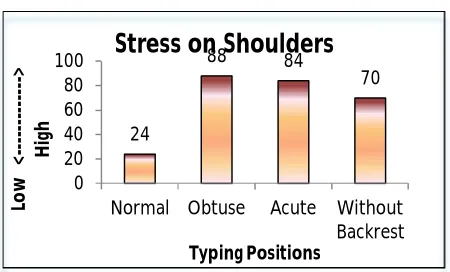
To know the opinion of the subjects about the stress they experienced on the shoulders.
2nd step:
Available Online at www.ijpret.com
243
3rd step:
To know the opinion of the subjects about the comfort they experienced while sitting on the chair and its effect on their productivity.
4th step:
To know the opinion of the subjects about the comfort they experienced while working on the computer and its effect on their productivity.
5th step:
To know the opinion of the subjects about the comfort they experienced with the keyboard and mouse and its effect on their productivity.
6th step:
To know the opinion of the subjects about the comfort they experienced with or without the footrest and its effect on their productivity.
7th step:
To know the opinion of the subjects about the effect of breaks, frequency of breaks and duration on their productivity.
8th step:
To know the opinion of the subjects about the stress they experienced on the back at different back angles.
RESULTS:
Available Online at www.ijpret.com
244
Quantitative Analysis :
From the results it is observed that the typing Speed Varies from person to person owing to their personal skills and experience of the profession.
From the results it is observed that in this position, the Stress on the wrists is experienced by the typist. This results in decrease in Typing speed and ultimately the productivity.
From the results it is observed that in this position, the Stress on the wrists and elbows is experienced by the typist. This results in reduced Typing speed and ultimately the productivity.
40 57
33 61
27
39 49 54 46 39
0 20 40 60 80
A B C D E F G H I J
W.
P
.M
.
Subjects
Net Speed in Normal Position
34 53
26 60
27 36 38
48 43 36 0 20 40 60 80
A B C D E F G H I J
W.
P
.M
.
Subjects
Net Speed in Obtuse ulnar Angle
35 47
29 59
26
39 33 46 40 36
0 20 40 60 80
A B C D E F G H I J
W.
P
.M
.
Subjects
Available Online at www.ijpret.com
245 From the results it is observed that in this position, the Stress on the wrists,Shoulders and elbows is experienced by the typist. This results in reduced Typing speed and ultimately the productivity.
From the results it is observed that the net typing speed decreases descendingly from position 1 to position 4. The Net Speed in Normal posture is high comparative to other awkward postures which ultimately affects the productivity of typists.
From the results it is observed that the Accuracy decreases from position 1 to position 4. In normal posture the typist work more accurately comparatively to other three postures.
34 47
26 58
23 37 33
42 39 35
0 20 40 60 80
A B C D E F G H I J
W
.P
.M
.
Subjects
Net Speed without Armrest & Backrest
20 30 40 50 60 70
A B C D E F G H I J
W
.P
.M
.
Subjects
Comparative Net Speed in different Postures
70 75 80 85 90 95 100
A B C D E F G H I J
A
cc
ur
ac
y
Available Online at www.ijpret.com
246
Fig 4.8: Effect of Screen distance on Net Speed.
From the results it is observed that as the distance of screen increases from normal position the productivity of the subject decreases. The typist is unable to read the matter conveniently and ultimately there is reduction in productivity.
Qualitative Analysis :
From the results it is observed that the stress experienced results in fatigue and reduces the productivity of the typists.
0 10 20 30 40 50 60 70
A B C D E F G H I J
W.
P
.M
.
Subjects
Effect of Screen distance on Net speed 24 88 84 70 0 20 40 60 80 100
Normal Obtuse Acute Without Backrest Lo w < ---> H ig h Typing Positions
Stress on Shoulders
24 66 92 24 0 20 40 60 80 100
Normal Obtuse Acute Without Backrest Lo w < -H ig
Available Online at www.ijpret.com
247 From the results it is observed that the stress experienced results in ache in wrist bones and the productivity of the typists decrease. In acute position the stress experienced at wrist is maximum, this causes Musculoskeletal disorder in typists.
From the results it is observed that Seat back & Armrest is given greatest significance then seat depth and seat height respectively. From the results it is observed that Monitor parameters plays crucial role in typists point of view.
From the results it is observed that both keyboard and mouse have vital roles in computer work ultimately it affect the productivity of the typist and reduces the discomfort in performing the task. 88 100 64 100 0 20 40 60 80 100 120 Seat height
Seat back Seat depth Armrest position Lo w < ---> H ig h
Importance of Chair Parameters
96 90 86 88 90 92 94 96 98
Keyboard Slope Mouse Size
Lo w < --> H ig
h Importance of Computer
Peripherals 56 92 0 20 40 60 80 100
Without Foot Rest With Foot Rest
Lo w < ---> H ig
Available Online at www.ijpret.com
248 From the results it is observed thatif proper support given by the foot rest, it helps to reduce the stress at the feet, angle, knee and which creates disturbance in performing the task.
From the results it is observed that the duration and frequency of the break plays vital role in increasing the productivity. Some exercises and alternate activities are also suggested to be done during the break.
From the results it is observed that the stress is maximum in without backrest position (Acute Back Angle), a bit less in straight 900 position and least in Obtuse Back angle. In 95 to 100 degree posture the maximum weight of body is distributed on back rest of the chair and hence the stress on back gets reduced.
CONCLUSIONS:
From the Result and discussion, in the previous chapter, the conclusions drawn are as under-
1. There is a direct relationship of typing speed and accuracy of the typist with typing positions. 2. There is a direct relationship of typing speed and accuracy of the typist with work surrounding (Temperature and disturbances).
86 50 48 0 50 100 Frequency of Breaks Duration of Breaks Alternative Practices Lo w < --> H ig
h
Importance of breaks
92 70 30 0 20 40 60 80 100 Without Backrest
90 degrees 95 to 100 degrees Lo w < ---> H ig h
Available Online at www.ijpret.com
249 3. Proper adjustments of the computer workstation influence the typing rate.
4. The level of discomfort is high in the inconvenient positions in which the stress (either physical or mental) is experienced by the typist.
5. The discomfort creates fatigue to the operator which in turn reduces his efficiency and productivity.
6. The experience of the typists plays a vital role in increasing their productivity. 7. Mental condition of the typist plays a crucial role in influencing his productivity.
8. If proper typing positions are adopted, the possibilities of being struck by the diseases or disorders mentioned before become minimum.
9. Frequent breaks also helps in increasing the productivity of the typists.
10. Most of the computer operator are Unaware about the health hazards Due to improper posture though They are working from a long.
REFERENCES
1. ERGONOMICS, Official Journals Of the Institute for Ergonomics and Human factor Coordinating Editor: Roger Haslam, Loughborough University, UK.
2. European Journal of Sport Science’ Official Journal of European College Of Sport Science / Editor –in-chief : Asker E. Jeukendrup, University of Burmingham, UK.
3. A Guideline on Office Ergonomics (CAN/CSA-Z412-M00), Canadian Standards Association , Toranto, 2000.
4. “ Computer Health And Safety” The Industrial Commission of Ohio Di- Vision of safety and hygiene.
5. “In search of an ideal seated posture” Focus on Ergonomic Seating, by Mark Taylor ,July/August 1996
6. Learn How To Limit Risk From Computers” National safety Council Newsletter-Campus Safety, May/June1991
7. VDT Workstation Design : Preferred Setting an Their Effects” The Human Factor Society , 1983
Available Online at www.ijpret.com
250 9. Chaffin C and Anderson .G.: Occupational Biomechanics. John Wile & Sons , New York , p254-60(1991).
10.Corlett E. N. and Bishop R. P. (1976): Body discomfort during agriculture Operation .p.16In : Ergonomics in Agriculture and allied Activities in India. L. P. Gite and G. Singh. Central Institute of Agriculture Engineering Bhopal (1997).
11.Darpanjot : Ergonomic study of Work Chair And Table To Fit The Body Comfort . M. Sc. Thesis , Punjab Agriculture University ,Ludhiyana(1996).