Complete genome sequence of Paludibacter propionicigenes
type
strain (WB4
T)
Sabine Gronow1, Christine Munk2,3, Alla Lapidus2, Matt Nolan2, Susan Lucas2, Nancy Hammon2, Shweta Deshpande2, Jan-Fang Cheng2, Roxane Tapia2,3, Cliff Han2,3, Lynne Goodwin2,3, Sam Pitluck2, Konstantinos Liolios2, Natalia Ivanova2, Konstantinos
Mavromatis2, Natalia Mikhailova2, Amrita Pati2, Amy Chen4, Krishna Palaniappan4, Miriam Land2,5, Loren Hauser2,5, Yun-Juan Chang2,5, Cynthia D. Jeffries2,5, Evelyne Brambilla1, Manfred Rohde6, Markus Göker1, John C. Detter2,3, Tanja Woyke2, James Bristow2, Jonathan A. Eisen2,7, Victor Markowitz4, Philip Hugenholtz2,8, Nikos C. Kyrpides2, and Hans-Peter Klenk1*
1 DSMZ - German Collection of Microorganisms and Cell Cultures GmbH, Braunschweig, Germany
2 DOE Joint Genome Institute, Walnut Creek, California, USA
3 Los Alamos National Laboratory, Bioscience Division, Los Alamos, New Mexico, USA 4 Biological Data Management and Technology Center, Lawrence Berkeley National
Laboratory, Berkeley, California, USA
5 Oak Ridge National Laboratory, Oak Ridge, Tennessee, USA
6 HZI – Helmholtz Centre for Infection Research, Braunschweig, Germany 7 University of California Davis Genome Center, Davis, California, USA
8 Australian Centre for Ecogenomics, School of Chemistry and Molecular Biosciences, The University of Queensland, Brisbane, Australia
*Corresponding author: Hans-Peter Klenk
Keywords: strictly anaerobic, nonmotile, Gram-negative, anoxic rice-field soil, mesophilic, chemoorganotrophic, Porphyromonadaceae, GEBA
Paludibacter propionicigenes Ueki et al. 2006 is the type species of the genus Paludibacter, which belongs to the family Porphyromonadaceae. The species is of interest because of the position it occupies in the tree of life where it can be found in close proximity to members of the genus Dysgonomonas. This is the first completed genome sequence of a member of the genus Paludibacter and the third sequence from the family Porphyromonadaceae. The 3,685,504 bp long genome with its 3,054 protein-coding and 64 RNA genes consists of one circular chromosome and is a part of the Genomic Encyclopedia of Bacteria and Archaea
project.
Introduction
Strain WB4
T(= DSM 17365 = CCUG 53888 = JCM
13257) is the type strain of
P. propionicigenes
,
which is the type species of the genus
Paludibacter
[1,2]. Currently, there is only one species placed in
the genus
Paludibacter
[1]. The generic name
de-rives from the Latin noun
palus
–
udis
meaning
swamp or marsh and the Neo-Latin word
bacter
meaning
a rod
, referring to a rod living in swamps
[2]. The species epithet is derived from the
Neo-Latin word
acidum propionicum
meaning
propio-nic acid
and the Greek verb
gennao
meaning
to
produce
, referring to the metabolic property of the
species [2].
P. propionicigenes
strain WB4
Twas
isolated together with a number of other strains
from rice plant residues in an anoxic rice-field soil
in Yamagata, Japan, and described for the first
time by Akasaka
et al
. in 2003 [3]. In 2006 the
species was formally described by Ueki
et al
. and
the genus
Paludibacter
was introduced [2]. No
fur-ther isolates have been obtained for
P.
propionici-genes
, however, cultivation-independent 16S
rRNA-dependent molecular investigations showed
the presence of
P. propionicigenes
in the rumen of
WB4
T, together with the description of the
com-plete genomic sequencing and annotation.
Classification and features
A representative genomic 16S rRNA sequence of
strain WB4
Twas compared using NCBI BLAST
un-der default values (e.g., consiun-dering only the best
250 hits) with the most recent release of the
Greengenes database [5] and the relative
frequen-cies, of taxa and keywords (reduced to their stems
[6]) were determined, weighted by BLAST scores.
The most frequently occurring genus was
Dysgo-nomonas
(100%) (8 hits in total). Among all other
species, the one yielding the highest score was
Dysgonomonas capnocytophagoides
, which
corres-ponded to an identity of 91.9% and a HSP
cover-age of 83.6%. The highest-scoring environmental
sequence was AY212569 ('water 10 m
down-stream manure clone 118ds10'), which showed an
identity of 99.6% and a HSP coverage of 100.1%.
The five most frequent keywords within the labels
of environmental samples which yielded hits were
'digest' (11.7%), 'anaerob' (6.2%), 'sludge' (6.1%),
'wastewater' (6.0%) and 'mesophile' (5.9%) (241
hits in total). The single most frequent keyword
within the labels of environmental samples which
yielded hits of a higher score than the highest
scoring species was 'downstream/manure/water'
(33.3%) (1 hit in total).
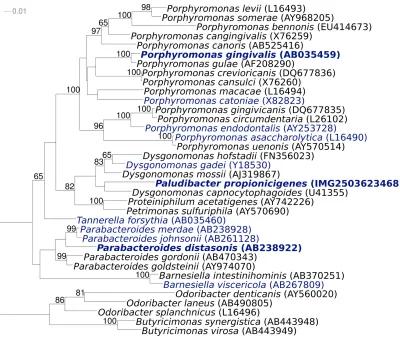
Figure 1 shows the phylogenetic neighborhood of
P. propionicigenes
WB4
Tin a 16S rRNA based tree.
The three identical 16S rRNA sequences in the
ge-nome differ by one nucleotide from the previously
published 16S rRNA sequence (AB078842).
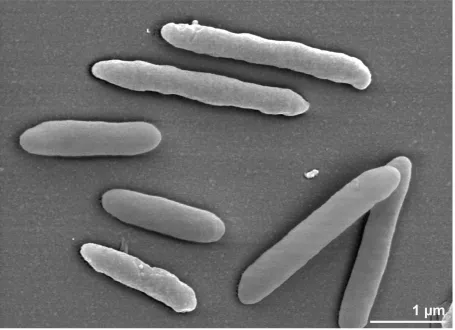
The cells of
P. propionicigenes
are generally
rod-shaped (0.5-
0.6 μm
× 1.3 -1.7 µm) with ends that
are round or slightly tapered [2]. Elongated cells
can also be seen, either as single cells or in short
chains (Figure 2).
P. propionicigenes
is a
Gram-negative and non spore-forming bacterium (Table
1). The organism is described to be nonmotile;
only eight genes associated with motility were
identified in the genome. The organism is strictly
anaerobic and chemoorganotrophic [2,3]. The
temperature range for growth is between 15°C
and 35°C, with an optimum at 30°C [2]. The
organ-ism does not grow at 37°C [2]. The pH range for
growth is 5.0-7.6 with an optimum at pH 6.6 [2].
NaCl concentrations from 0-0.5% (w/v) are
tole-rated.
P. propionicigenes
is able to utilize
arabi-nose, glucose, fructose, xylose, cellobiose,
galac-tose, mannose, malgalac-tose, melibiose, glycogen and
soluble starch as growth substrates [2]. The
or-ganism does not utilize ribose, lactose, sucrose,
melezitose, raffinose, sorbose, rhamnose,
treha-lose, cellutreha-lose, xylan, salicin, dulcitol, inositol,
mannitol, sorbitol, ethanol, glycerol, fumarate,
ma-late, lactate, succinate or pyruvate [2]. Glucose is
fermented to propionate and acetate in a molar
ratio of 2:1 as major products and succinate as a
minor product [2]. The organism does not reduce
nitrate, it does not hydrolyze gelatin or urea and
does not produce indole or hydrogen sulfide [2].
P.
propionicigenes
does not grow in the presence of
bile salts. Catalase and oxidase are not present in
the organism [2].
Chemotaxonomy
Little chemotaxonomic data are available for
strain WB4
T. Only the fatty acid composition has
been elucidated. The major fatty acids found were
anteiso-
C
15:0(30.8%), C
15:0(19.0%) and 3-hydroxy
anteiso-
C
17:0(17.9%) [2]. Also,
iso-
C
17:0 3-OH(6.2%)
and C
16:0(4.9%) were detected in intermediate
amounts whereas
iso-
C
15:0 3-OH,
iso-
C
16:0 3-OH, C
15:0 3-OH, C
16:03-OH,
iso
-C
15:0, C
14:0, C
16:0, and C
18:0were
present in minor amounts (1% to 5% of the total
fatty acids). Unsaturated fatty acids were not
de-tected [2].
Table 1. Classification and general features of P. propionicigenes WB4T according to the MIGS recommendations [14].
MIGS ID Property Term Evidence code
Current classification
Domain Bacteria TAS [15]
Phylum Bacteroidetes TAS [16]
Class Bacteroidia TAS [16,17]
Order Bacteroidales TAS [16]
Family Porphyromonadaceae TAS [16]
Genus Paludibacter TAS [2]
Species Paludibacter propionicigenes TAS [2]
Type strain WB4 TAS [2]
Gram stain negative TAS [3]
Cell shape rod-shaped TAS [3]
Motility non-motile TAS [2]
Sporulation none TAS [3]
Temperature range 15°C to 35°C TAS [3]
Optimum temperature 30°C TAS [2]
Salinity normal NAS
MIGS-22 Oxygen requirement strictly anaerobic TAS [3]
Carbon source carbohydrates TAS [3]
Energy source chemoorganotroph TAS [3]
MIGS-6 Habitat soil TAS [3]
MIGS-15 Biotic relationship free-living NAS
MIGS-14 Pathogenicity none NAS
Biosafety level 1 TAS [18]
Isolation rice plant residue in anoxic rice-field soil TAS [3]
MIGS-4 Geographic location Yamagata, Japan TAS [3]
MIGS-5 Sample collection time 1994 TAS [3]
MIGS-4.1 Latitude 38.25 NAS
MIGS-4.2 Longitude 140.34 NAS
MIGS-4.3 Depth not reported
MIGS-4.4 Altitude not reported
Evidence codes - IDA: Inferred from Direct Assay (first time in publication); TAS: Traceable Author Statement (i.e., a direct report exists in the literature); NAS: Non-traceable Author Statement (i.e., not directly observed for the living, isolated sample, but based on a generally accepted property for the species, or anecdotal evi-dence). These evidence codes are from of the Gene Ontology project [
19
]. If the evidence code is IDA, then the property was directly observed by one of the authors or an expert mentioned in the acknowledgements.Genome sequencing and annotation
Genome project history
This organism was selected for sequencing on the
basis of its phylogenetic position [20], and is part
of the
G
enomic
E
ncyclopedia of
B
acteria and
A
rc-haea
project [21]. The genome project is
depo-sited in the Genomes OnLine Database [11] and
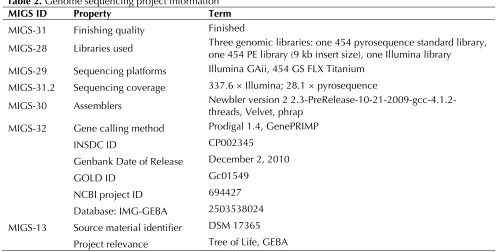
Table 2. Genome sequencing project information
MIGS ID Property Term
MIGS-31 Finishing quality Finished
MIGS-28 Libraries used Three genomic libraries: one 454 pyrosequence standard library, one 454 PE library (9 kb insert size), one Illumina library MIGS-29 Sequencing platforms Illumina GAii, 454 GS FLX Titanium
MIGS-31.2 Sequencing coverage 337.6 × Illumina; 28.1 × pyrosequence
MIGS-30 Assemblers Newbler version 2 2.3-PreRelease-10-21-2009-gcc-4.1.2-threads, Velvet, phrap MIGS-32 Gene calling method Prodigal 1.4, GenePRIMP
INSDC ID CP002345
Genbank Date of Release December 2, 2010
GOLD ID Gc01549
NCBI project ID 694427
Database: IMG-GEBA 2503538024 MIGS-13 Source material identifier DSM 17365
Project relevance Tree of Life, GEBA
Growth conditions and DNA isolation
P. propionicigenes
WB4
T, DSM 17365, was grown
anaerobically in DSMZ medium 104 [22] at 30°C.
DNA was isolated from 0.5-1 g of cell paste using a
MasterPure Gram-positive DNA purification kit
(Epicentre MGP04100) following the standard
protocol as recommended by the manufacturer,
with modification st/DL for cell lysis as described
in Wu
et al
. [21].
Genome sequencing and assembly
The genome was sequenced using a combination
of Illumina and 454 sequencing platforms. All
general aspects of library construction and
se-quencing can be found at the JGI website [23].
Py-rosequencing reads were assembled using the
Newbler assembler version
2.3-PreRelease-10-21-2009-gcc-4.1.2-threads (Roche). The initial
Newb-ler assembly consisting of 26 contigs in one
scaf-fold which was converted into a phrap assembly
by [24] making fake reads from the consensus, to
collect the read pairs in the 454 paired end
li-brary. Illumina GAii sequencing data (967 Mb)
was assembled with Velvet [25] and the
consen-sus sequences were shredded into 1.5 kb
over-lapped fake reads and assembled together with
the 454 data. The 454 draft assembly was based
on 93.4 Mb 454 draft data and all of the 454
paired end data. Newbler parameters are -consed
-a 50 -l 350 -g -m -ml 20. The Phred/Phrap/Consed
software package was used for sequence
assem-bly and quality assessment in the subsequent
fi-nishing process. After the shotgun stage, reads
were assembled with parallel phrap (High
Per-formance Software, LLC). Possible mis-assemblies
were corrected with gapResolution [23],
Dupfi-nisher, or sequencing cloned bridging PCR
frag-ments with subcloning or transposon bombing
(Epicentre Biotechnologies, Madison, WI) [26].
Gaps between contigs were closed by editing in
Consed, by PCR and by Bubble PCR primer walks
(J.-F.Chang, unpublished). A total of 124 additional
reactions and one shatter library were necessary
to close the gaps and to raise the quality of the
fi-nished sequence. Illumina reads were also used to
correct potential base errors and increase
consen-sus quality using a software Polisher developed at
JGI [27]. The error rate of the completed genome
sequence is less than 1 in 100,000. Together, the
combination of the Illumina and 454 sequencing
platforms provided 365.7 × coverage of the
ge-nome. The final assembly contained 333,397
py-rosequence and 34,564,373 Illumina reads.
Genome annotation
In-formation (NCBI) nonredundant database,
Uni-Prot, TIGR-Fam, Pfam, PRIAM, KEGG, COG, and
In-terPro databases. Additional gene prediction
anal-ysis and functional annotation was performed
within the Integrated Microbial Genomes - Expert
Review (IMG-ER) platform [30].
Genome properties
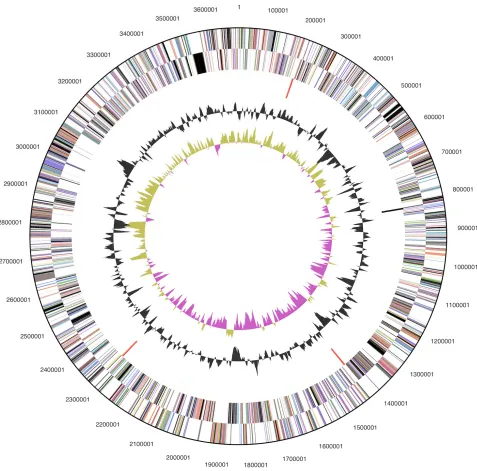
The genome consists of a 3,685,504 bp long
chro-mosome with a GC content of 38.9% (Figure 3 and
Table 3). Of the 3,118 genes predicted, 3,054 were
protein-coding genes, and 64 RNAs; 34
pseudo-genes were also identified. The majority of the
protein-coding genes (65.8%) were assigned with
a putative function while the remaining ones were
annotated as hypothetical proteins. The
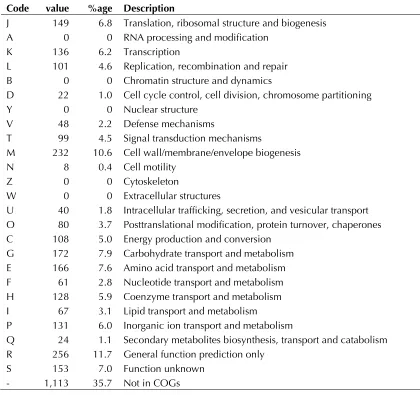
distribu-tion of genes into COGs funcdistribu-tional categories is
presented in Table 4.
Table 3. Genome Statistics
Attribute Value % of Total
Genome size (bp) 3,685,504 100.00%
DNA coding region (bp) 3,225,817 87.53% DNA G+C content (bp) 1,432,064 38.86%
Number of replicons 1
Extrachromosomal elements 0
Total genes 3,118 100.00%
RNA genes 64 2.05%
rRNA operons 3
Protein-coding genes 3,054 97.95%
Pseudo genes 34 1.09%
Genes with function prediction 2,051 65.78% Genes in paralog clusters 325 10.42%
Genes assigned to COGs 2,005 64.30%
Genes assigned Pfam domains 2,205 70.72% Genes with signal peptides 843 27.04% Genes with transmembrane helices 784 25.14%
CRISPR repeats 2
Table 4. Number of genes associated with the general COG functional categories Code value %age Description
J 149 6.8 Translation, ribosomal structure and biogenesis A 0 0 RNA processing and modification
K 136 6.2 Transcription
L 101 4.6 Replication, recombination and repair B 0 0 Chromatin structure and dynamics
D 22 1.0 Cell cycle control, cell division, chromosome partitioning
Y 0 0 Nuclear structure
V 48 2.2 Defense mechanisms
T 99 4.5 Signal transduction mechanisms
M 232 10.6 Cell wall/membrane/envelope biogenesis N 8 0.4 Cell motility
Z 0 0 Cytoskeleton
W 0 0 Extracellular structures
U 40 1.8 Intracellular trafficking, secretion, and vesicular transport O 80 3.7 Posttranslational modification, protein turnover, chaperones C 108 5.0 Energy production and conversion
G 172 7.9 Carbohydrate transport and metabolism E 166 7.6 Amino acid transport and metabolism F 61 2.8 Nucleotide transport and metabolism H 128 5.9 Coenzyme transport and metabolism I 67 3.1 Lipid transport and metabolism
P 131 6.0 Inorganic ion transport and metabolism
Q 24 1.1 Secondary metabolites biosynthesis, transport and catabolism R 256 11.7 General function prediction only
Acknowledgements
We would like to gratefully acknowledge the help of
Sabine Welnitz (DSMZ) for growing P. propionicigenes
cultures. This work was performed under the auspices of the US Department of Energy Office of Science, Bio-logical and Environmental Research Program, and by the University of California, Lawrence Berkeley Nation-al Laboratory under contract No. DE-AC02-05CH11231,
Lawrence Livermore National Laboratory under Con-tract No. DE-AC52-07NA27344, and Los Alamos Na-tional Laboratory under contract No. DE-AC02-06NA25396, UT-Battelle and Oak Ridge National La-boratory under contract DE-AC05-00OR22725, as well as German Research Foundation (DFG) INST 599/1-2.
References
1. Garrity G. NamesforLife. BrowserTool takes ex-pertise out of the database and puts it right in the browser. Microbiol Today 2010; 7:1.
2. Ueki A, Akasaka H, Suzuki D, Ueki K. Paludibac-ter propionicigenes gen. nov., sp. nov., a novel strictly anaerobic, Gram-negative, propionate-producing bacterium isolated from plant residue in irrigated rice-field soil in Japan. Int J Syst Evol Microbiol 2006; 56:39-44
3. Akasaka H, Izawa T, Ueki K, Ueki A. Phylogeny of numerically abundant culturable anaerobic bacteria associated with degradation of rice plant residue in Japanese paddy field soil. FEMS Micro-biol Ecol 2003; 43:149-161
4. Pei CX, Liu Q, Dong CS, Li H, Jiang JB, Gao WJ. Diversity and abundance of the bacterial 16S rRNA gene sequences in forestomach of alpacas (Lama pacos) and sheep (Ovis aries). Anaerobe
2010; 16:426-432
5. DeSantis TZ, Hugenholtz P, Larsen N, Rojas M, Brodie EL, Keller K, Huber T, Dalevi D, Hu P, Andersen GL. Greengenes, a Chimera-Checked 16S rRNA Gene Database and Workbench Com-patible with ARB. Appl Environ Microbiol 2006; 72:5069-5072
6. Porter MF. An algorithm for suffix stripping. Pro-gram: electronic library and information systems
1980; 14:130-137.
7. Lee C, Grasso C, Sharlow MF. Multiple sequence alignment using partial order graphs. Bioinformat-ics 2002; 18:452-464
8. Castresana J. Selection of conserved blocks from multiple alignments for their use in phylogenetic analysis. Mol Biol Evol 2000; 17:540-552
9. Stamatakis A, Hoover P, Rougemont J. A rapid bootstrap algorithm for the RAxML web-servers.
Syst Biol 2008; 57:758-771
10. Pattengale ND, Alipour M, Bininda-Emonds ORP, Moret BME, Stamatakis A. How Many Bootstrap Replicates Are Necessary? Lect Notes Comput Sci
2009; 5541:184-200
11. Liolios K, Chen IM, Mavromatis K, Tavernarakis N, Hugenholtz P, Markowitz VM, Kyrpides NC. The Genomes OnLine Database (GOLD) in 2009: status of genomic and metagenomic projects and their associated metadata. Nucleic Acids Res
2010; 38:D346-D354
12. Xu J, Mahowald MA, Ley RE, Lozupone CA, Ha-mady M, Martens EC, Henrissat B, Coutinho PM, Minx P, Latreille P, et al. Evolution of symbiotic bacteria in the distal human intestine. PLoS Biol
2007; 5:e156
13. Naito M, Hirakawa H, Yamashita A, Ohara N, Shoji M, Yukitake H, Nakayama K, Toh H, Yo-shimura F, Kuhara S, et al. Determination of the genome sequence of Porphyromonas gingivalis
strain ATCC 33277 and genomic comparison with strain W83 revealed extensive genome rear-rangements in P. gingivalis. DNA Res 2008;
15:215-225
14. Field D, Garrity G, Gray T, Morrison N, Selengut J, Sterk P, Tatusova T, Thomson N, Allen MJ, An-giuoli SV, et al. The minimum information about a genome sequence (MIGS) specification. Nat Biotechnol 2008; 26:541-547
15. Woese CR, Kandler O, Wheelis ML. Towards a natural system of organisms: proposal for the do-mains Archaea, Bacteria, and Eucarya.Proc Natl Acad Sci USA 1990; 87:4576-4579
16. Garrity GM, Holt JG. Taxonomic Outline of the
Syste-matic Bacteriology, Second Edition, Volume 1, Springer, New York, 2001, p. 155-166. 17. Ludwig W, Euzeby J, Whitman WG. Draft
tax-onomic outline of the Bacteroidetes, Planctomy-cetes, Chlamydiae, Spirochaetes, Fibrobacteres, Fusobacteria, Acidobacteria, Verrucomicrobia, Dictyoglomi, and Gemmatimonadetes.
18. BAuA. Classification of bacteria and archaea in risk groups. TRBA 2005; 466:84.
19. Ashburner M, Ball CA, Blake JA, Botstein D, But-ler H, Cherry JM, Davis AP, Dolinski K, Dwight SS, Eppig JT, et al. Gene Ontology: tool for the unification of biology. Nat Genet 2000; 25:25-29
20. Klenk HP, Goeker M. En route to a genome-based classification of Archaea and Bacteria? Syst Appl Microbiol 2010; 33:175-182
21. Wu D, Hugenholtz P, Mavromatis K, Pukall R, Dalin E, Ivanova NN, Kunin V, Goodwin L, Wu M, Tindall BJ, et al. A phylogeny-driven genomic encyclopaedia of Bacteria and Archaea. Nature
2009; 462:1056-1060
22. List of growth media used at DSMZ:
23. DOE Joint Genome Institute.
24. Phrap and Phred for Windows. MacOS, Linux,
and Unix
25. Zerbino DR, Birney E. Velvet: algorithms for de novo short read assembly using de Bruijn graphs.
Genome Res 2008; 18:821-829
26. Han C, Chain P. 2006. Finishing repeat regions automatically with Dupfinisher. in Proceeding of the 2006 international conference on bioinfor-matics & computational biology. Edited by Hamid R. Arabnia & Homayoun Valafar, CSREA Press. June 26- 29, 2006: 141-146.30.
27. Lapidus A, LaButti K, Foster B, Lowry S, Trong S, Goltsman E. POLISHER: An effective tool for us-ing ultra short reads in microbial genome assem-bly and finishing. AGBT, Marco Island, FL, 2008. 28. Hyatt D, Chen GL, LoCascio PF, Land ML,
Lari-mer FW, Hauser LJ. Prodigal: prokaryotic gene recognition and translation initiation site identifi-cation. BMC Bioinformatics 2010; 11:119
29. Pati A, Ivanova NN, Mikhailova N, Ovchinnikova G, Hooper SD, Lykidis A, Kyrpides NC. Gene-PRIMP: a gene prediction improvement pipeline for prokaryotic genomes. Nat Methods 2010;
7:455-457
30. Markowitz VM, Ivanova NN, Chen IMA, Chu K, Kyrpides NC. IMG ER: a system for microbial ge-nome annotation expert review and curation. Bio-informatics 2009; 25:2271-2278
![Table 1. Classification and general features of P. propionicigenes WB4T according to the MIGS recommendations [14]](https://thumb-us.123doks.com/thumbv2/123dok_us/685041.2066810/4.612.68.549.66.545/table-classification-general-features-propionicigenes-according-migs-recommendations.webp)