PhD Dissertation
International Doctorate School in Information and Communication Technologies
DISI - University of Trento
Modelling input texts:
from Tree Kernels to Deep Learning
Aliaksei Severyn
Advisor:
Prof. Alessandro Moschitti
Universit`a degli Studi di Trento
Writing a PhD dissertation requires a considerable effort, willingness and motivation to explore new research topics and, of course, the right mindset to go on when facing the unavoidable failures, dead end ideas and paper rejections. I can hardly imagine finishing this work without the help of others. I would like to greatly thank the following people:
• My advisor who inspired me to pursue a PhD in the first place and who has greatly helped me to perform at my best through the numerous technical discussions, sug-gestions and tips on carrying out research and academic writing.
• The current and former members of our group, and in particular Olga Uryupina, Bar-bara Plank, Massimo Nicosia, and Kateryna Tymoshenko for a fruitful collaboration on several joint papers.
• My supervisors Katja Filippova and Ioannis Tsochandaridis during my internship at Google Zurich, and Anastasios Kakalis at Google London for their great assistance through my industry experience while taking extra effort to make sure it was aligned with my research interests as much as it was possible.
• To Ryan McDonald for an interesting discussion that sparked my interest in Deep Learning methods and Nal Kalchbrenner who provided tips on relevant papers and sharing his experience.
For two years I was supported by the Google Doctoral Fellowship which gave me the possibility to focus on my research. I am very grateful for this gift from Google.
I would also like to thank the students of an MSc course on NLP and IR (for which I was a TA) who helped me appreciate the joy of teaching, and my friends Alexandre Kandalintsev, Iryna Haponchyk, and Andrey Bogomolov who helped me keep a better balance taking time outside of research and enjoy the life in Trento.
Abstract
One of the core questions when designing modern Natural Language Processing (NLP) systems is how to model input textual data such that the learning algorithm is provided with enough information to estimate accurate decision functions.
The mainstream approach is to represent input objects as feature vectors where each value encodes some of their aspects, e.g., syntax, semantics, etc. Feature-based methods have demonstrated state-of-the-art results on various NLP tasks. However, designing good features is a highly empirical-driven process, it greatly depends on a task requiring a significant amount of domain expertise. Moreover, extracting features for complex NLP tasks often requires expensive pre-processing steps running a large number of linguistic tools while relying on external knowledge sources that are often not available or hard to get. Hence, this process is not cheap and often constitutes one of the major challenges when attempting a new task or adapting to a different language or domain. The problem of modelling input objects is even more acute in cases when the input examples are not just single objects but pairs of objects, such as in various learning to rank problems in Information Retrieval and Natural Language processing.
An alternative to feature-based methods is using kernels which are essentially non-linear functions mapping input examples into some high dimensional space thus allowing for learning decision functions with higher discriminative power. Kernels implicitly gener-ate a very large number of features computing similarity between input examples in that implicit space. A well-designed kernel function can greatly reduce the effort to design a large set of manually designed features often leading to superior results.
However, in the recent years, the use of kernel methods in NLP has been greatly under-estimated primarily due to the following reasons: (i) learning with kernels is slow as it requires to carry out optimizaiton in the dual space leading to quadratic complexity; (ii) applying kernels to the input objects encoded with vanilla structures, e.g., generated by syntactic parsers, often yields minor improvements over carefully designed feature-based methods.
In this thesis, we adopt the kernel learning approach for solving complex NLP tasks and primarily focus on solutions to the aforementioned problems posed by the use of kernels. In particular, we design novel learning algorithms for training Support Vector Machines with structural kernels, e.g., tree kernels, considerably speeding up the training over the conventional SVM training methods. We show that using the training algorithms developed in this thesis allows for trainining tree kernel models on large-scale datasets containing millions of instances, which was not possible before.
dependency trees, are often a poor choice thus compromising the expressivity offered by a tree kernel learning framework. We propose several effective design patterns of the input tree structures for various NLP tasks ranging from sentiment analysis to answer passage reranking. The central idea is to inject additional semantic information relevant for the task directly into the tree nodes and let the expressive kernels generate rich feature spaces. For the opinion mining tasks, the additional semantic information injected into tree nodes can be word polarity labels, while for more complex tasks of modelling text pairs the relational information about overlapping words in a pair appears to significantly improve the accuracy of the resulting models.
Finally, we observe that both feature-based and kernel methods typically treat words as atomic units where matching different yet semantically similar words is problematic. Conversely, the idea of distributional approaches to model words as vectors is much more effective in establishing a semantic match between words and phrases. While tree kernel functions do allow for a more flexible matching between phrases and sentences through matching their syntactic contexts, their representation can not be tuned on the training set as it is possible with distributional approaches. Recently, deep learning approaches have been applied to generalize the distributional word matching problem to matching sentences taking it one step further by learning the optimal sentence representations for a given task. Deep neural networks have already claimed state-of-the-art performance in many computer vision, speech recognition, and natural language tasks.
Following this trend, this thesis also explores the virtue of deep learning architectures for modelling input texts and text pairs where we build on some of the ideas to model input objects proposed within the tree kernel learning framework. In particular, we explore the idea of relational linking (proposed in the preceding chapters to encode text pairs using linguistic tree structures) to design a state-of-the-art deep learning architecture for modelling text pairs. We compare the proposed deep learning models that require even less manual intervention in the feature design process then previously described tree kernel methods that already offer a very good trade-off between the feature-engineering effort and the expressivity of the resulting representation. Our deep learning models demonstrate the state-of-the-art performance on a recent benchmark for Twitter Sentiment Analysis, Answer Sentence Selection and Microblog retrieval.
Keywords
Contents
1 Introduction 1
1.1 Motivation . . . 1
1.1.1 The problem of modelling input texts . . . 2
1.1.2 Research goals. . . 4
1.2 Contributions and structure of the thesis . . . 6
2 Preliminaries: Supervised Learning with Structural Kernels 13 2.1 Supervised Learning . . . 13
2.2 Supervised learning problems in NLP . . . 15
2.2.1 Classification . . . 16
Problem formulation . . . 16
Example tasks. . . 16
2.2.2 Re-ranking. . . 17
Problem formulation . . . 18
Learning to Rank approaches . . . 18
Example tasks. . . 19
2.2.3 Structured Prediction Problems in NLP . . . 19
Problem formulation . . . 20
Example tasks. . . 20
2.3 Binary Support Vector Machines . . . 23
2.3.1 Primal formulation . . . 23
2.3.2 The dual . . . 24
2.3.3 The kernel trick . . . 26
2.4 Structural Kernels . . . 27
2.4.1 String Kernels . . . 27
2.4.2 Convolutional Tree Kernels . . . 28
Counting shared fragments . . . 28
Syntactic Tree Kernel (STK). . . 29
Partial Tree Kernel (PTK) . . . 30
3.1 Overview. . . 34
3.1.1 Approximate Cutting Plane Algorithm with model compression . . 34
3.1.2 Fast linearization of tree kernels . . . 36
3.1.3 Our contributions . . . 37
3.2 Preliminaries: Cutting Plane Algorithm with Sampling . . . 39
3.2.1 Cutting-plane algorithm (primal) . . . 39
3.2.2 Cutting-plane algorithm (dual) . . . 40
3.3 Fast CPA for Structural Kernels . . . 42
3.3.1 Compacting cutting plane models using DAGs . . . 42
3.3.2 DAG tree kernels . . . 42
3.3.3 Fast Computation of the CPM on Structural Data. . . 44
3.4 Implementation of the DAG Kernel . . . 45
3.4.1 DAG construction. . . 46
3.4.2 DAG kernel computation . . . 47
3.4.3 Parallelization . . . 48
3.5 Handling Class-Imbalanced data . . . 48
3.5.1 Cost-proportionate sampling . . . 49
3.5.2 Theoretical Analysis of the Algorithm. . . 51
3.6 Linearization of DAG models . . . 52
3.6.1 Feature enumeration aka feature hashing . . . 52
3.6.2 Reverse Kernel Engineering . . . 53
3.7 Experiments . . . 54
3.7.1 Experimental setup . . . 54
3.7.2 Data . . . 55
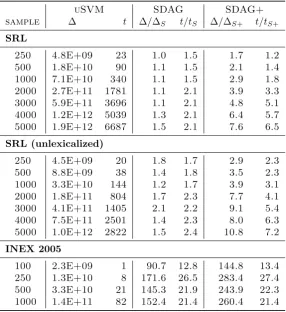
3.7.3 Comparative speedup analysis of DAG-based models . . . 56
Learning speedups . . . 57
Classification experiments . . . 59
3.7.4 Tuning up Precision and Recall . . . 61
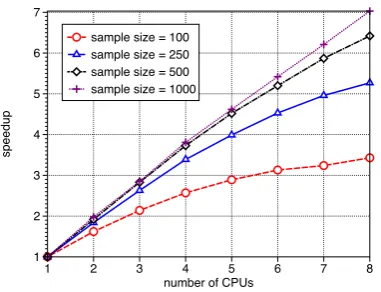
3.7.5 Parallelization . . . 62
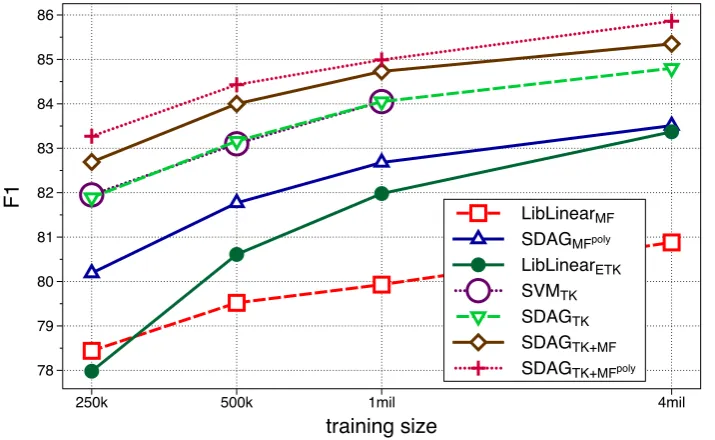
3.7.6 Linearization experiments . . . 63
Data and task . . . 63
Setup . . . 63
Feature-based learning . . . 64
Learning with kernels . . . 65
Tree Kernel Linearization . . . 67
Distributed linearization . . . 68
3.8 Related work . . . 69
4 Modelling YouTube comments with Shallow Syntactic Tree Structures 75
4.1 Overview. . . 75
4.1.1 Our contributions . . . 76
4.2 Representations and models . . . 77
4.2.1 Feature Set . . . 77
4.2.2 Structural model . . . 78
4.2.3 Learning . . . 79
4.3 YouTube comments corpus . . . 81
4.4 Experiments . . . 82
4.4.1 Task description. . . 82
4.4.2 Data . . . 83
4.4.3 Results . . . 84
In-domain experiments . . . 84
Learning curves . . . 85
Cross-domain experiments . . . 85
4.4.4 Discussion . . . 87
4.5 Related work . . . 87
4.6 Summary . . . 89
5 Modelling text pairs with syntactic trees 91 5.1 Overview. . . 92
5.1.1 Semantic Textual Similarity . . . 92
5.1.2 Microblog Retrieval . . . 93
5.1.3 Our contributions . . . 94
5.2 Semantic Textual Similarity . . . 95
5.2.1 Learning . . . 95
5.2.2 Syntactic models of text pairs . . . 96
5.2.3 Pairwise similarity features . . . 97
5.2.4 Experiments . . . 98
Experimental setup . . . 98
Results . . . 99
5.3 Microblog Retrieval . . . 99
5.3.1 Learning . . . 100
5.3.2 A syntactic model for tweets . . . 100
5.3.3 Experiments . . . 101
Experimental setup . . . 101
Results . . . 102
6.1 Overview. . . 108
6.2 Structural models of question-answer pairs . . . 110
6.2.1 Basic structural representations . . . 110
Shallow tree structures . . . 110
Soft matching for relational linking . . . 111
6.2.2 Refining relational tag using question focus and question category . 113 Question focus detection . . . 113
Question classification . . . 113
Semantic linking . . . 114
6.2.3 Tree kernels for automatic feature engineering . . . 114
6.3 QA tasks. . . 115
6.3.1 Answer passage reranking . . . 115
QA architecture . . . 115
Pairwise reranking with kernels . . . 116
6.3.2 Answer Sentence Selection . . . 117
QA pair classification with tree kernels . . . 117
6.3.3 Answer Sentence Extraction . . . 118
6.4 Feature Vector Representation . . . 119
6.4.1 Basic features . . . 119
6.4.2 Advanced features . . . 120
6.5 Experiments . . . 121
6.5.1 Answer Passage Reranking . . . 121
Experimental setup . . . 121
Data . . . 122
Search engines. . . 123
Relational learning on TREC . . . 123
Soft Word Matching . . . 124
Relational learning using Question Focus and Question Class . . . . 125
Learning cross-domain pairwise structural relationships . . . 126
Error Analysis. . . 126
6.5.2 Answer Sentence Selection . . . 128
Experimental setup . . . 128
Results . . . 129
6.5.3 Answer Extraction . . . 130
Recovering answers . . . 130
Best Answer Selection . . . 131
Discussion and Error Analysis . . . 131
6.7 Summary . . . 134
7 Deep Learning models of input texts 137 7.1 Overview. . . 138
7.1.1 Modelling tweets . . . 138
7.1.2 Modelling text pairs . . . 139
7.1.3 Our contributions . . . 141
7.2 Preliminaries: Convolutional Neural Networks . . . 142
7.2.1 Sentence matrix . . . 142
7.2.2 Convolution feature maps . . . 142
7.2.3 Activation units . . . 144
7.2.4 Pooling . . . 144
7.2.5 Hidden layers . . . 145
7.2.6 Softmax . . . 145
7.2.7 Training . . . 146
7.2.8 Regularization . . . 146
7.3 Modelling tweets . . . 146
7.3.1 Network architecture . . . 146
7.3.2 Phrase-level sentiment analysis . . . 147
7.3.3 Initializing the model parameters . . . 147
7.4 Modelling text pairs . . . 148
7.4.1 Sentence model . . . 148
7.4.2 Encoding overlapping words . . . 149
7.4.3 Our architecture for matching text pairs . . . 149
7.4.4 Matching query and documents . . . 149
7.4.5 The information flow . . . 150
7.5 Experiments . . . 151
7.5.1 Twitter Sentiment Analysis . . . 151
Experimental setup . . . 151
Pre-training the network . . . 151
Official rankings . . . 152
7.5.2 Answer Sentence Selection . . . 153
Experimental setup . . . 153
Word embeddings . . . 154
Training and hyperparameters . . . 155
Size of the model . . . 156
Results and discussion . . . 156
7.5.3 TREC Microblog Retrieval . . . 158
7.6 Related Work . . . 162
7.7 Summary . . . 163
8 Summary and Future Work 165 8.1 Fast SVMs with structural kernels . . . 166
8.2 Syntactic structures for modelling input texts: Youtube comments . . . 167
8.3 Syntactic structures for modelling text pairs . . . 167
8.4 Semantic syntactic structures for Question Answering . . . 168
8.5 Deep Learning architectures for modelling input texts and text pairs. . . . 169
List of Tables
3.1 Comparing speedups: STK . . . 58
3.2 Comparing speedups: PTK . . . 59
3.3 Classification speedups . . . 60
3.4 Large-scale experiment on SRL . . . 60
3.5 Handling class-imbalance problem . . . 61
3.6 Results of feature enumeration on SRL . . . 65
3.7 Feature overlap with SVM model . . . 66
3.8 Runtimes for kernelized models. . . 66
3.9 Accuracy of RKE models . . . 68
3.10 Large-scale learning with RKE . . . 69
4.1 Summary of YouTube comments data . . . 83
4.2 In-domain experiments . . . 84
4.3 Cross-domain experiment. . . 86
5.1 Results on STS-2012 . . . 98
5.2 Comparison with the Uva L2R model . . . 103
5.3 System performance on the top 30 runs from TMB2012 . . . 104
5.4 Results of improving system runs . . . 105
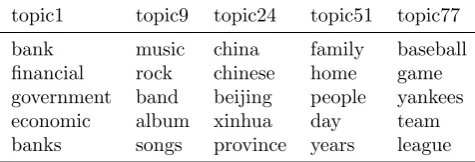
6.1 Example of LDA topics from Aquaint corpus . . . 112
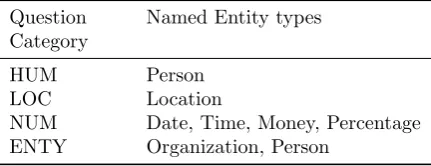
6.2 Mapping from question classes to named entity types. . . 114
6.3 Search Engine baselines on TREC QA. . . 123
6.4 Answer passage reranking on TREC QA . . . 124
6.5 Results on TREC QA using various relational tagging schemes . . . 125
6.6 Answer passage reranking on Answerbag. . . 126
6.7 Testing model robustness: training on Answerbag and testing on TREC QA.126 6.8 Summary of the TREC data for answer sentence selection. . . 129
6.9 Answer sentence reranking on TREC 13 . . . 130
6.10 Results on answer extraction . . . 132
7.2 Results on the progress test sets from Semeval-2015 . . . 152
7.3 Results on Semeval-2015 for phrase and tweet-level subtasks . . . 153
7.4 Summary of TREC QA datasets for answer reranking. . . 154
7.5 Results on TRAIN and TRAIN-ALL from TREC QA using only similarity score and also including the distributional representation of question and answer sentences. . . 157
7.6 Results on TREC QA when augmenting the deep learning model with relational information about overlapping words. . . 158
7.7 Survey of the results on the TREC QA answer selection task. . . 158
7.8 Summary of TREC Microblog datasets. . . 159
7.9 System performance on the top 30 runs from TMB2012 . . . 161
List of Figures
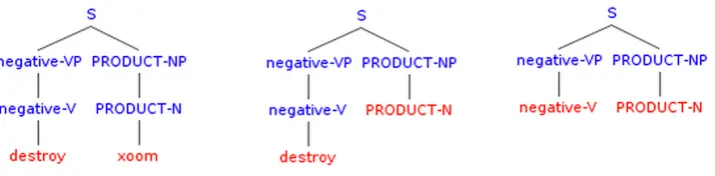
1.1 Shallow syntactic tree representation of the YouTube comment: “iPad 2 is
better. the superior apps just destroy the xoom.” . . . 5
1.2 Excerpt of tree fragment features automatically generated by the tree kernel function for the example shown in Figure 1.1. . . 5
2.1 Example syntactic trees. . . 23
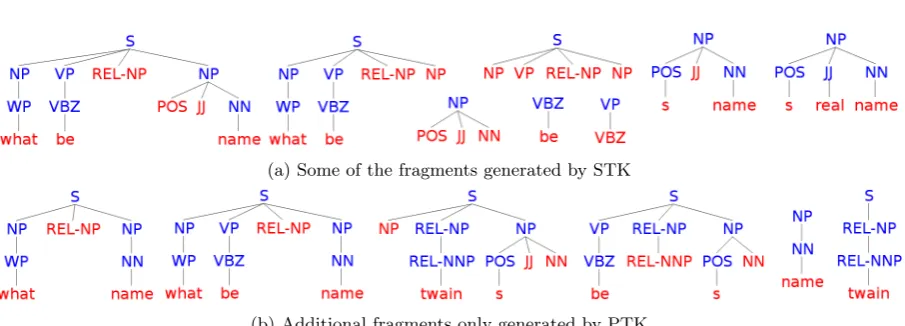
2.2 Example tree fragments generated by Tree Kernels. . . 29
3.1 Three syntactic trees and the resulting DAG.. . . 35
3.2 Comparing asymptotic algorithm efficiency on SRL . . . 56
3.3 Speedups due to parallelization . . . 63
3.4 Learning curves on SRL . . . 67
4.1 Example shallow tree representation of a Youtube comment . . . 78
4.2 In-domain learning curves . . . 86
4.3 Learning curves for the cross-domain setting . . . 86
5.1 A phrase-dependency based structural representation of a text pair . . . . 96
5.2 Example shallow tree model of a query-tweet pair . . . 101
6.1 Shallow chunk tree for the q/a pair . . . 111
6.2 Relational tagging of q/a pairs . . . 113
6.3 Some of the tree fragments generated from a q/a pair . . . 115
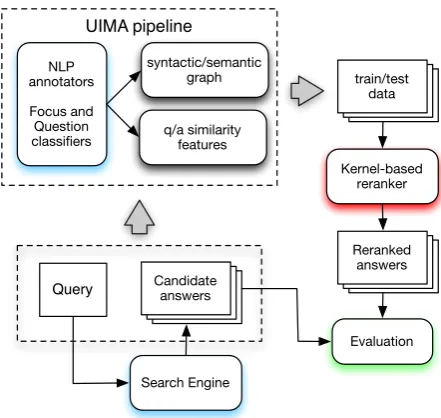
6.4 Kernel-based answer passage reranking system . . . 116
6.5 Basic CH representation of the example SV pair.. . . 126
6.6 Structural representation of the answer from the SV pair with the relational focus tag. . . 127
6.7 Incorrect answer with the relational focus tag. . . 128
6.8 Example q/a pair from SVs not activated after using typed relation focus tag. . . 128
Chapter 1
Introduction
1.1
Motivation
Perhaps the most prominent results in developing modern Natural Language Processing (NLP) systems are largely due to the application of statistical machine learning meth-ods. Prior attempts to tackle language-processing tasks were extremely labour intensive typically requiring to hand-engineer a large set of manual rules. For example, early spell-checkers and automatic machine translation systems required to define and encode thousands of rules leading to overly complicated systems that were hard to maintain and adapt to new languages or domains. In the past decades, the manual rule engineering approaches have been successfully replaced with statistical learning methods able to au-tomatically extract and learn such rules through the analysis of large collections of texts. For example, Google Translate, an automatic machine translation system developed by Google, can translate written text from one language into another supporting over 90 languages and is being used by millions users on a daily basis. Another example of a system where advanced statistical learning methods play an indispensable role to teach a machine to understand language at the level of a human is a Question Answering system developed by IBM Watson. Watson is an open domain question answering system whose core components are primarily based on advanced natural language processing, infor-mation retrieval, knowledge representation, automated reasoning, and machine learning technologies.
Given that the amount of textual information generated daily is growing at an increas-ing rate, buildincreas-ing intelligent NLP systems able to adapt to new domains and languages without methods able to automatically extract and capture salient patterns in the data is not possible.
word, and a desired output value, e.g., document category, sentence class or a word type. The goal is to infer a decision function by analysing the training data, which can be used for mapping unseen test examples to their output labels. This process is called training
and is typically set up to minimize some sort of an error (loss) function computed on the training set. The quality of the trained model is then estimated by how well it can generalize (predict) to the previously unseen test examples.
Hence, before approaching a given supervised learning problem it is generally required to: (i) decide on the type of the input data and construct a labeled training set; (ii) define a model to represent the input objects that will be fed to a learning algorithm; (iii) depending on the nature of the output labels and the class of functions that can be inferred from the training set, select a corresponding learning algorithm; and (iv) train the model and test it on a held out set to assess the model quality.
While there are many possible factors to consider when tackling a supervised learning task, e.g., the size of the training set, the choice of the learning algorithm and its hyper-parameters, etc., one of the key decisions to consider is how to represent the input objects. In fact, the accuracy of the learned model is greatly determined by how well we can model the input data to capture its important features helping to discriminate between examples with different labels. Typically, the input object is transformed into what is called a feature vector, which is essentially a vector of numbers that encode certain aspects of the object it represents.
1.1.1 The problem of modelling input texts
Among the first and most simple ideas to model the input textual information was to treat words as atomic units mapping them to arbitrary integers (drawn from a finite-sized set corresponding to the size of the word vocabulary). This representation is called bag-of-words, whose name stems from the fact that we treat texts as sets of words where the word order information is completely ignored. For example, a sentence "Mike wants to eat a cake" and its shuffled variant "cake eat to a Mike wants" are absolutely identical from the viewpoint of a learning algorithm that relies on the bag-of-words model. Despite its simplicity, such crude approximation of language, which, as we know, is inherently structured, results in surprisingly accurate models for many applications in Information Retrieval (IR) and NLP.
1.1. MOTIVATION
For a wide range of more complex NLP tasks the ability to capture the syntactic/se-mantic relations between words and phrases in a sentence is essential to train models with better generalization. In this case, using a bag-of-word model to represent input texts may lead to rather disappointing results. To increase the expressivity of the model to represent input objects, NLP researchers typically follow the path of encoding additional feature types that capture lexical, syntactic and semantic information.
An even more challenging problem than dealing with input texts is to represent text pairs, which is a common scenario in various IR and NLP applications, e.g., Retrieval, Question Answering, Paraphrasing, Textual Entailment, etc. The most widely used ap-proach is, again, to encode input text pairs using many complex lexical, syntactic and semantic features and then compute various similarity measures between the obtained rep-resentations. Typically, input texts are represented using various lexical, syntactic and semantic units such as words, n-grams, part-of-speech tags, dependency chains, predicate-argument relations, etc. These units are then translated into feature vectors using one-hot encoding scheme. Having mapped the input texts into a joint feature space, their sim-ilarity can be easily computed by an inner product between their feature vectors. The obtained similarity scores computed over various representations encode the input text pairs into feature vectors which are fed to a learning algorithm. Many state-of-the-art approaches that deal with text pairs follow that schema. For example, in answer passage reranking, Surdeanu et al. [157] employ complex linguistic features, modelling syntactic and semantic information as bags of syntactic and semantic role dependencies and build similarity and translation models over these representations.
Hence, a large effort in the design of NLP systems is devoted to engineering features in an attempt to encode various aspects of input objects that can help to learn better discriminative functions. However, the choice of representations and features is largely an empirical process, driven by the intuition, experience and domain expertise.
in NLP, bio-informatics, data mining, etc.
However, in the recent years the use of structural kernel methods in NLP has been greatly under-estimated primarily due to the following reasons:
• Learning with kernels scales quadratically in the number of training examples thus limiting their application to small datasets;
• Applying structural kernels to input objects represented using vanilla syntactic struc-tures, e.g. syntactic parse trees, results in models that demonstrate minor improve-ments over carefully designed feature-based methods.
1.1.2 Research goals
In this thesis we adopt the tree kernel learning approach for solving complex NLP tasks and focus on the aforementioned problems posed by the use of kernels: (i) slow training and (ii) designing more expressive structural representations of input texts going beyond plain structures produced by syntactic parsers.
To address the first problem, we design novel algorithms for training Support Vector Machines with structural kernels, e.g., tree kernels, considerably speeding up the training over the conventional SVM training methods. We show that using the novel training algorithms developed in this thesis it is possible to train tree kernel models on large-scale datasets containing millions of instances, which was not possible before.
Next, we focus on the problem of designing input structures that are fed to tree kernel functions to automatically generate a large set of tree-fragment features. We demonstrate that previously used plain structures generated by syntactic parsers, e.g., syntactic or dependency trees, are often a poor choice thus compromising the expressivity offered by a tree kernel learning framework.
To give a flavour of the structural tree representations of texts we propose in this thesis, consider the problem of building a sentiment classifier and the following example comment from a YouTube video about a Motorola Xoom smartphone:
iPad 2 is better. the superior apps just destroy the xoom.
The comment contains one negative and two positive tokens (for example, identified by a simple lookup in one of the available sentiment lexicons). This would strongly bias a typical feature-based sentiment classifier based on n-grams to assign a positive label to the comment. However, the polarity of this comment is negative with respect to the target product.
1.1. MOTIVATION
Figure 1.1: Shallow syntactic tree representation of the YouTube comment: “iPad 2 is better. the superior apps just destroy the xoom.”
typically have difficulties to model syntactic contexts of words, our structural representa-tion encodes the fact that the negative word,destroy, refers to the product xoom, where the latter is in object relation to the verbdestroy. Note that we augment the basic syntac-tic structure (composed of only part-of-speech and chunk tags) with additional semansyntac-tic labels plugged directly into the tree nodes to encode the target product (motorolaxoom) and sentiment-bearing words (better, superior, destroy). Consider the excerpt of tree fragments generated by the tree kernel shown in Figure 1.2 (in fact, the kernel function generates many more subtrees). The tree fragment on the left is a strong feature that helps the classifier to discriminate in such difficult cases. In general, tree kernels generate all possible subtrees, thereby producing generalized (back-off) features. For instance, the middle and right subtree shown in Figure1.2 generalize the one on the left.
Figure 1.2: Excerpt of tree fragment features automatically generated by the tree kernel function for the example shown in Figure1.1.
ex-pressive kernels generate rich feature spaces. For example, for the opinion mining tasks, the additional semantic information injected into tree nodes can be word polarity labels and target products (as we have just seen in Fig. 1.1), while for more complex tasks of modelling text pairs the relational information about overlapping words in a pair appears to significantly improve the accuracy of the resulting models.
Finally, we observe that both feature-based and kernel methods typically treat words as atomic units where matching different yet semantically similar words is problematic. Conversely, the idea of distributional approaches to model words as vectors is much more effective in establishing a semantic match between words and phrases. While tree kernel functions do allow for a more flexible matching between phrases and sentences through matching their syntactic contexts, their representation can not be tuned on the training set as with distributional approaches. Recently, deep learning approaches have been applied to generalize the distributional word matching problem to matching sentences taking it one step further by learning the optimal sentence representations for a given task. Deep neural networks have already claimed state-of-the-art performance in many computer vision, speech recognition, and natural language tasks.
Following this trend, this thesis also explores the virtue of deep learning architectures for modelling input texts and text pairs where we build on some of the ideas to model input objects proposed within the tree kernel learning framework. In particular, we explore the idea of relational linking (proposed in the preceding chapters to encode text pairs using linguistic tree structures) to design a state-of-the-art deep learning architecture for modelling text pairs. We compare the proposed deep learning models that require even less manual intervention in the feature design process then previously described tree kernel methods that already offer a very good compromise between the feature-engineering effort and the expressivity of the resulting representation. Our deep learning models demonstrate the state-of-the-art performance on a recent benchmark for Twitter Sentiment Analysis, Answer Sentence Selection and Microblog retrieval.
In the following we provide an overview of the thesis structure and highlight the con-tributions made in this thesis.
1.2
Contributions and structure of the thesis
1.2. CONTRIBUTIONS AND STRUCTURE OF THE THESIS
some of the most important structural kernels widely used in NLP and that are of central focus in this thesis.
Having introduced the general framework for learning with structural kernels, Chapter 3 describes several solutions to the first problem posed by the use of kernel methods: slow training times.
Contribution 1 (Chapter 3) Novel algorithms for speeding up the training of SVMs with structural kernels.
We propose the use of Directed Acyclic Graphs (DAGs) to compactly represent trees in the training algorithm of Support Vector Machines (SVMs). In particular, we use DAGs for each iteration of the cutting plane algorithm (CPA) to encode the model composed by a set of trees. This enables DAG kernels to efficiently compute Tree Kernel similarity between the current model and a given training tree. Consequently, the amount of total computation is reduced by avoiding redundant evaluations over shared substructures. We provide theory and algorithms to formally characterize the above idea. In addition, we propose an alternative sampling strategy within the CPA to address the class-imbalance problem, which coupled with fast learning methods provides a viable tree kernel learning framework for a large class of real-world applications. Finally, we use the fast training algorithms with DAG compression to define a novel linearization framework such that the optimization can be performed entirely in the linear space thus closing the gap between the tree kernel learning and learning with the feature-based methods.
In the following Chapters 4, 5, and 6 we focus on the second problem—designing syntactic/semantic structures to model input texts within the tree kernel learning frame-work. The central idea is to inject additional semantic information relevant for the task directly into the tree nodes and let the expressive kernels generate rich feature spaces. For the opinion mining tasks, the additional semantic information injected into tree nodes can be word polarity labels, while for more complex tasks of modelling text pairs the re-lational information about overlapping words in a pair appears to significantly improve the accuracy of the resulting models.
Contribution 2 (Chapter 4) Novel shallow syntactic models for opinion mining of YouTube comments.
Contribution 3 (Chapter 5 and 6) Novel structural relational models for modelling text pairs.
Effective methods for computing semantic textual similarity of text pairs is at the cor-nerstone of many NLP applications. We develop several types of relational structural representations and demonstrate their effectiveness on the following NLP tasks: Seman-tic Textual Similarity, passage reranking in Question Answering, answer sentence selec-tion and answer extracselec-tion, and Microblog Retrieval. Different from the majority of approaches, where a large number of pairwise similarity features are used to represent a text pair, the proposed model features the following: (i) it directly encodes input texts into relational syntactic structures; (ii) relies on tree kernels to handle feature engineer-ing automatically; (iii) combines both structural and feature vector representations in a single scoring model; and (iv) performs on the par or delivers significant improvements over strong feature-based models.
Contribution 4 (Chapter 6) Relational and semantic structures to model question-answer pairs for question-answer passage reranking, question-answer sentence selection and question-answer ex-traction.
In this chapter we elaborate further on the effectiveness of the relational linguistic struc-tures for modelling text pairs and demonstrate their effectiveness on a set of QA tasks: answer passage reranking, answer sentence selection, and answer extraction. Again, the proposed approach relies on a kernel-based learning framework, where structural kernels, e.g., tree kernels, are used to greatly ease the feature engineering effort. It is enough to specify the desired type of structures, e.g., shallow, constituency, dependency trees, repre-senting question and its candidate answer sentences and let the kernel learning framework learn to use discriminative tree fragments for the target task. An important feature of this approach is that it can effectively combine together different types of syntactic and semantic information, also generated by additional automatic classifiers, e.g., focus and question classifiers. We augment the basic structures with additional relational and se-mantic information by introducing special tag markers into the tree nodes.
In the final Chapter 7 we focus on the deep learning methods that treat words as vectors and have the benefit of making it possible to learn their optimal representation directly from the training data.
Contribution 5 (Chapter 7, Sec. 7.3) State-of-the-art deep learning system for Twit-ter Sentiment Analysis
1.2. CONTRIBUTIONS AND STRUCTURE OF THE THESIS
the parameter weights of the convolutional neural network, which is crucial to train an accurate model while avoiding the need to inject any additional features. Briefly, we propose to use an unsupervised neural language model to initialize word embeddings that are further tuned by a deep learning model on a distant supervised corpus. At a final stage, the pre-trained parameters of the network are used to initialize the model which is then trained on the supervised training data from Semeval-2015. According to results on the official test sets, my model ranks 1st in the phrase-level subtask A (among 11 teams) and 2nd on the message-level subtask B (among 40 teams). Interestingly, computing an average rank over all six test sets (official and five progress test sets) puts our system 1st in both subtasks A and B.
Contribution 6 (Chapter 7, Sec. 7.4) Deep learning architectures for modelling short text pairs.
We present a deep learning architecture for modelling short text pairs: query-tweet and question-answer pairs. We use convolutional neural networks to learn the optimal rep-resentation of text pairs to establish their similarity. In addition to the input texts we feed the network with the information about words that overlap in a pair. Effectively, the word embeddings are augmented with additional parameters (dimensions) to repre-sent the fact that words in a pair are related. These parameters are then tuned by the network. Intuitively, this idea is similar to the relational linking strategy that we explore when designing syntactic structures to model question-answer pairs within the tree-kernel framework. However, one important distinction is that treating overlapping words as an additional input to the network allows for tuning its representation on the training set. We empirically verify that modelling overlapping words in a pair allows the network to better capture the interactions between questions and answers resulting in a significant boost in the accuracy over the previous state-of-the-art approaches including previously proposed deep learning models.
Finally, Chapter 8summarizes the contributions of this thesis and discusses potential avenues for the future work.
Publications
Research presented in this dissertation resulted in the following publications:
1. Aliaksei Severyn and Alessandro Moschitti. Twitter Sentiment Analysis with Deep Convolutional Neural Networks. Under submission, 2015
3. Aliaksei Severyn and Alessandro Moschitti. Modelling Question-Answer Pairs with Convolutional Neural Networks. Under submission, 2015
4. Aliaksei Severyn and Alessandro Moschitti. UNITN: Training Deep Convolutional Neural Network for Twitter Sentiment Classification. In Semeval 2015 (to appear)
5. Aliaksei Severyn and Alessandro Moschitti. On the Automatic Learning of Sentiment Lexicons. In NAACL 2015 (to appear)
6. Aliaksei Severyn, Alessandro Moschitti, Olga Uryupina, Barbara Plank, and Katja Filippova. Multi-lingual Opinion Mining on YouTube. In Information Processing Management (IPM) journal, 2015 (to appear)
7. Aliaksei Severyn, Alessandro Moschitti, Manos Tsagkias, Richard Berendsen and Maarten de Rijke. A Syntax-Aware Re-ranker for Microblog Retrieval. In SIGIR 2014
8. Aliaksei Severyn, Alessandro Moschitti, Olga Uryupina, Barbara Plank, and Katja Filippova. Opinion Mining on YouTube. In ACL 2014
9. Olga Uryupina, Barbara Plank, Aliaksei Severyn, Agata Rotondi, and Alessandro Moschitti. SenTube: A Corpus for Sentiment Analysis on YouTube Social Media. In LREC 2014
10. Kateryna Tymoshenko, Alessandro Moschitti and Aliaksei Severyn. Encoding Se-mantic Resources in Syntactic Structures for Passage Reranking. In EACL 2014
11. Aliaksei Severyn and Alessandro Moschitti. Automatic Feature Engineering for An-swer Selection and Extraction. In EMNLP 2013
12. Aliaksei Severyn and Massimo Nicosia and Alessandro Moschitti. Building Structures from Classifiers for Passage Reranking. In CIKM 2013
13. Aliaksei Severyn and Massimo Nicosia and Alessandro Moschitti. Learning Adaptable Patterns for Passage Reranking. In CoNLL 2013
14. Aliaksei Severyn and Massimo Nicosia and Alessandro Moschitti. Learning Semantic Textual Similarity with Structural Representations. In ACL 2013
15. Aliaksei Severyn and Massimo Nicosia and Alessandro Moschitti. iKernels-Core: Tree Kernel Learning for Textual Similarity. In *SEM 2013
16. Aliaksei Severyn and Alessandro Moschitti. Fast Linearization of Tree Kernels over Large-Scale Data. In IJCAI 2013
1.2. CONTRIBUTIONS AND STRUCTURE OF THE THESIS
18. Aliaksei Severyn and Alessandro Moschitti. Fast Support Vector Machines for Con-volution Tree Kernels. In Data Mining and Knowledge Discovery (DMKD), Volume 25 (special issue), 2012
19. Aliaksei Severyn and Alessandro Moschitti. Fast Support Vector Machines for
Struc-tural Kernels. In ECML/PKDD 2011 [Best Student Paper Award]
20. Aliaksei Severyn and Alessandro Moschitti. Large-Scale Learning with Structural Kernels for Class-Imbalanced Datasets. In Communications in Computer and Infor-mation Science (CCIS), Springer 2011.
21. Aliaksei Severyn and Alessandro Moschitti. Large-Scale Support Vector Learning with Structural Kernels. In ECML/PKDD 2010
Competitions
The methods and techniques described in this thesis have been applied to develop the systems participating in the following competitions and challenges:
1. Twitter Sentiment Analysis (Task 10) at Semeval 2015 [129] Problem: 3-class Twitter Sentiment classification
Results:
Subtask A: rank 1stout of 11 teams Subtask B: rank 2ndout of 40 teams
2. Partly Sunny with a Chance of Hashtags at Kaggle 2013 [71]
Problem: multi-output classification for Twitter Sentiment Analysis. Results: rank 1st out of 259 teams
3. Semantic Textual Similarity shared task of *SEM 2013 [3]
Chapter 2
Preliminaries: Supervised Learning
with Structural Kernels
In this chapter we introduce some of the most important concepts that are heavily used throughout this thesis and the reader is assumed to be familiar with them before pro-ceeding to the next chapters. We briefly define the general problem of supervised learning starting from the definition of empirical risk minimization. We also formally define the classification, sequence labelling and reranking tasks and follow up with examples from NLP tasks that are directly related to this thesis. Next, we give a formal definition of an optimization problem solved by binary SVMs, and show how they can be kernelized to allow for learning non-linear decision boundaries. Finally, we define some of the most important tree kernel functions used in this thesis.
2.1
Supervised Learning
In this section we briefly overview some of the main concepts in supervised learning: specifying the decision function, the inference problem to assign labels to output variables, empirical risk minimization and a loss function.
In supervised learning, given a labeled training set D = {(xi,yi)}ni=1 the goal is to
learn a decision function h ∈ H from some hypothesis space H, that given an input x∈ X assigns an output label y∈ Y: h:X → Y.
Inference. The process of assigning a label to output variables can be formalized in the most general way as follows:
h(x) = arg max
y∈Y
where f : X × Y → R is a discriminant function parametrized by a vector of weights
w that assigns a numerical score to the input-output variables. It can be also thought of as a compatibility function measuring the degree to which input and output variables agree. Typically, the discriminant function f is chosen to be linear in the vector of model parameters w:
fw(x) = hw,Ψ(x,y)i, (2.2)
where h·,·i computes a dot product and Ψ : X × Y → Rd computes a joint feature
representation of the input example pairs (x,y) by mapping them into some feature space Rd.
Empirical Risk Minimization. Having fixed the hypothesis space H of possible deci-sion functions to have a linear form (as defined by the scoring function from Eq. 2.2), the remaining question is how to estimate the model parameters wfrom the training data.
In supervised learning we consider machine learning methods that perform estimation of the decision function by minimizing a task-dependent loss function evaluated on the training data. This is formalized by the Empirical Risk Minimization principle (regular-ized) [140]:
h∗ = arg min
h∈H
R(f) = arg min
h∈H 1 n
n
X
i=1
L(h(xi),yi) +λΩ(w) (2.3)
where L is task-dependent loss function which computes the cost of predicting y when the correct label is y∗ and Ω is a regularization term whose goal is to penalize complex model to prevent overfitting. One of the most common choice for the regularization term is the squared L2-norm:
Ω(w) = 1 2kwk
2
2. (2.4)
Loss function. Loss function L : Y × Y → R specifies how much we need to penalize incorrect predictions. Amongst the most commonly used loss functions is a hinge loss, which is an upper-bound approximation of the standard zero-one loss used in classification. In its most general form it can be formulated as follows:
Lhinge(y∗,y) = max
0,max
y6=y∗(∆(y,y ∗
) +hw,Ψ(x,y)i)− hw,Ψ(x,y∗)i, (2.5) where ∆(·,·) measures the discrepancy between the predicted labelyand the true output
y∗. It encodes the requirement that the true outputy∗ should score higher than any other predicted value y by at least ∆(y,y∗).
2.2. SUPERVISED LEARNING PROBLEMS IN NLP
1. A joint feature map Ψ(·,·) that maps input-output variables into some joint feature space Rd. In other words, it is a feature engineering process which plays a crucial
role in the design of machine learning systems. The expressiveness of the feature sets that encode input examples directly affects the accuracy of the learned models. It is largely empirical-driven, labour-intensive and a highly task-dependent process. In the later sections we will see how kernels may automate this process by generat-ing implicit feature spaces of high-dimensionality and lettgenerat-ing the learngenerat-ing algorithm select the relevant features.
2. An inference process of assigning output labelsyto the inputsx(Eq.2.1). In simple cases where the cardinality of the output space Y is small we can simply enumerate all possibleychoosing the one that results in the maximum score. However, in cases whenY is more complex it often becomes computationally intractable to enumerate all possible output values as the output space can be exponentially large. Hence, more efficient inference procedures are required. Typically, in cases whenY is complex, to make the inference problem tractable the feature map Ψ() is chosen to decompose into a set of local features.
3. A task-dependent loss function L that estimates how much we need to penalize incorrect predictions. To make the inference problem tractable, the ∆(·,·) is required to also decompose in the same fashion as the feature map Ψ().
4. The form of a regularizer Ω(·).
5. An optimization algorithm to estimate the model parameters w by minimizing the regularized empirical risk from Eq. 2.3.
All of the above choices lead to different learning algorithms. Yet a single factor that drives all of the above decisions and actually defines the type of the learning problem is the structure and the size of the output space Y. In the following we consider the main types of supervised learning problems exemplifying with tasks from NLP that are directly related to this thesis.
2.2
Supervised learning problems in NLP
this thesis, their description and our solutions will be described in much more detail in the corresponding chapters.
2.2.1 Classification
Tasks that can be treated as a classification problems are extremely common in NLP whether it’s a simple document classification problem or a more complex task of learning to match text pairs in Semantic Textual Similarity.
Problem formulation
In binary classification the output domain is simply Y = {−1,+1} and for multi-class classification Y = {1, .., K} for small number of classes K. The inference problem can be solved by exhaustive enumeration of output variables y and choosing the one that results in the maximum score. The joint feature map for binary classification is simply Ψ(x) = yΦ(x) where Φ : X → Rd denotes an arbitrary feature representation of inputs.
For multi-class Ψ(x) = Λk⊗Φ(x), where Λk refers to the binary encoding of the k-th label y and ⊗ is the tensor product which forms all products between the two argument vectors. A typical choice for the loss function in classification tasks is the hinge loss, whose general form is given by Eq. 2.3. For binary classification it simplifies to the following: max(0,1−yf(w,x)), and max(0,1 + max
y6=y∗f(wy,x)−f(wy
∗,x)) for multi-class classification.
Hence, in these type of tasks to learn accurate models that produce decision function with high discriminative power the main effort lies in how well we can model the structure of the input data.
Example tasks
2.2. SUPERVISED LEARNING PROBLEMS IN NLP
Focus Classification. The question focus is typically a simple noun representing the entity or property being sought by the question. It can be used to search for semantically compatible candidate answers in document passages, thus greatly reducing the search space. For example, in a question: ”What is the real Mark Twain’s name?” the question category isHuman, while the wordname is the question focus and helps to further specify the type of the answer phrase the correct answer candidates should contain. We build a focus identification classifier as a submodule of our QA pipeline in Ch. 6.
Sentiment Analysis. Sentiment Analysis is being increasingly used to automatically recognize opinions about products in natural language texts. The goal of sentiment anal-ysis is to identify a sentiment expressed by a user in a given text. It can be performed at various levels of granularity, e.g., classifying the sentiment expressed by a document, sentence, or individual words or phrases. A user might be interested not only in identify-ing the polarity of a text but also to identify the subject (who is expressidentify-ing an opinion) and its object (what item or product is the focus of the expressed opinion). The tar-get of the prediction can be binary, e.g., positive/negative, or multi-class, e.g. including additional classes, such as neutral or even introducing additional classes to make the
positive/negative more fine grained, etc.
We tackle the problem of Sentiment Analysis of YouTube comments using tree kernels in Ch. 4 and design a state-of-the-art deep learning system for identifying sentiment polarity of tweets in Sec. 7.3.
Semantic Textual Similarity. The goal of the Semantic Textual Similarity (STS) task is to learn a scoring model that given a pair of two texts returns a similarity score that correlates with human judgement of how semantically close these texts are. Hence, the key aspect of having an accurate STS framework is the design of features that can adequately represent various aspects of the similarity between texts, e.g., using lexical, syntactic and semantic similarity metrics. We address the STS problem in Sec. 5.2.
2.2.2 Re-ranking
Problem formulation
The most typical setup in supervised learning-to-rank tasks is as follows: we are given a set of retrieved lists, where each query qi ∈ Q comes together with its list of candidate
documents Di ={di1,di2, . . . ,din}. The candidate set comes with their relevancy
judge-ments {yi1, yi2, . . . , yn}, where, relevant documents have labels equal to 1 (or higher to
reflect the degree of relevancy) and 0 otherwise. The goal is to build a model that for each query qi and its candidate listDi generates an optimal rankingR= (ri1, ri2, . . . , rin), s.t.
relevant documents appear at the top of the list. Each rij specifies the position of the
document dij in the reranked list.
More formally, the task is to learn a ranking function in the general form:
h(w,Φ(qi,Di))→R, (2.6)
where function Φ(·) maps input query-document pairs to a feature vector representation where each component reflects a certain type of their relatedness, e.g., lexical, syntactic, and semantic. The weight vector wis a parameter of the model and is learned during the training.
Learning to Rank approaches
There are three most common approaches to learn the ranking function h referred to as pointwise, pairwise and listwise methods.
Pointwise approach is perhaps the most simple way to solve the reranking problem. It is treated as a binary classification problem, where each triple (qi,dij, yij) represents a
training instance and it is enough to train a classifier: h(w,Φ(qi,dij))→yij.
The decision functionh(·) typically takes a linear form simply computing a dot product between the model weightswand a feature representation generated by Φ(·). At test time, the learned model is used to classify unseen pairs (qi,dij), where the raw scores are used
to establish the global rank R of the documents in the retrieved set. This approach is widely used in practice because of its simplicity and effectiveness.
Pairwise approach. A more advanced approaches to reranking, is pairwise, where the model is explicitly trained to score correct pairs higher than incorrect pairs with a certain margin:
hw,Φ(qi,dij)i ≥ hw,Φ(qi,dik)i+,
where document dij is relevant and dik is not. Conceptually similar to the pointwise
2.2. SUPERVISED LEARNING PROBLEMS IN NLP
and pairwise approaches ignore the fact that ranking is a prediction task on a list of objects.
Listwise approach. The third method, referred to as a listwise approach [24], treats a query with its list of candidates as a single instance in learning, thus able to cap-ture considerably more information about the ground truth ordering of input candidates. However, the inference process is more computationally expensive.
While listwise approach claim to yield better performance, it is more complicated to implement and less effective train. Most often, producing a better representation Φ() that encodes various aspects of similarity between the input query-document pairs plays a far more important role in training an accurate reranker than choosing between different ranking approaches.
Example tasks
Discriminative reranking has a long standing history in NLP. Perhaps its most successful application across numerous NLP tasks was the idea to rerank the k-best output of proba-bilistic generative systems thus boosting their accuracy. This type of reranking has proven especially useful in developing accurate syntactic parsers for Named Entity Recognition, Semantic Role Labeling, Constituency parsing, Machine Translation, etc.
Another popular scenario of applying reranking stems from IR applications, where the output of retrieval components, e.g., search engines, is refined by learning to rank modules. Improving the accuracy of Question Answering systems using discriminative reranking is perhaps one of the best examples of blending retrieval and supervised machine learning.
In this thesis we focus on applications of reranking for Question Answering and Mi-croblog Retrieval in Chapter 6. Given a query with its associated list of candidates our goal is to learn a decision function (Eq.2.6) that scores input candidates that are relevant higher than those that are not relevant.
We adopt pointwise (Sec. 5.3, 6.5.3,7.4) andpairwise (Sec. 6.5) ranking methods and focus primarily on modelling rich representations of text pairs.
2.2.3 Structured Prediction Problems in NLP
Although not directly addressed in this thesis, the problem of structured output prediction is of key importance to NLP. In fact, the resulting syntactic parsers are used to derive various syntactic representations of the input examples that are heavily exploited in this thesis.
of labels or a tree structure. To exemplify the former, we consider part-of-speech tagging, shallow syntactic parsing (chunking), Named Entity Recognition (NER) and Semantic Role Labeling (SRL). The latter problem type where the output structures are trees is primarily addressed by dependency and constituency parsing.
Problem formulation
In sequence labeling problem, for a given input sequence x = (x1, . . . ,xm) of size m the
goal is to predict a label sequence y = (y1, . . . , ym). Denoting Σ to be a set of possible
labels for each yi the output space of all possible label assignments to our input sequence
is Y = Σm. As we can see the sizeY is exponential in the size of the input sequence, thus
rendering the possibility of treating it as a multi-class classification problem impractical. While it is possible to predict each individual label yi independently, thus effectively
reducing this problem to a simple classification problem, we are loosing the ability to capture interactions between the output variables, which appears to be quite important to train accurate models. The importance of modelling interactions between the output variables has been verified by the state-of-the-art systems for most of the sequence labeling tasks, e.g., chunking, named-entity-recognition, semantic role labeling, etc.
Tasks where the output structure is a tree, hence the output space Y is a set of all valid trees for considered inputs, represent an even more complex problem class, where effective inference methods are crucial to render the problem computationally tractable.
Learning to output complex structures in NLP, e.g., sequences and trees, have been tackled using a wide variety of approaches ranging from rule-based to discriminatively trained machine learning models, among which some of the most widely used in NLP are Hidden Markov Models [119], Conditional Random Fields [81], Perceptron [32], Max-imum Entropy models [17], SVMs and Structured SVMs [166], and Max Margin Markov Networks [160], etc.
In the following we briefly describe part-of-speech tagging, shallow syntactic parsing and Named Entity Recognition (NER), Semantic Role Labeling (SRL), constituency and dependency based trees.
Example tasks
2.2. SUPERVISED LEARNING PROBLEMS IN NLP
of tags assigned by a POS tagger typically contains tens to hundreds of tags. The most commonly used set of POS tags for English is the Penn TreeBank tagset which includes 36 tags.
Current state-of-the-art part-of-speech taggers can process many thousands of tokens per second with per-token accuracies around 97%. The information provided by POS tagging is useful in many applications, e.g., Information Retrieval, Speech processing, Word Sense Disambiguation, Machine Translation, Question Answering, etc. There is a large number of freely available POS tagger.1
In this thesis, the POS tags are used ubiquitously to build syntactic representations that are the focus of Chapters 4, 5, and 6.
Shallow syntactic parsing or chunking seeks to divide a text into segments which correspond to certain syntactic units such as noun (NP), verb (VP) or prepositional phrases (PP). The idea is to identify syntactically related words and group them into non-overlapping syntactic units. An example output of the chunker for the following sentence: [Mike]NP [would join]VP us [this evening]NP.
Chunks are represented as groups of words denoted by the squared brackets and are associated with a tag indicating their syntactic category. The chunking task is typically framed as a sequence labeling problem using BIO scheme, i.e., each word in a sentence is labeled with a tag starting withB- denoting the start of a chunk, I- if the word is inside a previously detected chunk, and O for words outside of any chunks.
Chunking is an intermediate step towards full parsing, being much faster and more robust. The information provided by a chunker is useful in many NLP tasks, such as information extraction, text summarization, machine translation, etc. According to the results on test set from CoNLL chunking shared task in 2000 [163], the state-of-the-art accuracy is about 94% in F1-score.
In this thesis, the output of the chunker is one of the key components of our syntactic tree representations described in Ch. 4, 5, and 6.
Named Entity Recognition is the task of locating a word or a phrase that references a particular entity. Typical types of detected named entities are the names of persons, organizations and locations.
For example the following output of a NER tagger: [U.N.]ORG official [Ekeus]PER heads for [Baghdad]LOC contains three named entities: Ekeus is a person, U.N. is a organization andBaghdad is a location.
Similar to chunking, the task is typically framed as a sequence labeling problem using BIO scheme. Features extracted from POS tags and chunking information are heavily exploited by NER systems.
Named entity recognition is an important subtask of information extraction systems and is widely used in Information Retrieval, Question Answering. According to the results on test set from NER task at CoNLL-2003 [164], the state-of-the-art F1 score for NER taggers is about 90%.
In this thesis, we use the NER tagger to build our relational syntactic tree models for Question Answering in Chapter 6.
Semantic Role Labeling orshallow semantic parsing annotates phrases of a sentence with semantic roles with respect to a target predicate (verb). Typical semantic arguments are Agent, Patient, Instrument, etc. For example, the output of an SRL tagger: [John]A0 [ate]V [the apple]A1 , whereateis a verb, whileJohnis an argument of type 0 meaning it is an acceptor and the apple is tagged with A1 (thing accepted).
Recognizing and labeling semantic arguments is a key task in Information Extraction, Question Answering, Summarization, many other NLP tasks where semantic interpreta-tion is needed. SRL is a far more complex task, and according to the results on the test set from CoNLL-2005 SRL shared task [25], the state-of-the-art accuracy is about 78% in F1-score.
While representing a sequence labeling task, state-of-the-art approaches to SRL often treat it as a two-stage problem: first identifying boundaries of predicate arguments and then classifying them with a corresponding semantic role. State-of-the-art SRL approaches rely on the output of syntactic constituency parsers to identify argument boundaries. Once the predicate arguments are identified assigning them with a semantic role is essentially a classification problem.
In this thesis we address the first step of boundary identification of predicate argu-ments for SRL and show how tree kernel approaches can achieve state-of-the-art accuracy (Chapter 3).
Constituency parsing. The idea behind generating constituency parse trees is to hi-erarchically organize words in a sentence into nested constituents. To model the con-stituency structure parsers rely on a set of rules specified by a context-free grammar. The constituency parse tree conveys several layers of information: POS tags of individ-ual words, the grouping of words into phrases, interactions between constituents which captures their syntactic/semantic role.
Given that using constituency tree parsers is a rather computationally expensive pre-processing step (typical complexity is O(n3)), in this thesis we use it to build a syntactic
tree model only for Semantic Textual Similarity in Sec 5.2.
2.3. BINARY SUPPORT VECTOR MACHINES
Mike ate the cake
root
subj det
obj
(a) Dependency tree
(b) Constituency tree
Figure 2.1: Example syntactic trees.
heads. An example of labeled dependency parse tree is shown in Fig. 2.1a. The arrows indicate the dependency relations between words (starting from the head word going to the modified word) while the labels specify the exact nature of the dependency. For example, in the Fig.2.1a wordateis the head word of the wordMike linked by thesubj dependency type.
In the subsequent section we introduce a kernelized binary SVM classifier that can handle classification, regression and ranking problems that are considered in this thesis. In turn, the syntactic parsers described in this section are used to construct syntactic structures used in the SVM tree kernel framework for automatically generating rich feature spaces to ease the tedious task of manual feature engineering.
In this thesis we consider the use of dependency structures for Semantic Textual Sim-ilarity task in Sec 5.2.
2.3
Binary Support Vector Machines
One of the most prominent classes of supervised learning algorithms are Support Vector Machines that enable the use of kernels. SVMs are based on the margin maximization principle and enable the use of high-dimensional feature spaces via the ”kernel trick”. SVMs come with strong generalization guarantees and have demonstrated state-of-the-art performance in many tasks including document categorization, optical character recog-nition, image classification and many more. As previously mentioned, binary SVMs can handle classification, regression and ranking problems.
In the following, we provide a brief formulation of an SVM optimization problem and show how it can be kernelized to allow for learning non-linear decision boundaries.
2.3.1 Primal formulation
Binary SVMs deal with the output space that isY ={−1,+1}. The joint feature map reduces to a product of the output label and the input feature map: Ψ(x, y) = yΦ(x). For the moment we consider a simple case of linear SVMs where the input feature map is an identity Φ(x) = x. Hence, binary SVMs estimate the following linear discriminant function2:
fw(x) = hw,xi, (2.7)
where w ∈ Rd is a vector of model parameters. In this case, the inference procedure is simply y∗ =sign(hw,xi). One of the distinctive characteristics of SVMs is the maximum-margin principle derived from the geometric intuition that examples of different classes should be separated by a decision function with a large margin. In the formalism of general supervised learning from Sec. 2.1 this aspect is captured by using the L2-norm regularizer.
The hinge loss defined in Eq. 2.5 for binary classification takes the form: L(y) = max(0,1−yfw(x))). Hence, in lieu of Empirical Risk Minimization principle (Eq. 2.3,
SVM estimates the weight vectorwby solving the following optimization problem, e.g., [140]: minimize
w
1 2kwk
2+CX
i
max(0,1−yihw,xii) (2.8)
where the first term in the objective function is a regularizer encoding the maximum-margin principle and the second term represents the empirical loss incurred on the training set. The margin trade-off parameter C controls the balance between the regularization term and the empirical loss. Equivalently, Eq. 2.8 can reformulated as the following constrained optimization problem:
minimize
w,ξ
1 2kwk
2+CX
i
ξi
subject to yihw,xii ≥1−ξi
ξi ≥0
(2.9)
The constraints enforce the requirement to classify the training examples with a minimum margin. The slack variables ξi allow for violations in classification, which is essential in
practice when dealing with noisy data.
2.3.2 The dual
The SVM optimization problem is often more convenient to solve in the dual, which also, as we will see later, allows for using kernels. To derive the dual formulation, the
2.3. BINARY SUPPORT VECTOR MACHINES
Lagrangian of the primal problem (3.1) is computed as:
LP(w, ξ, α, λ) =
1 2kwk
2
+CX
i
ξ−X
i
αi(1−yihw,xii −ξi)−
X
i
λiξi, (2.10)
whereα and λ are the Lagrange multipliers.
Using the fact that both gradients ofLwith respect towandξ vanish at the optimum: δLP
δw = 0 ⇒w=
X
i
αiyixi
δLP
δξ = 0 ⇒αi+λi−C = 0,
(2.11)
and by substituting variables from (2.11) into (2.10), we obtain the dual Lagrangian:
LD(α, λ) =
X
i,j
αiαjyiyjhxi,xji+
X
i
αi (2.12)
Now we can state the dual variant of the optimization problem (3.1):
maximize
a≥0
X
i
αi−
1 2
X
i,j
αiαjyiyjhxi,xji
subject to 0 ≤αi ≤C,
(2.13)
Using the first equation from (2.11), we get the connection between the primal and dual variables:
w=
n
X
i=1
αiyixi, (2.14)
The classifier decision function is now expressed through the dual variables:
fα(x) =
X
i
αiyihxi,xi (2.15)
There a few key observations we can make about Eq. 2.15:
• First, we note that the form of the decision function in Eq. 2.15 that we derived directly from the SVM optimization problem using Lagrangian multipliers is a direct result of a particular instance of Representer’s theorem [140]. It postulates that for a large class of algorithms minimizing a sum of an empirical risk term and a regularization term the optimal solutions can be written as kernel expansions in terms of training examples.
X) with dual variables αi that are independent of the dimensionality of the input
space and are used to weight training examples.
• Examples with αi ≥ 0 are called support vectors, hence the name Support Vector
Machines. In practice, it is often the case that a large portion of the αi are zeros,
hence the produced solution is often sparse.
• The training instancesxin both optimization problem (Eq.2.13) and decision func-tion (Eq. 2.15) appear only in the form of the inner products.
• While the decision function has a linear form, it is straight-forward to make it non-linear by transforming input examples from their original feature space into another other space via a non-linear feature map φ(x) :Rd→
Rd
0
. To increase the discrimi-native capacity of the classifier the dimensionality of the transformed feature space d0 is chosen to be d0 d and can be potentially infinite.
The last point above is the key to making SVMs able to learn non-linear decision boundaries via non-linear feature transforms. The kernel trick is described next.
2.3.3 The kernel trick
As previously noted SVMs use the data only through inner products. Because of this, they can be made non-linear in a very general way via feature maps φ(x) :Rd→
Rd
0 :
fα(x) =
X
i
αiyihφ(xi), φ(x)i
In fact, the non-linear map φ(·) doesn’t have to be computed explicitly. Instead of mapping our data viaφ(·) and computing the inner product, we can do it in one operation, leaving the mapping completely implicit. This is a direct result of the Mercer’s Theorem (for example, see [140]), which states the following: a symmetric function K(xi,xj) can
be expressed as an inner product
K(xi,xj) =hφ(xi), φ(xj)i (2.16)
for some φ() if and only ifK(xi,xj) is positive semidefinite, i.e.
X
i,j
K(xi,xj)cicj ≥0,∀c
2.4. STRUCTURAL KERNELS
Hence, the decision function of the kernelized SVMs can be expressed as a kernel expansion:
fα(x) =
X
i
αiyiK(xi,x) (2.17)
The choice of a kernel functionK depends on the task and the type of input data and is up to the user. Some examples of widely used kernel functions are:
• Polynomial of degreep: K(x,y) = (1 +hx,yi)p
• Sigmoid: K(x,y) = tanh(ahx,yi+b)
• Gaussian RBF: K(x,y) = exp(−kx−yk2/2σ2)
So far we considered cases where x is a vector of fixed dimensionality, i.e., is a list of real-valued numbers. However, given that a kernel function is only required to provide an inner product between objects in some implicit feature space, kernels can be easily applied to other types of input objects, e.g., histograms, strings, trees, graphs, etc. In the next section we define kernels useful for NLP tasks that need to operate on textual inputs, e.g., strings and tree structures.
2.4
Structural Kernels
Structural kernels have been successfully applied to ease the design of machine learning systems in diverse domains, ranging from bioinformatics [78,82