An edge texture features based methodology for bulk paddy
variety recognition
Basavaraj S. Anami
1, N. M. Naveen
2*, N. G. Hanamaratti
3(1. Department of Computer Science and Engineering, K L E Institute of Technology, Hubli, 580030, India;
2. Department of Information Science and Engineering, K L E Institute of Technology, Hubli, 580030, India;
3. Department of Genetics and Plant Breeding, University of Agricultural Sciences, Dharwar, 580002, India)
Abstract: The paper presents a method for recognition of paddy varieties from their bulk grain sample edge images based on Haralick texture features extracted from grey level co-occurrence matrices. The edge images were obtained using Canny and maximum gradient edge detection methods. The average paddy variety recognition performances of the two categories of edge images were evaluated and compared. A feature set of thirteen texture features was considered and the feature set was reduced based on contribution of each feature to the paddy variety recognition accuracy. The average paddy variety recognition accuracy of 87.80% was obtained for the reduced eight texture features extracted from maximum gradient edge images. The work is useful in developing a machine vision system for agriculture produce market and developing multimedia applications in agriculture sciences.
Keywords: paddy, canny, sobel, texture features, feature extraction, ANN, pattern recognition
Citation: Anami, Basavaraj S., N. M. Naveen, and N. G. Hanamaratti. 2016. An edge texture features based methodology for bulk paddy variety recognition. Agric Eng Int: CIGR Journal, 18(1):399-410.
1 Introduction
1India is an agriculture based country which decides
its economy. Agriculture sector contributes around 26%
of the gross domestic product (GDP). Paddy, jowar,
wheat, sugarcane, maize are few major crops in different
parts of India. Paddy is one of the most important
universal cereal grain crops and it is grown in all the
continents except Antarctica. India is the second largest
producer of wheat and paddy. India and China are
competing to establish the world record on rice yields.
Its cultivation is of immense importance to food security
of Asia, where more than 90% of the global rice is
produced and consumed.
Human beings recognize the paddy varieties during
quality evaluation and cultivation. The grain quality,
yield, resistance to pests and diseases, tolerance to
Received date: 2015- 09-06 Accepted date: 2015-11-04
*Corresponding author: N. M. Naveen, Asst. Professor, Department of ISE, K L E Institute of Technology, Hubli – 580030. E-mail: [email protected].
environmental stresses, farm input requirement, the
production of rice, rice flakes and puffed rice and pricing,
all these depend upon the variety. At present paddy grain
handling operation is carried out manually (also referred to
as visual inspection) by the trained personnel and is
considered as time consuming and moreover subjective.
These shortcomings of manual approach demand for the
development of a machine vision system to automatically
carry out recognition of paddy variety. This automation
would benefit the potential farmers in getting their right
price and right variety for cultivation. In order to know
the state-of-the-art in automation of such activities in the
field of agriculture, we have carried out a survey and the
gist of papers given under is divided into two broad
categories, one paddy related and the other allied.
Mousavi et al. (2014) presented an algorithm to
classify five different varieties of rice from unshelled
singleton kernel using the color and texture features. The
method used a feed-forward neural network classifier for
recognition of rice varieties and obtained 96.67% accuracy.
algorithm for classification of bulk paddy, brown and
white variety using 36 color features in RGB, HSI and
HSV color spaces. The algorithm adopted back
propagation neural network for classification and obtained
a mean classification accuracy of 96.66% with 13 color
features. Pazoki et al. (2014) proposed a methodology
for the classification of five paddy grain varieties using 24
color features, 11 morphological features and four shape
features. The features extracted from color images of
singleton grains of paddy gave classification accuracies of
99.46% and 99.73% for multi-layer perceptron (MLP) and
neuro-fuzzy classifiers respectively. Archana et al. (2014)
proposed an algorithm to classify four paddy varieties from
shape and texture features using artificial neural network.
The algorithm gave accuracies of 82.61%, 88.00%, and
87.27% for texture, shape and texture and shape features
respectively. The algorithm used singleton paddy grain
images. Mousavi et al. (2012) presented image processing
techniques to identify five different classes of unshelled
rice varieties using ensemble classifier. The forty-one
morphological features used to train ANN classifier gave
99.86% recognition accuracy. Pourreza et al. (2012)
applied machine vision techniques for the classification of
wheat varieties using one hundred and thirty one texture
features. The features included were GLCM (gray level
co-occurrence matrix), GLRM (gray level run-length
matrix), LBP (local binary patterns), LSP (local similarity
patterns) and LSN (local similarity numbers). The
deployed LDA (linear discriminate analysis) classifier gave
an average classification accuracy of 98.15%. The results
revealed that LSP, LSN and LBP features had significant
influence on classification accuracy. Guzman et al. (2008)
proposed a machine vision system based on neural
networks for automatic identification of five paddy
varieties of Philippines based on morphological features.
The method gave a classification accuracy of 70%.
Savakar (2010) illustrated an algorithm for
recognition and classification of similar looking grain
images using back propagation artificial neural network.
The method gave accuracy in the range 78%-84% for
individual color and texture features and in the range
85%-90% for combined color and texture features. Anami
et al. (2009) presented a methodology to identify the
different grain types from image samples of tray containing
multiple grains using color and textural features. A back
propagation neural network was used for identification of
bulk food grains using eighteen color and texture features.
Five different types of grains namely, alasandi, green gram,
metagi, red gram and wheat were tested and identification
accuracies observed in this work were 94% and 80% for
wheat and alasandi. Anami et al. (2005) developed a
Neural network approach for classification of single grain
kernels of different grains like wheat, maize, groundnut,
redgram, greengram and blackgram based on color, area
covered, height and width. The minimum and maximum
classification accuracies reported were 80% and 90%
respectively. Anami et al. (2009) presented different
methodologies devised for recognition and classification
of images of agricultural/horticultural produce based on
BPNN using color, texture and morphological features
with 87.5% accuracy. Huang et al. (2004) proposed an
identification method based on Bayes’ decision theory to
classify rice variety from individual grain samples using
color and shape features with 88.3% accuracy. Visen et
al. (2004) proposed combined color and texture features
based methodology to identify grain type from color
images of bulk grains using back propagation neural
network. A feature set consisting of 154 features was
reduced to 20. Classification accuracies of over 98% were
obtained for five grain types, namely barley, oats, rye,
wheat, and durum wheat for combined ten color features
and ten texture features, Paliwal et al. (2004) proposed a
robust algorithm for classifying images of bulk samples of
barley, wheat, oats, and rye using a four layer back
propagation neural network and obtained classification
accuracy of 99% using combined color and texture features.
Shearer and Holmes (1990) proposed a method for
identifying plants based on color texture characterization of
canopy sections. Color co-occurrence matrices were
saturation, and hue giving 11 texture features. The LDA
with 33 color texture features were used to identify plants.
Overall classification accuracy of 91% was obtained.
From the literature survey, it is observed that there is
some amount of research carried related to recognition and
classification of paddy grains and rice kernels. The
published work has mainly focused on classification of
paddy grains in singleton and non-touching grains. The
number of varieties is small. The morphological, color,
texture and shape features are employed in the works.
The size of the feature set adopted is large and amounts to
increased computational overhead during classification of
bulk paddy grains. Further, limited work is noticed on
variety identification from bulk samples of paddy grains.
This is the motivation for the present work, with an aim to
devise a smaller feature set, based on edge texture features
for variety recognition from bulk paddy grain sample
images.
2 Proposed methods
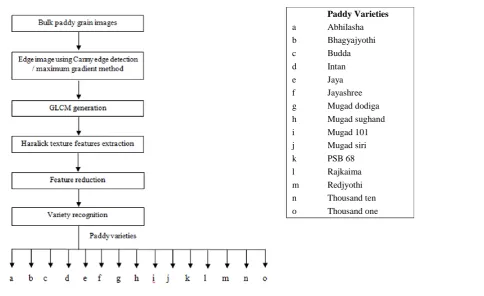
The proposed method consists of four stages, namely,
image acquisition, edge detection, feature extraction,
feature selection and paddy variety recognition as shown
in Figure 1. The bulk sample edge images of fifteen
paddy grain varieties and Haralick texture features are
considered. A multilayer feed-forward artificial neural
network is used as recognizer of paddy varieties.
2.1 Image acquisition
In consultation with the University of Agricultural
Sciences (UAS), Dharwad, Karnataka State, India, fifteen
certified and popular paddy varieties are selected as grain
samples in the work. The paddy varieties are obtained
from Agricultural Research Station, Mugad, Dharwad.
These varieties are grown in different parts of Karnataka,
India. The varieties considered in the work include
Abhilasha, Bhagyajyothi, Budda, Intan, Jaya, Jayashree,
Mugad dodiga, Mugad sughand, Mugad 101, Mugad siri,
PSB 68, Rajkaima, Redjyothi, Thousand one and
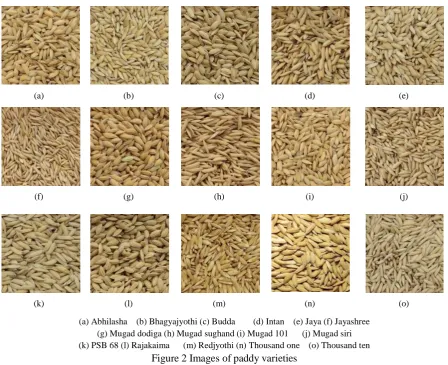
Thousand ten. The images of paddy varieties are shown
in Figure 2.
Paddy Varieties
a Abhilasha b Bhagyajyothi
c Budda
d Intan
e Jaya
f Jayashree g Mugad dodiga h Mugad sughand i Mugad 101 j Mugad siri k PSB 68 l Rajkaima m Redjyothi n Thousand ten o Thousand one
A total 3000 images, considering 200 images from
each type of 15 paddy varieties are acquired under
standard lighting conditions using color camera PENTAX
MX-1, USA, having resolution of 14 mega pixels. In
order to provide a stable support and easy vertical
movement, the camera is mounted on a tripod stand as
shown in Figure 3. The images are taken keeping
approximately the object distance of 0.5 m. The acquired
images of size 1920 pixels 1080 pixels are resized to
400 pixels
400 pixels for reasons of reduction incomputational overhead and storage requirements.
Figure 3 Image acquisition setup
2.2 Edge detection
The edges in bulk sample ofpaddy grain images are
considered to be the most important image attributes that
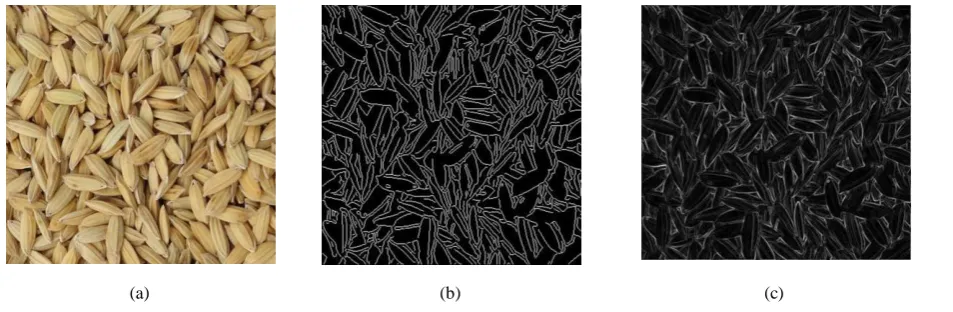
exhibit different texture properties as shown in Figure 4
and provide valuable information for paddy variety
identification. This is the reason for adopting texture
analysis of edge images for paddy variety identification
from their bulk samples. Two standard edge detection
methods namely, Canny and maximum gradient method
are used to obtain edge images from RGB bulk paddy
grain image samples. The Canny edge detection method
basically finds edges where the grayscale intensity of the
image changes the most as shown in Figure 4b. These
areas are found by determining gradients of the image.
The maximum gradient method determines gradients at
each pixel in the image by applying Sobel operator and
returns edges at those points where the gradient of the
image is the maximum. The maximum gradient edge
(a) (b) (c) (d) (e)
(f) (g) (h) (i) (j)
(k) (l) (m) (n) (o)
(a) Abhilasha (b) Bhagyajyothi (c) Budda (d) Intan (e) Jaya (f) Jayashree (g) Mugad dodiga (h) Mugad sughand (i) Mugad 101 (j) Mugad siri (k) PSB 68 (l) Rajakaima (m) Redjyothi (n) Thousand one (o) Thousand ten
image is shown in Figure 4c. It is clear from Figure 4b
and Figure 4c that the maximum gradient edge detection
method is able to detect more edges than the Canny edge
detection method.
2.3 Feature extraction
From the edge images obtained using Canny and
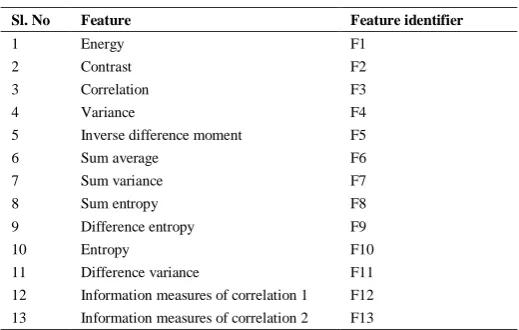
maximum gradient edge detection methods, thirteen
Haralick texture features are extracted using gray level
co-occurrence matrix method (GLCM) and the texture
features are listed in Table 1. The GLCM Pφ, d (i, j)
represents a matrix of relative frequencies describing how
frequency pair of gray levels (i, j) appear in the window
separated by a given distance d = (dx, dy) at an angle ‘φ’.
Gray level co-occurrence matrices (GLCMs) method
counts how often pairs of gray level of pixels separated by
certain distance and oriented in a certain direction, while
scanning the image from left-to-right and top-to-bottom.
In the present work, a distance of 1 (d=1) when ‘φ’ is 0° or 90° and √2 (d= √2) when ‘φ’ is 45° or 135° has been
considered. The procedure of computing the
co-occurrence matrix is given in the Algorithm 1.
Algorithm 1: Computation of co-occurrence matrix
Pφ, d (i, j) from the image P (i, j)
Input: Color (RGB) image.
Output: Co-occurrence matrix Pφ, d(i, j) for d=1 in the
direction ‘φ’.
Start
Step 1: Convert input color image to gray level image
P (i, j)
Step 2: Assign Pφ, d (i, j) =0 for all i, j Є [0, L], where
‘L’ is the maximum gray level
Step 3: For all pixels (i1, j1) in the image, determine
(i2, j2), which is at distance ‘d’ in direction ‘φ’ of (00, 450,
900, and 1350) and compute P(i, j) | p (i1, j1), p (i2, j2)| =
Pφ, d |p (i1, j1), p (i2, j2)| + 1
Step 4: Compute Pφ, d = (p0, d + p45, d + p90, d + p135,
d)
Stop.
In order to define Haralick features, GLCM is
normalized as given in the Equation (1).
( ) ( )
∑ ∑ ( ) (1)
Where,
Px (i) = ∑ - ( ) (2)
Py (j) = ∑ ( )
-
(3)
Where, Px (i) and Py (i) are marginal probability
matrices, P(i, j) is the image attribute matrix, p(i, j, 1, 0)
represents the intensity co-occurrence matrix, Ng is total
number of intensity levels.
The Haralick features are defined as follows.
The angular moment (F1) or energy measures image
uniformity.
∑ ∑ [〖 ( )]〗
( )
(a) (b) (c)
(a) Original RGB image (b) Canny edge image (c) Maximum gradient edge image
Contrast (F2) measures intensity or gray level
variations between the pixel and its neighborhood.
∑ ∑ ( ) (5)
Where,
k=0, 1, 2……., 2 (Ng - 1)
Correlation (F3) measures intensity linear
dependence of gray level values to its neighborhood. Here,
μxandμyare the means and σx and σy are the standard
deviations of Pxand Pyrespectively.
(∑ ∑ ( )
) (6)
The sum of squares (F4) is defined by
∑ ∑ ( ) ( ) (7)
Where, is the mean gray level of the image.
Inverse difference moment (F5) is generally called
homogeneity that measures local homogeneity of the
image.
∑
∑
( )
( )
(8)
The sum average feature (F6) is defined by
∑ ( )
( )
(9)
The sum variance feature (F7) is defined by
∑ ( )( ) ( ) (10)
The sum and difference entropies (F8 and F9) are defined
by
∑ ( ) ( ) ( ) (11)
∑ ( )
( ) (12)
The entropy feature (F10) measures randomness of
intensity in the image defined by
∑ ∑ ( ) ( ) (13)
The difference variance (F11) is defined by
(14)
The information measures of correlation (F12 and F13) are
defined by
( ) ( ( )) (15)
[ ( )] (16)
Where,
∑ ( ) ( ) (17)
∑ ∑ ( ) [ ( ) ( )] (18)
∑ ∑ ( ) ( ) [ ( ) ( )] (19)
The procedure used in obtaining the texture features
based on co-occurrence matrix is given in the Algorithm 2
and the Equations (4) to (16) are being used in the
algorithm to extract Haralick texture features. The features
are listed in Table 1.
Algorithm 2: GLCM texture feature extraction
Input: Color (RGB) image.
Output: Texture features.
Description: Pφ, d (i, j) means GLCM matrices in the
direction φ = 00, 450,900, and 1350 and ‘d’ is the distance.
Start
Step 1: Compute the co-occurrence matrix which is
independent of direction using
Algorithm 1
Step 2: Calculate co-occurrence texture features using
Equations (4) through (16)
Stop.
Table 1 Haralick texture features
Sl. No Feature Feature identifier
1 Energy F1
2 Contrast F2
3 Correlation F3
4 Variance F4
5 Inverse difference moment F5
6 Sum average F6
7 Sum variance F7
8 Sum entropy F8
9 Difference entropy F9
10 Entropy F10
11 Difference variance F11
12 Information measures of correlation 1 F12
13 Information measures of correlation 2 F13
2.3.1 Canny edge texture features extraction
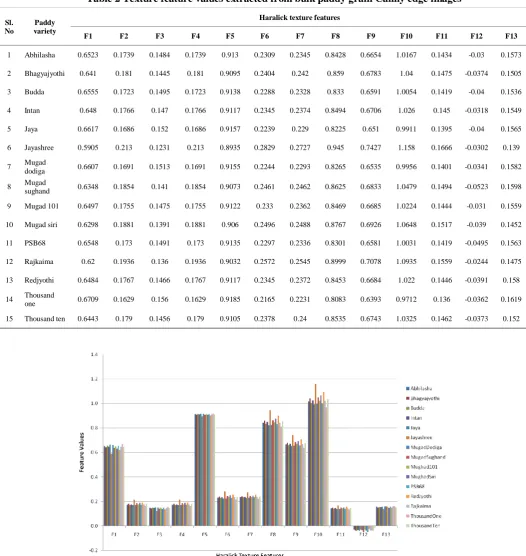
Thirteen Haralick texture features are extracted from
the Canny edge images of all the fifteen paddy varieties
and the feature values are given in Table 2. The
graphical representation of the texture feature values with
2.3.2 Gradient edge texture features extraction
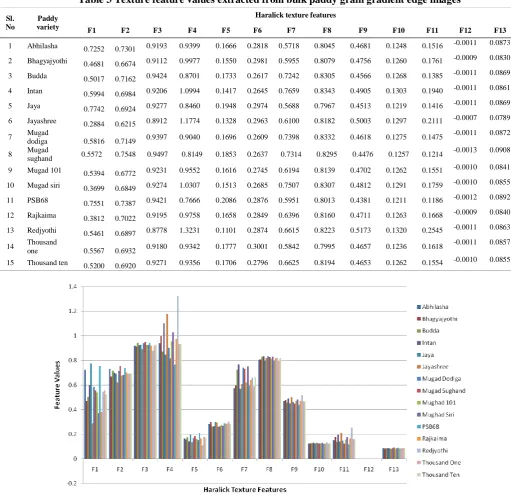
Thirteen Haralick texture features are extracted from
the gradient edge images of all the fifteen paddy varieties
and the feature values are given in Table 3. The
graphical representation of the texture feature values with
respect to different paddy varieties are shown in Figure 6.
Table 2 Texture feature values extracted from bulk paddy grain Canny edge images
Sl. No
Paddy variety
Haralick texture features
F1 F2 F3 F4 F5 F6 F7 F8 F9 F10 F11 F12 F13
1 Abhilasha 0.6523 0.1739 0.1484 0.1739 0.913 0.2309 0.2345 0.8428 0.6654 1.0167 0.1434 -0.03 0.1573
2 Bhagyajyothi 0.641 0.181 0.1445 0.181 0.9095 0.2404 0.242 0.859 0.6783 1.04 0.1475 -0.0374 0.1505
3 Budda 0.6555 0.1723 0.1495 0.1723 0.9138 0.2288 0.2328 0.833 0.6591 1.0054 0.1419 -0.04 0.1536
4 Intan 0.648 0.1766 0.147 0.1766 0.9117 0.2345 0.2374 0.8494 0.6706 1.026 0.145 -0.0318 0.1549
5 Jaya 0.6617 0.1686 0.152 0.1686 0.9157 0.2239 0.229 0.8225 0.651 0.9911 0.1395 -0.04 0.1565
6 Jayashree 0.5905 0.213 0.1231 0.213 0.8935 0.2829 0.2727 0.945 0.7427 1.158 0.1666 -0.0302 0.139
7 Mugad
dodiga 0.6607 0.1691 0.1513 0.1691 0.9155 0.2244 0.2293 0.8265 0.6535 0.9956 0.1401 -0.0341 0.1582
8 Mugad
sughand 0.6348 0.1854 0.141 0.1854 0.9073 0.2461 0.2462 0.8625 0.6833 1.0479 0.1494 -0.0523 0.1598
9 Mugad 101 0.6497 0.1755 0.1475 0.1755 0.9122 0.233 0.2362 0.8469 0.6685 1.0224 0.1444 -0.031 0.1559
10 Mugad siri 0.6298 0.1881 0.1391 0.1881 0.906 0.2496 0.2488 0.8767 0.6926 1.0648 0.1517 -0.039 0.1452
11 PSB68 0.6548 0.173 0.1491 0.173 0.9135 0.2297 0.2336 0.8301 0.6581 1.0031 0.1419 -0.0495 0.1563
12 Rajkaima 0.62 0.1936 0.136 0.1936 0.9032 0.2572 0.2545 0.8999 0.7078 1.0935 0.1559 -0.0244 0.1475
13 Redjyothi 0.6484 0.1767 0.1466 0.1767 0.9117 0.2345 0.2372 0.8453 0.6684 1.022 0.1446 -0.0391 0.158
14 Thousand
one 0.6709 0.1629 0.156 0.1629 0.9185 0.2165 0.2231 0.8083 0.6393 0.9712 0.136 -0.0362 0.1619
15 Thousand ten 0.6443 0.179 0.1456 0.179 0.9105 0.2378 0.24 0.8535 0.6743 1.0325 0.1462 -0.0373 0.152
2.4 Feature selection
In order to reduce the computational overhead, the
feature set is reduced. The useful features that contribute
to the recognition process are selected by testing each
individual texture feature for paddy variety recognition
and performance feature selection is carried out. The
procedure for selecting significant features is given in
Algorithm 3.
Algorithm 3: Recognition performance based texture
feature selection.
Input: Extracted texture features along with their
respective average recognition accuracies (PARA ).
Output: Reduced feature sets with selected features.
Start
Step 1: Find out minimum and maximum average
recognition accuracies in all the texture features.
X = MINIMUM(PARA) // Minimum average
recognition accuracy in all the texture features
Y = MAXIMUM(PARA) // Maximum average
recognition accuracy in all the texture features Table 3 Texture feature values extracted from bulk paddy grain gradient edge images
Sl. No
Paddy variety
Haralick texture features
F1 F2 F3 F4 F5 F6 F7 F8 F9 F10 F11 F12 F13
1 Abhilasha 0.7252 0.7301 0.9193 0.9399 0.1666 0.2818 0.5718 0.8045 0.4681 0.1248 0.1516 -0.0011 0.0873
2 Bhagyajyothi 0.4681 0.6674 0.9112 0.9977 0.1550 0.2981 0.5955 0.8079 0.4756 0.1260 0.1761 -0.0009 0.0830
3 Budda 0.5017 0.7162 0.9424 0.8701 0.1733 0.2617 0.7242 0.8305 0.4566 0.1268 0.1385 -0.0011 0.0869
4 Intan 0.5994 0.6984 0.9206 1.0994 0.1417 0.2645 0.7659 0.8343 0.4905 0.1303 0.1940 -0.0011 0.0861
5 Jaya 0.7742 0.6924 0.9277 0.8460 0.1948 0.2974 0.5688 0.7967 0.4513 0.1219 0.1416 -0.0011 0.0869
6 Jayashree 0.2884 0.6215 0.8912 1.1774 0.1328 0.2963 0.6100 0.8182 0.5003 0.1297 0.2111 -0.0007 0.0789
7 Mugad
dodiga 0.5816 0.7149 0.9397 0.9040 0.1696 0.2609 0.7398 0.8332 0.4618 0.1275 0.1475
-0.0011 0.0872
8 Mugad
sughand 0.5572 0.7548 0.9497 0.8149 0.1853 0.2637 0.7314 0.8295 0.4476 0.1257 0.1214
-0.0013 0.0908
9 Mugad 101 0.5394 0.6772 0.9231 0.9552 0.1616 0.2745 0.6194 0.8139 0.4702 0.1262 0.1551 -0.0010 0.0841
10 Mugad siri 0.3699 0.6849 0.9274 1.0307 0.1513 0.2685 0.7507 0.8307 0.4812 0.1291 0.1759 -0.0010 0.0855
11 PSB68 0.7551 0.7387 0.9421 0.7666 0.2086 0.2876 0.5951 0.8013 0.4381 0.1211 0.1186 -0.0012 0.0892
12 Rajkaima 0.3812 0.7022 0.9195 0.9758 0.1658 0.2849 0.6396 0.8160 0.4711 0.1263 0.1668 -0.0009 0.0840
13 Redjyothi 0.5461 0.6897 0.8778 1.3231 0.1101 0.2874 0.6615 0.8223 0.5173 0.1320 0.2545 -0.0011 0.0863
14 Thousand
one 0.5567 0.6932 0.9180 0.9342 0.1777 0.3001 0.5842 0.7995 0.4657 0.1236 0.1618
-0.0011 0.0857
15 Thousand ten 0.5200 0.6920 0.9271 0.9356 0.1706 0.2796 0.6625 0.8194 0.4653 0.1262 0.1554 -0.0010 0.0855
Step 2: Compute recognition accuracy threshold
(RAT) value.
RAT = (X + Y)/2
Step 3: Compare the average recognition accuracies
of all the features with RAT.
Construct reduced feature set by selecting the texture
features whose average recognition accuracies are equal to
or greater than the RAT value.
Step 4: Compare, if RAT <= Y, then X = RAT and go
to Step 2 else return the reduced feature sets.
End
2.5 Recognition of paddy varieties
A multilayer feed-forward neural network is
considered for paddy variety recognition. The number of
neurons in the input layer is set to the number of
appropriate texture features selected as input and the
output layer is set to 15. Levenberg-Marquardt (LM)
back propagation algorithm is used for the training. The
termination error (TE) is set to 0.01, learning rate (η) is set
to 0.05 and momentum coefficient (µ) is set to 0.6. The
sigmoid activation functions are used in the hidden layers.
The network is trained and tested for 1000 epochs. With
these parameters, the network is trained. Once the
training is complete, the test data for each of the paddy
variety is tested. The overall recognition process is given
in Algorithm 4.
Algorithm 4: Overall recognition of paddy varieties
from bulk grain sample images using color texture
features.
Input: Bulk paddy sample images of different
varieties.
Output: Recognized paddy variety
Start
Step 1: Convert color (RGB) input images into
(Canny/Gradient) edge images.
Step 2: Compute co-occurrence matrix (GLCM) for
the edge images using Algorithm 1.
Step 3: Extract texture features of the edge images
using Algorithm 2.
Step 4: Perform feature selection using Algorithm 3
Step 5: Train artificial neural network (ANN) with
the selected texture feature set obtained in Step 4.
Step 6: Accept test image and extract the selected
texture features using Algorithm 3.
Step 7: Recognize the image containing bulk paddy
sample using ANN classifier. Repeat the steps 6 and 7 for
all the test images.
End
3 Results and discussion
The software tool MATLAB 7.11.0 is used to
implement the devised algorithms. A total of 3000 image
samples, 200 images of each varietal type are considered.
Out of these image samples 1500 images (100 images of
each paddy variety) are used for training and 1500 images
(100 images of each paddy variety) are used for testing.
The percentage of recognition accuracy as the ratio of total
number of correctly recognized test image samples to the
total number of test image samples is given by the
Equation (20). The average recognition accuracy (PARA)
is calculated as the ratio of sum of recognition accuracies
of all the paddy varieties to the total number of paddy
varieties considered and is given by the Equation (21).
(20)
Where, PA is the percentage of recognition accuracy (%);
TC is the total number of correctly recognized images; and
TT is the total number of test images.
∑
(21)
Where, PARA is Average recognition accuracy (%);i is the
variety order number; percentage of recognition
accuracy of ith variety; and TN is the total number of the
paddy varieties.
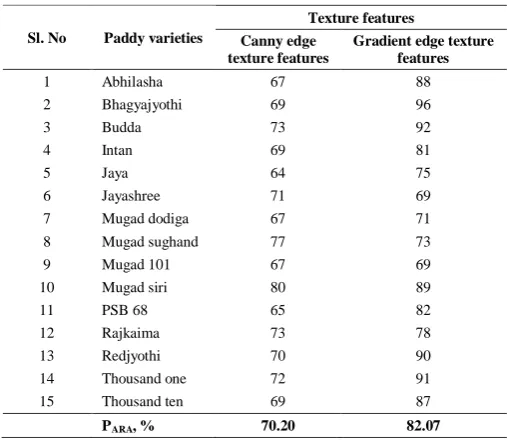
3.1 Variety recognition using canny edge texture
features
The training and testing processes are carried out
using texture features extracted from the Canny edge
texture features are considered for the paddy recognition
process and obtained average variety recognition accuracy
of 70.20% across 15 paddy varieties as given in Table 4.
Table 4 Paddy variety recognition using edge texture features
Sl. No Paddy varieties
Texture features
Canny edge texture features
Gradient edge texture features
1 Abhilasha 67 88
2 Bhagyajyothi 69 96
3 Budda 73 92
4 Intan 69 81
5 Jaya 64 75
6 Jayashree 71 69
7 Mugad dodiga 67 71
8 Mugad sughand 77 73
9 Mugad 101 67 69
10 Mugad siri 80 89
11 PSB 68 65 82
12 Rajkaima 73 78
13 Redjyothi 70 90
14 Thousand one 72 91
15 Thousand ten 69 87
PARA, % 70.20 82.07
3.2 Variety recognition using gradient edge texture
features
The training and testing processes are carried out
using texture features extracted from the gradient edge
images of bulk sample of 15 paddy varieties. Initially, 13
texture features are considered for the paddy recognition
process and obtained average variety recognition accuracy
of 82.07% across 15 paddy varieties as given in Table 4.
It is observed from the Table 4 that the gradient edge
texture features give better average recognition accuracy
over canny edge texture features. So we have adopted
gradient edge texture features for paddy variety
identification.
In order to improve the recognition accuracy of
gradient edge texture features, the performance based
feature selection operation is carried out using Algorithm
3. The recognition accuracies of all the individual
gradient edge texture features are evaluated as input to the
algorithm and the recognition accuracies are given in
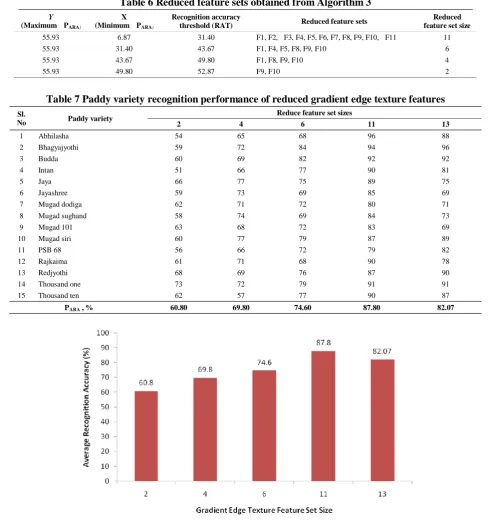
Table 5. The reduce feature sets and their sizes obtained
using the algorithm are given in Table 6. The reduced
feature sets are trained and tested using ANN and the
obtained results are given in Table 7. From Table 7, the
highest average recognition accuracy of 87.80% is
obtained for the reduced feature set with size 11 and the
paddy variety Abhilasha gives the highest recognition
accuracy of 96% and lowest is obtained for the paddy
variety PSB 68. The recognition performances of all the
reduced gradient edge texture feature sets are graphically
shown in Figure 7.
Table 5 Paddy variety recognition performance of individual gradient edge texture feature
Sl. No
Paddy varieties
Gradient edge texture features
F1 F2 F3 F4 F5 F6 F7 F8 F9 F10 F11 F12 F13
1 Abhilasha 53 26 31 45 41 33 42 49 45 66 46 1 16
2 Bhagyajyothi 57 30 33 49 45 37 43 57 51 55 37 6 12
3 Budda 50 23 29 55 41 41 36 48 58 49 33 7 21
4 Intan 48 36 32 52 47 28 47 50 51 67 36 3 28
5 Jaya 47 41 36 53 51 31 42 54 67 77 42 11 23
6 Jayashree 45 24 24 51 43 33 37 58 62 47 36 3 19
7
Mugad
dodiga 47 28 20 51 46 36 33 56 63 56 33 21 22
8
Mugad
sughand 46 31 38 49 44 44 38 52 55 55 31 1 26
9 Mugad 101 51 33 41 38 46 35 31 57 49 49 26 5 24
10 Mugad siri 49 37 22 43 51 40 45 54 52 53 29 10 29
11 PSB 68 52 40 37 40 49 31 42 49 40 47 36 6 16
12 Rajkaima 49 28 37 47 46 30 38 54 44 45 41 2 19
13 Redjyothi 52 38 32 39 49 27 32 50 62 58 25 16 31
14 Thousand ten 51 29 35 47 47 37 35 55 39 65 35 2 26
15
Thousand
one 55 30 33 29 50 29 41 44 54 50 30 9 30
The proposed method has considered fifteen paddy
varieties, which is three times more than the reported work
and the number of features considered is less than the
features used in the reported work as depicted in Table 8. Table 6 Reduced feature sets obtained from Algorithm 3
Y
(Maximum PARA)
X
(Minimum PARA)
Recognition accuracy
threshold (RAT) Reduced feature sets
Reduced feature set size
55.93 6.87 31.40 F1, F2, F3, F4, F5, F6, F7, F8, F9, F10, F11 11
55.93 31.40 43.67 F1, F4, F5, F8, F9, F10 6
55.93 43.67 49.80 F1, F8, F9, F10 4
55.93 49.80 52.87 F9, F10 2
Table 7 Paddy variety recognition performance of reduced gradient edge texture features
Sl.
No Paddy variety
Reduce feature set sizes
2 4 6 11 13
1 Abhilasha 54 65 68 96 88
2 Bhagyajyothi 59 72 84 94 96
3 Budda 60 69 82 92 92
4 Intan 51 66 77 90 81
5 Jaya 66 77 75 89 75
6 Jayashree 59 73 69 85 69
7 Mugad dodiga 62 71 72 80 71
8 Mugad sughand 58 74 69 84 73
9 Mugad 101 63 68 72 83 69
10 Mugad siri 60 77 79 87 89
11 PSB 68 56 66 72 79 82
12 Rajkaima 61 71 68 90 78
13 Redjyothi 68 69 76 87 90
14 Thousand one 73 72 79 91 91
15 Thousand ten 62 57 77 90 87
PARA , % 60.80 69.80 74.60 87.80 82.07
Figure 7 Graphical representation of gradient edge texture features performance in paddy variety recognition
Table 8 Comparison of proposed method with the literature
Literature Number of paddy varieties Sample type Features Accuracy (%)
(Guzman et al., 2008) 5 Singleton grain 13 morphological features 70.00
(Pazoki et al., 2014) 5 Singleton grain 24 color, 11 morphological, 4 shape features 99.73
(Golpur et al., 2014) 5 Bulk grains 13 color features 96.66
4 Conclusions
The Haralick texture features are used for the
recognition of 15 paddy varieties from their bulk sample
edge images. The Canny and maximum gradient edge
detection methods are applied to obtain the edge images.
The average recognition accuracy of 87.80% is obtained
for reduced 11 texture features extracted from maximum
gradient edge images which is better than the recognition
result obtained using the texture features extracted from
Canny edge images. The proposed method has
considered number of varieties three times more and
number of features used is nearly half than the reported
work. The results are encouraging. The work finds
application in developing a machine vision system for
agriculture produce market and developing multimedia
applications in agriculture sciences.
References
Anami, B. S., and D. G. Savakar. 2009. Recognition and Classification of Food Grains, Fruits and Flowers Using Machine Vision. International Journal of Food Engineering, 5(4): 1-25. Issue 4, Article 14.
Anami, B. S., D. G. Savakar, and S. B. Vijay. 2009. Identification of multiple grain image samples from tray. International journal of food science & technology, 44(12): 2452-2458.
Chaugule, A., and S. N. Mali. 2014. Evaluation of texture and shape features for classification of four paddy varieties. Journal of Engineering, Article ID 617263.
Anami, B. S., D. G. Savakar, A. Makandar, and P. H. Unki. 2005. A neural network model for classification of bulk grain samples based on color and texture. In Proceedings of International Conference on Cognition and Recognition. Mandya, India.
Canny, J. F. 1986. A computational approach to edge detection. IEEE Trans Pattern Analysis and Machine Intelligence, 8(6): 679-698.
Guzman, J. D., and E. K. Peralta. 2008. Classification of Philippine rice grains using machine vision and artificial
neural networks. In Iaald Afita WCCA World Conference on Agricultural Information and IT, 24-27. Tokyo, Japan. Golpour, I., Parian, J.A. and Chayjan, R. A. 2014. Identification and
classification of bulk paddy,brown and white rice cultivars with colour features extraction using image analysis and neuralnetwork, Czech Journal Food Science, 32(3): 280–287. Haralick, R.M., K. Shanmugam, and I.H. Dinstein. 1973. Textural features for image classification. Systems, Man and Cybernetics, IEEE Transactions on Vol. SMC-3(6): 610-621. Huang, X. Y., J. Li, and S. Jiang. 2004. Study on identification of rice varieties using computer vision. Journal of Jiangsu University (National Science Edition), 25(2): 102–104. Mousavi Rad, S. J., Tab, F. A., & Mollazade, K. 2014. Classification
of rice varieties using optimal color and texture features and BP neural networks. In Machine Vision and Image Processing (MVIP), 7th Iranian (pp. 1-5). IEEE.
Paliwal, J., M. S. Borhan, and D. S. Jayas. 2004. Classification of cereal grains using a flatbed scanner. Canadian Biosystems Engineering, 46: 1-3.
Pazoki, A. R., F. Farokhi, and Z. Pazoki. 2014. Classification of Rice Grain Varieties using Two Artificial Neural Networks (MLP and Neuro-Fuzzy). The Journal of Animal & Plant Sciences, 24: 336-343.
Pourreza, A., Pourreza, H., Abbaspour-Fard, M.H. and Sadrnia, H., 2012. Identification of nine Iranian wheat seed varieties by textural analysis with image processing. Computers and electronics in agriculture, 83:102-108.
Savakar, D. G. 2012. Recognition and Classification Of Similar Looking Grain Images Using Artificial Neural Networks. Journal of Applied Computer Science and Mathematics, 13. Shearer, S. A., and R. G. Holmes. 1990. Plant identification using
color co-occurrence matrices. Transactions of the ASAE, 33(6): 2037-2044.
Silva, C. S., and U. Sonnadara. 2013. Classification of Rice Grains Using Neural Networks. Proceedings of Technical Sessions, 29: 9-14.
Sobel, I., and G. Feldman. 1968. A 3x3 Isotropic Gradient Operator for Image Processing. Presented at the Stanford Artificial Intelligence Project (SAIL).