Effect of some operating parameters on the performance of a
pelleting press
Okewole O.T.
1*, Igbeka J.C.
2(1. Process Concepts and Technologies (Procontec) Limited. Trumed Building, SW9/1427, New Adeoyo State Hospital Road, G.P.O.
Box 17383, Ibadan, Oyo State. Nigeria;
2. Department of Agricultural and Environmental Engineering, Faculty of Technology, University of Ibadan, Ibadan, Nigeria)
Abstract: One of the major challenges of fish pellets production at the micro and small scale level is the principal complement of equipment necessary for the local manufacture of the same. Imported fish pellets are quite expensive and unaffordable for the average fish farmer. Hence, the need to be able to produce fish feed at a lower cost yet achieving the objective of quantity and quality expected of pelleted feeds are paramount to the viability of the enterprise.
The aim of the study was to investigate the effects of some operating parameters (moisture content of the compounded feed, die speed of the press, and the feed rate) on the pelleting efficiency, throughput capacity, pellet durability and pellet bulk density and to optimise the conditions. Three moisture content levels (M1= 13, M2= 20 and M3 = 25% wet basis) of the
compounded feed were used. For each of the moisture contents, two feed rates (Q1= 500, Q2= 350 kg/hr); and two die
speeds (V1=200, and V2=250 r/min) were used for a die hole size of 4 mm. The effect of the independent parameters was
significant for pellet efficiency, throughput capacity, pellet durability and pellet bulk density with R2 values of 0.9399, 0.9612,
0.8806 and 0.8977 respectively. This shows that the coefficient of determination is of positive correlation as determined from the ANOVA (Analysis of Variance) and the model equation. ANOVA was performed to check the adequacy of the fitted models. The response surface plots showing the interaction of variables were developed in Design-Expert 6.0.6 for every response, linear variables were found more significant than quadratic variables. Optimum conditions for maximum pellet efficiency, throughput capacity, pellet durability and bulk density corresponds to moisture content 25%, feed rate 499.99 kg/hr, speed 250 r/min with the desirability of 0.986. At this condition, pellet efficiency, throughput capacity, pellet durability and pellet bulk density were recorded as 95.7893%, 166.276 kg/hr, 98.0435% 0.846702 g/cm3 respectively. Keywords: pelleting press, efficiency, durability, throughput capacity, bulk density, Response Surface Methodology (RSM), evaluation
Citation: Okewole, O. T., and J. C. Igbeka. 2016. Effect of some operating parameters on the performance of a pelleting press. Agric Eng Int: CIGR Journal, 18(1):326-338.
1 Introduction
1Pelleted feeds have been defined as agglomerated
feeds formed by extruding individual ingredients or
mixtures by compacting and forcing through die openings
by any mechanical process. Pelleted feeds are easier to
handle; more palatable and usually result in improved
feeding when compared to the unpelleted feeds. Pelleted
feeds yield positive effects on growth of livestock fish
inclusive and production efficiency (Kilburn and Edwards,
Received date: 2015-09-16 Accepted date: 2016-01-26 *Corresponding author: Okewole, O.T., Process Concepts and Technologies (Procontec) Limited. Trumed Building, SW9/1427, New Adeoyo State Hospital Road, G.P.O. Box 17383, Ibadan, Oyo State. Nigeria. Email:[email protected].
2001; Greenwood et al., 2004; McKinney and Teeter,
2004).
Generally, the processing methods of fish feed
pelleting include sourcing of feeds, grinding mixing with
other materials to obtain desired ration, pelleting with the
addition of water or preferably steam, drying, cooling and
storing which is very crucial as it determines
bioavailability of nutrients, feed acceptability, palatability
and durability which ultimately reflects in the performance
of fish (Gabriel et al., 2007).
According to Vijayagopal (2004), the factors that
most influence the nature of the pelletized product are
basically classified into two most which are the operating
the food amongst others, some of which are elaborated
below:
a) The operating condition of the machine such as the
temperature, pressure, diameter of the die aperture and the
share rate;
b) The rheological properties of the food such as
moisture content and the physical state;
c) The materials and their chemical composition,
particularly the amount and type of starches, protein and
fats;
d) Leakage flow, which is similar to pressure flow
and is driven by a pressure gradient;
e) This flow occurs in the clearance between the
screw flights and the barrel and within any slot in the
barrel wall or surfaces. Leakage flow reduces the machine
output.
Response Surface Methodology (RSM) has been
successfully used to model and optimize biochemical and
biotechnological process related to food systems. The
main advantage of RSM enables the evaluation of the
effects of several process variables and their interactions
on response variables. RSM is a collection of statistical
and mathematical techniques that has been successfully
used for developing, improving and optimizing processes
(Myers and Montgomery, 2002). It is faster and more
informative than the classical one variable-at-a-time
approach or the use of full factorial designs (Ozdemir et
al., 2008). RSM is usually applied following a set of
design experiments, which have the purpose of screening
out the important factors. The primary purpose of the
RSM methodology is to find the optimum settings for the
factors that influence the response.
The possibility and potentials inherent in the
production of pellets for animal feed have not been fully
realized and one of the major challenges is the principal
complement of equipment necessary for the local
manufacture of the same. Imported fish pellets are quite
expensive and unaffordable for the average fish farmer.
Hence, the need to be able to produce fish feed at a lower
cost yet achieving the objective of quantity and quality
pelleted feeds are paramount to the viability of the
enterprise.
The main objective of this research work is to
investigate the effect of some operating parameters
including moisture content, die speed and feed rate on
evaluation parameters for producing pellets from a vertical
shaft pelleting machine. This is essentially based on
previous studies of Ojomo et al. (2010) and Davies et al.
(2011) on locally fabricated horizontal pelleting press that
indicated the importance of these parameters. However,
there are different types of pelleting presses, namely:
piston and molding presses, tableting presses, roll presses,
pellet mills, screw extruders (Perry and Green 1999).
The study will enable small holder local pellet producers
from fish feed that is compounded from the various
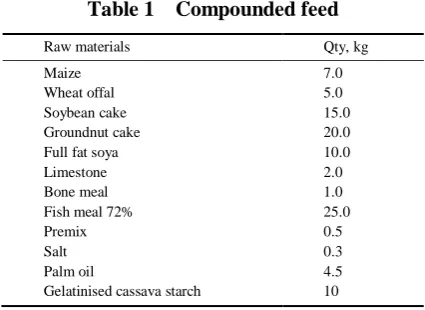
ingredients as indicated in Table 1 to produce pellets
through the right combination of operating parameters.
Table 1 Compounded feed
Raw materials Qty, kg
Maize Wheat offal Soybean cake Groundnut cake Full fat soya Limestone Bone meal Fish meal 72% Premix Salt Palm oil
Gelatinised cassava starch
7.0 5.0 15.0 20.0 10.0 2.0 1.0 25.0 0.5 0.3 4.5 10 Source: Novus Aquaculture, 2014
2 Materials and methods
2.1 Materials
The materials include components of the fish feed,
namely; maize, wheat offal, soybean cake, groundnut cake,
full fat soya, limestone, bone meal, fish meal, premix, salt
palm oil, and gelatinised starch as represented in Table 1.
The devices required for the experiment measurements
include: digital tachometer, moisture meter, stop watch,
and vernier calliper, tumble box, and the press. The
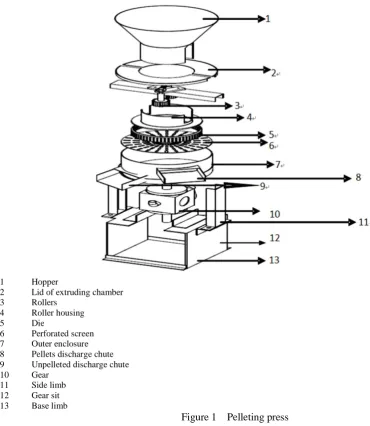
- the pelleting press comprises of a hopper in form
of a conical frustum.
- the pressure devices which comprise the rollers,
the bolts, vertical transmission shaft, die (rotor speed and
diameter).
- the speed is controlled by the introduction of a
right angled speed reduction gear assembly of about 1:2 to
appropriately reduce the speed to the desired range.
- other parts are the rollers’ housing/ casing,
discharge outlet for the pellets and unpelleted mash,
limbs/stand, bolts and nuts to enhance fastenings, etc. The
view of the machine is shown in Figure 1.
2.2 Responses
2.2.1 Pelleting efficiency (P.E)
It is ratio of the quantity of actual feed pelleted
obtained at the main die orifice to the total feed input per
unit time (Ojomo et al., 2010; Mansour, 2007; Davies et
al., 2011). This was determined using the following
Equation (1).
P.E. = (%) (1)
Where;Wp is the quantity of actual feed pelleted, kg; and
Wm is the total feed input mass, kg.
2.2.2 Throughput capacity (T.C.)
This is the ratio of the quantity of actual feed pelleted
to the time taken (Ojomo et al., 2010). The weight of
pellets was measured by weighing a sample of pellets after
the pelleting process with respect to the time taken to
produce that sample using the stop watch. The
throughput capacity was therefore estimated as the weight
1 2 3 4 5 6 7 8 9 10 11 12 13
Hopper
Lid of extruding chamber Rollers
Roller housing Die
Perforated screen Outer enclosure Pellets discharge chute Unpelleted discharge chute Gear
Side limb Gear sit Base limb
of the sampled pellets per time of production of a
particular sample as defined in Equation (2).
T.C. = (kg/hr) (2)
Where; Wp is the weight of the pellets, kg; and T is the
time taken to pelletize the specified feed in hours.
2.2.3 Pellet durability
Pellet durability fish feed pellets can be described as
the ability of pellets to withstand destructive loads and
frictional forces during handling and transport.
According to ASABE (ASAE S269.4 DEC1991, R2007),
the pellet durability was therefore determined as follows;
500 g of pellets placed in the tumbling box device for
tumbling up to 10 minutes at 50 r/min after which the
broken and cracked pellets were separated and the weight
determined. The durability therefore was calculated
using the following relation:
Pellet Durability = 100(%) (3)
Where; Wa is the pellets mass after shaker treatment, g;
and
Wb is the pellets mass before shaker treatment, g.
2.2.4 Pellet bulk density (PBD)
The pellet bulk density is the degree of compaction of
the pellets per unit volume. It is also defined as the ratio
of the mass of the extrudates (g) occupying a given bulk
volume to the volume of the bulk (cm3) according to the
method recommended by USDA (1999).
Pellet Bulk Density 𝑃𝐵𝐷= 𝑊𝑑/𝑉𝑑 (g/cm3) (4)
Where; Wd is the pelleting mass, g; and Vd is the pellets
sample volume, cm3.
Pellet bulk density was determined using an 80 mL
cylindrical container. The empty cylindrical container
was weighed; pellets were sifted to remove any fines,
poured into the cylinder, and levelled by striking off the
overflow using the edge of a ruler and the weight was
taken again. The weight of the pellets is weight of
cylinder with pellets minus weight of empty cylinder.
The mass was then recorded and density determined.
2.3 Experimental design and statistics
In general, performance evaluation of the press
influenced by some parameters such as moisture content,
feed rates and die speeds. Therefore, the independent
variables were three moisture content levels (M1= 13, M2=
20 and M3 = 25% wet basis). This is to adequately
represent the moisture levels across the possible range of
pelleting for the pelleting machine as represented by
Vijayagopal (2004) and measured by the moisture meter
of the compounded feed. Feed rates of Q1; 500 and Q2;
350 kg/hr and the die speeds of V1; 200 and V2; 250 r/min.
The range of this moisture levels and values were
determined based on review of literature by (Kholief, 1996)
and (Mohammad et. al., 2010).
The Response Surface Methodology (RSM) was
employed to establish the relationship between the
response functions and the process variables. The design
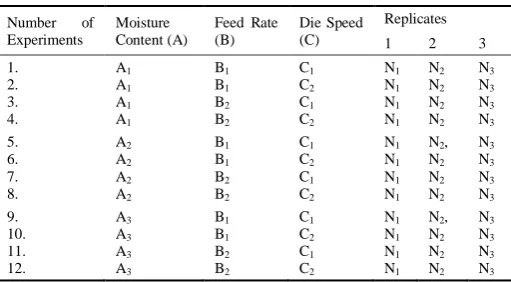
consisted of 12 experiments conducted in triplicates
(Table 2) with three independent factors (Moisture
Content, Die speed and Feed rate).
Table 2 Number of experiments conducted
Number of Experiments
Moisture Content (A)
Feed Rate (B)
Die Speed (C)
Replicates
1 2 3
1. 2. 3. 4. A1 A1 A1 A1 B1 B1 B2 B2 C1 C2 C1 C2 N1 N1 N1 N1 N2 N2 N2 N2 N3 N3 N3 N3 5. 6. 7. 8. A2 A2 A2 A2 B1 B1 B2 B2 C1 C2 C1 C2 N1 N1 N1 N1
N2,
N2 N2 N2 N3 N3 N3 N3 9. 10. 11. 12. A3 A3 A3 A3 B1 B1 B2 B2 C1 C2 C1 C2 N1 N1 N1 N1
N2,
N2 N2 N2 N3 N3 N3 N3
The design expert software was used to generate
response surfaces plots. The data were subjected to
ANOVA and the effect of the responses was determined at
linear, and two factor interactive levels. The P values
were used as a tool to check the significance of each of the
coefficients, which, in turn are necessary to understand the
pattern of the mutual interactions between the test
variables. Historical data of Response Surface
Methodology (RSM) was used to understand the
interactions of independent variables and to derive the
the analysis, the level of significance was fixed at 5%
(p<0.5).
3 Results and discussion
3.1 Results
The fitness and adequacy of the model was judged by
the coefficient of determination (R2) and lack-of-fit. R2,
which can be defined as the ratio of the explained
variation to the total variation is a measure of the degree
of fit. The closer the R2 value to unity, the better the
empirical model fits the actual data. R2 values of 0.9399,
0.9612, 0.8806 and 0.8977 represent the coefficient of
determination for pellet efficiency, throughput capacity,
pellet durability and pellet bulk density respectively.
3.2 Pellet efficiency
The results is as represented below in Table 3
Table 3: Results for pellet efficiency
A, % B, kg/hr C, r/min PE, %
13 500 250 37.5
13 350 250 35.0
13 500 200 40.0
13 350 200 41.7
20 500 250 79.2
20 350 250 80.8
20 500 200 76.7
20 350 200 76.7
25 500 250 95.0
25 350 250 89.3
25 500 200 93.3
25 350 200 89.3
Note: A= moisture content, B= feed rate, C= shaft speed, and PE= pellet efficiency.
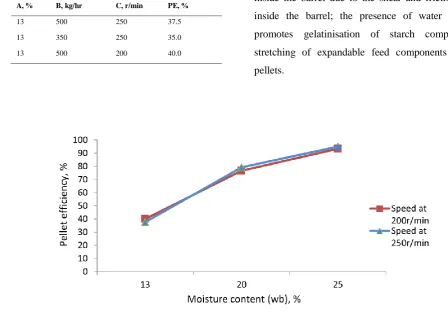
It was observed from the performance evaluation and
as shown in Table 2 and Figures 2a and 2b that the pellet
efficiency increased with the increase in moisture content
considerably at the speed of 200 r/min and 250 r/min from
13% to 25% for both 500 kg/hr and 350 kg/hr. This was
in line with the observation of Linko et al. (1981); Ojomo
et al. (2010) that there is always high temperature rise
inside the barrel due to the shear and friction generated
inside the barrel; the presence of water in the feed
promotes gelatinisation of starch components and
stretching of expandable feed components to produce
pellets.
The equation to predict the efficiency of the machine
for pellet efficiency is:
PE 𝐵
(5)
R2= 0.9399
where, A represents moisture content, %; B is the feed rate,
kg/hr; and C is the speed, r/min.
3.3 Throughput capacity
The results are as presented in Table 4
Table 4 Results for throughput capacity
A, % B, kg/hr C, r/min TC, kg/hr
13 500 250 76.9
13 350 250 64.3
13 500 200 71.7
13 350 200 73.2
20 500 250 125.7
20 350 250 116.2
20 500 200 112.3
20 350 200 108.3
25 500 250 168.2
25 350 250 153.2
25 500 200 139.6
25 350 200 142.3
Note: A=moisture content, B=feed rate, C=shaft speed, and TC= throughput capacity.
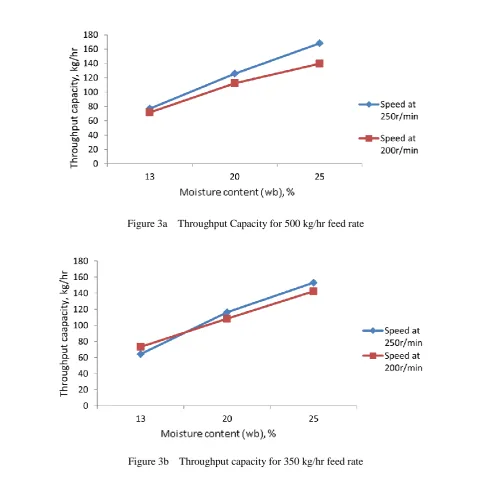
The results as displayed in Figure 2 indicates the
increase in throughput as speed, moisture content and feed
rate increases. This is further corroborated in Figures 3a
and 3b. The throughput capacity was observed to follow
a similar pattern as the pellet efficiency as the throughput
capacity increases with the increase in moisture content
considerably at the speed of 200 and 250 r/min from 13%
to 25% for both 500 kg/hr and 350 kg/hr. This is because
the increase in speed of the die and moisture content of the
feed promotes pellet formation by increase in frictional
force within the barrel that translates to increase binding
forces within the interstices of the feed and faster passage
through the die of the pelletizer. The results corroborate
the observation of Yacu (1995) which stated that the screw
speed is a factor in determining the maximum volumetric
output of the pelletizer, and is one reason why most
pelletizer manufacturers design machines to run at
maximum speed. The only argument against this is the
increase in wear rate of the mechanical components of the
machine (Ojomo et al., 2010). Moisture content (wb), %
TC 𝐵
𝐵 𝐵
(6)
R2 = 0.9612
Where, A represents moisture content, %; B is the feed
rate, kg/hr; and C is the speed, r/min.
3.4 Pellet durability
The result is as presented in Table 5.
Table 5 Results for pellet durability
A, % B, kg/hr C, r/min PD, %
13 500 250 47.8
13 350 250 52.4
13 500 200 47.8
13 350 200 44.0
20 500 250 86.3
20 350 250 84.6
20 500 200 87.0
20 350 200 85.6
25 500 250 91.6
25 350 250 94.8
25 500 200 92.2
25 350 200 96.3
Note: A= moisture content, B= feed rate, C= shaft speed, and PD= pellet durability.
The figure as shown in Figures 4a and 4b showed
a general increase of pellet durability with the increase in
moisture content for both 500 kg/hr and 350 kg/hr feed
rates which resulted in the highest value of pellet
durability at 25% moisture content and the lowest at 13%
moisture content. In the case of 500 kg/hr feed rate
(Figure 4b) the die speed of 250 r/min and 200 r/min had Figure 3a Throughput Capacity for 500 kg/hr feed rate
very close values as is shown in Figure 4a. This
corroborates findings by Fallahi et al. (2013) where
increase in moisture content had an increase in Pellet
Durability Index and increase in speed had very little
decrease (difference of 0.42) in pellet durability between
350 r/min and 400 r/min. The increase in moisture
content enhances the binding strength of the feed as a
result of frictional force generated while the feed is forced
through the die by the rollers.
PD 𝐵
(7)
R2 =0.8806
Where, A represents moisture content, %; B is the feed
rate, kg/hr; and C is the speed,
3.5 Pellet bulk density
The results is as presented in Table 6.
Table 6 Results for pellet bulk density
A , % B , kg/hr C, r/min PBD, g/cm3
13 500 250 0.3
13 350 250 0.24
13 500 200 0.28
Figure 4a Pellet durability for 500kg/hr feed rate
13 350 200 0.29
20 500 250 0.38
20 350 250 0.56
20 500 200 0.53
20 350 200 0.53
25 500 250 0.64
25 350 250 0.90
25 500 200 0.94
25 350 200 0.96
Note: A= moisture content, B= feed rate, C= shaft speed, and PBD= pellet bulk density.
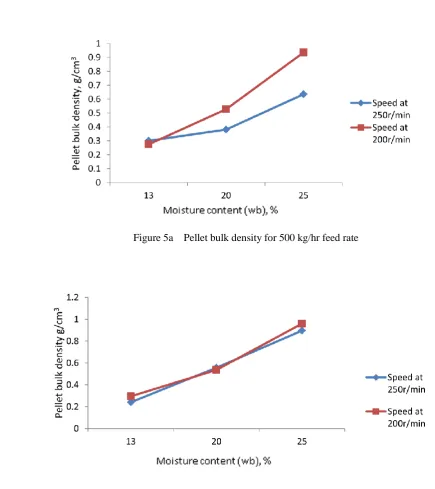
The pellet bulk density followed a similar pattern of
increase from 13% to 25% moisture content with 13% m.c.
having the lowest bulk density in g/cm3 and 25% m.c has
the highest pellet bulk density in g/cm3 as observed in
Table 6 above. Increase in moisture tends to increase the
weight and in turn the bulk density. This is also in
agreement with Fallahi et al. (2013) where increase in
speed resulted in decrease in bulk density.
PBD 𝐵
(8)
R2 = 0.8977
Where, A represents moisture content, %; B is the feed
rate, kg/hr; and C is the speed, r/min. Figure 5a Pellet bulk density for 500 kg/hr feed rate
3.6 Optimisation
Optimum conditions depending on variables for
evaluation of the pelleting press were determined to obtain
maximum pellet efficiency, throughput capacity, pellet
durability and pellet bulk density. First order polynomial
models obtained in this study were utilised for each
response in order to determine the specified optimum
conditions. The moisture content, die speed and feed rate
were selected in the range of 13%-25%, 200-250 r/min,
350-500 kg/hr respectively. Numerical Optimisation was
done in Design Expert 6.0.6 with models developed by
these independent variables. After optimisation, ten
different solutions were obtained; the solution with the
maximum desirability was selected. The optimum
conditions for the evaluation of the pellet press are
moisture content 25% feed rate 499.99 kg/hr, speed 250
r/min with the desirability of 0.986. At these conditions,
pellet efficiency 95.7893%, throughput capacity 166.276
kg, pellet durability 98.0435% and pellet bulk density
0.846702 g/cm3 is obtained.
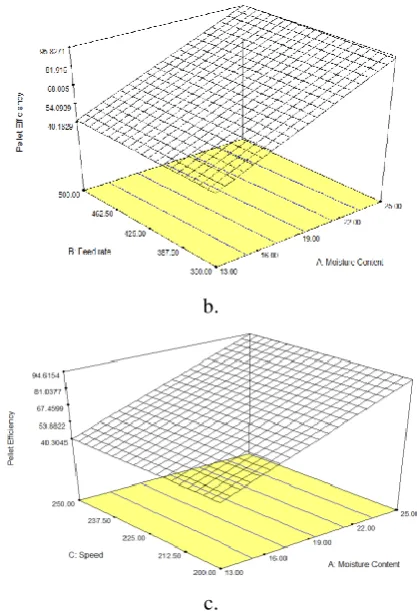
The response surface plots that indicate the
interactions of the moisture content, feed rate and speed on
pellet efficiency, throughput capacity, pellet durability and
pellet bulk density are shown below Figures 6 to 9:
a.
b.
c.
Figure 6 Response surface plots for pellet efficiency (%) as a function of; a. feed rate(kg/hr) and moisture content
(%). b. feed rate (kg/hr) and speed (r/min). c. speed (r/min) and moisture content (%)
a.
c.
Figure 7 Response surface plots for throughput capacity (kg/hr) as a function of; a. feed rate(kg/hr) and moisture content (%). b. feed rate (kg/hr) and speed (r/min). c.
speed (r/min) and moisture content (%).
a.
b.
c.
Figure 8 Response surface plots for pellet durability (%) as a function of; a. feed rate (kg/hr) and moisture content
(%). b. feed rate (kg/hr) and speed (r/min). c. speed (r/min) and moisture content (%)
a.
b.
c.
Figure 9 Response surface plots for pellet bulk density (g/cm3) as a function of; a. feed rate(kg/hr) and moisture
content (%). b. feed rate (kg/hr) and speed (r/min). c. speed (r/min) and moisture content (%)
Some performance evaluation parameters of the
pelleting press were studied and the following conclusions
were drawn:
(1) The effect of independent parameters was significant
for pellet efficiency, throughput capacity, pellet durability
and pellet bulk density with R2 values of 0.9399, 0.9612,
0.8806 and 0.8977 respectively from the ANOVA analysis.
(2) Optimum conditions for maximum pellet efficiency,
throughput capacity, pellet durability and bulk density
corresponds to moisture content 25%, feed rate 499.99
kg/hr, speed 250 r/min with the desirability of 0.986. At
this condition, pellet efficiency throughput capacity, pellet
durability and pellet bulk density were recorded as
95.7893%, 166.276 kg, 98.0435%, 0.846702 g/cm3,
respectively.
This study provides useful information for engineers
to improve the performance of the vertical shaft pelleting
machines. The machine does not make use of steam
thereby making it very easy to operate; however, a binder
should be added to the feed to further strengthen the
pelletized feeds otherwise the structural integrity of the
pellets may be compromised easily as a result of low
binding forces. The adoption of the pelleting machine by
micro and small-scale fish farmers would go a long way in
helping them to produce their own feed thereby alleviating
the problems associated with the sourcing of imported
feeds. However, only up to a maximum of 50% of the
total moisture content of the material being processed is
actually lost on leaving the machine. Heat is generated
as a result of friction and shear and it is difficult to achieve
adequate processing temperatures if the total moisture
content of the material being fed is above 30%. High fat
levels can also create problems. In practice to produce a
shelf stable finished product, the initial moisture content
of the material should be between 20%-26%.
References
Adapa, P. K., A. Singh, G. J. Schoenau, and L. G. Tabil. 2006. Pelleting characteristics of fractionated alfalfa grinds - hardness models. International Journal of Powder Handling and Processing, 18(5): 294-299.
ASABE. ASAE S269.4 DEC1991 (R2007) - Cubes, Pellets, and Crumbles - Definitions and Methods for Determining Density, Durability, and Moisture. In ASABE Standards 2007, 624-626, 2007; St. Joseph, MI: American Society of Agricultural and Biological Engineers.
Davies, R. M., and O. A. Davies. 2011. Development and performance evaluation of manually operated fish pelleting machine. Innovations in Science and Engineering, 1(1): 9-16.
Fallahi, P., K. A. Rosentrater, K. Muthukumarappan, and M. Tulbek. 2013. Effects of steam, moisture, and screw speed on physical properties of DDGS-based extrudates. Cereal Chemistry, 90(3):186-197.
Gabriel, U. U., O. A. Akinrotimi, D. O. Bekibele, D. N. Onunkwo, and P. E. Anyanwu. 2007. Locally produced fish feed: potentials for aquaculture development in sub-Saharan Africa. African Journal of Agricultural Research, 2(7): 287-295.
Greenwood, M. W., P. M. Clark, and R. S. Beyer. 2004. Effect of feed fines level on broilers, fed two concentrations of dietary lysine from 14 to 30 days of age. International Journal of Poultry Science, 3(7): 446-449.
Hill, B., and D. A. Pulkinen. 1998. A study of factors affecting pellet durability and pelleting efficiency in the production of dehydrated alfalfa pellets. A special report, Saskatchewan Dehydrators Association, Tisdale, SK, Canada: 20-23.
Kholief, R. M. 1996. Manufacturing of pellets production machine for livestock. P.hD. Thesis, Agric.Engneering Dept. Faculty of Agric Kafr El-Sheikh, Tanta University. Egypt.
Kilburn, J., and H. M. Edwards, Jr. 2001. The response of broilers to the feeding of mash or pelleted diets containing maize of varying particle sizes. Broilers Poultry Science,
42(2): 484-492.
Linko, P., P. Colonna and C. Mercier, 1981. High Temperature Short Time Extrusion Cooking. In: Advances in Cereal Science and Technology, Pomeranz, Y. (Ed.). American Association of Cereal Chemists, St. Paul, MN, ISBN: 0-913250-21-x, pp: 145-235.
Mansour, V. M. 2007. Study on some engineering parameters affecting the production of fish pelleting machine. A thesis submitted in partial fulfilment of the requirements for the degree of Master of Science. Department of Agricultural Engineering, Zagazig University.Egypt.
McKinney, L. J., and R. G. Teeter. 2004. Predicting effective caloric value of non nutritive factors: I. Pellet quality and II. Prediction of consequential formulation dead zones.
Poultry. Science, 83(7): 1165-1174.
Mohammad, H. A., M. A. Tawfik, and A. M. El Shal. 2010. Effect of using poultry by-product meal on aquatic pellets quality and fish growth using ring-die pelleting machine.
Myers, R. H., and D. C. Montgomery. 2002. Response Surface Methodology: process and product optimization using designed experiment. A Wiley-Interscience Publication. Novus Aquaculture. 2014. Met plus Catfish Guidelines. Norgem
Nigeria Limited. Anthony, Lagos.
Ojomo, A. O., L. A. S.Agbetoye, and F. O. Ologunagba. 2010. Performance evaluation of a fish feed pelleting machine. Asian Research Publishing Network (ARPN) Journal of Engineering and Applied Sciences, 9(5):88-97.
Ozdemir, M., B. F. Ozen, L. L. Dock, and J. D. Floros. 2008. Optimization of osmotic dehydration of diced green peppers by response surface methodology. Lebensm Wiss Technology, 41(10): 2044-2050.
Perry, R. H., and D. W. Green. 1999. Perry’s Chemical Engineers’ Handbook, 7th
Edition. Mc Graw- Hill
International Editions. Chemical Engineering Series. pp 20-81:20-84.
USDA (United States Department of Agriculture). 1999. Practical procedures for grain handlers: Inspecting grain. Grain Inspection, Packers, and Stockyards Administration, U.S. Department of Agriculture: Washington, D.C.
Available at: http://
archive.gipsa.usda.gov/pubs/primer.pdf. Assessed May 18, 2010.
Vijayagopal, P. 2004. Aquatic Feed Extrusion Technology: An update. Fishing Chimes, 23(1): 10-11
Yacu, W. A. 1995. Modeling a twin screw co-rotating extruder.