Dept., of ECE/SJBIT Page 1 DIGITALSIGNALPROCESSING
SUBJECT CODE :10EC52 IAMARKS :25
NO. OF LECTURE HRS/WEEK :04 EXAM HOURS :03 TOTAL NO. OF LECTURE HRS.:52 EXAMMARKS :100
UNIT-1
DISCRETE FOURIER TRANSFORMS (DFT): FREQUENCY DOMAIN SAMPLING AND RECONSTRUCTION OF DISCRETE TIME SIGNALS. DFT AS A LINEAR TRANSFORMATION, ITS
RELATIONSHIP WITH OTHER TRANSFORMS. 6HRS
UNIT-2
PROPERTIES OF DFT, MULTIPLICATION OF TWO DFTS- THE CIRCULAR CONVOLUTION,
ADDITIONAL DFT PROPERTIES. 6HRS
UNIT-3
USE OF DFT IN LINEAR FILTERING, OVERLAP-SAVE AND OVERLAP-ADD METHOD. DIRECT COMPUTATION OF DFT, NEED FOR EFFICIENT COMPUTATION OF THE DFT (FFT
ALGORITHMS). 7HRS
UNIT-4
RADIX-2 FFT ALGORITHM FOR THE COMPUTATION OF DFT AND IDFT–DECIMATIONIN
-TIME AND DECIMATION-IN-FREQUENCY ALGORITHMS.GOERTZEL ALGORITHM, AND CHIRP-Z
TRANSFORM. 7HRS
UNIT-5
IIR FILTER DESIGN: CHARACTERISTICS OF COMMONLY USED ANALOG FILTERS –
BUTTERWORTH AND CHEBYSHEVE FILTERS, ANALOG TO ANALOG FREQUENCY
TRANSFORMATIONS. 6HRS
UNIT-6
IMPLEMENTATION OF DISCRETE-TIME SYSTEMS: STRUCTURES FOR IIR AND FIR SYSTEMS DIRECT FORM I AND DIRECT FORM II SYSTEMS, CASCADE, LATTICE AND PARALLEL
REALIZATION. 7HRS
UNIT-7
FIR FILTER DESIGN: INTRODUCTION TO FIR FILTERS, DESIGN OF FIR FILTERS USING
-RECTANGULAR, HAMMING, BARTLET AND KAISER WINDOWS, FIR FILTER DESIGN USING
FREQUENCY SAMPLING TECHNIQUE. 6HRS
UNIT-8
DESIGN OF IIR FILTERS FROM ANALOG FILTERS (BUTTERWORTH AND CHEBYSHEV) -IMPULSE INVARIANCE METHOD. MAPPING OF TRANSFER FUNCTIONS: APPROXIMATION OF DERIVATIVE (BACKWARD DIFFERENCE AND BILINEAR TRANSFORMATION) METHOD, MATCHED Z TRANSFORMS,VERIFICATION FOR STABILITY AND LINEARITY DURING MAPPING
Dept., of ECE/SJBIT Page 2 TEXTBOOK:
1. DIGITAL SIGNAL PROCESSING – PRINCIPLES ALGORITHMS & APPLICATIONS, PROAKIS &
MONALAKIS,PEARSON EDUCATION,4TH EDITION,NEW DELHI,2007.
REFERENCEBOOKS:
1.DISCRETE TIME SIGNAL PROCESSING,OPPENHEIM &SCHAFFER,PHI,2003.
Dept., of ECE/SJBIT Page 3 INDEX SHEET
SL.NO TOPIC PAGE NO.
I Unit-1: Discrete Fourier Transforms 6-16
1.1 Frequency Domain Sampling
1.2 Reconstruction of Discrete time signals 1.3 DFT as a Linear Transform
1.4 DFT relationship with other transforms
II UNIT - 2 : Properties of DFT 18-26
2.1 Multiplication of two DFTs –Circular convolution 2.2 Additional DFT properties
2.3 Use of DFT in Linear Filtering
2.4 Overlap save and Overlap Add Method 2.5 Solution to Problems
III UNIT – 3 : Fast Fourier Transform Algorithms 27-35 3.1 Direct computation of DFT
3.2 Need for Efficient computation of DFT 3.2 FFT algorithms
IV UNIT – 4 : Radix-2 FFT Algorithms for DFT and
IDFT 39-60
4.1 Decimation In Time Algorithms 4.2 Decimation-in-Frequency Algorithms 4.3 Goertzel Algorithms
4.4 Chirp-z-Transforms
V UNIT – 5 : IIR Filter Design 61-78
5.1 Characteristics of commonly used Analog Filters 5.2 Butterworth and Chebysheve Filters
5.3 Analog to Analog Frequency Transforms 5.4 Solution to problems
VI UNIT – 6 : FIR Filter Design 79-106
6.1 Introduction to FIR filters
6.2 Design of FIR Filters using Rectangular and Hamming window
6.3 Design of FIR Filters using Bartlet and Hamming window 6.4 F IR filter design using frequency sampling technique
VII UNIT – 7 : Design of IIR Filters from Analog Filters 107-144 7.1 Impulse Invariance Method
7.2 Mapping of Transfer Functions
7.3 Approximation of derivative (Backward Difference and Bilinear Transforms) method
7.4 Matched Z transforms
7.5 Verification for stability and Linearity during mapping 7.6 Solution to problems
Dept., of ECE/SJBIT Page 4 8.1 Structure of IIR and FIR systems
8.2 Direct form I and direct form II Systems 8.3 Cascade Realization
Dept., of ECE/SJBIT Page 5
UNIT
1
D
ISCRETEF
OURIERT
RANSFORMS(DFT)
C
ONTENTS:-
DISCRETE FOURIER TRANSFORMS (DFT): FREQUENCY DOMAIN SAMPLING AND
RECONSTRUCTION OF DISCRETE TIME SIGNALS. DFT AS A LINEAR TRANSFORMATION, ITS
RELATIONSHIP WITH OTHER TRANSFORMS. 6HRS
R
ECOMMENDEDR
EADINGS1. DIGITAL SIGNAL PROCESSING –PRINCIPLES ALGORITHMS &APPLICATIONS,PROAKIS &
MONALAKIS,PEARSON EDUCATION,4THEDITION,NEW DELHI,2007.
2. DISCRETE TIME SIGNAL PROCESSING,OPPENHEIM &SCHAFFER,PHI,2003.
Dept., of ECE/SJBIT Page 6
UNIT 1
Discrete Fourier Transform
1.1
Introduction:
Before we introduce the DFT we consider the sampling of the Fourier transform of an
aperiodic discrete-time sequence. Thus we establish the relation between the sampled Fourier
transform and the DFT.A discrete time system may be described by the convolution sum, the
Fourier representation and the z transform as seen in the previous chapter. If the signal is
periodic in the time domain DTFS representation can be used, in the frequency domain the
spectrum is discrete and periodic. If the signal is non-periodic or of finite duration the
frequency domain representation is periodic and continuous this is not convenient to
implement on the computer. Exploiting the periodicity property of DTFS representation the
finite duration sequence can also be represented in the frequency domain, which is referred to
as Discrete Fourier Transform DFT.
DFT is an important mathematical tool which can be used for the software
implementation of certain digital signal processing algorithms .DFT gives a method to
transform a given sequence to frequency domain and to represent the spectrum of the sequence
using only k frequency values, where k is an integer that takes N values, K=0, 1, 2,…..N-1.
The advantages of DFT are:
1. It is computationally convenient.
2. The DFT of a finite length sequence makes the frequency domain analysis much
simpler than continuous Fourier transform technique.
1.2
FREQUENCY DOMAIN SAMPLING AND RECONSTRUCTION OF DISCRETE TIME SIGNALS:
Consider an aperiodic discrete time signal x (n) with Fourier transform, an aperiodic finite
energy signal has continuous spectra. For an aperiodic signal x[n] the spectrum is:
n
jwn
e n x w
Dept., of ECE/SJBIT Page 7 Suppose we sample X[w] periodically in frequency at a sampling of w radians between
successive samples. We know that DTFT is periodic with 2, therefore only samples in the
fundamental frequency range will be necessary. For convenience we take N equidistant
samples in the interval (0<=w<2 ). The spacing between samples will be
N
w
2 as shown
below in Fig.1.1.
Fig 1.1 Frequency Domain Sampling
Let us first consider selection of N, or the number of samples in the frequency domain.
If we evaluate equation (1) at
N k w 2
0,1,2,...,( 1)2 2 /
N k e n x N k X n N kn j ………. (1.2)We can divide the summation in (1) into infinite number of summations where each sum
contains N terms.
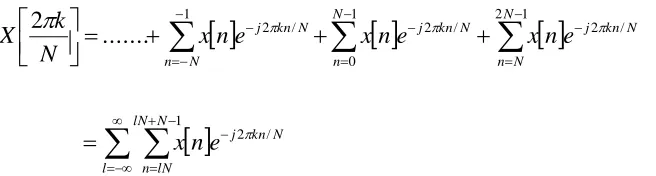
l N lN lN n N kn j N n N N n N kn j N kn j N n N kn j e n x e n x e n x e n x N k X 1 / 2 1 0 1 2 / 2 / 2 1 / 2 ... 2 If we then change the index in the summation from n to n-l N and interchange the order of
summations we get:
X[w]
w
Dept., of ECE/SJBIT Page 8
0,1,2,...,( 1)2 1
0
/
2
N k for e lN n x N k N n N kn j l …….(1.3)Denote the quantity inside the bracket as xp[n]. This is the signal that is a repeating version of
x[n] every N samples. Since it is a periodic signal it can be represented by the Fourier series.
0,1,2,...,( 1)1
0
/
2
N n e c n x N k N kn j k p With FS coefficients:
0,1,2,...,( 1) 1 10
/
2
N k e n x N c N n N kn j p k ……… (1.4)Comparing the expressions in equations (1.4) and (1.3) we conclude the following:
) 1 ( ,..., 1 , 0 2
1
k k N
N X N ck ………. (1.5)
Therefore it is possible to write the expression xp[n] as below:
1 2 0,1,...,( 1)1
0
/
2
N n e k N X N n x N k N kn j p ………. (1.6)The above formula shows the reconstruction of the periodic signal xp[n] from the samples of
the spectrum X[w]. But it does not say if X[w] or x[n] can be recovered from the samples.
Let us have a look at that:
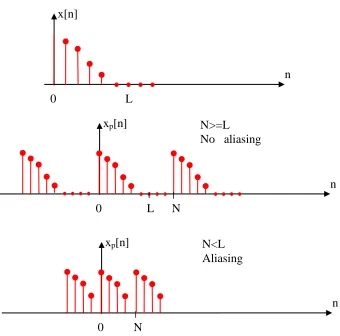
Since xp[n] is the periodic extension of x[n] it is clear that x[n] can be recovered from xp[n] if
there is no aliasing in the time domain. That is if x[n] is time-limited to less than the period N
Dept., of ECE/SJBIT Page 9
Fig. 1.2 Signal Reconstruction
Hence we conclude:
The spectrum of an aperiodic discrete-time signal with finite duration L can be exactly
recovered from its samples at frequencies
N k wk
2
if N >= L.
We compute xp[n] for n=0, 1,..., N-1 using equation (1.6)
Then X[w] can be computed using equation (1.1).
1.3
Discrete Fourier Transform:
The DTFT representation for a finite duration sequence is ∞ -jωn
X (jω) = ∑ x (n) ℮ n= -∞
jωn
X (n) =1/2π ∫X (jω) e dω , Where ω═ 2πk/n x[n]
n
0 L
xp[n]
n
0 L N
N>=L No aliasing
xp[n]
n
0 N
Dept., of ECE/SJBIT Page 10 2π
Where x(n) is a finite duration sequence, X(jω) is periodic with period 2π.It is
convenient sample X(jω) with a sampling frequency equal an integer multiple of its period =m that is taking N uniformly spaced samples between 0 and 2π.
Let ωk= 2πk/n, 0≤k≤N-1
∞ -j2πkn/N Therefore X(jω) = ∑ x(n) ℮
n=−∞
Since X(jω) is sampled for one period and there are N samples X(jω) can be expressed as
N-1 -j2πkn/N
X(k) = X(jω)│ ω=2πkn/N ═∑ x(n) ℮ 0≤k≤N-1
n=0
1.4
Matrix relation of DFT
The DFT expression can be expressed as
[X] = [x(n)] [WN] T
Where [X] = [X(0), X(1),……..]
[x] is the transpose of the input sequence. WN is a N x N matrix
WN = 1 1 1 1 ………1 1 wn1 wn2 wn3………...wn n-1 1 wn2 wn4 wn6 ………wn2(n-1) ………. ………. 1………..wN (N-1)(N-1)
ex;
4 pt DFT of the sequence 0,1,2,3
X(0) 1 1 1 1 X(1) 1 -j -1 j X(2) = 1 -1 1 -1 X(3) 1 j -1 -j
Solving the matrix X(K) = 6 , -2+2j, -2 , -2-2j
Dept., of ECE/SJBIT Page 11
1.5.1 Relationship of Fourier transform with continuous time signal:
Suppose that xa(t) is a continuous-time periodic signal with fundamental period Tp= 1/F0.The
signal can be expressed in Fourier series as
Where {ck} are the Fourier coefficients. If we sample xa(t) at a uniform rate Fs = N/Tp = 1/T,
we obtain discrete time sequence
Thus {ck’} is the aliasing version of {ck}
1.5.2 Relationship of Fourier transform with z-transform
Let us consider a sequence x(n) having the z-transform
With ROC that includes unit circle. If X(z) is sampled at the N equally spaced points on the
unit circle Zk = e j2πk/N for K= 0,1,2,………..N-1 we obtain
The above expression is identical to Fourier transform X(ω) evaluated at N equally spaced
Dept., of ECE/SJBIT Page 12 If the sequence x(n) has a finite duration of length N or less. The sequence can be recovered
from its N-point DFT. Consequently X(z) can be expressed as a function of DFT as
Dept., of ECE/SJBIT Page 13
Recommended Questions with solutions
Question 1
The first five points of the 8-point DFT of a real valued sequence are {0.25, 0.125-j0.318, 0, 0.125-j0.0518, 0}. Determine the remaining three points
Ans: Since x(n) is real, the real part of the DFT is even, imaginary part odd. Thus the remaining points are {0.125+j0.0518,0,0, 0.125+j0.318}.
Question 2
Compute the eight-point DFT circular convolution for the following sequences. x2(n) = sin 3πn/8
Ans:
Question 3
Dept., of ECE/SJBIT Page 14
Question 4
Define DFT. Establish a relation between the Fourier series coefficients of a continuous time signal and DFT
Solution
The DTFT representation for a finite duration sequence is ∞
X (jω) = ∑ x (n) ℮-jωn
n= -∞
X (n) =1/2π ∫X (jω) e jωn dω , Where ω═ 2πk/n 2π
Where x(n) is a finite duration sequence, X(jω) is periodic with period 2π.It is convenient sample X(jω) with a sampling frequency equal an integer multiple of its period =m that is taking N uniformly spaced samples between 0 and 2π.
Let ωk= 2πk/n, 0≤k≤N
∞ Therefore X(jω) = ∑ x(n) ℮-j2πkn/N
n=−∞
Since X(jω) is sampled for one period and there are N samples X(jω) can be expressed as
N-1
X(k) = X(jω)│ ω=2πkn/N ═∑ x(n) ℮-j2πkn/N 0≤k≤N-1
n=0
Question 5
Solution:-Dept., of ECE/SJBIT Page 15
Question 6
Find the 4-point DFT of sequence x(n) = 6+ sin(2πn/N), n= 0,1,………N-1
Solution :-
Question 7
Dept., of ECE/SJBIT Page 16
Question 8
Solution
Dept., of ECE/SJBIT Page 17
U
NIT
2
P
ROPERTIES OFD
ISCRETEF
OURIERT
RANSFORMS(DFT)
C
ONTENTS:-
PROPERTIES OF DFT, MULTIPLICATION OF TWO DFTS- THE CIRCULAR CONVOLUTION,
ADDITIONAL DFT PROPERTIES. 6HRS
R
ECOMMENDEDR
EADINGS1. DIGITAL SIGNAL PROCESSING –PRINCIPLES ALGORITHMS &APPLICATIONS,PROAKIS &
MONALAKIS,PEARSON EDUCATION,4THEDITION,NEW DELHI,2007.
2. DISCRETE TIME SIGNAL PROCESSING,OPPENHEIM &SCHAFFER,PHI,2003.
Dept., of ECE/SJBIT Page 18
Unit 2
Properties of DFT
2.1 Properties:-
The DFT and IDFT for an N-point sequence x(n) are given as
In this section we discuss about the important properties of the DFT. These properties are
helpful in the application of the DFT to practical problems.
Periodicity:-
Dept., of ECE/SJBIT Page 19 Then A x1 (n) + b x2 (n) a X1(k) + b X2(k)
2.1.3 Circular shift:
In linear shift, when a sequence is shifted the sequence gets extended. In circular shift the
number of elements in a sequence remains the same. Given a sequence x (n) the shifted
version x (n-m) indicates a shift of m. With DFTs the sequences are defined for 0 to N-1.
If x (n) = x (0), x (1), x (2), x (3)
X (n-1) = x (3), x (0), x (1).x (2)
X (n-2) = x (2), x (3), x (0), x (1)
2.1.4 Time shift:
If x (n) X (k)
mk Then x (n-m) WN X (k)
2.1.5 Frequency shift
If x(n) X(k) +nok
Wn x(n) X(k+no) N-1 kn Consider x(k) = x(n) W n n=0
N-1
(k+ no)n X(k+no)=\ x(n) WN n=0
kn non = x(n) WN WN
non
X(k+no)x(n) WN
Dept., of ECE/SJBIT Page 20
For a real sequence, if x(n) X(k)
X(N-K) = X* (k)
For a complex sequence DFT(x*(n)) = X*(N-K)
If x(n) then X(k)
Real and even real and even Real and odd imaginary and odd Odd and imaginary real odd
Even and imaginary imaginary and even
2.2 Convolution theorem;
Circular convolution in time domain corresponds to multiplication of the DFTs
If y(n) = x(n) h(n) then Y(k) = X(k) H(k)
Ex let x(n) = 1,2,2,1 and h(n) = 1,2,2,1 Then y (n) = x(n) h(n)
Y(n) = 9,10,9,8
N pt DFTs of 2 real sequences can be found using a single DFT
If g(n) & h(n) are two sequences then let x(n) = g(n) +j h(n)
G(k) = ½ (X(k) + X*(k))
H(k) = 1/2j (X(K) +X*(k))
2N pt DFT of a real sequence using a single N pt DFT
Let x(n) be a real sequence of length 2N with y(n) and g(n) denoting its N pt DFT
Let y(n) = x(2n) and g(2n+1) k
X (k) = Y (k) + WN G (k)
Using DFT to find IDFT
Dept., of ECE/SJBIT Page 21 X(n) = 1/N [DFT(X*(k)]*
Recommended Questions with solutions
Question 1
State and Prove the Time shifting Property of DFT
Solution
The DFT and IDFT for an N-point sequence x(n) are given as
Time shift:
If x (n) X (k)
mk Then x (n-m) WN X (k)
Question 2
State and Prove the: (i) Circular convolution property of DFT; (ii) DFT of Real and even sequence.
Solution
(i) Convolution theorem
Circular convolution in time domain corresponds to multiplication of the DFTs If y(n) = x(n) h(n) then Y(k) = X(k) H(k)
Ex let x(n) = 1,2,2,1 and h(n) = 1,2,2,1 Then y (n) = x(n) h(n)
Y(n) = 9,10,9,8
Dept., of ECE/SJBIT Page 22 If g(n) & h(n) are two sequences then let x(n) = g(n) +j h(n)
G(k) = ½ (X(k) + X*(k)) H(k) = 1/2j (X(K) +X*(k))
2N pt DFT of a real sequence using a single N pt DFT
Let x(n) be a real sequence of length 2N with y(n) and g(n) denoting its N pt DFT Let y(n) = x(2n) and g(2n+1)
X (k) = Y (k) + WNK G (k)
Using DFT to find IDFT
The DFT expression can be used to find IDFT X(n) = 1/N [DFT(X*(k)]*
(ii)DFT of Real and even sequence.
For a real sequence, if x(n) X(k) X (N-K) = X* (k)
For a complex sequence DFT(x*(n)) = X*(N-K)
If x(n) then X(k)
Real and even real and even Real and odd imaginary and odd Odd and imaginary real odd
Even and imaginary imaginary and even
Question 3
Distinguish between circular and linear convolution
Solution
1) Circular convolution is used for periodic and finite signals while linear convolution is used for aperiodic and infinite signals.
2) In linear convolution we convolved one signal with another signal where as in circular convolution the same convolution is done but in circular pattern depending upon the samples of the signal
3) Shifts are linear in linear in linear convolution, whereas it is circular in circular convolution.
Dept., of ECE/SJBIT Page 23
Solution(a)
Solution(b)
Solution(c)
Dept., of ECE/SJBIT Page 24
Question 5
Solution
Question 6
Dept., of ECE/SJBIT Page 26
U
NIT
3
F
ASTF
OURIERT
RANSFORMS(FFT)
A
LOGORITHMSC
ONTENTS:-
USE OF DFT IN LINEAR FILTERING : OVERLAP-SAVE AND OVERLAP-ADD METHOD. DIRECT
COMPUTATION OF DFT, NEED FOR EFFICIENT COMPUTATION OF THE DFT (FFT ALGORITHMS).
7HRS
R
ECOMMENDEDR
EADINGS1. DIGITAL SIGNAL PROCESSING –PRINCIPLES ALGORITHMS &APPLICATIONS,PROAKIS &
MONALAKIS,PEARSON EDUCATION,4THEDITION,NEW DELHI,2007.
2. DISCRETE TIME SIGNAL PROCESSING,OPPENHEIM &SCHAFFER,PHI,2003.
Dept., of ECE/SJBIT Page 27
UNIT 3
F
AST
-F
OURIER
-T
RANSFORM
(FFT)
ALGORITHMS
3.1 Digital filtering using DFT
In a LTI system the system response is got by convoluting the input with the impulse
response. In the frequency domain their respective spectra are multiplied. These spectra are
continuous and hence cannot be used for computations. The product of 2 DFT s is equivalent
to the circular convolution of the corresponding time domain sequences. Circular convolution
cannot be used to determine the output of a linear filter to a given input sequence. In this case a
frequency domain methodology equivalent to linear convolution is required. Linear
convolution can be implemented using circular convolution by taking the length of the
convolution as N >= n1+n2-1 where n1 and n2 are the lengths of the 2 sequences.
3.1.1 Overlap and add
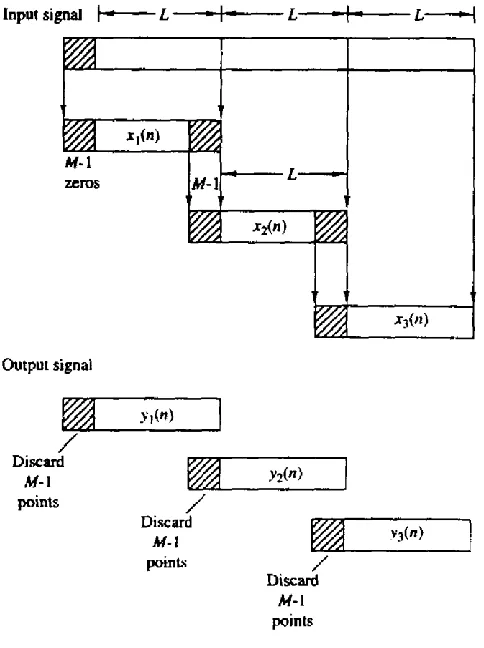
In order to convolve a short duration sequence with a long duration sequence x(n) ,x(n)
is split into blocks of length N x(n) and h(n) are zero padded to length L+M-1 . circular
convolution is performed to each block then the results are added. These data blocks may be
represented as
The IDFT yields data blocks of length N that are free of aliasing since the size of the
DFTs and IDFT is N = L+M -1 and the sequences are increased to N-points by appending
zeros to each block. Since each block is terminated with M-1 zeros, the last M-1 points from
Dept., of ECE/SJBIT Page 28 block. Hence this method is called the overlap method. This overlapping and adding yields the
output sequences given below.
2.1.2 Overlap and save method
In this method x (n) is divided into blocks of length N with an overlap of k-1 samples.
The first block is zero padded with k-1 zeros at the beginning. H (n) is also zero padded to
length N. Circular convolution of each block is performed using the N length DFT .The output
signal is obtained after discarding the first k-1 samples the final result is obtained by adding
Dept., of ECE/SJBIT Page 29 In this method the size of the I/P data blocks is N= L+M-1 and the size of the DFts and
IDFTs are of length N. Each data block consists of the last M-1 data points of the previous
data block followed by L new data points to form a data sequence of length N= L+M-1. An
N-point DFT is computed from each data block. The impulse response of the FIR filter is
increased in length by appending L-1 zeros and an N-point DFT of the sequence is computed
once and stored.
The multiplication of two N-point DFTs {H(k)} and {Xm(k)} for the mth block of data yields
Since the data record is of the length N, the first M-1 points of Ym(n) are corrupted by
aliasing and must be discarded. The last L points of Ym(n) are exactly the same as the result
Dept., of ECE/SJBIT Page 30
3.2 Direct Computation of DFT
The problem:
Given signal samples: x[0], . . . , x[N - 1] (some of which may be zero), develop a procedure to compute
for k = 0, . . . , N - 1 where
We would like the procedure to be fast, simple, and accurate. Fast is the most important, so we will sacrifice simplicity for speed, hopefully with minimal loss of accuracy
3.3 Need for efficient computation of DFT (FFT Algorithms)
Let us start with the simple way. Assume that has been precompiled and stored in a
table for the N of interest. How big should the table be? is periodic in m with period N,
Dept., of ECE/SJBIT Page 31 (Possibly even less since Sin is just Cos shifted by a quarter periods, so we could save just Cos
when N is a multiple of 4.)
Why tabulate? To avoid repeated function calls to Cos and sin when computing the DFT. Now
we can compute each X[k] directly form the formula as follows
For each value of k, there are N complex multiplications, and (N-1) complex additions. There
are N values of k, so the total number of complex operations is
Complex multiplies require 4 real multiplies and 2 real additions, whereas complex additions
require just 2 real additions N2 complex multiplies are the primary concern.
N2 increases rapidly with N, so how can we reduce the amount of computation? By exploiting the following properties of W:
The first and third properties hold for even N, i.e., when 2 is one of the prime factors of N. There are related properties for other prime factors of N.
Divide and conquer approach
We have seen in the preceding sections that the DFT is a very computationally
intensive operation. In 1965, Cooley and Tukey published an algorithm that could be used to
compute the DFT much more efficiently. Various forms of their algorithm, which came to be
known as the Fast Fourier Transform (FFT), had actually been developed much earlier by
other mathematicians (even dating back to Gauss). It was their paper, however, which
stimulated a revolution in the field of signal processing.
Dept., of ECE/SJBIT Page 32 straight forward implementation of the DFT can be computationally expensive because the
number of multiplies grows as the square of the input length (i.e. N2 for an N point DFT). The FFT reduces this computation using two simple but important concepts. The first concept,
known as divide-and-conquer, splits the problem into two smaller problems. The second
concept, known as recursion, applies this divide-and-conquer method repeatedly until the
problem is solved.
Recommended Questions with solutions
Question1
Solution:-Question 2
Dept., of ECE/SJBIT Page 33
Question 3
Dept., of ECE/SJBIT Page 34
Question 4
Solution:- (a)
Dept., of ECE/SJBIT Page 35
U
NIT4
F
ASTF
OURIERT
RANSFORMS(FFT)
A
LGORITHMSC
ONTENTS:-
RADIX-2FFT ALGORITHM FOR THE COMPUTATION OF DFT AND IDFT
DECIMATION IN- TIME AND DECIMATION-IN-FREQUENCY ALGORITHMS. GOERTZEL ALGORITHM, AND CHIRP-Z TRANSFORM. 7HRS
R
ECOMMENDEDR
EADINGS1. DIGITAL SIGNAL PROCESSING –PRINCIPLES ALGORITHMS &APPLICATIONS,PROAKIS &
MONALAKIS,PEARSON EDUCATION,4THEDITION,NEW DELHI,2007.
2. DISCRETE TIME SIGNAL PROCESSING,OPPENHEIM &SCHAFFER,PHI,2003.
Dept., of ECE/SJBIT Page 36
UNIT 4
R
ADIX
-2
FFT
ALGORITHM FOR THE COMPUTATION OF
DFT
AND
IDFT
4.1 Introduction:
Standard frequency analysis requires transforming time-domain signal to frequency
domain and studying Spectrum of the signal. This is done through DFT computation. N-point
DFT computation results in N frequency components. We know that DFT computation
through FFT requires N/2 log2N complex multiplications and N log2N additions. In certain
applications not all N frequency components need to be computed (an application will be
discussed). If the desired number of values of the DFT is less than 2 log2N than direct
computation of the desired values is more efficient that FFT based computation.
4.2 Radix-2 FFT
Useful when N is a power of 2: N = rv for integers r and v. ‘r’ is called the radix, which comes from the Latin word meaning .a root, and has the same origins as the word radish.
When N is a power of r = 2, this is called radix-2, and the natural .divide and conquer approach. is to split the sequence into two sequences of length N=2. This is a very clever trick
that goes back many years.
4.2.1 Decimation in time
Dept., of ECE/SJBIT Page 38
4.2.2 Decimation-in-frequency Domain
Another important radix-2 FFT algorithm, called decimation-in-frequency algorithm is
obtained by using divide-and-conquer approach with the choice of M=2 and L= N/2.This
choice of data implies a column-wise storage of the input data sequence. To derive the
algorithm, we begin by splitting the DFT formula into two summations, one of which involves
the sum over the first N/2 data points and the second sum involves the last N/2 data points.
Thus we obtain
Dept., of ECE/SJBIT Page 39
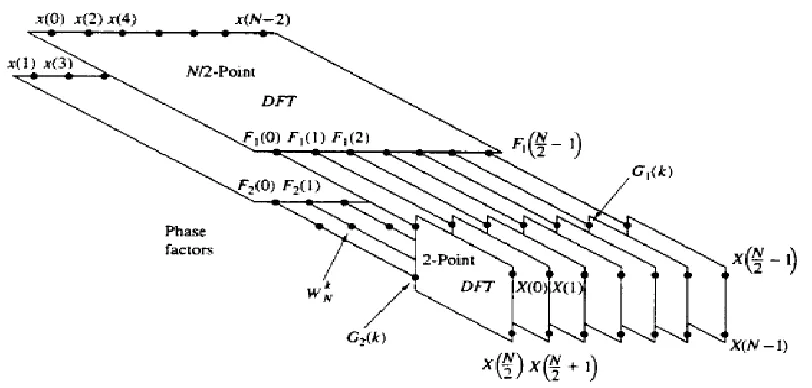
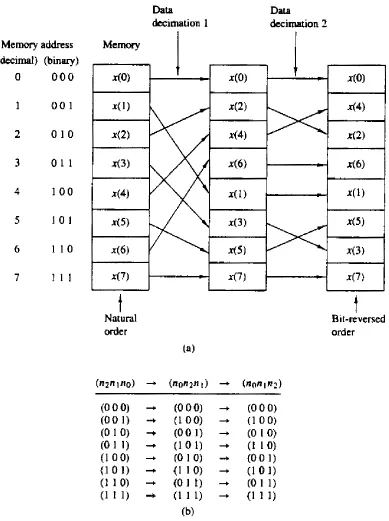
Fig 4.2 Shuffling of Data and Bit reversal
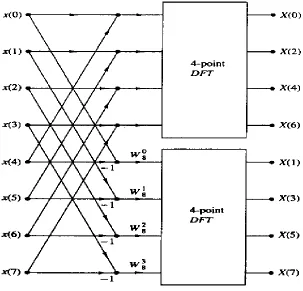
The computation of the sequences g1 (n) and g2 (n) and subsequent use of these
sequences to compute the N/2-point DFTs depicted in fig we observe that the basic
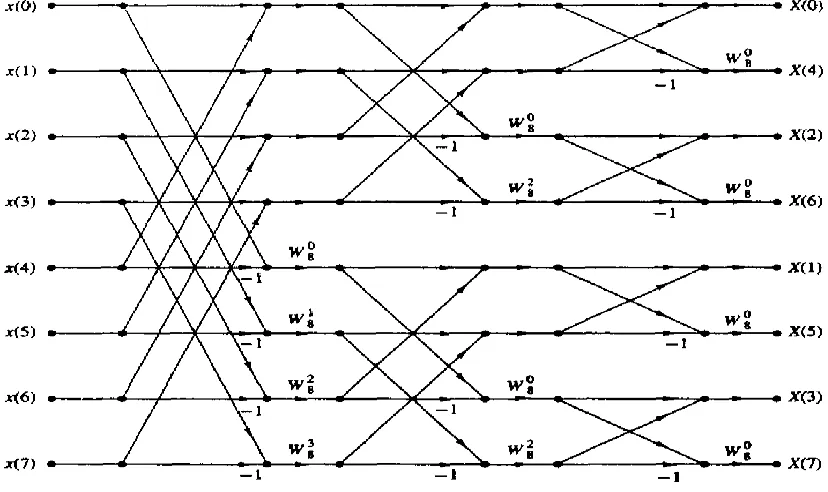
Dept., of ECE/SJBIT Page 40 The computation procedure can be repeated through decimation of the N/2-point DFTs,
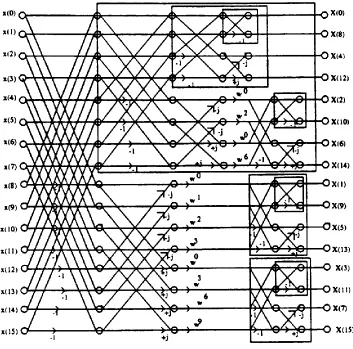
X(2k) and X(2k+1). The entire process involves v = log2 N of decimation, where each stage
involves N/2 butterflies of the type shown in figure 4.3.
Dept., of ECE/SJBIT Page 41 Fig 4.4 N=8 point Decimation-in-frequency domain Algorithm
4.2 Example: DTMF – Dual Tone Multi frequency
This is known as touch-tone/speed/electronic dialing, pressing of each button generates a
unique set of two-tone signals, called DTMF signals. These signals are processed at exchange
to identify the number pressed by determining the two associated tone frequencies. Seven
Dept., of ECE/SJBIT Page 42 In this application frequency analysis requires determination of possible seven (eight)
DTMF fundamental tones and their respective second harmonics .For an 8 kHz sampling freq,
the best value of the DFT length N to detect the eight fundamental DTMF tones has been
found to be 205 .Not all 205 freq components are needed here, instead only those
corresponding to key frequencies are required. FFT algorithm is not effective and efficient in
this application. The direct computation of the DFT which is more effective in this application
is formulated as a linear filtering operation on the input data sequence.
This algorithm is known as Goertzel Algorithm
This algorithm exploits periodicity property of the phase factor. Consider the DFT definition
Since is equal to 1, multiplying both sides of the equation by this results in;
This is in the form of a convolution
Where yk(n) is the out put of a filter which has impulse response of hk(n) and input x(n).
The output of the filter at n = N yields the value of the DFT at the freq ωk = 2πk/N
The filter has frequency response given by
The above form of filter response shows it has a pole on the unit circle at the frequency ωk =
2πk/N.
Entire DFT can be computed by passing the block of input data into a parallel bank of N single-pole filters (resonators)
kN N W ) 2 ( ) ( ) ( ) ( 1 0 ) ( 1 0
N m m N k N N m mk N kNN x mW x mW
W k X ) ( ) ( )
(n x n h n yk k
) 3 ( ) ( ) ( 1 0 ) (
N m m n k Nk n x mW
y ) 4 ( ) ( )
(n W u n hk Nkn
) 6 ( 1 1 )
( 1
Dept., of ECE/SJBIT Page 43 The above form of filter response shows it has a pole on the unit circle at the frequency ωk =
2πk/N.
Entire DFT can be computed by passing the block of input data into a parallel bank of N single-pole filters (resonators)
1.3 Difference Equation implementation of filter:
From the frequency response of the filter (eq 6) we can write the following difference equation relating input and output;
The desired output is X(k) = yk(n) for k = 0,1,…N-1. The phase factor appearing in the
difference equation can be computed once and stored.
The form shown in eq (7) requires complex multiplications which can be avoided doing suitable modifications (divide and multiply by 1WNkz1). Then frequency response of the filter can be alternatively expressed as
This is second –order realization of the filter (observe the denominator now is a second-order expression). The direct form realization of the above is given by
) 7 ( 0 ) 1 ( ) ( ) 1 ( ) ( 1 1 ) ( ) ( ) ( 1 k k k N k k N k k y n x n y W n y z W z X z Y z H ) 8 ( ) / 2 cos( 2 1 1 )
( 1 2
Dept., of ECE/SJBIT Page 44 The recursive relation in (9) is iterated for n = 0,1,……N, but the equation in (10) is computed
only once at time n =N. Each iteration requires one real multiplication and two additions.
Thus, for a real input sequence x(n) this algorithm requires (N+1) real multiplications to yield
X(k) and X(N-k) (this is due to symmetry). Going through the Goertzel algorithm it is clear
that this algorithm is useful only when M out of N DFT values need to be computed where M≤
2log2N, Otherwise, the FFT algorithm is more efficient method. The utility of the algorithm
completely depends on the application and number of frequency components we are looking
for.
4.2. Chirp z- Transform
4.2.1 Introduction:
Computation of DFT is equivalent to samples of the z-transform of a finite-length
sequence at equally spaced points around the unit circle. The spacing between the samples is
given by 2π/N. The efficient computation of DFT through FFT requires N to be a highly
composite number which is a constraint. Many a times we may need samples of z-transform
on contours other than unit circle or we my require dense set of frequency samples over a
small region of unit circle. To understand these let us look in to the following situations:
1. Obtain samples of z-transform on a circle of radius ‘a’ which is concentric to unit circle
The possible solution is to multiply the input sequence by a-n
Dept., of ECE/SJBIT Page 45 From the given specifications we see that the spacing between the frequency samples is
π/512 or 2π/1024. In order to achieve this freq resolution we take 1024- point FFT of
the given 128-point seq by appending the sequence with 896 zeros. Since we need
only 128 frequencies out of 1024 there will be big wastage of computations in this
scheme.
For the above two problems Chirp z-transform is the alternative.
Chirp z- transform is defined as:
Where zk is a generalized contour. Zk is the set of points in the z-plane falling on an arc which
begins at some point z0 and spirals either in toward the origin or out away from the origin such
that the points {zk}are defined as,
) 12 ( 1
,.... 1 , 0 )
( 0
0
0
0
re Re k L
zk j j k
) 11 ( 1
,... 1 , 0 )
( )
(
1
0
L k
z n x z
X
N n
Dept., of ECE/SJBIT Page 46 Note that,
a. if R0< 1 the points fall on a contour that spirals toward the origin
b. If R0 > 1 the contour spirals away from the origin
c. If R0= 1 the contour is a circular arc of radius
d.If r0=1 and R0=1 the contour is an arc of the unit circle.
(Additionally this contour allows one to compute the freq content of the sequence x(n) at
dense set of L frequencies in the range covered by the arc without having to compute a large
DFT (i.e., a DFT of the sequence x(n) padded with many zeros to obtain the desired resolution
in freq.))
e. If r0= R0=1 and θ0=0 Φ0=2π/N and L = N the contour is the entire unit circle similar to the
Dept., of ECE/SJBIT Page 47
Substituting the value of zk in the expression of X(zk)
where
4.2.2 Expressing computation of X(zk) as linear filtering operation:
By substitution of
we can express X(zk) as
Where
both g(n) and h(n) are complex valued sequences
4.2.3 Why it is called Chirp z-transform?
If R0 =1, then sequence h(n) has the form of complex exponential with argument ωn =
n2Φ0/2 = (n Φ0/2) n. The quantity (n Φ0/2) represents the freq of the complex exponential
) 13 ( ) )( ( ) ( ) ( 1 0 0 1 0 0 nk N n n j N n n k
k x n z x n re W
z X
) 14 ( 0 0 j e R W ) 15 ( ) ) ( ( 21 2 2 2
n k k n
nk
) 16 ( 1 . ,... 1 , 0 ) ( / ) ( ) ( )
(z W 2/2y k y k h k k L X k k
2 /
2
) (n Wn
h 0 /2
2 0)
)( ( )
(n x n rej nW n g
Dept., of ECE/SJBIT Page 48 signal, which increases linearly with time. Such signals are used in radar systems are called
chirp signals. Hence the name chirp z-transform.
4.2.4 How to Evaluate linear convolution of eq (17)
1. Can be done efficiently with FFT
2. The two sequences involved are g(n) and h(n). g(n) is finite length seq of length N and
h(n) is of infinite duration, but fortunately only a portion of h(n) is required to compute
L values of X(z), hence FFT could be still be used.
3. Since convolution is via FFT, it is circular convolution of the N-point seq g(n) with an
M- point section of h(n) where M > N
4. The concepts used in overlap –save method can be used
5. While circular convolution is used to compute linear convolution of two sequences we
know the initial N-1 points contain aliasing and the remaining points are identical to
the result that would be obtained from a linear convolution of h(n) and g(n), In view of
this the DFT size selected is M = L+N-1 which would yield L valid points and N-1
points corrupted by aliasing. The section of h(n) considered is for –(N-1) ≤ n≤ (L-1)
yielding total length M as defined
Dept., of ECE/SJBIT Page 49 h1(n) = h(n-N+1) n = 0,1,…..M-1
7. Compute H1(k) and G(k) to obtain
Y1(k) = G(K)H1(k)
8. Application of IDFT will give y1(n), for
n =0,1,…M-1. The starting N-1 are discarded and desired values are y1(n) for
N-1 ≤n ≤ M-1 which corresponds to the range 0 ≤n ≤ L-1 i.e.,
y(n)= y1(n+N-1) n=0,1,2,…..L-1
9. Alternatively h2(n) can be defined as
10.Compute Y2(k) = G(K)H2(k), The desired values of y2(n) are in the range
0 ≤n ≤L-1 i.e.,
y(n) = y2(n) n=0,1,….L-1
11.Finally, the complex values X(zk) are computed by dividing y(k) by h(k)
For k =0,1,……L-1
4.3 Computational complexity
In general the computational complexity of CZT is of the order of M log2M complex
multiplications. This should be compared with N.L which is required for direct evaluation.
If L is small direct evaluation is more efficient otherwise if L is large then CZT is more
efficient.
4.3.1 Advantages of CZT
a. Not necessary to have N =L
b.Neither N or L need to be highly composite
c.The samples of Z transform are taken on a more general contour that includes the unit circle as a special case.
4.4 Example to understand utility of CZT algorithm in freq analysis
(ref: DSP by Oppenheim Schaffer)
CZT is used in this application to sharpen the resonances by evaluating the z-transform
off the unit circle. Signal to be analyzed is a synthetic speech signal generated by exciting a 1
)) 1 (
(
1 0
) ( ) ( 2
M n L L
N n h
L n n
Dept., of ECE/SJBIT Page 50 five-pole system with a periodic impulse train. The system was simulated to correspond to a
sampling freq. of 10 kHz. The poles are located at center freqs of 270,2290,3010,3500 & 4500
Hz with bandwidth of 30, 50, 60,87 & 140 Hz respectively.
Solution: Observe the pole-zero plots and corresponding magnitude frequency response for different choices of |w|. The following observations are in order:
• The first two spectra correspond to spiral contours outside the unit circle with a resulting
broadening of the resonance peaks
• |w| = 1 corresponds to evaluating z-transform on the unit circle
• The last two choices correspond to spiral contours which spirals inside the unit circle and
Dept., of ECE/SJBIT Page 51
4.5 Implementation of CZT in hardware to compute the DFT signals
The block schematic of the CZT hardware is shown in down figure. DFT computation
requires r0 =R0 =1, θ0 = 0 Φ0 = 2π/N and L = N.
The cosine and sine sequences in h(n) needed for pre multiplication and post multiplication are
usually stored in a ROM. If only magnitude of DFT is desired, the post multiplications are
unnecessary,
In this case |X(zk)| = |y(k)| k =0,1,….N-1
Dept., of ECE/SJBIT Page 52
Recommended Questions with solutions
Question 1
Solution:-Dept., of ECE/SJBIT Page 53
Question 2
Solution :- There are 20 real , non trial multiplications
Dept., of ECE/SJBIT Page 54
Question 3
Solution:-
Question 4
Dept., of ECE/SJBIT Page 55
Question 5
Solution:-
Question 6
Solution:-
Dept., of ECE/SJBIT Page 57
U
NIT
5
IIR
F
ILTERD
ESIGNC
ONTENTS:-
IIR FILTER DESIGN: CHARACTERISTICS OF COMMONLY USED ANALOG FILTERS –
BUTTERWORTH AND CHEBYSHEVE FILTERS, ANALOG TO ANALOG FREQUENCY
TRANSFORMATIONS. 6HRS
R
ECOMMENDEDR
EADINGS1. DIGITAL SIGNAL PROCESSING –PRINCIPLES ALGORITHMS &APPLICATIONS,PROAKIS &
MONALAKIS,PEARSON EDUCATION,4THEDITION,NEW DELHI,2007.
2. DISCRETE TIME SIGNAL PROCESSING,OPPENHEIM &SCHAFFER,PHI,2003.
Dept., of ECE/SJBIT Page 58
Unit 5
Design of IIR Filters
5.1 Introduction
A digital filter is a linear shift-invariant discrete-time system that is realized using finite
precision arithmetic. The design of digital filters involves three basic steps:
The specification of the desired properties of the system.
The approximation of these specifications using a causal discrete-time system.
The realization of these specifications using finite precision arithmetic.
These three steps are independent; here we focus our attention on the second step. The
desired digital filter is to be used to filter a digital signal that is derived from an analog signal
by means of periodic sampling. The specifications for both analog and digital filters are often
given in the frequency domain, as for example in the design of low pass, high pass, band pass
and band elimination filters.
Given the sampling rate, it is straight forward to convert from frequency specifications
on an analog filter to frequency specifications on the corresponding digital filter, the analog
frequencies being in terms of Hertz and digital frequencies being in terms of radian frequency
or angle around the unit circle with the point Z=-1 corresponding to half the sampling
frequency. The least confusing point of view toward digital filter design is to consider the filter
as being specified in terms of angle around the unit circle rather than in terms of analog
Dept., of ECE/SJBIT Page 59 Figure 5.1: Tolerance limits for approximation of ideal low-pass filter
A separate problem is that of determining an appropriate set of specifications on the
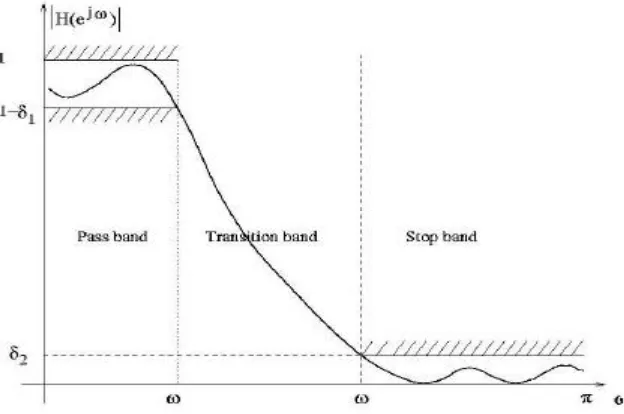
digital filter. In the case of a low pass filter, for example, the specifications often take the form
of a tolerance scheme, as shown in Fig. 5.1.
Many of the filters used in practice are specified by such a tolerance scheme, with no
constraints on the phase response other than those imposed by stability and causality
requirements; i.e., the poles of the system function must lie inside the unit circle. Given a set
of specifications in the form of Fig. 5.1, the next step is to and a discrete time linear system
whose frequency response falls within the prescribed tolerances. At this point the filter design
problem becomes a problem in approximation. In the case of infinite impulse response (IIR)
filters, we must approximate the desired frequency response by a rational function, while in the
finite impulse response (FIR) filters case we are concerned with polynomial approximation.
Dept., of ECE/SJBIT Page 60 The traditional approach to the design of IIR digital filters involves the transformation
of an analog filter into a digital filter meeting prescribed specifications. This is a reasonable
approach because:
The art of analog filter design is highly advanced and since useful results can be
achieved, it is advantageous to utilize the design procedures already developed for
analog filters.
Many useful analog design methods have relatively simple closed-form design
formulas.
Therefore, digital filter design methods based on analog design formulas are rather simple to
implement. An analog system can be described by the differential equation
And the corresponding rational function is
The corresponding description for digital filters has the form
and the rational function
In transforming an analog filter to a digital filter we must therefore obtain either H(z)
or h(n) (inverse Z-transform of H(z) i.e., impulse response) from the analog filter design. In
such transformations, we want the imaginary axis of the S-plane to map into the nit circle of
the Z-plane, a stable analog filter should be transformed to a stable digital filter. That is, if the
analog filter has poles only in the left-half of S-plane, then the digital filter must have poles
Dept., of ECE/SJBIT Page 61
5.2 Characteristics of Commonly Used Analog Filters:
From the previous discussion it is clear that, IIT digital filters can be obtained by
beginning with an analog filter. Thus the design of a digital filter is reduced to designing an
appropriate analog filter and then performing the conversion from Ha(s) to H (z). Analog filter
design is a well - developed field, many approximation techniques, viz., Butterworth,
Chebyshev, Elliptic, etc., have been developed for the design of analog low
pass filters. Our discussion is limited to low pass filters, since, frequency transformation can
be applied to transform a designed low pass filter into a desired high pass, band pass and band
stop filters.
5.2.1 Butterworth Filters:
Low pass Butterworth filters are all - pole filters with monotonic frequency response in
both pass band and stop band, characterized by the magnitude - squared frequency response
Where, N is the order of the filter, Ώc is the -3dB frequency, i.e., cutoff frequency, Ώp is the
pass band edge frequency and 1= (1 /1+ε2 ) is the band edge value of │Ha(Ώ)│2. Since the
product Ha(s) Ha(-s) and evaluated at s = jΏ is simply equal to │Ha(Ώ)│2, it follows that
The poles of Ha(s)Ha(-s) occur on a circle of radius Ώc at equally spaced points. From Eq.
(5.29), we find the pole positions as the solution of
Dept., of ECE/SJBIT Page 62 Note that, there are no poles on the imaginary axis of s-plane, and for N odd there will
be a pole on real axis of s-plane, for N even there are no poles even on real axis of s-plane.
Also note that all the poles are having conjugate symmetry. Thus the design methodology to
design a Butterworth low pass filter with δ2 attenuation at a specified frequency Ώs is Find N,
Where by definition, δ2 = 1/√1+δ2. Thus the Butterworth filter is completely
characterized by the parameters N, δ2, ε and the ratio Ώs/Ώp or Ώc.Then, from Eq. (5.31) find
the pole positions Sk; k = 0,1, 2,……..(N-1). Finally the analog filter is given by
5.2.2 Chebyshev Filters:
There are two types of Chebyshev filters. Type I Chebyshev filters are all-pole filters
that exhibit equiripple behavior in the pass band and a monotonic characteristic in the stop
band. On the other hand, type II Chebyshev filters contain both poles and zeros and exhibit a
monotonic behavior in the pass band and an equiripple behavior in the stop band. The zeros of
this class of filters lie on the imaginary axis in the s-plane. The magnitude squared of the
frequency response characteristic of type I Chebyshev filter is given as
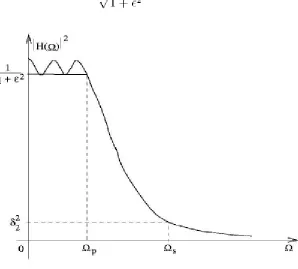
Where ε is a parameter of the filter related to the ripple in the pass band as shown in Fig.
(5.7), and TN is the Nth order Chebyshev polynomial defined as
Dept., of ECE/SJBIT Page 63 Where T0(x) = 1 and T1(x) = x.
At the band edge frequency Ώ= Ώp, we have
Figure 5.2: Type I Chebysehev filter characteristic
Or equivalently
Where δ1 is the value of the pass band ripple.
The poles of Type I Chebyshev filter lie on an ellipse in the s-plane with major axis
And minor axis
Dept., of ECE/SJBIT Page 64 The angular positions of the left half s-plane poles are given by
Then the positions of the left half s-plane poles are given by
Where σk =
r
2 Cos φk and Ώk =r
1 Sinφk. The order of the filter is obtained fromWhere, by definition δ2 = 1/√1+δ2.
Finally, the Type I Chebyshev filter is given by
A Type II Chebyshev filter contains zero as well as poles. The magnitude squared response is given as
Where TN(x) is the N-order Chebyshev polynomial. The zeros are located on the imaginary
axis at the points
Dept., of ECE/SJBIT Page 65 Where
and
Finally, the Type II Chebyshev filter is given by
The other approximation techniques are elliptic (equiripple in both passband and
stopband) and Bessel (monotonic in both passband and stopband).
5.3 Analog to Analog Frequency Transforms
Frequency transforms are used to transform lowpass prototype filter to other filters like
highpass or bandpass or bandstop filters. One possibility is to perform frequency transform in
the analog domain and then convert the analog filter into a corresponding digital filter by a
mapping of the s-plane into z-plane. An alternative approach is to convert the analog lowpass
filter into a lowpass digital filter and then to transform the lowpass digital filter into the
desired digital filter by a digital transformation.
Suppose we have a lowpass filter with pass edge ΩP and if we want convert that into
another lowpass filter with pass band edge Ω’P then the transformation used is
Dept., of ECE/SJBIT Page 66 Thus we obtain
Dept., of ECE/SJBIT Page 67
Recommended Questions with answers
Question 1
I Design a digital filter to satisfy the following characteristics.
-3dB cutoff frequency of 0:5_ rad.
Magnitude down at least 15dB at 0:75_ rad.
Monotonic stop band and pass band Using
Impulse invariant technique
Approximation of derivatives
Bilinear transformation technique
Figure 5.8: Frequency response plot of the example Solution:-
a) Impulse Invariant Technique
From the given digital domain frequency, _nd the corresponding analog domain frequencies.
Where T is the sampling period and 1/T is the sampling frequency and it always corresponds
to 2Π radians in the digital domain. In this problem, let us assume T = 1sec.
Then Ώc = 0:5Π and Ώs = 0:75Π
Dept., of ECE/SJBIT Page 68 Where δ2 is the gain at the stop band edge frequency ωs.
Order of filter N =5.
Then the 5 poles on the Butterworth circle of radius Ώc = 0:5 Π are given by
Then the filter transfer function in the analog domain is
where Ak's are partial fractions coefficients of Ha(s).
Dept., of ECE/SJBIT Page 69
b)
c) For the bilinear transformation technique, we need to pre-warp the digital frequencies into corresponding analog frequencies.
Then the order of the filter
The pole locations on the Butterworth circle with radius Ώc = 2 are
Then the filter transfer function in the analog domain is
Dept., of ECE/SJBIT Page 70
Question 2
Design a digital filter using impulse invariant technique to satisfy following characteristics
(i) Equiripple in pass band and monotonic in stop band
(ii) -3dB ripple with pass band edge frequency at 0:5П radians.
(iii) Magnitude down at least 15dB at 0:75 П radians.
Dept., of ECE/SJBIT Page 73
Question 3
Solution:-
Dept., of ECE/SJBIT Page 74
Question 4
Dept., of ECE/SJBIT Page 75
U
NIT
6
Implementation of Discrete time systems
C
ONTENTS:-
IMPLEMENTATION OF DISCRETE-TIME SYSTEMS:STRUCTURES FOR IIR AND FIR SYSTEMS DIRECT FORM I AND DIRECT FORM II SYSTEMS, CASCADE, LATTICE AND PARALLEL
REALIZATION. 7HRS
R
ECOMMENDEDR
EADINGS:-
1. DIGITAL SIGNAL PROCESSING –PRINCIPLES ALGORITHMS &APPLICATIONS,PROAKIS &
MONALAKIS,PEARSON EDUCATION,4THEDITION,NEW DELHI,2007.
2. DISCRETE TIME SIGNAL PROCESSING,OPPENHEIM &SCHAFFER,PHI,2003.
Dept., of ECE/SJBIT Page 76
UNIT 6
Implementation of Discrete-Time Systems
6.1 Introduction
The two important forms of expressing system leading to different realizations of FIR & IIR filters are
a) Difference equation form
M
k k N
k
ky n k b x n k
a n
y
1 1
) ( )
( )
(
b) Ration of polynomials
N
k
k k M k
k k
Z a
Z b Z
H
1 0
1 ) (
The following factors influence choice of a specific realization,
Computational complexity
Memory requirements
Finite-word-length
Pipeline / parallel processing
6.1.1 Computation Complexity
This is do with number of arithmetic operations i.e. multiplication, addition & divisions. If the realization can have less of these then it will be less complex computationally.
In the recent processors the fetch time from memory & number of times a comparison between two numbers is performed per output sample is also considered and found to be important from the point of view of computational complexity.
6.1.2 Memory requirements
This is basically number of memory locations required to store the system parameters, past inputs, past outputs, and any intermediate computed values. Any realization requiring less of these is preferred.
6.1.3 Finite-word-length effects
Dept., of ECE/SJBIT Page 77
6.1.4 Pipeline / Parallel Processing
This is to do with suitability of the structure for pipelining & parallel processing. The parallel processing can be in software or hardware. Longer pipelining make the system more efficient.
6.2 Structure for FIR Systems:
FIR system is described by,
1 0 ) ( ) ( M kkx n k
b n
y
Or equivalently, the system function
1 0 ) ( M k k kZ b Z HWhere we can identify
otherwise n n b n h n 0 1 0 ) (
Different FIR Structures used in practice are, 1. Direct form
2. Cascade form
3. Frequency-sampling realization 4. Lattice realization
6.2.1 Direct – Form Structure
Convolution formula is used to express FIR system given by,
1 0 ) ( ) ( ) ( M k k n x k h n y It is Non recursive in structure
As can be seen from the above implementation it requires M-1 memory locations for storing the M-1 previous inputs
It requires computationally M multiplications and M-1 additions per output point
It is more popularly referred to as tapped delay line or transversal system
Efficient structure with linear phase characteristics are possible where )
1 ( )
(n h M n
Dept., of ECE/SJBIT Page 78
Prob:
Realize the following system function using minimum number of multiplication
(1) 1 2 3 4 5
3 1 4 1 4 1 3 1 1 )
(Z Z Z Z Z Z H We recognize
,1
3 1 , 4 1 , 4 1 , 3 1 , 1 ) (n h
M is even = 6, and we observe h(n) = h(M-1-n) h(n) = h(5-n) i.e h(0) = h(5) h(1) = h(4) h(2) = h(3)
Direct form structure for Linear phase FIR can be realized
Exercise: Realize the following using system function using minimum number of multiplication. 8 7 6 5 3 2 1 4 1 3 1 2 1 2 1 3 1 4 1 1 )
(Z Z Z Z Z Z Z Z H m=9
, 1
4 1 , 3 1 , 2 1 , 2 1 , 3 1 , 4 1 , 1 ) (n h odd symmetry
Dept., of ECE/SJBIT Page 79
6.2.2 Cascade – Form Structure
The system function H(Z) is factored into product of second – order FIR system
K k
k Z
H Z
H
1
) ( )
(
Where Hk(Z)bk0bk1Z1bk2Z2 k = 1, 2, ….. K and K = integer part of (M+1) / 2
The filter parameter b0 may be equally distributed among the K filter section, such that b0
= b10 b20 …. bk0 or it may be assigned to a single filter section. The zeros of H(z) are grouped
Dept., of ECE/SJBIT Page 80 In case of linear –phase FIR filter, the symmetry in h(n) implies that the zeros of H(z) also exhibit a form of symmetry. If zk and zk* are pair of complex – conjugate zeros then 1/zk and 1/zk* are also a pair complex –conjugate zeros. Thus simplified fourth order sections are formed. This is shown below,
4 3 1 2 2 1 1 0 * 1 1 1 1
0(1 )(1 * )(1 / )(1 / ) ) ( z z C z C z C C z z z z z z z z C z H k k k k k k k k k k
Problem: Realize the difference equation
) 4 ( ) 3 ( 75 . 0 ) 2 ( 5 . 0 ) 1 ( 25 . 0 ) ( )
(n x n x n x n x n x n y
in cascade form.
Soln: ) ( ) ( ) ( ) 821 . 0 3719 . 1 1 )( 2181 . 1 1219 . 1 1 ( ) ( 75 . 0 5 . 0 25 . 0 1 ) ( ) 75 . 0 5 . 0 25 . 0 1 ){ ( ) ( 2 1 2 1 2 1 4 3 _ 2 1 4 3 2 1 z H z H z H z z z z z H z z z z z H z z z z z X z Y
6.3 Frequency sampling realization:
We can express system function H(z) in terms of DFT samples H(k) which is given by
Dept., of ECE/SJBIT Page 81 This form can be realized with cascade of FIR and IIR structures. The term (1-z-N) is realized
as FIR and the term
1
0
1 1
) ( 1 N
k
k N z
W k H
N as IIR structure.
The realization of the above freq sampling form shows necessity of complex arithmetic.
Incorporating symmetry in h(n) and symmetry properties of DFT of real sequences the realization can be modified to have only real coefficients.
6.4 Lattice structures
Lattice structures offer many interesting features:
1. Upgrading filter orders is simple. Only additional stages need to be added instead of redesigning the whole filter and recalculating the filter coefficients.
2. These filters are computationally very efficient than other filter structures in a filter bank applications (eg. Wavelet Transform)
3. Lattice filters are less sensitive to finite word length effects.
Consider
i m
i
m i z
a z
X z Y z
H
1 ( )
) (
) ( ) (
1
m is the order of the FIR filter and am(0)=1
Dept., of ECE/SJBIT Page 82 y(n)= x(n)+ a1(1)x(n-1)
f1(n) is known as upper channel output and r1(n)as lower channel output.
f0(n)= r0(n)=x(n)
The outputs are
) ( ) ( ), 1 ( 1 ) 1 ( ) ( ) ( 1 ) 1 ( ) ( ) ( 1 1 1 0 0 1 1 0 1 0 1 n y n f then a k if b n r n f k n r a n r k n f n f