International Doctorate School in Information and Communication Technologies
DISI - University of Trento
E
VENT
B
ASED
M
EDIA
I
NDEXING
Ivan Tankoyeu
Advisor:
Prof.Fausto Giunchiglia
Universit`a degli Studi di Trento
Multimedia data, being multidimensional by its nature, requires
appropri-ate approaches for its organizing and sorting. The growing number of sensors
for capturing the environmental conditions in the moment of media creation
en-riches data with context-awareness. This unveils enormous potential for
event-centred multimedia processing paradigm. The essence of this paradigm lies
in using events as the primary means for multimedia integration, indexing and
management.
Events have the ability to semantically encode relationships of different
in-formational modalities. These modalities can include, but are not limited to:
time, space, involved agents and objects. As a consequence, media processing
based on events facilitates information perception by humans. This, in turn,
de-creases the individual’s effort for annotation and organization processes.
More-over events can be used for reconstruction of missing data and for information
enrichment.
The spatio-temporal component of events is a key to contextual analysis. A
variety of techniques have recently been presented to leverage contextual
in-formation for event-based analysis in multimedia. The content-based approach
has demonstrated its weakness in the field of event analysis, especially for the
event detection task. However content-based media analysis is important for
object detection and recognition and can therefore play a role which is
comple-mentary to that of event-driven context recognition.
event-dissertation we propose i) a novel model for event based multimedia
representa-tion, ii) a robust approach for mining events from multimedia and iii)
exploita-tion of detected events for data reconstrucexploita-tion and knowledge enrichment.
Keywords
media indexing, event-based analysis, context processing, multimedia
I would like to express deep gratitude to my scientific advisor Professor Fausto
Giunchiglia, for the chance that he gave me, for countless life and professional
lessons and for his continuous help and support on different steps of my PhD
life.
I wish to express sincere appreciation to Dr. Ilya Zaihrayeu and Dr. Julian
St¨ottinger. They played crucial roles in my research activity. I would like to
thank them for patience and guidance without which this study would never
have reached the current state.
I must also acknowledge my friends for their support. I would like to give
special thanks to Siarhei Bykau, Maksim Khadkevich, Uladzimir Kharkevich,
Heorhi Raik and Yury Zhauniarovich for their encouragement and assistance
within tough periods in my life.
Finally, I thank my family: my mother Anastasia Tankoeva, my sister Nadezhda
Tseliuk, her husband Dmitri Tseliuk and my future wife Viktoryia Tankoeva
1 Introduction 1
1.1 The Motivation . . . 3
1.2 Objectives . . . 4
1.3 User Scenarios . . . 5
1.3.1 Trip to Portugal . . . 5
1.3.2 Football match . . . 6
1.3.3 Protests in Syria . . . 6
1.3.4 Air show . . . 6
1.3.5 Concert . . . 7
1.3.6 Photo collection . . . 7
1.4 Structure of the Thesis . . . 8
2 Event-based Content Representation 11 2.1 State of the art on media content modelling . . . 12
2.2 Event Content Media Modelling . . . 14
2.2.1 Structural components of the framework . . . 17
2.3 Image and Photo . . . 22
2.3.1 Image Etype . . . 22
2.3.2 Photo Etype . . . 23
2.4 Video and Video File . . . 24
2.4.1 Video File . . . 25
3 Multimedia Event Mining 29
3.1 Introduction . . . 29
3.2 Personal events vs Social events . . . 29
3.3 Personal Event Detection . . . 33
3.3.1 State of the Art . . . 34
3.3.2 Methodology . . . 36
3.3.3 Experimental Data-set . . . 42
3.3.4 Experimental Set-up . . . 44
3.3.5 Event-based Album Recreation . . . 45
3.3.6 Momentum of attraction . . . 49
3.3.7 Growing Data-set . . . 50
3.3.8 Discussion . . . 52
3.4 Social Event Detection . . . 53
3.4.1 State of the art . . . 54
3.4.2 Methodology . . . 55
3.4.3 Experiments . . . 58
3.4.4 Discussion . . . 60
3.5 Conclusion . . . 61
4 Exploitation of Detected Events 63 4.1 Introduction . . . 63
4.2 Event-based Geoannotation . . . 63
4.2.1 State of the Art . . . 65
4.2.2 Methodology . . . 67
4.2.3 Experiments . . . 69
4.2.4 Discussion . . . 71
4.3 Event-based Social Connections Discovery . . . 72
4.3.3 Experimental results . . . 76
4.3.4 Discussion . . . 77
4.4 Conclusion . . . 78
5 Conclusion 81
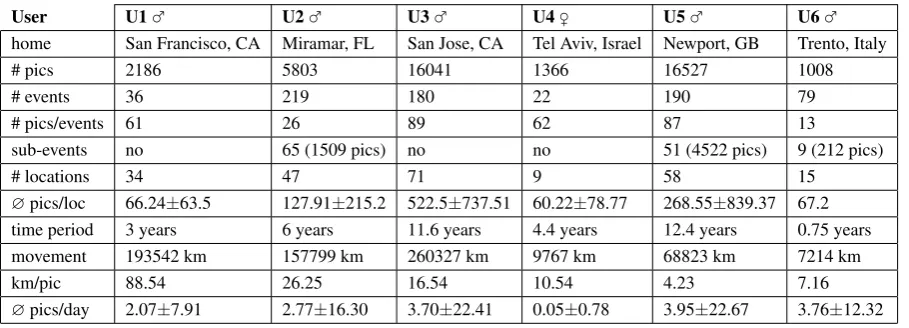
3.1 Overview of the data-set used in the experiments crawled from
Picasaweb. . . 42
3.2 Experimental results for automatic event detection in relation to
the user’s album organization. . . 45
3.3 Experimental results for automatic sub-event detection in
rela-tion to the user’s album organisarela-tion. . . 48
3.4 Results for the parameter learning phase, comparing true
pos-itives against under-joint (U-Joint) and over-joint (O-joint)
so-cial events. Best results where achieved using cT = 0.50 and
cS = 1.00. . . 61 4.1 Experimental results for Event-Based Semantic Interpolation
(EBSI), Time-Based Interpolation (TBI) and Linear
Interpola-tion (LI) . . . 71
4.2 Experimental results for the degree of co-participation in events.
The comparison is made counting occurrences of pairs of users
participating in the same event. We establish two groups to
clasify user pairs depending on wheter these user pairs have
each other as contacts (the “Contacts row”) or not (the
“Non-contacts” row). Additionally, we provide the results of the
“Con-tacts” row as a percentage relative to the total number of user
2.1 Covering different informational aspects by current standard. . . 13
2.2 Example of simplified entity-oriented model for event and me-dia management. . . 16
2.3 Simplified Lattice of Entity Types. . . 18
2.4 Example of Video Content description. . . 26
3.1 Distinction between personal events and social events. . . 31
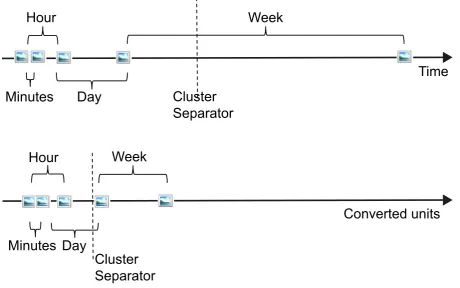
3.2 Scaling by ψ(∆n)and MMC on temporal scale . . . 38
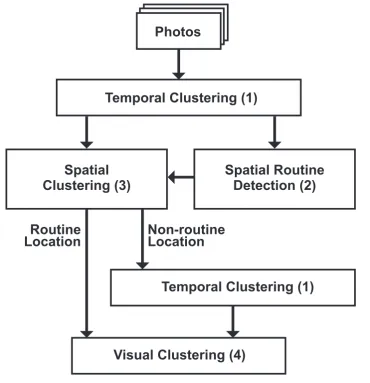
3.3 Schematic overview over the proposed framework. . . 39
3.4 Photo of Castle Mir using different camera settings and view points. . . 42
3.5 Relative number of pictures of the 10 most active locations (black bars) per user. Picture densityΦper location (white bars). Rou-tine locations are marked bold, from left to right: U1 to U5. . . . 46
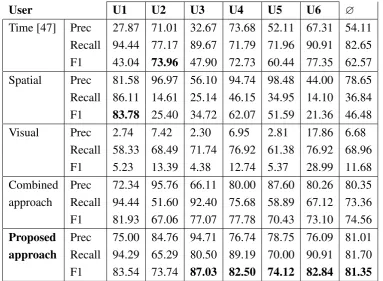
3.6 Sensitivity per User. Bars from left to right: Time [47], spatial, visual, combined approach and proposed approach. . . 46
3.7 (a)Distribution of photos per location; (b) density (Φ) of days with photos taken per location . . . 47
3.8 Number of photos per day of U6. . . 49
of Pisa. Second attractive scene: on the roof of Notre- Dame,
second row. Most unattractive event: a photo of a new book
(lower right). . . 51
3.11 Mean F1-measure on the growing data-set. . . 52
3.12 a) Time overlap of tA and tB and b) selecting the minimum spatial distance of all points pbj of PB to a particular point pai
or PA . . . 57 4.1 Examples of extrapolation (2) and interpolation (3). . . 68
4.2 Comparison of images with manual geoannotation and assigned
by GPS-enabled device. . . 70
4.3 Comparison results for different approaches . . . 70
4.4 Images geoannotated by EBSI with minimal error. . . 72
4.5 Ratio of users with social ties vs. users without social ties per
degree of co-participation in the same events. . . 78
4.6 Shared contacts per degree of event co-participation. Included
in parentheses are the number of occurrences for pairs of users
Introduction
The storytelling being in a broad sense the process of transmitting information
plays a vital role in mankind development. It is used not only as a way to
entertain but also to share and transfer knowledge and experience. According to
Wikipedia1 the process of storytelling stands for “conveying of events in words,
images, and sounds” . This definition allows us to distinguish main components
of storytelling: eventsand corresponded media.
The story of our life memorized in autobiographical memory is compiled
from a set of events experienced within our lifetime [88]. This signalized about
the importance of events as “intellectual landmarks” for indexing one’s
individ-ual memory [61]. Furthermore, these “intellectindivid-ual landmarks” can retrieve
dif-ferent types of related to an event information such as temporal, spatial, causal,
etc. [9], [54]. Thus, we can say that events play a role of natural aggregators of
contextual information. Therefore, events can be used to represent context in a
semantically meaningful way that follows how we humans process our
experi-ences. By the context we imply the information about environmental conditions
of an event.
Due to the recent advances in computer technology and arrivals of new
me-dia capturing and storage devices the process of storytelling has made a major
transformation. New media capturing and storage devices e.g. cameraphones
have changed the traditional storytelling form to the digital one. Digital
story-telling become even more popular with the developing of on-line facilities for
sharing and publishing personal content in the Internet. Digital media that can
be taken almost at no cost allows people to collect huge amount of personal
data that can be used “to tell” a story of their life. This media is characterized
by the heterogeneous nature, in the sense of diversity of content’s form.
How-ever, the enormous amount of digital media requires appropriate techniques for
its indexing and organizing.
To this end, we propose to use events as the primary means for media
index-ing and organization. Moreover, the ability of digital devices to capture the
con-text (i.e. spatio-temporal information) along with the media content facilitates
this task. In our research we use definition of [38] and refer events as
“some-thing that occurs in a certain place during a particular interval of time”. This
def-inition allows us to scope event mining task as the detection of spatio-temporal
boundaries of an event.Therefore spatio-temporal data processing dominates in
the event-based multimedia analysis.
Event-based multimedia analysis paradigm is a relatively young approach for
indexing, management and organizing multimedia data. However, it
demon-strates enormous potential for media analysis. To unveil this potential
event-based techniques for semantic multimedia analysis require a lot of work.
This thesis touches different phases of event-based media analysis. On the
initial phase we develop a model for event content representation with the focus
on media components of this model. The second phase consists of the event
detection part that describes an approach for mining events on the global and
local scale. The phase of event detection is followed by the final phase of event
exploitation, that clearly demonstrates the power of events for providing a new
knowledge.
goals of the thesis; Section 1.3 exemplify these goals with user scenarios; Sec-tion 1.4describes the overall structure of the thesis.
1.1
The Motivation
The rapid growth in the number of digital photos and videos within the past
decade has led to a rethinking of the traditional principles for media indexing
and organizing. In fact, object-centred media analysis strategy has a limited
ability to satisfy user needs in organizing personal media collections [2].
Recent developments in media industry show the interest towards an
event-based multimedia indexing. Apple´s iPhoto2 allows a user to organize manually
his images by folders called events, Adobe´s Lightroom3 lets the user build
im-age collections. Both Google´s Picasa4 and iPhoto let the user visualize their
pictures according to detected faces and locations. Still, there is neither a
com-bination of this information nor an extended knowledge extracted from these
clusters. Opposed to these applications, the highly controversial timeline from
Facebook5 aims to represent the entire life of an user as a chain of events.
How-ever, the absence of automated or semi-automated approach for event-based
me-dia clustering of personal collection bothers a user with the tiresome and boring
work of organizing it manually. Nevertheless, recent studies have demonstrated
that at very least 70% of albums published at Google Picasaweb represent events
related to a user´s life. Therefore, the new event-based paradigm of multimedia
analysis has drawn a significant attention recently [52], [70].
Tremendous growth of personal media collection and the absence of
appro-priate tools for managing and organizing them have made the event-based media
indexing techniques an emerging area of research. In this area the contextual
2http://www.apple.com/ilife/iphoto/
3http://www.adobe.com/products/photoshoplightroom/ 4http://picasa.google.com/
features of media plays the crucial role. We contribute to this area developing
our ecosystem that consist of framework for storing media and its metadata,
event detection tools for minig events from digital photo collections and the
exploitation of detected events.
1.2
Objectives
The main objective of this thesis is to investigate the concept of events for
mul-timedia content indexing, organizing and management. In order to achieve this
main goal, the thesis addresses a wide variety of design and technical
chal-lenges, which closely relate to the following detailed objectives:
• Provide a user with relevant model for event-based media content
representa-tion and management;
• Assist a user in media organization according to events and context to ease
further collection management through fully automatic event detection
ap-proach;
• Improve the quality of contextual data of the personal media collection via
the spatial context reconstruction;
• Derive knowledge for a user inferring social ties of a user via semantic layer
of events;
• Enrich semantics of media collection with the most ”attractive” moments;
• Provide advanced indexing and retrieval techniques that expand complex event
structure to the atomic sub-events with different level of granularity;
• Support a user within the media annotation process providing
1.3
User Scenarios
The presented below set of user scenarios shows how the proposed paradigm
of event-based media analysis helps a user in different real life situations. In
order to cover user’s needs described in those scenarios possible services are
proposed. Further in this thesis different sections have references to presented
scenarios and services.
1.3.1 Trip to Portugal
Maxim and Mila have just returned from a well-organized by an agency
touris-tic trip in Portugal. Mila being a professional photographer made a lot of nice
shots by a professional camera. Maxim preferred to use his smartphone for
tak-ing photos and videos. They enjoyed the trip and want to share taken media
with their friends via online service tools. For a better storytelling they are
go-ing to locate all the photos from the trip on a web mappgo-ing service application.
However, the vast majority of taken photos and videos are not geo tagged.
An-notating process is very boring and tedious for them so they decided to submit
their photos and videos from the trip to the system. Based on the existing
spatio-temporal information the system automatically assigns missing geo-stamps to
some media within the collection.
Services:
· estimate geographical coordinates to photos and videos with missing geo
in-formation
· place photo on the map
1.3.2 Football match
Last night Yuri was on the football match of his favourite team BATE. He made
a nice collection of photos during the match. A friend of Yuri missed it and
asked him to show some of the photos with interesting moments of the match.
Usually the frequency of taking photos by Yuri is higher within the attractive
moments of an event. In order to find these moments Yuri uploads the photos to
the system. It analyses the photos and propagates him a subset of photos related
to the most attractive moments of the match.
Services:
· get an attractive moments of an event
· get an attractive moments of a sub-event
· search the location of the match
1.3.3 Protests in Syria
Serge is a professional blogger interested in protests in Syria. He is writing an
article about it. He has photos of the protests created by a professional
pho-tographer. However, he would like to gather additional media taken by the
participants of this event. So he uses the system for media propagation based
on the existing set of photos.
Services:
· get related photos
· get related videos
· get related articles
1.3.4 Air show
George is an aviation fan and each year he visits some of the European air
MAKS in Moscow. Each time he takes a lot of media entities with automatically
acquainted geo-spatial information. Being a communicative person he got to
know a lot of people during these trips. Recently he has started to use the
system. He would like to find the users in the system he may know in real
life. To do this he uploads all his media taken within air show events to the
system. The system retrieves a set of users and for each of them the number of
co-attended with George events. Most likely George knows users with the high
number of co-participated events and has similar interests with other propagated
users.
Services:
· get a user with the given number of co-attended events
1.3.5 Concert
John was on a charity concert to aid the victims of a tsunami. He took a huge
collection of photos and videos within the celebrity performances. He is eager
to share it on-line but foremost he would like to properly annotate the media.
He exploits the system to automatize this process. The system extracts media
description of different users participated in the same concert and propagates it
to John.
Services:
· get related textual annotation for photos
· get event description
1.3.6 Photo collection
The growing number of digital photos taken by Victoria becomes
unmanage-able. So she finally decides to sort them. In order to make this automatically
she submits the collection to the system. It indexes the media collection
Services:
· sort collection on space basis
· sort collection on event basis
1.4
Structure of the Thesis
The reminder of the thesis is compromised of three major parts. The first part
describes a model for event-content representation with emphasis on image and
video components of the model. The second part is dedicated to event mining
from multimedia collections. The last part gives insights into the use of the
detected events. More detail description of each chapter is given further down.
Chapter 2 contains the description of the framework that models the mul-timedia content and the events that may be depicted. The framework aims to
describe the structure of events by answering to five W questions (i.e. Who,
What, When, Where, Why). Moreover, this framework is able to represent
possible relations (e.g. spatial, temporal) among different components of the
proposed event structure such as actors, objects etc. We will briefly describe the
architecture of the framework. This architecture allows preserving semantically
meaningful to a user information that is codified in events and media content.
This chapter also describes some of the features of the framework components
and possible services for them. In particular, we concentrate on the
compo-nents dedicated for multimedia content representation. Following publications
are related to the chapter: [19].
Chapter 3 aims to describe our approach for mining events from personal and social multimedia archives. In particular, the first section of the chapter
distinguishes personal events and social events. The second section describes
the methodology for personal event detection from the multimedia collection
of a user. Moreover, an approach for reconstruction of the hierarchy of events
sub-events within detected events. This, in turn, eases the navigation process
for a user on different levels of granularity of events. The description of the
col-lected data set and the experimental validation concludes the section. The last
section of the chapter addresses an issue of personal information organization
in social environment. We propose a fully automated approach for detection
of social events from personal events. The section contains detailed
descrip-tion of the algorithm for social event detecdescrip-tion and it experimental validadescrip-tion.
Following publications are related to the chapter: [78], [58], [79], [59]
In Chapter 4 we demonstrate how the detected events can be exploited. The main goal of the section is to demonstrate abilities of the event-centered
approach to metadata reconstruction and information enrichment. The process
of metadata reconstruction allows a user to recover missing metadata related
to media. In contrast to it, information enrichment stands for providing a user
with the new knowledge derived from the analysis of data fusion. Following
publications are related to the chapter: [80], [81], [59]
Event-based Content Representation
In this chapter we describe how a framework for event-based media content
management is built. The framework is based on the entity-oriented model.
The model represents a complex structure of entities of different types, their
relationships and set of services for them. The underlying idea of this model is
to describe the world in terms of entities and relationships between them. An
entity type describes instances of a particular class by defining the attributes
that can be used to describe common properties of these instances. A type of
an entity depends on the scope of application and can be defined by a user. In
the course of our research we have developed media entity types (Etypes) and
defined the interaction process with other Etypes such as event, location, person,
organization.
This chapter is organized as follows. In Section 2.1 state of the art models and standards for event-content representation is considered. Section 2.2gives an essential insight into the framework for event-based media content
manage-ment. Section 2.3 and Section 2.4 describes accordingly how the Image and Video are represented in the framework. Finally the chapter concludes with
2.1
State of the art on media content modelling
Recent studies have shown growing interest towards event-centred multimedia
modelling. Well-structured information about an event provided by an ontology
can facilitate organization and indexing of multimedia resources. The authors in
[32] propose to use ontology (top down approach) with standard content-based
image retrieval technique (bottom up approach) as a way to bridge the
seman-tic gap. In [85] the authors use Wikipedia-based ontology and low-level visual
feature ontology for improving performance of web-based image retrieval. An
event-centred approach for conceptualizing, storing, and querying multimedia
information is presented in [57]. The main aim of this work is to use events as a
unifying concept to model various types of multimedia data. Design of a formal
model of events (F model) based on the foundational ontology DOLCE+DnS
Ultralite is considered in [71]. This formal model is used to facilitate the
inter-change of event related information between different event-based components
and systems. The work of Jain et al. [65] mainly focuses on the issues of event
composition using the sub-event-of relationship between events. In order to
represent the possible semantics of a composite event they propose to compute
event attributes as a function of its sub-event attributes. A set of requirements
for a base model of events is presented in [87] that categorises all the properties
and relations of an event into six aspects: temporal, spatial, informational,
ex-periential, structural and causal. This work is based upon the event model E for
e-chronicle applications [86]. In [72], this model is extended and specialized in
order to support description of events in multimedia data. The model in [65] is
based on the generic models E and F, as well as novel sets of event composition
operators are presented. LODE [75] also addresses the temporal, spatial and
in-formational aspects by integrating different event ontological models. In [90],
the Event Ontology (EO) [66] is implemented in OWL and is used to describe
in [83] to represent not only who did what, when and where, but also to model
the roles of each actor involved, when and for how long this is valid and
ac-cording to whom. MediAssist [55] organises digital photo collections using
time and location information combining it with content-based analysis
(face-detection and other feature detectors. In [26], a semantic-syntactic video model
(SsVM) is proposed, which provides mechanisms for video decomposition and
semantic description of video segments at different granularity levels. In [27],
the video event representation language (VERL) and the video event markup
language (VEML) are presented for the description and annotation of events in
videos respectively. In both models, events are not treated as first class entities,
i.e., the instantiation of an event presumes the existence of a video segment
de-picting the event. Wide variety of approaches for event-content modelling
Figure 2.1: Covering different informational aspects by current standard.
can be found in different standards developed for practical purposes. A good
example of this kind of approaches is IPTC G2 group of news exchange
with deep semantic annotation (see green circle on Figure 2.1) in a journalistic
fashion. Since this model is follow the idea that images are only used to
comple-ment a story the support for media is limited. In [76], the conceptual reference
model (CRM) ISO standard of the International Committee for Documentation
(CIDOC) is described, aiming to provide formal semantics for the integration
of multimedia data in cultural heritage domain applications MPEG-7 is a
pow-erful standard for describing multimedia semantic but does not face the reality
of state of the art in low-level features for image content description (red circle
on Figure 2.1). Lack of a predefined set of attributes for describing technical
information of a media item is one of the disadvantages of the standard. EXIF is
used to standardize such essential technical information (blue circle on Figure
2.1) like camera setting, timestamp and geographical coordinates, that
automat-ically acquired by the device at the moment of creation of digital media. XMP
and DIG35 standards are dedicated for describing technical and semantic
in-formation of digital media. The considered digital media standards show their
appliance for different tasks. However, the existing standards are limited to
some extent in different aspects for applying them for event-centred media
de-scription. Most of the standards do not describe a digital media from the both
content and context sides (see Figure 2.1).
2.2
Event Content Media Modelling
The crucial role of the entities and their linking relationships has been widely
recognized in different research fields such as Semantic Web (see [3] and [6]),
Information Extraction (see [14] ), Digital Libraries (see [69]). In [3]
enti-ties presented as single units which are used for reasoning and linking
Seman-tic Web applications and represented with a conceptual model. Moreover the
schema with different entity classes and types is presented also. In [14],
by categorizing entities. In [31], employ linked data in order to support a user
fact-finding and question answering tasks. Globally unique identifiers proposed
in [6]. The authors have developed a framework where those identifiers are used
for data integration and the development of entity-centric applications.
In [69], possible infrastructure for contextualized search in the Digital library
domain is described. It is used to link different types of informational sources
among the Internet (e.g., calendar directories, location gazetteer, biographical
dictionaries). ”Linked Data” principle and practice is described in [34]. More
specifically, the mechanism to access data sources in uniform way from the
application layer is proposed.
The initial version of proposed model for our framework is described in [29]
and uses similar to Linked Data and Resource-oriented mechanism for unique
entity identification. Unique identifier is used to enable interaction with the
entity representations over a framework. The detail description of the
mecha-nism can be found in [69] and [34]. During the framework development I was
involved in the development of the event-media related part of the model.
How-ever, in order to have a deeper understanding of the framework we will consider
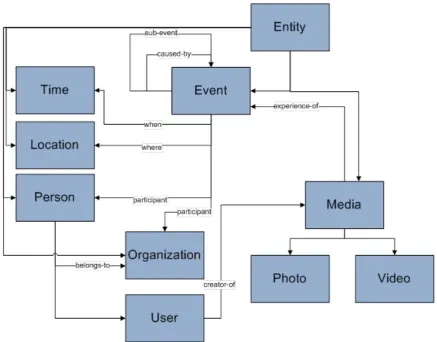
the essence of the model (see Figure 2.2).
The entity (en) is defined in the framework as a pair: en =< uri, Etype >
Where:
· uri, is a unique identifier of an entity;
· Etype, is a non-empty set of entity types. It represents the class to which entity belongs e.g. the entity “Air show” is of type Event.
An entity typeEtype defined as follows:
ET ype=< Attr, S, Rel >
Where:
describe the properties (e.g., “duration time”) of the entity;
· S,stands for a set of services that can be executed on the entity level for ex-ample, a service “get causal events” can be enabled on the Event Etype.
· Rel, is used to describe the entity relation, where relationrel consists of rela-tion name rel name and relation value rel value, for example “George” is a participant of “Air show”;
Figure 2.2: Example of simplified entity-oriented model for event and media management.
We would like to emphasize that the framework contains a list of Entity
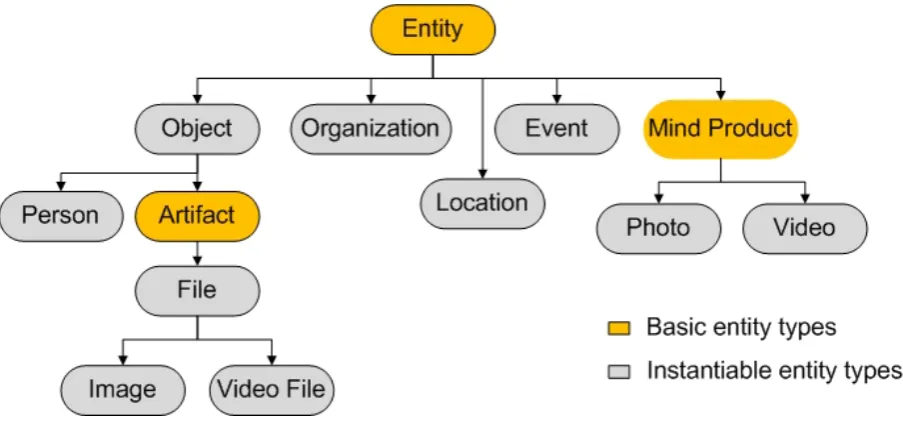
Types, so called ”Etype Lattice” (see Figure 2.2). The generic entity type has
the following mandatory attributes:
· name, the label given to the entity (e.g., “Trento”, “trip to Italy”, etc.)
· description, a verbose description of the entity
· start, the time when the entity is started to exist
· end, the time when the entity ceased to exist
· partof, specifies the relation parent-child relationship with other entities. Among the services associated to the generic entity type, we consider
Create-Read-Update-Delete (CRUD) operations:
· create entity, creates a new Entity of the given type and with the given set of
attributes
· create attribute, creates an instance of an attribute with the given value(s), to
later be assigned to an entity
· add role, assigns the given role with the given set of attribute instances to the
entity
· read entitiy, returns the set of entities that instantiate this Etype
· delete entity, deletes the given Entity.
Assigning the role to an entity is arbitrary and depends on the nature of the
entity.
2.2.1 Structural components of the framework
In this section, we focus on the most related entity types to the event-media
content modeling. Among these entities, event entity type plays one of the key
roles in the framework. Therefore the description of this Etype is given in more
detailed manner.
Event
Events are regarded as domain-level entities, i.e., things that happen and have
Figure 2.3: Simplified Lattice of Entity Types.
the hierarchical nature. Moreover, there are sometimes different views of the
same event; for this reason, in our model an event is considered as an entity that
is subjective to the user who describes it. We group attributes and relational
at-tributes on five aspects that are similar to some extent with the six event aspects
described in [87]. These attributes separated by the following aspects:
informa-tional, temporal, spatial, associated and experiential. Below is a more detailed
description of each aspect.
Informational aspect provides general description of events along with the
inherited from parental Etype attributes (e.g. name, description). It contains the
following attributes:
· category, the category to which the event belongs (e.g., concert, wedding,
soccer match, trip)
· status, specifies the state of the event (e.g., postponed, expected)
· participant, a set of relational attributes specifying event participants and links
to agentive entities, i.e. entities of type Person and Organization.
Each event participant could have a role. The role is assigned on the entity
role on an Air show event and this attribute can be valid only within the event
scope. In the context of our model, we define the role attribute similarly to the
non-substantial predicate specified by Guarino et al. in [30].
Temporal aspectdescribes time-related attributes of the event entity type. On
this stage of work we just consider absolute-time as the temporal location of an
event. Such attribute defines a temporal interval whose endpoints and length
might be specified with varying degrees of accuracy. Note that, in general, the
information on the date can be relative (e.g., “in two week after the Wedding”).
For a basic event-model, we assume the temporal location as always being a
single time interval.
Spatial aspect is a relational attribute which links to an entity of type
Loca-tion (see the detail at SecLoca-tion 2.2.1).
Associated events aspectstands for description of relationship between events.
There are two types of relations between events: structural and compositional
(in [87], they are separated categories). Structured relation is used to represent
the decomposition of an event into two or more sub-events. Each sub-event is
a self-standing event. Causal relation links a given event to events caused by
it and to the events that generated it. The kind of relationship between these
events are indicated by the bidirectional links: sub-event of/parent of and
gen-erated by/caused by for structured and causal aspects of event accordingly. The
ability to represent these two categories by a unified way allows us to merge
them in our framework.
Experiential aspect is represented by relational attributes that links an event
to its associated media. The links either point to media entities as wholes or
to part of them: for example, a link might identify a piece of video, the one
describing a given event.
The following services are offered for entities of Event Etype:
· show events on map, displays the given entity on a map, where map provider
· show events in timeline, displays all the event entities of a given type (if
spec-ified) in a timeline
· show associated events, shows related events in maps and/or timeline
accord-ing to the relation types
· get latest events, gets all event entities added to the system since the time
specified
· sort sub-events, sorts the sub-events belonging to a given macro-event
accord-ing to their temporal aspect
· detect events, detects event by analysing spatio-temporal data extracted from
media collection
· guess event location, guesses event location from other metadata (e.g. by
analysing data from media related to event)
· guess time, guesses event time from other metadata (e.g. by analysing data
from media related to event).
Person
The Person type is identified by a set of attributes describing different types
of information about a person in the real world and a set of related services.
For example the hockey player W. Gretzky can be described with an instance
of Person Etype with the full name, date of birth, nationality, etc. specified.
Attributes are taken from existing vocabularies such as FOAF [8] for personal
information (e.g., name, gender, nationality, etc.), Freebase [5] for carrier
infor-mation (degree, major, etc.), XFN for social relations (e.g., friend, colleague,
etc.).
The following services are provided for this entity type:
· find related people: finds entities representing other people that are socially
related to the current entity. Several conditions could be defined as
param-eter, e.g., which social relation to use, if the relation should be transitive
· recommend people by event: finds and recomends people who co-attended
the given number of events with the given person
· search people: searhes people with the given set of attributes.
Organization
The Organization type comprises group of persons organized for some end or
work, or social institutions such as companies, societies etc. As stated in FOAF
specifications, an organization type identifies ad-hoc collections of individuals.
A basic relational attribute of an Organization type is member: it links to an
entity of type Person. Among the other attributes of such type are:
date-of-foundation, statute, acronym, main-seat, homepage, domain-field (e.g.,
educa-tional, science, sport, etc.), area-of-activity. An example of the services is:
· show on map: display the given entity on a map.
Location
The Location type includes all those entities for which the spatial dimension
is significant. It identifies spatial objects, real entities occupying regions of
space (e.g., regions, cities, natural-bodies, buildings, etc.). The Location Etype
inherits all attributes from the generic entity etype and includes the following
ones: latitude, longitude, and altitude (optional) in accordance with the WGS84
standard. Besides the just mentioned attributes, new metadata can be added
de-pending on the location category: for example, if the location identifies a
build-ing an address will be specified. For instances of Location Etype we consider
following services:
· show on map, display the given entity on a map.
2.3
Image and Photo
Photo and Image types contain a set of attributes related to a static two
dimen-sional entity that represent something or somebody. Our model distinguishes
between Image that stands for container and Photo which represents content.
An Image is the digital representation of a Photo. Therefore Image type
identi-fied by a set of attributes describing pixel-level parameters (e.g. Byte per pixel)
and the way of displaying the image on the screen (e.g. Width, Height, Color
representation). Photo Etype aims to describe the content of the medium and
contains links to other Etypes (e.g. Person, Location, Event). The relationship
between Photo and Image Etypes is one to many.
The list of services proposed for these Etypes is following:
· show the entity, displays the given photo
· read entity metadata, extracts the embedded metadata from the given image
· sort collection, sorts the collection of photos by space, time, events
· estimate geo coordinate, estimates geographic coordinates of a photo based
on its position within the collection
· annotate the entity, annotates photo with location name and related event
· find the momentum of attraction, find the attractive moment of a given photo
collection.
2.3.1 Image Etype
An image entity is a digital form of a photo entity in the framework. Image
Etype contains all the attributes related to the creation and representation of an
image entity. Image Etype being a descendant of File Etype 2.2 inherits all the
attributes from it such as source of creation, device model, etc. The set of basic
attributes of Image Etype includes but are not limited by the image size, color
Since any kind of low level processing is performed on the level of Image
Etype an attribute for low level image representation is required. To this end we
propose to use a pair of attributes for low level image description:
· feature name, is a type of low level image feature
· File Etype, is the file that contains the low level feature of the image
2.3.2 Photo Etype
A photo entity inherits the set of attributes from Mind Product Etype along with
the Entity Etype. These attributes deals with authorship and copyrighting issues.
At the first glance it seems that all the contextual information captured by
camera (i.e. EXIF, see details in [1]) in the moment of image creation is
re-lated to Image Etype. However, the major part of this contextual information
corresponds to Photo Etype. Further we will consider example that helps us
dis-tinguish them. The set of Photo Etype attributes is separated on three categories:
camera setting, geographical attributes and content attributes.
Camera settings attributes stand for representation of the camera settings at
the moment of photo creation e.g. focal length, exposure time, flash. They are
used by photographers during the creation of the mind product. For example
the exposure and light source plays a crucial role in creation of art photography.
Therefore we refer this category of attributes to Photo Etype.
Geographical attributes describe information related to the place where the
photo is taken. The set of attributes contains GPS coordinates and the direction
of the camera at the moment of photo creation. Geographical coordinates can
be translated to a human readable form such as name of location. This is done
via reverse geocoding tools.
Content attributesaims to describe the content of a photo. In order to provide
a detail description of photo content we have developed a system for referring
is specified as a bounding box by a user or system. In case of absence of a
bounding box we assume that the ROI relates to the whole image. The image is
described in a Cartesian system. Starting point of the system [0,0] is a pixel on
the top left corner where the X-axis horizontal and directed to the right and the
Y-axis vertical and directed downward. The rectangle of interest on an image
is described as coordinates of starting point of a rectangle (top left corner) and
coordinate of end-point (down right corner). However, there is an issue in this
system: each time when the image is cropped the position of ROI may become
disoriented.
The system of referring ROI within an image allows a user to tag any kind of
object or entity on it. This flexibility facilitate for a user or a system the process
of linking content data with entities e.g. Person, Location, etc.
2.4
Video and Video File
Video being a sibling Etype to Photo shares some attributes with it. These
attributes were inherited from parental Etypes and include time of creation,
cre-ator and others attributes. Similarly to the previous section we define Video
and Video File as content and container accordingly. Video Etype describes the
content in the semantically meaningful to a human way referring it to a
Per-sons, Location, Events, etc. Video file describes the digital representation of a
video with attributes like frame rate, decoding algorithm, etc. Video File Etype
also contains link to low level features of the video entity. The following list of
services is proposed for the these Etypes:
· show the entity, displays the given photo
2.4.1 Video File
After a deep analysis of state of the art standards we have chosen the list of
attributes which from the one hand are essential to describe video file entity
and from another hand fit the needs of our entity model. Three categories of
attributes is defined for Video File Etype: basic information, audio information
and low level representation information.
Basic informationcontains the information required for video file decoding,
the length of video, frame rate, frame size, etc.
Audio informationprovides information related to the soundtrack of a video
file. The examples of these attributes are bit rate and number of channels.
Video File follows the similar to Image Etype (see section 2.3.1) approach
of addressinglow level representation information.
2.4.2 Video
Video being a complex media entity requires appropriate tools for content
de-scription and its semantic representation in the framework. Thus, we treat it as
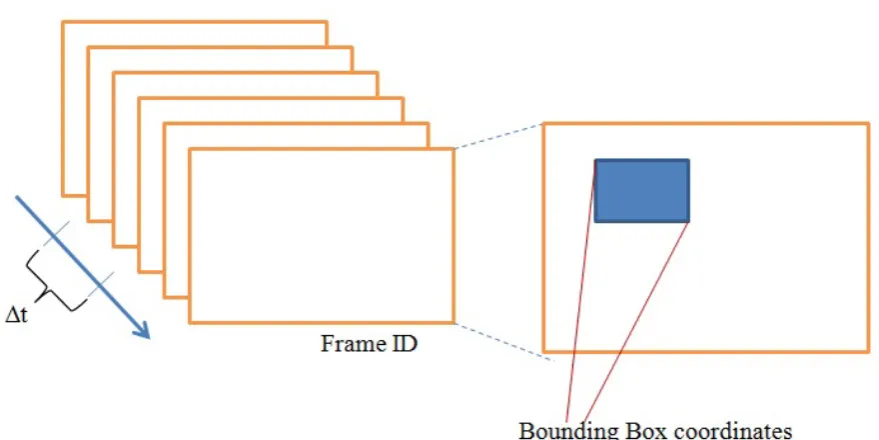
the composition of a set of images and accompanying sound. This approach
allows us to employ existing mechanism of Photo content description for Video
content description. The additional attribute to address frame ID is required.
This attribute allow us to reefer a specific frame of the video. The coordinates
of a bounding box describe the region on the framework.
The sound track of a video treated separately. In order to refer an interesting
Figure 2.4: Example of Video Content description.
2.5
Conclusion
In this chapter we have described the model for media content and event
repre-sentation. The state of the art approaches and standards for event modelling are
considered and discussed. The essential insight given by the considered state of
the art allows us to define possible improvements that can be done. The analysis
of metadata shows that events can be described by the common set of attributes
like space, time, participants, etc.
The developed model is able to refer specific pieces of media and link them
to another Etypes such as Entity, Person, Location, Organization. Moreover, the
flexibility of this model eases the process of event media analysis and allows a
system to preserve the semantics of media content.
So far we have focused on videos and photos because those media are used
further in the thesis. Event mining and exploitation use the spatio-temporal
con-text extracted from images and videos. Further in the thesis we will demonstrate
how Location, Person and Event Etypes are involved in the process of data and
Multimedia Event Mining
3.1
Introduction
In this chapter we describe an approach for multimedia event mining separated
on two parts: (i) personal event detection using individual, unsorted photo
col-lections, in which we make use of the spatio-temporal context embedded in
digital photos to detect event boundaries within the collection; (ii) social event
detection for which we use a tailored similarity measurement between personal
events of different users. We introduce the notion of personal events and
distin-guish them from social.
The chapter is organized as follows: in Section 3.2 we distinguish personal
and social events and how they correlate with personal and collective
experi-ence. Section 3.3 contains a methodology and experimental validation of an
approach for personal event detection. In Section 3.4 a novel approach for
de-tection of social event from personal events is given, while Section 3.5
con-cludes.
3.2
Personal events vs Social events
Life can be seen as a chain of events that chronologically pace our everyday
busi-ness trip or a winter vacation are the lens through which we see and collect
our own personal experiences. An autobiographical memory records a con-nected set of personal events and can be characterized by a high personal belief
of accurateness, certain perceptual qualities, detailed accounts of the personal
circumstances and highly vivid details. Smith et al. [50] hypothesize that
mem-ory improves with higher levels of experienced emotion. Their study examined
the memories of Canadian students for the (here: social) events of September
11, 2001 in New York. They found that the memory for the 9/11 events was
less consistent than for the personal event memory. With higher arousal at the
time the news broke, the quality of memory of the 9/11 events did not increase,
but the accuracy of the related personal events did (“Where have you been at
9/11?”). Therefore the autobiographical memory is positively correlated with
the level of emotional arousal. The richness of details shows significant decline
by the time passed since the event occurred. In the scope of this work, we
there-fore argue that a higher frequency in the photo-taking activity correlates with
higher personal relevance.
Brown [9] showed that the retrieval time in our autobiographical memory
is hardly affected from the time that passed since a personal event occurred.
Therefore we argue that this is the best way to index media over a long period
of time. Autobiographical memory is the structure that can be retrieved in the
most convenient way for the user. Details about a certain personal event may be
vanished already, but in our memory the personal event itself is still very vivid
and at hand. Connections and the hierarchy of personal events are predom-inantly invariant to time. Rarely, personal events “stand alone” after a certain
passage of time in the auto-biographical memory, not being connected to other
events any more. Interestingly, the younger the test persons are, the less
con-nections are established between personal memories. With age, people seem to
draw more and more conclusions based on their personal experiences, but do
hierarchy of personal events does not become meaningless after time.
Personal events are put into context and are stored in our autobiographical
memory. In this sense, we refer to our personal experiences as noumena in the
sense of Kant [41]: a personal, possibly inexpressible, reality, that is the sum of
personal reasoning in an attempt to understand the world in which we exist. In
the course of producing and collecting personal media, people try to represent
the memorable events. Unfortunately, the representations are not able to provide
the full context of these memories.
autobiographical memory
personal events
personal media collection
collective memory
social events
social media collection
real world representation
NOUMENON PHENOMENON
N.. aggregate ..1
context
content, objectivity, scale may serve as
Figure 3.1: Distinction between personal events and social events.
Personal eventsform a hierarchical narrative-like structure that is connected by causal, temporal, spatial and thematical relations [9]. Figure 3.1 gives a
classification in relation to social events.
In contrast, social events are phenomena aggregated by multiple personal events. Social events build the basis for the collective memory, our common denominator for social communication. Since personal media is shared between
people who are either participating or interested in specific social events, social
media collections are built. When these collections serve as personal media
multi-ple peomulti-ple is not necessarily a representation for one’s personal memory, and
therefore an automated approach to reason about such an index is to the greatest
possible extent unfeasible.
Events are more than simple aggregators for our memories, being essential
for collective experiences to take place. These collective experiences arise when
two people exchange their individual views of the world and discover common
interests and goals based on the roles they play in the events they co-participate
in. Thus, we can say that events have a social impact in the shaping of
interper-sonal ties between individuals.
In contrast, a social event is a convergence of multiple personal events. A
social event, being one of the nodes in the collective memory, builds the basis
for the collective experience, our common denominator for social
communi-cation. Since personal media is shared between people who are either
partici-pating or interested in specific social events, social media collections are built.
When these collections serve as personal media collections, a loss in context is
observed: A media collection taken by multiple people is not necessarily a
rep-resentation for ones personal memory, and therefore an automated approach to
reason about such an index is to the greatest possible extent unfeasible. Events
provide the common framework inside which the local experience-driven
con-textual information can be not only codified but also shared and reduced to a
common denominator. Consider a simple example of a photo taken within an
party that can be contextualized to a specific place, time or set of participants.
We can say that the context accumulated by an event entity contains values for
the five Ws (Who, What, When, Where and Why) to fill the complete story.
Naturally, one could argue that there is a strong causal connection between
hierarchically close personal events. This would constitute an unfeasible
prob-lem for automated approaches aiming at indexing media: a profound
under-standing of the content of the media in the sense of strong artificial
ap-proaches, we do not remember causatively: In Brown’s experiments, only 2%
of the 904 judged personal event connections were causally related. It seems
that real “media understanding” is not necessary for a personally meaningful
indexing. People tend to connect personal events by (i) a non-narrative relation
(17%), which is predominantly a closeness in time, and (ii) participants (13%),
and (iii) a common location (7%), and others that are not so significant. These
findings give a good explanation why the state-of-the-art in visual analysis of
media largely fails in this problem (e.g. [22, 23]).
We build context from time, location and visual appearance by putting them
into a higher level of abstraction: Personal photos are visual representations of
our personal memory; events are mental pivots which are used by humans to
fa-cilitate the extraction of their memories. Therefore, we aim at organizing photo
collections following this new paradigm and advocate the use of a personal
fo-cus for media indexing using personal events.
3.3
Personal Event Detection
In the last decade we have been observing a tremendous growth in the number
of digital images in personal photo collections. Standard photo software lets the
user assign photos toalbums, the metaphor originating from the traditional way
of storing developed photos, or solely clusters the media by certain tags. The
lack of a proper automated indexing of personal photos leaves the users with
the tedious task of manually organizing their photos.
Therefore, we propose a fully automated approach for managing photo
col-lections in the most intuitive, flexible and semantically meaningful way. We
aim to aggregate the entities of the autobiographical memory as personal events.
This is done via the convergence of multi-modal information in time, space and
image content.
learn iteratively from the data-set and discover the routine and non-routine
pat-terns of taking photos. Based on this fundamental distinction, we interpret the
location, the frequency and the color layout of the images to extract a personal
distinction between events.
Emulating the autobiographic memory in a personal photo collection is the
most natural and convenient way for the user. Personal events as memory
episodes are milestones in our autobiographical memory.
3.3.1 State of the Art
Many popular photo applications were developed around the album metaphor.
This approach comes from how people have been organizing their printed
pho-tographs before the advent of digital photography. However, there is a new trend
that aims at studying new metaphors of organization to leverage more complex
indexing and search.
Although Flickr is mainly designed using the album metaphor, it has
in-troduced a very loose organization system focusing on tags to group photos.
Andrews et al. [2] study tagging in Flickr and other services, pointing out that
these services do not take into account the semantics that users want to encode
in each tag. To avoid ambiguous annotations the researchers provide an
alterna-tive model where tags are tied to concepts instead of being free strings. These
services can also make use of GPS-enabled devices that “geotag” media
auto-matically. MyLifeBits [28] is an authoring tool for storytelling that use location
information to organize media in a map, thus enabling a richer way to present
stories. Moreover, recent face recognition capabilities can be used to provide
search and navigation based on acquaintances depicted in the photo.
Most popular media management services continue to model tasks around
the “album” metaphor as people need to group media together in ways that are
more meaningful to them than just a location or time grouping. To model this
focus on theeventmetaphor to combine metadata. This interest in events as
me-dia aggregators predates digital photography [11]; however, Chalfen argues that
people do not share photosper se but use them to tell a story. Miller et al. [53]
also concluded that users take photos mainly to archive important events and
share within their community.
Time- and visual-based clustering are the most popular approaches for photo
organization. [15] and [16] show a fusion for clustering photo collections based
on temporal information and visual content of images. [10] presents an
innova-tive approach to event recognition of collections of images: the essence of the
paper is to build a collection of photos with time stamp and geographical
coordi-nates, and to define a compact ontology of events and scenes. Their model takes
into account two types of correlations: the first is a correlation by time and GPS
tags, the latter is a correlation between scenes represented in images and
corre-sponding events. Temporal intervals between photos are used in [62] in order to
group these photos using an adaptive threshold. The same feature has been used
in [47], reporting very robust results. Low level features of photo content and
creation time of the photo are exploited in [44] for the task of automatic
sum-marization. Event-level Bag-of-Features (BOF) representation is considered in
[37] to model typical events. There, sets of concepts are linked to an event to
define an event-related pattern. A similar approach of Bag-of-Features and time
constraints have been used for (sub-)event recognition in [51]. Spatio-temporal
information and visual appearance have been proposed to build multilayer
hi-erarchical models of scene and event in [10] for image annotation within the
context personal photo collection. Detecting the significant subset of events
within a personal photo collection using a technique based on time series is
3.3.2 Methodology
This section shows how the contextual information of a photo can be used
to build a hierarchy of personal events. We suggest a multi-modal clustering
(MMC) approach described in the following Section 3.3.2. The proposed
frame-work around MMC is presented in Section 3.3.2.
Multi Modal Clustering (MMC)
We use a method based on 2-means clustering as shown in [47] and extended
in [78] which is independent to the density and robust to extreme variation in
the distribution of the data. The data can consist of a high number of (also
highly unbalanced) dimensions, but must be sequentially sortable. It allows for
a robust clustering without knowing the final number of clusters.
Differently from [47], we apply the 2-means to a combined
time-space-routine-visual clustering. The method locates significant gaps in assorted data,
where for each sample ni in the set ni−1 ≤ ni ≤ ni+1 holds, where ni can be a timestamp, a color vector or GPS coordinates. The method uses the distances
∆n between the samples n and clusters them using k-means with k = 2. It divides efficiently one cluster with many small distances in the data and another
cluster that defines fewer, but significantly more distant gaps between given
samples. Every distance is then assigned to be a member of either the first or
the latter cluster. For each distance that is a member of the cluster of larger
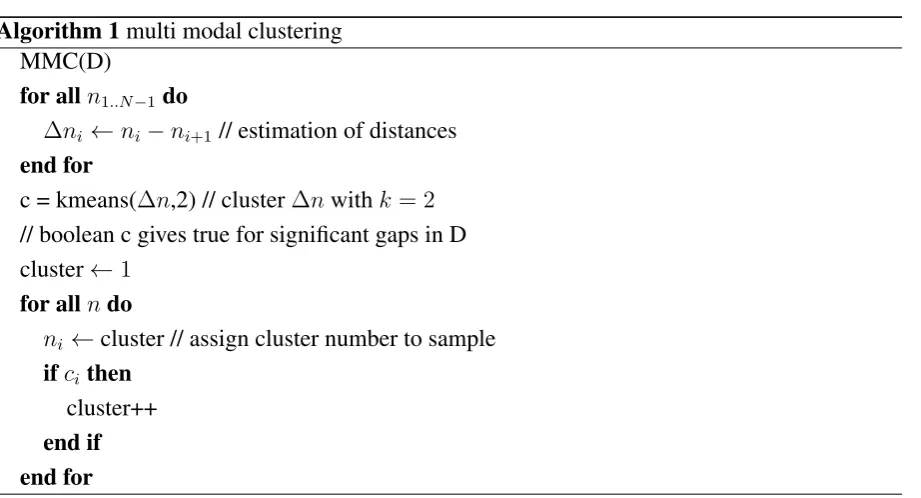
distances ci, a boundary in the data is marked. For the final cluster estimation, we iterate over alln1..N once. Everynis merged with the current cluster until a boundary is encountered. Then, a new cluster is built. For a data-set D with the samples n1..N, the pseudo code is given in Algorithm 1.
For temporal clustering in photo collections, the time intervals between
pho-tos are of a too large variation to provide satisfying results. We face problems
Algorithm 1multi modal clustering MMC(D)
for alln1..N−1 do
∆ni ←ni−ni+1 // estimation of distances
end for
c = kmeans(∆n,2) // cluster∆nwithk = 2
// boolean c gives true for significant gaps in D cluster←1
for allndo
ni ←cluster // assign cluster number to sample
ifci then
cluster++
end if end for
the cluster corresponding to event separations (compare Figure 3.2). Therefore,
following [47], a scaling function ψ to scale ∆n has to be introduced. Using semantically meaningful intervals as there are y = [quarter days, days, weeks, months and years]we apply
ψ(∆n) = i
√
∆n, (3.1)
wherei is the index of the according element in y. To this end, we are able to adjust this function based on statistical data obtained from a given data-set (i.e.,
mean time between events, mean duration of an event, etc.) or from semantic
terms. Therefore, the only parameter y of the approach is providing flexibility regarding the granularity of the resulting clusters.
Event Detection
Figure 3.3 shows a flowchart of the proposed approach. The numbers (1) to (4)
link to the corresponding paragraphs in this section. People tend to think about
events in terms of spatial entities leveraged by personal context likehome,work,
last-Week Hour
Day
Minutes Cluster
Separator
Time
Converted units Week
Hour
Day Minutes
Cluster Separator
Figure 3.2: Scaling byψ(∆n)and MMC on temporal scale
ing memories. Therefore we advocate discriminating events in two categories:
homeand away-from-home.
One fundamental presumption of the approach is that breaking a routine – and
returning to it – frames one semantically connected memory. This entity
pro-vides the borders of a root event being away from home. Since a trip typically
starts on routine places, e.g. taking photos at the home airport, photos taken at
routine places may belong to an event away from a routine place. A movement
out of the routine locations starts a new root event, for which we hierarchically
detect sub events until a routine location is entered again. This coincides with a
memory of ”my trip to the States”. Typically, in such a memory, there are many
very different sub events. Still, the events are connected by the one predominant
property of being away from one’s routine locations. This does not apply for
Photos
Temporal Clustering (1)
Spatial Routine Detection (2)
Visual Clustering (4) Routine
Location Non-routineLocation
Spatial Clustering (3)
Temporal Clustering (1)
Figure 3.3: Schematic overview over the proposed framework.
No additional context is given a priori. The home events span sparsely a long
temporal period but occur on a very narrow space scale.
Temporal Clustering (1) Temporal information is the most essential and re-liable type of information for detecting events within the personal photo
col-lection. The main reason is that the time stamp is unique, whereas for events
the spatial location is not. Time stamps can be easily extracted from the EXIF
metadata embedded in digital images. Photos captured within an event are
typ-ically characterized by relatively small temporal gaps between them. Therefore
MMC algorithm. The clustering results in an assignment of every photo in the
collection to the clusters c1, c2, .., cn.
Spatial Routine Detection (2)First we map the GPS information of the photos to meaningful GeoLocation1 by reverse geocoding. Reverse geocoding is the
process of converting geographic coordinates into a readable address or place
name. We use a granularity of city level, or, if not available, province. This gives
us already a meaningful clustering of our photo locations. If several images are
missing GPS information, the spatial movement is linearly interpolated between
the existing data points. A density function Φof GeoLocations is built based on
the number of days with one or more photos taken – accumulated by location.
The function Φ is given in Fig. 3.7 (b). The presented function is invariant
to the absolute number of images taken in one location (compare Fig. 3.7 (a)).
In simple terms, we want to define home as where you take the most photos on
different days.
The routine locationsph are determined by the MMC described before: ∆ni are the sample points of ψ. Since the spatial distance of the GeoLocation does not play a role (e.g. moving from New York to Paris is similar as moving from
Boston to Washington in the change of routine), we disregard the actual location
of the GeoLocation in ψ. Leaving the city or province is already a change of routine.
Spatial Clustering (3) Based on the temporal clusters Ci we discriminate be-tween photos taken at routine locations ph and photos that are taken outsideph. As soon as one photo of an event is taken outside ofph, the event is regarded as being a non- routine event. We spatially cluster all non-routine photos by their
GPS coordinates. At this stage, geocoding does not give precise enough results
any more. Therefore similarly to temporal clustering we cluster the locations by
the spatial distances between chronologically neighboring images into clusters
Cha{Cl1, Cl2, .., Cln}. The resulting spatial clusters give us clusters of locations
that may disseminate over various locations. Therefore we are able to overcome
mistakes being made when city borders are crossed often. There is no relation
between taking two photos in the same location and them being part of the same
event. For example, cl1 is a cluster of photos taken in Milan. This cluster
con-tains photos related to a Christmas time and Italy Republic Day which should
be separated into two clusters. For each clusterCha, we perform temporal clus-tering as described above. This results in the final root event clusters and the
corresponding sub-events.
Visual MMC (4)
A semantically meaningful color similarity [82] is chosen to make up for
varying lighting conditions and camera settings. Following a user study on
images downloaded from the Internet the mapping of 11 English color names
to RGB coordinates is learnt, thereby creating a look-up table of each RGB
coordinate to one of the eleven color names2.
Without any presumption about the nature of the content of the image, we
do not rely on color models when matching visual content, but we merely ask
figuratively ”Can this object still be regarded as brown?”. Following the
look-up table of colors, as long as people would agree that the color stays the same,
we can successfully match two images. A typical example is given in Fig.3.4,
where the color of the castle changes significantly, still maintaining similar
in-formation from the perceptual point of view. The images are matched
succes-fully to belong to one scene.
For histogram creation the 11-dimensional feature vector is extracted for
each image. Euclidian distances between feature vectors of neighboring
im-ages are computed on the