Improving Language Learning Strategies and Performance
of Pre-Service Language Teachers Through a CALLA-TBLT Model
Mejoramiento de las estrategias de aprendizaje y desempeño
en inglés de profesores en formación en idiomas a través del modelo
académico-cognitivo y basado en tareas para el aprendizaje de lenguas
Maria Eugenia Guapacha Chamorro
*Luis Humberto Benavidez Paz
** Universidad del Valle, Cali, ColombiaThis paper reports an action-research study on language learning strategies in tertiary education at a Colombian university. The study aimed at improving the English language performance and language learning strategies use of 33 first-year pre-service language teachers by combining elements from two models: the cognitive academic language learning approach and task-based language teaching. Data were gathered through surveys, a focus group, students’ and teachers’ journals, language tests, and documentary analysis. Results evidenced that the students improved in speaking, writing, grammar, vocabulary and in their language learning strategies repertoire. As a conclusion, explicit strategy instruction in the proposed model resulted in a proper combination to improve learners’ language learning strategies and performance.
Key words: learning strategies, task-based language teaching, tertiary education.
Este artículo versa sobre una investigación-acción en estrategias de aprendizaje en educación terciaria en una universidad colombiana. El estudio buscaba mejorar el desempeño en inglés y el uso de estrategias de aprendizaje de 33 profesores en formación en idiomas de primer año al combinar elementos de dos modelos: enfoque cognitivo y académico para el aprendizaje de lenguas y aprendizaje basado en tareas. Los datos se recolectaron a través encuestas, un grupo focal, diarios de los profesores y estudiantes, pruebas de inglés y análisis documental. Los resultados revelaron el mejoramiento de los estudiantes en la oralidad, escritura, gramática, vocabulario y en el desarrollo de estrategias de aprendizaje. Como conclusión, la instrucción explícita en estrategias dentro del modelo propuesto resultó ser una adecuada combinación para mejorar el desempeño en lengua y en estrategias de aprendizaje de los estudiantes.
Palabras clave: aprendizaje basado en tareas, educación terciaria, estrategias de aprendizaje.
* E-mail: [email protected] ** E-mail: [email protected]
How to cite this article (apa, 6th ed.): Guapacha Chamorro, M. E., & Benavidez Paz, L. H. (2017). Improving language learning strategies and performance of pre-service language teachers through a calla-tblt model. profile Issues in Teachers’ Professional Development, 19(2), 101-120. http://dx.doi.org/10.15446/profile.v19n2.57581.
This article was received on May 21, 2016, and accepted on December 2, 2016.
Introduction
Language learning strategies (lls) have played an influential role in language learners’ learning process (Chamot, 2009; Cohen, 2014; Cohen & Macaro, 2007; Oxford, 1990, 2013; Rubin, 1975); also, explicit lls instruction enhances learners’ academic success (Ehrman & Oxford, 1995; Oxford & Nyikos, 1989). Furthermore, language instructors interested in inquiring into their students’ learning preferences, in fostering the use of lls, and in orienting an effective foreign language learning (l2) instruction might contribute to their students’ academic success (Oxford, 1990). Language tasks have also shown to be effective in the teaching of languages and in fostering lls (Chamot, 2009).
Based on these premises, as language instructors in a Bachelor of Arts in Foreign Languages programme, we embarked on this study to provide our first-year pre-service language teachers with tools that will enhance their learning process and future teaching practices. The study also derives from the scarce lls research in our language programme. This was reflected in the lack of systematisation of data obtained from questionnaires administered to freshmen, inquiring into their lls use, study habits, learning styles, and language skills. It was also observed that freshmen’s lls repertoire was low, and that there was need for explicit lls instruction in the initial English language courses of the language programme.
This action-research inquiry, therefore, aimed to improve the lls use and English language performance of 33 first-year pre-service language teachers through the cognitive academic language learning approach (calla) and task-based language teaching (tblt) methodology. The findings from this research serve as a diagnosis for the students involved in this study and for the language programme; therefore, curriculum improvements are suggested. Pedagogical implications on how to integrate lls instruction with language tasks to enhance language teaching and learning are offered. These research questions were posed:
Main research question: To what extent do first-year pre-service teachers improve their lls repertoire and language skills through the calla-tblt models?
Specific research questions:
• What are the students’ most and least used lls? • What are the students’ strengths and weaknesses
in language skills?
• What types of tasks and learning resources will help these students improve their language performance and lls use?
Literature Review
For over 40 years, extensive research has shown the key role of lls in l2 instruction (Cohen, 2014; Cohen & Macaro, 2007; Griffiths, 2003, 2015; O’Malley & Chamot, 1990; Oxford, 2013; Oxford & Schramm, 2007; Rubin & Thompson, 1994). However, there is still need for further research (Cohen & Griffiths, 2015; Griffiths, 2015; Oxford, 2013), more qualitative studies (Griffiths & Oxford, 2014), and more implementation of tblt with lls (Macaro, 2014) informing the field with new findings.
Language Learning Strategies
For this study, we stick to our working definition on lls since strategy is a useful concept referring to how learners address their learning (Griffiths, 2015). Moreover, we consider that explicit instruction develops students’ greater metacognition and understanding of their own learning process when they establish connections between the strategies they use with their effectiveness (Chamot, 2009). We also believe that learners self-regulate and develop autonomy once they have gained certain maturation and experience with lls.
Taxonomies of Language Learning Strategies
lls have originated several taxonomies (O’Malley & Chamot, 1990; Oxford, 1990, 2013; Wenden & Rubin, 1987). The differences are determined by the selected number of strategies, sub classifications, and distinct research methods used to group them more comprehensibly and accurately. Although a broad number of lls have been proposed, language learners choose the strategies that fit their age, gender, cultural background, personality, proficiency, language learning needs and interests, and learning styles (Chamot, 2009; Cohen, 2014; Oxford, 2013). We adopted Oxford’s (1990) lls taxonomy since it has been widely used in lls research, making this classification valid and reliable. The model offers a detailed classification of direct and indirect strategies that can be intertwined with language tasks. Oxford’s set of strategies leads to specific outcomes. Although the author proposes a new lls classification in her updated strategic self-regulated (s2r) language learning model (Oxford, 2013), she still suggests that learning strategies are teachable and that learners select the ones that address their learning purposes. Further research might explore this new taxonomy.
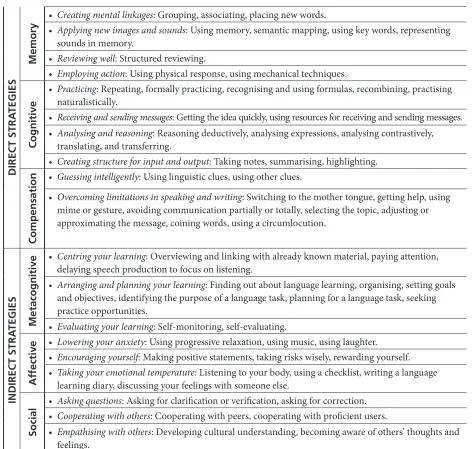
Oxford’s (1990) taxonomy integrates lls with language skills (reading, writing, speaking, listening, grammar, and vocabulary). The author classifies 62 lls into two types: direct and indirect strategies. Direct strategies (ds), subdivided into memory, cognitive, and
compensation strategies, involve the learners’ mental
processing of the target language. Indirect strategies (is), subdivided into metacognitive, affective, and social
strategies, foster learners’ language learning without directly involving the target language. Table 1 presents Oxford’s (1990) lls taxonomy.
The Combined Model:
Cognitive Academic Language Learning Approach and Task-Based Language Teaching
A proper combination of lls instruction and language teaching methodology is essential to ensuring that effective instruction impact learners’ language performance. Furthermore, strategy instruction should be tailored to the students’ needs and contexts in order to be effective (Richards & Lockhart, 1994; Wenden, 1991). Although diverse lls instruction models have been proposed (Chamot, 2009; Grenfell & Harris, 1999; O’Malley & Chamot, 1990; Oxford, 1990), all of them emphasise a continuous cycle introducing or modelling the strategy, generating contextualised practice, self-monitoring and evaluating the learners’ progress, and expanding the strategies to new areas or tasks.
Table 1. Language Learning Strategy Taxonomy (Based on Oxford, 1990)
DIRECT STRA
TEGIES
Memory
• Creating mental linkages: Grouping, associating, placing new words.
• Applying new images and sounds: Using memory, semantic mapping, using key words, representing sounds in memory.
• Reviewing well: Structured reviewing.
• Employing action: Using physical response, using mechanical techniques.
Cognitive
• Practicing: Repeating, formally practicing, recognising and using formulas, recombining, practising naturalistically.
• Receiving and sending messages: Getting the idea quickly, using resources for receiving and sending messages. • Analysing and reasoning: Reasoning deductively, analysing expressions, analysing contrastively,
translating, and transferring.
• Creating structure for input and output: Taking notes, summarising, highlighting.
Compensation
• Guessing intelligently: Using linguistic clues, using other clues.
• Overcoming limitations in speaking and writing: Switching to the mother tongue, getting help, using mime or gesture, avoiding communication partially or totally, selecting the topic, adjusting or approximating the message, coining words, using a circumlocution.
INDIRECT STRA
TEGIES Metacognitive
• Centring your learning: Overviewing and linking with already known material, paying attention, delaying speech production to focus on listening.
• Arranging and planning your learning: Finding out about language learning, organising, setting goals and objectives, identifying the purpose of a language task, planning for a language task, seeking practice opportunities.
• Evaluating your learning: Self-monitoring, self-evaluating.
Af
fective
• Lowering your anxiety: Using progressive relaxation, using music, using laughter. • Encouraging yourself: Making positive statements, taking risks wisely, rewarding yourself. • Taking your emotional temperature: Listening to your body, using a checklist, writing a language
learning diary, discussing your feelings with someone else.
Social
• Asking questions: Asking for clarification or verification, asking for correction. • Cooperating with others: Cooperating with peers, cooperating with proficient users.
• Empathising with others: Developing cultural understanding, becoming aware of others’ thoughts and feelings.
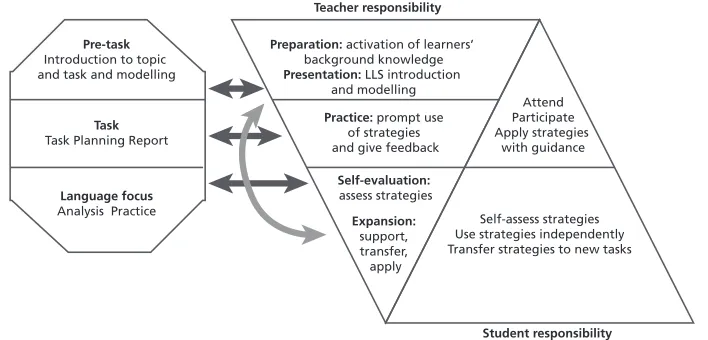
tblt are compatible in their principles, leading learners to improve language and their lls repertoire through contextualised activities.
Chamot (2009) states that “calla is an instructional model designed to meet the academic needs of English language learners” (p. 1) through five cycles: preparation,
presentation, practice, self-evaluation, and expansion.
calla incorporates task-based learning strategies for
learners to accomplish learning tasks. Willis’ (1996) tblt framework was adopted. Its three cycles, pre-task,
The pre-task cycle in tblt andthe preparation and
presentation cycles in calla identify students’ prior knowledge which is linked to the new topic. Teachers introduce the learning goals (tasks and strategies) and provide models of both task and strategy. Techniques such as brainstorming are used to recall and elicit information. The task cycle in tblt and practice in calla involve students’ practice of the target language and learning strategy through cooperative learning activities. The task cycle is subdivided into three stages (task, planning, and report) in which students complete the task (individually, with peers, or in groups). Students plan, organise, practise, and report the task to the class and receive feedback (from peers and/or teacher). Practice
in callainvolves students practicing the strategy. The last cycles, language focus in tblt and self
-evaluation and expansion in calla, encompass assessment of the students’ learning progress and independent work. Language focus is subdivided into
analysis and practice. The former leads students to examine specific features of the target language derived from the task; the latter encourages students to practise using the language in other contexts. In calla self-evaluation makes students reflect upon their learning process, and expansion invites them to apply their new knowledge into other contexts.
Empirical Studies
There has been extensive research on lls worldwide. For instance, Tuckman and Kennedy (2011) reported the effectiveness of eight lls in the freshmen’s performance of a Midwestern university after explicit lls instruction in a psychology course. Del Ángel Castillo and Sessarego Espeleta (2013) explored the lls most frequently used by successful English language learners at a Chilean University. The results revealed that cognitive strategies were more frequently used than metacognitive strategies by successful learners. In Colombia, Orrego and Díaz Monsalve (2010) explored the concept of learning held by language instructors and first-year pre-service language teachers of a b.a. in foreign languages programme, and the frequency of lls used by these students. Findings yielded that the concept of learning differs from learners and instructors, and that similar lls were used by the students in English and French language courses.
In our workplace, Hernández Gaviria (2008) explored the lls that first-year students in an English language course used naturalistically. The findings yielded that the students understood the importance of lls in their learning process; however, students’ autonomy development needed to be fostered. Although strategies such as goal setting, planning, compensation, and transferring were not considered by the students,
Figure 1. TBLT and CALLA Integration Model (Adapted From Willis’ and Chamot’s Frameworks)
Pre-task Introduction to topic and task and modelling
Preparation: activation of learners’ background knowledge Presentation: LLS introduction
and modelling Practice: prompt use
of strategies and give feedback
Attend Participate Apply strategies
with guidance
Self-assess strategies Use strategies independently Transfer strategies to new tasks Self-evaluation:
assess strategies Expansion:
support, transfer, apply Task
Task Planning Report
Language focus Analysis Practice
Teacher responsibility
Student responsibility
they were able to identify their strengths and weaknesses, particularly those related to their linguistic knowledge. They also monitored and assessed their learning and generated, mainly, oral practice opportunities while the writing skill required more guidance.
Ramírez Espinosa (2015) designed an English language course syllabus to foster students’ autonomy. The author suggests ten steps that contribute to an effective language course design impacting language teaching and learning. The steps include a context diagnosis, students’ autonomy profile identification, learner-training workshops, self-access materials design, needs analysis, a course syllabus plan, students’ interests and goals inclusion, an assessment plan, tblt approach implementation, students’ class involvement and contribution, feedback and peer-evaluation inclusion, and journals use. Although all these studies contribute to the field of lls with valuable findings, our study makes a difference in its research design, provides explicit lls instruction covering a good number of strategies, and adopts calla for strategy instruction and tblt for language teaching.
Method
Setting and Participants
The study was conducted with 33 first-year pre-service teachers from two classes (16 and 17 students respectively) during two academic semesters in English language course i and ii in a b.a. in Foreign Languages (English-French) programme at Universidad del Valle, Colombia. These sequential language courses followed an integrated skills syllabus approach and were each scheduled three times a week with a two-hour class session. The subjects’ ages ranged from 16 to 26. A great percentage had studied in public schools. Only a few students had initiated a major before. They manifested different language learning interests and evidenced an a2 English language level, according to the Common European Framework of Reference (Council of Europe,
2001) and to the English language course ii. These students were selected since they were freshmen who needed support in their lls development from the outset and because they were teachers-to-be for whom this knowledge is essential.
Research Design
Unlike extensive quantitative large-scale research conducted worldwide, this study reports an action research (Creswell, 2012) by gathering quantitative and qualitative data. Cardona, Fandiño, and Galindo’s (2014) design was adopted. This design consists of two cycles:
Cycle 1:
a) Observation: Students’ profile, language level, and lls use and needs identification in diagnostic stage.
b) Planning: lls selection and tasks and learning resources design based on the students’ needs.
c) Intervention: calla-tblt implementation. d) Reflection and evaluation: on-going assessment of the students’ improvement.
Cycle 2:
a) Planning: new lls, tasks and learning resources design and integration.
b) Intervention: new lls, tasks and learning resources implementation.
c) Reflection and evaluation: evaluation and analysis of lls, tasks and learning resources impact.
Data Collection Instruments and Analysis
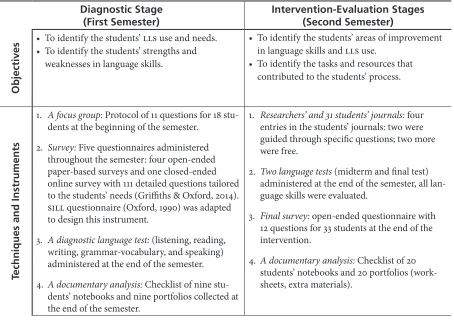
Data were gathered through surveys, a focus group, students’ and teachers’ journals, language tests, and documentary analysis, which are instruments used to document the students’ lls use and improvement (Chamot, 2005; Oxford, 1990). Table 2 presents the research stages, objectives, and data collection instruments.
Table 2. Data Collection Techniques and Instruments
Diagnostic Stage
(First Semester) Intervention-Evaluation Stages(Second Semester)
Objectives
• To identify the students’ lls use and needs. • To identify the students’ strengths and
weaknesses in language skills.
• To identify the students’ areas of improvement in language skills and lls use.
• To identify the tasks and resources that contributed to the students’ process.
Techniques and Instruments
1. A focus group: Protocol of 11 questions for 18 stu-dents at the beginning of the semester.
2. Survey: Five questionnaires administered throughout the semester: four open-ended paper-based surveys and one closed-ended online survey with 111 detailed questions tailored to the students’ needs (Griffiths & Oxford, 2014). sill questionnaire (Oxford, 1990) was adapted to design this instrument.
3. A diagnostic language test: (listening, reading, writing, grammar-vocabulary, and speaking) administered at the end of the semester. 4. A documentary analysis: Checklist of nine
stu-dents’ notebooks and nine portfolios collected at the end of the semester.
1. Researchers’ and 31 students’ journals: four entries in the students’ journals: two were guided through specific questions; two more were free.
2. Two language tests (midterm and final test) administered at the end of the semester, all lan-guage skills were evaluated.
3. Final survey: open-ended questionnaire with 12 questions for 33 students at the end of the intervention.
4. A documentary analysis: Checklist of 20 students’ notebooks and 20 portfolios (work-sheets, extra materials).
Results and Discussion
Diagnostic Stage
What are the students’ most and least used lls?
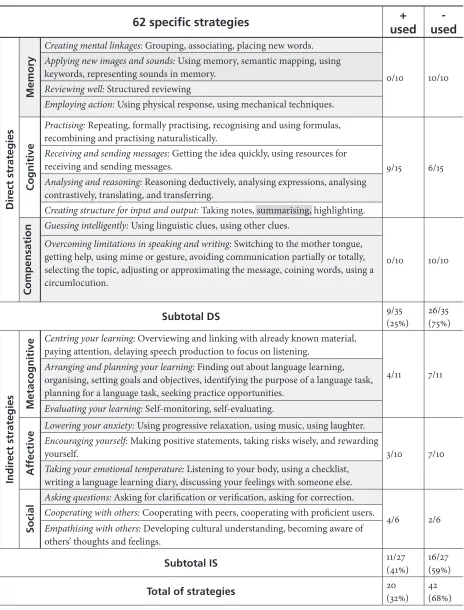
A focus group, surveys, and documentary analysis answered this research question reported in Table 3. Shaded boxes represent the least used.
Table 3 shows that 68% of the 62 specific strategies were not used by the students. It is understandable that these freshmen were not familiar with many strategies that would benefit their overall learning. However, an adequate number (32%) between ds and is were found as the most used, meaning that they were possibly taught before or used naturistically by these students based on their learning styles and purposes. The students used more is than ds. This suggests a certain level of awareness and reflection on their learning process. Within the
metacognitive group (is), centring your learning was the most used strategy, revealing that the students made connections between prior and new information, paid attention to their process, and focused on listening. Songs comprised the learning resources most used by the students, as reported in the focus group and surveys. Songs were used to practice pronunciation and increase vocabulary and linguistic structures. It is usual that beginners centre their learning on songs and on the listening skill, diverting their attention from other academic resources and language skills that may enrich their linguistic knowledge.
Table 3. Most and Least LLS Used by the Students
62 specific strategies
used
+
used
-
Dir
ect strategies
Memory
Creating mental linkages: Grouping, associating, placing new words.
0/10 10/10
Applying new images and sounds: Using memory, semantic mapping, using keywords, representing sounds in memory.
Reviewing well: Structured reviewing
Employing action: Using physical response, using mechanical techniques.
Cognitive
Practising: Repeating, formally practising, recognising and using formulas, recombining and practising naturalistically.
9/15 6/15
Receiving and sending messages: Getting the idea quickly, using resources for receiving and sending messages.
Analysing and reasoning: Reasoning deductively, analysing expressions, analysing contrastively, translating, and transferring.
Creating structure for input and output: Taking notes, summarising, highlighting.
Compensation
Guessing intelligently: Using linguistic clues, using other clues.
0/10 10/10
Overcoming limitations in speaking and writing: Switching to the mother tongue, getting help, using mime or gesture, avoiding communication partially or totally, selecting the topic, adjusting or approximating the message, coining words, using a circumlocution.
Subtotal DS 9/35(25%) 26/35(75%)
Indir
ect strategies
Metacognitive
Centring your learning: Overviewing and linking with already known material, paying attention, delaying speech production to focus on listening.
4/11 7/11
Arranging and planning your learning: Finding out about language learning, organising, setting goals and objectives, identifying the purpose of a language task, planning for a language task, seeking practice opportunities.
Evaluating your learning: Self-monitoring, self-evaluating.
Af
fective
Lowering your anxiety: Using progressive relaxation, using music, using laughter.
3/10 7/10
Encouraging yourself: Making positive statements, taking risks wisely, and rewarding yourself.
Taking your emotional temperature: Listening to your body, using a checklist, writing a language learning diary, discussing your feelings with someone else.
Social
Asking questions: Asking for clarification or verification, asking for correction.
4/6 2/6
Cooperating with others: Cooperating with peers, cooperating with proficient users.
Empathising with others: Developing cultural understanding, becoming aware of others’ thoughts and feelings.
Subtotal IS 11/27(41%) 16/27(59%)
learners’ arrangement and the planning and assessment of their learning process, which reflects the students’ inexperience in directing their learning. The common use of affective (encourage yourself) and social strategies (cooperating and empathising with others) reflected the students’ enthusiasm for their process, interacting with others, taking risks, working collaboratively and cooperatively, and tolerating differences. All which are overriding factors that might help them cope with the challenges that language learning entails. The focus group and surveys indicated that learners required strategies that help them lower their anxiety and feel confident when taking language tests or giving presentations.
The most used ds, cognitive strategies (practising,
receiving and sending messages,and creating structure for input and output) provide learners with opportunities to develop receptive and productive skills. Since
memory and compensation strategies were the least used, it might explain the students’ anxiety and low confidence level. These strategies facilitate the students’ recall and organisation of information easily, enrich their vocabulary, and help them overcome limitations when speaking. All in all, the fact that these students did not use all the lls at all times does not necessarily mean that they were not good learners (Rubin & Thompson, 1994) or that their learning was not effective (Chamot, 2009; Oxford, 2013); nevertheless, if they had implemented more specific and systematic strategies, their academic process could have been more effective.
What are the students’ strengths and weaknesses in language skills? The focus group, surveys, and diagnostic
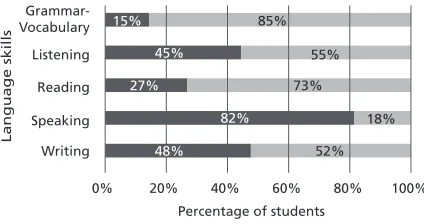
language test answered this research question. The students’ self-perception informed that while listening was their main strength, reading, speaking, grammar, and vocabulary represented their weaknesses. The language test, however, indicated that speaking was the students’ strength (Figure 2). This was an accumulative test which evaluated the students’ four language skills plus grammar and vocabulary in a separate component.
It was administered to the 321 students at the end of
the first semester. The results served as a diagnosis of their language level. The test results are presented as high scores (4-5) and low scores (0-3.9) of a grading scale from 0 to 5.
Figure 2. Students’ Strengths and Weaknesses in Language Skills (Diagnostic Test)
0% Grammar-Vocabulary Listening
Reading
Speaking
Writing
20% 40% 60%
Percentage of students
Low scores (0 - 3.9) Weaknesses
Language skills
85%
15%
55%
18%
52%
80% 100%
73%
High scores (4 - 5) Strenghts
45%
27%
82%
48%
According to Figure 2, the students performed better in speaking, contrary to what they reported in the surveys and focus group. Although the students manifested a low confidence level in speaking, the researchers’ observations reported their good language command during the speaking tasks. Moreover, the oral production emphasis in the syllabus and the extensive practice during the course may have influenced the students’ positive results. Listening was considered the students’ strength; however, the language test showed that only 45% of the students achieved good scores in this skill. It might be that listening to songs does not guarantee high achievement in listening tasks.
Throughout the English language Course I, the students were exposed to audios different from songs, such as long conversations and interviews by native speakers. These tasks might have been different from the students’ purposes and more challenging since they were required to identify explicit and implicit information and specific patterns and discourse. Thus, more practice, use of thought-provoking resources, and
awareness of varied functions and contexts of listening were necessary. Reading, grammar-vocabulary, writing, and listening represented the students’ weaknesses. The first three skills were also confirmed by the students. It could be that reading, grammar-vocabulary, writing, and listening are complex skills, demanding the students’ use of specific strategies to achieve better results, or they might not represent the students’ interests. From these results, we could interpret that the students’ perceptions of their own strengths and weaknesses are distant from their actions and outcomes.
Intervention and Evaluation Stages
After having diagnosed the students’ strengths and weaknesses in lls use and language skills, we designed tasks and resources that addressed both strategies and language. In the intervention stage, 33 out of 62 strategies were selected based on (a) the diagnostic stage yielding the least used lls by the students, (b) their relevance to our students’ learning foundations, and (c) their applicability to the course contents and language tasks. Cognitive, affective (only encourage yourself),and social strategies were included despite the students’ common use in order to give them a more academic purpose. Lowering your anxiety and taking your emotional temperature were not included since the language programme offers students psychological support.Table 4 illustrates the selection and integration of the lls with language skills and three instruments (notebook, journal, and portfolio) used by the students to document their learning process. The students followed the instructors’ guidelines to organise their notes, record their process, and arrange hand-outs.
Three workshops were designed integrating calla and tblt (see the Appendix for a workshop sample). Eleven strategies were introduced in three four-week workshops based on the three syllabus topics: childhood and teenage stages, turning points in life, and the neighbourhood. The selected tasks and resources were crucial in the lls instruction and the students’ lls
adoption and learning improvement. The following section presents the findings of the students’ tasks and learning resources preferences.
What types of tasks and learning resources will help these students improve their language performance and lls use? The researchers’ and the
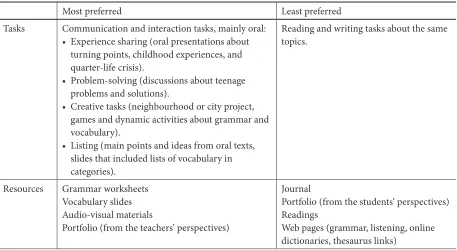
students’ journals and the final survey answered this third research question, summarised in Table 5.
It is evident that the students preferred oral tasks to literacy tasks. This preference might be related to the students’ desire of getting input through conversations and interviews and to practising the language. The preferred listening tasks and audio-visual materials engaged the students in identifying general and specific information, summarising, classifying, and reporting descriptions, interviews, narratives, and documentaries. The images and videos supported the students’ listening comprehension. As to speaking, class discussion on different topics, presentations, and projects helped them improve their fluency, pronunciation, and self-confidence.
Table 4. Integration of LLS With Language Skills and Instruments
Direct strategies Indirect strategies
Memory
Grouping (l, r, g-v)
Associating, using physical response (v) Placing new words (r, s, w)
Structured reviewing (g-v) Semantic mapping (l, r, w, s, g-v) Using keywords (l, r)
Cognitive
Recognising and using formulas (l, r, g) Getting the idea quickly (l, r)
Using resources for receiving and sending messages, analysing expressions (l, r, g-v)
Reasoning deductively, highlighting (r, g-v) Taking notes (l, r, w, g-v)
Summarising (l, r, w)
Compensation
Getting help, using a circumlocution (s, w)
Metacognitive
Paying attention, finding out about language learning (l, r, s, w, g-v, j, n, p)
Organising, setting goals and objectives, self-monitoring, self-evaluating (j, n)
Identifying the purpose of a language task (l, r, s, w, g-v) Planning for a language task, seeking practice
opportunities (s, w)
Affective
Making positive statements, writing a language learning diary (j)
Social
Asking for clarification, asking for correction (l, r, w, s, g-v)
Cooperating with peers, cooperating with proficient users, developing cultural understanding (l, r, w, s, g-v)
Note. Listening (l), Reading (r), Writing (w), Speaking (s), and Grammar-Vocabulary (g-v). Journal (j), Notebook (n), and Portfolio (p).
Table 5. The Most and the Least Preferred Tasks and Resources
Most preferred Least preferred
Tasks Communication and interaction tasks, mainly oral: • Experience sharing (oral presentations about
turning points, childhood experiences, and quarter-life crisis).
• Problem-solving (discussions about teenage problems and solutions).
• Creative tasks (neighbourhood or city project, games and dynamic activities about grammar and vocabulary).
• Listing (main points and ideas from oral texts, slides that included lists of vocabulary in categories).
Reading and writing tasks about the same topics.
Resources Grammar worksheets
Vocabulary slides Audio-visual materials
Portfolio (from the teachers’ perspectives)
Journal
Portfolio (from the students’ perspectives) Readings
and established criteria to select appropriate resources. Online thesaurus dictionaries were disregarded; instead, Google translator was consulted more. The students might have chosen this resource for its practicality and accessibility, ignoring the usefulness of thesaurus dictionaries as an academic tool in expanding their lexicon.
The students preferred activities and materials that increased their language knowledge to reflective and introspective tools that could contribute to their self-assessment. In five journals and surveys students affirmed that portfolios did not contribute to their learning and did not reflect any outcome. The fact that the students did not deem journal and portfolios as their favourite tools probably means that they were not used to reflecting on their own process, writing in journals, organising materials, and adopting new and challenging tasks. It might be that previous school practices failed to train students in the use of reflective strategies. This is a matter of raising awareness gradually through explicit lls instruction in further courses.
The researchers’ observations, however, reported the value of the portfolio and its contribution to the students’ organisation, fulfilment of assignments, autonomy when consulting extra sources, and transference of strategies to other areas. This result may have been influenced by the fact that the portfolio was graded, so the students met the requirement.
To what extent do first-year pre-service teachers improve their lls repertoire and language skills through the calla-tblt models? The researchers’
and the students’ journals, final survey, documentary analysis, and language tests yielded the students’ areas of improvement in lls and language skills. The final survey indicated that 79% of the students found lls useful for their academic process, 3% found them redundant, and 18% did not answer. The reasons for using them were paraphrased:
• To study, take notes, recall info and clarify doubts. • To be organised at home and in class.
• To acquire info and classify vocabulary easily. • To improve the learning process.
• They fit the learning style and study habits. • To develop critical thinking.
• To be more reflective towards learning. • They motivate to review their lessons. • Classes are more enjoyable
And the reasons for not considering them useful were:
• They generate pressure. • They are not practical. • They require time and effort. • They do not fit their learning style
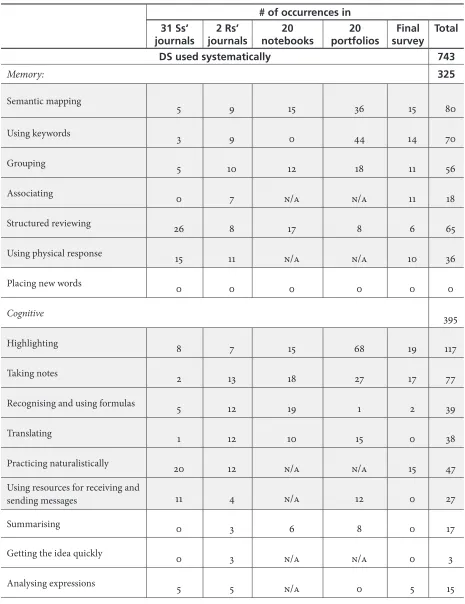
Sixty-six percent of the students stated that they transferred the strategies to other subjects (French, Spanish composition, English pronunciation, and morphology classes); this was corroborated in eight notebooks and six portfolios in which the students attached evidence voluntarily. Table 6 summarises the findings of all instruments of the second stage. The shaded boxes indicate the lls used systematically by the students.
To summarise, the students increased their lls repertoire and it seems that the explicit instruction influenced this result. Both ds and is increased in a balanced way: ds = 63.2% (12 out of 19 instructed strategies) and is = 61.54% (8 out of 13). As to ds, the students incorporated memory strategies (43.74%, 325/743 occurrences) and continued using cognitive
strategies (53.2%, 395/743 occurrences). This means that the students gained experience in using strategies that helped them organise and recall information easily as well as analysing the language more consciously. However, compensation strategies were not widely adopted by the students, similar to Hernández Gaviria’s (2008) finding. A possible cause was their low language level (beginners) and low oral interactions. Students also incorporated is (249/361 = 69%), predominantly
Table 6. LLS Used Systematically by the Students (Instruments, Second Stage)
# of occurrences in 31 Ss’
journals journals 2 Rs’ notebooks20 portfolios20 surveyFinal Total
DS used systematically 743
Memory: 325
Semantic mapping
5 9 15 36 15 80
Using keywords 3 9 0 44 14 70
Grouping 5 10 12 18 11 56
Associating 0 7 n/a n/a 11 18
Structured reviewing 26 8 17 8 6 65
Using physical response 15 11 n/a n/a 10 36
Placing new words 0 0 0 0 0 0
Cognitive 395
Highlighting 8 7 15 68 19 117
Taking notes 2 13 18 27 17 77
Recognising and using formulas 5 12 19 1 2 39
Translating 1 12 10 15 0 38
Practicing naturalistically 20 12 n/a n/a 15 47
Using resources for receiving and
sending messages 11 4 n/a 12 0 27
Summarising 0 3 6 8 0 17
Getting the idea quickly 0 3 n/a n/a 0 3
# of occurrences in 31 Ss’
journals journals 2 Rs’ notebooks20 portfolios20 surveyFinal Total
Reasoning deductively
5 5 n/a 0 5 15
Compensation 23
Using a circumlocution 5 2 0 6 3 16
Getting help 0 3 n/a n/a 4 7
IS used systematically 361
Metacognitive 249
Paying attention 2 14 0 15 10 41
Organising 7 7 18 n/a 8 40
Setting goals and objectives 41 10 16 n/a 4 71
Finding out about language
learning 5 3 0 15 0 23
Planning for a language task 3 8 5 23 0 39
Self-monitoring- evaluating 2 1 3 4 3 13
Identifying the purpose of a
language task 4 8 n/a n/a 1 13
Seeking practice opportunities 8 0 n/a n/a 1 9
Affective 40
Making positive statements 23 13 0 n/a 0 36
Writing a language learning diary 2 2 n/a n/a 0 4
Social 72
Cooperating with peers and with
proficient users 17 14 n/a n/a 4 35
Developing cultural
understanding 10 9 n/a n/a 2 21
Asking for clarification and
correction 0 4 4 n/a 8 16
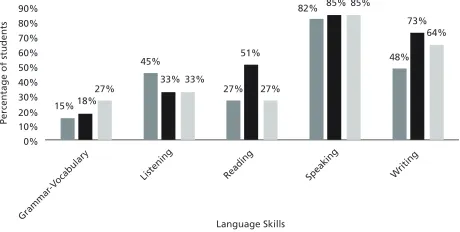
reflecting, and evaluating their learning. The least used strategies were self-monitoring and self-evaluating, which require students’ introspection and appraisal of their own learning. It could be that the students rely more on the teachers’ assessment than on their self-assessment. Concerning the students’ language level, the two language tests administered to the students in the second semester, which corresponded to the midterm and final term tests, were used to measure the students’ improvements. The three tests (diagnostic, mid, and final term) were comparable in the sense that they assessed the students’ four language skills and grammar and vocabulary in a separate component, using communicative tasks. However, their level of complexity was adjusted to the course and students’ levels. Figure 3 compares the results of the three tests.
Figure 3. Diagnostic, Midterm, and Final Term Language Tests
0%
Language Skills
Diagnostic test high scores (4-5) Mid-term test high scores (4-5) Final test high scores (4-5) Grammar
-Vocabulary Listening Reading Speaking W
riting 10% 20% 15% 27% 45% 33% 33% 51% 27% 27% 85% 82% 85% 73% 48% 64% 18% 30% 40% 50% 60% 70% 80% 90%
Percentage of students
Figure 3 illustrates that speaking remained as the students’ main strength, and that writing improved, followed, to a lesser extent, by grammar-vocabulary. Our interpretation is that the course emphasis on oral interaction and the students’ motivation to speak in English might have influenced this result. Moreover, the students’ preferred tasks (sharing experiences,
problem solving, creative tasks, listing, and comparing) and strategies (practicing naturalistically, setting goals,
planning for a language task, and cooperating with peers and proficient users) might have enhanced this
language skill. The students’ writing skill might have been enhanced by the academic emphasis and purposes of the language course, even when writing tasks were not highly preferred by them. Strategies such as semantic mapping and planning for a language task helped them structure their writing and oral presentations.
The students’ grammar and vocabulary improvement might be associated with memory games, vocabulary slides, and grammar worksheets as their preferred learning resources. Also semantic mapping, using keywords, grouping, associating, structured reviewing,and
using physical response strategies might have influenced this result. It could also be that the grammar-vocabulary component was more difficult in the final test; that is why a low percentage of students achieved higher results. On the other hand, listening and reading decreased. The students’ low improvement could offer varied interpretations. It might be that these language skills still represent more of a challenge for the students, they might not represent their interests, or the final test language tasks were more difficult. It might be also associated with the fact that reading tasks and resources were not the most preferred by the majority of the students.
Conclusions
Communication and interaction tasks such as sharing experiences, problem-solving, creative tasks, and listing showed to be effective in improving the students’ productive skills. Grammar worksheets, vocabulary slides, audio-visual materials, and portfolios (the latter from the teachers’ perspectives) resulted as having been useful resources contributing to the students’ language learning, particularly when designed by language instructors who base their designs on the students’ academic needs. Additionally, structured notes (dates, titles, use of colours and columns, use of sticky notes) seem to contribute to learners’ organisation and information recall. Concrete strategies also lead to reachable learning goals and outcomes.
The calla-tblt model seemed to be effective in explicit lls instruction, leading to students’ improvement of speaking, writing and grammar, and vocabulary. These approaches follow similar principles and, when intertwined, facilitate lls and language tasks instruction. Despite its short-term implementation, it was effective for these students; nevertheless, the calla-tblt model efficacy requires further confirmatory research. Language learners, especially pre-service language teachers, need explicit lls instruction from initial levels so that they can build their own scaffolding system for learning languages and have that experience useful for their future teaching practices. Thus, lls should be incorporated into the curriculum and the language courses syllabi, as well as tailored to the students’ needs. lls are teachable and transferable to other subjects but students may require some time to internalize and use them on their own.
Overall, a careful selection of lss, language tasks, learning resources, and appropriate strategy and language instruction results in being effective in improving students’ lls use and language performance. This instruction is effective when considering the students’ needs. Our findings confirm the effectiveness of lls to help learners succeed academically, as demonstrated by theoretical and empirical research. The findings also confirm Tuckman and Kennedy’s (2011) findings of
the effectiveness of lls and their explicit instruction to improve freshmen’s performance. Ramírez Espinosa’s (2015) suggestions on the features that make English language courses effective to foster learners’ academic success were also corroborated.
Limitations and Recommendations
The limitations of our study bring about rec-ommendations for further research. Fewer strategies should be selected and worked over a longer period of time to corroborate their effectiveness and learners’ language improvement. This is also to not overwhelm learners. Combining checklists with free journal entries might help students self-monitor and evaluate more closely their own progress thus allowing instructors to keep track of and measure the students’ achievements more accurately. Task complexity in language tests should be comparable so as not to affect the students’ test results (in our study, the final language test was probably more complex than the midterm test). Oxford’s (1990) taxonomy is ambiguous at some points since some activities can fit into various strategies. We suggest, therefore, establishing specific criteria and sticking to them.
References
Allwright, D. (1990). Autonomy in language pedagogy (crile
Working Paper 6). Lancaster, uk: Centre for Research in Education, University of Lancaster.
Cardona, A., Fandiño, Y., & Galindo, J. (2014). Formación docente: creencias, actitudes y competencias para el uso de tic [Teacher education: Beliefs, attitudes, and competences for the use of ict]. Lenguaje, 42(1), 173-208. Chamot, A. U. (2005). Language learning strategy instruction: Current issues and research. Annual Review of Applied Linguistics,25, 112-130. http://doi.org/10.1017/ s0267190505000061.
Cohen, A. D. (2014). Strategies in learning and using a second language (2nd ed.). London, uk: Routledge.
Cohen, A. D., & Griffiths, C. (2015). Revisiting lls research 40 years later. tesol Quarterly, 49(2), 414-429. http:// doi.org/10.1002/tesq.225.
Cohen, A. D., & Macaro, E. (Eds.). (2007). Language learner strategies: Thirty years of research and practice. Oxford,
uk: Oxford University Press.
Council of Europe. (2001). Common European Framework of Reference: Learning, teaching, and assessment. Oxford,
uk: Oxford University Press.
Creswell, J. W. (2012). Qualitative inquiry and research design: Choosing among five approaches. London, uk: Sage Publications.
Del Ángel Castillo, M. C., & Sessarego Espeleta, I. E. (2013). Strategies used by successful English learners in a Chilean university. Matices en Lenguas Extranjeras,7, 23-39. Dörnyei, Z. (2005). The psychology of the language learner:
Individual differences in second language acquisition. Mahwah, us: Lawrence Erlbaum Associates.
Ehrman, M. E., & Oxford, R. L. (1995). Cognitive plus: Correlations of language learning success. The Modern Language Journal, 79(1), 67-89. http://doi. org/10.1111/j.1540-4781.1995.tb05417.x.
Ellis, R. (2009). Task-based language teaching: Sorting out the misunderstandings. International Journal of Applied Linguistics, 19(3), 221-246. http://doi. org/10.1111/j.1473-4192.2009.00231.x.
Grenfell, M., & Harris, V. (1999). Modern languages and learning strategies: In theory and practice. London, uk: Routledge. Griffiths, C. (2003). Patterns of language learning strategy
use. System, 31(3), 367-383. http://doi.org/10.1016/ S0346-251X(03)00048-4.
Griffiths, C. (2013). The strategy factor in successful language learning. Bristol, uk: Multilingual Matters.
Griffiths, C. (2015). What have we learnt from ‘good language learners’? elt Journal, 69(4), 425-433. http://doi. org/10.1093/elt/ccv040.
Griffiths, C., & Oxford, R. L. (2014). The twenty-first century landscape of language learning strategies: Introduction to
this special issue. System, 43, 1-10. http://doi.org/10.1016/j. system.2013.12.009.
Hernández Gaviria, F. (2008). Aprendizaje estratégico: un camino al aprendizaje autorregulado [Strategic learning: A path towards self-regulated learning]. Cali, co: Universidad del Valle.
Holec, H. (1981). Autonomy and foreignlanguage learning. Oxford, uk: Pergamon.
Macaro, E. (2006). Strategies for language learning and for language use: Revising the theoretical framework. The Modern Language Journal,90(3), 320-337. http://doi. org/10.1111/j.1540-4781.2006.00425.x.
Macaro, E. (2014). Reframing task performance: The relationship between tasks, strategic behaviour, and linguistic knowledge in writing. In H. Byrnes & R. Manchón (Eds.), Task-based language learning: Insights from and for l2 writing (pp. 53-77). Amsterdam, nl: John Benjamins Publishing. http://doi.org/10.1075/ tblt.7.03mac.
Nunan, D. (2004). Task-based language teaching. Cambridge,
uk: Cambridge University Press. http://doi.org/10.1017/ CBO9780511667336.
O’Malley, J. M., & Chamot, A. U. (1990). Learning strategies
in second language acquisition. Cambridge, uk:
Cambridge University Press. http://doi.org/10.1017/ CBO9781139524490.
Orrego, L. M., & Díaz Monsalve, A. E. (2010). Empleo de estrategias de aprendizaje de lenguas extranjeras: inglés y francés [Use of foreign language learning strategies: English and French]. Íkala, Revista de Lenguaje y Cultura, 15(24), 105-142.
Oxford, R. L. (1990). Language learning strategies: What every teacher should know. Rowley, us: Newbury House Publishers.
Oxford, R. L. (2013). Teaching and researching: Language learning strategies. London, uk: Routledge.
Oxford, R. L., & Schramm, K. (2007). Bridging the gap between psychological and sociocultural perspectives on
l2 learner strategies. In A. D. Cohen & E. Macaro (Eds.), Language learner strategies: Thirty years of research and practice (pp. 47-68). Oxford, uk: Oxford University Press. Ramírez Espinosa, A. (2015). Fostering autonomy through
syllabus design: A step-by-step guide for success. how, 22(2), 114-134. http://doi.org/10.19183/how.22.2.137. Richards, J. C., & Lockhart, C. (1994). Reflective teaching in second
language classroom. New York, us: Cambridge University Press. http://doi.org/10.1017/CBO9780511667169. Rubin, J. (1975). What the “good language learner” can teach us.
tesolQuarterly, 9(1), 41-51. http://doi.org/10.2307/3586011. Rubin, J. (2001). Language learner self-management. Journal
of Asian Pacific Communication, 11(1), 25-37. http://doi. org/10.1075/japc.11.1.05rub.
Rubin, J., & Thompson, I. (1994). How to be a more successful language learner. Boston, us: Heinle & Heinle Publishers.
Tuckman, B. W., & Kennedy, G. J. (2011). Teaching learning strategies to increase success of first-term college students. The Journal of Experimental Education, 79(4), 478-504. http://doi.org/10.1080/00220973.2010.512318.
Van den Branden, K. (Ed.). (2006). Task based language education: From theory to practice. Cambridge, uk: Cambridge University Press. http://doi.org/10.1017/ CBO9780511667282.
Wenden, A. (1991). Learner strategies for learner autonomy. London, uk: Prentice-Hall International.
Wenden, A., & Rubin, J. (Eds). (1987). Learner strategies in language learning. Hemel Hempstead, uk: Prentice Hall. Willis, J. (1996). A framework for task-based learning. New
York, us: Longman.
Zimmerman, B. J. (2002). Becoming a self-regulated learner: An overview. Theory into Practice, 41(2), 64-70. http:// doi.org/10.1207/s15430421tip4102_2.
About the Authors
Maria Eugenia Guapacha Chamorro is Assistant Professor at Universidad del Valle, Cali, Colombia.
Currently, she is a phd candidate at The University of Auckland (New Zealand). She holds an m.a. in English Teaching and a b.a. in Foreign Languages. She is an efl instructor and has taught at all educational levels.
Luis Humberto Benavidez Paz is Assistant Professor at Universidad del Valle, Cali, Colombia. He
holds an m.a. in Linguistics and Spanish and a b.a. in Foreign Languages. He currently teaches efl, esp, eap, classroom research, and pedagogy. His research interests include interculturality, learning strategies, and curriculum design.
Acknowledgments
Appendix: Workshop Sample
Childhood Memories
Retrieved from Google Images
Pre-task ←→ Preparation and Presentation (4 hours)
lls: grouping, taking notes, using key words, semantic mapping, placing new words, using a circumlocution,
developing cultural understanding.
Task: Students will share childhood anecdotes by using audio visual aids (slides, photos, objects, etc.) Vocabulary
Learning strategy: grouping
Warm-up and Pre-listening activity
Teachers’ instructions: Divide the class into two groups and play hangman using the words from the box. Have students use them in situations related to the topic.
Grow up memories holidays great-grandma kid football game friends
Pre-listening activity
1. Do you remember how you spent your summer holidays when you were a child?
2. Did you use to travel to visit some relatives or stay at home? What activities did you use to do? 3. What are the most unforgettable moments you remember from that time of your life?
While-listening
Learning strategies: taking notes – using key words – grouping
4. Listen to the conversation between Vella and Daniel and take notes by identifying key words and ideas. Example: Key words: Grow up in Chile
Idea: Daniel grew up in Chile.
5. Listen again and complete the following diagram with aspects related to childhood and detailed information given in the conversation.
Childhood memories
Trips Games
Amazing
lunch ChristmasNew Year
6. Based on your notes and diagram, what can you report about the conversation? How did they spend their childhood holidays?
Post-listening
Learning Strategy: placing new words – using a circumlocution
7. Try to define the key words and expressions from the conversation. You can use a thesaurus dictionary to help you with synonyms.
a. Fond memories: _________________________________________________________________ Expression in context: _______________________________________________________________
Speaking
Learning Strategy: developing cultural understanding
8. After listening to the conversation, what do you notice about the relationship between seasons and holidays? Discuss with your classmates.
9. Compare the school break that Daniel used to experience with yours when you were a child.
10. Establish similarities and differences between the school breaks in Colombia and in other countries (consider break length, type of leisure activities, food, outfits, celebrations, etc.).
Homework
1. Find out about others’ childhood memories (use internet, talk to the language assistant, ask a native English speaker, a friend, etc.).