Unmanned Parking System using Lab view
https://doi.org/10.3991/ijoe.v14i10.9104
U. Dhanalakshmi(*), V. Bindusree, J. Swetha, D. Khalandar Basha
Institute of Aeronautical Engineering, Hyderabad, India [email protected]
Abstract—The existing parking system requires manual support for control-ling and monitoring vehicles. The motive of this system is to find out appropri-ate solution of parking relappropri-ated issues in different aspects. The proposed system can be control the vehicle parking system in shopping malls, Theatres, outdoor stadiums etc. The proposed system consists of two levels of parking for vehi-cles, where each level has limit of 100. In this proposed parking control system IR sensors will detect and count the number of vehicles on arrival and guided to enter into the vacant parking levels accordingly. This system is designed with automatic lighting and fire detection facility.
Keywords—IR sensor, Parking System, Automatic lighting.
1
Introduction
From past few years the vehicular parking system is controlling and monitoring [4]-[7] manually. Humans use to move physically in the parking [1] area to provide space for the entering and leaving vehicles and also to switch on and off lights in those areas. Today’s human being life cycle is busy and they are not following stand-ard system to check for parking spaces. The objective of the proposed system is to control the operation and to monitor the progress of the process itself. With the ad-vancement of new electronic technologies combining with older building techniques.
2
Proposed System
level 1 count value is less than 100 then vehicle directed to level (L1). The lights in the level (L1) will switch on. Whenever any vehicle leaves the level (L1) the IR sen-sor will detect it and opens the exit gate1 also decreases level 1 count value and opens the gate for further vehicle parking into level (L1). By detecting full count in level1 vehicles will be diverted automatically to enter into next level i.e., level (L2). The IR sensor in level (L2) detects vehicle and starts increasing the level 2 count value for each detection and also lights in level (L2) will switch on. If any vehicle [2] leaves the level (L2) it will be detected by IR sensor at exit gate 2 and gate will be opened. When any one of the exit sensor is detected the main exit gate will be opened and when all level counts becomes zero then automatically main exit gate will be closed. This process can be repeated for number of levels. The parking system is also provid-ed with alert system. Whenever smoke sensor [8] detects fire or smoke then buzzer will ring alerting everyone in the parking area. This proposed parking system [5] is designed with three smoke sensors connected in each level. All the levels entry gates and exit gates are represented with LEDS. Two level parking system is designed us-ing IR sensors [6], Fire sensor and buzzer.
2.1 Block Diagram
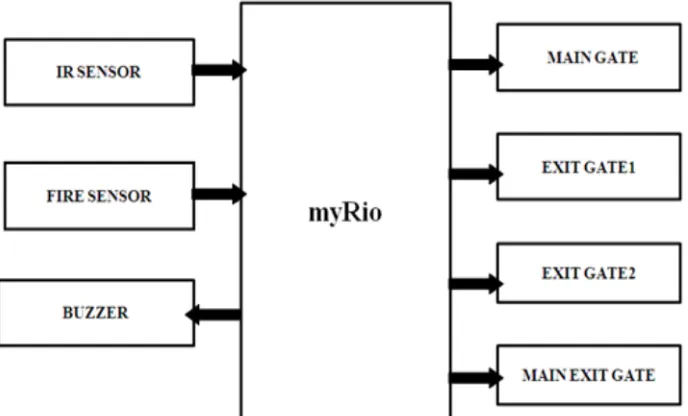
The block diagram of Unmanned parking system is shown in figure 1.
Fig. 1. Unmanned parking system block diagram
2.2 IR TX and RX
of measuring the heat being emitted by an object and detecting motion. LED will glow with respect to the IR sensor [6] detection. Every IR sensor has a transmitter and a receiver. Figure 2 shows IR Transmitter & Receiver. For every transmitter and re-ceiver, there are total two registers and one more register is present to maintain volt-age of LED that will show the status of parking slot to customers. When the IR does not detect any object in front of it, it returns the value TRUE, meaning HIGH volt output from the sensor [8] and FALSE for when a object is detected meaning LOW volt output.
Fig. 2. IR Transmitter & Receiver
2.3 Fire sensor
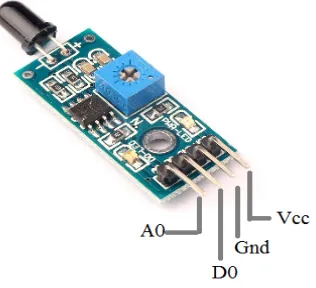
Fire sensor is used to sense fire generated in various levels of parking system. The fire sensor circuit will be operating at a voltage of 3.3V to 5Vcc. This sensor is capable of detecting fire up to 1meter distance and the fire source wavelength detection range is 760nm – 1100 nm. The sensor circuit consists of a high speed and high sensitive NPN silicon phototransistor and LM393 [6] chipset in comparator. The Analog output pin is interfaced with myRio. The following figure 3 shows Fire sensor.
2.4 Buzzer
A buzzer is a small compact 2-pin audio signaling device. The longer terminal lead is a positive applied with 6V DC. Figure 4 shows buzzer [6]. The shorter terminal lead is a negative typically connected to ground.
Fig. 4. Buzzer
3
Interfacing of modules with myRio
3.1 Interfacing of IR Sensor
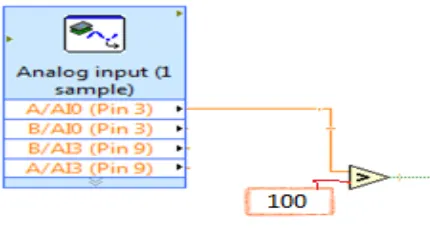
The proposed parking system consists of 3 IR Sensors; each sensor analog output is connected each sensor output is connected to myRio as shown in figure 5, the Ana-log Input pins are A/AI0 (pin3), B/AI0 (pin3) and B/AI3 (pin9).
Fig. 5. Interfacing of IR sensor
3.2 Interfacing of Fire sensor
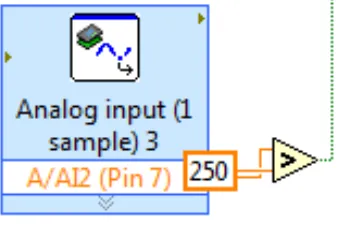
Fig. 6. Interfacing of Fire sensor
Figure 6 shows the interfacing of myRio with Fire sensor.
3.3 Interfacing of Buzzer
The proposed parking system consists of 3 buzzers, each sensor output is connect-ed to myRio as shown in figure 7, the Digital Output pins are A/DIO1 (pin13), A/DIO6 (pin23) and A/DIO2 (pin15). The fire sensor output is received by myRio and compared with the threshold value; if the output is greater than threshold then buzzer will ring.
Fig. 7. Interfacing of Buzzer
3.4 Interfacing of LED
Fig. 8. Interfacing of LED
4
Proposed system Description
The figure 9 shows proposed unmanned parking system using Lab view myRio [3] consists of IR sensors [6], Fire sensor [6] and buzzer. The system consists of two levels of parking each with limit of 100 vehicles. On detection of every vehicle [2] level count gets incremented, if the count value is less than 100 then the vehicle is directed in to that level for parking [1]. If any vehicle leaves the parking area then exit gate will be opened and level count is decreased.
5
Result
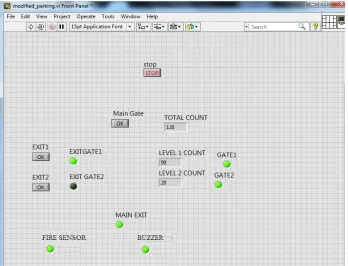
After the successful connection, the data from sensors are sent to Lab view for monitoring of the system. The figure 10 shows the Front Panel of Unmanned Parking System, which provides monitoring [7] and controlling of vehicles in parking system [2] in shopping malls, theatres, outdoor stadiums etc.
Fig. 10.Front panel of Un manned parking system
6
Conclusion
7
Acknowledgements
The author would like to thank the management, Director, Principal, Head of De-partment of Institute of aeronautical college, Hyderabad for their support and guid-ance in completion of this research paper.
8
References
[1]R.S.Harishraghav, G.Sri Naga Chaitanya.” Advanced Embedded Automatic Car Parking System”, The International Journal of Engineering and Science (IJES), vol 3, pp.84-98, 2014.
[2]Hitesh J. Lad, Dr. Vibhuti G. Joshi.” Vehicle Parking Management Using Embedded Sys-tem”, International Journal of Engineering Science and Innovative Technology (IJESIT) Vol 2, Issue 4, July 2013.
[3]Shamili A.R, Lakshmi Ravi Teja M, Nehru. K, Abhinaya. R. “Designing of Scientific Cal-culator with Case Structure Using NI Labview Software”, Journal on Software Engineer-ing. Jan-Mar2017, Vol. 11 Issue 3, p19-30. 12p.
[4]Basil Hamed.” Design & Implementation of Smart House Control Using LabVIEW”, In-ternational Journal of Soft Computing and Engineering (IJSCE) ISSN: 2231-2307, Vol-ume-1, Issue-6, January 2012.
[5]Hitendra G. Wasnik, Dr. R. D. Askhedkar, Dr. S.K. Choudhary,” Optimal Automatic Car Parking System for Indian Environment”, Indian Streams Research Journal, ISSN:-2230-7850, Vol.1, pp. 1-4. Nov 11.
[6]Ummadisetty Nagamani, Bindusree V, J Swetha.” Wireless Sensor Based Smart Kitchen Monitoring System With Web Server And Internet Of Things”, Journal of Advanced Re-search in Dynamical and Control Systems Vol. 9, Issue 4, Oct.2017.
[7]Vijaykumar G, Anil Gantala, Mary Swarna Latha Gade, P Anjaneyulu, Sk. Hasane Ahammad, “Microcontroller Based Heartbeat Monitoring and Display on PC”, Journal of Advanced Research in Dynamical and Control Systems, Vol. 9, Issue 4, 2017. (ISSN: 1943-023X, Scopus Indexed).
[8] Nagarjuna Telagam, Nehru Kandasamy, Menakadevi Nanjundan.”Smart sensor network based high quality air pollution monitoring system using Labview. Innovative Journal Of online Education ‒ Vol. 13, No. 8, 2017
9
Authors
U. Dhanalakshmi (corresponding author) is with the Electronics and Communi-cation Engineering Department, Institute of Aeronautical Engineering, Hyderabad, India. Currently, she is working as an Assistant Professor. She received her Bachelor degree from JNTUH University/CVSR College of Engineering in 2008. She received her Master degree from JNTUH University/ Nishitha College of Engineering in 2013. She has 4 years of experience in teaching and research.
Univer-sity/Sri Saradhi institute of Engineering and Technology in 2006. She received her Master degree from JNTUH University/ Indur Institute of Engineering and Technolo-gy in 2012. She has 4 years of experience in teaching and research.
J. Swetha is with the Electronics and Communication Engineering Department, Institute of Aeronautical Engineering, Hyderabad, India. Currently, she is working as an Assistant Professor. She received her Bachelor degree from JNTUH University/ Tirumala Engineering College in 2012. She received her Master degree from JNTUH University/CMR College of Engineering and Technology in 2016. She has 1 year of teaching experience.
D. Khalandar Basha is with the Electronics and Communication Engineering Department, Institute of Aeronautical Engineering, Hyderabad, India. Currently, he is working as an Assistant Professor. He is interested in the areas of Digital Image Pro-cessing, Very Large Scale Integration. He is pursing his Ph.D at Sri Venkateswara University, Tirupati.