Source Reduction, on-site handling
and processing of Solid waste
Func tio na l Ele me nt s o
f W
Source Reduction/Waste Minimization
• First element of any waste management chain for
achieving integrated management of solid wastes
• Waste minimization refers to waste avoidance
through the actions of the waste generators to avoid generating solid waste.
• Waste utilization comprises actions that make the
waste a useful product or raw-material for other processes, eliminating the need for disposal.
• Hazard reduction means finding ways to reduce
On-site Processing and Storage
• second functional element of an integrated solid
waste management system
• describes the separation of components and/or
treatment of solid wastes
• used for materials that have already escaped
source reduction and are on the way to being discarded into the environment at or near the source of generation
• On-site storage means storage of solid waste
Advantages of Source Reduction and
On-site Processing
• generation of clean recyclable materials
• removal of hazardous materials from general waste
streams in order to
• minimize health risks to the general population,
particularly the waste handlers
• improved working condition within recycling plants
• improved efficiency of energy recovery processes, thus
helping to operate the waste treatment system cost-effectively
• improved quality of end-products minimization of
Importance
• In order to minimize environmental
degradation, 'end-of-pipe' treatment technologies to 'front-of-pipe' waste reduction
• Emphasized at the United Nations Conference
Beneficial consequences related to climate
change
• It reduces the consumption of energy through
reuse of goods by consumers and use of minimum quantities of materials in industry. This leads to the production of fewer products, which ultimately
saves the energy required to collect raw materials, to produce the products, and to transport them to the consumers.
• Emissions at treatment and disposal sites are
reduced.
• Pressures on vegetative cover and trees are
Main Strategic options in source reduction
Table 3.1
• Decreased Consumption of products • Resource Recovery
Key Concepts
• resource recovery to generate less waste • hazard reduction
• separation of different fractions of waste
Significance
• On site processing is one of the most effective and sustainable
ways to achieve resource recovery.
• It reduces hazards and diverts different fractions of material present
in the waste
stream to locations for appropriate treatment in the solid waste mgt.
• It reduces the quantity of general waste and minimizes the toxicity
of the general waste stream (if hazardous materials are diverted).
• It minimizes the cost of the operation and reduces maintenance
problems of biological - treatment and recycling technologies. The economic viability of most biological treatment options largely depends on separation of waste materials at source.
• Without sorting at source, expensive pre-sorting and final refining
Source Separation and collection in developed vs developing countries
• Most developed cities or countries (North America, Australia,
Japan, Korea etc) have
adopted municipally – sponsored source separation and collection system. In some
cases, separation of post-consumer materials by waste generators has been made
mandatory (IETC, 1996).
• For example, in Japan and Australia, cities have implemented laws
and regulations
governing disposal that bans substances such as batteries, tires, waste oil, CFC gases,
etc. In Japan, to ensure that separation of waste is carried out properly; households are
required to use transparent plastic bags for waste disposal, so that collection crews can easily
Mixed Materials
collection of all (non-separated) waste from residential and commercial establishments, as well as from industrial enterprises. External
actors either collect the mixed waste from the source of generation, or the waste generators are responsible for bringing their waste to
Source separated materials
Waste materials that have been separated at source are collected and transported to
recycling and resource recovery facilities
• Dry Recyclable materials
Problem:
Effect of home recovery on Energy content of Collected Solid Waste• Problem 3.1: Using the typical percentage distribution data given in Table 2.12
Implementation of source reduction
and on-site processing
• competence of waste generators • motivation of waste generators • economic incentives
• convenience
Calculation of Source Reduction
Source reduction for a given period of time involves the following formula:
• Source reduction=(projected waste generation
at a given time) – ( actual waste generation at that time)
• For a small community, this can be measured by conducting a survey at the source of waste generation for a given period of time.
• For nationwide information, the estimate generally involves the calculation of the
On-site storage
Influenced by a number of factors
• type of storage containers used • location of storage containers • public health and aesthetics
• availability of resources for waste
management
• available methods for waste collection and
further transportation.
Storage Containers
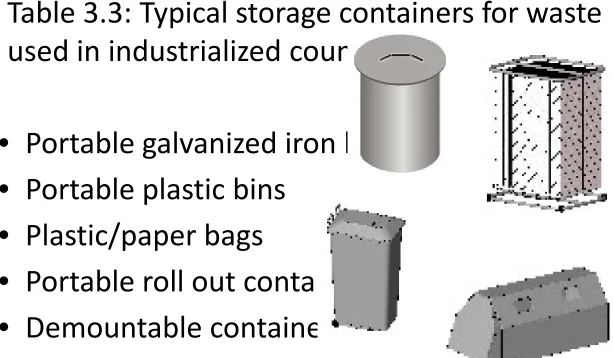
Table 3.3: Typical storage containers for waste used in industrialized countries
• Portable galvanized iron bins • Portable plastic bins
• Plastic/paper bags
Storage Containers
• Table 3.4: Typical designs used in developing
countries
• Fixed enclosures • Fixed Depots
• Fixed storage bins • Demountable
Design of Storage Containers
General Considerations
• Nature of Waste • Capacity Margin • Compatibility
• Standardization • Efficiency
• Convenience
Size of Storage Containers
• The size of a storage container can be
calculated using the following simple equation 3.5.
Size of storage container = (N X G X F) / D + capacity margin (3.5)
Where,
N = number of population served (nos, cap); G = average rate of waste generation
(kg/cap/day);