42
Dayak and Their Daily Life
Hamid Darmadi
IKIP PGRI Pontianak, Pontianak, Indonesia E-mail: [email protected]
Abstract.This article titled "Dayak and Daily Life" This paper aims to reveal the Dayak and in their daily life. Dayak is a native of Borneo has its own characteristics. Dayak, divided into 405 sub-sub clans [1]. Each sub Dayak both Indonesia and Malaysia are identical. Dayak customs and culture comes from the word "Power" which means upstream, to refer to people who live in inland areas or in the interior of Borneo. In the arsenal of art and culture, Dayak has many similarities such as; saber, chopsticks, beliong, betang, cupai, renjung, empajang and others. Dayak indigenous religion is Kaharingan which is the original religion born of the cultural ancestors of the Dayaks. Most of the Dayak people still adhere to the belief of the existence of unseen objects in certain places such as rocks, large trees, planting gardens in the forest, lakes, pools, and others are believed to have "magical powers". Daily life of the Dayaks in general farming, farming. When will open farming land, farming they held ritual.
Keywords: Dayak; Daily Life; Borneo
I. INTRODUCTION
Dayak is a term for natives of the island of Borneo. Borneo island is divided by region Administrative governing each region consisting of: the capital city of Samarinda in East Kalimantan, South Kalimantan capital Banjarmasin, the capital of Central Kalimantan Palangkaraya, and West Kalimantan capital Pontianak, the capital city of North Kalimantan Tanjung Selor.
Dayak tribes, divided into 405 sub-tribes [1]. Each of the sub-tribe has customs and cultures are similar, both Dayak Dayak in Indonesia as well as in Sabah and Sarawak Malaysia. Ethnic Dayak consists of six major ethnic groups and divided into 405 sub small tribe, who live spread across the hinterlands of Borneo including Sabah and Sarawak Malaysia [1]. Differences sub Dayak because they live in groups of spot/area where they are domiciled. As the river's name, the name of the hero, realm name and so they make Ethnicity themselves. for example Dayak rod Loepar because they left around the trunk Loepar, Dayak Lebang because they live around Lebang river, Dayak Ketungau because they are domiciled around the river of Mualang, Dayak Seberang because they remain around Seberuang river, Dayak sleepiness because they live around Sleepiness river, Dayak Hill (Kanayatn/Ahe) comes from the Bawang Hill.
Dayak tribes living scattered across the territory of either living interior of Borneo Indonesian territory or are domiciled in Sabah Malaysia Sarak. They live spread explore rivers upstream to downstream and then inhabit the coast of the island of Borneo. According to their history, Dayak never built an empire. In the Dayak oral tradition, called "Nansarunai Usak Java", which is a Dayak Nansarunai ruined kingdom overrun by an army of Majapahit, is expected to occur between the years
1309-1389 [2]. The incident resulted in the Dayak tribes living scattered all over rural Kalimantan.
In line with the changing times and social progress, many Dayak tribes who converted to Islam (Muslim). Most of the Dayak tribes who converted to Islam no longer refer to themselves as Dayak, but calls himself as a "Malay" or the "Banjar" [3]. While the Dayaks who do not embrace Islam back down the river, into the interior of Borneo. In South Kalimantan, for example, live in the area around Wood Tangi, in Amuntai, Margasari, Watang Amandit, Lawas and Labuan Watang Balangan. In part of the area is longer continues to go into the interior. Dayaks who converted to Islam mostly located in South Kalimantan and some Kotawaringin, one of the famous Sultan Banjar Sultanate is Mangkurat is a Dayak Maanyan or Danum immortalized as the name of the University Mangkurat in Banjarmasin [2].
Until now there are still some Dayak tribal customs are still preserved. Dayak supernatural world in ancient times still looked strong until now. This custom is one of the cultural property owned by the Indonesian nation. A long time ago the famous Dayak with the term "ngayau" (adventuring by finding the opponent's head to become "Dengah") [4]. Tiwah ceremony (A ceremony held to usher in the bones of the deceased to "stumbled"). "Stumbled" is a sort of small home made specifically for storing bones of the dead.
43
had many Dayak men who occupy positions in both the government and private field, not a few who work abroad.
In his daily life, each Dayak grows and develop its own culture. For example, in dance or other arts clothing and there is a developing trend in accordance with local domicile. In the art of ancient weaponry, Saber is considered to have magical and only used in certain rituals such as: if the war, headhunting, fixtures traditional dance, and ceremonial. Saber believed to have levels of efficacy or miracle. The power of magic is not only derived from the rituals of manufacture but also derived from the tradition of headhunting. The more people who will be more powerful dikayau mandaunya. Hair kayau the results used to decorate the handle of "Saber". They believe that those who die in-kayau, his spirit will live in their mandau so that it becomes magic saber. However, this time the function of Saber has been a lot of switching function, namely as objects of art and culture, souvenirs, collectibles and weapons for hunting, prune shrubs and farming, although it must be still recognized Dayak in the forest, the mountains that preserve the ritual as goods considered sacred.
II. DAYAKS BELIEF WILL MUSEUMS INVISIBILITY The Dayaks still adhere to the belief in certain places, certain objects such as rocks, big trees, lakes, pools (of river water in) and others there are rulers, which they call: Jubata, Petara, Ala Taala, Penompa and others, to mention God the highest, then they still have other authority under the power of God's highest, for example, Puyang Gana (ruler of the land), King Juata (ruler Air), Kama "Baba (ruler Army) Jobata, Apet Kuyangh and others. For those who still adhere to the original beliefs and cultural dynamism, while looking for fertile land for farming and planting them broke away into the woods out farther inland forests of Borneo. The more fertile land and dense forests, the more they gather to prepare for tillage and cultivation.
III.DAYAK CULTURAL ARTS
A. Dance “Temuai Ajat Datai” (Dance Welcomes Guests)
"Ajat temuai Datai" lifted from the Dayak language Mualang, sleepiness and Dayak Desa (Ibanic Group), which can not be interpreted directly since there are irregularities if interpreted verbatim. But Ajat intention is to hold ritual offerings or a traditional ceremony, then temuai means: at Datai means: Coming. If adjusted for the purpose of dances are: Dance Ceremony procession welcoming guests or Dance Greeting guests [7].
B. Ngayan
Headhunting, derived from the word "me and ngayau". Me means action, ngayau: beheading enemies, decapitating enemy action (Mengayau contained in the Iban language and Ibanik, also on the Dayak community in general). But if mengayau contains a special sense that an action seeking other groups (the enemy) by attacking and decapitating opponent (headhunting consists of various customary as Kayau banyau/crowded/attack, Kayau Son namely:
Mengayau in small groups, Kayau Beguyap namely: Mengayau no more than three people. In the past, the heroes returning from headhunting and bring evidence of Kayau the form of a human head was among the revered and regarded as someone who is able to become a hero for the group. Therefore, they held a ceremony "Ajat temuai Datai". The Dayak believe that the person's head to save a spirit or life force that can protect the person and kinsmen [1].
There are four objectives mengayau namely: (1) to protect agriculture, (2) to get the extra power of the soul, (3) for revenge, and as the durability of the establishment of a building. After getting the results of head-hunting, the heroes must not enter the territory of the village, but by providing a sign language called Nyelaing Dayak (Dayak shouts) which reads Heeih !!!, seven times, which means hero back home and win in headhunting and obtaining head opponents are still fresh. If the cry is only three times mean the heroes win the war or head-hunting but fell victim on his side. If just once means that the hero does not get anything and not hold a special reception. After marking nyelaing, the hunters sent a delegation to meet with the head or heads of tribes to prepare a welcoming ceremony.
This reception process, through four innings namely: (1) Ngunsai Rice (scatter some rice in front of the Bujang Berani / knight / hero, as he recited prayers through the intercession of Sengalang Burong), (2) Mancong Buloh namely; Saber slash / Nyabor to decide bamboo deliberately aligned or in the pond at the entrance of the house panjai region. (3) Ngajat Ngiring temuai: dancing to the guest or guests until the next walk up stairs Panjai House (houses on stilts long) temuai ngiring process is done by means of dance and dance is called Ngajat Ngiring temuai. (4)Tamak 'room (enter the house panjai) or go to certain places after soaking her feet on a rock in a container as a symbol pencelap semengat, after a procession it is a long permitted to go home with the intent to purify themselves in a ceremony called Start semengat (restore the spirit of war), then just held Gawai palak 'event to honor the results kayau head, and in the event there are several dances called: Palak Swing Dance, Sword Dance etc. The names of some of the Commander/Tuwak Dayak Mualang the past, namely: Tuwak Biau Balau (leader Kayau), Tuwak Pangkar Begili (Never Back, strategy if beleaguered, rotate and strike), Tuwak Sangau Sibi (Every time wanted) Mengayau) Tuwak Tali Aran (happy collection enemy heads his best in the headhunting Tuwak Lang Ngindang (always lurking place - where the enemy defenses in advance like a hawk, if beleaguered he will jump and drift with the wind), and others. (key informant: Community leaders Kumpang Belitang Central etc.).
C. Clothes Dayak
44
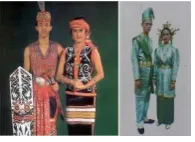
These two tribes influencing social culture and customs that developed in West Kalimantan. The influence of example we can see from:
Fig. 1 Clothes Dayak and Malay
1) Clothes Dayak man called "King Baba. In the Dayak language, King means clothes and Baba mean men. These garments are made of bark or wood kapuo ampuro plant. Both types of wood are Kalimantan endemic plants that have high fiber content.
2) To make the king baba, the bark is pounded with a hammer, a round in the water, so that only the fiber left alone. After bending, the skin is then dried and decorated with paintings of ethnic Dayak using natural dyes. The bark is formed such that it resembles a sleeveless vest and a pair of pants. As a garnish, bark fiber was also made into a sort of headband. As a complement to garnish, usually male indigenous Dayak tribe in Kalimantan Barat also would slip feather hornbills, typical of Borneo that is now scarce. Not to forget, the traditional weapons such as saber and shield is also subject to, especially when they are going to war. Therefore, it is not uncommon in traditional clothing West Kalimantan is also known by the name of the armor. Hornbills or also called hornbill is a bird with a beak resembling horns in bright colors. This bird is endemic in the region of Borneo. Hornbills are sacred by Dayaks as follows:
Fig. 2 Hornbills
3) Indigenous Women's Clothing Dayak same as men in traditional clothing Dayak, Kalimantan Barat custom clothing for women is also made of the same material and method. However, the designs are more polite with equipment, among others topless, stagen, fabric subordinates, as well as various other trinkets such as necklaces, beads and ornaments hornbill feathers on his head. Some other jewelry worn include: Jarat hand (bracelet) is a bracelet made of spun tengang plant roots to be worn on the hand as a repellent reinforcements and reinforcing the spirit. Necklace of materials such as wood or leather roots (bone) as an antidote to disruption of animal spirits, especially often used on infants. Various types of bracelets, including fur fibers Tantawan, feather canopy area, necklaces mace, galling ivory, beads barely girder, girder
barely, sa'sawak mulung rope, sa'sawat Pirak kurumut, and posong. By the Dayak community in West Kalimantan, both types have always worn good clothes while undergoing daily activities, such as farming, hunting, or when performing traditional ceremonies. As for ingredients that tend to be hot and uncomfortable to wear, this custom clothing over time began to be abandoned. The advancement of civilization and the influence from outside the area make the Dayaks in Kalimantan Barat began to try a variety of other types of clothing more comfortable. Some of them are: Bulang Buri Buri and King is a custom dress made of buri or sea shell. Clothes King Kabo 'is clothing made from bark only a loincloth with decorative beads or ribbons tassel.
King Tompang clothing is clothing from fabric in a solid color that began to be known since there is interaction with the Malays. Manik Indulu clothing is clothing patch of cloth with beads as embellishments. Remove Kuureng are bracketed with long sleeve shirt made of velvet. And much more, including clothing Bulang Wire, King Tatak, Bulang Panosokan, Bulang Kontong. Well, so some kind of custom clothing and caption West Kalimantan. Of the various types of clothing on top, this time still remains sustainable is King Baba and King Bibinge. Both of these clothes until now still used primarily by Kubu Dayak tribes who still live in rural and nomadic survival.
D. Spiritual
Fig. 3 Spiritual
Supernatural world to the Dayaks had been since ancient times is a hallmark of the Dayak culture. Because of this supernatural calling people overseas also Dayak as a man-eater (cannibal). But in fact, Dayak is a very peaceful tribe of origin they are not disturbed and afflicted arbitrarily. Dayak Kalimantan supernatural power of many kinds, for example, Manajah Antang. Manajah Antang a way Dayak for clues such as finding the existence of an enemy that is difficult to find on the ancestors to birds Antang media, wherever the enemy being sought will be found because they were given instructions Antang.
E. Red Bowl
45
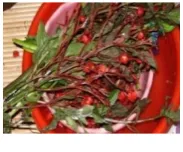
Fig. 4 Red Bowl
Red bowl not haphazardly distributed. Before circulated warlords act led ceremonies to know when the right time to start a war. In a custom event that the spirits of the ancestors will permeate the body of the commander and if the commander of the Air Tariu "(summon ancestral spirits for help and declared war) then the Dayaks who hear it will be as strong as commander. Usually, people whose spirit labile could sick or crazy when they hear tariu.
People who already possessed by the spirits of the ancestors will be a man "possessed" not self-aware. So the blood, liver murdered victim will be eaten. If not in an atmosphere of war never eat human Dayaks. Head decapitated, skinned and stored for ceremonial purposes. Drinking the blood and eating the liver, then the magical power will increase. The more the enemy is killed then the person is more powerful.
Red bowls made from the bamboo terrace (could also be of clay) which is designed in a circular shape. To accompany this bowl is provided also other equipment such as sweet red jerangau (acorus Calamus), which symbolizes courage (can be replaced with yellow rice), chicken feathers red to fly, lights the torch of bamboo for the torch (can be replaced with a matchstick), palm leaf (Metroxylon sagus) for shelter and rope knot on leather kepuak as a symbol of unity. Supplies had been packed in a bowl of bamboo and covered with red cloth [8]
According to the Dayaks belief, especially the Dayak hinterland of Borneo passed from mouth to mouth, until now unwritten lead to more or less than the truth, that the origins of the ancestors of the Dayak tribe descended from the sky to the seven into this world with Palangkaraya Bulau "(Palangkaraya is holy, clean, a shelf, a stretcher that is holy, holy yoke of gold descended from the sky, often also mentioned shelf or Kalangkang").
F. Ceremony Tiwah/Sandung
Fig. 5 Sandung
1) Saber Blade
Saber blades are made of forged iron plates to form a flat-length such as machetes and pointed-toe (to resemble half of the upper part of the grooved flat). One side of the blade sharpened eye, while the other side is left a little thick and blunt. There are several types of materials that can be used to make a saber, namely: montallat iron, matikei iron, and steel were taken from a car, machine saw blades, discs vehicle, and so forth. That said, the best quality saber is made from melted mountain stone specifically so that the iron is very strong and sharp and decorations gave a touch of gold, silver, or copper. This type of saber made only by certain people. Making the saber blades begins with making coals in a furnace for iron expands.
The wood used to make the embers are ironwood (some call it wood purchases). This type of wood is chosen because it can produce a higher heat compared to other wood species. After the wood into coal, the iron will be placed thereon saber blades in order to expand. Then, forged with a hammer. Forging is done repeatedly to get the desired shape saber blades. After the blade is formed, the next step is to make an ornament of curves and serrations on the eyes as well as the holes saber on saber blades. It is said that in ancient times the number of holes on a saber represents a number of victims who never hit the saber slash. How to make a decoration for a way to make blades saber, which expands and it with hammers repeatedly to get the desired shape. After that, then smoothed by using a saber blade grinder.
2) Saber Hilt
Saber hilt made from deer antlers carved to resemble a bird's head. The entire surface of the handle carved with various motifs such as a dragon's head, the bird's beak, gyre, and hooks. At the end of the hilt, some are adorned with fur or human hair. The shape and carvings on the handle are able to differentiate Saber made origin, ethnicity, and social status of the owner.
3) Saber Holster
Saber scabbard made of thin wooden plates. The top coated ring-shaped bone. The middle and bottom are covered with a woven rattan as clamp amplifier. As a garnish, usually placed hornbill feathers, beads and occasionally also inserted a talisman. In addition, the saber is also equipped with a small knife (lunggai) bonded leather sheath attached to the side holster and belt of woven rattan. Making Cultural Values saber, if examined carefully, in it contains values that in turn can be used as a reference in everyday life for the people. Those values include beauty (art), persistence, thoroughness, and patience.
IV.CONCLUSIONS
46
REFERENCES
[1] J.U. Lontaan. Sejarah, Hukum Adat, dan Adat Istiadat
Kalimantan-Barat Ed. 1. Pontianak: Pemda Tingkat I Kalbar Pilindo, 1974.
[2] “Fridolin Ukur Biography." Internet: www.gunungmulia.com. [Nov. 25, 2016].
[3] A.B. Hudson. "A Note on Selako: Malayic Dayak and Land Dayak Languages in Western Borneo." Sarawak Museum Journal, vol. 18, pp. 36-37, 1970.
[4] R. Putra. Makna di Balik Teks Dayak Sebagai Etnis Headhunter. Journal Communication Spectrum, vol. 1, 2012.
[5] M. Coomans. Manusia Dayak Dahulu, Sekarang, Masa Depan. Jakarta: Gramedia Pustaka Utama, 1987.
[6] T. Riwut. Sanaman Mantikei Manaser Panatau Tatu Hiang:
Menyelami Kekayaan Leluhur. Palangkaraya: Pusaka Lima, 2003.
[7] Y. Davesa. "Simbol dan Makna Gerak Tari Pedang dalam Upacara Ngayau Dayak Mualang Kabupaten Sekadau." Jurnal Pendidikan dan
Pembelajaran, vol. 6, 2017.
[8] M. Hawkins. "Violence and The Construction of Identity: Conflict between the Dayak and Madurese in Kalimantan, Indonesia,” in The Politics of the Periphery in Indonesia: Social and Geographical