Available online at www.jallr.ir ISSN: 2376-760X
Correspondence:Maryam Jannati, Email: [email protected] © 2015 Journal of Applied Linguistics and Language Research
Iranian EFL learners' Perception of Learning Environment in English
Language Institutes and its Relationship with Learners' English Proficiency
Maryam Jannati
M.A. in TEFL, Department of Foreign Languages, Shiraz Branch, Islamic Azad University, Shiraz, Iran
Amin Marzban
Assistant Professor, Department of Foreign Languages, Shiraz Branch, Islamic Azad University, Shiraz, Iran
Abstract
The present study aimed to explore Iranian EFL learners' perception of leaning environment in English language institutes and its relationship with learners' English proficiency. The participants included 100 intermediate EFL learners (50 males and 50 females) aged 15 to 25 years. The instruments in this study included The What Is Happening in This Classroom (WIHIC) Questionnaire (Adolple, 2002) that was used to measure the participants’ perceptions of the language learning environment. In addition, a shortened version of a paper-based TOEFL was used to measure the participants' level of English proficiency. The results indicated that there was a significant relationship between Iranian EFL learners' perceptions of their preferred learning environment and their English proficiency level. Besides, the male and female participants’ perceptions of actual and preferred learning environment were significantly associated with their English proficiency level.
Keywords: learning environment, learner perception, English proficiency
INTRODUCTION
Most researchers and teachers are aware of the fact that a stimulating, supportive, and challenging learning environment can meaningfully improve performance and growth for every individual in the classroom context (Haertel, Walberg, & Haertel, 1981; Fraser, 1986; & Frasr, 1991). Accordingly, it is always important to structure temporal space, improve collaborative processes, and employ appropriate tools in order to help learners achieve their desired learning outcomes. A learning environment conducive to such outcomes certainly increases the possibility of learners’ satisfaction.
preferred environments, and making practical attempts to improve classroom environments.
In this regard, the concept of effective learning environment (ELE) is defined as an open system of changeable factors that affect the effectiveness of student learning from the perspective of learners, faculty, administrators, and professional staff (Appatova & Prats, 2008). Results of studies show that learners’ perceptions of their current learning environment are a stronger predictor of learning outcomes at a university than their prior achievements at school (Lizzio, Wilson, & Simons, 2002). Besides, Kolb and Kolb (2003) stress the significance of the learning environment concept as a framework for understanding the interface between student learning styles and the institutional learning environment.
Other studies also suggested that approaches to learning, regulation of learning, and cognitive strategies as learning environment factors are interdependent and influence the overall academic success (Heikkiä & Lonka, 2006). Learners themselves are also considered as a part of learning environment. For instance, (Dochy & Segers, 1999) emphasized the importance of peers and their effect on the higher education process. Therefore, there is also a need to re-conceptualize the role of teachers and students and to reconsider conventional relationships among teachers and students.
In addition, much of the research conducted in the field of learning environments is related to science and mathematics classrooms. The contribution of EFL/ESL/ELT researchers to this field of inquiry is not significant enough since only few studies aiming to enhance English or ELT classroom environment can be found in the literature. It does not mean that studies of learning environments are a forgotten part of our profession as EFL researchers and teachers; rather it is the unsystematicity of such research that demands more work and attention.
Finally, an important topic concerning EFL learning environments is the way EEL learners’ conceptions of learning environments (actual or preferred) may be related to their English proficiency, i.e. whether there is any significant relationship between English language learners’ understandings of learning environments and their level of proficiency in English as a foreign language. Accordingly, the aim of the present study is to find out if there is any relationship between Iranian EFL learners’ perception of learning environment and their English language proficiency level and if there is any possible difference between Iranian male and female EFL learners in this regard. As such, two research questions were posed in this study:
1. Is there any relationship between Iranian EFL learners’ perception of learning environment and their English proficiency level?
LITERATURE REVIEW
Learning Environment
The classroom learning environment sometimes referred to as the educational environment or the classroom climate is the social atmosphere in which learning happens (Johnson & McClure, 2004). Learning environment includes a number of physical variables which affect learning (e.g., temperature, sound, light, food, and time). In fact, learning environment is one of the factors of learning style that has been defined by researchers as the likes or dislikes individuals have with respect to how they learn. To be more specific, learning styles are the general habitual approaches adopted by the students when learning a particular subject. In other words, they are general patterns that provide broad direction to learning and make the same educational method preferred by some students and disliked by others. Accordingly, learners understand and process information differently. For instance, some people prefer to hear, read, or do something with the information they receive.
Clayton, Blumberg, and Auld (2010) examined how students’ achievement goals, self-efficacy and learning strategies influenced their choice of an online, hybrid, or traditional learning environment. The participants were 132 post-secondary students who completed surveys eliciting their preferences for learning environments, reasons for their preferences, their motivational orientation towards learning and learning strategies used. They found that most students preferred traditional learning environment as such environment matched their personal learning style and engaged them as students. They also reported significant differences in motivational beliefs and learning strategies. For instance, students who preferred traditional environments showed a mastery goal orientation and greater willingness to make effort while learning. On the contrary, students who preferred less traditional environments were more confident that they could manage a non-traditional class.
In a study conducted by Papathanassiou, Pistofidis, and Emmanouilidis (2013), students in the Nursing Department answered questions to check the relationship between learning environment and student satisfaction. It was observed that learning environment personalization, satisfaction, and task orientation were the most important factors in this regard. It was also found that satisfaction is positively and significantly correlated with personalization. A very remarkable finding of the study is that there was a significant difference between the preferred clinical learning environment and the environment which is established based on the students' opinions, suggesting that students generally prefer a more positive environment than what they have experienced, especially with reference to satisfaction, individualization, and innovation.
Learning styles, in general, seem to be habitual, moderately stable personal traits that learners keep when dealing with and processing information (Aliweh, 2011)
When we first think of learning environment, we usually tend to visualize a typical classroom environment with a teacher and a group of learners. However, the concept of learning environment may go beyond this simple notion to include emotional factors related to learners and teachers. For instance, Galbraith (1989, 1990) has suggested that the educational climate consists of both physical environment and the psychological or emotional climate as well as the activities that takes place to establish a supportive, challenging, friendly, informal, and open atmosphere. Besides, Pappas (1990) has pointed out four key elements of what he calls the psychological environment: spatial behavior, physical characteristics (light, temperature, noise, decor, and furniture arrangements), the role of tradition, and the affective experience i.e. the way a person anticipates and responds to a learning setting.
Language Proficiency
The term language proficiency has been defined in different ways by different researchers. Many researchers distinguish between the skills that govern oral fluency and those related to successful functioning in an academic environment. For example, Cummins (2000) uses the terms Basic Interpersonal Communication Skills and Cognitive Academic Language Proficiency to distinguish these two aspects of language proficiency. On the other hand, other researchers such as MacSwan and Pray (2005) consider proficiency as including all aspects of language development, including phonology (pronunciation), morphology (word formation), the principles of oral discourse including semantics (word meanings), the rules governing syntax (word order), and pragmatics (the social uses of language).
Bailey, Huang, Shin, Farnsworth, and Butler (2007) developed a more comprehensive conceptualization of academic English language (AEL) that is beyond linguistic features and includes the language skills learners need to comprehend instruction in school and to deal with the linguistic requirements of the academic content presented in classroom environments. Evaluation of academic English language proficiency would include tests of listening, speaking, reading, and writing.
Learning Environment and Students’ Outcomes
(1998) established the relationships between WIHIC scales and three students’ outcomes (examination results, attitudes, and self-esteem) among a large sample of students of mathematics and geography. Quek, Fraser, and Wong (2001) studied 497 gifted and non-gifted chemistry students and observed associations between students’ attitudes and outcomes. In addition, Khoo and Fraser (2008) found some associations between student satisfaction and dimensions of WIHIC among a sample of 250 students in 23 computer classes. Teh and Fraser (1995) used an instrument for computer-assisted instruction classrooms and surveyed a sample of 671 high school geography students in 24 classes in Singapore. They reported associations between classroom environment, student achievement, and attitudes.
Margianti, Fraser, and Aldrige (2001) studied a sample of 2498 university students in Indonesia using a version of WIHIC translated into Indonesian and found relationships between the outcomes of achievement and attitudes and students’ perceptions of their learning environment. A sample of 1879 science students in 50 classes in Taiwan was surveyed by Aldridge and Fraser (2000). The results confirmed outcome-environment relationships for student satisfaction. Such links between leaners’ perceptions of learning environment and learning outcomes have been also reported frequently by other studies (Poth & Fraser, 2001). However, when it comes to the field of language learning, especially EFL contexts, no study to the date has explored the relationship between language learners’ perceptions of learning environments and their level of language proficiency as a proxy for learning outcomes. Motivated by such gap in the literature, the present study attempts to find out if there is any relationship between Iranian EFL learners’ perceptions of actual and preferred learning environments and their English proficiency.
METHOD
Participants
The present study employed a correlational-descriptive design to determine the relationship between Iranian EFL learners’ perceptions of learning environment and their English proficiency level. The participants in this study were 110 intermediate EFL learners (45 males and 65 females) aged 15 to 25 years, selected through multistage sampling. The participants were studying English in four language institutes in Shiraz at the time of conducting this study and their native English was Persian.
Instruments
In addition, a shortened version of a paper-based TOEFL test was used to measure the participants' level of English proficiency. The test included three sections: English grammar and written expressions (20 items), Vocabulary (20 items), a Reading comprehension (10 items), all together consisting of 50 items. Finally, the collected data were analyzed using SPSS Software (Version 19) to answer the research questions.
RESULTS
Participants’ Perceptions of Actual and Preferred Learning Environments
Table 1 shows the descriptive statistics for participants’ scores of their perceptions of actual and preferred learning environment:
Table1. Participants’ Perceptions of Actual and Preferred Learning Environment
Learning environment N Minimum Maximum Mean Std. Deviation
Actual 110 100 266 183.04 32.801
Preferred 110 119 285 218.26 30.732
As can be seen in the above table, the mean score of the participants’ perceptions of actual learning environment is 183.04. In contrast, the mean score of the participants’ perceptions of preferred learning environment is 218.26, which is higher than their mean score of the actual learning environment. Consequently, it appears that the participants in this study had different views concerning actual and preferred learning environments. However, what seems of interest here is to find out whether this difference is significant or not. Table 2 shows the results of the paired-sample t-test to find out if the participants’ perceptions of these two types of learning environments are significantly different or not.
Table 2. Results of Paired-Samples Test for Differences in Participants’ Perceptions of Learning Environments
Paired Differences T Df Sig.
(2-tailed)
Mean Std.
Deviation Error Std. Mean
95% Confidence Interval of the
Difference Lower Upper Actual
Preferred
-35.227 38.783 3.698 -42.55 -27.89 -9.527 109 .000
Male and Female Participants’ Perceptions of Actual and Preferred Learning Environments
This section addresses how the male and female Iranian EFL learners perceived the actual and preferred learning environments. Table 3 shows statistics related to the male and female participants’ perceptions of the actual learning environment. In this table, the mean score of male participants is 180.33 and that of female participants is 184.91. This shows the female participants in this study had slightly more favourable views about the actual learning environment that the male participants.
Table 3. Male and Female Participants’ Perceptions of the Actual Learning Environment
Gender N Mean Std. Deviation Std. Error Mean Actual Male 45 180.33 35.944 5.358
Female 65 184.91 30.586 3.794
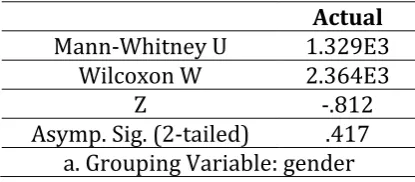
It is now of importance to see if there is any significant difference between the way male and female EFL students viewed the environment in which they were studying. Table 4 shows the results of the Mann-Whitney U Test concerning the differences between males and females’ views of the actual learning environment.
Table 4. Results of Mann-Whitney U Test for Differences in Males and Females
Perceptions of Actual Learning Environment
Actual
Mann-Whitney U 1.329E3
Wilcoxon W 2.364E3
Z -.812
Asymp. Sig. (2-tailed) .417 a. Grouping Variable: gender
As can be seen in the table, the difference between male and female participants’ perceptions of the actual learning environment is not significant (U = 1.329, P > 0.05) at 95% confidence interval. So, it can be said that the male and female participants in this study had no significantly different perceptions of the actual learning environment in which they were educating at the time when the present study was conducted. In other words, the male and female participants expressed similar views concerning the actual learning environments. Table 5 presents the results of independent-sample t-test for male and female participants’ perceptions of preferred learning environment.
Table 5. Male and Female Participants’ Perceptions of Preferred Learning Environment
Gender N Mean Std. Deviation Std. Error Mean Preferred Male 45 223.69 23.895 3.562
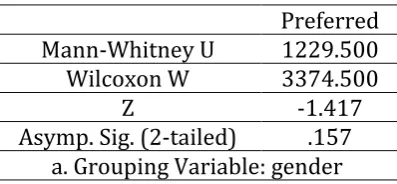
As can be seen in the above table, the mean score of male participants is 223.69 and that of female participants is 214.51. Accordingly, male participants had a slightly higher perceptions of their preferred learning environment than the female participants. However, it seems that the difference between male and female participants’ perceptions of the preferred learning environment is not significant as shown in Table 6:
Table 6. Results of Mann-Whitney U Test for Differences in Males and Females
Perceptions of Preferred Learning Environment Preferred Mann-Whitney U 1229.500 Wilcoxon W 3374.500
Z -1.417
Asymp. Sig. (2-tailed) .157 a. Grouping Variable: gender
As it is evident in the table, there is no significant difference between male and female participants’ perceptions of their preferred learning environment (U = 1.329, P > 0.05), suggesting that as was the case for the actual learning environment, male and female participants in this study had similar views concerning their preferred learning environment that is the environment they were willing to learn English. Table 4.7 presents a comparison of male participants’ perceptions of actual and preferred learning environments and female participants’ perceptions of these two learning environments.
Table 7. Males and Females’ Perceptions of Actual and Preferred Learning Environments
Gender Environments Mean Mean Differences Male Actual 180.33 43..36
Preferred 223.69
Female Actual 184.91 29.6 Preferred 214.51
As is evident in the table, the mean scores of male participants’ perceptions of actual and preferred learning environments are 180.33 and 223.69 and their mean difference is 43..36. Moreover, the mean scores of female participants’ perceptions of actual and preferred learning environments are 184.91 and 214.51 with a mean difference of 29.6. Consequently, the mean difference for male participants’ perceptions of actual and preferred learning environments is greater than the mean difference for these two types of environments in female participants’ viewpoints. As such, it can be said that the female participants were more satisfied with their actual leaning environment than male participants were. In other words, the male participants in this study were more dissatisfied with the actual learning environment than female participants were.
Participants’ Scores on the English Proficiency Test
participants’ language proficiency and their perceptions of the learning environment in English language institutes. Table 8 shows how the participants performed on the English proficiency test:
Table 8. Descriptive statistics for the participants’ scores on the proficiency test Proficiency N Minimum Maximum Mean Std. Deviation
Scores 110 15 42 26.67 6.076
Valid N (listwise) 110
As the above table indicates, the total mean score of the participants in the English proficiency test is 26.67 out of 50 which shows that the participants had a relatively poor performance in the proficiency test. Besides, the minimum score is 15 and the maximum score is 42. Table 9 presents the mean scores of male and female participants on the English proficiency test:
Table 9. Male and female participants’ scores on the proficiency test Gender N Mean Std. Deviation Std. Error Mean Sig. (2-tailed)
Males 45 25.38 5.726 .854 .063
Females 65 27.57 6.192 .768 .059
As shown in the above table, the mean score of the male participants in the proficiency test is 25.38 and that of the female participants is 27.57. Therefore, the female participants scored higher than male participants in the proficiency test. In other words, female participants had a better performance in the proficiency test than male participants did. However, as the value of significance level indicates, there is no significant difference between male and females’ performance in the proficiency test (P > 0.05). In other words, both male and female participants performed similarly in the proficiency test.
Relationship between Participants’ Perceptions of Actual and Preferred Learning Environment and Their English Proficiency
This section examines the relationship between participants’ perceptions of actual learning environment and their English proficiency level. Table 10 shows the results of Pearson correlation coefficient between participants’ perceptions of actual learning environment and their English proficiency level.
Table 10. Correlation between participants’ perceptions of actual learning environment and their English proficiency
Correlation Proficiency Actual
Motivation Pearson Correlation 1 .019
Sig. (2-tailed) .842
As can be seen, the value of correlation coefficient between the participants’ perceptions of actual learning environment and their English proficiency is 0.19. Therefore, there is a weak positive correlation between participants’ perceptions of actual learning environment and their English proficiency. In addition, as the value of significance level shows (P > 0.05), this correlation is not significant. So, there is no significant relationship between the participants’ perceptions of actual learning environment and their English proficiency. Table 11 presents the results of Pearson correlation coefficient for participants’ perceptions of preferred learning environment and their English proficiency level.
Table 11. Correlation between participants’ perceptions of preferred learning environment and their English proficiency
Correlation Proficiency Preferred
Motivation Pearson Correlation 1 .446**
Sig. (2-tailed) .000
N 110 110
As evident in the above table, the value of correlation coefficient between the participants’ perceptions of preferred learning environment and their English proficiency level is 0.446. As a result, there is a moderate correlation between participants’ perceptions of preferred learning environment and their English proficiency. Besides, as the value of significance level shows, this correlation is significant (P < 0.01). So, there is a significant relationship between the participants’ perceptions of their preferred learning environment and their English proficiency level. Table 12 shows the results of Pearson correlation coefficient for male participants’ perceptions of actual learning environment and their English proficiency level.
Table 12. Correlation between male participants’ perceptions of actual learning environment and their English proficiency
Correlation Proficiency Actual
Motivation Pearson Correlation 1 -.323*
Sig. (2-tailed) .030
N 45 45
Table 13. Correlation between female participants’ perceptions of actual learning environment and their English proficiency
Correlation Proficiency Actual
Motivation Pearson Correlation 1 .254*
Sig. (2-tailed) .041
N 65 65
As can be seen in the above table, the value of correlation coefficient for the female participants’ perceptions of actual learning environment and their English proficiency is 0.254. Accordingly, there is a slightly positive correlation between females’ perceptions of actual learning environment and their English proficiency level. Moreover, as the value of significance level suggests (P < 0.05); there is a significant relationship between the female participants’ perceptions of actual learning environment and their English proficiency level.
Our findings showed that there was a significant relationship between the male and female participants’ perceptions of actual learning environment and their English proficiency level. Now, let’s consider the correlation between male and female participants’ perceptions of preferred learning environment and their English proficiency level. Table 14 shows the results of Pearson correlation coefficient for male participants’ perceptions of preferred learning environment and their English proficiency level.
Table 14. Correlation between male participants’ perceptions of preferred learning environment and their English proficiency
Correlation Proficiency Preferred
Motivation Pearson Correlation 1 .295*
Sig. (2-tailed) .049
N 45 45
As evident in the table, the value of correlation coefficient for the males’ perceptions of preferred learning environment and their English proficiency is 0. 295. Accordingly, it can be suggested that there is a relatively positive correlation between males’ perceptions of preferred learning environment and their English proficiency level. Besides, as the value of significance level indicates (P < 0.05); there is a significant relationship between males’ perceptions of preferred learning environment and their English proficiency level.
Table 15. Correlation between female participants’ perceptions of preferred learning environment and their English proficiency
Correlation Proficiency Preferred
Motivation Pearson Correlation 1 .576**
Sig. (2-tailed) .000
N 65 65
The value of correlation coefficient for females’ perceptions of preferred learning environment and their English proficiency in the above table is 0.576, so there is a moderately positive correlation between females’ perceptions of preferred learning environment and their English proficiency level. Additionally, as the value of significance level shows (P < 0.05); there is a significant relationship between females’ perceptions of preferred learning environment and their English proficiency level.
DISCUSSION
The findings of the present study suggested that the Iranian EFL learners in this study had significantly different views of actual and preferred learning environments. This shows that there was a big difference between the learners’ actual learning environment and the environment in which they were willing to learn language. So, they were not satisfied with the actual learning environment and that’s why they had not have a good performance on the language proficiency test. Such findings are in line with studies done by Waldrip and Fisher (2003), Efe (2009), and Schaal (2010) who have pointed out student’s achievement is higher in those environments in which students feel comfortable and positive.
A possible reason for why the participants were less satisfied with the actual learning environment compared to their favorable learning environment is that the learning environments, whether actual or preferred, are not fully conceptualized or as Papathanassiou et al., (2013) put it “personalized” for both EFL teachers and students in the educational context of Iran. In view of that, EFL researchers and teachers can explore possible ways to fill the gap between differences between actual and preferred learning environments in the perceptions of EFL students i.e. to bring the actual learning environment closer to the environment preferred by language learners in order to enhance their learning outcomes.
environments can be employed as a basis for the improvement of classroom environments (Thorp et al., 1994; Yarrow et al., 1997, cited in Fraser, 2002).
The findings of the study also showed that there was a significant relationship between the participants’ perceptions of their preferred learning environment and their English proficiency level, between the male and female participants’ perceptions of actual learning environment and their English proficiency level as well as between males’ and females’ perceptions of their preferred learning environment and their English proficiency level. This corresponds to the previous research (Fraser, 2002; Waldrip & Fisher, 2003; Efe, 2009; and Schaal, 2010) on the relationships between the classroom environment and student outcomes. However, as mentioned earlier through this study, learning environments have not received much attention in Iran. Besides, both teachers and learners do not have sufficient understanding of the nature and the components of such environments and factors affecting them such as students’ relationships with each other, teacher support, students’ participation in the classroom discussions and tasks, problem solving activities by students, and students’ goals in the learning process which are among dimensions of learning environment (Aldridge & Fraser, 1997).
CONCLUSION
The findings of this showed that there was a significant relationship between the participants’ perceptions of their preferred learning environment and their English proficiency level as indicated by previous research (Fraser, 19994; Fraser, 2002; Waldrip & Fisher, 2003). Besides, the participants were dissatisfied with their actual learning environment as there was a significant difference in their perceptions of actual and preferred learning environment. Accordingly, EFL researchers and teachers must pay more attention to the concept of learning environment to create a favorable learning environment as expected by the students in order to motivate them to achieve higher level of English proficiency.
This study suffered from some limitations. For example, some of the participants’ were unwilling to take part in the study and; therefore, they did not answer the questions carefully and cooperatively. Such responses were excluded from the data analysis in order not to endanger the reliability of the data and the generalization of the findings of the study. Besides, the number of the participants was limited in this study, so the findings must be generalized and used with caution. Using this number of participants was due to manageability concerns, though. Concerning time limitations, only the intermediate Iranian EFL learners were investigated in this study.
Second, future research can focus on learning environments other than English language institute, for instance on learning environments in elementary, middle, and high school. Finally, future researchers can explore EFL learning environments in the view of EFL learners with different proficiency levels to find out what are the effects of such environments on learners’ motivation and their English language proficiency as well as other learning outcomes.
The findings of the study can provide some valuable points which serves as guidelines to be taken into account by EFL teachers and researchers. First, as the findings of the study suggested there was a considerable difference between the participants’ actual learning environment and the preferred learning environment. This suggests that Iranian EFL learners are dissatisfied with their actual learning environment. Accordingly, EFL teachers and educators need to take into account factors that may improve the students’ views about their existing learning environment to make it as much as possible similar to their ideal learning environment. Second, it is suggested that teacher support, involvement, investigation, and equity in the classroom be taken into account by EFL teachers so that they can provide students with more support, to involve them in classroom activities, and pay attention to them and what they need.
REFERENCE
Aldridge, J. M. & Fraser, B. J. (2000). A cross-cultural study of classroom learning environments in Australia and Taiwan. Learning Environments Research, 3, 101-134.
Aldridge, J.M., & Fraser, B.J. (1997). Examining science classroom environments in a
cross-national study. Paper presented at the 12th WAIER Research Forum for the Western
Australian Institute for Educational Research, Perth, Australia.
Aliweh, A. M. (2011). The effect of electronic portfolios on promoting Egyptian EFL college students’ writing competence and autonomy. Asian EFL Journal, 13(2), 90-133.
Appatova, V. & Prats, H. (2008). Effective academic environment for under-prepared
college/university learners: listen to student voices. Paper presented at the 16th EAN
Annual Conference.
Bailey, A. L.; Huang, B. H.; Shin, H. W.; Farnsworth, T., & Butler, F. A. (2007). Developing Academic English Language Proficiency Prototypes for 5th Grade Reading: Psychometric and Linguistic Profiles of Tasks. CSE Technical Report 727. National Center for Research on Evaluation, Standards, and Student Testing (CRESST). Chionh, Y. H. & Fraser, B. J. (1998, April). Validation of the ‘What Is Happening In This Class’
questionnaire. Paper presented at the annual meeting of the National Association
for Research in Science Teaching, San Diego, CA.
Cummins, J. (2000). Putting language proficiency in its place: Responding to critiques of the conversational/academic language distinction. English in Europe: The
Acquisition of a Third Language, 54-83.
Dochy F., Segers, M. (1999). The use of self-, peer and co-assessment in higher education: a review. Studies in Higher Education, 24(3), 331-350.
Efe, R. (2009). Science student teachers attitudes towards reflective practice: differences in subjects and grades. Cypriot Journal of Educational Sciences, 4(2), 72–86.
Fraser, B. J. (1986). Classroom environment. London: Croom Helm.
Fraser, B. J. (1991). Two decades of classroom environment research. In B. J. Fraser, & H. J. Walberg (Eds.). Educational environments: Evaluation, antecedents and
consequences. New York: Pergamon.
Fraser, B. J. (1994). Research on classroom and school climate. In D. Gabel (Ed.).
Handbook of research on science teaching and learning (pp. 493-541). New York:
Macmillan.
Fraser, B. J. (2002). Learning environments research: Yesterday, today and tomorrow. In S. C. Goh, & M. S. Khine (Eds.). Studies in educational learning environment: An
international perspective (pp. 1-25). Singapore: World Scientific.
Fraser, B. J. (2007). Classroom learning environments. In S. K. Abell, & N. G. Lederman (Eds.). Handbook of research on science education (pp. 103-124). Mahwah, NJ: Lawrence Erlbaum.
Fraser, B. J., Fisher, D. L., & McRobbie, C. J. (1996). Development, validation and use of
personal and class forms of a new classroom environment instrument. Paper
presented at the annual meeting of the American Educational Research Association, New York, USA.
Galbraith, M. W. (1989). Essential skills for the facilitator of adult learning. Lifelong
Learning: An Omnibus of Practice and Research, 12(6), 10-13.
Galbraith, M. W. (1990). Attributes and skills of an adult educator. In M. W. Galbraith (ed.),
Adult Learning Methods. Malabar, Fla.: Robert E. Krieger.
Goh, S. C. & Fraser, B. J. (1998). Teacher interpersonal behavior, classroom environment and student outcomes in primary mathematics in Singapore. Learning Environment
Research, 1, 199-229.
Haertel, G. D.; Walberg, H. J.; & Haertel, E. H. (1981). Social-psychological environments and learning: A quantitative synthesis. British Educational Research Journal. 7(1), 27-36.
Heikkiä A. & Lonka K. (2006). Studying in higher education. Students’ approaches to learning, self-regulation, and cognitive strategies. Studies in Higher Education, 31(1), 99-117.
Johnson, B. & McClure, R. (2004). Validity and reliability of a shortened version of the constructivist learning environment survey (CLES). Learning Environments
Research, 7, 65-80.
Khoo, H. S., & Fraser, B. J. (2008). Using classroom psychosocial environment in the evaluation of adult computer application courses in Singapore. Technology,
Kolb A.Y., Kolb D.A. (2005). Learning Styles and Learning Spaces: Enhancing Experiential Learning in Higher Education. Academy of Management Learning & Education, 4(2), 193–212.
Lizzio A., Wilson K., & Simons R. (2002). University students' perceptions of the learning environment and academic outcomes: Implications for theory and practice. Studies
in Higher Education, 27(1), 27-52.
MacSwan, J., & Pray, L. (2005). Learning English bilingually: Age of onset of exposure and rate of acquisition among English language learners in a bilingual education program. Bilingual Research Journal, 29(3), 653-678.
Margianti, E.S.; Fraser, B.J.; & Aldridge, J.M. (2001). Classroom environment and students’
outcomes among university computing students in Indonesia. Paper presented at the
annual meeting of the American Educational Research Association, Seattle, WA. Papathanassiou, N., Pistofidis, P., & Emmanouilidis, C. (2013). Competencies development
and self-assessment in maintenance management e-training. European Journal of
Engineering Education, 38(5), 497-511.
Pappas, J. P. (1990). Environmental psychology of the learning sanctuary. In E. G. Simpson and C. E. Kasworm (eds.), Revitalizing the residential conference center environment.
New Directions for Adult and Continuing Education, no. 46. San Francisco:
Jossey-Bass.
Poth, J. E. & Fraser, B. J. (2001). Science classroom environments in a middle school
undergoing reform. Paper presented at the annual meeting of the American
Educational Research Association, San Diego, CA.
Quek, C.L.; Fraser, B.; & Wong, A.F.L. (2001). Determinants and effects of perceptions of chemistry learning environments in secondary school gifted education classes in
Singapore. Paper presented at the annual Conference of the Australian Association
for Research in Education, Fremantle, Australia.
Schaal, S. (2010). Enriching traditional biology lectures digital concept maps and their influence on cognition and motivation. World Journal on Educational Technology, 2(1), 42–54.
Teh, G. & Fraser, B.J. (1995). Associations between student outcomes and geography classroom environment. International Research in Geographical and Environmental
Education, 4(1), 3-18.
Thorp, H., Burden, R.L. & Fraser, B.J. (1994). Assessing and improving classroom environment. School Science Review, 75, 107–113.
Waldrip, B. & Fisher, D. (2003). Identifying exemplary science teachers through their classroom interactions with students. Learning Environments Research: An
International Journal, 6,157-174.
Wong, A. L. F. & Fraser, B. J. (1996). Environment-attitude associations in the chemistry laboratory classroom. Research in Science and Technological Education, 14, 91-102. Yarrow, A.; Millwater, J.; & Fraser, B. (1997). Improving university and primary school
classroom environments through preservice teachers’ action research.