Persistence of a commercial codling moth
granulovirus product on apple fruit and foliage
J.E. COSSENTINE
1,2and L.B.M. JENSEN
1ABSTRACT
Codling moth, Cydia pomonella (L.), larval bioassays were carried out on apples and leaves collected from trees treated with the commercially available codling moth granu-lovirus, Virosoft CP4®, to estimate the persistence of the product over time. The virus
had a significant effect on survival of laboratory derived codling moth larvae placed on apples collected up to five and eight days post-treatment. Larvae died with virus symp-toms after feeding on treated foliage and the leaf bioassay was easier to count than the apple bioassay. A combination assay, exposing larvae to leaf discs and fruit may more accurately account for potential exposure of wild neonate codling moth to virus in treated orchards. The addition of fish, soybean or mineral oils to Virosoft CP4®
treat-ments did not significantly increase the efficacy or persistence of the viral insecticide on apples in this study.
Key Words:Virosoft CP4®, leaf discs, Cydia pomonella
INTRODUCTION
The codling moth granulovirus (CpGV) (Baculoviridae) is found in wild and colo-nized codling moth (Cydia pomonella (L.), Lepidoptera: Tortricidae) (Tanada 1964; Eastwell et al. 1999) which is a major pest of apples and pears throughout most of the temperate world (Cross et al. 1999). CpGV is noted for its high virulence when in-gested by this host, particularly in the neo-nate stage (Sheppard and Stairs 1976; Tanada and Leutenegger 1968). Commer-cial formulations of the virus have been registered for use against the codling moth in Europe since 1988 and in the U.S.A. since 1995. In 2000, Virosoft CP4®, pro-duced by BioTepp Inc., Quebec, became registered for use on apples and pears in Canada.
Commercial formulations of CpGV require application of aqueous suspensions of the virus onto the apples and foliage of treated trees. There is a relatively short time when a wild codling moth can be ef-fectively exposed to CpGV treatment in an orchard. Most wild codling moth eggs are
oviposited on leaves (Jackson 1979). Neo-nates move over leaf surfaces before find-ing a fruit and chewfind-ing through the surface where they remain, feed and develop through to the last instar. Ballard et al.
(2000) found that CpGV was ingested by codling moth neonates browsing on CpGV treated leaf surfaces, therefore there is the potential for codling moth neonates to en-counter and ingest lethal levels of CpGV on both treated foliage and fruit surfaces.
Orchard trials of various commercial preparations of CpGV have generally shown good early suppression of neonate codling moth (Glen and Payne 1984; Jaques et al. 1987). However, like other viral insecticides, the CpGV is susceptible to inactivation and dilution due to tempera-ture, exposure to sunlight, and precipita-tion (Jaques 1975, 1985; Glen and Payne 1984). CpGV has been found to be 50% inactivated in 2-8 d on apples (Glen and Payne 1984; Jaques et al. 1987; Arthurs and Lacey 2004).
The goal of this study was to determine
the persistence of Virosoft CP4® on apples and foliage under the orchard conditions in the interior of British Columbia (BC), Can-ada. We also evaluated whether various oils, added to the spray mixture, could
in-crease or extend the duration of the Viro-soft CP4®'s efficacy under orchard condi-tions, by possibly improving coverage and increasing the penetration of the virus through the leaf surface.
MATERIALS AND METHODS
All treatments were applied to a high density (1m tree spacing within rows) or-chard of MacIntosh apple trees at the Pa-cific Agri-Food Research Centre, Summer-land, BC.
Virulence of Virosoft CP4 over time on apples and leaves. Two blocks of five rows of high density apple trees were treated with Virosoft CP4® at 239 ml/ha (original preparation: 4x10¹³ occlusion bodies/946.34 ml) on 12 June, 2003 using an air-blast sprayer set to deliver a volume of 2,347.6 L/ha. The Virosoft CP4® was stored refrigerated. An untreated block of trees separated by > 30 trees in the same orchard was used as the control. Two hours after application of the virus, 10 leaves and apples were randomly collected from the treatment and the control. Similar collec-tions were made 1, 4, 6, 8, and 12 days after application of the treatments. The entire trial was replicated on different blocks of trees within the same orchard on 3 July, 2003. Mean ± SE daily tempera-tures during the orchard collection (12-24 June:17.6 ± 3.0 oC; 3-15 July: 22.5 ± 2.3 oC) and the accumulated daily rain that occurred during the June (0.6 ± 1.1 mm/d) and July replications (0 ± 0 mm/d) were similar to daily temperatures (18.8 ± 4.1 oC) and precipitation (0.7 ± 2.3 mm/day) for this area, from 1 June to 15 July, aver-aged over a 5 y period (1999 - 2004) (Anon. 2004).
Codling moth neonates used in the as-says emerged on the same day that the leaves and apples were collected, from egg sheets obtained from the colony of the Okanagan-Kootenay Sterile Insect Release Program (Osoyoos, BC). Five neonate cod-ling moth were placed on the stem end of each collected apple. The apples were sealed in plastic cups and incubated at 24
oC, 16:8 h L:D before codling moth sur-vival was assessed by cutting open the fruit on days 7 and 14. The total number of live larvae in the apple bioassays was a more accurate assessment of the impact of the virus than percentage mortality as larvae occasionally could not be found. Some neonates naturally move off the apple and die by dessication without feeding in apple assays (Laing and Jaques 1980); others disintegrate beyond recognition due to a viral infection or are difficult to locate.
One disc (1 cm diameter) was cut from each leaf, avoiding the center vein, within an hour of their collection and placed on a layer of stikem (Stikem SpecialTM, Phero-Tech Inc., Delta, BC) in a small plastic petri dish. Ten codling moth neonates were placed on each leaf disc. The discs, with the larvae, were placed in the dark for 60 minutes at 22 ± 1 oC to encourage feeding. Larvae that had consumed leaf material frequently had green coloured alimentary canals, green frass and a portion of the leaf surface was scarred. Five larvae which showed evidence of feeding per leaf were transferred to the surface of a pinto-bean based diet (modified from Shorey and Hale 1965) within individual 30-ml plastic cups. The cups were sealed and incubated at 24 oC, 16:8 h L:D until the number of living larvae was assessed on days 7 and 14. Data were analysed using an ANOVA (SAS 2000) and the means were separated within each day the apples or leaves were col-lected with individual ANOVAs and Tukey’s studentized range test.
ha + mineral oil (Superior 70 oil, United Agri Products, Dorchester, ON) at 2L/ha, Virosoft CP4® 239 ml/ha + fish oil (Crocker’s Fish Oil, Inc., Quincy, WA) at 2L /ha or Virosoft CP4® 239 ml/ha + once descummed soybean oil at 2.5 L/ha, 17 June, 2004 using an air-blast sprayer set to deliver a volume of 1,553.6 L/ha. A block of untreated trees separated by >10 trees in the same orchard was used as the control. Ten apples were randomly collected from each treatment and the control at least two hours after application of treatments on day 0, as well as 1, 2, 5, 7, and 10 days post-treatment. The entire trial was repli-cated on 28 June 2004 on different blocks
of trees within the same orchard. Mean ± SE daily temperatures during the orchard collection (17-27 June 2: 22.4 ± 2.5 oC; 28 June to 8 July: 17.3 ± 3.4 oC) and the accu-mulated rain that occurred during the first (2.1 ± 5.5 mm/day) and second replication (0.8 ± 1.3 mm/day) are similar to mean daily temperatures and precipitation for this area, averaged over 5 y, as recorded above. Bioassays were carried out using codling moth neonates on the collected apples as described above. The number of living larvae were counted seven days post exposure. Data were analysed as described for the previous study.
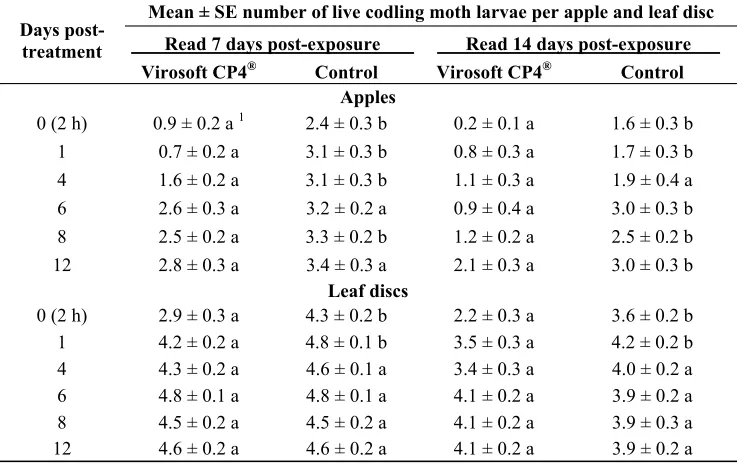
Efficacy of Virosoft CP4 over time on apples and leaves. The Virosoft CP4® had an overall significant impact on the num-ber of codling moth able to survive the virus treatment, compared to control lar-vae, when the data were collected both 7 and 14 days post-exposure to field col-lected apples (7 d: F1, 226 = 77.6, P < 0.0001; 14 d: F1, 226 = 66.7, P < 0.0001). Significantly fewer codling moth larvae survived for seven days in apples from trees treated with the virus, compared to untreated apples, two hours, and 1, 4, and 8 days post-treatment with Virosoft CP4® (Table 1). This significant difference be-tween the number of living larvae in the treated versus control apples was extended to 12 days post-treatment when the data were read on day 14, except in apples col-lected four days post-treatment (Table 1). The number of live codling moth larvae found both in untreated and treated apples was generally lower over all days, when the assays were read at 14 versus 7 days, due to the difficulty locating larvae in the fruit at the later date. The apples had to be carefully sectioned to find the larvae and long term larval mortality data may have been influenced by decay in the fruit. The disappearance and death of a small number of larvae may be partially due to mortality caused by a colony derived CpGV
infec-tion and subsequent disintegrainfec-tion of the dead larvae (personal observation). As this mortality would occur in both treated and control apples any differences in surviving codling moth would be attributable to the treatment. Some additional virus-induced death would be expected to occur between days 7 and 14, however, the poor survivor-ship of larvae in decaying control apples decreases the value of data obtained at this later date.
Codling moth larvae died after consum-ing CpGV in leaf disc assays and Virosoft CP4® had a significant impact on the num-ber of codling moth larvae able to survive the virus treatment, compared to control larvae (7 d: F1, 226 = 12.6, P <0.0005; 14 d: F1, 226 = 7.5, P <0.0007). Significantly fewer living codling moth larvae were found when larvae fed on leaf discs col-lected two hours and one day post-treatment from Virosoft CP4® treated trees, compared to discs from untreated leaves (Table 1). Similar results were found when the number of surviving larvae were counted 7 and 14 days post-exposure. The leaf disc bioassay was easier to count than the apple bioassay as more larvae were found in the former.
The difference in the active persistence of the virus determined in the apple and leaf disc bioassays is probably due to
nates feeding more readily and extensively on the surface of the apple than on the foli-age. Glen and Clark (1985) found that 90% of codling moth neonates hatching from eggs on leaves spent more than 10 min on leaves before moving to the fruit. Penetra-tion of fruit by codling moth has been re-corded to take 1 to 2.5 h (Geier 1963). As the neonates in our study were held for 60 minutes on a leaf disc before transferring them to the diet, each neonate had a realis-tic, but limited chance to ingest the virus. Ballard et al. (2000) did not observe feed-ing by codlfeed-ing moth neonates on leaf tissue until neonates were left for 15 minutes. It is also possible that more virus is accumu-lated near the stem and the calyx ends of apples (Arthurs and Lacey 2004) and many of the codling moth neonates choose these areas of the apple to feed and then pene-trate. Most wild codling moth would en-counter CpGV on both the leaf and apple surfaces, therefore it would be appropriate to improve these assays by exposing
neo-nates to both treated surfaces to obtain a more realistic assessment of potential mor-tality in the orchard.
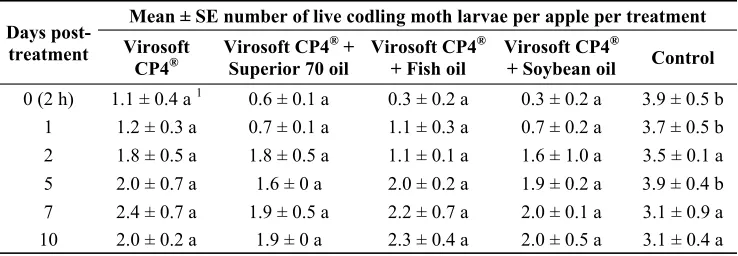
Virosoft CP4 + oils. The virus treat-ments had a significant effect on survival of codling moth larvae (F4, 25 = 32.2, P <0.001). Significantly fewer living codling moth larvae were found in apples collected two hours, one day, and five days post-treatment from trees treated with Virosoft CP4® alone, or in combination with any of the oils, than in the control apples. In ap-ples collected two, seven and ten days post-treatment, this difference was not significant (Table 2). Although the mean numbers of live codling moth larvae per apple in Virosoft CP4® treatments in com-bination with an oil was lower on days 0 and 1, the numbers were not significantly lower than those in the Virosoft CP4® treatment alone.
The virulence of the Virosoft CP4® applied in June and early July, under con-ditions that are typical for the southern
Table 1.
Mean ± SE number of live codling moth larvae found per apple or leaf disc after 7 and 14 days when neonates were placed on Virosoft CP4® treated or control apples or leaf discs. Replicated
twice; n = 10 apples or leaves; 5 codling moth larvae per apple and leaf disc.
1 Means within rows and days post-exposure followed by the same letter are not significantly
different (P > 0.05), determined with Tukey’s studentized range test (SAS 2000).
Days post-treatment
Mean ± SE number of live codling moth larvae per apple and leaf disc Read 7 days post-exposure Read 14 days post-exposure
Virosoft CP4® Control Virosoft CP4® Control
Apples
0 (2 h) 0.9 ± 0.2 a 1 2.4 ± 0.3 b 0.2 ± 0.1 a 1.6 ± 0.3 b
1 0.7 ± 0.2 a 3.1 ± 0.3 b 0.8 ± 0.3 a 1.7 ± 0.3 b 4 1.6 ± 0.2 a 3.1 ± 0.3 b 1.1 ± 0.3 a 1.9 ± 0.4 a 6 2.6 ± 0.3 a 3.2 ± 0.2 a 0.9 ± 0.4 a 3.0 ± 0.3 b 8 2.5 ± 0.2 a 3.3 ± 0.2 b 1.2 ± 0.2 a 2.5 ± 0.2 b 12 2.8 ± 0.3 a 3.4 ± 0.3 a 2.1 ± 0.3 a 3.0 ± 0.3 b
0 (2 h) 2.9 ± 0.3 a 4.3 ± 0.2 b 2.2 ± 0.3 a 3.6 ± 0.2 b 1 4.2 ± 0.2 a 4.8 ± 0.1 b 3.5 ± 0.3 a 4.2 ± 0.2 b 4 4.3 ± 0.2 a 4.6 ± 0.1 a 3.4 ± 0.3 a 4.0 ± 0.2 a 6 4.8 ± 0.1 a 4.8 ± 0.1 a 4.1 ± 0.2 a 3.9 ± 0.2 a 8 4.5 ± 0.2 a 4.5 ± 0.2 a 4.1 ± 0.2 a 3.9 ± 0.3 a 12 4.6 ± 0.2 a 4.6 ± 0.2 a 4.1 ± 0.2 a 3.9 ± 0.2 a
interior of BC, decreased quickly over time in both trials. In orchard trials in Washing-ton State, Arthurs and Lacey (2000) found a similar decline in activity and estimated a Virosoft CP4® (3.2 oz/ac) half-life on ap-ples to be 3.8 to 8.7 d post June and July treatments, respectively. It is important to
recognize that our study was carried out using colony derived larvae and that wild codling moth larvae may feed on treated apple tree leaves and fruit differently under orchard conditions, which may modify the impact of the virus on the host.
Table 2.
Mean ± SE number of live codling moth larvae per apple after 7 days when neonates were placed on fruit treated with Virosoft CP4® combined with one of three oils, or nothing.
Repli-cated twice; n = 10 apples; 5 codling moth larvae per apple.
1 Means within rows followed by the same letter are not significantly different (P > 0.05) as
determined with Tukey’s studentized range test (SAS, 2000).
Days post-treatment
Mean ± SE number of live codling moth larvae per apple per treatment Virosoft
CP4® Virosoft CP4 ® +
Superior 70 oil Virosoft CP4
®
+ Fish oil Virosoft CP4
®
+ Soybean oil Control
0 (2 h) 1.1 ± 0.4 a 1 0.6 ± 0.1 a 0.3 ± 0.2 a 0.3 ± 0.2 a 3.9 ± 0.5 b
1 1.2 ± 0.3 a 0.7 ± 0.1 a 1.1 ± 0.3 a 0.7 ± 0.2 a 3.7 ± 0.5 b 2 1.8 ± 0.5 a 1.8 ± 0.5 a 1.1 ± 0.1 a 1.6 ± 1.0 a 3.5 ± 0.1 a 5 2.0 ± 0.7 a 1.6 ± 0 a 2.0 ± 0.2 a 1.9 ± 0.2 a 3.9 ± 0.4 b 7 2.4 ± 0.7 a 1.9 ± 0.5 a 2.2 ± 0.7 a 2.0 ± 0.1 a 3.1 ± 0.9 a 10 2.0 ± 0.2 a 1.9 ± 0 a 2.3 ± 0.4 a 2.0 ± 0.5 a 3.1 ± 0.4 a
ACKNOWLEDGEMENTS
We are grateful to B. Tiffin (Pacific
Agri-Food Research Centre, Summerland) for applying the treatments in the orchard.
REFERENCES
Anon. 2004. PARC Summerland weather. Http://res2.agr.ca/parc-crapac/summerland/ clim/index_e.htm. Arthurs, S.P. and L.A. Lacey. 2004. Field evaluation of commercial formulations of the codling moth
granulovirus: persistence of activity and success of seasonal applications against natural infestations of codling moth in Pacific Northwest apple orchards. Biological Control 31: 388-397.
Ballard, J., D.J. Ellis and C.C. Payne. 2000. Uptake of granulovirus from the surface of apples and leaves by first instar larvae of the codling moth Cydia pomonella L. (Lepidoptera: Olethreutidae). Biocontrol Science and Technology 10: 617-625.
Cross, J.V., M.G. Solomon, D. Chandler, P.J. Jarrett, P.N. Richardson, D. Winstanley, H. Bathon, J. Huber, B. Keller, G.A. Langenbruch and G. Zimmermann. 1999. Review of biocontrol of pests of apples and pears in northern and central Europe: 1. Microbial agents and nematodes. Biocontrol Sci-ence and Technology 9: 125-149.
Eastwell, K.C., J.E. Cossentine and M.G. Bernardy. 1999. Characterization of Cydia pomonella granu-lovirus from codling moths in a laboratory colony and in orchards in British Columbia. Annals of Applied Biology 134: 285-291.
Geier, P.W. 1963. The history of the codling moth, Cydia pomonella (L.) (Lepidoptera: Tortricidae), in the Australian Capital Territory. Australian Journal of Zoology 11: 323-367.
Glen, D.M. and J. Clark. 1985. Death of Cydia pomonella larvae and damage to apple fruit, after field application of codling moth granulosis virus. Entomologia Experimentalis et Applicata 38: 93-96. Glen, D.M. and C.C. Payne. 1984. Production and field evaluation of codling moth granulosis virus for
control of Cydia pomonella in the United Kingdom. Annals of Applied Biology 104: 87-98.
Entomologi-cal Society of America 72: 361-368.
Jaques, R.P. 1975. Persistence, accumulation and denaturation of nuclear polyhedrosis and granulosis viruses, pp. 90-99. In M.D. Summers, R. Engler., L.A. Falcon, and P. Vail (Eds), Baculoviruses for Insect Pest Control: Safety Considerations. American Society for Microbiology, Washington DC. Jaques, R.P. 1985. Stability of insect viruses in the environment, pp. 285-360. In K. Maramorosch and
K.E. Sherman (Eds) Viral Insecticides for Biological Control. Academic Press, New York.
Jaques, R.P., J.E. Laing, D.R. Laing and D.S.K. Yu. 1987. Effectiveness and persistence of the granulosis virus of the codling moth Cydia pomonella (L.) (Lepidoptera: Olethreutidae) on apple. The Canadian Entomologist 119: 1063-1067.
Laing, D.R. and R.P. Jaques. 1980. Codling moth: techniques for rearing larvae and bioassaying granulo-sis virus. Journal of Economic Entomology 73: 851-853.
SAS 2000. Proc GLM Users Manual Version 8.1. SAS Institute, Cary, NC.
Sheppard, H. H. and G.R. Stairs. 1976. Effects of dissemination of low dosage levels of a granulosis virus in populations of the codling moth. Journal of Economic Entomology 69: 583-586.
Shorey, H.H. and R.L. Hale. 1965. Mass-rearing of the larvae of nine noctuid species on a simple artificial medium. Journal of Economic Entomology 58: 522-524.
Tanada, Y. 1964. A granulosis virus of codling moth, Carpocapsa pomonella (Linnaeus) (Olethreutidae, Lepidoptera). Journal of Invertebrate Pathology 6: 378-380.
Tanada, Y. and R. Leutenegger. 1968. Histopathology of a granulosis-virus disease of the codling moth,