ISSN: 2286-2668 © College of Management (NUPSPA) & Tritonic Books
Conceptual Diagnosis Model Based on Distinct Knowledge Dyads
for Interdisciplinary Environments
Cristian VIZITIU
Bucharest University of Economic Studies 2-2A Calea Grivitei, sector 3, 010731, Bucharest, Romania
Abstract. The present paper has a synergic dual purpose of bringing a psychological and neuroscience related perspective oriented towards decision making and knowledge creation diagnosis in the frame of Knowledge Management. The conceptual model is built by means of Cognitive-Emotional and Explicit-Tacit knowledge dyads and structured on Analytic Hierar-chy Process (AHP) according to the hypothesis which designates the first dyad as an accessing mechanism of knowledge stored in the second dyad. Due to the well acknowledged needs concerning new advanced decision making instruments and enhanced knowledge creation processes in the field of technical space projects emphasized by a high level of complexity, the herein study tries also to prove the relevance of the proposed conceptual diagnosis model in Systems Engineering (SE) methodology which foresees at its turn concurrent engineering within interdisciplinary working environments. The theoretical model, entitled DiagnoSE, has the potential to provide practical implications to space/space related business sector but not merely, and on the other hand, to trigger and inspire other knowledge management re-lated researches for refining and testing the proposed instrument in SE or other similar deci-sion making based working environment.
Keywords: knowledge management, decision making, knowledge creation, cognitive-emo-tional, explicit-tacit knowledge dyad, systems engineering (SE), DiagnoSE.
Introduction
Lawson & Samson, 2001; Branzei & Vertinsky, 2006) with important contribu-tions from neuro-psycho-economics (Sanfey, Loewenstein, McClure, & Cohen, 2006; Camerer, Loewenstein, & Prelec, 2005). In this context, there has arisen the request also for further behavioral decision research in order to obtain a higher efficiency within complex technological projects made by means of spe-cific project engineering methodologies deployed in interdisciplinary working environments (Glimcher, Fehr, Camerer, & Poldrac, 2009; Camerer et al., 2005).
In any project team, especially in those interdisciplinary related, there is a huge “amount of knowledge” under continuous transformation in order to en-able work performance, and whose flow characteristic is called knowledge dy-namics (Vizitiu & Văleanu, 2012; Nissen, 2006). Knowledge dydy-namics encom-passes besides the knowledge transfer, transformation and sharing processes, also the key to continuous and radical innovations in terms of knowledge creation (Brătianu, 2013), and inherently the decision making valuable pro-cesses. In this vision of knowledge dynamics, mostly pointing out knowledge creation and decision making components, the Japanese intellectual tradition and its economic sector advocate a specific type of knowledge epistemology which lays in the distinction and conversion between tacit and explicit knowl-edge, as being the cornerstone to continuous innovation at individual, group, organizational and inter-organizational levels (Nonaka & Takeuchi, 1995; Nonaka, Toyama, & Byosiere, 2001). More than that, Brătianu developed a new dyad in the knowledge dynamics field composed by cognitive knowledge and emotional knowledge (Brătianu, 2008; Brătianu, 2011a,b; Brătianu & An-driessen, 2008), and also affirmed that Cognitive-Emotional and Explicit-Tac-it knowledge dyads illustrate the Eastern and Western cultures characterized by oneness of body and mind, and by their dualism respectively (Brătianu, Mandruleanu, Vasilache, & Dumitru, 2011), but both reflecting comprehen-sive aspects for knowledge creation and decision making.
The initiative of the herein paper of carrying out a diagnosis concept model upon decision making and knowledge creation within complex technological projects, suits very well with Systems Engineering (SE) methodology due to its decision making connection with and innovativeness related provisions.
SE methodology is an interdisciplinary approach which concerns “sequence of activities and decisions towards identifying technological and market oppor-tunities, and converting customers' operational needs into system specifications and configurations” (Tanţău, Vizitiu & Văleanu, 2014, p.112) in order to ho-listically achieve some of the most complex technical challenges (Pyster, Ol-well, Hutchison, Enck, Anthony, Henry & Squires, 2012). SE methodology has been developed six decades ago for implementing the technological projects with high complexity in the space sector and nowadays continues to be ap-plied also in other areas with stringent requirements (International Council on Systems Engineering [INCOSE], 2000) as robotic surgery, space based ap-plications for societal needs, automotive industry and so forth.
Besides the highly weight of decision making in SE, this methodology is also considered to be in a great measure dependent on the knowledge creation process (Vizitiu & Văleanu, 2012), in consequence to meet burgeoning in-novations and explorations from the space complex sector (European Space Agency [ESA] Annual report, 2011) and not merely. Even though SE envis-ages and facilitates decision making and knowledge creation, The National Aeronautics and Space Administration (NASA) has been required the devel-opment of new advanced decision making tools for an increased efficiency of the SE process (The National Aeronautics and Space Administration [NASA], 2007; 1995), and implicitly for a better management in dealing high uncer-tainty and providing the foreseen huge economic benefits.
Hence, the purpose of this paper is to present a new perspective related to psychology and neuroscience fields towards connecting the Cognitive-Emo-tional and Explicit-Tacit knowledge dyads, and accommodating them on the Analytic Hierarchy Process (AHP) mathematical model developed by Saaty (2009) in order to diagnose decision making and knowledge creation within interdisciplinary working environments determined by SE methodology. The conceptual paper is entitled DiagnoSE and tries also to demonstrate its rel-evance and huge benefits upon the Systems Engineering (SE) methodology.
Cognitive-Emo-tional and Explicit-Tacit knowledge dyads in enhancing the decision making process in the frame of SE.
In the following sections of the paper, it is provided a theoretical overview upon the Cognitive-Emotional and Explicit-Tacit knowledge dyads and their connection based on certain aspects residing to psychology and neuroscience, the novel presentation of the construct of the conceptual diagnosis model for SE, a brief illustration of SE methodology including DiagnoSE relevance on SE, and as well future possible researches along with the final conclusions.
Cognitive-Emotional and Explicit-Tacit knowledge dyads
and their connection
Individuals’ thinking patterns or mental models in the form of approximations of the real world represent the key solution to escape from the paradox given by the situation of understanding the unlimited universe using limited minds from the psychological and biological point of view (Brătianu, 2011; Plesu, 2003; Senge, 1990). More than that, mental models “describe a cognitive mecha-nism for representing and making inferences about a system or problem which the user builds as he or she interacts with and learns about the system” (Borgman, 1986, p.48), where the human mind constructs such mental models especially as a result of individuals’ embedded knowledge (Johnson-Laird, Girotto & Legrenziet, 1998). In this context, knowledge consists in the interpretation and representation of the environment we live in, with paramount importance in undertaking decisions, actions and, implicitly, knowledge creation.
Nonaka and Takeuchi (1995) asserted that the dynamics of knowledge cre-ation in any organizcre-ation regards the complementary relcre-ationship between explicit knowledge and tacit knowledge, as its two main building blocks. Thus, the kernel of continuous innovation stands in the interaction of these two types of knowledge at different ontological levels as individual, group, organizational and inter-organizational, and while the tacit knowledge repre-sents the context-specific, or the “personal knowledge embedded in individual experience and involves intangible factors such as personal belief, perspective, and the value system” (Nonaka & Takeuchi, 1995, p.viii), explicit knowledge corresponds to formal, systematic or codified knowledge under the form of mathematical and grammatical statements, and specifications, which is eas-ily transmittable among individuals through manuals, formal courses and so forth.
The entire process of the knowledge creation dynamics lays in a continuous knowledge creation spiral lifted from lower till higher ontological levels as a result of explicit to tacit knowledge and vice versa knowledge transformation, and as well of tacit to tacit knowledge and explicit to explicit knowledge trans-fer. Through the interaction of these two types of knowledge with each other, there are constituted four modes of knowledge conversion, namely Socializa-tion, ExternalizaSocializa-tion, CombinaSocializa-tion, and Internalization (SECI), also consid-ered the engine of the knowledge creation process (Nonaka & Takeuchi, 1995; Vizitiu & Văleanu, 2012; Brătianu, 2010).
With respect to Explicit-Tacit knowledge dyad functioning, it is mentioned in the literature the fact that tacit knowledge is hard to be formal articulated and conveyed among individuals, and at the individual level it is stored in the non-conscious part of the brain, and non-rational in its nature because the lack of aware when using it, while explicit knowledge is rational since we consciously use it and easily explain and transfer to others (Brătianu et al., 2011).
connec-tion of Cognitive-Emoconnec-tional knowledge dyad components with the relaconnec-tion- relation-ship between an elephant (i.e. emotional side of the individual) with its rider (i.e. rationality side of the individual), strongly emphasizing in this way the precarious control of rationality upon emotions in the form of rider’s control upon the huge animal.
In the psychology, the relation between cognition and emotions still finds un-der a scientific dilemma in a certain extent (Eysenck & Keane, 2002), but con-crete aspects analyzed by researchers from this field shown that emotions are determined by explicit and tacit knowledge with implications at conscious or non-conscious level of the rationality process, and at their turn, emotions may have a powerful influence on decision making and behaviors (Ortony, Clore & Collins, 1990; Resnick, 2012; Zerbe, Härtel & Ashkanasy, 2008). More than that, in the frame of decision making and in case of emergency situations, it is generally attested that emotions could force and enable the individuals through a short-cut to the mind and outrunning the cognitive processes to react or make decisions based on their embedded knowledge (Hill, 2008; Brătianu et al., 2011). On the other side, cognition determines the process-ing capacity of individuals, enablprocess-ing them to organize, to learn and so forth (Churchland, 2002), while the interaction with emotions could be none in case of standard emotions, or intensively in case of emotion-inducing percep-tions (Ortony et al., 1990).
Zerbe, Härtel and Ashkanasy (2008) stress an important fact in decision mak-ing process, namely that cognition and emotions could represent access ways in the stored knowledge, and furthermore it can be understood that deliber-ately or not, decision making could be undertaken either by cognition and emotions, or just by one of them.
fainter representation with the one prior body expressed, and as consequence the decision is made in the “as-if-loop” anatomical system. Furthermore, it has been discovered the fact that “body loop” physiologic event is engaged when decisions encompasses ambiguity and risks, while under certainty, with no risks at all, “as-if-loop” is emerged (Bechara, 2004). Related to “as-if-loop”, it could be affirmed that after emotions are experienced, tacit knowledge is stored in the brain under the form of experience representations, and after-wards, when the case of dealing with similar decisions, there is accessed the stored necessary knowledge.
Based on the theoretical overview upon the Cognitive-Emotional and Explic-it-Tacit knowledge dyads residing to Knowledge Management, psychology and neuroscience, it can be drawn some conclusions with respect to their con-nection. Hence, the analyzed dyads are different in the field of action, namely underlining the Explicit-Tacit knowledge dyad orientation towards structuring and storing knowledge, while the Cognitive-Emotional knowledge dyad is con-sidered to act as a slow vs. quick, deliberate vs. intuitive mechanism for accessing knowledge from the Explicit-Tacit dyad and use it accordingly in decision mak-ing processes.
Besides the already drawn conclusion, there is the need to ascertain also the benefit of the Explicit-Tacit knowledge dyad in knowledge creation dynamics by means of SECI. Thus, according to the established hypothesis which des-ignates the Cognitive-Emotional dyad as an accessing mechanism of knowl-edge stored in the Explicit-Tacit dyad, and further on the SECI knowlknowl-edge creating potential identified in the Japanese knowledge literature, the herein paper presents a novel decision making diagnosis instrument suitable for in-terdisciplinary environments as enabled by SE methodology, in which it can be distinguished the technical project teams‘ predisposition to make decisions with respect to rationality, emotionality and project specific objective proce-dures, and more to diagnose the knowledge creation dynamics, all these to the purpose of enhancing decision making processes.
The proposed conceptual diagnosis model
in decision making: DiagnoSE
re-lation between the Cognitive-Emotional and Explicit-Tacit knowledge dyads, and their accommodation on Analytic Hierarchy Process (AHP) mathemati-cal method developed by Saaty (2009).
The first cornerstone of DiagnoSE construct is represented by two main prin-ciples. The first principle affirms that the analyzed dyads are different in the field of action, namely the Explicit-Tacit knowledge dyad is oriented towards structuring and storing knowledge, while the Cognitive-Emotional knowl-edge dyad acts as a slow vs. quick, deliberate vs. intuitive mechanism for ac-cessing knowledge from the Explicit-Tacit dyad and use it accordingly in de-cision making processes. The first principle acknowledges also the character-istic of the Explicit-Tacit knowledge dyad as being responsible to knowledge creation dynamics within groups of individuals. On the other side, the second principle concerns the fact that organizational decision making process is not always undertaken deliberately or influenced by cognition therefore it can be identified a specific decision making predisposition of individuals between rationality, emotionality and project specific procedural protocols.
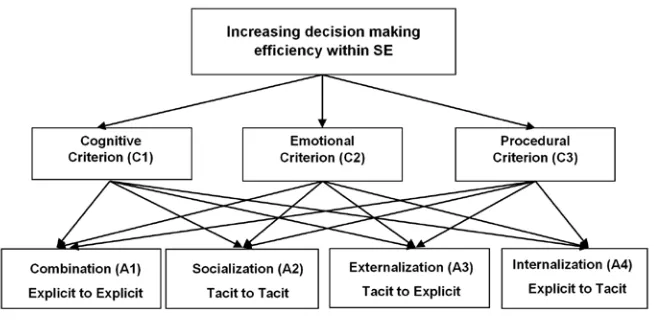
The second cornerstone of DiagnoSE construct regards the dyads algorithm described in the first cornerstone accommodated as a psychometric model on the AHP mathematical structure. Taking into account that AHP has the potential to structure the main decision problem into a hierarchy and resides to the group of Multi Criteria Decision Making (MCDM) methods (Brătianu & Orzea. 2013; Saaty, 1994), DiagnoSE by means of AHP envisages a three level hierarchy where at the top defines the goal of increasing decision mak-ing efficiency within interdisciplinary environments, as SE could enable, at the second level involves Cognitive-Emotional knowledge dyad components and the procedural component in the frame of decision criteria, while at the third level includes Explicit-Tacit knowledge dyad components as activities, under the form of SECI knowledge creating engine, in order to support each criterion and furthermore the global goal.
Thus, DiagnoSE envisages the Explicit-Tacit and Cognitive-Emotional knowl-edge dyads accommodated on AHP as it is illustrated in the Figure 1, in order to provide a proper decision making and knowledge creation dynamics diag-nosis.
Figure 1. DiagnoSE according to AHP method
The main components of the knowledge dyads are organized systematically on three levels in format of AHP and explained in the following section.
The top level of DiagnoSE represents actually the goal level and corresponds to “increasing decision making efficiency within interdisciplinary working envi-ronments, as SE is represented”.
The second level of DiagnoSE corresponds to criteria formulated to achieve the goal, and which consist actually into the Cognitive-Emotional dyad ele-ments together with the procedural component, defined as follows: the Cog-nitive Criterion (C1) translated as the rational, quantitative and objective cri-terion based on the individual’s own judgment; the Emotional Criterion (C2) seen as the subjective and qualitative criterion based on the individual’s own preferences, perspectives, intuitions; the Procedural Criterion (C3) based on the objectively administrative project procedures, standards and work plans which are totally unrelated to individual’ preferences, but needed to be con-sidered in some moments of SE projects progression.
envi-ronments described by SE through the considered criteria. This is the level of implementation and whose components are constituted by the Explicit-Tacit knowledge dyad elements in the form of SECI knowledge creation engine, as Japanese tradition developed it.
With respect to the elements residing to the third level of DiagnoSE, these are the four modes of knowledge conversion-Socialization, Externalization, Combination, Internalization, emerged due to the interaction between Ex-plicit and Tacit knowledge at different ontological levels, and according to the specific Knowledge Management literature (Nonaka & Takeuchi, 1995; Nonaka et al., 2001; Brătianu, 2010), their meanings are the followings: Com-bination represents a process of knowledge transfer (i.e. explicit knowledge to explicit knowledge), resulted by social and formal interactions among in-dividuals through virtual communication networks, face to face meetings, phone conversations, documents collection and so forth; Socialization,as the previous process, is also oriented to knowledge transfer (i.e. tacit knowledge to tacit knowledge) and foresees the process of sharing context related experi-ences among individuals through informal meetings, preferably outside the workplace; Externalization is the key knowledge conversion process (i.e. tacit knowledge into explicit knowledge) in the entire knowledge creation dynam-ics, being enabled when individuals try to clarify concepts or set down skills, articulating in this way their tacit knowledge; while Internalization is a knowl-edge conversion process (i.e. explicit knowlknowl-edge into tacit knowlknowl-edge) at the individual level, and regards mainly leaning by doing process through virtual situations as experiments, or real situations as training programs.
The methodology imposed by AHP consists in numerically quantified paired comparisons of criteria with respect to the goal, and as well of activities with respect to each criterion implementation, in this way building up decisional matrices which can be processed through eigenvalue problems and resulting in vector of priorities. Thus, the priority vectors represent the criteria rank-ing with respect to the goal, and the activities rankrank-ing with respect to each criterion, all these based on individuals’ perceptions in the frame of interdis-ciplinary projects. Finally, it can be obtained through arithmetical averages, also global vectors of priorities which aggregate all questioned individuals’ perceptions, in order to have a great image of the teams’ needs and diagnos-ing decision makdiagnos-ing and knowledge creation dynamics properly, at high level.
de-ploys, namely based on entire groups of individuals’ perceptions, diagnosing decision making predisposition (i.e. by means of criteria level) in order to enhance decision making efficiency within SE, but also diagnosing the knowl-edge creation dynamics (i.e. by means of activities level), whose activities may implement each criterion and further the main goal defined herein. Hence, DiagnoSE provides a novel diagnosis model with synergic dual purpose in increasing decision making efficiency in complex technical projects.
Systems Engineering (SE) methodology and the relevance of DiagnoSE
on this type of interdisciplinary working environments
Systems Engineering (SE) “is an interdisciplinary approach and means to en-able the realization of successful systems. It focuses on holistically and concur-rently understanding stakeholder needs; exploring opportunities; documenting requirements; and synthesizing, verifying, validating, and evolving solutions while considering the complete problem, from system concept exploration through system disposal” (Pyster et al., 2012, p.9). To be mentioned the fact that the term “system” has a wide understanding starting from technological products till possible interconnections of users, processes, knowledge in the form of services with stringent objectives (Tanţău et al., 2014).
SE mission is to assist in developing complex projects through spectacular innovations, implicitly, through continuous knowledge creation (Vizitiu & Văleanu, 2012), and whose developed systems to satisfy new user needs and new user communities in space or on Earth, by means of interdisciplinarity in uncertain technical conditions, being involved large capital investments with benefits in achieving Corporate Entrepreneurship strategy (Vizitiu, Văleanu & Tanţău, 2013).
SE methodology embraces both technical knowledge and systems engineering management (Department of Defense, 2001; INCOSE, 2006), thus including, as needed according to the specific developments, a large amount of multidis-ciplinary engineering knowledge, but also the corresponding management for the guidance of the engineering effort (Tanţău et al., 2014).
compatibility, interactions, interfaces, and so forth in integrating the whole complex system (Kossiakoff, Sweet, Seymour & Biemer, 2011), and as well, im-plicitly passing through the formal phases of SE which characterize a project life cycle as indicated by NASA, namely advanced studies (i.e. Pre-Phase A), preliminary analysis (i.e. Phase A), system definition (i.e. Phase B), system de-sign (i.e. Phase C), system integration/verification (i.e. Phase D), and the last, system operation and disposal (i.e. Phase E) (NASA, 2007; NASA, 1995). Due to its nature of concurrent engineering, SE crucially requires individual and collective judgments whose members’ explicit and tacit knowledge is needed throughout the system life cycle (NASA, 1995; Sage, 1992). More than that, there are some types of decisions whose verification acceptances/validations are imperative for the projects to pass in the next phases, and these decision formalities are called Control Gates (Forsberg & Mooz, 1991) or Key Decision Points (NASA, 2007). NASA emphasizes the need in some cases (e.g. techni-cal issues, trade-off studies etc.) of making decisions within interdisciplinary teams by qualitative evaluations with respect to quantifying the probability of occurrence and corresponding consequences of events (NASA, 1995).
Summarizing the main SE features as involving vital individual/collective mainly qualitative decision making and judgments holistically and concur-rently deployed in the frame of multi/interdisciplinary working environments where the projects outcomes detain high technical uncertainty, there is no doubt in underlining the relevance of DiagnoSE upon SE in diagnosing and enhancing decision making in teams performing complex projects, and in the same time, in knowledge creation dynamics taking into consideration the huge amount of knowledge conveyed among the team members and the re-quested radical innovations.
Conclusions
DiagnoSE envisages the accommodation of the Cognitive-Emotional and Ex-plicit-Tacit knowledge dyads on the Analytic Hierarchy Process (AHP) math-ematical model, and has the synergic dual utility to distinguish the technical project teams’ predisposition to make decisions with respect to rationality, emotionality and project specific objective procedures, and more to diagnose the knowledge creation dynamics, implicitly to identify the right activities for each considered criterion, all these to the purpose of enhancing decision mak-ing processes in interdisciplinary workmak-ing environments.
Taking into account NASA’s requirement with respect to the need for more decision making advanced tools in SE methodology, there is pointing out the opportunity to trigger and inspire other knowledge management related re-searches starting from DiagnoSE with respect to refine and test the proposed instrument upon SE Romanian aerospace sector or, even further, on other similar decision making based working environments, and correlate the re-sults with the teams’ strategies.
In practice, DiagnoSE, the knowledge management psychometric instrument, could provide great benefits in increasing the efficiency of critical decision making processes and of innovation extent in complex project teams, by di-agnosing upon professionals’ perceptions, the specific way to make decisions and the knowledge creation dynamics within the teams, and in consequence leaders (e.g. system engineers, project managers etc.) shall be able to improve and undertake specific activities with the purpose to gain more efficient SE decision makers and to sustain a continuous knowledge creation spiral, all these for achieving more efficient and effective technological projects.
References
Bechara, A. (2004). The role of emotion in decision-making: Evidence from neurological patients with orbitofrontal damage. Brain and Cognition, 55, 30–40.
Borgman, C.L. (1986). The user’s mental model of an information retrieval system: An experiment on a prototype online catalog. International Journal of Man-Machine Studies, 24, 47–64.
Branzei, O., and Vertinsky, I. (2006). Strategic pathways to product innova-tion capabilities in SMEs. Journal of Business Venturing, 21 (1), 75-105.
Brătianu, C. (2010). A critical analysis of Nonaka’s model of knowledge dynamics. In 2nd European Conference on Intellectual Capital, ISCTE Lisbon
University Institute (115-120). Lisbon: Academic Publishing.
Brătianu, C. (2011). Knowledge and Intellectual Capital. Society for Busi-ness Excellence. Bucharest, Romania.
Brătianu, C. (2011a). Changing paradigm for knowledge metaphors from dynamics to thermodynamics. System Research and Behavioral Science, 28, 160-169.
Brătianu, C. (2011b). A new perspective of the intellectual capital dynam-ics in organizations. In Vallejo-Alonso, B., Rodriguez-Castellanos, A., Arre-gui-Ayastuy (Eds.), Identifying, measuring, and valuing knowledge-based in-tangible assets: new perspectives (1-21). Hershey: Business Science Reference.
Brătianu, C. (2013). The Triple Helix of the Organizational Knowledge. Management Dynamics in the Knowledge Economy, 1 (2), 207-220.
Brătianu, C., and Andriessen, D. (2008). Knowledge as energy: a meta-phorical analysis. Proceedings of the 9th European Conference on Knowledge Management, Southampton Solent University, UK, 4-5 September 2008 (75-82). Reading: Academic Publishing International.
Brătianu, C., and Orzea, I. (2009). Emergence of the Cognitive-Emotional Knowledge Dyad. Review of International Comparative Management, 10 (5), 893-901.
Brătianu, C., and Orzea, I. (2013). Knowledge Strategies in Using Social Networks. Management Dynamics in the Knowledge Economy, 1 (1), 25-38.
Brătianu, C., Mandruleanu, A., Vasilache, S., and Dumitru, I. (2011). Busi-ness Management. Bucharest: Editura Universitară.
Camerer, C., Loewenstein, G., and Prelec, D. (2005). Neuroeconomics: how neuroscience can inform economics. Journal of Economic Literature, XLIII, 9–64.
Chang, C-M., Hsu, M-H., and Yen, C-H. (2012). Factors affecting knowl-edge management success: the fit perspective. Journal of Knowledge Manage-ment, 16 (6), 847-861.
Churchland, P.S. (2002). Brain-Wise. Cambridge: MIT Press.
Department of Defense (2001). Systems Engineering Fundamentals. Fort Belvoir, Virginia: Defense Acquisition University Press.
Drucker, P.F. (1993). Post-Capitalist Society. New York: HarperCollins Publishers.
ESA Annual Report (2011). Published by ESA Communication Dep., The Netherlands.
Forsberg, K., and Mooz, H. (1991). The Relationship of System Engineer-ing to the Project Cycle. National Council On Systems EngineerEngineer-ing (NCOSE) and American Society for Engineering Management (ASEM). Chattanoo-ga.
Goldberg, C. (2008). Differences between East and West discovered in people’s brain activity. The Tech, 123(9). Retrieved from http://tech.mit.edu/ V128/N9/culture.html.
Heath, C., and Heath, D. (2010). Switch: How to change things when change is needed. New York: Broadway Books.
Hill, D. (2008). Emotionomics. Leveraging emotions for business success. London: Kogan Page.
INCOSE (2000). Systems Engineering Applications Profiles. Version 3.0. Commercial and Public Interest Working Group.
INCOSE (2006). Systems Engineering Handbook. A Guide for System Life Cycle Processes and Activities. INCOSE-TP-2003-002-03, version 3, USA.
Johnson-Laird, P.N., Girotto, V. & Legrenziet, P. (1998). Mental models: a gentle guide for outsiders. Retrieved from http://www.si.umich.edu/ICOS/ gentleintro.html
Lawson, B., and Samson, D. (2001). Developing innovation capability in organizations: a dynamic capabilities approach. International Journal of In-novation Management, 5 (3), 377-400.
Kossiakoff, A., Sweet, W. N., Seymour, S., and Biemer, S.M. (2011). Systems Engineering Principles and Practice. New Jersey: John Wiley & Sons.
NASA/ SP-610S (1995). NASA Systems Engineering Handbook. Washing-ton: National Aeronautics and Space Administration NASA Headquarters.
NASA/SP-2007-6105 Rev1 (2007). NASA Systems Engineering Handbook. Washington, D.C: National Aeronautics and Space Administration NASA Headquarters.
Nissen, M.E. (2006). Harnessing knowledge dynamics: Principled organiza-tional knowing and learning. London: IRM Press.
Nonaka, I., Toyama, R., and Byosiere, Ph. (2001). A theory of organiza-tional knowledge creation: understanding the dynamic process of creating knowledge. In Dierkes, M., Antal, A.B., Child, J., Nonaka, I. (Eds.), Handbook of organizational learning and knowledge (487-491). Oxford: Oxford Univer-sity Press.
Nonaka, I., and Takeuchi, H. (1995). The knowledge creating company. How Japanese companies create the dynamics of innovation. Oxford: Oxford Univer-sity Press.
Plesu, A. (2003). Jurnalul de la Tescani[The journal from Tescani]. Bucha-rest: Humanitas.
Polanyi, M. (1983). The tacit dimension. Gloucester.
Pyster, A., D. Olwell, N. Hutchison, S. Enck, J. Anthony, D. Henry, and A. Squires (Eds.) (2012). Guide to the Systems Engineering Body of Knowledge (SEBoK) version 1.0. Hoboken, NJ: The Trustees of the Stevens Institute of Technology 2012. Retrieved from http://www.sebokwiki.org
Resnick, M.L. (2012). The Effect of Affect: Decision Making in the Emo-tional Context of Health Care. 2012 Symposium on Human Factors and Ergo-nomics in Health Care, 39-44.
Sanfey, A.G., Loewenstein, G., McClure, S.M., and Cohen, J.D. (2006). Neuroeconomics: cross-currents in research on decision-making. TRENDS in Cognitive Sciences, 10 (3).
Sage, A.P. (1992). Systems Engineering. London: Wiley Interscience Publi-cation.
Saunila, M., and Ukko, J. (2012). A conceptual framework for the measure-ment of innovation capability and its effects. Baltic Journal of Management, 7 (4), 355-375.
Senge, P. (1990). The fifth discipline. The art and practice of the learning organizations. London: Random House.
Saaty, T.L. (2009). Theory and applications of the analytic network process. Decision making with benefits, opportunities, costs and risks. Pittsburgh: RWS Publications.
Tanţău, A.D., Vizitiu, C., and Văleanu, V. (2014). The responsibility of tele-medicine focused organizations in regards to creating compliant end users products and services. Amfiteatru Economic Journal, XVI (35), 108-122.
Vizitiu, C., Văleanu. V., and Tanţău, A.D. (2013). Space based mobile tele-medicine assisted by specific Systems Engineering approach. 6th International Conference on Recent Advances in Space Technologies-RAST 2013 (789-783). Istanbul.
Vizitiu, C., and Văleanu, V. (2012). Case Study: Knowledge Dynamics within The Institute of Space Science – Romania. Proceedings of the „4th Inter-national Conference on Knowledge Management for Space Missions”. Toulouse Space Show 2012.