Journal of Applied Linguistics and Language Research Volume 3, Issue 7, 2016, pp. 47-59
Available online at www.jallr.com ISSN: 2376-760X
* Correspondence: Nayere Ghasemi Nasab, Email: ati.ghasemi1238 yahoo.com © 2016 Journal of Applied Linguistics and Language Research
The Effect of Multimedia Dictionary-Based Software on the
Vocabulary Learning of Persian EFL Learners
Nayere Ghasemi Nasab *
English Department, Yazd University, Iran
Ali Mohamad Fazilatfar
English Department, Yazd University, Iran
Abstract
Vocabulary learning has been one of the important issues in the English Language Teaching. A Variety of ways has been employed to teach lexical items of a language. The current study demonstrated the use of multimedia instructional technology for effective vocabulary teaching. To this end, Oxford Quick Placement test was administered to 50 female and male students studying at a private institute in Iran, Rafsanjan. Thirty pre-intermediate participants were selected. Thirty target words were selected to be taught to four groups of mixed gender via different methods. The experimental groups were provided with multimedia dictionary software. The control groups were assigned to use traditional teaching materials. Data were collected over the course of six sessions via a pre /posttest, and a delayed posttest to measure the participants' long term retention of vocabulary. The findings of ANOVA tests revealed that there was a significant difference between the experimental and control groups. Females in comparison to males showed some preferences to some designed tasks. Additionally, there are some pedagogical implications for language educators and material designers. They can use the tasks used in multimedia software and expand their experience of teaching with new technological devices to improve learning and teaching vocabulary items of a language.
Keywords: Dictionary-based Teaching, Vocabulary Learning, Multimedia, Long Term Retention, Traditional Teaching Materials, Semantic Mapping.
INTRODUCTION
language learners progress their observations and attitudes towards language acquisition by using multimedia applications (Taylor, 2006). Chun and Plass (1996) examined how reading comprehension can be improved with a multimedia application for language learning.
Moreover, vocabulary has an important role in reading comprehension. It is not a simple process because students must understand the vocabulary to interact with and comprehend the text. In addition to looking up words in a dictionary, vocabulary is acquired explicitly and implicitly through direct and indirect exposure to language. Multimedia offers information that helps students improve their ability to read and understand English. Consequently, electronic dictionaries can be viewed as appreciated instructional tools to increase students' knowledge of a variety of lexical items and provide friendly classroom experiences, giving students the chance to improve their reading and vocabulary skills. One of the usual problems is that students are sometimes hesitant to ask their teachers about the meaning of new words. The need emerges to lessen students' anxiety by utilizing applications like electronic dictionaries to upgrade their vocabulary acquisition.
Moreover, most English language learners express a general weakness understanding new vocabulary in texts. This might be related to a failure of the traditional methods of teaching words. Researchers believe that vocabulary acquisition and retention is one of the key difficulties that FL students have. They have tried to explore the influence of using electronic dictionaries as instructional tools on students' vocabulary learning. Many studies have been conducted so far in the area of vocabulary learning by L2 learners of English. But this study may be very significant because it is an attempt to consider the impact of multimedia applications, such as electronic dictionaries on EFL students' achievement.
This study is, also, significant in that it takes into consideration the role of the learners’ gender in their learning of new English vocabularies. It may help EFL teachers integrate electronic dictionaries into their teaching practices and make a more effective learning atmosphere. This study may determine the importance of multimedia in educational practices and encourage teachers and curricula designers to have newer approaches that develop their students’ skills to comprehend and keep in mind the elements of language that were otherwise difficult to grasp.
OBJECTIVES OF THE STUDY
1. What are the significant effects of using multimedia dictionary software and traditional way on Persian EFL learners' vocabulary learning?
2. What are the significant effects of using multimedia dictionary software and traditional way on long-term retention of vocabulary learning of Persian EFL learners?
3. What is the role of gender in using multimedia dictionary software and traditional way on vocabulary learning of Persian EFL learners?
REVIEW OF THE LITERATURE
Nelson (1979) asserted that visual materials like pictures are helpful for memory, since they have variety. Also, Paivio's dual coding theory (1986) is a theory which contains many implications for learning process. According Mayer & Sims (1994) learning a lot of words is much more difficult than visual materials such as pictures or real objects because the use of imagery is easier and more effective. A number of studies have been carried out about the issue of vocabulary learning and the effect of dictionary use and multimedia software on them. There are a number of studies reported in literature, in regard to the use of dictionary in second language learning.
In a research project, Inami, Nishikata, Nakayama, and Shimizu (1997) compared a CD-ROM based dictionary and a paper dictionary in their effectiveness for learning a set of English words. The results in the CD-ROM condition were higher than in the PD condition when students were allowed to look for the word freely in the determined time. Iwamoto’s (1998) study compared the efficiency of a handheld electronic dictionary with a paper dictionary to get the meaning in an entry and the contextual meaning. Ten students studying in university were requested to find out the first meaning in an entry for a set of words by using an electronic dictionaries and a paper dictionary. Then, they were requested to find the contextual meaning in an entry for another set of words. Iwamoto found that the students could find the first meaning much faster than with an ED than with a PD, also they could find the contextual meaning much faster with an ED than with a PD.
In another study, Laufer and Hill (2000) surveyed L2 learners’ look-up forms and the relationship between these forms and retention of the intended words, using a Computer Assisted Language Learning (CALL) program. 72 participants were selected from EFL university learners in Hong Kong and Israel. They were requested to read a text on the screen, different lexical information of highlighted words was also available. Laufer and Hill found that the use of multiple dictionary information causes better retention. In a study by Al-Seghayer (2001), he provided his participants with three types of annotations: video and text, still picture and text, and text only. In his survey, he found that words glossed with video and text gave the best results in correct memory or production, followed by words annotated with still pictures and text. Words glossed with text only produced the worst results.
undergraduate students were selected to read two texts without using a dictionary. Then they took a vocabulary test with a paper dictionary or an electronic dictionary. After a week, students took recognition and recall vocabulary tests. The result showed that there were no significant differences between PD and ED conditions in the rate of recall; however, the mean score was expressively higher in the ED state than in the PD state in the rate of recognition. Lastly, although they viewed it as right way of learning vocabulary, the effectiveness of an ED for learning EFL was not necessary for students. Koyama and Takeuchi conclude that the use of PD leads to higher retention.
Shao (2012) used survey method to explore the interest level of Chinese university students with the multimedia software and their desire towards multimedia application. He also intended to examine the effectiveness of multimedia application among Chinese EFL learners. Learners had extremely positive attitudes to the application of the multimedia software. And the results showed the effectiveness of the application of multimedia to the progression of vocabulary acquisition. Furthermore, Hashemi and Pourgharib (2013) examined the impact of visual training like pictures, flash cards, real objects on vocabulary learning. So, 39 female intermediate students were selected and divided into two groups, Experimental and Control groups. Fifty six vocabularies were taught during the 8 sessions. The words were taught visually to the experimental group, and to the control group, they were taught traditionally. The Post-test results showed noticeable improvement of experimental group. The result indicated that visual material could improve learning and retention of vocabulary. Also, there was a significant difference between two groups which proves the effectiveness of visual materials for the students.
Arikan and Taraf (2013) studied the effect of authentic animated cartoons in teaching English to young Turkish learners. In this study they compared the instruction on traditional teaching of vocabulary and grammar and the one using authentic animated cartoons. Thirty students from a private school took part in this study. Traditional teaching method was used in the control group for four weeks while in the experimental group, the students watched `The Simpsonsʹ. The results showed that the experimental group's result was significantly different with the control groups in learning grammar and vocabulary.
METHOD
Participants
techniques in dictionary software. The control groups were assigned to use traditional teaching materials.
Instruments
The first measuring tool was the pen and paper version of the Oxford Quick Placement Test. In addition, a pretest, an immediate posttest, and a delayed posttest were designed for the study. They were designed based on the reading passages in their textbooks, Mark Hancock and Annie McDonald English Result series (2009).
Procedure
In order to investigate the effects of using multimedia dictionary software on EFL learners' vocabulary learning 33 pre-intermediate participants were selected from Shokouh language institute in Rafsanjan. The treatment sessions began after the pretest. 30 words were chosen from the Mark Hancock and Annie McDonald English Result series (2009) book. The participants received the treatments in six sessions so the 30 new words were divided into groups of five target words. 20 to 30 minutes allocated to each session of the treatment. Upon finishing the treatment sessions, the immediate posttest was conducted to measure the level of achievement of learning new words in their course of instruction by subjects. After the posttest with a two-week interval the participants took another exam, the delayed posttest, to measure the level of retention of subjects over time.
Before the instruction began the projector had been made ready. Different dictionary software was provided on a computer to be used during the instruction. When the students faced the target word their attention would be absorbed to the board. An example will be explained to make it clearer. One of the selected texts was about politics. One student was asked to read the text. While reading she faced a new word "election": "at one time voters used a small black ball to vote in elections". Finishing the sentence, the teacher asked the students to look at the screen. The word was shown on the screen. Then the teacher played the pronunciation of that word several time and the students repeated it. The dictionary software had several options like pronunciation, word origin, culture, thesaurus, collocations, synonyms, example bank, countable or uncountable, definition, examples, and difference between American and British forms. However, all these parts were not covered; some of them were selected and the student read them aloud, so the students could see and hear what was on the screen.
RESULTS
Pretest Results
A one-way between groups analysis of variance was conducted to explore the homogeneity of the subjects in terms of familiarity with the chosen words prior to receiving any instructions. Thus the subjects in all groups were homogeneous in terms of familiarity with the words used in the study prior to taking part in any treatment sessions.
Table1. Results of the Descriptive Statistics in the Pretest (95% Confidence Interval for Mean)
N Mean Std.
Deviation
Std. Error
Lower Bound
Upper
Bound Minimum Maximum
Dictionary 15 5.67 1.11 0.28 5.05 6.28 4 8
Translation 18 5.56 1.29 0.3 4.91 6.2 3 8
Posttest results
To investigate the effectiveness of the experimental tasks on learning the new vocabulary, a one way between groups analysis of variance (ANNOVA) was conducted to compare and contrast the results of each groups. The statistical analysis was conducted and the results indicated that all the groups were significantly different comparing to their performance before receiving the treatment. In the posttest the multimedia dictionary software had the mean of 18.27 and the translation group had lower mean of 13.06.
Table 2. Results of the ANOVA in the Posttest (95% Confidence Interval for Mean)
N Mean Std.
Deviation
Std. Error
Lower Bound
Upper
Bound Minimum Maximum
Dictionary 15 18.27 6.37 1.64 14.74 21.80 6 26
Translation 18 13.06 3.68 .86 11.22 14.89 8 21
Delayed post test results
In this section the results of the delayed posttest are elaborated. So, a one way between groups analysis of variance was conducted. The multimedia dictionary software achieved higher mean of M=18.20 than translation group M=14.11. Table 3 presented descriptive analysis of the delayed posttest that demonstrates the mean and standard deviation of the groups.
Table 3. Descriptive Statistics of the Delayed Posttest (95% Confidence Interval for Mean)
N Mean Deviation Std. Error Std. Lower Bound Bound Upper Minimum Maximum
Dictionary 15 18.20 7.00 1.80 14.32 22.08 6 28
The scores on the vocabulary learning were compared at posttest and delayed posttest between groups. The results showed, the value Wilk`s lambda is .99, with probability value of .75 because the p value is less than .05, we understand that there was not a statistically significant difference effect for time. It shows that there was not a change in the vocabulary learning scores across the two different time periods. This main effect for time was significant [ Wilk`s Lambda=.99, F (2,50) =102, p=.75, Eta squared=.002].
The results of Table 4.14 revealed that there was a significant difference between the groups (P=.000) which is less than the alpha level .05. So the main effect for groups was significant.
Table 4. Comparisons of the groups
Source Type III Sum of Squares df Mean Square F Sig. Partial Eta Squared
Intercept 31512.09 1 31512.09 783.65 .000 .94
Method 875.80 2 437.90 10.89 .000 .30
Error 2010.59 50 40.21
Table 5 presents multiple comparison of the groups. Which group is significantly different. comparing the results of dictionary with the translation, showed that there was a significant difference between them p=.01
Table 5. Multiple comparison of All Groups
(I) method (J) method Mean
Difference (I-J) Std. Error Sig.
95% Confidence Interval Lower Bound Upper Bound
Dictionary translation 4.65* 1.56 .01 .70 8.60
Posttest Across Gender
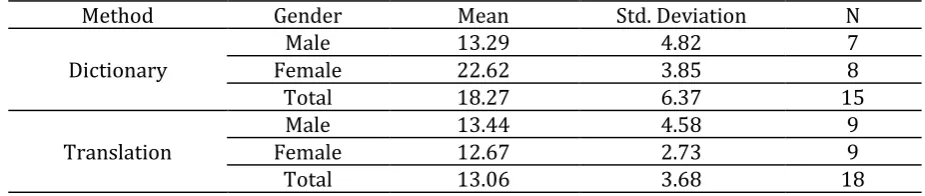
An analysis of variance was conducted to compare scores on the vocabulary learning at methods across different gender, male and female. The descriptive statistics for the different groups is presented in table 4.16. As the results revealed in dictionary group, female (M=22.62, SD=3.85) performed better than male (M=13.29, SD=4.82). However, in translation group male (M=13.44, SD=4.58) acted better than female (M=12.67, SD=2.73).
Table 6. Descriptive Statistics of the Results Concerning Gender
Method Gender Mean Std. Deviation N
Dictionary
Male 13.29 4.82 7
Female 22.62 3.85 8
Total 18.27 6.37 15
Translation
Male 13.44 4.58 9
Female 12.67 2.73 9
Total 13.06 3.68 18
Table 7 is for the translation group. The mean difference for male is (M=13.44, SD=4.58) and for female (M=12.67, SD=2.73); Therefor, there is not much difference.
Table 7. Descriptive Statistics of the Translation Group in Immediate Posttest
gender N Mean Std. Deviation Std. Error Mean
Immediate posttest
male 9 13.44 4.58 1.52
female 9 12.67 2.73 .91
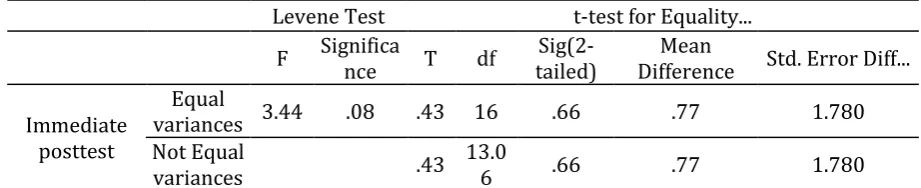
From table 8, we can conclude that there is no significant difference between male and female because the significant value is .08 which is above .05. So, we look at the first raw the sig. (2 tailed) .66 confirming no difference between groups.
Table 8. Inferential Statistics of the Translation Method in Immediate Posttest
Levene Test t-test for Equality...
F Significa
nce T df
Sig(2-tailed)
Mean
Difference Std. Error Diff...
Immediate posttest
Equal
variances 3.44 .08 .43 16 .66 .77 1.780
Not Equal
variances .43
13.0
6 .66 .77 1.780
The Analysis of Variance of Delayed Posttest
A two way between groups analysis of variance was conducted to compare scores on the vocabulary learning at the methods across gender, male and female. Table 4.26 presents the descriptive statistics for the different groups. As it is shown in dictionary group, female (M=23.38, SD=3.54) outperformed the male (M=12.29, SD=4.82). In translation group female (M=15.33, SD=7.48) acted better than male (M=12.89, SD=4.01).
Table 9. Descriptive Statistics of the Delayed Posttest Comparing Three Methods
Method gender Mean Std. Deviation N
Dictionary
male 12.29 4.82 7
female 23.38 3.54 8
Total 18.20 7.00 15
translation male 12.89 4.01 9
female 15.33 7.48 9
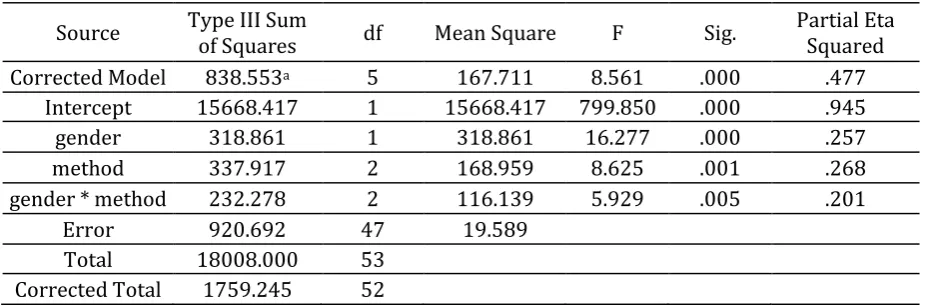
The most important information is the main effects of the independent variable gender and method. Looking at the method, we can see the significance value of .001 under the sig. column. The value indicates that method has been effective, with partial Eta square of 4.26. However, the main effect of the gender variable with significant value of .000 shows that gender can affect learning vocabulary (eta square=.25).
Table 10. Inferential Statistics of the Delayed posttest
Source Type III Sum of Squares df Mean Square F Sig. Partial Eta Squared
Corrected Model 838.553a 5 167.711 8.561 .000 .477
Intercept 15668.417 1 15668.417 799.850 .000 .945
gender 318.861 1 318.861 16.277 .000 .257
method 337.917 2 168.959 8.625 .001 .268
gender * method 232.278 2 116.139 5.929 .005 .201
Error 920.692 47 19.589
Total 18008.000 53
Corrected Total 1759.245 52
As it is obvious from this table, there was a significant difference between dictionary and translation methods (p=.03).
Table 11. Descriptive Statistics of the delayed Posttest
(I) method (J) method Mean Difference (I-J) Std. Error Sig. 95% Confidence Interval Lower Bound Upper Bound
dictionary translation 4.09* 1.54 .039 .18 8.00
To understand where the difference in each method is exactly considering male or female, we need to conduct a t-test. The significant value of .69 shows that the assumption of homogeneity of variance is met. The mean difference shows that the male participants in dictionary group had better performance than the female participants. The sig. (2 tailed) column confirms this idea. The significant value is .000 which shows that the difference is statistically significant. eta squared=.66 shows that the magnitude of the difference in the means was large.
Table 12. Independent Samples T-test of Delayed Posttest in Dictionary Method
Levene Test t-test for Equality
F Significance t df
Sig(2-tailed)...
Mean Difference
Std. Error Diff...
Delayed posttest
Equal
variances .158 .698
-5.124 13 .000 -11.089 2.164
Not Equal
variances -5.01 10.92 .000 -11.089 2.211
The last t-test was conducted to see if male and female differed on their scores on the vocabulary learning in translation method. The results indicated that there was no significant difference for male (M=12.89, SD=4.01) and female (M=15.33, SD=7.48) (t=.86, p=.40, df=12.25).
Table 13. Independent Samples T-test of Delayed Posttest in Translation Method
Levene Test t-test for Equality...
F Significance t df tailed)... Sig(2- Difference Mean Std. Error Diff.
Delayed posttest
Equal variances 4.55 .049 .86 - 16 .40 -2.44 2.83
Not Equal variances
DISCUSSION
Multimedia dictionary software
The first research question deals with the effect of multimedia dictionary software and traditional approach in vocabulary learning. The results from all the tasks revealed the participants higher mean in multimedia software group comparing the mean score of traditional group.
Consequently, it can be concluded that the participants show a higher preference for learning vocabulary using multimedia dictionary software. it indicates that mapping the words using multimedia software has influential impact on the learners` achievement of vocabulary. The pattern of the results obtained from this study is similar to the results obtained from the studies by many researchers like Ward and Annita (1998), Al-Seghayer (2001), Shao (2012). All of these researchers in their studies believed that learning vocabulary using multimedia is effective. As an example Ward and Annita (1998) suggested using semantic mapping as a pre-reading or pre-writing stimulus, or as a post-reading check of comprehension. However, they didn’t consider the semantic mapping of words using multimedia dictionary. Al-Seghayer (2001), also, had a study on learning via multimedia. he understands that words annotated with video and text gives the best results, proving the role of multimedia. Learning vocabulary using multimedia and traditional approach was compared in some studies by Shao (2012). In Shao`s survey he examined the effectiveness of multimedia application among Chinese EFL learners.
Retention ofvocabulary
The second research question targeted the effect of multimedia software on retention of the participants in vocabulary learning. In the present study, a delayed posttest was conducted two weeks after the posttest. The results showed that the participants in multimedia dictionary software outperformed the participants in translation groups. Although the traditional task did not work as well as the other group and the participants got the lowest scores in immediate and delayed posttest but the participants' performance in delayed posttest was better than immediate posttest. It can be predicted that this result might happen because of some reasons like the effect of practice or memory effect. But totally we can conclude that participants' retention of the target vocabulary did not reduce.
Role of gender
The last research question is about the role of gender in using multimedia dictionary software, and traditional way on vocabulary learning of Persian EFL learners. In previous studies did not pay much attention to this factor. But certainly there are some preferences for males and females in learning. The results of the independent samples t-test showed that in immediate postt-test, females outperformed males in dictionary based software. In the traditional group, male performed better.
CONCLUSION
The present study aimed at investigating the effectiveness of multimedia dictionary software, and traditional tasks on the vocabulary learning.
The results of pretest and immediate posttest proved the usefulness of multimedia dictionary software and comparing to our control group translation in learning of new vocabulary. Comparing and contrasting the dictionary group and translation group, the higher efficacy was won in favor of dictionary group for both posttest and delayed posttest. The results of the analyses of posttest and delayed posttest confirmed the usefulness of in learning vocabulary. Moreover, when looking at the delayed posttest, it was found that the subjects` performance was positively affected by time, from posttest to delayed posttest. The analysis of t-tests revealed that gender performance was just different in dictionary method in posttest. Again the same thing happened in delayed posttest, in the other methods there was not any significant difference between male and female, they acted similarly.
To sum up, the comparison provided experimental evidence for the usefulness of the teaching method on learning and retention of vocabulary. On the other hand, it indicated that although the experimental group outperformed the control group in long term retention their immediate and posttest was significantly different. More precisely, the results revealed that software method can improve the learner's vocabulary learning more effective than translation.
Implications of the Study
The results of this study can help curriculum designers gain further insights on the Persian learners' vocabulary learning and how these methods can be used to make learning more convenient. Furthermore, the findings of this study give rise to the awareness and solution of learning problems specifically concerning learning vocabulary in EFL context. Second and foreign language researchers or linguists can also make benefit of this study, since it provides them with some crucial insights to have follow up studies. What's more, the findings of this study can help the English teachers to use multimedia dictionary software and expand their experimental knowledge in using new pedagogical material.
Limitations of the study
Some limitations identified in this study are as follows:
The first limitation imposed on the study was the large number of participants. The number of students in each class and number of each class for the intended level was limited in the institute. There was another limitation and it was the restricted number of and class of words. Concerning reliability, we had to choose the words from the students course book and because the texts were short and didn’t contain many different and new words from different classes, verb, noun…., so it imposed limitations on our task. Finally, we used multiple choice test and it was the only form of the measuring instrument in our study. In order to have more reliable results we can make use of other test formats.
Suggestion for Further Investigation
This study has taken into consideration a number of criteria to the investigation of Persian learners' acquisition of new vocabulary. However, there are other dimensions, which need clarification in order to gain a comprehensive insight as to the exact learning problems and processes. Therefore, the following suggestions are made for further studies in the area of vocabulary learning.
REFERENCE
Al-Seghayer, K. (2001). The effect of multimedia annotation modes on L2 vocabulary acquisition: A comparative study. Language Learning & Technology, 5(1), 202-232. Arikan, A. (2009). Environmental peace education in foreign language learners’ English
grammar lessons. Journal of Peace Education, 6(1), 87-99.
Chun, D. M., & Plass, J. L. (1996). Effects of multimedia annotations on vocabulary acquisition. The Modern Language Journal, 80(2), 183-198.
Hashemi, M., & Pourgharib, B. (2013). The effect of visual instruction on new vocabularies learning. International Journal of Basic Science and Applied Research,
2 (6), 623-627.
Iwamoto, Y. (1998). Effectiveness of reduction of search time in using electronic dictionary [In Japanese]. Bulletin of Chugoku Shikoku Education Society, 44, 97-102. Koyama, T., & Takeuchi, O. (2004). How look up frequency affects EFL learning: An empirical study on the use of handheld-electronic dictionaries. Proceedings of
CLaSIC 2004, 1018– 1024.
Laufer, B., & Hill, M. (2000). What lexical information do L2 learners select in a CALL dictionary and how does it affect word retention? Language Learning &
Technology, 3, 58-76.
Mayer, R. E., & Sims, V. K. (1994). For whom is a picture worth a thousand words? Extensions of a dual-coding theory of multimedia learning. Journal of educational
psychology, 86(3), 389.
Najjar, L. J. (1996). Multimedia information and learning. Journal of educational
multimedia and hypermedia, 5, 129–150.