Available online at:
http://ejournal.upi.edu/index.php/IJAL/article/view/15933
doi: 10.17509/ijal.v9i1.15933
177 * Corresponding Author
Email: [email protected]
The interplay between pronunciation self-efficacy sources and
self-efficacy beliefs: A structural equation modeling approach
Muhammad Waleed Shehzad
1*, Ali Alghorbany
2, Sana Anwar Lashari
3,
Tahira Anwar Lashari
4, and Shazma Razzaq
51,2
School of Languages, Civilisation and Philosophy, Universiti Utara Malaysia, 06010 UUM, Sintok, Malaysia 3
School of Education and Modern Languages, Universiti Utara Malaysia, 06010 UUM, Sintok, Malaysia 4
Department of Education, The University of Lahore (TUOL), Sub-Campus Sargodha, Pakistan 5
National College of Business Administration and Economics (NCBA&E), Bahawalpur, Pakistan
ABSTRACT
This study was conducted to find the association between pronunciation self-efficacy sources and pronunciation self-efficacy beliefs. It was quantitative in nature using correlational research design. A sample of 155 Malaysian ESL university students was selected from two Malaysian universities by employing proportionate stratified random sampling. Two questionnaires were used to collect the data related to pronunciation self-efficacy sources and self-efficacy beliefs. In order to analyze the collected data, the correlational analysis was carried out with a statistical software named Smart PLS 3.0. Findings indicated that all the self-efficacy sources were significantly and positively correlated with pronunciation self-efficacy beliefs, except physiological state which was significantly but negatively correlated with pronunciation self-efficacy beliefs. Based on the outcomes of this study, implications for ESL instructors and educational policymakers were presented.
Keywords: English as a second language (ESL); pronunciation efficacy beliefs; self-efficacy sources;
First Received:
14 January 2019
Revised:
29 March 2019
Accepted:
25 April 2019
Final Proof Received:
28 May 2019
Published:
31 May 2019
How to cite (in APA style):
Shehzad, M. W., Alghorbany, A., Lashari, S. A., Lashari, T. A., & Razzaq, S. (2019). The interplay between pronunciation self-efficacy sources and self-efficacy beliefs: A structural equation modeling approach. Indonesian Journal of Applied Linguistics, 9, 177-187. doi: 10.17509/ijal.v9i1.15933
INTRODUCTION
Ever since Bandura (1997) offered the concept of self-efficacy, researchers have focused on apprehending the probable effect of learners’ self-efficacy on their learning performance (e.g., Liem, Lau, & Nie, 2008; Pintrich & De Groot, 1990). Self-efficacy beliefs of learners can have an effect on several learning aspects including their choices while performing a task, amount of effort they apply, and the persistence they exhibit while facing challenges in learning tasks (Britner & Pajares, 2006; Kiran & Sungur, 2012). As specified by several researchers (e.g., Brown & Lent, 2006; Usher & Pajares, 2006), self-efficacy does not only exhibit a substantial effect on the academic accomplishments of
learners but also their direction towards a future intended career. Besides, the previous literature indicated that out of all the psychological variables, self-efficacy was the most significant predictor of achievement (Artino, 2012; Klassen & Usher, 2010).
Conklin, 2015; Ruegg, 2018; Lichtinger, 2018). However, only a few studies, if any, have focused on English pronunciation self-efficacy.
Furthermore, based on the social cognitive theory presented by Bandura (1986), self-efficacy beliefs are originated among individuals from four sources, i.e., mastery experience, vicarious experience, verbal persuasion, and physiological state. Review of the previous literature indicated that the four self-efficacy sources were tested with several kinds of self-efficacy including learning self-efficacy (Arslan, 2012), performance efficacy (Arslan, 2013), ESL self-efficacy (Templin, 2011), English reading self-self-efficacy (Dawit, 2008), and English writing self-efficacy (Assegdew, 2011). However, there is a dearth of studies focusing on the association of English pronunciation efficacy sources and English pronunciation self-efficacy beliefs.
In Malaysian ESL context, various studies indicated that English pronunciation of Malaysian ESL learners was not up to the mark due to the reason that not enough emphasis was given to the teaching of English pronunciation in Malaysian classrooms (see Jayapalan & Pillai, 2011; Nair, Krishnasamy, & de Mello, 2006; Pillai, 2008; Rajadurai, 2006). The studies indicated the condition of Malaysian ESL students’ pronunciation. However, there is a scarcity of studies regarding pronunciation self-efficacy in Malaysian ESL context. Also, Sardegna, Lee, and Kusey (2018) affirmed that there was a crucial need to conduct studies regarding pronunciation self-efficacy globally. It is evident from the aforementioned discussion and previous literature that there is a need to conduct a study in global as well as ESL context that provides significant insights for educational policy makers, teachers, and ESL learners regarding pronunciation self-efficacy sources and pronunciation self-self-efficacy beliefs. Thus, in order to fill this crucial literature gap, the current study was intended to determine the association between English pronunciation self-efficacy sources and English pronunciation self-efficacy beliefs among Malaysian ESL learners.
Self-efficacy beliefs and its sources
Bandura (1997) defines self-efficacy beliefs as persons’ perceptions regarding his capabilities to carry out particular actions. Self-efficacy beliefs denote persons’ subjective anticipations of and devotion to achieve the academic tasks at hand (Lau & Roeser, 2002). These subjective anticipations, in return, affect the effort and perseverance that individuals will apply in the behavioral dominion (Bandura, 1986). Previous studies indicate that individuals having high self-efficacy beliefs tend to perform better in academic tasks (Klassen & Usher, 2010; Usher & Pajares, 2008). For example, individuals who consider themselves as high self-efficacious learners while doing academic tasks generally exhibit greater interest, engagement, set superior aims, and relentlessly put greater strength while facing hurdles. On the other hand, low self-efficacious
individuals could be at risk while doing academic activities, causing lower achievement and evading from arduous academic situations (Bong & Skaalvik, 2003).
Bandura (1986, 1997) proposes four sources from which self-efficacy beliefs among individuals are originated. The four hypothesized self-efficacy sources are as follows: mastery experience, vicarious experience, verbal persuasion, and physiological state. In simple terms, the first self-efficacy source, i.e., ‘mastery experience’ refers to the past experiences of the individuals regarding a particular task. Successes in the past could elevate the self-efficacy beliefs among individuals; however, failures can alleviate the self-efficacy level (Bandura, 1997). Also, mastery experience is considered as the most influential source of self-efficacy (Bandura, 1997; Usher & Pajares, 2008). The second self-efficacy source, i.e., ‘vicarious experience’ denotes to the observation of the performances of the other people present around an individual. Bandura (1997) affirmed in his social cognitive theory that when an individual observes a model performing any particular task well, the self-efficacy beliefs of an individual would get elevated. On the other hand, if the model performs poorly, the self-efficacy among an individual would be decreased. The third self-efficacy source, i.e., ‘verbal persuasion’ implies the feedback from the significant people in the life of an individual (Bandura, 1997). Social cognitive theory clearly explains that this feedback could be positive as well as negative in nature (Bandura, 1986, 1997). Both kinds of feedback affect the self-efficacy of an individual differently. For instance, the positive comments of the people about an individual’s skill would increase the self-efficacy level; however, the negative criticism would decrease one’s self-efficacy level (Bandura, 1986, 1997; Fenning & May, 2013; Usher & Pajares, 2008; Vallerand & Reid, 1984). Last but not least, ‘physiological state’ is the fourth self-efficacy source. It denotes fatigue, stress, and anxiety among individuals which consequently affects the self-efficacy beliefs of an individual (Bandura, 1986, 1997). Moreover, Corkett, Hatt, and Benevides (2011) explain that the main symptoms of anxiety, such as sweaty palms and abnormal heart beating pace, could give way to low self-efficacy beliefs among individuals.
and positively associated with science self-efficacy beliefs. In the same manner, Ozyurek (2005) found a positive and significant relationship between self-efficacy sources and mathematics self-self-efficacy except for vicarious experience among 292 Turkish high school students. Furthermore, some of the studies were conducted on the association between self-efficacy sources and science self-efficacy beliefs (Lin & Tsai, 2018). Lin and Tsai (2018) conducted a study on 390 Taiwanese high school students to determine the association between self-efficacy sources and science self-efficacy beliefs. The results showed that mastery experience, vicarious experience, and verbal persuasion were positively and significantly correlated with science self-efficacy beliefs. The physiological state showed a significant but negative association with science self-efficacy.
Moreover, several studies determined the relationship between self-efficacy sources and academic/learning self-efficacy. Arslan (2012) conducted a study on 1049 middle school students in Turkey. He found a significant and positive association between all the four self-efficacy sources and learning self-efficacy beliefs. Similarly, Arslan (2013) piloted a study on 984 secondary school students in Turkey. The objective of the study was to determine the association between self-efficacy sources and learning and performance self-efficacy beliefs. The findings indicated a significant association between four self-efficacy sources and self-self-efficacy beliefs. Moreover, Kudo and Mori (2015) conducted an experimental study involving pre/post research design on 163 middle school students in Japan. In his study, only two self-efficacy sources, i.e., mastery experience and vicarious experience were studied. The findings indicated that mastery experience significantly influenced the academic self-efficacy beliefs; whereas, the vicarious experience did not influence the academic self-efficacy beliefs of the EFL learners. Lastly, Lin (2016) piloted as a study to determine the relationship between self-efficacy sources and learning self-self-efficacy beliefs among 1073 Taiwanese university students, majoring in computing disciplines. The findings revealed a significant and positive association between all the four self-efficacy sources and learning self-efficacy beliefs.
Studies conducted regarding the relationship between self-efficacy sources and self-efficacy beliefs in English skills are limited. Aro et al. (2018) conducted an intervention study in which they introduced self-efficacy sources as an intervention. The results indicated that self-efficacy sources significantly influenced reading self-efficacy beliefs. Additionally, Dawit (2008) determined the relationship between self-efficacy sources and English reading and writing self-efficacy beliefs. The sample of the study comprised 106 Ethiopian university students. The findings indicated a significant association between all the four self-efficacy sources and reading and writing self-efficacy beliefs. Templin (2011) conducted a study to determine the association between efficacy sources and ESL
self-efficacy beliefs among 130 ESL university students. The outcomes of the study found a positive and significant relationship between self-efficacy sources and ESL self-efficacy beliefs. Assegdew (2011) also found a positive significant association between three self-efficacy sources (i.e., mastery experience, vicarious experience, and verbal persuasion) and English writing self-efficacy beliefs among 138 Ethiopian school students. On the same line, the physiological state showed a significant but negative association with writing self-efficacy.
In the domain of English pronunciation, several studies were conducted on the relationship of pronunciation self-efficacy and pronunciation performance (Kalanzadeh, Mahnegar, Hassannejad, & Bakhtiarvand, 2013; Koosha, Ketabi, & Kassaian, 2011; Sardegna, 2012). In addition, regarding self-efficacy sources, researchers determined the relationship between self-efficacy sources and pronunciation performance (Yang, 2017), and between self-efficacy sources and public speaking skills (Zhang & Ardasheva, 2019). However, there is a lack of research regarding the relationship between pronunciation self-efficacy sources and self-efficacy beliefs. Thus, the current study is intended to fill this literature gap.
METHODS
The current study employed a quantitative research paradigm. Moreover, correlational research design had been used. According to Creswell (2005), correlational research design involves the relationship between two or more variables by employing statistical methods. Therefore, the current study intended to determine the association between English pronunciation self-efficacy sources and English pronunciation self-efficacy beliefs among Malaysian ESL learners. The research design of the current study is depicted in Figure 1.
Population and sample of the study
The population of the study was 513 first semester undergraduate students, majoring in English of two Malaysian government universities, located in Perlis state. According to Bartlett, Kotrlik, and Higgins’ (2001) sample determination table, for the aforementioned population, the sample size ought to be 155. Moreover, in order to select the sample, proportionate stratified random sampling was employed.
Instruments
items). More specifically, items number 1 to 6 were related to mastery experience. Items number 7 to 12 were related to vicarious experience. Items number 13 to 18 were related to verbal persuasion. Lastly, items number 19 to 24 were related to the physiological state. ‘English pronunciation self-efficacy scale’ (refer to Appendix B) was employed to collect data regarding
respondents’ English pronunciation self-efficacy beliefs. It was adapted from a questionnaire named ‘learner attitudes and motivations for pronunciation’ (LAMP), developed by Sardegna, Lee, and Kusey (2014). The adapted English pronunciation self-efficacy scale comprises four items.
r
a rb
r
c
rd
Figure 1. Research Design
r
a= The correlation between mastery experience and pronunciation self-efficacy beliefs
r
b= The correlation between vicarious experience and pronunciation self-efficacy beliefs
r
c= The correlation between verbal persuasion and pronunciation self-efficacy beliefs
r
d= The correlation between physiological state and pronunciation self-efficacy beliefs
Data collection procedures
The data collection process took two days. The researchers self-administered the questionnaires in the first university on 26th February 2019 and in the second university on 28th February 2019. Before administering the questionnaires, the students were explained all the items to avoid ambiguity. The respondents were given a time of half an hour to fill in both the questionnaires.
Data analysis
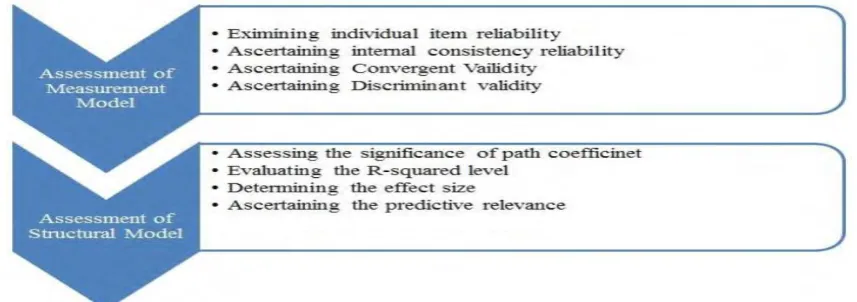
A two-phase method designed by Henseler, Ringle, and Sinkovics (2009) was used in the current study to present the PLS-SEM results. The first phase is called ‘measurement model assessment’ and the second phase is known as ‘structural model assessment’ (Hair Jr., Ringle, & Sarstedt, 2013). The suggested components in the two phases by Henseler et al. (2009) are listed by Hameed, Basheer, Iqbal, Anwar, and Ahmad (2018) as depicted in Figure 2.
Figure 2. Two Step PLS-SEM (Hameed et al., 2018)
Measurement model
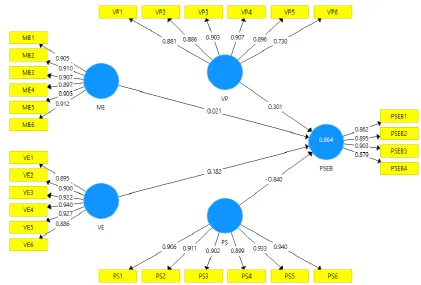
The assessment of measurement model requires the scrutiny of numerous entities comprising Cronbach’s alpha, discriminant validity, composite reliability, factor loadings, and average variance extracted (AVE). Figure 3 and Table 1 illustrate the outcomes of the measurement model.
With the intention of assessing the measurement model, several entities were scrutinised including discriminant validity, average variance extracted
(AVE), factor loadings, Cronbach’s alpha, and composite reliability.
Pronunciation self-efficacy sources consist of four sources including mastery experience (ME), vicarious experience (VE), verbal persuasion (VP), and physiological state (PS). ME is gauged by six items (i.e., ME1, ME2, ME3, ME4, ME5. ME6). Also, VE is gauged by six items (i.e., VE1, VE2, VE3, VE4, VE5, VE6). VP is gauged by six items (i.e., VP1, VP2, VP3, VP4, VP5, VP6). Lastly, six items gauge PS (i.e., PS1,
Pronunciation Self-efficacy Beliefs
Mastery Experience
Vicarious Experience
Verbal Persuasion
PS2, PS3, PS4, PS5, PS6). Moreover, pronunciation self-efficacy beliefs are gauged by four items (i.e., PSEB1, PSEB2, PSEB3, PSEB4).
The factor loadings of all the constructs are shown in Figure 3. According to Hair Jr., Black, Babin, Andersen, and Tatham (2010), the value of factor
loadings ought not to be lower than 0.5 in order to establish convergent validity. In the current study, all the variables’ factor loading values fulfill the aforementioned benchmark. More particularly, the values range from 0.73 to 0.94. Therefore, it can be concluded that convergent validity is established.
Figure 3. Confirmatory factor analysis
The values of AVE, Cronbach’s alpha, and composite reliability are shown in Table 1. Regarding Cronbach’s alpha benchmark, George and Mallery (2016) affirmed that it ought not to be lower than 0.7. In the current study, the Cronbach’s alpha value ranges from 0.907 to 0.961. Moreover, regarding composite reliability’s (CR) and AVE benchmarks, Fornell and Larcker (1981) asserted that the value of CR should be equal to or greater than 0.7 and the value of AVE should be equal to greater than 0.5. In the current study, the benchmarks of CR and AVE are achieved as shown in Table 1. Additionally, discriminant validity is achieved by means of Heterotrait-Monotrait Ratio (HTMT) method. The values of HTMT are shown in Table 2.
Table 1. Cronbach’s Alpha, composite reliability and AVE
Variables Cronbach's Alpha rho_A CR (AVE)
ME 0.957 0.958 0.965 0.821
PS 0.961 0.961 0.969 0.838
PSEB 0.907 0.908 0.935 0.783
VE 0.959 0.96 0.967 0.831
VP 0.935 0.94 0.949 0.756
Structural model
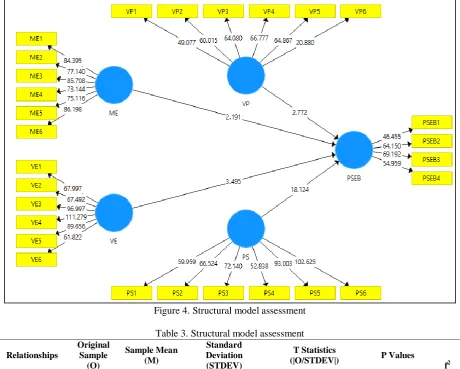
In order to determine the influence of ME, VE, VP, and PS on PSEB, the structural model was assessed.
Moreover, t-values and path coefficient values were considered in order to accept or reject the hypotheses.
Table 2. Heterotrait-Monotrait Ratio (HTMT)
ME PS PSEB VE VP
ME
PS 0.786
PSEB 0.77 0.789
VE 0.689 0.735 0.721
VP 0.785 0.784 0.792 0.711
Figure 4. Structural model assessment
Table 3. Structural model assessment
Relationships
Original Sample
(O)
Sample Mean (M)
Standard Deviation (STDEV)
T Statistics
(|O/STDEV|) P Values
f2
ME -> PSEB 0.021 0.027 0.0101 2.191 0.041 0.025
PS -> PSEB -0.84 -0.84 0.046 18.124 0 0.362
VE -> PSEB 0.182 0.185 0.053 3.495 0.002 0.142
VP -> PSEB 0.301 0.308 0.109 2.772 0.006 0.151
The R2 values is shown in Table 4. It indicates that all four self-efficacy sources impacted the pronunciation self-efficacy by 86%. Moreover, the values of predictive relevance (Q2) are shown in Table 5. The value of Q2 ought not to be less than zero (Henseler et al., 2009). In this study, the value of the Q2 for PSEB is 0.628.
Table 4. R-Square (R2) Value
Dependent variable R Square
PSEB 0.864
Table 5. Predictive Relevance (Q2)
SSO SSE Q² (=1-SSE/SSO)
PSEB 712 264.522 0.628
FINDINGS AND DISCUSSION
The major objective of the current study was to determine the relationship between four pronunciation self-efficacy sources and pronunciation self-efficacy beliefs. The outcomes of this study indicated that all four pronunciation self-efficacy sources were significantly correlated with pronunciation self-efficacy
experience is the most significant predictor of self-efficacy. This particular finding could be attributed to the speculation that Malaysian ESL students might have limited good experiences regarding their pronunciation in the past. As indicated by many researchers, limited emphasis is given to the teaching of English pronunciation in Malaysian classrooms (see Jayapalan & Pillai, 2011; Nair et al., 2006; Pillai, 2008; Rajadurai, 2006).
The second self-efficacy source, i.e., vicarious experience, was positively and significantly correlated with pronunciation self-efficacy (t-value= 3.495; β-value= 0.182). This finding implies that Malaysian ESL university students’ self-efficacy beliefs were elevated by observing others’ pronunciation performance. Numerous studies indicated that there was a positive and significant relationship between vicarious experience and self-efficacy beliefs (Arslan, 2012; Britner & Pajares, 2006; Chen & Usher, 2013; Hampton & Mason, 2003; Kaya & Bozdag, 2016; Lin, 2016; Lin & Tsai, 2018; Phan & Ngu, 2016; Tschannen‐Moran & McMaster, 2009; Usher & Pajares, 2009).
Moreover, the third self-efficacy source, i.e., verbal persuasion, showed a significant and positive association with pronunciation self-efficacy (t-value= 2.772; β-value= 0.301). In simple terms, the current study’s participants’ pronunciation self-efficacy beliefs were boosted from the feedback of other people regarding their pronunciation skill. This outcome is consistent with past literature (Arslan, 2012; Britner & Pajares, 2006; Chen & Usher, 2013; Hampton & Mason, 2003; Joët et al., 2011; Kaya & Bozdag, 2016; Kiran & Sungur, 2012; Lin, 2016; Lin & Tsai, 2018; Phan, 2012; Phan & Ngu, 2016; Tschannen‐Moran & McMaster, 2009; Usher & Pajares, 2009). Also, Woodrow (2006) emphasized that authentic and realistic feedback from teachers could elevate the students’ self-efficacy, and as a result, they would put more effort into honing their pronunciation skill.
Lastly, physiological state showed a significant but negative association with pronunciation self-efficacy beliefs (t-value= 18.124; β-value= - 0.84). The findings indicated that lesser anxiety yielded higher pronunciation self-efficacy among Malaysian ESL students and vice versa. The findings are supported by Bandura’s (1986) social cognitive theory as well as numerous past studies (Kaya & Bozdag, 2016; Yurt, 2014).
CONCLUSION
The findings of the current study could be beneficial for ESL pronunciation instructors and policymakers. The ESL instructors need to develop pronunciation efficacy among students from the four sources of self-efficacy as indicated by the findings of this study. Moreover, educational policymakers ought to incorporate the four self-efficacy sources into the English pronunciation pedagogy.
In spite of the numerous contributions, the current study has few limitations. Firstly, only quantitative approach was employed in the current study. By employing a qualitative research method, a deep insight regarding pronunciation self-efficacy could have been achieved. Secondly, the findings of this study are generalizable, but only to be viewed in the current population’s context, i.e., Malaysian ESL university students, majoring in English.
By considering the findings of the current study, several suggestions could be presented to future researchers. As the current study found that mastery experience was not the strongest predictor of pronunciation self-efficacy beliefs, the future studies should be conducted by employing qualitative or mixed-methods research design to get a deeper insight regarding this unusual finding. Moreover, the future researchers ought to include other factors including gender, socio-economic status, and age to determine the relationship between self-efficacy sources and pronunciation self-efficacy beliefs. Lastly, the current study provided a baseline regarding the association between efficacy sources and pronunciation self-efficacy beliefs among university ESL learners. Thus, the future researchers should conduct research on different nature of the sample, i.e., school students, EFL learners, or non-English major students.
REFERENCES
Aro, T., Viholainen, H., Koponen, T., Peura, P., Räikkönen, E., Salmi, P., & Aro, M. (2018). Can reading fluency and self-efficacy of reading fluency be enhanced with an intervention targeting the sources of self-efficacy? Learning and
Individual Differences, 67(1), 53-66. doi: 10.1016/j.lindif.2018.06.009
Arslan, A. (2012). Predictive power of the sources of primary school students' self-efficacy beliefs on their self-efficacy beliefs for learning and performance. Educational Sciences: Theory and Practice, 12(3), 1915-1920.
Arslan, A. (2013). Investigation of relationship between sources of self-efficacy beliefs of secondary school students and some variables. Educational
Sciences: Theory and Practice, 13(4), 1983-1993. Artino, A. R. (2012). Academic self-efficacy: From
educational theory to instructional practice. Perspectives on Medical Education, 1(2), 76-85. doi: 10.1007/s40037-012-0012-5
Assegdew, D. A. (2011). Sources of efficacy, efficacy, gender and performance in the writing skills of government and private school students: A comparative study. The Ethiopian Journal of Education, 31(1), 1-32.
Bandura, A. (1997). Self-efficacy: The exercise of control. New York, NY: Freeman.
Bartlett, J. E, Kotrlik, J., W. & Higgins, C. C. (2001). Organizational research: Determining appropriate sample size in survey research. Information Technology, Learning, and Performance Journal, 19(1), 43-50. doi: 10.12691/ajrd-5-2-1
Bong, M., & Skaalvik, E. M. (2003). Academic self-concept and self-efficacy: How different are they really? Educational Psychology Review, 15(1), 1– 40. doi: 10.1023/A:1021302408382
Britner, S. L., & Pajares, F. (2006). Sources of science self-efficacy beliefs of middle school students. Journal of Research in Science Teaching, 43(1), 485–499. doi: 10.1002/tea.20131
Brown, S. D., & Lent, R. W. (2006). Preparing adolescents to make career decisions: a social cognitive perspective. In F. Pajares & T. Urdan (Eds.), Adolescence and education: vol. 5. Self-efficacy beliefs of adolescents (Vol. 5, pp. 201– 223). Greenwich: Information Age.
Chen, J. A., & Usher, E. L. (2013). Profiles of the sources of science self-efficacy. Learning and Individual Differences, 24(1), 11-21. doi: 10.1016/j.lindif.2012.11.002
Corkett, J., Hatt, B., & Benevides, T. (2011). Student and teacher self-efficacy and the connection to reading and writing. Canadian Journal of Education, 34(1), 65-98.
Creswell, J. W. (2005). Educational research:
Planning, conducting, and evaluating quantitative and qualitative approaches to research (2nd ed.). Upper Saddle River, NJ: Merrill/Pearson Education.
Dawit, A. (2008). An investigation of the correlation among efficacy sources, students’ self-efficacy and performance in reading and writing skills: Bahir Dar University in focus (Unpublished master thesis). Addis Ababa University, Addis Ababa, Ethiopia.
Ekholm, E., Zumbrunn, S., & Conklin, S. (2015). The relation of college student self-efficacy toward writing and writing self-regulation aptitude: writing feedback perceptions as a mediating variable. Teaching in Higher Education, 20(2), 197-207. doi: 10.1080/13562517.2014.974026 Fenning, B. E., & May, L. N. (2013). “Where there is a
will, there is an A”: Examining the roles of self-efficacy and self-concept in college students’ current educational attainment and career planning. Social Psychology of Education, 16(4), 635-650. doi: 10.1007/s11218-013-9228-4 Fornell, C., & Larcker, D. F. (1981). Evaluating
structural equation models with unobservable variables and measurement error. Journal of Marketing Research, 18(1), 39-50. doi: 10.2307/3151312
George, D., & Mallery, P. (2016). IBM SPSS statistics 23 step by step: A simple guide and
reference. New York, NY: Routledge.
Hair Jr, J. F., Black, W. C., Babin, B. J., Andersen, R. E., & Tatham, R. L. (2010). Multivariate data analysis (7th ed.). Upper Saddle River, NJ: Pearson Prentice Hall.
Hair Jr, J. F., Ringle, C. M., & Sarstedt, M. (2013). Editorial-partial least squares structural equation modeling: Rigorous applications, better results and higher acceptance. Long Range Planning, 46(1-2), 1-12.
Hameed, W. U., Basheer, M. F., Iqbal, J., Anwar, A., & Ahmad, H. K. (2018). Determinants of Firm’s open innovation performance and the role of R & D department: an empirical evidence from Malaysian SME’s. Journal of Global Entrepreneurship Research, 8(1), 29-49. doi: 10.1186/s40497-018-0112-8
Hampton, N. Z., & Mason, E. (2003). Learning disabilities, gender, sources of efficacy, self-efficacy beliefs, and academic achievement in high school students. Journal of School
Psychology, 41(2), 101-112. doi: 0.1016/S0022-4405(03)00028-1
Henseler, J., Ringle, C. M., & Sinkovics, R. R. (2009). The use of partial least squares path modeling in international marketing. New Challenges to International Marketing Advances in International Marketing, 20(1), 277–319. doi: 10.1108/S1474-7979(2009)0000020014
Idrus, H., & Salleh, R. (2017). Perceived self-efficacy of Malaysian ESL engineering and technology students on their speaking ability and its pedagogical implications. The English Teacher, 37(1), 61-75.
Jayapalan, K., & Pillai, S. (2011). The state of teaching and learning English pronunciation in Malaysia: A preliminary study. Malaysian Journal of ELT Research, 7(2), 63-81.
Joët, G., Usher, E. L., & Bressoux, P. (2011). Sources of self-efficacy: An investigation of elementary school students in France. Journal of Educational Psychology, 103(3), 649-663. doi:
10.1037/a0024048
Kalanzadeh, G. A., Mahnegar, F., Hassannejad, E., & Bakhtiarvand, M. (2013). The influence of EFL students’ self-esteem on their speaking skills. The International Journal of Language Learning and Applied Linguistics World, 2(2), 77-84. doi: 10.7575/aiac.ijels.v.6n.4p.35
Kamaruddin, W. N., & Zawawi R. A. (2017). Oral communication self-efficacy beliefs among students of Politeknik Sultan Salahuddin Abdul Aziz Shah. Advanced Journal of Technical and Vocational Education 1(1), 79-86.
Kaya, D., & Bozdag, H. C. (2016). Resources of mathematics self-efficacy and perception of science self-efficacy as predictors of academic achievement. European Journal of Contemporary Education, 18(4), 438-451. doi:
Kiran, D., & Sungur, S. (2012). Middle school students’ science self-efficacy and its sources: examination of gender difference. Journal of Science Education and Technology, 21(5), 619 -630. doi:
10.1007/s10956-011-9351-y
Klassen, R. M., & Usher, E. L. (2010). Self-efficacy in educational settings: Recent research and emerging directions. In The decade ahead: Theoretical perspectives on motivation and achievement (pp. 1-33). Bingley, UK: Emerald Group Publishing Limited.
Koosha, B., Ketabi, S., & Kassaian, Z. (2011). The effects of self-esteem, age and gender on the speaking skills of intermediate university EFL learners. Theory & Practice in Language Studies, 1(10), 1328-1337. doi:
10.4304/tpls.1.10.1328-1337
Kudo, H., & Mori, K. (2015). A preliminary study of increasing self-efficacy in junior high school students: Induced success and a vicarious experience. Psychological Reports, 117(2), 631-642. doi: 10.2466/11.07.PR0.117c22z4
Lau, S., & Roeser, R. W. (2002). Cognitive abilities and motivational processes in high school students’ situational engagement and achievement in science. Educational Assessment, 8(1), 139–162. doi: 10.1207/S15326977EA0802_04
Lichtinger, E. (2018). Gap between self-efficacy and college students’ writing skills. Journal of College Reading and Learning, 48(2), 124-137. doi: 10.1080/10790195.2017.1411213
Liem, A. D., Lau, S., & Nie, Y. (2008). The role of self-efficacy, task value, and achievement goals in predicting learning strategies, task disengagement, peer relationship, and achievement outcome. Contemporary Educational Psychology, 33(1), 486 –512. doi: 10.1016/j.cedpsych.2007.08.001 Lin, G. Y. (2016). Self-efficacy beliefs and their sources
in undergraduate computing disciplines: An examination of gender and persistence. Journal of Educational Computing Research, 53(4), 540-561. doi: 10.1177/0735633115608440
Lin, T. J., & Tsai, C. C. (2018). Differentiating the sources of Taiwanese high school students’ multidimensional science learning self-efficacy: An examination of gender differences. Research in Science Education, 48(3), 575-596. doi:
10.1007/s11165-016-9579-x
McLean, S., & Poulshock, J. (2018). Increasing reading self-efficacy and reading amount in EFL learners with word-targets. Reading in a Foreign
Language, 30(1), 76-91.
Nair, R., Krishnasamy, R., & De Mello, G. (2006). Rethinking the teaching of pronunciation in the ESL classroom. The English Teacher, 35(1), 27-40.
Ozyurek, R. (2005). Informative sources of math-related self-efficacy expectations and their relationship with math-related self-efficacy, interest, and
preference. International Journal of Psychology, 40(1), 145-156. doi: 10.1080/00207590444000249 Phan, H. P. (2012). The development of English and
mathematics self-efficacy: A latent growth curve analysis. The Journal of Educational Research, 105(3), 196-209. doi:
10.1080/00220671.2011.552132
Phan, H. P., & Ngu, B. H. (2016). Sources of self-efficacy in academic contexts: A longitudinal perspective. School Psychology Quarterly, 31(4), 548-564. doi: 10.1037/spq0000151
Pillai, S. (2008). Speaking English the Malaysian way– correct or not? English Today, 24(4), 42-45. doi: 10.1017/S0266078408000382
Pintrich, P. R., & De Groot, E. V. (1990). Motivational and self-regulated learning components of classroom academic performance. Journal of Educational Psychology, 86(1), 193 –203. Rahimirad, M., & Zare-ee, A. (2015). Metacognitive
strategy instruction as a means to improve listening self-efficacy among Iranian
undergraduate learners of English. International Journal of Instruction, 8(1), 117-132. doi: 10.12973/iji.2015.819a
Rajadurai, J. (2006). Pronunciation issues in non-native contexts: a Malaysian case study. Malaysian Journal of ELT Research 2(1), 42–59. Ruegg, R. (2018). The effect of peer and teacher
feedback on changes in EFL students’ writing self-efficacy. The Language Learning Journal, 46(2), 87-102. doi: 10.1080/09571736.2014.958190 Sardegna, V. G. (2012). Learner differences in strategy
use, self-efficacy beliefs, and pronunciation improvement. In Social factors in pronunciation acquisition. Proceedings of the 3rd Pronunciation in Second Language Learning and Teaching Conference (pp. 39-53). Iowa State University. Sardegna, V. G., Lee, J., & Kusey, C. (2014).
Development and validation of the learner attitudes and motivations for pronunciation (LAMP) inventory. System, 47(1), 162-175. doi: 10.1016/j.system.2014.10.009
Sardegna, V. G., Lee, J., & Kusey, C. (2018). Self‐ efficacy, attitudes, and choice of strategies for English pronunciation learning. Language Learning, 68(1), 83-114. doi: 10.1111/lang.12263 Taguchi, K. (2018). A progress report – a replication
study on listening strategy use and self-efficacy in relation to listening proficiency in EFL. The Economic Review of Toyo University, 43(2), 301-312.
Templin, S. A. (2011). Examining the effects of self-efficacy sources on English as a second Language (ESL) self-efficacy beliefs and ESL proficiency (Doctoral dissertation). Trident University International, California, United States of America.
Quantitative and qualitative analyses. European Journal of English Language Teaching, 2(1), 93-120. doi: 10.5281/zenodo.321540
Tschannen-Moran, M., & McMaster, P. (2009). Sources of self-efficacy: Four professional development formats and their relationship to self-efficacy and implementation of a new teaching strategy. The Elementary School Journal, 110(2), 228-245. doi: 10.1086/605771
Usher, E. L., & Pajares, F. (2006). Sources of academic and self-regulatory efficacy beliefs of entering middle school students. Contemporary Educational Psychology, 31(1), 125–141. doi: 10.1016/j.cedpsych.2005.03.002
Usher, E. L., & Pajares, F. (2008). Sources of self-efficacy in school: Critical review of the literature and future directions. Review of Educational Research, 78(4), 751-796. doi:
10.3102/0034654308321456
Usher, E. L., & Pajares, F. (2009). Sources of self-efficacy in mathematics: A validation study. Contemporary Educational
Psychology, 34(1), 89-101. doi: 10.1016/j.cedpsych.2008.09.002
Vallerand, R. J., & Reid, G. (1984). On the causal effects of perceived competence on intrinsic motivation: A test of cognitive evaluation theory. Journal of Sport Psychology, 6(1), 94-102. Woodrow, L. J. (2006). A model of adaptive language
learning. The Modern Language Journal, 90(1), 297–319. doi: 10.1111/j.1540-4781.2006.00424.x Yang, X. (2017). Sources of Chinese learners’
self-efficacy in learning English pronunciation. Theory and Practice in Language Studies, 7(6), 449-454. doi: 10.17507/tpls.0706.06
Yurt, E. (2014). The predictive power of self-efficacy sources for mathematics achievement. Egitim ve Bilim, 39(176), 159-169. doi:
10.15390/EB.2014.3443
Zhang, X., & Ardasheva, Y. (2019). Sources of college EFL learners' self-efficacy in the English public speaking domain. English for Specific
Appendix A
Sources of English Pronunciation Self-efficacy Scale
No. Statement
Stro
ng
ly
D
is
a
g
ree
Dis
a
g
ree
N
eutra
l
Ag
ree
Stro
ng
ly
A
g
ree
1. I make excellent grades on English pronunciation tests. 1 2 3 4 5
2. I have always been successful with English pronunciation. 1 2 3 4 5
3. Even when I try very hard to pronounce English words, I
pronounce poorly.
1 2 3 4 5
4. I got good grades in English pronunciation on my last report card. 1 2 3 4 5
5. I do well on English pronunciation assignments. 1 2 3 4 5
6. I do well on even the most difficult English pronunciation
assignments.
1 2 3 4 5
7. Seeing adults pronouncing English words well pushes me to
pronounce better.
1 2 3 4 5
8. When I see how my pronunciation teacher pronouncing English
words well, I can picture myself pronouncing the words in the same way.
1 2 3 4 5
9. Seeing peers do better than me in English pronunciation pushes
me to pronounce better.
1 2 3 4 5
10. When I see how another student pronouncing an English word
correctly, I can see myself pronouncing the word in the same way.
1 2 3 4 5
11. I imagine myself pronouncing challenging English words
successfully.
1 2 3 4 5
12. I compete with myself in English pronunciation. 1 2 3 4 5
13. My pronunciation teachers have told that I am good at English
pronunciation.
1 2 3 4 5
14. People have told me that I have a talent for English
pronunciation.
1 2 3 4 5
15. Adults in my family have told me that I am good at English
pronunciation.
1 2 3 4 5
16. I have been praised for my ability in English pronunciation. 1 2 3 4 5
17. Other students have told me that I’m good at English
pronunciation.
1 2 3 4 5
18. My classmates like to work with me regarding English
pronunciation because they think I’m good at it. 1 2 3 4 5
19. Just being in English pronunciation class makes me feel stressed
and nervous.
1 2 3 4 5
20. Doing English pronunciation practice takes all of my energy. 1 2 3 4 5
21. I start to feel stressed-out as soon as I begin English
pronunciation practice.
1 2 3 4 5
22. My mind goes blank and I am unable to think clearly when doing
English pronunciation practice.
1 2 3 4 5
23. I get depressed when I think about learning English
pronunciation.
1 2 3 4 5
24. My whole body becomes tense when I have to do English
pronunciation.
1 2 3 4 5
Appendix B
English Pronunciation Self-efficacy Scale
No. Statement
Stro
ng
ly
D
is
a
g
ree
Dis
a
g
ree
N
eutra
l
Ag
ree
Stro
ng
ly
A
g
ree
1. I feel confident that people understand me when I talk in English. 1 2 3 4 5
2. I think I can improve my English pronunciation on my own using
online materials.
1 2 3 4 5
3. I am satisfied with my English pronunciation progress this last
year.
1 2 3 4 5