A Documentary Video Assignment to
Enhance Learning in Large First-Year
Science Classes
Louise J. Kuchela, Sarah K. Stevensa, Robbie Wilsona, and John Cokleyb
Corresponding author: [email protected]
aSchool of Biological Sciences, The University of Queensland, , Brisbane QLD 4072, Australia bEdupreneur Services International, Australia
Keywords: student engagement, group work, science communication, communication, deep learning, visual learning, oral communication, biology, novel assessment, pedagogy, video, documentary
International Journal of Innovation in Science and Mathematics Education, 22(4), 48-64, 2014.
Abstract
The video documentary assignment described in this paper provides students with learning opportunities in a range of core competencies in biology, framed by and including communication skills. The design, presented as a flow chart to illustrate scaffolding activities, is a culmination of six years of reflective practice and evidence based evaluation (e.g., student perspectives, teacher perspectives and student performance on certain criteria). The assignment forms part of a large (600 student) first year biology course and requires groups of four students to investigate and explain the biology behind an environmental issue to a lay audience. Scaffolding activities support development of interpersonal communication skills (team training activities), visual and oral communication skills (through interaction with a journalist and/or TV presenter) and the basics of audience analysis. They also develop information literacy skills and involve students in evaluation of basic logic and argument in a selection of Youtube videos. Student engagement and motivation with the assignment is very high and it provides a fun and bonding experience for students in their first semester of university. Evidence and justification for design decisions are presented in this article and should prove useful for others looking to implement a similar task in a different context, either as a whole or part.
Introduction
assignment takes the novel form of a digital video that may be uploaded to Youtube, thus exposing students to one of the diverse platforms now used for communicating science. It provides an alternative to written assessments which dominate communication tasks in undergraduate science (Stevens, 2013). The assignment is suitable for courses with large or small numbers of students from diverse backgrounds and interests, and may be adapted to suit most science disciplines.
This article describes the design of the communication task and provides evidence and justification for design decisions. The design is presented so as to facilitate adoption of the task in parts or as a whole, using lessons learned over six years of reflection and evaluation. Should you be interested in further explanation, collaboration or access to supporting resources, please contact the corresponding author.
Some resources for the video component of this assignment can also be found on the Australian Learning and Teaching Council 'New Media for Science' website along with examples of other assessment tasks that use new media in undergraduate science courses in Australia (http://newmediaforscience-research.wikispaces.com). Examples of student work from this task are available for viewing at the following website: http://researchers.uq.edu.au/researcher/796.
Assignment overview
The video documentary assignment is a communication task where groups of four students investigate a local environmental issue of their choosing. It provides an alternative to written communication assignments which predominate in science courses (Stevens, 2013). Students are expected to explain the biology that underpins that issue and communicate the relevance of the biology to a peer, lay audience (of 17 to 19 year olds) in a four to five minute film created over a 10 week period (Kuchel & Wilson, 2008; Wilson, Niehaus, White, Rasmussen & Kuchel, 2009). Scaffolding activities for this assignment are mostly conducted during practical classes and led primarily by postgraduate laboratory demonstrators (teaching assistants; 14 in total). Scaffolding activities are kept at a basic level and have been adjusted over the six years of implementation to suit the needs and knowledge gaps of first semester university students in our context (see below for specific details of context).
There are three assessed components to the assignment and three non-assessed hurdles totalling 22% of the course grade. The mandatory non-assessed components include group meeting minutes, draft storyboard or script and an online module about ethical behaviour in the context of the assignment. The primary aim of these hurdles is to assist students in time management and planning for making their video. Assessed components include:
• An annotated bibliography as background research and justification for selection of
sources of evidence (5%) – students conduct this as individuals and receive an individual mark.
• A peer assessment of group member contribution to the assignment based on the
criteria of participation, reliability and contribution (5%) – students receive an individual mark being the mean of marks allocated by their group members.
• The video product (12%) – students conduct this as a group and receive a group
mark.
sent to a local television channel where the presenter and producers of children science programs vote on their favourite. The winning group is invited to attend a day of filming with the crew. An awards ceremony and public viewing of some of the top videos is also held after the end of semester where academic choice and television channel choice awards are handed out. We also encourage students to enter their videos into local film competitions such as those run by the Queensland Museum and local councils.
Details of assignment design
An illustration of the overall assignment design and associated scaffolding activities is presented in Figure 1. Further details of each activity within the design are presented below, including rationales for the content or order of activities and the time commitments for in-class activities. Out of in-class time commitments and evaluation data are presented in the section titled ‘Evidence and justification for design’.
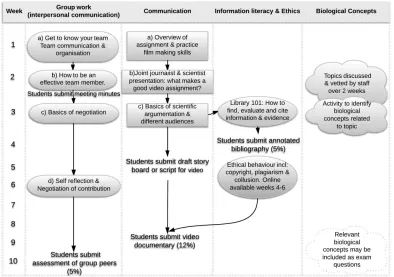
Figure 1: Design of the video assignment which illustrates the timing and sequence of scaffolding activities over the 10 week period. Activities have been divided into common learning objectives in the diagram although students experience all aspects as a unified sequence under the banner of the ‘video assignment’. The bulk of the instructional activities occur in the first three weeks, as indicated by the shaded shapes in the diagram. Submitted items are all mandatory hurdles that are not marked unless indicated by a percentage (%). Further details about each activity are presented in the main text.
e.g., the language and detail used for biological explanations, the types and level of vision and sound quality, serious versus light hearted approaches. Groups then practice and demonstrate learned filming and editing skills with guidance from staff. Rationale: Staff in our course report anxiety about filming and editing abilities (or the lack of) and standards of production to be common among students when they first encounter this assessment task. We find that these anxieties are greatly reduced (see Martin, 2009, for the learning benefits of reducing student anxiety) by running this activity as an introduction to the assignment. The activity also initiates students to getting to know their group members whilst having fun. In-class time: 1 hour.
Communication b): The aim of this activity is to set expectations for criteria and standards for the assignment as well as provide practical tips on how to achieve them. A joint presentation by the course lecturer (scientist) and a local journalist or TV science presenter is given (usually as a lecture). Students view two professional film clips about biology (see resources listed in Table 1), one entertaining but inaccurate, the other highly accurate but less entertaining. Appeal and the use of story are discussed, contrasting the scientist and journalist perspectives. Marking criteria are explained (Table 2) and the tools of story-boarding and script drafting are presented as time saving techniques for students to use. The journalist explains production techniques such as ‘supers’, use of still images and visual aids, music, etc. whilst showing (and pausing) a relevant science video clip (see resources listed in Table 1). Rationale: We have found student work to be highly responsive to the details and emphases given during this presentation, hence our presentation is now quite scripted to encourage work of a particular quality and content. The credibility of the science journalist is key to inspiring students to respond in their work, as is balancing the approaches and priorities of the journalist (e.g., sophisticated film and sound techniques, focus on the social and controversial aspects of an issue) with the academic needs of the course/assignment (e.g., focus on biological aspects of an issue and including reference to sources of information). To assist students with time management, they must later submit a draft story board or script as evidence of progress on their assignment. In-class time: 50 min.
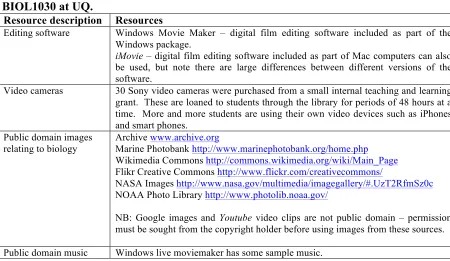
Table 1: Resources used to support students in the video assignment in the course BIOL1030 at UQ.
Resource description Resources
Editing software Windows Movie Maker – digital film editing software included as part of the Windows package.
iMovie – digital film editing software included as part of Mac computers can also be used, but note there are large differences between different versions of the software.
Video cameras 30 Sony video cameras were purchased from a small internal teaching and learning grant. These are loaned to students through the library for periods of 48 hours at a time. More and more students are using their own video devices such as iPhones and smart phones.
Public domain images relating to biology
Archive www.archive.org
Marine Photobank http://www.marinephotobank.org/home.php Wikimedia Commons http://commons.wikimedia.org/wiki/Main_Page Flikr Creative Commons http://www.flickr.com/creativecommons/
NASA Images http://www.nasa.gov/multimedia/imagegallery/#.UzT2RfmSz0c NOAA Photo Library http://www.photolib.noaa.gov/
NB: Google images and Youtube video clips are not public domain – permission must be sought from the copyright holder before using images from these sources.
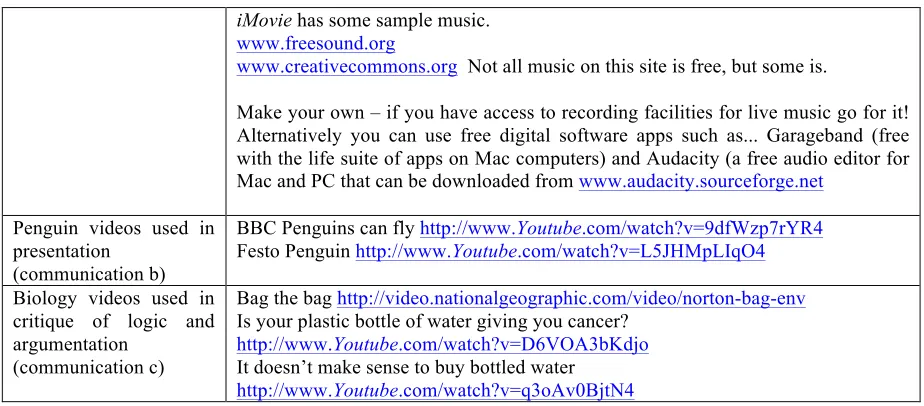
iMovie has some sample music. www.freesound.org
www.creativecommons.org Not all music on this site is free, but some is.
Make your own – if you have access to recording facilities for live music go for it! Alternatively you can use free digital software apps such as... Garageband (free with the life suite of apps on Mac computers) and Audacity (a free audio editor for Mac and PC that can be downloaded from www.audacity.sourceforge.net
Penguin videos used in presentation
(communication b)
BBC Penguins can fly http://www.Youtube.com/watch?v=9dfWzp7rYR4 Festo Penguin http://www.Youtube.com/watch?v=L5JHMpLIqO4
Biology videos used in critique of logic and argumentation
(communication c)
Bag the bag http://video.nationalgeographic.com/video/norton-bag-env Is your plastic bottle of water giving you cancer?
http://www.Youtube.com/watch?v=D6VOA3bKdjo It doesn’t make sense to buy bottled water
http://www.Youtube.com/watch?v=q3oAv0BjtN4
Table 2: Marking criteria and indication of standards for the video documentary assignment.
Criteria Description of Standards
Is it convincing? Are the opinions and/or arguments presented logical and supported by convincing scientific evidence? Could it convince a student in this course?
Not Some- Yes, at all what very
0...10... 20 Is information correct and synthesised? Are connections
between biological ideas and information clear and correct, demonstrating deep understanding of the topic?
Never Some- Always times
0...10 ...20 Is it relevant? Does it describe how the biology informs public
debate/decision making about the issue?
No Somewhat Yes
0...7.5... 15 Does it tell a story with a clear message? Is the story and flow
of ideas obvious? Does your audience know and remember your main message? Does the story lead the audience to your message or support the message?
No Somewhat Yes
0...7.5... 15
Is it creative and appealing? Is the story interesting for the intended audience? Is it fun, motivational, sad, tragic, dramatic or pleasant to watch? Does it make your audience want to watch it again?
Never Sometimes Always
0...7.5... 10
Is it credible? Are references and sources of information (including interviewees) reliable and/or appropriate for the topic? Are references evident (e.g. credit crawl at end, overlay at bottom of screen, spoken during video)?
Never Sometimes Always
0... 5... 10
Are the sound and visuals clear, audible and in focus for the majority of the video? Is the editing at least passable for the majority of the video?
hard to variable easy to see & quality see & hear most hear all of of the time the time
0... 5...10 Is it within the time limit (i.e., 4 - 5 mins)? Plus or minus
20 secs
Scaled for the group.
Minus 20% if ± 20 s NB: videos longer than 5min 40 will not be marked (= 0 /100).
Did you contribute to the making of the assignment? All stages of the assignment are to be considered by the group in allocating marks to peers e.g., background research, compiling the story, filming, organising, editing, etc.
Scaled for the individual.
Minus 20% if peer mark ≤2.5. Minus 50% if peer mark ≤1.5.
Communication c): The aim of this activity is to make explicit principles of tailoring communication to a specific audience and use of evidence and logic in developing arguments. Students compare a peer-reviewed science article, a government science-related website and television documentary to explore how scientific information can be presented differently. They are then asked to identify the intended audience in each case and discuss details of why and how the communication differs. Students are encouraged to locate examples where claims or statements have been supported by evidence. They then view three short Youtube
videos about science topics (see resources in Table 1) and rank them according to the logic and supporting evidence they contain. Rationale: This activity has greatly reduced the occurrence of unsupported and/or sweeping claims in student assignments. It helps to clarify the different expectations for communicating science in this assignment compared with laboratory reports, which are also conducted in the course. In-class time: 30 min.
Group work a): This activity aims to establish expectations and tools for practicing effective team work. The notion of team members taking on different roles in a team depending on their personality and skill set is introduced and students discuss which roles might best suit each group member (adapted from Oakley et al., 2004). Templates for recording meeting minutes, a blank timetable that includes after-hours and a table of various avenues for communication (e.g., Facebook, text messaging and email) are filled out by each group. Each group is encouraged to decide on a common communication platform and out of class meeting time. Rationale: These activities address common group issues we encountered in the past. Each group must later submit one set of meeting minutes as evidence their group has met outside of class hours. In-class time: 20 min.
Group work b): This activity establishes the criteria for the peer assessment. Students discuss how to be an effective team member based on the principles of contribution, reliability and participation. Criteria for the peer assessment are based on these principles. In-class time: 15 min.
Group work c): This activity introduces some basic principles of how to negotiate. Students role play a script and discuss recommended steps to achieve agreement (adapted from Fisher & Ury, 1991). Rationale: Many students are unfamiliar with how to negotiate agreement, which is the cause of many group problems. In-class time: 15 min.
Group work d): This activity helps the group and each member to monitor their progress on and contribution to the assignment. Students self-reflect on how to be an effective team member based on the principles of contribution, reliability and participation (introduced in group work activity b). As a group they then negotiate in writing who did how much of each task in producing the assignment to date (adapted from Winston, 1985). Rationale: Reflection is an important learning tool. This activity helps students prepare for the assessment of peer members and its timing allows for students to respond and recover ground if required before the assignment is completed. It helps to objectively resolve group work problems without singling out a particular team or team member. The result is win-win because it is less administration hassle for staff in troubleshooting group problems and students are more satisfied about their group situation. In-class time: 20 min.
the video assignment (think back to all stages including background research, script, filming, editing and organisation)? In instances where a mean student mark is less than 50%, information as to the dynamics of that group is sought to help moderate unreasonable student assessments. The assessment is done online out of class time.
Library 101: The aim of this activity is to ensure students know how to search for scientific information. Students access “Library 101”, a series of online modules from the UQ library. Students work in pairs through modules that cover how to recognise peer-review journal articles online, how and which library databases to use, how to evaluate resources (including websites), and how to cite and reference information. Students then search for and record information related to their chosen topic for the assignment. Rationale: Most university libraries have resources available online, many including video clips, activities as well as information which instructors and students can leverage for specific course needs. Our experience with this assignment suggests that students engage with these resources far better if accessed in class and in the context of a specific assignment. In class time: 30 min.
Ethical behaviour: The aim of this activity is to assist students to comply with ethical requirements for the assignment. Students complete a series of formative quiz questions as part of an online module that addresses common ethical issues encountered in doing the video assignment (Edwards, 2011). Topics include the differences between collaboration and collusion, how to avoid plagiarism, how to identify public domain images and music or seek copyright permission, ethical editing, obtaining permission to film and simple risk assessment for filming off campus. Rationale: Posting videos on YouTube and elsewhere is common practice among students, and we encourage students to show their video beyond the bounds of the course. As well as being confused about or unaware of copyright issues, most students are uncertain about academic ethics and have difficulty applying generic advice to specific tasks. The module addresses the ethical considerations frequently breached by students and/or frequently asked. Out of class time: 25 min.
Biological concepts: This activity assists students to identify a topic for their video. Students have access to example environmental issues and guiding questions to help them choose a suitable topic for the assignment. Student topics are submitted to staff one week after the assignment is announced, vetted and students confirm their choice of topic in the third week of the assignment. In class time: less than 5 min.
Biological concepts: This activity helps students focus on the biological aspects of their chosen topic and its relevance to the course content. Each group brainstorms what they know about their video topic and identify the biology relating to each aspect. Staff guidance through use of open-ended questions can be particularly beneficial in this activity. We are currently planning the use of concept maps (student derived and/or example maps) to enhance this activity. Rationale: Prior to this activity being incorporated in the learning design we found that many groups spent too much time on non-biological tangents in their assignments. In-class time: 15 min.
Evidence and Justification for Design
Course and University context
the Bachelor of Science program (up to 11 different degrees). Less than 10% of students enrolled are international residents, the remainder are permanent residents of Australia. The course is framed to highlight the relevance of organismal biology to student lives through global challenges such as sustainability of food, environmental change, etc. More details about the course can be found at http://www.uq.edu.au/study/course.html?course_code= BIOL1030&offer=53544c554331494e. Methods used to obtain the data presented in this article were approved by and conducted according to the University of Queensland Human Ethics Committee project numbers 2009001049 and 2013000637.
Student Engagement
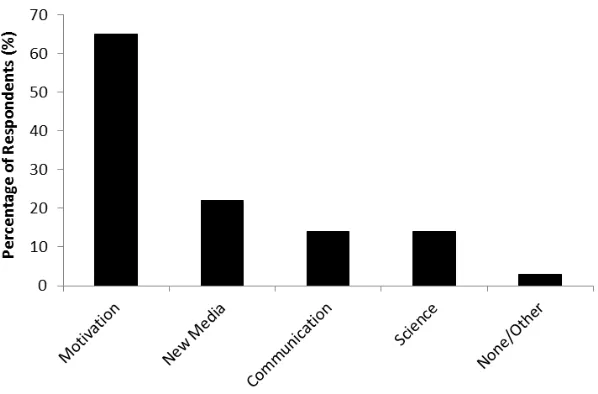
Student engagement with the video documentary assignment is very high. Many students report that it provides a fun bonding experience which helps them to find and make friends within the first few weeks of university. Data collected through anonymous student surveys consistently report the highlight of the video assignment as being factors that foster intrinsic motivation; including the opportunity to make friends, novel hands-on and outdoor experiences, and independence in topic choice and presentation style (Figure 2; Table 3). The video assignment is frequently reported by students on course evaluations (CEVAL, SeT-C) as among the best aspects of the course.
Figure 2: When asked “What was the highlight of the mini documentary assignment?” 65% of students attributed it as some kind of “motivation” factor (e.g., fun/creative, social/make friends, inspirational talking to interviewee, freedom of choice, relevant or close to home). Results are from an end of assignment survey in 2013 (N = random subsample of 100 students).
Table 3: Example student responses to the question “What was the highlight of the video assignment?” Quotes presented are from an end of assignment survey of the 2013 student cohort. These responses represent common themes in student responses each year we have asked this question.
Theme Student quotes
Friendship • “Being a first year student it was daunting coming to university and not knowing almost anyone. The highlight … was getting to work with other students and getting to know them better so early in the semester”
• “It gave me the ability to meet new people and set me up with friends who I can ask
Novel assessment
task • “Having the chance to do an assessment that is creative and different from a normal exam or written assignment”
• “I loved how it was hands on! It wasn’t just about reading a textbook or researching.
We got much more in-depth!”
• “It was good to get outside and do something in the sun, rather than being stuck at a
desk”
Choice of topic &
style • “The freedom to choose a topic that interested us and how to present it within the video”
• “… The independence we were given with the assignment was also great.”
Communication • “Being able to explore and learn to use another form of communication (video)”
• “…how each aspect of the filming, script, biology etc. came together cohesively to form a video which had the potential to convey a message”
Learning to work
as a team • “…the video assignment gave me a very important experience of how to work with others to finish a group assignment…”
• “The communication skills learned can give me an advantage of how to finish a group assignment well with the group mates”
Fun • “…having lots of laughs while filming”
• “Having fun with filming the other group members”
Negatives (<2% of responses)
• “I had a lot of problems with my group and it made it difficult to enjoy the actual
assignment”
• “I didn’t enjoy doing this assignment very much”
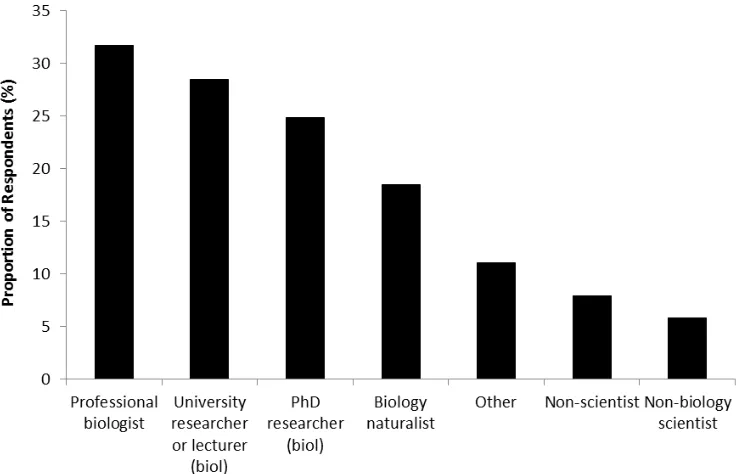
The extent of engagement in the assignment is also reflected by the number of interviews and diverse locations students visit to create their assignment, be it for sourcing information, video footage or interviewees. We have had students travel to nearby islands to film and interview biologists at research stations, to bee and macadamia farms in northern NSW, as well as urban educational centres and bushland. Conducting interviews with experts is not a requirement of the assignment, yet typically half or more of the groups each year do (e.g., 53% in 2008; Kuchel & Wilson, 2008). Interviewees are primarily on campus researchers or PhD students, but include a high proportion of professional biologists, naturalists and a few non-scientists (Figure 3).
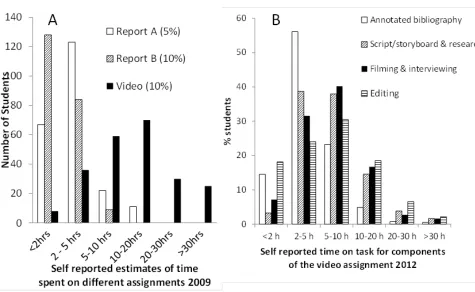
Time on task outside of class hours is another reflection of the level of engagement, with individual students consistently spending more time on the group video assignment than their other individual written assignments worth similar value for the same course (Figure 4a; Wilson et al. 2009). Naturally this result could also be interpreted as a logistical concern with students ‘wasting’ valuable learning time on technical issues such as editing. Anecdotal evidence suggests this was certainly the case in the early years of implementation, however addition of tools such as the annotated bibliography, script/story board and improvements in online support for and within editing software itself have reduced this substantially, according to data on self-reported time on task. The number of students reporting spending more than 20 hours on task outside of class time has dropped from ~20% to less than 5% since implementing these changes in 2011. Students now spend an average of 15 to 25 hours in total on the task outside of class contact time (Figure 4b).
Figure 4: Students self-reported time on task outside of class contact hours for a) assessment tasks of equal grade value (i.e., each worth 10%) in 2009 (N = 289), and b) the various components of the video assignment in 2012 (N = 551). NB: the design of the video assignment changed considerably between 2009 and 2012. On average students spend between 15 to 25 hours outside of class time to complete the video task as described in this article.
When asked about what they would change about the video assignment and why, students responded anonymously with the following themes in an end of assignment survey in 2013: Longer time limit for video (i.e. more than 5 min), no group work, the assignment was too time consuming and/or should be worth more than 22% (particularly the video product portion), requests for support/resources for programs other than Windows Movie Maker.
Core competencies in science
When asked about whether the video assignment helps students learn science related to their video topic, all staff we have talked with who were involved in designing, marking and/or participating (i.e., interviewees) in them expressed confidence that students do learn. Given the ubiquity and central relevance of scientific knowledge as learning objective in science degrees (e.g., Jones, Yates & Kelder, 2011; Brewer & Smith, 2009) it is important to establish that students do indeed learn science/biology from this assignment. Student scores on the marking criteria related to scientific knowledge reflect staff perceptions and are typically high (in the range of 40 to 60 out of a total of 65) i.e., ‘Is information correct and synthesised’, ‘Is it convincing’, and ‘Is it relevant’ (Table 2). The assignments are marked by carefully selected postgraduate students with a keen interest and wide knowledge in this field of biology. As anyone who has supervised marking by postgraduate students will know, postgraduate markers tend to focus on and mark more stringently against knowledge criteria than criteria for other skills (Bloxham & Boyd, 2011). Some students also listed learning of science as the highlight of doing the assignment (Figure 2; Table 4). Anecdotally, the quality and focus of the biological concepts contained in the videos has improved over the years. We are continuing to investigate ways of evidencing and comparing the depth of learning of content through the video assignment compared with other means of assessment, as it is an important consideration.
Table 4: Example quotes from students who identified the learning of science. When asked “What was the highlight of the mini documentary assignment?”
• “An entertaining piece of assessment, which improves our knowledge on a particular ecological topic.” • “…researching our topic… I was learning about the environmental impacts of the flood, as opposed to
the human ones which were the main focus of the news coverage. It was interesting to see how the river systems have adapted and started to regenerate themselves after such an extreme event. Also to learn about how both the flora and fauna reacted.”
• “…learning about a new side of the biological process of competition…”
• “Studying the possible impacts of Myrtle rust and how serious of a problem it really is.” • “Importance of grey headed flying foxes in an ecosystem.”
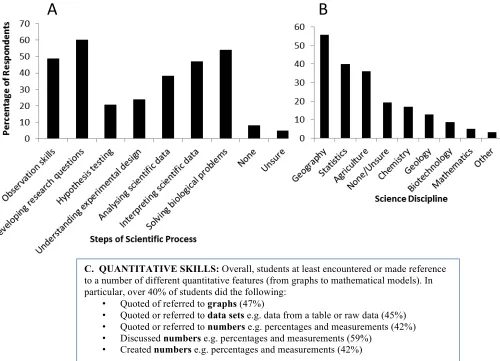
Figure 5: Core science competencies that students encountered during the making of the BIOL1030 video documentary assignment. The relevant panels show student responses to the questions a) “…which steps [in the process of science] did you gain a better understanding in as a result of this assignment?” b) “What fields of science other than biology did your assignment draw information from?” and c) “Which of the following quantitative skills did you use when preparing your video assignment”. Results are from an end of assignment survey in 2013 (N = 557, 555 and 552 students respectively).
Communication Skills
Despite the video assignment being very much a visual and oral presentation, the emphasis of the communication criteria for the assignment is on telling a story with a clear message, explanation of biological knowledge (this is also a knowledge criterion), maintaining the attention of an audience and presenting a supported argument rather than on vocal and visual skills (Table 2). These criteria were informed by collaboration with journalism colleagues and present students with a more sophisticated way of thinking about communication than is typically seen in marking schemes for communication in science courses (which commonly focus on criteria such as grammar, spelling and clarity). Despite the emphasis of the marking criteria, we find that the standard of oral and visual presentation in student work is high. This is probably because students are influenced by exemplars they watch in their daily lives as well as the peer pressure of being in a group and on camera.
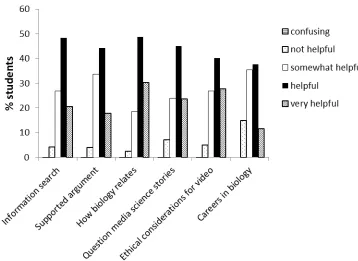
The majority of students report the scaffolding activities that support the marking criteria for communication to be helpful or very helpful in their learning (Figure 6). Staff who teach into
C. QUANTITATIVE SKILLS: Overall, students at least encountered or made reference to a number of different quantitative features (from graphs to mathematical models). In particular, over 40% of students did the following:
• Quoted of referred to graphs (47%)
• Quoted or referred to data sets e.g. data from a table or raw data (45%)
• Quoted or referred to numbers e.g. percentages and measurements (42%)
• Discussed numbers e.g. percentages and measurements (59%)
• Created numbers e.g. percentages and measurements (42%)
and mark assignments in the course have noted substantial improvements in the structure and provision of supporting evidence in arguments over the years, particularly in response to implementation and refinement of the relevant scaffolding activities. These activities also provide students with a framework to begin critiquing science stories they come across in the public media, which students also report as being helpful (Figure 6).
The video documentary assignment encourages various forms of communication such as explanation, advocacy, engaging story-telling and so on. To date we have not formally evaluated the quality and scaffolding impacts on these specific communication attributes, but doing so could be of value in the future to inform effective teaching practices for these skills in an undergraduate science context.
Figure 6: Likert scale responses from students to the question “To what extent did doing the video assignment and associated activities HELP your LEARNING of...” “…searching for biological information”, “…using evidence to support an argument”, “…how biology relates to society and environmental issues”, “…how to question the science behind media stories”, “…ethical considerations for video making”, and “…careers in biology”. Data are from an end of assignment survey conducted in 2012 (N = 548 to 551 students per question).
Evaluation of team training activities
teaching staff have noted a reduction in the number of group issues that require administrative attention or intervention since implementation of the team training activities.
Implementation Challenges & Solutions
Technology: The challenge that is likely to cause hesitation about implementing a video task is how to supply, manage and support student use of the technology involved. Our approach has been to encourage students to use whichever technology they are familiar with, but to emphasise that we only offer support for particular tools (see Table 1).
Mobile digital video recording devices are now fairly ubiquitous, being incorporated into phones and many cameras, but this was not the case when we first implemented our video assignment. Thus, to overcome the challenge of students being able to collect footage we secured an internal teaching and learning grant to purchase 50 Sony HD digital handycams and SD cards/tapes (60 min tapes, 8 GB SD cards). Students are able to loan these from the library for periods of 48 hours and return of the cameras is encouraged by the standing library policy of withholding the release of academic grades for non-returns. We find that more and more students are using their personal phones to record video footage and demand for the cameras is lessening, so it is likely we will slowly reduce the number of cameras available over time.
For editing, students have access to computer laboratories on campus outside of class hours. Due to the very large file sizes created during editing we needed to negotiate with IT to ensure sufficient temporary storage is available on the student network (we based calculations for the amount of storage required on the file size required for 100 min of video recording per assignment). The large files created during editing are only stored on the university system for 24 hours, so students must back them up as they go – students require constant reminders to do so. In the early years we provided a tutor in the computer laboratories after hours to assist with student questions about editing. We no longer do this as sufficient help and tutorials are available online. We do provide a peer discussion forum on our learning management system (Blackboard) where students can help one another with editing queries. We have found there to be considerable expertise among 600 students in resolving technical issues.
Assignment submission has been a challenge. Our solution to date has been to require that students convert their final assignment to a format such as Quicktime or an Mpeg file, which condenses file size considerably. Previously we have had students upload their finished assignments onto a computer hard-drive, but this year we are trialling uploading them to
Blackboard. If successful, this opens up the possibility of the sharing of videos among student groups. It is possible to establish private channels on Youtube for this purpose, but the logistics of enrolling such a large number of students into such a channel has deterred us from this option to date.
moderation activity at the start and part way through the marking process help to establish and maintain consistency of judgement between markers. We allocate 10 - 12 min per assignment for marking to allow the video to be viewed twice, marks to be entered and feedback written.
Credibility among colleagues: When initiating a novel assessment task such as a video documentary, it is likely that you will encounter the damaging perception from academic colleagues (and an occasional student) that the assignment is insufficiently scientific. This was commonly expressed prior to and during the early years of our implementation. Both academics and students now all agree that the video task described is a valuable and ‘scientific’ assignment. Much of the concern of academic colleagues was alleviated early on by showing examples of student videos at staff meetings and explaining that the marking criteria is similar to that for an oral presentation or essay assignment (i.e., approx. 30% presentation and 70% content and argument criteria). The addition of the biological concept activity as well as involvement of increasing numbers of academic staff in interviews for the assignments has also helped considerably, as has the growing call for better communication of science to the public from scientists themselves (see the recent special edition of the Proceedings of the National Academy of Sciences (PNAS) about science communication, 2013, as an example).
Group work: Complaints about students not pulling their weight, organisation of group meetings and differences in expectations among students are common to all group assignments. We found that complaints reduced dramatically following the combined introduction of the peer mark and team work scaffolding activities (Figure 1). The incorporation of team work activities into standing laboratory classes which are endorsed by both staff and assessment marks helps engage those students who are most likely to benefit from them – something difficult to achieve in online, out-of-class activities.
Student use of supporting evidence and references: When students are presented with a ‘documentary’ style assignment, they naturally attempt to emulate documentaries they have seen on television or the internet. Professional documentaries typically take an advocate position towards a topic, generalise/simplify information and usually do not include reference to the sources of their information. As such, the documentary genre of communication lends itself to students making large sweeping statements without provision of substantiating evidence or references to sources. Since both are integral skills to becoming a scientist and important marking criteria for this assignment, it is important to illustrate and explain to students the distinctions between commercial documentaries and expectations for their assignment. Presenting a contrast of the perspectives and priorities of film makers and scientists is helpful in this regard, and we have found that having both types of people in the same room as the students to discuss it to be an excellent way of conveying the distinction. To assist students to apply it to their own contexts we explicitly demonstrate simple argumentation in lectures and include within the learning design an activity where students critique short videos for supporting evidence and sources of information (Figure 1).
perspectives and collaborate on what messages you wish to convey to students. By planning and giving a joint presentation we found we were able to address unforseen differences and unexpected messages.
Giving structure to freedom of choice: Whilst providing students with freedom to choose their topic is highly motivating (Figure 2; Table 3), it can pose a challenge for students and leave them floundering as to how to start. We address this challenge in a few simple ways. Among the supporting materials we provide students with a list of example environmental issues and guiding questions from which they can derive more specific topics. Our staff vet student topics and we explicitly discuss options for visuals, such as the use of still images, models or drawings, to encourage students not to be restricted by what they can film directly. Finally, we explicitly include creativity in the marking criteria and show students past student videos as exemplars to demonstrate the variety of creative approaches to presenting science in the assignment.
Keeping popular interviewees on-side: Complaints from experts associated with popular topics about requests for interviews or unprofessional behaviour of interviewing students was an unexpected challenge we encountered. We now use a three-pronged approach to address this where we remind students about professional etiquette in contacting experts, notify common interviewees about the commencement of the assignment (it may take several iterations of the assignment to know who these are) and liaise with popular places to film (e.g., Lone Pine Koala Sanctuary) to establish protocols for students wishing to visit.
Conclusion
Evaluation of the video documentary assignment described in this paper shows that it provides students with quality, motivating learning opportunities in a range of core competencies in biology, framed by and including communication skills. The task is multidimensional and in the design described here has notable links to all of the Australian Threshold Learning Outcomes for science: understanding science (TLO 1.2), scientific knowledge (TLO 2), inquiry and problem solving (TLO 3.1), communication (TLO 4) and personal and professional responsibility (TLO 5). Thus it provides a rich learning experience for science academics looking to implement a fun learning task that addresses multiple learning outcomes.
The design of the video documentary task described in this article is modular and readily adaptable to suit most science disciplines and/or emphasise different learning outcomes. Whilst the design suits both small and large numbers of students, it does require a lengthy period of time for students to complete (5 to 10 weeks). Considerable lead in time is also required to plan the implementation of the task e.g., IT and technical considerations. Should it be implemented it is likely that the learning design of the task will require some revision following the initial implementation in order to best fit a specific context, but this typical for most educational tasks.
academics to implement a diversity of communication tasks in their courses. Should you wish to discuss implementation of a similar task to this or obtain access to resources used in our context, please do not hesitate to contact the corresponding author.
Acknowledgements
Many people have played instrumental roles in establishing and refining the successful video task described in this article. Of particular note are the following: Amanda Niehaus, Jimmy White, Amanda Rasmussen, Lyn Beard, Billy Van Uitrect, Dr. Rob Bell from CSIRO, staff at Channel 10 Brisbane, Brad Turner, all of the BIOL1030 tutors and interviewees over the past six years. We wish to thank them for their contributions.
References
Brewer, C.A. & Smith, D. (2009). Vision and change in undergraduate biology: A call to action. Washington DC: American Association for the Advancement of Science.
Biggs, J. (1996). Enhancing teaching through constructive alignment. Higher education, 32(3), 347-364.
Bloxham, S. & Boyd, P. (2012). Accountability in grading student work: Securing academic standards in a 21st century quality assurance context. British Educational Research Journal, 38(4), 615-634.
Bruner, J.S. (1960). The process of education. Cambridge, MA: Harvard University Press.
Edwards, W. (2011). An assignment-specific, scalable, novel approach to addressing academic integrity in large first year science classes. 5th Asia Pacific Conference on Educational Integrity. 26-28 September.
Perth, Western Australia.
Entwhistle, N.J. & Entwhistle, A.C. (1991). Forms of understanding for degree examinations: The pupil experience and its implications. Higher Education, 22, 205-227.
Fisher, R. & Ury, W. (1991). Getting to yes: Negotiating agreement without giving in. Penguin Group
Hounsell, D. (1997). Understanding teaching and teaching for understanding. In F. Martin, D. Hounsell & N. Entwhistle (Eds.), The experience of learning (pp. 238-257). Edinburgh: Scottish Academic Press.
Jones, S., Yates, B. & Kelder, J. (2011). Learning and Teaching Academic Standards Statement – SCIENCE, Learning and Teaching Academic Standards Project. Australian Learning and Teaching Council, Sydney. Kuchel, L. & Wilson, R. (2008). Increased engagement and visual literacy for large 1st year classes. Paper
Presented at Chemistry Education Conference, Dec. Fremantle, Western Australia.
Martin, A. J. (2009). Motivation and Engagement Across the Academic Life Span A Developmental Construct Validity Study of Elementary School, High School, and University/College Students. Educational and Psychological Measurement, 69(5), 794-824.
Marton, F. & Saljo, R. (1997). Approaches to learning. In F. Marton, D. Hounsell & N. Entwhistle (Eds.), The experience of learning (pp. 39-58). Edinburgh, Scottish Academic Press.
Oakley, B., Felder, R.M., Brent, R. & Elhajj, I. (2004). Turning student groups into effective teams. Journal of Student Centred Learning, 2(1), 9-34.
Ramsden, P. (1997). The context of learning in academic departments. In F. Marton, D. Hounsell & N. Entwhistle (Eds.), The experience of learning (pp. 198-216). Edinburgh: Scottish Academic Press.
Rasmussen, A., Rossini, R. & Kuchel, L. (2011). Is it worth taking time out of first year science courses to explicitly teach team skills? Higher Education Research and Development Society of Australasia Conference. July 2011. Gold Coast, Australia.
Rogers, C.R. (1969). Freedom to Learn. Merrill, Columbus, OH.
Stevens, S. (2013) What communication skills are taught in Australian science degrees and what else do students learn from "communication to non-scientists" tasks. Honours thesis. School of Biological Sciences, The University of Queensland, Australia.
Warburton, K. (2003). Deep learning and education for sustainability. International Journal of Sustainability in Higher Education, 4(1), 44-56.
Wilson, R. S., Niehaus, A. C., White, J., Rasmussen, A., Kuchel, L. (2009) Using documentary video-making to enhance learning in large first-year biology classes. Integrative and Comparative Biology. 49, E325-E325.